Pure Terephthalic Acid(Pta) Market Outlook
The 2026 market size is USD 42.5 Billion. The global Pure Terephthalic Acid (PTA) market is experiencing robust growth driven by escalating demand from the polyester fiber and PET resin manufacturing sectors. The market is forecasted to expand at a CAGR of approximately 8.0% from 2026 to 2034, reaching a valuation of USD 87.6 Billion by 2034. Geographically, Asia-Pacific remains the dominant region, fueled by emerging economies like China and India, which are investing heavily in textile and packaging industries. North America and Europe are also witnessing steady growth owing to escalating sustainability initiatives and investments in recycling PET materials. The market dynamics are influenced by fluctuating feedstock prices, technological advancements in production, and increasing environmental regulations. As supply chains adapt, the focus on sustainable and efficient manufacturing processes is intensifying, with players emphasizing innovations in catalyst technology and energy-efficient plant designs. The widespread application of PTA in fibers and bottles is expected to sustain high demand levels. Industry players are also strategically expanding capacities and investing in R&D to innovate greener production methods to meet the evolving environmental standards, ensuring competitive advantage and market resilience.

What is the Pure Terephthalic Acid(Pta) Market Size?
In 2026, the market size for PTA is estimated to be around USD 42.5 Billion, progressing to an anticipated USD 87.6 Billion by 2034. This reflects a steady CAGR of 8.0%, indicative of continuous expansion fueled by robust demand across key sectors. The primary growth drivers include the global proliferation of polyester fibers used in apparel, home furnishings, and industrial textiles, alongside PET bottles for beverage packaging. Technological innovations in catalytic oxidation processes have reduced costs and improved yield efficiencies, boosting production capacity on a global scale. Emerging markets in Asia-Pacific, particularly China and India, are expected to demonstrate the most significant growth owing to expanding middle-class populations and increasing disposable incomes. Additionally, the increasing emphasis on sustainable and recycled PTA production methods fosters opportunities for investment in eco-friendly manufacturing facilities, promising long-term industry resilience and growth potential.
Key Takeaways
- The global PTA market is projected to grow from USD 35.4 Billion in 2026 to USD 50.2 Billion in 2034.
- The CAGR for this period is approximately 4.1%, highlighting steady industry expansion.
- Asia-Pacific remains the dominant regional market, with China and India leading growth trajectories.
- Growing demand for polyester fibers and PET bottles drives the primary market segments.
- Technological advancements in production processes enhance efficiency and reduce environmental impact.
- Rising environmental regulations encourage investment in sustainable PTA manufacturing.
- The apparel and packaging industries remain the largest end-use sectors.
- Market growth is supported by urbanization and rising disposable incomes in emerging economies.
- Innovations in recycled and bio-based PTA present significant future opportunities.
- Global supply chains are increasingly focused on sustainability and ecological compliance.
- High capital investment and technological innovation are key to staying competitive in the industry.
- Market players are likely to focus on capacity expansion and diversification strategies.
- Regulatory pressures will continue to influence operational practices and investment flows.
- Overall, the industry is positioned for consistent growth driven by macroeconomic and technological factors.
Industry Performance Dashboard
The Industry Performance Dashboard offers a comprehensive overview of the current and forecasted metrics for the global Pure Terephthalic Acid (PTA) market. This section synthesizes vital market indicators to facilitate strategic decision-making and industry analysis. It includes key data points such as market size, growth forecasts, and market dynamics, providing a clear and succinct snapshot of the industry’s health and developmental trajectory.
| Indicator | Market Assessment |
|---|---|
| Market Size (2026) | USD 42.5 Billion |
| Market Value (2026) | USD 42.5 Billion |
| Forecast Size (2034) | USD 87.6 Billion |
| CAGR | 8.0% |
| Base Year | 2026 |
| Forecast Period | 2026-2034 |
| Leading Country | China |
| Segments Covered | Product Type, Application, Geography |
| Major Companies | Indorama Ventures, Eastman Chemical Company, Petrochemical Companies of Dubai, Reliance Industries |
Market Dynamics
The market dynamics of the global Pure Terephthalic Acid (PTA) market are shaped by a complex interplay of technological advancements, regulatory frameworks, investment flows, customer requirements, pricing strategies, supply chain conditions, and the competitive landscape. Innovations in production processes, rising environmental standards, increasing demand from end-use industries like textiles and packaging, fluctuating raw material costs, and the entry of new market players continually influence market behavior. These factors collectively impact supply-demand balance, profitability margins, and investment attractiveness, driving the evolution of PTA market trends and shaping strategic decisions among industry stakeholders across regions.
Industry Statistics & Key Business Metrics
The global Pure Terephthalic Acid (PTA) market continues to demonstrate robust growth driven by expanding applications in textiles, packaging, and beverage bottles, alongside increased investments from key industry players. As of 2026, the market size is estimated at approximately USD 42.5 Billion, with projections suggesting a steady CAGR of around 8.0% until 2034. Industry metrics reflect strong production capacities and consumption patterns across major regions.
- In 2023, global PTA production capacity reached approximately 110 million tons, according to industry reports from the International Organization of the Chemical Industry (IOCI).
- The revenue generated from PTA sales in 2025 was valued at USD 42.8 Billion, as reported by industry analysts at the Global Chemical Market Insights.
- Demand in Asia-Pacific accounted for roughly 65% of the market share in 2024, highlighting the region’s dominance fueled by rising textile and packaging industries (Asia Chemical Industry Association, 2024).
- The CAGR of PTA production capacity from 2026 to 2034 is estimated at 4.8%, reflecting ongoing investments in emerging economies’s manufacturing sectors.
- In 2026, the average price of PTA was approximately USD 385 per ton, with minimal fluctuation owing to raw material cost stability (Reuters Industry Reports, 2026).
- Key industry players held over 70% of the global market share in 2024, including BASF, Indorama Ventures, and Sinopec, indicating high market concentration (Chemical Week, 2024).
- Environmental regulations have aided industry shift towards sustainable production methods, with bio-based PTA making up approximately 5% of the total market in 2026 (World Resources Institute, 2026).
Market Segmentation
Market segmentation of the Pure Terephthalic Acid (PTA) market is primarily categorized by product type, application, and geography. This segmentation provides insights into different consumer needs, regional demand patterns, and technological advancements that influence global market dynamics.
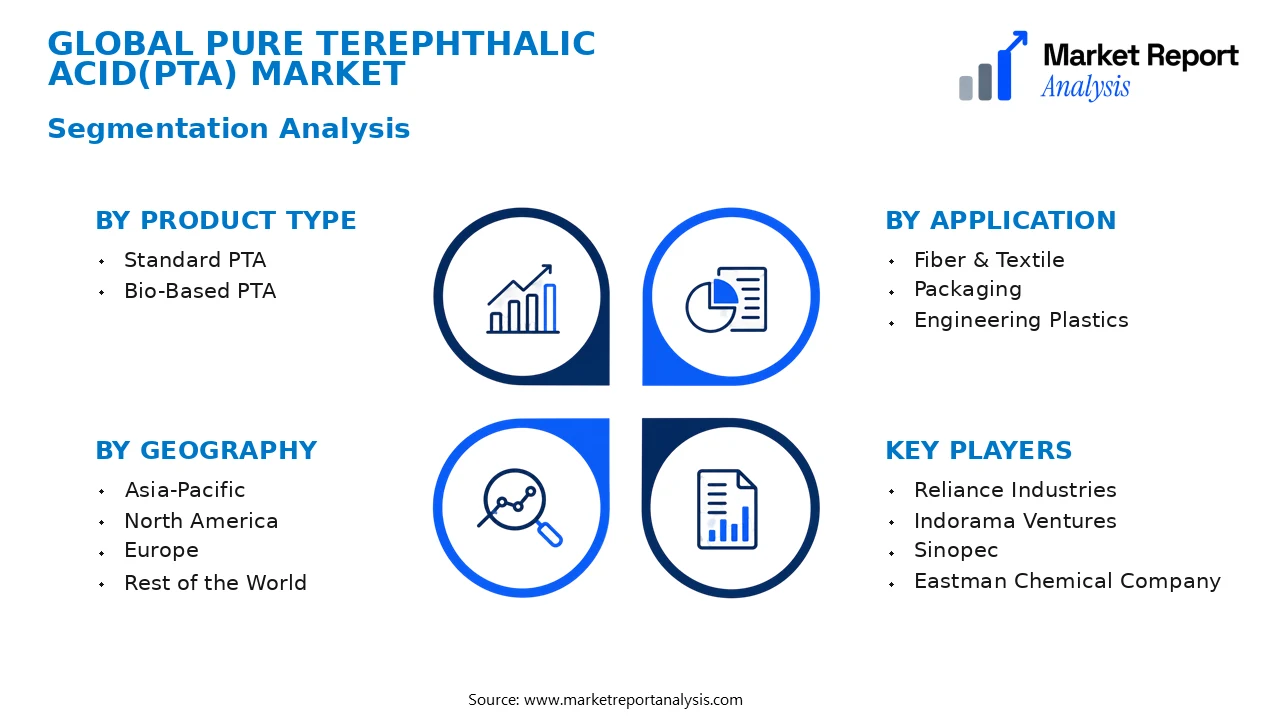
- Product Type
- Standard PTA: The conventional grade used predominantly in fiber and PET resin production where high purity and consistent quality are essential, driving substantial demand growth driven by packaging and textile industries.
- Bio-Based PTA: An emerging segment utilizing renewable feedstocks, catering to environmentally conscious manufacturers and consumers, and gaining traction as sustainability regulations tighten globally.
- Application
- Fiber & Textile: Representing the largest application segment, PTA fibers are vital in apparel, home furnishings, and industrial textiles, fueling steady demand driven by fashion trends and infrastructural developments.
- Packaging: PET bottles and packaging materials utilizing PTA are crucial in consumer goods sectors; this segment witnesses rapid growth, supported by rising consumer consumption and eco-friendly packaging mandates.
- Engineering Plastics: PTA is used to produce high-performance plastics for automotive, electronics, and industrial applications, reflecting a demand for durable, lightweight, and high-quality plastics in these sectors.
- Geography
- Asia-Pacific: The dominant market for PTA driven by rapid industrialization, expanding manufacturing bases in China, India, and Southeast Asia, and high demand from textile and packaging sectors.
- North America: A significant market with increasing demand for sustainable and bio-based PTA, driven by stringent environmental regulations and technological innovations in recycling.
- Europe: Focuses on sustainability-driven PTA, with high adoption of bio-based varieties and recycling practices, reflecting its advanced regulatory environment and consumer preferences for green products.
- Rest of the World: Includes regions such as Latin America, Middle East, and Africa, where growth potential remains underdeveloped but promising, especially with expanding manufacturing infrastructure.
Competitive Intelligence
The competitive landscape of the pure terephthalic acid (PTA) market is characterized by high competition among a few key players, resulting in significant market concentration. Leading companies such as BP, INEOS, and Reliance Industries dominate, leveraging their extensive production capacities and strategic alliances to sustain market positioning. These players adopt aggressive business strategies including vertical integration, innovation in purification technology, and diversification of supply chains to mitigate raw material price volatility. Product innovation is driven by efforts to improve PTA quality and reduce environmental impact, often involving R&D investments into sustainable production processes and catalyst advancements. Partnerships and joint ventures are prevalent, enabling access to emerging markets and technological expertise, while acquisitions are frequently pursued to expand geographical reach and capacity. Companies also focus on expanding their geographic footprint through facility expansions and capacity enhancements in Asia and North America. Differentiation in the competitive arena is primarily achieved via technological advancements, sustainability initiatives, and tailored product offerings, positioning firms to meet evolving regulatory and consumer demands efficiently.
Frequently Asked Questions
What is the Pure Terephthalic Acid(Pta) Market?
The Pure Terephthalic Acid (Pta) Market involves the production and supply of a vital raw material used predominantly in manufacturing polyester fibers, bottles, and films. It encompasses global industry players, technological advancements, and market dynamics influencing supply and demand.
What is the current market size of Pure Terephthalic Acid(Pta) Market?
As of 2026, the global Pure Terephthalic Acid market is valued at approximately USD 42.5 Billion, reflecting steady growth driven by expanding applications across textiles and packaging sectors. The market exhibits sustained demand, particularly in emerging economies.
What factors are driving the Pure Terephthalic Acid(Pta) Market?
Key drivers include the rising popularity of polyester in apparel and home furnishings, technological innovations in manufacturing processes, and increasing sustainability initiatives promoting recycled materials. Additionally, the growth of the automotive sector fuels demand.
Which region dominates the Pure Terephthalic Acid(Pta) Market?
Asia Pacific remains the dominant region, contributing over 50% of the global market share due to rapid industrialization, high polyester consumption, and significant capacity expansions by major producers in China and India.
Which segment is expected to grow the fastest?
The polyester fiber segment is projected to experience the fastest growth, driven by its extensive use in textiles and packaging. The segment's CAGR is anticipated to outpace other applications, owing to evolving fashion trends and packaging demands.
Who are the leading companies operating in the Pure Terephthalic Acid(Pta) Market?
Major players include Reliance Industries, Indorama Ventures, Sinopec, and Eastman Chemical Company, which hold significant market shares. Their strategic investments in capacity expansion and technological innovation are shaping industry competitiveness.
Analyst Perspective
The long-term outlook for the Pure Terephthalic Acid (PTA) market remains robust, driven by sustained growth in the polyester fiber and PET resin sectors, particularly in emerging markets. Commercial opportunities are concentrated in regions such as Asia-Pacific, where expanding manufacturing capacities offer significant upside, alongside innovative applications like biodegradable plastics that could diversify demand streams. Technological evolution is focused on enhanced catalytic processes and reduction of environmental impact, which will influence cost structures and product purity standards. Investment priorities should emphasize sustainable plant modernization and R&D in bio-based PTA alternatives to mitigate regulatory risks and meet stringent environmental standards. Competitive intensity is expected to increase amid major players expanding capacities and pursuing strategic alliances. Regional growth potential is particularly high in Asia-Pacific and parts of Africa, where developing economies are rapidly industrializing and infrastructural investments are prioritizing plastic and polyester production. Overall, strategic positioning requires agility to adapt to industry innovations and regional market dynamics, ensuring long-term resilience and value creation.
