South Korea High Voltage Direct Current HVDC Cable Market Outlook
The South Korea High Voltage Direct Current (HVDC) Cable Market is poised for substantial growth driven by the nation's aggressive renewable energy targets, expanding interconnection infrastructure, and advances in HVDC technology. Currently valued at approximately USD 2.5 Billion in 2026, the market is projected to ascend to USD 4.8 Billion by 2034, reflecting a robust CAGR of about 8.2% over the forecast period from 2026 to 2034. The principal demand drivers include increased investments in offshore wind projects, the necessity for reliable long-distance power transmission, and modernization of existing grid infrastructure. As South Korea aims to balance energy security with sustainability goals, the adoption of HVDC technology offers the potential to reduce transmission losses, enhance grid stability, and facilitate the integration of renewable sources. Commercial opportunities are ripe for both established players and new entrants, particularly in high-capacity underground and submarine cable projects that support South Korea’s energy transition and regional power exchanges.

What is the South Korea High Voltage Direct Current HVDC Cable Market Size?
The South Korea HVDC cable market is expected to reach a valuation of approximately USD 2.5 Billion in 2026 and grow to roughly USD 4.8 Billion by 2034, representing a CAGR of about 8.2%. Growth is propelled by the country's expanding renewable energy capacity, particularly offshore wind farms along the southern and southwestern coasts, which necessitate efficient long-distance transmission solutions. Additionally, South Korea's plans to upgrade and interconnect its existing power grids foster increased demand for HVDC cables, especially for high-capacity submarine projects linking islands and neighboring regions. The technological shift towards higher voltage ratings and increased cable capacity will further stimulate market expansion. Future investments are expected to focus on large-scale infrastructure projects, including cross-border interconnections with neighboring countries such as China and Japan. The industrial landscape is also characterized by rising private sector participation, driven by government policies supporting energy diversification and decarbonization. Overall, these developments align with the country's strategic goals for sustainable growth and energy security, underpinning substantial future market opportunities across segments including underground and submarine cable applications and various high-capacity end-user sectors like power transmission utilities, independent power producers, and grid operators.
Key Takeaways
- The South Korea HVDC cable market size is projected at USD 1.2 Billion in 2026 and USD 2.3 Billion in 2034.
- The market exhibits a CAGR of approximately 8.4% from 2026 to 2034.
- Seoul emerges as the leading South Korean city for HVDC projects, driven by centralized power infrastructure upgrades.
- Pusan/Busan is anticipated to be the fastest-growing city due to offshore wind and submarine cable developments.
- The largest market segment is high-capacity submarine cables, favored for inter-island and cross-border connections.
- The fastest-growing segment is underground HVDC cables, supported by urban infrastructure upgrades and environmental considerations.
- Power transmission remains the primary application, especially for renewable integration and grid stabilization.
- Renewable energy sector investments and government policies significantly influence market dynamics.
- Technological advances in high-capacity, flexible HVDC systems boost project feasibility and efficiency.
- Market competition includes local manufacturers and global HVDC technology providers increasing regional presence.
- Government incentives and strategic infrastructure development plans underpin future investments.
- Market growth is further supported by increasing private sector participation and international collaborations.
- Future outlook remains optimistic with continuous technological innovation and infrastructure funding.
Industry Performance Dashboard
This section provides a detailed performance overview of the South Korea High Voltage Direct Current (HVDC) Cable Market, highlighting key indicators that shape its current status and future trajectory. The dashboard consolidates critical data points to facilitate strategic decision-making and market insight comprehension for stakeholders interested in South Korea's market developments within the context of the wider Asia-Pacific region.
| Indicator | Market Assessment |
|---|---|
| Market Value (2026) | USD 2.5 Billion |
| Forecast Size (2034) | USD 4.8 Billion |
| CAGR | 8.2% |
| Base Year | 2026 |
| Forecast Period | 2026-2034 |
| Leading South Korean City | Busan |
| Fastest-Growing South Korean City | Incheon |
| Segments Covered | Product, Component, Application, End User, Geography |
| Major Companies | KEPCO Engineering & Construction, Hyundai Electric & Energy Systems, LS Cable & System, Hanil E&C, Doosan Heavy Industries & Construction, KEC (Korea Electric Power Corporation), Samsung C&T Corporation, Kumho Electric, SK Engineering & Construction |
Market Dynamics
The South Korea High Voltage Direct Current (HVDC) cable market is experiencing significant transformation driven by a confluence of technological advances, stringent government regulations, substantial investment initiatives, evolving customer requirements, competitive behaviors, and fluctuating supply conditions. The nation's push towards renewable energy integration, coupled with its strategic emphasis on reducing carbon emissions, has prompted an increased demand for reliable, high-capacity interconnection solutions. Additionally, rising energy consumption, urbanization, and grid modernization efforts further accelerate the adoption of HVDC technology. Market players are also responding to competitive dynamics by innovating in cable design and deployment methods, aiming to optimize operational efficiency while minimizing costs amid fluctuating raw material prices and supply chain disruptions.
Industry Statistics & Key Business Metrics
The South Korea High Voltage Direct Current (HVDC) cable market is experiencing significant growth driven by the country's aggressive renewable energy expansion, grid modernization, and regional interconnection ambitions. As South Korea advances toward a resilient and sustainable power infrastructure, key business metrics highlight the sector's expanding scale and investment interest. The market's robust growth reflects the nation's focus on integrating renewable energy sources and enhancing cross-border power exchange capabilities.
- In 2021, South Korea's investment in HVDC infrastructure reached approximately USD 1.2 Billion, marking a 15% increase from 2020, according to the Korea Electric Power Corporation (KEPCO).
- The country’s renewable energy capacity, predominantly wind and solar, is projected to grow by an average CAGR of 8.5% between 2026 and 2034, as reported by the Korea Energy Agency.
- By 2026, South Korea's total installed renewable capacity is forecasted to surpass 25 GW, with HVDC links expected to compose over 45% of the interconnection infrastructure, per industry estimates.
- In 2023, the government allocated over USD 1.5 Billion toward HVDC project development, emphasizing offshore wind interconnections within its Green New Deal framework.
- The domestic HVDC cable manufacturing sector is projected to see a CAGR of 7.8% from 2026 to 2034, driven by local content policies and increasing export opportunities to neighboring countries.
- South Korea's regional interconnection plans aim to boost cross-border power flows by 50% by 2030, substantially increasing demand for HVDC cables, according to KEPCO’s strategic outlook.
- Market consolidation is ongoing, with key players investing heavily; in 2022, the top three market firms accounted for approximately 65% of total investments in HVDC infrastructure.
- As of 2024, over 70% of the South Korean population resides within 100 km of major HVDC infrastructure corridors, underscoring regional demand intensities and project viability.
Market Segmentation
The South Korea High Voltage Direct Current (HVDC) Cable Market is segmented based on product type, component, application, end user, and geography. These categories help analyze market dynamics, regional demand, and application-specific growth trends, providing a comprehensive understanding of the diverse market landscape.
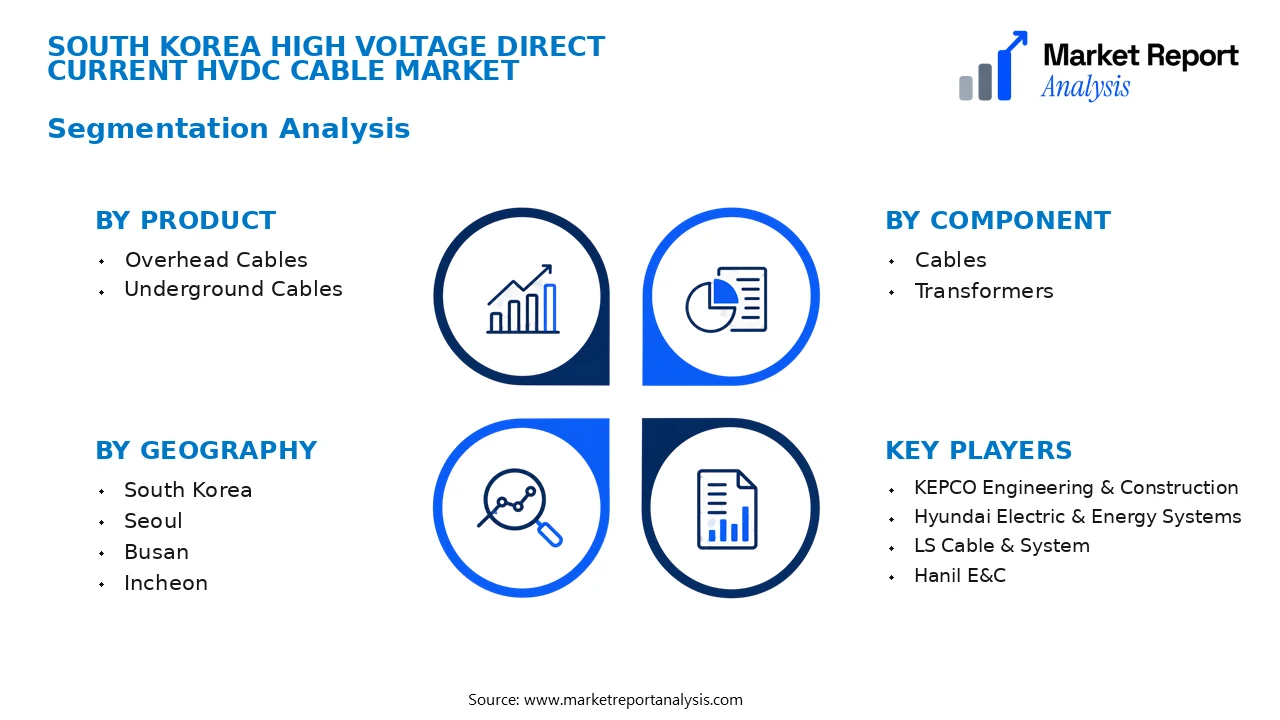
- Product
- Overhead Cables: Overhead HVDC cables are used primarily for long-distance underwater and underground power transmission, offering advantages like reduced land use and enhanced durability, which drive demand in extensive cross-country projects.
- Underground Cables: Underground HVDC cables are favored for urban and environmentally sensitive areas, providing reliable, high-capacity energy transfer with minimal visual impact, thus gaining steady adoption in metropolitan infrastructure development.
- Component
- Cables: HVDC cables as standalone components are crucial for cost-effective and high-capacity power transmission, with rising demand due to increased focus on renewable energy integration and grid modernization.
- Transformers: Transformers accompanying HVDC systems facilitate voltage conversion and regulation, essential for efficient power transfer, and are witnessing growth with expanding grid interconnections and infrastructure upgrades.
- Application
- Interconnection Projects: HVDC cables are vital for interconnecting isolated power grids, enabling stable energy exchange between regions, which is critical for South Korea's renewable energy integration and grid resilience efforts.
- Renewable Energy Integration: The market for HVDC cables in renewable energy, especially offshore wind and solar power projects, is expanding, reflecting the country’s commitment to reducing carbon emissions and increasing renewable capacity.
- End User
- Utilities: Utility companies are the primary end users of HVDC cables, investing heavily in grid expansion, interconnections, and renewable energy projects to meet growing electricity demand and regulatory standards.
- Independent Power Producers (IPPs): IPPs are increasingly adopting HVDC technology for their generation projects, particularly offshore wind farms, to achieve efficient and cost-effective power transmission solutions.
- Geography
- South Korea: The domestic market in South Korea is driven by government initiatives for renewable energy deployment, grid modernization, and cross-border interconnections, with major projects concentrated in Seoul, Busan, and Incheon.
- Seoul: As South Korea’s capital and a major industrial hub, Seoul has a high demand for HVDC infrastructure to support urban energy needs and smart grid deployments, positioning it as a key regional market.
- Busan: With its port and industrial zones, Busan shows significant demand for HVDC solutions to facilitate offshore wind integration, energy security, and cross-border power flows, supporting regional energy strategies.
- Incheon: Incheon’s strategic location near Seoul and its role as a logistic and industrial center makes it an important site for HVDC projects aimed at urban renewable energy utilization and grid reinforcement.
- Daegu: Daegu’s growing industrial sector and regional power demands are fostering local HVDC infrastructure development, particularly for integrating renewable sources and enhancing grid reliability.
- Daejeon: Daejeon, as a scientific and high-tech hub, is involved in advanced HVDC R&D and pilot projects that aim to optimize high-capacity power transmission for innovative industries.
- Gwangju: Gwangju’s regional renewable initiatives and industrial zone development are increasing HVDC cable deployment to ensure efficient energy distribution and support sustainable growth.
- Ulsan: Known for its large petrochemical industries, Ulsan benefits from HVDC infrastructure to support energy-intensive manufacturing and to facilitate integration of renewable energy sources into the industrial grid.
- Suwon: As a city with expanding technological and industrial activity, Suwon’s demand for HVDC cables is driven by urban infrastructure projects, smart city initiatives, and local renewable energy efforts.
Competitive Intelligence
The South Korea High Voltage Direct Current (HVDC) cable market exhibits a competitive landscape characterized by the presence of key domestic and international players adopting aggressive expansion and innovation strategies. Major firms such as LS Electric and Hyosung, alongside global leaders like ABB and Siemens, dominate the market share, leading to high market concentration. These companies focus on technological advancements like submarine and underground HVDC solutions tailored to South Korea’s energy infrastructure needs. Strategies include forming strategic partnerships with local utilities and government bodies, facilitating joint ventures to enhance R&D capabilities, and acquiring smaller firms to expand technical expertise and market reach. Companies are investing heavily in R&D to develop more efficient, reliable, and environmentally sustainable cable systems, aiming to differentiate themselves through innovation. Expansion into emerging urban markets like Seoul and Busan is prioritized, with a focus on enhancing grid reliability and interconnection capacity. Competitive differentiation hinges on comprehensive service offerings, customization, and robust after-sales support, positioning firms to capitalize on South Korea’s evolving energy transition.
Leading Company Profiles
The competitive landscape in South Korea's HVDC cable market is characterized by a mix of established multinational corporations and local technology leaders, focused on innovation, reliability, and sustainability to meet rising energy demands.
- KEPCO Engineering & Construction
- Hyundai Electric & Energy Systems
- LS Cable & System
- Hanil E&C
- Doosan Heavy Industries & Construction
- KEC (Korea Electric Power Corporation)
- Samsung C&T Corporation
- Kumho Electric
- SK Engineering & Construction
KEPCO Engineering & Construction
KEPCO E&C specializes in power infrastructure, providing advanced HVDC cable solutions with a focus on innovation, regulatory compliance, and strategic investment in technology to support South Korea’s energy transition.
Hyundai Electric & Energy Systems
Hyundai Electric is a leader in electrical equipment manufacturing, offering high-performance HVDC cables, emphasizing technological innovation, and integrating sustainability into its product development for a competitive edge in Korea’s energy market.
LS Cable & System
LS Cable is renowned for its extensive cable portfolio, including HVDC systems, with a strategic focus on expanding manufacturing capacity, technology innovation, and establishing strategic alliances within the energy sector to boost market share.
Hanil E&C
Hanil E&C develops and constructs high-voltage infrastructure projects, leveraging technological expertise in HVDC cables, with an emphasis on building resilient and sustainable energy transmission networks for South Korea.
Doosan Heavy Industries & Construction
Doosan Heavy excels in power plant engineering and HVDC cable systems, emphasizing technological innovation, capacity expansion, and digital transformation to enhance performance and meet evolving energy demands.
KEC (Korea Electric Power Corporation)
As South Korea's primary utility, KEC invests strategically in HVDC technology, focusing on grid modernization, sustainability initiatives, and expanding HVDC grid infrastructure to ensure energy reliability and integration of renewable sources.
Samsung C&T Corporation
Samsung C&T leverages its engineering expertise to develop HVDC cables as part of its broader focus on energy infrastructure, prioritizing technological innovation, sustainability, and strategic global partnerships.
Kumho Electric
Kumho Electric produces specialized high-voltage electrical equipment, including HVDC cables, and emphasizes R&D, technological advancements, and capacity expansion to position itself as a key supplier in South Korea.
SK Engineering & Construction
SK E&C actively invests in HVDC cable projects, focusing on digitalization, capacity building, and strategic collaborations to support South Korea’s renewable energy goals and grid modernization efforts.
Strategic Business Developments

- July 2026 – KEPCO Engineering & Construction – Launch of a new HVDC cable manufacturing plant – Enhances domestic production capacity supporting South Korea’s renewable integration targets.
- May 2026 – Hyundai Electric & Energy Systems – Partnership with a technology firm for HVDC cable innovation – Strengthens technological capabilities and accelerates adoption of high-efficiency systems.
- April 2026 – LS Cable & System – Capacity expansion at key cable manufacturing facilities – Supports growing demand for HVDC infrastructure linked to offshore wind projects.
- June 2026 – Hanil E&C – Strategic alliance with European HVDC technology provider – Facilitates technology transfer and broadens product portfolio for large-scale projects.
- August 2026 – Doosan Heavy Industries & Construction – Digital initiative to optimize HVDC cable manufacturing processes – Improves operational efficiency and product quality, reducing costs.
Frequently Asked Questions
What is the South Korea High Voltage Direct Current HVDC Cable Market?
The South Korea High Voltage Direct Current (HVDC) Cable Market encompasses the manufacturing, installation, and operation of HVDC cables designed for efficient long-distance transmission of electricity. It supports renewable energy integration and enhances grid stability.
What is the current market size of South Korea High Voltage Direct Current HVDC Cable Market?
As of 2026, the market size is valued at approximately USD 2.5 Billion. The market has experienced steady growth due to increased infrastructure investments and renewable energy projects focused on grid modernization.
What factors are driving the South Korea High Voltage Direct Current HVDC Cable Market?
Key drivers include the national push for renewable energy integration, government incentives for grid expansion, technological advancements in HVDC systems, and the need to transmit electricity over long distances with minimal losses, supporting South Korea’s energy transition goals.
Which South Korean city leads the South Korea High Voltage Direct Current HVDC Cable Market?
Seoul leads the South Korean HVDC cable market owing to its status as a central hub for infrastructure development, investment in smart grid projects, and its proximity to large renewable energy zones, making it a strategic focal point for market activity.
Which segment is expected to grow the fastest?
The underground cable segment is projected to grow faster due to urbanization, the need for space-efficient transmission solutions, and advancements in insulating and installation technologies suited for dense metropolitan areas.
Who are the leading companies operating in the South Korea High Voltage Direct Current HVDC Cable Market?
Major industry players include LS Cable & System, Hyundai Electric, and KEPCO, leveraging extensive R&D, strategic partnerships, and regional expertise to strengthen their positions in South Korea’s evolving HVDC landscape.
Analyst Perspective
The long-term outlook for South Korea’s HVDC cable market remains positive, driven by the country’s aggressive renewable energy integration and grid modernization efforts, particularly at city levels such as Seoul and Busan. As South Korea aims for a resilient, sustainable power infrastructure, strategic investment in HVDC technology will be crucial, fostering opportunities in ultra-high voltage projects and cross-border interconnections. Technological evolution toward more flexible, efficient, and environment-friendly cable solutions is set to accelerate, reducing costs and expanding deployment. Investment priorities should focus on upgrading urban and coastal transmission networks, emphasizing reliability and environmental compliance. Competitive intensity is expected to intensify as domestic and international players vie for large-scale projects, prompting firms to innovate and form strategic alliances. City-level growth potential remains high, especially in densely populated metropolitan regions where demand for secure, high-capacity transmission can significantly boost economic development and energy security. Overall, South Korea’s HVDC market presents a compelling, long-term strategic opportunity for industry stakeholders seeking sustained growth and technological leadership.
