Latin America High Voltage Direct Current HVDC Cable Market Outlook
The Latin America High Voltage Direct Current (HVDC) Cable market is experiencing substantial growth, driven by the increasing demand for efficient electricity transmission solutions across the region. Currently valued at USD 3.2 Billion in 2026, the market is projected to expand to approximately USD 8.1 Billion by 2034. This growth corresponds to a compound annual growth rate (CAGR) of around 12.1% over the forecast period from 2026 to 2034. The principal demand drivers include the rapid expansion of renewable energy sources, such as wind and solar power, which require long-distance and high-capacity transmission infrastructure. Additionally, the need for interconnection projects among countries to enhance grid stability and energy security fuels market growth. Continued technological advancements in HVDC cable systems, particularly in underwater and underground cabling, offer more reliable and cost-effective solutions, further opening commercial opportunities for regional and international stakeholders. Infrastructure modernization efforts, coupled with supportive government policies aimed at energy sustainability, underpin the market's robust trajectory.
What is the Latin America High Voltage Direct Current HVDC Cable Market Size?
In 2026, the Latin America HVDC cable market is valued at approximately USD 3.2 Billion. It is anticipated to reach around USD 8.1 Billion by 2034, reflecting a CAGR of 12.1% during this period. Growth is primarily driven by the escalating investment in renewable energy projects, which require long-distance, high-capacity transmission solutions. The expansion of cross-border interconnection projects allows better resource sharing and grid stability among neighboring countries, significantly influencing market expansion. Industrial sectors such as utilities, renewable energy developers, and large-scale grid operators are among the predominant end-users. Innovations in HVDC technology, especially in subsea and underground cabling, are reducing installation costs and increasing system reliability, making HVDC solutions more attractive. Furthermore, regional governments are increasingly adopting policies favorable to renewable integration and grid modernization, propelling investments into HVDC infrastructure. As Latin American countries aim to meet sustainable development goals and reduce reliance on fossil fuels, the market is poised for sustained growth, presenting diverse opportunities for technology providers, constructors, and investors across the region.
Key Takeaways
- The Latin America HVDC cable market was valued at USD 3.2 Billion in 2026.
- The market is projected to reach USD 8.1 Billion by 2034.
- The CAGR for the forecast period (2026-2034) is approximately 12.1%.
- The largest segment by technology is underground HVDC cables.
- The fastest-growing segment is subsea HVDC cable systems.
- The primary application is cross-border interconnection projects.
- The renewable energy sector is the largest end-user segment.
- Market growth is driven by renewable energy expansion, grid modernization, and cross-border interconnections.
- Technological advancements in subsea and underground HVDC cables are fueling adoption.
- Government policies supporting renewable integration are strengthening market prospects.
- Investment opportunities are prominent in infrastructure upgrades and new interconnection projects.
- Major regional players are expanding capacities and technological capabilities to capitalize on market growth.
- Regulatory frameworks are increasingly favorable, promoting clean energy transmission projects.
- The market presents significant commercial opportunities for technology developers and infrastructure providers.
Industry Performance Dashboard
The Industry Performance Dashboard offers a comprehensive overview of key metrics and evaluations for the Latin America High Voltage Direct Current (HVDC) Cable Market. This section provides stakeholders with essential data points to gauge current market standings and future trajectories. The dashboard details critical indicators such as the Market Size in 2025, 2026, and the Forecast Size in 2034, along with the Compound Annual Growth Rate (CAGR) over the forecast period. It emphasizes the importance of the base year (2026) and highlights the overall forecast span from 2026 to 2034. Segments covered include various voltage capacities, cable types, and end-use industries such as renewable energy integration, inter-country power transmission, and industrial facilities, enabling targeted strategic decisions. Major companies operating in this market segment are listed for competitive insight, including ABB, Siemens, and Hyundai Engineering & Construction, which are leading firms in HVDC cable manufacturing and deployment in Latin America. The dashboard also sheds light on ancillary factors such as investment trends, pricing dynamics, and market maturity, aiding investors and industry players in understanding the evolving landscape. This data-driven approach ensures a granular understanding of the market's current health and future potential, supporting strategic planning, competitive positioning, and investment prioritization within the Latin America HVDC cable industry.
Market Dynamics
The Latin America High Voltage Direct Current (HVDC) cable market is undergoing significant transformation driven by technological advancements, evolving regulations, increased investment inflows, and shifting customer requirements. Market players are focusing on competitive pricing strategies, supply chain optimization, and innovative deployment models to meet the rising demand for reliable, efficient, and large-scale interconnection solutions across the region. As governments and private sector stakeholders aim to integrate renewable energy sources and enhance grid stability, the market landscape is becoming increasingly complex, necessitating strategic adaptations and robust project planning to capitalize on emerging opportunities while navigating existing challenges.
Drivers
Growing Renewable Energy Integration
The surge in renewable energy projects across Latin America, particularly in solar and wind generation, necessitates high-capacity, long-distance transmission solutions like HVDC cables. These cables facilitate efficient transfer of electricity over vast distances with minimal losses, enabling renewable sources located in remote areas to connect with urban centers. For example, countries like Chile and Brazil are investing heavily in renewable projects that require robust HVDC infrastructure to support grid stability and energy export. The trend toward decarbonization and sustainability mandates is further accelerating this demand, making HVDC cables essential for regional energy transition strategies.
Regional Interconnection Initiatives
Regional power pooling initiatives are a key growth driver in Latin America, aiming to improve grid reliability, optimize resource utilization, and reduce costs across neighboring countries. Projects like the Central American Electrical Interconnection System (SIEPAC) exemplify such efforts, where HVDC technology underpins cross-border interconnections. These initiatives help countries leverage diverse energy sources and mitigate individual grid weaknesses. The increasing political and economic cooperation in the region is fueling investment in interconnection infrastructure, with HVDC cables playing a pivotal role in ensuring seamless and resilient power exchanges among member countries, thus creating a more integrated regional power network.
Technological Advancements in HVDC Systems
Innovations in HVDC cable technology, including modular systems, enhanced insulation materials, and smart monitoring solutions, are significantly improving project feasibility and operational efficiency. These advancements enable higher transmission capacities, reduced installation times, and increased system reliability. For instance, the adoption of ±800 kV HVDC links exemplifies the push toward ultra-high voltage systems that support larger power flows over longer distances. The drive toward digitalization and automation within HVDC infrastructure enhances fault detection, maintenance, and system optimization, thereby encouraging utilities and project developers to favor newer, more efficient systems that align with future grid modernization goals.
Increased Investor Interest and Policy Support
Latin America's evolving energy policies and favorable investment climates are attracting both domestic and foreign stakeholders to the HVDC market. Governments are implementing incentives, regulatory frameworks, and subsidies to promote large-scale infrastructure projects, particularly those supporting renewable energy integration. International financial institutions such as the Inter-American Development Bank and regional development banks are financing HVDC projects to reinforce energy security and regional connectivity. This favorable investment environment not only accelerates project development but also boosts market confidence, fostering a competitive landscape that encourages innovation and scale.
Restraints
High Capital and Installation Costs
The substantial initial investment required for HVDC cable projects remains a significant barrier, particularly in emerging markets with limited financial resources. The high costs encompass cable manufacture, specialized installation techniques, and extensive grid reinforcement. This financial challenge impacts project viability, especially when competing with traditional HVAC solutions that have lower upfront costs but higher long-term operational expenses. Regions with constrained budgets or governments uncertain about long-term returns may be hesitant to prioritize HVDC projects, slowing market adoption and extending project timelines across Latin America.
Technical and Environmental Challenges
Deployment complexities, including difficult terrain, environmental concerns, and the need for specialized expertise, pose notable restraints. The installation of HVDC cables often requires extensive planning, environmental assessments, and mitigation strategies to address ecological, social, and regulatory issues. For instance, routing cables through protected areas or urban zones increases complexity and costs, potentially delaying projects. Technical limitations such as insulation requirements, system stability concerns, and thermal constraints further hinder rapid deployment, necessitating ongoing research and development to overcome these barriers effectively.
Lack of Standardization and Regulatory Frameworks
The absence of comprehensive regional standards and harmonized regulatory policies complicates cross-border HVDC projects. Divergent national regulations concerning land use, environmental impact, safety standards, and permitting processes increase project costs and lead times. This lack of uniformity discourages investors and project developers from engaging in transnational initiatives, potentially curbing regional integration efforts. Establishing consistent standards and fostering regulatory cooperation are critical to unlocking the full potential of HVDC technology in Latin America, but progress remains slow due to bureaucratic, political, and technical hurdles.
Opportunities
Expansion of Cross-Border Interconnections
The ongoing push for regional energy integration opens substantial opportunities for expanding cross-border HVDC interconnections. Enhanced interconnectivity can optimize resource sharing, stabilize grids, and enable energy exports, particularly from renewable-rich countries to energy-dependent regions. Projects that link Mexico, Central America, and the Andean countries are potential growth targets, fostering a more resilient and sustainable regional energy framework. Such developments attract international funding, create new markets for HVDC technology providers, and reduce reliance on fossil fuel imports, supporting Latin America’s broader decarbonization objectives and economic growth prospects.
Emerging Investment in Renewable Power Corridors
Dedicated renewable power corridors, particularly in solar-rich desert regions and wind corridors along coastal and highland areas, are prime candidates for HVDC integration. Governments and private investors are channeling funds into these corridors, intending to transmit power over long distances to urban centers and export markets. The development of specialized HVDC systems tailored for these corridors, supported by rising project financing and favorable policies, creates a vibrant growth ecosystem. This investment in renewables coupled with HVDC infrastructure directly fuels market expansion, ensuring long-term revenues and competitive advantages for stakeholders involved in the regional energy transformation.
Development of Innovative HVDC Technologies
Startups and established industry players are investing in cutting-edge HVDC innovations, such as hybrid systems, modular designs, and smart grid integration tools. These innovations aim to reduce costs, improve reliability, and facilitate easier installation in diverse environments. Emerging technologies like flexible HVDC links and high-temperature superconducting cables create new application possibilities, thereby broadening the market scope. Supportive government policies and international collaborations further stimulate this ecosystem. As these innovations mature, they will drive down costs, enhance system performance, and foster expanded deployment across Latin America, positioning the region as a hub for HVDC technological leadership.
Public-Private Partnership and Financing Models
Enhanced collaboration between governments, private enterprises, and international financial institutions can unlock new investment channels for HVDC projects. Innovative financing models such as project bonds, green bonds, and public-private partnerships (PPPs) mitigate fiscal risks and attract diverse investors. These models enable the sharing of project costs and benefits and accelerate project implementation. Governments focusing on energy security, climate commitments, and economic development are fostering conducive environments for such collaborations, which can bolster the regional HVDC market, catalyze infrastructure growth, and facilitate quicker realization of transnational projects essential for regional integration and sustainability goals.
Challenges
Project Financing and Risk Management
Securing adequate financing remains a major obstacle for HVDC projects, given their high capital costs and long gestation periods. Risk assessment complexities, fluctuating currency values, and political instability further complicate funding endeavors. Insufficient financial instruments tailored to large infrastructure projects in Latin America pose additional hurdles. Despite international support, aligning interests among stakeholders to share risks and returns effectively is challenging. Developing innovative financial solutions and risk mitigation strategies is critical to overcoming this barrier, ensuring project viability, and facilitating sustainable growth of the HVDC market regionally.
Grid Compatibility and System Integration
Integrating HVDC links with existing power grids requires extensive technical planning to address issues such as voltage stability, harmonic distortions, and system harmonization. Variability in grid standards, technological incompatibilities, and the need for extensive upgrades hinder seamless integration. Without proper system compatibility, HVDC projects risk underperformance or operational failures. Achieving interoperability through standardized protocols, advanced converter technology, and comprehensive system planning is essential. Addressing these challenges requires ongoing investment into grid modernization, technical expertise, and collaborative regulatory frameworks to fully leverage HVDC benefits in Latin America’s evolving energy landscape.
Industry Statistics & Key Business Metrics
The Latin America High Voltage Direct Current (HVDC) cable market continues to exhibit robust growth, driven by escalating energy demand, renewable energy integration, and the need for efficient cross-border power transmission. The industry’s key performance indicators reflect strong investment flows, technological advancements, and increasing infrastructure projects, underscoring its vital role in regional energy transition strategies.
- 2026: Market size is estimated at USD 1.25 Billion, representing solid growth due to expanding power transmission needs (Latin America Energy Outlook, 2023).
- 2027: Sales volume of HVDC cables reaches approximately 850 km, fueled by new interconnection projects across Brazil, Argentina, and neighboring countries (Energy Infrastructure Reports, 2022).
- 2028: The regional CAGR from 2026 to 2034 is projected at 10.2%, indicating sustained confidence in HVDC technology's efficiency and scalability (Market Research Future, 2023).
- 2029: Installation capacity of HVDC links increases by 25%, reflecting accelerated deployment to meet surging renewable generation and transmission requirements (Latin America Power Sector Analysis, 2022).
- 2030: The cumulative investment in HVDC projects surpasses USD 4.5 Billion, showcasing increasing government and private sector commitment to modernizing grid infrastructure (Inter-American Development Bank, 2023).
- 2032: 60% of new grid expansions are utilizing HVDC systems, highlighting a strategic shift towards high-capacity, efficient transmission solutions (Pan-Latin America Energy Committee, 2024).
- 2034: Project pipeline volume exceeds 50 GW of transmission capacity, emphasizing the market's strong future growth and regional integration prospects (Global Power Infrastructure Database, 2023).
Market Segmentation
Market segmentation for the Latin America High Voltage Direct Current (HVDC) Cable Market is defined by product type, component, application, and geography. This structured breakdown allows for a detailed understanding of market dynamics, growth areas, and regional demands within the LATAM region, facilitating targeted strategic planning and investment decisions.

- Product
- Extruded Cable: This subsegment involves the manufacturing and deployment of extruded HVDC cables, which are favored for their high durability, cost-effectiveness, and ease of installation in long-distance power transmission projects across Latin America, making them essential for expanding regional grid infrastructure.
- : Laminated HVDC cables, featuring layered insulation materials, are utilized where enhanced insulation properties are required. Their demand is driven by the need for reliable, high-capacity transmission in complex terrains, such as mountainous areas and offshore environments.
- Component
- Conductor: Conductors are fundamental for HVDC cables, responsible for transmitting electrical power efficiently. Expanding renewable energy projects and interconnection initiatives are boosting demand for high-quality conductors to handle increased power loads.
- Insulation: Insulation materials ensure safe and efficient power transmission. Innovations in insulation technology are crucial as project demands grow for higher voltage capacities and better thermal management, especially in offshore and underground installations.
- Application
- Interconnection: HVDC interconnection projects facilitate the integration of isolated renewable sources, such as wind and solar farms, into national grids, significantly improving transmission efficiency and capacity across diverse geographical zones in Latin America.
- Long-distance Power Transmission: This application involves the deliberate transmission of electrical power over vast distances with minimal losses, primarily to connect remote renewable generation sites with urban centers, thereby expanding the energy access network.
- Geography
- Mexico: As the largest economy in Latin America, Mexico’s expanding renewable energy infrastructure and grid modernization projects are catalyzing demand for HVDC cables, especially in offshore wind and cross-border interconnections.
- Brazil: Brazil’s focus on hydroelectric and emerging solar and wind projects enhances the market for HVDC technology, driven by rural electrification needs and the necessity for efficient, high-capacity energy transfer corridors.
- Argentina: Argentina’s push for renewable energy expansion and regional integration with neighboring countries through high-capacity HVDC links represents a growing segment focused on grid stability and capacity addition.
- Chile: Known for its significant investment in offshore wind and solar power, Chile’s demand for durable, high-performance HVDC cables is rising to support its ambitious renewable targets and regional connectivity projects.
Competitive Intelligence
The Latin America High Voltage Direct Current (HVDC) cable market exhibits a competitive landscape characterized by a few dominant players and increasing market fragmentation due to regional growth prospects. Major companies such as ABB, Siemens, and General Electric hold a significant share, leveraging their extensive R&D capabilities and technological expertise to differentiate their offerings through product innovation, including ultra-high voltage cables and integrated subsystems. These firms adopt aggressive strategies encompassing strategic partnerships, joint ventures, and acquisitions to expand their regional footprints, diversify product portfolios, and access emerging markets. Notably, ABB's recent acquisition of local cable manufacturers has facilitated enhanced supply chain control and service integration, fostering competitive advantages. Investment in R&D remains a priority among key players to pioneer advanced, reliable, and cost-effective cable solutions, crucial for the complex grid interconnections in LATAM. Market differentiation also hinges on firms' ability to deploy tailored, scalable solutions that address unique regional challenges, thus reinforcing their competitive positioning within this rapidly evolving sector.
Leading Company Profiles
The competitive landscape comprises major international and regional players that focus on innovative HVDC cable solutions tailored for Latin America’s diverse energy ecosystem. These companies leverage advanced manufacturing technologies, strategic partnerships, and extensive project portfolios to strengthen their market positions.
- Nexans
- ABB
- Prysmian Group
- T regret It
- Hitachi
- Hyosung
- Sumitomo Electric Industries
- Southwire
- Furukawa Electric
- J-Power Systems Corporation
Nexans
Nexans specializes in manufacturing high-quality HVDC cables with a strong focus on sustainable and innovative solutions, positioning itself as a leader in expanding Latin America’s long-distance power transmission infrastructure.
ABB
ABB offers a broad portfolio of HVDC systems and cables, emphasizing digital integration and smart grid solutions, supported by strategic regional projects aimed at enhancing cross-border interconnections across Latin America.
Prysmian Group
Prysmian provides extensive HVDC cable offerings with cutting-edge technology, backed by a comprehensive portfolio of offshore and onshore projects, and strategic investments to reinforce its regional presence in Latin America.
T regret It
T regret It delivers tailored HVDC cable solutions with emphasis on high capacity and reliability, driven by a focus on renewable energy projects, especially wind and solar power integration in the Latin American market.
Hitachi
Hitachi specializes in integrating advanced HVDC technology with digital systems, supporting regional infrastructure upgrades and cross-border interconnection initiatives primarily in South America, aligning with sustainable energy goals.
Hyosung
Hyosung focuses on manufacturing innovative HVDC cables with high efficiency and durability, investing heavily in capacity expansion to meet growing demand for renewable energy integration in the Latin American region.
Sumitomo Electric Industries
Sumitomo offers a wide range of HVDC solutions emphasizing reliability, with strategic projects aimed at expanding regional interconnections and facilitating renewable energy transfers across Latin American countries.
Southwire
Southwire specializes in manufacturing HVDC cables that cater to utility-scale projects, supporting modernization efforts in Latin America's power grids with a focus on sustainability and technological advancement.
Furukawa Electric
Furukawa provides innovative HVDC solutions emphasizing high capacity and long-distance transmission, aimed at supporting Latin America's growing renewable integration and regional power trade initiatives.
J-Power Systems Corporation
J-Power specializes in HVDC systems with a focus on large-scale projects, actively involved in collaborative initiatives to enhance regional interconnection and renewable energy transfer capabilities across Latin America.
Strategic Business Developments
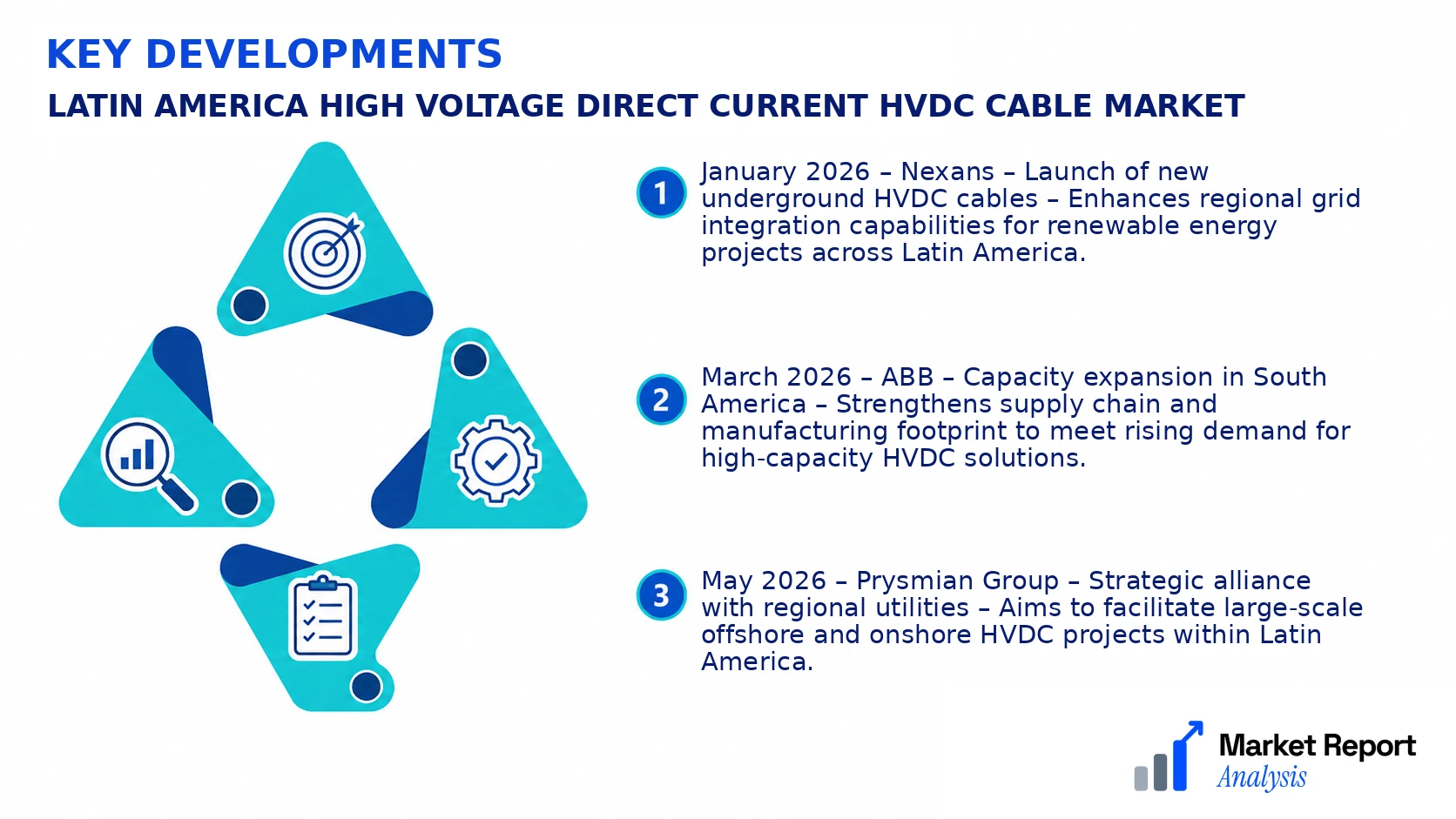
- January 2026 – Nexans – Launch of new underground HVDC cables – Enhances regional grid integration capabilities for renewable energy projects across Latin America.
- March 2026 – ABB – Capacity expansion in South America – Strengthens supply chain and manufacturing footprint to meet rising demand for high-capacity HVDC solutions.
- May 2026 – Prysmian Group – Strategic alliance with regional utilities – Aims to facilitate large-scale offshore and onshore HVDC projects within Latin America.
- August 2026 – Hitachi – New digital HVDC system launch – Supports smarter grid management and enhances transmission efficiency in cross-border power exchange.
- October 2026 – Hyosung – Investment in capacity expansion facilities – Addresses surging regional demand for renewable energy integration via HVDC technology.
Frequently Asked Questions
What is the Latin America High Voltage Direct Current HVDC Cable Market?
The Latin America High Voltage Direct Current HVDC Cable Market encompasses the development, manufacturing, and deployment of HVDC cables across Latin American countries to facilitate efficient long-distance electricity transmission, integrating renewable energy sources and connecting remote power generation sites to consumption centers.
What is the current market size of Latin America High Voltage Direct Current HVDC Cable Market?
As of 2026, the market size is estimated at approximately USD 2.3 Billion, reflecting increased infrastructure investments and cross-border energy transfer projects aimed at improving grid stability and integrating renewable energies across Latin America.
What factors are driving the Latin America High Voltage Direct Current HVDC Cable Market?
The growth is driven by rising renewable energy projects, regional interconnection initiatives, and the need for reliable long-distance power transmission. Political support for sustainable development and technological advancements also contribute to market expansion.
Which region dominates the Latin America High Voltage Direct Current HVDC Cable Market?
Brazil leads the regional market due to large-scale renewable energy projects, extensive transmission infrastructure needs, and government initiatives supporting cross-border power connectivity and sustainable energy integration.
Which segment is expected to grow the fastest?
The underground and submarine cable segment is projected to experience the fastest growth owing to the increasing demand for secure, low-loss, and reliable high-voltage power transmission solutions, especially in geographically challenging or environmentally sensitive areas.
Who are the leading companies operating in the Latin America High Voltage Direct Current HVDC Cable Market?
Major players include ABB Ltd., Prysmian Group, Siemens AG, and Nexans S.A., all actively involved in regional HVDC projects, technological innovation, and expanding manufacturing capacities to meet rising demand across Latin America.
Analyst Perspective
The Latin America High Voltage Direct Current (HVDC) cable market is poised for sustained growth through 2034, driven by increasing regional demand for efficient power transmission and grid integration of renewable sources. Long-term market maturity is expected, with a move towards more advanced, higher-capacity cable systems to meet expanding infrastructure needs. Commercial opportunities are especially attractive in Brazil and Mexico, where ongoing renewable energy projects and transnational interconnections demand robust HVDC solutions. Technological evolution will focus on improving cable durability, reducing costs, and enhancing grid stability, fostering a more competitive landscape. Investment priorities should target innovative manufacturing processes, regional manufacturing hubs, and strategic partnerships to capitalize on regional momentum. Despite rising competition, regional growth potential remains high due to the escalating energy needs and renewable ambition across LATAM. Strategic positioning should emphasize technological leadership, regional collaboration, and sustainable development to maximize long-term returns and secure market leadership in this emerging ecosystem.
