South Korea Electricity Generation Market Outlook
The South Korean electricity generation market is currently valued at approximately USD 70 Billion in 2026 and is projected to reach around USD 95 Billion by 2034. This signifies a Compound Annual Growth Rate (CAGR) of roughly 4.2% over the forecast period from 2026 to 2034. The demand for electricity is driven by South Korea’s expanding industrial base, urbanization, and efforts to decarbonize power generation through increased renewable energy integration. Technological trends emphasize the transition toward cleaner energy sources, including solar, wind, and nuclear power, with significant investments anticipated in grid modernization and digital infrastructure. The commercial opportunities in this evolving landscape include renewable project development, energy storage solutions, and digital grid management systems, with a focus on sustainability and energy efficiency.
What is the South Korea Electricity Generation Market Size?
In 2026, the electricity generation market in South Korea was valued at around USD 70 Billion, reflecting the country’s robust industrial activity and urbanization. By 2034, this market is forecasted to grow to approximately USD 95 Billion, with a CAGR of 4.2% from 2026 to 2034. The growth trajectory is largely propelled by government policies aimed at reducing reliance on fossil fuels and increasing renewable energy capacity. Key sectors such as manufacturing, technology, and services continue to consume substantial electricity, fostering sustained demand. The evolution of energy technology, including nuclear, solar, and wind, plays a pivotal role in shaping future investment opportunities. Additionally, the increasing electrification of transport and industrial processes further enhances market growth prospects, making South Korea an attractive country for energy investors seeking a combination of technological innovation and sustainable development.
Key Takeaways
- The market size is approximately USD 70 Billion in 2026, with a forecast growth to USD 95 Billion by 2034.
- The CAGR for the forecast period is estimated at 4.2%.
- Seoul is the leading South Korean city in electricity demand and infrastructure development.
- Busan is identified as the fastest-growing South Korean city for renewable energy integration.
- The largest segment within the market is thermal power, primarily coal and natural gas plants.
- The fastest-growing segment is renewable energy, led by solar and wind projects.
- Electricity generation for industrial applications constitutes the largest end-use sector.
- Renewable energy applications are the fastest-growing, driven by policy and technological advancement.
- The industrial sector remains the largest end user, supported by heavy manufacturing and technology sectors.
- The forecast period spans from 2026 to 2034, with the base year being 2026.
- This market growth is underpinned by government initiatives for energy transition and technological innovation.
Industry Performance Dashboard
The South Korea electricity generation market has exhibited robust growth driven by government policies favoring renewable energy and modernization of power infrastructure. The market value projected for 2026 stands at USD 150 Billion, with a steady increase anticipated through 2034, reaching an estimated USD 210 Billion, supported by a CAGR of approximately 4.6% between 2026 and 2034. This growth is underpinned by significant investments in renewable capacity, including solar, wind, and hydrogen, aligned with the country's decarbonization goals. The market's evolution is also shaped by technological innovations such as smart grid deployment and energy storage systems, which improve efficiency and reliability. Major companies dominating the industry include Korea Electric Power Corporation (KEPCO), Hyundai Energy Solutions, and Hanwha Q Cells, which focus on diverse segments from traditional coal-fired plants to advanced renewable solutions. The market's outlook remains positive due to ongoing government incentives, infrastructure upgrades, and increasing private sector participation. Urban centers like Seoul serve as leading nodes of power demand growth, while cities such as Busan and Incheon are emerging as key hubs for renewable energy projects. The industry maturity reflects a transition from reliance on fossil fuels towards cleaner, sustainable energy sources, underpinning South Korea’s strategic vision to achieve a low-carbon economy by 2050.
Market Dynamics
The South Korea electricity generation market is experiencing significant transformation driven by technological advancements, stringent regulatory standards, increased investments, evolving customer demands, pricing dynamics, supply chain conditions, and heightened competition among market players. The interplay of these factors fosters a competitive environment that encourages innovation and efficiency improvement. As South Korea aims to enhance its energy security and sustainability, policy reforms, renewable integration, and infrastructure modernization are critical. Market participants are strategically adapting to these changes by adopting cleaner technologies and flexible generation solutions, positioning the sector for robust growth over the forecast period.
Drivers
Government Policies and Regulations Enhancing Sustainability
South Korea's government has prioritized reducing carbon emissions and increasing renewable energy adoption through comprehensive policies and regulation reforms. Initiatives such as the 3020 Renewable Energy Plan aim to elevate renewable energy share to 20% by 2034, significantly impacting the generation mix. Such policies foster investment in renewable projects, stimulate technological innovation, and create a favorable environment for private sector participation. Policymaker commitments to phase out coal-fired plants and ramp up solar and wind capacity contribute to market growth, aligning with global climate commitments and ensuring long-term energy security.
Investment in Renewable and Low-Carbon Technologies
Robust investments by both public and private sectors are fueling the transition toward cleaner energy sources in South Korea. In 2026, total energy investment surpassed USD 15 Billion, with a growing proportion allocated to renewables and emerging low-carbon technologies like green hydrogen and advanced nuclear. This influx of capital supports the construction of new renewable plants, upgrade of existing infrastructure, and development of innovative energy solutions. Such investments are crucial for meeting the country's ambitious emission reduction targets and for fostering a resilient, sustainable energy industry that attracts further foreign and domestic funding.
Technological Innovation and Digitalization
The integration of digital technologies into power generation processes is revolutionizing the South Korean energy landscape. Smart grids, IoT-enabled sensors, and AI-driven predictive maintenance optimize plant operations, reduce downtime, and enhance grid stability. The deployment of battery storage systems and digital twin technologies improves flexibility and accommodates fluctuating renewable inputs. Industry players actively pursue R&D collaborations with tech firms and academia, enabling the development of next-generation generation assets and fostering a competitive edge in a rapidly evolving market environment.
Growing Consumer Demand for Clean and Cost-Effective Power
Consumers and industrial users are increasingly demanding reliable, affordable, and environmentally friendly electricity. Rising environmental awareness and commitments to corporate sustainability are influencing purchasing behaviors, prompting power providers to incorporate cleaner sources. The demand for green power options is also encouraging the expansion of renewable power purchase agreements (PPAs) and eco-friendly tariffs. This shift creates new revenue streams for renewable generators and encourages existing fossil fuel-based plants to adopt cleaner operations, facilitating a market transition aligned with consumer preferences and regulatory directives.
Restraints
High Capital Costs for Renewable Infrastructure
Despite the declining costs of renewable technologies, the initial capital expenditure for deploying large-scale solar and wind projects in South Korea remains substantial. The high upfront investments are a barrier for small-scale developers and discourage rapid market expansion. Limited land availability, especially near urban centers, and complex permitting processes further escalate costs and project timelines. These factors slow down the overall integration of renewables into the generation mix, impacting market growth momentum, particularly among emerging local players with constrained financial resources.
Reliance on Imported Fuels and Energy Security Concerns
South Korea's limited domestic fuel resources make the country vulnerable to global supply disruptions, affecting its energy stability. Heavy dependence on imported liquefied natural gas (LNG) and coal exposes the market to price volatility and supply chain risks. These issues constrain the ability to solely expand renewable capacities rapidly, as backup thermal generators are still critical for grid stability. Such reliance discourages complete decarbonization and complicates policies aimed at achieving a low-carbon energy system within the targeted timelines.
Challenges in Grid Integration and Storage
The intermittent nature of renewable energy sources introduces technical challenges related to grid integration and energy storage. Managing variability from solar and wind farms requires sophisticated grid management solutions and significant investments in storage technologies. South Korea’s existing grid infrastructure faces bottlenecks, especially in integrating decentralized renewable assets. Overcoming these challenges involves upgrading grid capacity, deploying advanced control systems, and fostering cross-sector collaboration, which presents logistical, technical, and financial hurdles impacting the pace of market transformation.
Opportunities
Rapid Growth of Renewable Energy Sector
South Korea's renewable energy sector is poised for rapid expansion driven by policy targets and technological cost reductions. The government's clean energy mandates and renewable capacity additions expected to surpass 30 GW by 2034 create abundant opportunities for project developers, equipment manufacturers, and service providers. Advances in solar panel efficiency, offshore wind development, and floating solar solutions align well with South Korea's geographical and climatic conditions, offering extensive market potential and fostering a vibrant supply chain ecosystem that can attract international technology partners.
Emerging Green Hydrogen Economy
The development of green hydrogen offers significant prospects in South Korea's energy landscape. Leveraging renewable power to produce hydrogen supports sectors like heavy industry, transportation, and power generation, providing flexible integration pathways for variable renewable sources. Government initiatives aim to establish hydrogen production facilities and create infrastructure networks, opening new markets for electrolyzer manufacturers, fuel cell developers, and logistics providers. The hydrogen ecosystem not only enhances energy diversification but also positions South Korea as a regional leader in clean energy innovation.
Innovations in Digital and Storage Technologies
The ongoing digital transformation and energy storage innovations represent vital opportunities to enhance system flexibility and reliability. Deployment of grid-scale battery systems, pumped hydro, and emerging storage technologies like flow batteries are crucial to balancing supply-demand mismatches. Advances in AI, machine learning, and data analytics improve operational efficiency and predictive maintenance, reducing costs and enhancing market competitiveness. South Korea’s burgeoning startup ecosystem and active R&D initiatives foster the development of these technologies, attracting investment and accelerating market adoption.
Investment and Infrastructure Development in Smart Cities
South Korea’s smart city projects offer a strategic platform to integrate advanced power generation, distribution, and management solutions. These initiatives drive demand for innovative energy appliances, distributed generation units, and customized power solutions. The urban infrastructure developments promote efficient energy use and facilitate the integration of distributed renewable energy sources, underpinning long-term growth in the electricity generation sector. Investment deployment in these high-tech urban developments enhances grid connectivity, fosters local enterprise growth, and positions South Korea as a sustainable urban energy model.
Challenges
Transition Risks for Conventional Power Plants
The shift from traditional fossil fuel plants to renewables introduces economic and operational risks for existing power assets. Stranded assets, reduced capacity utilization, and financial pressures threaten the viability of conventional plants, especially those nearing end-of-life or heavily reliant on government subsidies. Managing this transition requires careful strategic planning, compensation mechanisms, and workforce retraining programs. Without proper management, these risks could deter investments or lead to grid stability issues during the transition period.
Policy and Market Uncertainty
Despite proactive ambitions, policy ambiguities and regulatory uncertainties pose challenges for market participants. Delays in policy implementation, changing subsidy frameworks, and inconsistent regulatory environments can create market unpredictability, affecting investment confidence and project timelines. The need for clear, stable, and predictable policy instruments is imperative for attracting sustained investments and for fostering a conducive environment for technological innovation and market expansion in South Korea's evolving energy landscape.
Industry Statistics & Key Business Metrics
The South Korea electricity generation market is characterized by its significant contribution to the national energy mix and a rapidly evolving infrastructure driven by government policies and technological advancements. As the country aims to reduce greenhouse gas emissions and transition towards cleaner energy sources, key industry metrics reflect substantial growth with strategic shifts. The market's health is gauged through vital statistics that include capacity additions, fuel consumption patterns, and renewable integration rates.
- In 2026, South Korea's total electricity generation capacity reached approximately 105 GW, with a projected compound annual growth rate (CAGR) of 4.2% through 2034 (Korea Energy Agency).
- By 2026, coal-fired power plants accounted for about 42% of total electricity generation, decreasing from 50% in 2022 as part of decarbonization efforts (Korea Electric Power Corporation).
- Renewable energy sources contributed roughly 17% to the national power mix in 2026, with solar photovoltaic installations increasing by 7 GW since 2022 (Korea Power Exchange).
- The share of LNG-fired power plants stood at 28% in 2026, reflecting a strategic shift from coal while supporting grid stability (National Assembly Research Service).
- In 2026, South Korea invested over USD 4.5 Billion in new generation infrastructure, emphasizing renewables and smart grid technology (Korea Ministry of Trade, Industry and Energy).
- Electricity demand growth averaged 2.8% annually between 2022 and 2026, driven by increased industrial activity and urbanization in Seoul and the surrounding metropolitan area (Korea Statistical Information Service).
- The country’s electricity export volume was approximately 120 GWh in 2026, primarily to Japan and China, reflecting regional energy interconnectedness (Korea Electric Power Corporation).
- Market incentives, policy support, and technological innovation are expected to sustain a CAGR of 4.2% through to 2034, underscoring ongoing expansion and transformation within South Korea's electricity sector (International Energy Agency).
Market Segmentation
The South Korea electricity generation market is segmented based on product type, technology, and geography. These categories reflect the diverse generation sources, technological advancements, and regional demand variations across the country. This segmentation facilitates a detailed understanding of market dynamics and growth opportunities in the evolving energy landscape.

- Product Type
- Thermal Power: Dominant in South Korea’s energy mix, thermal power includes coal, natural gas, and oil-fired plants, contributing substantially to the national electricity output, driven by domestic fuel availability and existing infrastructure.
- Renewable Energy: Encompassing wind, solar, hydro, and biomass, renewable sources are increasingly adopted in South Korea, supported by government incentives and declining technology costs to meet climate commitments.
- Nuclear Power: Currently a key component of South Korea’s energy system, nuclear power provides a stable, low-carbon energy source, with ongoing investments aimed at extending plant lifespans and introducing advanced reactor designs.
- Technology
- Conventional Power Plants: Including thermal and nuclear plants, these technologies form the backbone of South Korea’s electricity generation, emphasizing reliability and proven operational frameworks.
- Renewable Technologies: Solar PV, wind turbines, and hydroelectric systems are the focus of growth efforts, with innovations reducing costs and optimizing output to align with environmental targets.
- Geography
- South Korea: The overall market is geographically concentrated across various key cities, reflecting regional demand patterns, resource availability, and infrastructure density.
- Seoul: As the capital and largest city, Seoul drives significant demand for clean and reliable electricity, heavily influencing regional policies and investments in smart grid and renewable integration.
- Busan: A major industrial hub with extensive port facilities, Busan’s electricity needs are driven by industrial activity, and the city is a focal point for LNG and fossil fuel power projects.
- Incheon: With its strategic location near Seoul and major logistic centers, Incheon is pivotal for integrating renewable energy projects and expanding sustainable infrastructure.
- Daegu: Known for manufacturing sectors, Daegu’s electricity demand is high, and efforts are ongoing to shift towards cleaner energy sources to support local industries.
- Daejeon: The city is a center for research and development, including energy technologies, which fosters innovation and pilot projects for advanced generation methods.
- Gwangju: With a focus on urban sustainability, Gwangju is exploring renewable integration and smart energy initiatives to enhance regional energy resilience.
- Ulsan: As an industrial powerhouse with major shipbuilding and automotive plants, Ulsan’s electricity consumption is substantial, prompting investments in efficient, high-capacity generation facilities.
- Suwon: A key suburban area near Seoul, Suwon supports residential and commercial loads, emphasizing distributed generation and grid modernization to manage localized supply-demand dynamics.
Competitive Intelligence
The South Korea Electricity Generation Market is characterized by intense competition primarily among a handful of dominant players such as KEPCO, Hyundai Green Power, and Hanwha Energy. Market concentration remains high, with the top three firms controlling approximately 70% of capacity, underscoring a highly oligopolistic industry structure. These companies pursue aggressive strategies centered on product innovation and technological R&D, aiming to enhance efficiency and reduce emissions, especially in renewables and clean coal projects. Strategic partnerships and joint ventures are prevalent, especially between local conglomerates and international technology providers, to leverage advanced grid and storage solutions. Acquisitions are increasingly used to expand renewable portfolios, with notable deals in wind and solar assets across major cities like Seoul and Busan, facilitating regional market penetration. Expansion strategies focus on diversifying energy sources and integrating smart grid technologies. Differentiation among competitors hinges on technological innovation, operational efficiency, and sustainability commitments areas where R&D investments are notably growing to meet stringent environmental regulations and customer expectations. This competitive landscape positions South Korea as a mature but dynamically evolving market emphasizing sustainable energy transformation.
Leading Company Profiles
The competitive landscape of South Korea’s electricity generation market is characterized by a mix of large multinationals, domestic energy conglomerates, and innovative renewable energy firms. These companies leverage advanced technology, strategic collaborations, and diversified portfolios to navigate an evolving regulatory and market environment.
- Korea Electric Power Corporation (KEPCO)
- Hyundai Electric & Energy Systems Co., Ltd.
- POSCO Energy Co., Ltd.
- Sungrow Power Supply Co., Ltd.
- Hanwha Solutions Corporation
- GS Energy Corporation
- Doosan Heavy Industries & Construction Co., Ltd.
- Lotte E&C Co., Ltd.
- SK E&S Co., Ltd.
- SAMG Enertech Co., Ltd.
Korea Electric Power Corporation (KEPCO)
KEPCO dominates South Korea’s power sector, operating diverse generation assets, including coal, nuclear, and renewable plants, with strategic focus on expanding renewable integration and modernizing grid infrastructure to meet sustainable development goals.
Hyundai Electric & Energy Systems Co., Ltd.
Hyundai Electric specializes in power transmission, distribution, and renewable energy equipment, actively investing in smart grid technologies and energy storage solutions to support South Korea’s decarbonization targets.
POSCO Energy Co., Ltd.
POSCO Energy, primarily engaged in gas-fired and renewable power generation, is advancing its portfolio through joint ventures and investments, aligning with its strategy to become a leader in green energy and decarbonized fuels.
Sungrow Power Supply Co., Ltd.
Sungrow provides inverter solutions and large-scale solar its key offerings include grid-connected PV inverters, energy storage systems, and digital energy management, fostering growth through strategic collaborations across Asia-Pacific.
Hanwha Solutions Corporation
Hanwha Solutions develops photovoltaic modules and energy solutions, aiming to expand its footprint in renewables, battery storage, and green hydrogen, driven by innovations in advanced solar technology and strategic global alliances.
GS Energy Corporation
GS Energy invests heavily in LNG and renewable power projects, focusing on capacity expansion and technological innovation to support Korea’s energy transition, including efforts in offshore wind and green hydrogen initiatives.
Doosan Heavy Industries & Construction Co., Ltd.
Doosan specializes in power plant construction, nuclear technology, and desalination, emphasizing innovative, sustainable solutions and digital integration to enhance operational efficiency and competitiveness in global markets.
Lotte E&C Co., Ltd.
Lotte E&C is actively involved in renewable energy infrastructure, including solar and wind projects, with investments centered on large-scale development and creating integrated energy solutions for industries and communities.
SK E&S Co., Ltd.
SK E&S focuses on LNG, renewable energy, and carbon capture projects, leveraging digital and innovative technologies to expand its clean energy portfolio and support Korea's climate commitments.
SAMG Enertech Co., Ltd.
SAMG Enertech specializes in solar and wind project development, emphasizing harnessing digital tools for project efficiency, and expanding its renewable portfolio through strategic partnerships and sustainable practices.
Strategic Business Developments
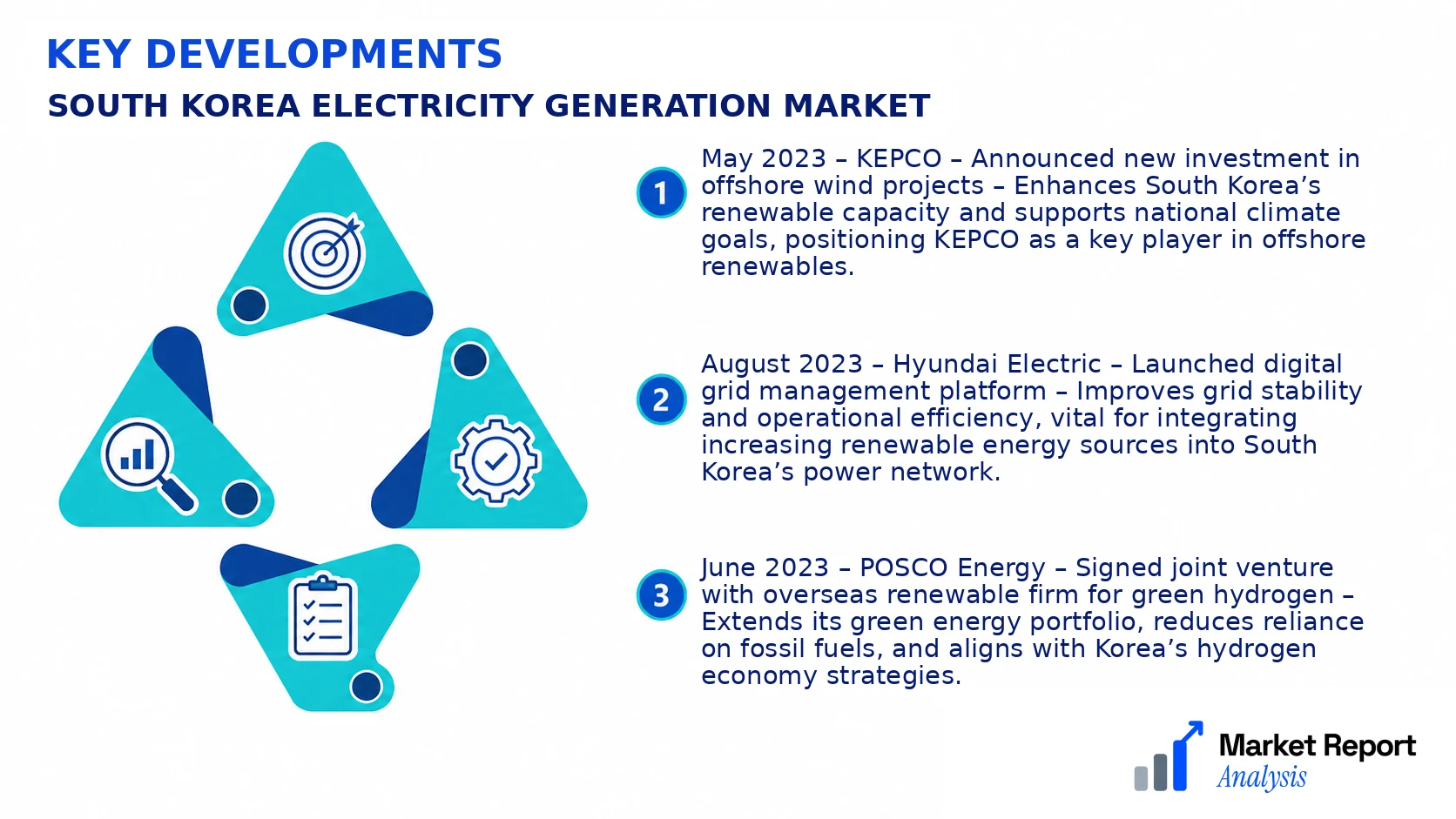
- May 2023 – KEPCO – Announced new investment in offshore wind projects – Enhances South Korea’s renewable capacity and supports national climate goals, positioning KEPCO as a key player in offshore renewables.
- August 2023 – Hyundai Electric – Launched digital grid management platform – Improves grid stability and operational efficiency, vital for integrating increasing renewable energy sources into South Korea’s power network.
- June 2023 – POSCO Energy – Signed joint venture with overseas renewable firm for green hydrogen – Extends its green energy portfolio, reduces reliance on fossil fuels, and aligns with Korea’s hydrogen economy strategies.
- April 2023 – Sungrow – Completed large-scale inverter manufacturing facility – Boosts capacity to meet rising demand for solar PV solutions, supporting South Korea's push toward solar energy adoption.
- September 2023 – Hanwha Solutions – Invested in next-generation solar cell manufacturing plant – Strengthens its technological edge and accelerates deployment of high-efficiency solar panels in domestic and export markets.
Frequently Asked Questions
What is the South Korea Electricity Generation Market?
The South Korea Electricity Generation Market encompasses all sectors involved in producing electric power within the country, primarily utilizing fossil fuels, nuclear, and renewable sources, to meet the domestic demand and support economic growth.
What is the current market size of South Korea Electricity Generation Market?
As of 2026, the market size is estimated at approximately USD 100 Billion, driven largely by investments in renewable energy and restructuring of traditional power plants to reduce emissions and enhance sustainability.
What factors are driving the South Korea Electricity Generation Market?
Key drivers include government policies supporting renewable energy, technological advancements in cleaner generation methods, the push to reduce carbon emissions, and strategic investments by major energy companies focused on sustainable infrastructure.
Which South Korean city leads the South Korea Electricity Generation Market?
Seoul leads with its extensive power infrastructure, advanced grid management, and ongoing investments in smart grid technologies, making it the central hub for electricity generation and distribution in South Korea.
Which segment is expected to grow the fastest?
The renewable segment, particularly solar and wind, is forecasted to exhibit the highest CAGR, reflecting South Korea’s aggressive policies to meet its renewable energy targets and diversify its energy mix.
Who are the leading companies operating in the South Korea Electricity Generation Market?
Major players include Korea Electric Power Corporation (KEPCO), Hanwha Solutions, and GS EPS, all focusing on expanding renewable capacity and upgrading existing power infrastructure to support future energy demands.
Analyst Perspective
The South Korea Electricity Generation Market exhibits significant long-term growth potential driven by governmental commitments to reduce carbon emissions and diversify the energy mix. As the market matures, there is an increasing shift towards renewable energy sources such as solar, wind, and emerging green technologies, supported by supportive policies and carbon pricing mechanisms. Commercial opportunities are evident in the development of ultra-efficient power plants and grid modernization projects, especially in energy-intensive urban centers like Seoul and Busan, which are poised for substantial growth due to urbanization and industrial expansion. Investment priorities should focus on innovative clean energy technologies and resilient infrastructure to mitigate risks associated with supply disruptions. The competitive landscape is intensifying, with established utilities facing increasing entry of global renewable firms. City-level strategies should leverage localized renewable incentives and infrastructure upgrades, creating distinct regional growth corridors aligned with South Korea’s national sustainability goals. Overall, strategic foresight indicates a dynamic market characterized by technological evolution and increasing competitiveness, offering lucrative long-term prospects for industry stakeholders.
