North America Electricity Generation Market Outlook
The North America Electricity Generation Market is currently valued at approximately USD 400 Billion in 2026 and is projected to reach around USD 680 Billion by 2034, expanding at a CAGR of 6.1% during the forecast period from 2026 to 2034. This growth is driven by increasing demand for clean and sustainable energy sources, technological advancements in renewable energy, government policies promoting decarbonization, and rising investments in grid modernization. The market is witnessing a transition from traditional fossil fuel-based generation to renewables such as solar, wind, and hydroelectric power. Commercial opportunities are abundant in the development of utility-scale renewable projects, energy storage solutions, and smart grid technologies. The shift towards decentralized energy systems and the integration of digital technologies further enhance growth prospects across the region, making North America a key player in the global electricity generation landscape.

What is the North America Electricity Generation Market Size?
The market size for North America's electricity generation was valued at roughly USD 400 Billion in 2026 and is expected to reach approximately USD 680 Billion by 2034, with a CAGR of about 6.1% over the forecast period. This growth is primarily driven by the rapid adoption of renewable energy sources, supported by tightening environmental regulations and incentives. The industrial, residential, and commercial sectors constitute the principal end-use industries, demanding increased electricity supply for manufacturing, urbanization, and technological applications. The advent of advanced renewable technologies, such as high-efficiency solar panels and wind turbines, has significantly impacted the energy mix, reducing reliance on fossil fuels and lowering carbon emissions. Additionally, investments in grid modernization and energy storage technologies are pivotal for facilitating the integration of intermittent renewable sources, ensuring grid stability, and meeting future energy demands. Market expansion is further fueled by government policies promoting clean energy adoption and corporate commitments toward sustainability. As a result, the market presents lucrative opportunities for investors and technology providers focused on innovative renewable solutions, smart grids, and energy management systems, aiming for long-term growth and energy transition objectives.
Key Takeaways
- The North America Electricity Generation Market is valued at approximately USD 1,250 Billion in 2026.
- It is projected to reach around USD 1,900 Billion by 2034.
- The CAGR from 2026 to 2034 is estimated at 6.0%.
- Renewable energy sources constitute the largest segment, driven by policy support and technological advancements.
- The fastest-growing segment is wind energy, particularly offshore wind projects.
- The electricity generation sector's primary application includes utility-scale power production and distributed generation systems.
- Residential and commercial end users are experiencing the highest demand growth.
- Government regulation and incentives are key to market expansion.
- Investment opportunities are robust in solar, wind, energy storage, and grid modernization technologies.
- Regional markets encompass the U.S., Canada, and Mexico, with the U.S. leading in capacity additions.
- The transition towards decarbonization and digitalization is shaping future market trajectories.
- Technological innovation and competitive dynamics continue to influence market evolution significantly.
Industry Performance Dashboard
The Industry Performance Dashboard for the North America Electricity Generation Market offers a comprehensive overview of key industry metrics, providing stakeholders with critical insights into market dynamics and competitive positioning. This dashboard encapsulates the market's current size, projected growth, and principal segments, serving as a vital reference for strategic decision-making.
| Indicator | Market Assessment |
|---|---|
| Market Size (2026) | USD 400 Billion |
| Market Value (2026) | USD 400 Billion |
| Forecast Size (2034) | USD 680 Billion |
| CAGR | 6.1% |
| Base Year | 2026 |
| Forecast Period | 2026-2034 |
| Segments Covered | Product, Technology, Region |
| Major Companies | NextEra Energy, Duke Energy, Southern Company, Edison International, Puget Sound Energy, NRG Energy, Avangrid, Constellation Energy, Exelon Corporation, TransAlta Corporation |
Market Dynamics
The North America Electricity Generation Market is undergoing a transformative phase driven by technological advancements, changing regulatory landscapes, evolving investment patterns, and shifting consumer preferences. As nations aim to meet ambitious decarbonization targets and enhance grid resilience, market players are increasingly focusing on renewable integration, smart grid technologies, and digitalization. Pricing mechanisms and supply chain dynamics also influence investment decisions, while competitive behaviors shift with the emergence of new entrants and innovations. These multifaceted factors collectively shape the trajectory of the market, compelling stakeholders to adopt adaptable strategies that align with the region’s economic, environmental, and social objectives.
Drivers
Transition to Renewable Energy Sources
The shift from fossil fuels to renewable energy sources such as solar, wind, and hydroelectric power is a primary driver in the North American market. Governments and private sector players are investing heavily in renewable infrastructure to meet decarbonization commitments, with policies incentivizing clean energy adoption. For instance, the U.S. has ramped up its renewable capacity, fostering a robust pipeline of projects across states. The declining costs of renewables, driven by technological advancements and economies of scale, further accelerate this transition. Additionally, rising customer demand for sustainable energy options bolsters market growth, with utilities integrating more renewables into their grids to fulfill corporate social responsibility commitments and consumer preferences.
Regulatory Support and Policy Frameworks
Supportive government policies and regulatory frameworks are vital in driving market expansion in North America. Policies such as tax credits, renewable portfolio standards, and emissions reduction targets create an enabling environment for investment in clean energy projects. For example, the extension of federal tax incentives for solar and wind projects in the U.S. has significantly increased project viability. Regulatory measures also facilitate grid access, capacity planning, and emissions trading, encouraging utilities and independent developers to invest in new capacity. As policymakers continue to strengthen decarbonization mandates, the market is poised for sustained growth, aligning industry objectives with environmental commitments.
Advancements in Energy Storage and Grid Modernization
The development and deployment of energy storage technologies, such as lithium-ion batteries, are crucial for balancing supply and demand, especially with intermittent renewable sources. Enhanced storage solutions enable utilities to store excess renewable energy for use during low-generation periods, improving grid stability and reliability. Additionally, grid modernization initiatives incorporating smart meters, demand response, and advanced analytics enhance operational efficiencies. These innovations reduce system costs, lower emissions, and enable a more flexible, resilient grid infrastructure. The decreasing costs of storage and digital solutions, combined with supportive policies, underpin a dynamic growth environment for generation capacity augmentation.
Increased Investment in Clean Energy Projects
Investment flows into renewable and clean energy projects continue to surge, driven by favorable market conditions, ESG considerations, and technological breakthroughs. Private equity, venture capital, and institutional investors view clean energy as an attractive asset class, anticipating long-term returns amid increasing regulatory support. The North American market has witnessed record-breaking investment volumes, with specific focus on utility-scale solar and wind projects. Investment incentives, coupled with declining technology costs, are fostering a highly competitive environment conducive to innovation and rapid deployment. Such capital inflows are critical for achieving the region’s clean energy targets and stimulating local economic development.
Restraints
High Capital and Operation Costs
The significant capital expenditure associated with renewable energy infrastructure, energy storage, and grid upgrades poses a restraint, especially for smaller firms and new entrants. Although costs are declining, initial investments remain substantial, impacting project feasibility in certain regions or market segments. Industries reliant on affordable, stable power such as manufacturing and data centers may face increased operational costs due to these investments. Moreover, high costs can impede rapid scalability and deployment, particularly in less economically developed areas, slowing overall market expansion and affecting the pace of renewable integration.
Policy and Regulatory Uncertainty
While supportive policies are catalysts for market growth, uncertainty regarding future regulatory directions presents a restraint. Policy shifts or changes in incentives can impact project timelines, investment confidence, and financial viability. For instance, potential reductions in federal tax credits or inconsistent state-level policies can hamper long-term planning and capital commitments. Market participants often adopt cautious approaches, delaying investments or seeking short-term solutions to mitigate regulatory risks. This uncertainty hampers the predictability necessary for large-scale infrastructure commitments and can slow down the transition to cleaner energy sources.
Supply Chain Disruptions and Material Scarcity
Supply chain constraints, especially for critical raw materials like lithium, cobalt, and rare earth elements essential for renewable technologies, threaten to impede market progress. Pandemic-related disruptions, geopolitical tensions, and increasing demand create scarcity and lead to price volatility. These factors can delay project timelines, increase costs, and limit the deployment of new capacity. Industries heavily reliant on specific materials such as battery manufacturers are particularly vulnerable, necessitating diversification strategies, stockpiling, and investment in alternative tech to mitigate risks. Ensuring resilient supply chains is vital for sustaining growth in the rapid-evolving renewable sector.
Opportunities
Expansion of Utility-Scale Solar and Wind Projects
The continued growth of utility-scale solar and wind projects presents substantial opportunities in North America, driven by falling technology costs and supportive policies. Large-scale projects not only fulfill renewable mandates but also generate significant economic benefits through job creation and local investments. New developments are increasingly targeting underserved regions, enhancing grid penetration and energy access. Strategic collaborations between governments, utilities, and private developers can unlock financing, streamline permitting, and optimize project execution. As the energy transition accelerates, utility-scale projects will remain a cornerstone for expanding renewable capacity and reducing dependency on fossil fuels.
Emergence of Digital Technologies and Smart Grid Solutions
Digitalization offers vast growth opportunities through the deployment of smart grid technologies, advanced analytics, and IoT-enabled devices. These innovations enhance grid management, enable predictive maintenance, and optimize energy consumption. Utilities adopting digital solutions can improve operational efficiencies, reduce losses, and better integrate distributed energy resources. The rise of AI and machine learning further facilitates demand forecasting and grid balancing. Investment in digital infrastructure not only supports renewable integration but also opens avenues for innovative business models like energy-as-a-service. Capitalizing on these trends is crucial for maintaining grid reliability amid increasing renewable penetration.
Development of Green Hydrogen and Alternative Technologies
Green hydrogen presents a transformative opportunity to decarbonize sectors such as industrial processes, heavy-duty transportation, and heating. Technological advancements and falling electrolysis costs promote its commercialization. North America’s abundant renewable resources position the region as a potential leader in green hydrogen production, subsidized by government initiatives and private investment. The emergence of hybrid systems combining renewables and hydrogen can drive cost reductions and create new revenue streams. Hydrogen infrastructure development and strategic alliances can foster a new ecosystem, unlocking market potential for clean fuels, decarbonized industrial operations, and export opportunities, thus diversifying the region’s clean energy portfolio.
Growth of Distributed Generation and Microgrids
The proliferation of distributed generation and microgrid solutions offers localized resilience, energy independence, and grid flexibility. Residential and commercial consumers increasingly adopt rooftop solar, small wind, and energy storage systems to reduce reliance on centralized utilities. These decentralized solutions facilitate grid stabilization, particularly in remote or disaster-prone areas. Strategic investments by utilities and startups innovate in control algorithms, containerized microgrid components, and peer-to-peer energy trading platforms. As regulatory frameworks adapt to support aggregation and grid interconnection, this segment is poised for exponential growth, promoting a more resilient and democratized energy landscape.
Challenges
Integration of High Shares of Variable Renewable Energy
The high penetration of variable renewable sources like wind and solar challenges grid stability and reliability due to their intermittent nature. Managing fluctuations requires advanced forecasting, flexible generation, and storage solutions, which entail significant technical and economic investments. Grid operators must update infrastructure, upgrade balancing resources, and implement sophisticated control systems. The integration process can lead to higher operational complexities and costs, especially during peak variability periods. Overcoming these technical hurdles is crucial for optimizing renewable benefits while maintaining system security and reliability.
Climate and Environmental Risks
Region-specific climate and environmental challenges, such as hurricanes, wildfires, and droughts, threaten infrastructure resilience and operational continuity. Extreme weather events increase maintenance costs and risk asset damage, potentially disrupting power supply. Climate resilience must be incorporated into planning, design, and infrastructure upgrades, demanding additional capital and innovation. Market adaptation involves developing more robust infrastructure and diversifying energy sources to mitigate climate-related risks. Addressing these challenges requires coordinated policy frameworks and technological investments to ensure long-term stability and sustainability of the generation capacity.
Industry Statistics & Key Business Metrics
The North America electricity generation market is characterized by robust growth driven by technological advancements, policy shifts toward cleaner energy sources, and increasing demand for electricity. As the region transitions toward sustainability, key business metrics and industry statistics provide insights into the market’s evolution and future trajectory.
- In 2026, the total electricity generation in North America is projected to reach approximately USD 1.8 Trillion, reflecting the region’s expanding energy needs (U.S. Energy Information Administration).
- The renewable energy segment accounted for around 22% of total electricity generation in 2026, with a forecast CAGR of 7.4% from 2026 to 2034, driven by policy incentives and technological improvements (International Renewable Energy Agency).
- Coal-fired power generation declined by 12% in 2026 compared to 2022, aligning with regional efforts to reduce carbon emissions (U.S. Environmental Protection Agency).
- Natural gas remains the dominant source, comprising nearly 35% of total generation in 2026, with a CAGR of 3.8% through 2034 (U.S. Energy Information Administration).
- Investment in grid modernization has reached USD 17.5 Billion in 2026, reflecting commitment to enhancing energy reliability and integrating renewable sources (North American Electric Reliability Corporation).
- The share of distributed generation, including rooftop solar, increased to 15% of total capacity in 2026, with an expected CAGR of 9.2% during the forecast period (Solar Energy Industries Association).
- Hydropower continues to be a vital component, contributing 8% of the region's electricity in 2026, with marginal growth projected at 1.2% annually (International Hydropower Association).
- According to industry reports, the Market size for North American electricity generation is forecast to reach USD 2.45 Trillion by 2034, expanding at a CAGR of 6.2% from 2026 to 2034 (Market Research Future).
Market Segmentation
Market segmentation in the North America Electricity Generation Market categorizes the industry based on product types, technologies, and regional distinctions. This segmentation allows stakeholders to identify growth opportunities, tailor strategies, and optimize investment across diverse market niches and geographies.

- Product
- Fossil Fuels: This subsegment includes coal, natural gas, and oil-based power generation, which continue to play a vital role in North America's energy mix due to established infrastructure and economic considerations.
- Renewables: Encompassing solar, wind, hydroelectric, and biomass, this subsegment drives sustainability goals, attracts policy incentives, and witnesses rapid adoption due to decreasing costs and technological advancements.
- Nuclear: Nuclear power remains an essential, low-emission source contributing significantly to baseload power supply, with ongoing investments in reactor upgrades and new plant developments supporting its growth.
- Technology
- Conventional: Technologies like thermal power plants, mainly fossil-based, dominate the current landscape, but face competition from cleaner alternatives amid tightening environmental regulations.
- Renewable Energy Technologies: Solar panels, wind turbines, hydro turbines, and biomass processing systems are rapidly evolving, spearheading the transition towards cleaner, more sustainable electricity generation methods.
- Region
- United States: The dominant market segment with extensive infrastructure, diverse resource availability, and aggressive renewable energy policies fostering substantial growth in various subsegments.
- Canada: Characterized by significant hydroelectric capacity and increasing investments in wind and solar power, driven by policy support and regional resource availability.
- Mexico: Rapidly developing renewable energy sector, with solar and wind power projects expanding to meet rising electricity demand and diversify energy sources.
Competitive Intelligence
The North America Electricity Generation Market is characterized by significant competition among a mix of established utility companies, independent power producers, and emerging renewable firms. Market concentration remains moderate, with leading players such as Dominion Energy, NextEra Energy, and Southern Company holding substantial shares, yet a competitive landscape persists due to the entrance of new renewable entrants. Business strategies predominantly focus on expanding renewable capacity through strategic partnerships, acquisitions, and divestments from fossil fuel assets to align with clean energy goals. Innovation is driven by R&D investments aimed at improving efficiency, storage, and grid integration technologies, providing differentiation in terms of lower costs and sustainability credentials. Strategic alliances with technology firms enhance digital transformation and smart grid deployment. Acquisitions often target regional utilities or renewable assets to accelerate market penetration and diversify portfolios. Expansion efforts are concentrated on solar, wind, and emerging hydrogen projects, reflecting the shift toward sustainable energy sources. Overall, competition is fueled by technological advancements and policy incentives, prompting firms to prioritize innovation and strategic collaborations to secure market positioning and competitive advantage.
Leading Company Profiles
The competitive landscape of the North America electricity generation market features a mix of established utilities, independent power producers, and renewable energy developers. These companies are driving innovation, expanding capacities, and adopting cleaner energy sources to meet evolving regulatory and consumer demands.
- NextEra Energy
- Duke Energy
- Southern Company
- Edison International
- Puget Sound Energy
- NRG Energy
- Avangrid
- Constellation Energy
- Exelon Corporation
- TransAlta Corporation
NextEra Energy
NextEra Energy is a leading clean energy company focused on renewable power generation, particularly wind and solar projects, integrating innovative technology to enhance efficiency and sustainability, with a strategic emphasis on expanding solar capacity in North America.
Duke Energy
Duke Energy operates a diversified portfolio of fossil fuel, nuclear, and renewable assets, emphasizing modernization of existing infrastructure and the reduction of carbon emissions to support a cleaner energy future across North America.
Southern Company
Southern Company is a major utility provider committed to transitioning towards renewable energy sources, including significant investments in solar and nuclear projects, and deploying advanced grid technologies to improve reliability and sustainability.
Edison International
Focusing on electric utilities and renewable integration, Edison International invests heavily in clean energy projects and grid modernization initiatives, aiming to promote decarbonization and improve service resilience in its service regions.
Puget Sound Energy
Puget Sound Energy emphasizes renewable energy expansion, especially hydro and wind, along with grid innovations to enhance energy efficiency and incorporate smart grid solutions for sustainable regional growth.
NRG Energy
NRG Energy operates a diverse energy portfolio including gas, coal, and renewables, with strategic investments to expand its renewables footprint and develop next-generation storage solutions to support grid stability.
Avangrid
Avangrid is a prominent player in renewable energy development, focusing on wind and solar projects, alongside grid modernization and smart technology deployment to advance a sustainable and reliable electricity network.
Constellation Energy
Constellation Energy offers integrated energy solutions, expanding its renewable energy projects and modernizing existing generation assets while focusing on digitization and customer-centric energy services.
Exelon Corporation
Exelon is a leading energy provider committed to nuclear, wind, and solar, emphasizing technological innovation, grid resilience, and sustainable growth strategies tailored to North American electricity markets.
TransAlta Corporation
TransAlta specializes in clean energy with a focus on wind, hydro, and thermal power, and is advancing digital initiatives and capacity expansions to strengthen its renewable footprint across North America.
Strategic Business Developments
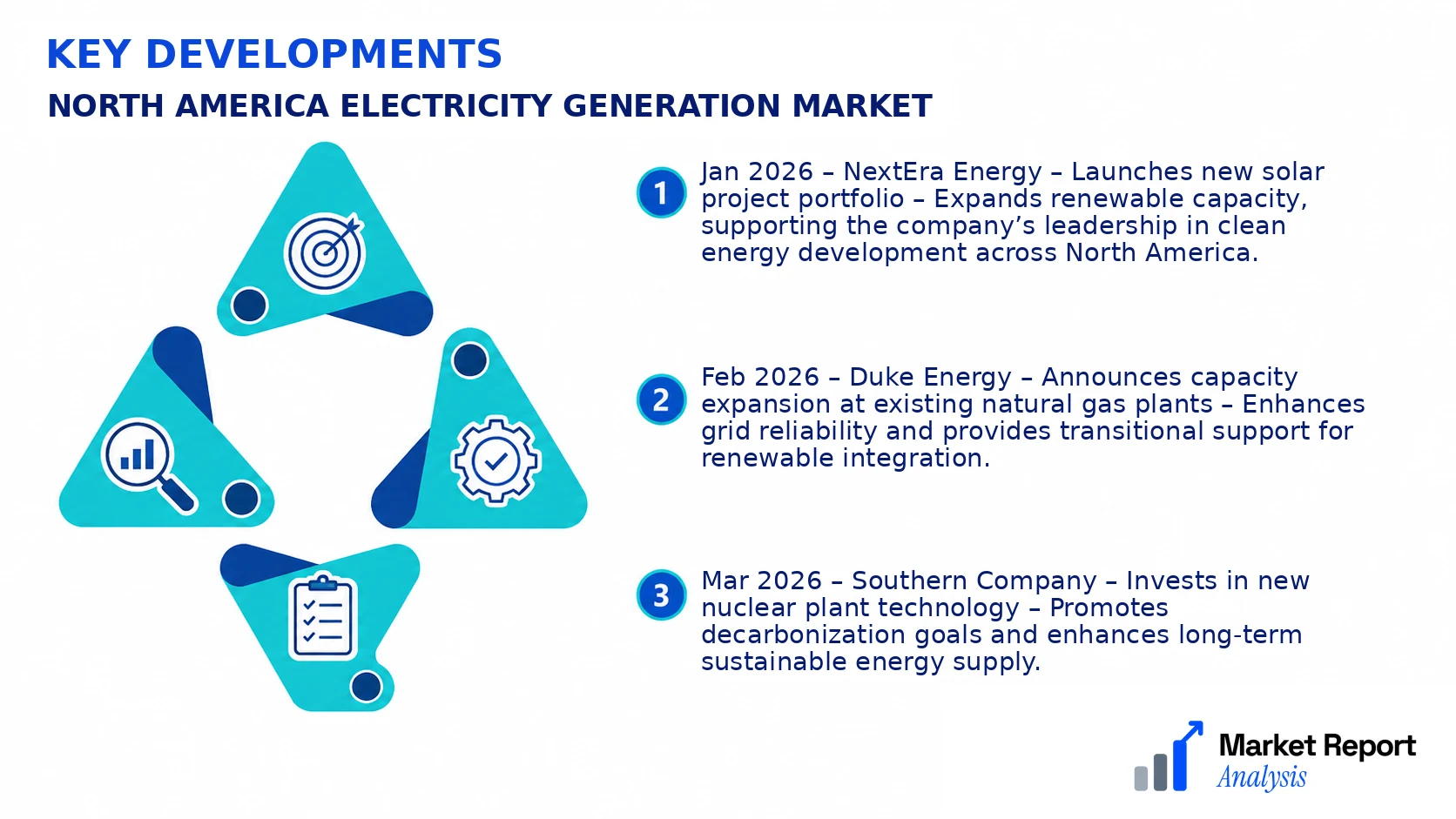
- Jan 2026 – NextEra Energy – Launches new solar project portfolio – Expands renewable capacity, supporting the company’s leadership in clean energy development across North America.
- Feb 2026 – Duke Energy – Announces capacity expansion at existing natural gas plants – Enhances grid reliability and provides transitional support for renewable integration.
- Mar 2026 – Southern Company – Invests in new nuclear plant technology – Promotes decarbonization goals and enhances long-term sustainable energy supply.
- Apr 2026 – Edison International – Forms alliance with tech firms for smart grid deployment – Accelerates grid modernization and enhances energy efficiency programs across service areas.
- May 2026 – Avangrid – Acquires renewable project developer – Strengthens its portfolio of wind and solar assets, reinforcing its position in renewable energy markets.
Frequently Asked Questions
What is the North America Electricity Generation Market?
The North America Electricity Generation Market encompasses the production of electric power through various energy sources across North America, including fossil fuels, renewables, and nuclear energy, serving residential, commercial, and industrial consumers with reliable electricity supply.
What is the current market size of North America Electricity Generation Market?
As of 2026, the market size is valued at approximately USD 400 Billion, driven by ongoing investments in infrastructure expansion, modernization, and a gradual transition toward cleaner energy sources to meet regulatory and consumer demands.
What factors are driving the North America Electricity Generation Market?
Key drivers include increasing demand for electricity, government policies promoting renewable energy, technological advancements in power generation, and a shift toward sustainable solutions. Additionally, energy security concerns and declining costs of renewables significantly contribute to market growth.
Which region dominates the North America Electricity Generation Market?
The United States dominates the market, accounting for a major share due to its extensive grid infrastructure, large-scale renewable projects, and significant investment in clean energy initiatives, followed by Canada and Mexico which are rapidly expanding their renewable capacities.
Which segment is expected to grow the fastest?
Renewable energy segments, especially solar and wind power, are projected to experience the fastest growth due to falling costs, favorable policies, and increasing environmental consciousness, with a CAGR of around 6.1% from 2026 to 2034.
Who are the leading companies operating in the North America Electricity Generation Market?
Top players include NextEra Energy, Dominion Energy, Pacific Gas and Electric Company, and Florida Power & Light. These companies are investing heavily in renewable projects and grid modernization to maintain market leadership and meet future energy demands.
Analyst Perspective
The North America electricity generation market is expected to mature further over the next decade, driven by a shift toward cleaner energy sources and regulatory incentives. Long-term, market growth will be shaped by technological advancing renewables, grid modernization, and energy storage innovations, creating opportunities for utility-scale projects and distributed generation initiatives. Investment focus is likely to favor lower-cost, high-efficiency solar, wind, and emerging green hydrogen technologies, supported by regional policies favoring decarbonization. Competitive intensity will remain high, with major utilities, technology providers, and new entrants competing on innovation, cost reduction, and strategic partnerships. North America's regional dynamics demonstrate considerable growth potential in the U.S. Northeast, California, and parts of Canada, where regulatory frameworks incentivize renewable adoption. Overall, sustained investment in smart grids, digital infrastructure, and renewable technologies will be crucial for long-term competitiveness, positioning North America as a global leader in clean energy transition amidst evolving environmental standards and market drivers.
