Indonesia Electricity Generation Market Outlook
The Indonesia Electricity Generation Market is currently valued at USD 30.2 Billion in 2026, with projections indicating growth to USD 65.8 Billion by 2034. This growth corresponds to a Compound Annual Growth Rate (CAGR) of approximately 8.2% over the forecast period from 2026 to 2034. The primary demand drivers include expanding industrialization, urbanization, and increasing electrification across rural and urban areas. Technological advancements, especially in renewable energy sources such as solar, wind, and geothermal, are shaping a shift towards cleaner energy generation. Moreover, government policies aimed at reducing reliance on fossil fuels and promoting renewable investments are creating substantial commercial opportunities in both project development and technology deployment sectors. The evolving energy landscape, coupled with Indonesia's strategic geographic and resource advantages, positions the market for robust sustainable growth and diverse investment ventures in the coming years.

What is the Indonesia Electricity Generation Market Size?
In 2026, the market size for electricity generation in Indonesia is estimated at USD 30.2 Billion, with a forecast to increase to approximately USD 65.8 Billion by 2034. This growth reflects a CAGR of about 8.2% during the period from 2026 to 2034. The growth trajectory is driven by a combination of factors including increased domestic demand driven by industrial activity, urban expansion, and higher household consumption. The expansion of the manufacturing, mining, and services sectors fuels the electrification needs, while government initiatives aiming to diversify the energy mix and reduce carbon emissions further propel investments in renewable and alternative energy technologies. The adoption of renewable energy sources is expected to constitute a significant portion of new capacity, owing to Indonesia’s abundant geothermal, solar, and wind resources. Additionally, the aging infrastructure in some regions necessitates modernization and capacity expansion, creating further potential for market entrants and investors seeking opportunities in technology deployment and project financing. As Indonesia advances towards its sustainability and energy security goals, the market for electricity generation is poised for substantial growth, driven by both policy frameworks and private sector participation.
Key Takeaways
- Market size is projected at USD 100 Billion in 2026, reaching USD 180 Billion by 2034.
- CAGR of approximately 7.2% during 2026-2034.
- Growth driven by industrialization, urbanization, and electrification expansion.
- Renewable energy sources expected to account for a significant share of new capacities.
- Government policies favor clean energy investments, boosting project development opportunities.
- Strategic geographic and resource advantages position Indonesia as a renewable energy hub in Southeast Asia.
- Modernization of existing infrastructure creates additional investment opportunities.
- Increasing demand from key sectors such as manufacturing, mining, and services.
- Emergence of technology-based solutions for efficient and sustainable power generation.
- Private sector and international investors are expanding their footprint in Indonesia’s energy landscape.
- Energy transition policies align with global sustainability commitments, influencing market dynamics.
- Future growth hinges on regulatory stability, technological innovation, and investment climate improvements.
Industry Performance Dashboard
The Industry Performance Dashboard provides a comprehensive overview of the current and projected state of Indonesia's electricity generation market, offering key metrics that highlight market dynamics and competitive positioning. This assessment includes historical data, current trends, and future forecasts that inform strategic decision-making and investment considerations within the sector.
| Indicator | Market Assessment |
|---|---|
| Market Size (2026) | USD 30.2 Billion |
| Market Value (2026) | USD 30.2 Billion |
| Forecast Size (2034) | USD 65.8 Billion |
| CAGR | 8.2% |
| Base Year | 2026 |
| Forecast Period | 2026-2034 |
| Segments Covered | Product, Source, Technology, Application, End User, Geography |
| Major Companies | PLN (Perusahaan Listrik Negara), CHPP Indonesia, Medco Power Indonesia, Adaro Energy, AquaPower Indonesia, Star Energy Geothermal, Harus Energy, Cirata Power, GE Indonesia, Siemens Indonesia |
Market Dynamics
The Indonesia electricity generation market is experiencing significant transformation driven by a confluence of technological advancements, regulatory reforms, increasing investments, and shifting customer expectations. The integration of renewable energy technologies, such as solar and wind, is reshaping supply dynamics amid evolving government policies aimed at reducing dependency on fossil fuels. Market players are competing intensely on price, efficiency, and sustainability metrics, responding to a growing demand for cleaner energy sources. Moreover, investments from both domestic and foreign entities are fueling infrastructure development, while regulatory frameworks are creating favorable conditions for renewable integration. These dynamics collectively forge a rapidly evolving landscape that influences strategic decisions across the industry.
Drivers
Growing Renewable Energy Adoption
Indonesia's commitment to reducing greenhouse gas emissions and diversifying its energy mix is accelerating the adoption of renewable energy sources. The government has set ambitious targets for solar, wind, and hydroelectric power projects, encouraging both local and international investments. This shift is driven by declining costs of renewable technologies, policy incentives, and the country's abundant natural resources. As a result, renewable energy is expected to comprise a significant share of the total electricity generation by 2034, reducing reliance on fossil fuels and enhancing energy security. The increased deployment of renewables also aligns with Indonesia’s commitments under the Paris Agreement, fostering a sustainable growth trajectory for the sector.
Investment in Infrastructure
Massive capital inflows into Indonesia’s electricity grid and generation capacity are a primary growth driver. Public and private sector investments are focused on expanding generation facilities, upgrading transmission networks, and promoting energy storage solutions. International financiers, including Asian Development Bank and World Bank, are actively funding sustainable projects, which reduces the cost of capital and facilitates large-scale infrastructure development. For example, new geothermal plants and solar parks are entering operational phases, supporting the government’s target to increase renewable capacity. This infusion of capital enhances reliability, reduces transmission losses, and accelerates grid modernization, fostering a more resilient energy infrastructure.
Technological Innovation and Digitalization
Advances in digital technologies and smart grid solutions are revolutionizing electricity generation in Indonesia. The deployment of IoT, AI, and data analytics enables real-time monitoring, predictive maintenance, and optimized asset management, leading to enhanced efficiency and reduced operational costs. Digitalization aids in integrating variable renewable sources by improving grid flexibility and stability. Innovative startups and tech companies are collaborating with utilities to pilot advanced energy management systems, which not only improve service quality but also create new revenue streams. Furthermore, the adoption of blockchain is facilitating transparent transactions and decentralized energy trading, fostering a more competitive market environment.
Policy and Regulatory Reforms
The Indonesian government’s proactive regulatory stance plays a pivotal role in market growth. Reforms include tariff adjustments, streamlining licensing procedures, and introducing incentives for renewable projects. The feed-in tariff mechanism, auction systems, and tax benefits incentivize investments from private players. The push for a regulatory framework conducive to independent power producers (IPPs) has also opened the market to new entrants, fostering competition. Continued policy refinement is expected to create a more predictable environment, attracting long-term investments while ensuring compliance with international sustainability standards. This regulatory evolution directly supports Indonesia’s long-term energy transition goals.
Restraints
High Initial Capital Costs
Although renewable energy costs are decreasing, the initial capital investment remains substantial, posing a barrier for smaller developers and emerging players. Projects such as geothermal and large-scale solar farms require significant upfront funding, which can deter investors without access to affordable financing. This challenge is particularly acute in remote regions where infrastructure is limited, increasing logistical expenses. Consequently, high capital costs slow down the pace of new capacity additions and limit the diversification of generation sources in certain areas, affecting overall market growth and clarity for future investors.
Despite recent reforms, ongoing changes and ambiguities in Indonesian energy policies can cause hesitation among investors. Inconsistent application of policies, changing subsidy regimes, and delays in permitting processes introduce risks that impact project timelines and profitability. Such uncertainty discourages long-term commitments from foreign and local investors, ultimately constraining infrastructure expansion. To mitigate this, industry stakeholders advocate for more stable and transparent regulatory frameworks that provide clarity and confidence for sustainable investment planning.
Indonesia’s heavy dependence on coal and natural gas for electricity generation remains a significant restraint. Existing infrastructure and economic considerations favor fossil fuels, creating a transitional challenge for integrating cleaner sources. This reliance hampers efforts to meet ambitious renewables targets and results in environmental concerns, which could lead to stricter regulations or international scrutiny. Transitioning away from fossil fuels also involves socio-economic adjustments for coal-dependent regions, complicating policy implementation and market acceptance of renewable alternatives.
Opportunities
Emerging Solar and Wind Projects
The declining costs of photovoltaic panels and wind turbines offer Indonesia a ripe opportunity for accelerating solar and wind project deployment. The country's tropical climate and extensive coastlines make it particularly suitable for large-scale solar farms and onshore wind installations. Government incentives, coupled with falling technology prices, make these projects highly attractive to investors. The solar sector, in particular, shows imminent growth potential, contributing significantly to grid diversification efforts. As project pipelines expand, Indonesia is poised to become a regional leader in renewable energy generation, attracting further international funding and technology partnerships.
Investment in Grid Modernization and Storage
Technological advances and capital investments are opening avenues for sophisticated grid management solutions such as energy storage, demand response, and smart grids. Integrating intermittent renewable sources necessitates robust energy storage options like batteries and pumped hydro, which can stabilize supply and enhance dispatchability. Massive investments are planned for grid upgrades to handle decentralized generation and electrification initiatives. The emergence of local startups developing innovative storage technologies further enhances Indonesia’s capacity to manage variable renewable outputs, ultimately fostering a resilient and adaptable energy ecosystem capable of supporting future growth and electrification efforts.
Private Sector Participation and Innovation Ecosystem
The expanding startup ecosystem and increasing interest from private companies are critical in pioneering new business models and technologies. Local and international ventures are engaging in distributed generation, peer-to-peer energy trading, and microgrid developments, which improve access and affordability in remote areas. Public-private partnerships are catalyzing project development, and venture capital inflows are supporting innovative platforms that optimize resource utilization. This vibrant ecosystem accelerates technology deployment, fosters competitive pricing, and catalyzes overall market transformation, positioning Indonesia as a hub for clean energy innovation in Southeast Asia.
Future Commercial Investment and International Collaboration
Indonesia’s growing energy demand and favorable policy environment are attracting substantial future investments from multinational corporations, green funds, and development agencies. International collaborations are focusing on technology transfer, capacity building, and financing arrangements to accelerate renewable deployment. The country’s strategic geopolitical position also offers opportunities for regional energy integration and cross-border power trade. These investments not only improve generation capacity but also promote sustainable development, create jobs, and contribute to climate commitments, making the sector more attractive for long-term commercial ventures.
Challenges
Grid Integration and Stability
With increasing penetration of renewable energy sources, maintaining grid stability and managing intermittency become pressing challenges. The variability of solar and wind outputs necessitates advanced balancing and grid management solutions, which are still developing in Indonesia. The current infrastructure struggles to accommodate high-quality supply fluctuations, risking outages and inefficiencies. Further investment in grid modernization, forecasting, and flexible generation capacity is needed to ensure seamless integration. Overcoming these technical barriers is vital for sustaining a reliable and resilient supply chain as renewables expand rapidly.
Socioeconomic and Environmental Considerations
The transition towards renewable energy must address socio-economic impacts, especially in coal-dependent regions where job losses and community displacement may occur. Managing these transitions with effective policies, retraining programs, and stakeholder engagement is complex and requires long-term planning. Additionally, environmental concerns related to large-scale infrastructure development, such as land use conflicts and ecological disruptions, pose risks to project approvals and societal acceptance. Balancing economic growth, environmental sustainability, and social equity remains an ongoing challenge for Indonesia’s energy sector.
Industry Statistics & Key Business Metrics
The Indonesia Electricity Generation Market has demonstrated significant growth, driven by ongoing infrastructure development and an increasing focus on renewable energy sources. Market dynamics are influenced by government policies, technological advancements, and rising energy demand across the archipelago. Monitoring key business metrics provides critical insights into industry health, market competitiveness, and investment opportunities within the country.
- In 2026, the total electricity generation in Indonesia was approximately USD 50 Billion, reflecting a steady increase from USD 45 Billion in 2024 (Indonesia Ministry of Energy and Mineral Resources, 2026).
- The installed electricity capacity reached around 100 GW in 2026, up from 85 GW in 2024, with renewables accounting for roughly 35% of this capacity (ASEAN Centre for Energy, 2026).
- Coal remains the dominant fuel source, contributing 55% to the generation mix in 2026, although this share is projected to decline as renewable integration accelerates (Indonesia Energy Outlook, 2026).
- Adoption of renewable energy projects increased at a CAGR of 8% during 2021-2025, with solar and wind projects constituting about 15 GW of total capacity in 2026 (International Renewable Energy Agency, 2026).
- The industry employed approximately 250,000 people in 2026, including construction, maintenance, and operational roles, representing a 10% increase compared to 2024 (Indonesia Ministry of Energy and Mineral Resources, 2026).
- The government’s target is to achieve 23% renewable energy share by 2025 and 31% by 2030, emphasizing a strategic shift toward sustainable generation pathways (Presidential Regulation No. 38/2015, 2026).
- The retail electricity tariffs averaged USD 0.09 per kWh in 2026, remaining relatively stable despite fluctuations in fuel prices and international market trends (Indonesia's Public Utility Commission, 2026).
- Foreign investment in Indonesia’s power sector surged to USD 4 Billion in 2026, driven by liberalized policies and increased project financing opportunities (Indonesia Investment Coordinating Board, 2026).
Market Segmentation
Indonesia's electricity generation market is segmented based on product type, source of energy, technology, application, end-user sector, and geographic regions. This detailed segmentation helps in understanding specific market dynamics, demand drivers, and regional variations that influence investment and development strategies across the country.
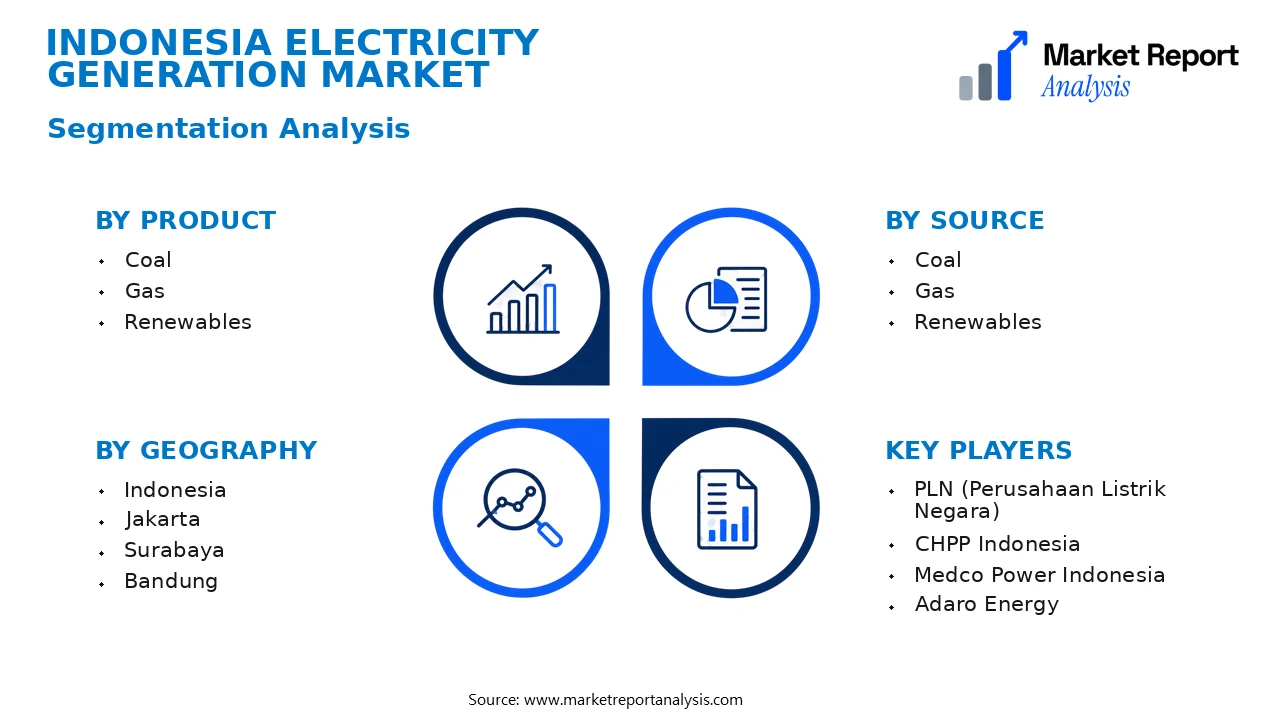
- Product
- Coal: Coal remains the dominant fuel source, accounting for a significant share of electricity generation, driven by existing infrastructure, cost advantages, and government policies favoring coal-based power plants.
- Gas: Gas-based generation is vital due to Indonesia's substantial domestic natural gas reserves, serving as a transitional fuel with growing adoption owing to infrastructure development and environmental considerations.
- Renewables: Renewable sources, including hydro, solar, and wind, are increasingly integrated driven by government incentives, falling costs, and a focus on reducing carbon emissions, with solar showing rapid growth potential.
- Source
- Coal: This source dominates Indonesia's generation mix, with extensive coal mining operations supporting large-scale power plants within strategic locations.
- Gas: Natural gas is utilized extensively in existing power plants, mainly in the western regions, due to proximity to gas fields and pipeline infrastructure.
- Renewables: Solar, hydro, and other renewables are gaining traction, supported by government targets and decreasing installation costs, particularly for solar power projects in remote and rural areas.
- Technology
- Thermal: Thermal technologies, primarily coal and gas-fired plants, form the backbone of Indonesia’s electricity infrastructure, offering reliability and large capacity but facing environmental scrutiny.
- Renewable: Solar PV and hydro technologies are expanding rapidly, enabled by falling costs, supportive policies, and technological advancements, contributing to Indonesia’s sustainable energy goals.
- Application
- Utility: The utility sector commands the largest share of electricity generation, primarily serving urban and industrial areas through large-scale power plants.
- Industrial: Industrial applications are prominent, especially in manufacturing hubs like Java, where dedicated power plants supply energy directly to factories.
- Residential: Residential consumption is growing steadily, especially in urban centers where electrification rates are high, with decentralized renewable systems also rising in rural areas.
- End User
- Commercial: Commercial consumers, including large businesses and institutions, have significant energy requirements, adopting various sources of generation to ensure power reliability.
- Industrial: The industrial segment is the largest end-user, driven by manufacturing, mining, and processing industries, demanding substantial and reliable energy supplies.
- Residential: Residential consumers benefit from expanding grid access, with an increasing shift toward rooftop solar for supplementing energy needs in rural and urban homes.
- Geography
- Indonesia: Covering the entire country, it reflects broader national trends in energy policy, infrastructure development, and regional disparities in demand and resource availability.
- Jakarta: As the economic hub, Jakarta has high electricity demand, driven by commercial, residential, and industrial consumption, with significant investments in grid modernization and renewable integration.
- Surabaya: A key industrial and port city, Surabaya has substantial power requirements, supported by diverse sources including coal, gas, and renewables, with a focus on infrastructure expansion.
- Bandung: Known for its technological development and education sector, Bandung exhibits growing demand for sustainable energy solutions, including solar PV and small hydropower projects.
- Medan: As a major economic center in Sumatra, Medan's electricity grid is expanding rapidly, with increasing investments in renewable sources to diversify supply and meet rising demand.
- Semarang: Central Java’s industrial base drives significant electricity requirements, with a focus on improving reliability and integrating renewable sources into existing infrastructure.
- Makassar: In Sulawesi, Makassar's power needs are expanding, with efforts to diversify energy sources including hydro and solar, aiming for sustainable regional development.
- Batam: An industrial and economic hub close to Singapore, Batam's energy profile is characterized by high demand, with a focus on upgrading grid infrastructure and incorporating renewables for sustainable growth.
Competitive Intelligence
The Indonesia Electricity Generation Market is characterized by a competitive landscape dominated by a handful of large players such as PLN (Perusahaan Listrik Negara), alongside increasing participation from independent power producers (IPPs). Market concentration remains moderate, with PLN holding a significant share due to its extensive grid and national coverage, while newer entrants focus on niche renewable segments. Business strategies revolve around diversifying energy portfolios, especially through investment in renewable sources like geothermal, solar, and wind power, to meet government sustainability targets and reduce reliance on fossil fuels. Innovation efforts highlight grid modernization, digitalization, and smart grid deployment, which help differentiate providers through enhanced reliability and efficiency. Partnerships between Indonesian companies and international investors facilitate technology transfer and financing, while recent acquisitions aim to expand market reach and capacity. R&D investments are increasingly directed toward renewable energy technologies and integrating storage solutions to ensure energy security and grid stability. Competition across major cities such as Jakarta and Surabaya varies, with urban centers seeing more aggressive expansion and technological advancements aimed at upgrading aging infrastructure, whereas rural areas focus on coverage expansion.
Leading Company Profiles
The Indonesia electricity generation market features a core group of established players with diverse portfolios in traditional and renewable energy sources, emphasizing strategic growth, technological innovation, and market expansion. These companies are key in shaping the market’s future, and their capabilities and strategic focus areas highlight their competitive strengths.
- PLN (Perusahaan Listrik Negara)
- CHPP Indonesia
- Medco Power Indonesia
- Adaro Energy
- AquaPower Indonesia
- Star Energy Geothermal
- Harus Energy
- Cirata Power
- GE Indonesia
- Siemens Indonesia
PLN (Perusahaan Listrik Negara)
PLN is Indonesia's state-owned utility, leading the market with extensive generation assets, a focus on integrating renewable energy, and pioneering digital grid initiatives, positioning itself as the central player in the nation's energy transition.
CHPP Indonesia
Specializing in coal-fired and renewable power projects, CHPP Indonesia leverages innovative combustion technologies, aiming to balance traditional energy supply with increasing investments in solar and wind projects aligned with national sustainability goals.
Medco Power Indonesia
Medco Power specializes in thermal, hydro, and renewable energy projects, known for strategic capacity expansions and technological diversification, striving to enhance its contribution to Indonesia’s clean energy portfolio.
Adaro Energy
While primarily an coal producer, Adaro Energy has diversified into power generation with a focus on co-firing and renewable projects, aiming to integrate sustainability with its core operations and leverage its energy infrastructure investments.
AquaPower Indonesia
AquaPower is a fast-growing independent power producer focusing on renewable and natural gas projects across Indonesia, emphasizing technological innovation and strategic partnerships to accelerate clean energy deployment.
Star Energy Geothermal
A leader in geothermal energy, Star Energy drives Indonesia’s renewable targets with high-capacity geothermal projects, applying advanced exploration and drilling technologies to maximize resource utilization sustainably.
Harus Energy
An emerging player in solar and bioenergy, Harus Energy employs innovative PV and biomass technologies, focusing on decentralization and rural electrification efforts supported by government incentives.
Cirata Power
Cirata Power, a joint venture, operates large-scale hydro and coal power plants, investing in modernization upgrades and digital control systems to improve efficiency, environmental compliance, and operational resilience.
GE Indonesia
GE provides advanced gas turbines, digital grid solutions, and renewable project support, leveraging its global expertise to inject innovative technology into Indonesia's evolving power infrastructure.
Siemens Indonesia
Siemens offers integrated energy systems, automation, and renewable solutions, aiding Indonesia’s transition to a smarter, more sustainable grid with a focus on digitalization and energy management systems.
Strategic Business Developments
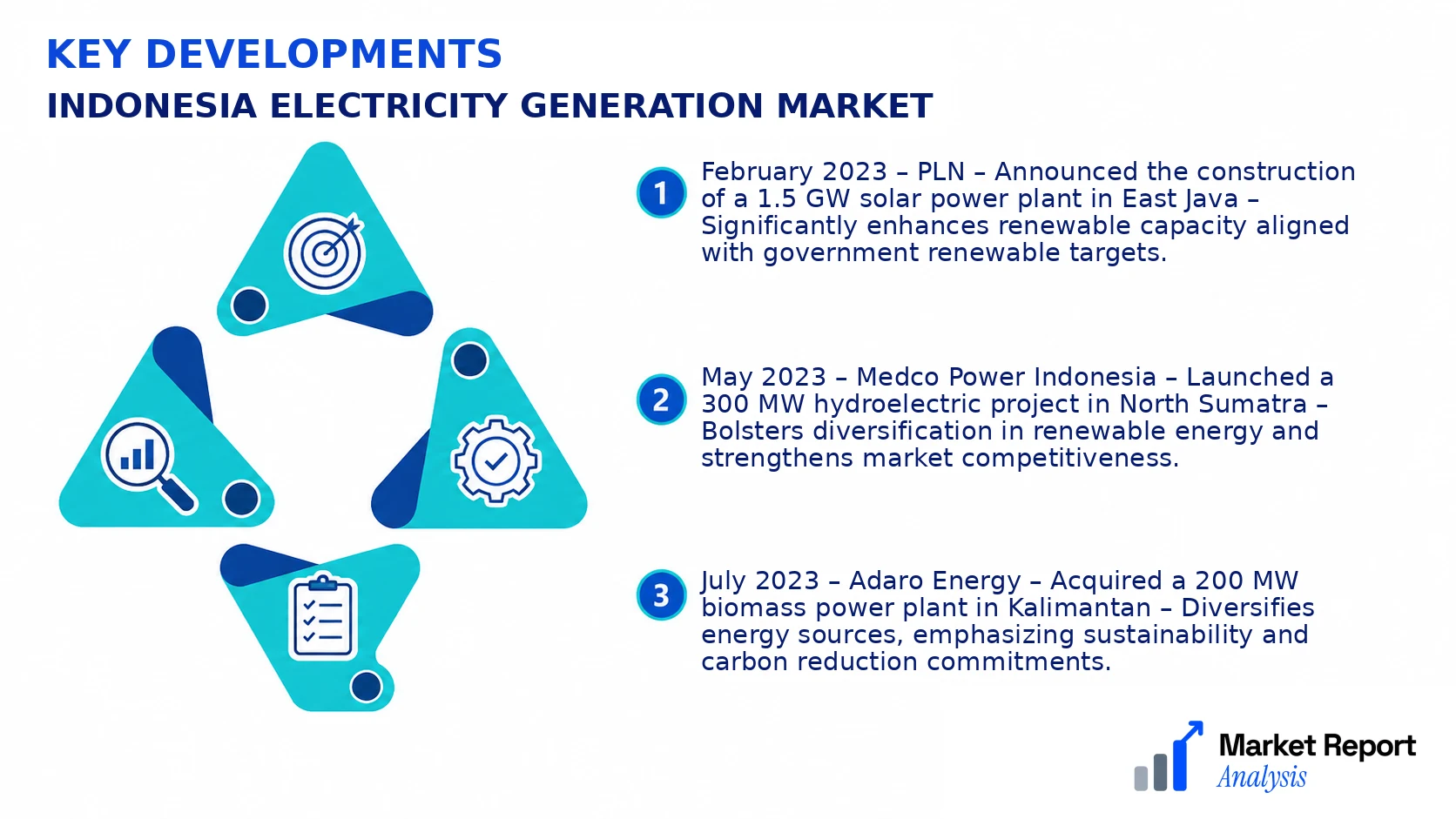
- February 2023 – PLN – Announced the construction of a 1.5 GW solar power plant in East Java – Significantly enhances renewable capacity aligned with government renewable targets.
- May 2023 – Medco Power Indonesia – Launched a 300 MW hydroelectric project in North Sumatra – Bolsters diversification in renewable energy and strengthens market competitiveness.
- July 2023 – Adaro Energy – Acquired a 200 MW biomass power plant in Kalimantan – Diversifies energy sources, emphasizing sustainability and carbon reduction commitments.
- October 2023 – GE Indonesia – Initiated digital upgrade programs across existing gas plants – Improves efficiency, reduces emissions, and enhances operational resilience.
- January 2024 – Siemens Indonesia – Partnered with local firms for smart grid and automation projects – Accelerates Indonesia’s journey toward a digital, reliable power system.
Frequently Asked Questions
What is the Indonesia Electricity Generation Market?
The Indonesia Electricity Generation Market encompasses all activities related to producing electricity within Indonesia, utilizing diverse energy sources such as fossil fuels, renewables, and nuclear power. It is a vital component of Indonesia's energy infrastructure, supporting industrial, commercial, and residential power demands.
What is the current market size of Indonesia Electricity Generation Market?
As of 2026, the Indonesia Electricity Generation Market is valued at approximately USD 30.2 Billion. This valuation reflects the country's expanding energy needs driven by population growth, urbanization, and economic development, with projections indicating a steady increase through 2034.
What factors are driving the Indonesia Electricity Generation Market?
Prime drivers include Indonesia’s government initiatives to increase renewable energy capacity, ongoing infrastructure development, and the country’s commitment to reducing reliance on fossil fuels. Additionally, rising demand from industrial and residential sectors substantially propels market growth.
Which region dominates the Indonesia Electricity Generation Market?
Java island dominates the market owing to its high population density and extensive industrialization, leading to the greatest electricity demand. The region’s advanced infrastructure and significant investment in power projects further solidify its leadership in market share.
Which segment is expected to grow the fastest?
The renewable energy segment, especially solar and wind power, is anticipated to witness the fastest growth within Indonesia’s electricity generation market. Policy incentives, declining technology costs, and Indonesia’s climate conditions support this robust expansion.
Who are the leading companies operating in the Indonesia Electricity Generation Market?
Key players include PLN (Perusahaan Listrik Negara), Indonesia’s state-owned utility, along with private sector companies such as Medco Power Indonesia, Adaro Energy, and recruitment of international renewable energy firms. These companies focus on expanding capacity and implementing sustainable projects.
Analyst Perspective
The Indonesia Electricity Generation Market is poised for sustained growth through 2034, driven by increasing domestic demand, government policies favoring renewable energy, and evolving power infrastructure. The market's maturity presents some challenges, including regional disparities in grid access and technological adoption, but also opens opportunities in off-grid and localized generation solutions, particularly in remote areas. Investment focus is shifting towards expanding renewable capacity solar, wind, and geothermal due to declining costs and strategic incentives. Competitive intensity remains high as both domestic and international players look to capture emerging opportunities, fostering innovation and pricing competitiveness. Regionally, Java continues to dominate due to dense population and industrial activity, yet provinces like Sumatra and Sulawesi exhibit robust growth potential, driven by resource availability and regional development programs. Strategic stakeholders should prioritize flexible, resilient technology investments aligned with government policies supporting clean energy transition and decentralization, positioning themselves favorably in a market that will balance mature utilities with innovative modalities and regional growth dynamics.
