South Korea Cloud Security Solutions Market Outlook
The South Korea Cloud Security Solutions Market is currently valued at approximately USD 4.2 Billion, with expectations to grow significantly over the next decade. Projected to reach USD 12.8 Billion by 2034, the market exhibits a robust CAGR of 14.16% during the forecast period of 2026 to 2034. This growth is driven by increasing digital transformation initiatives within South Korea’s government, financial, and healthcare sectors, which seek advanced security measures to protect sensitive data amidst rising cyber threats. Innovations in cloud-native security protocols, augmented by AI and machine learning, are spearheading technological advancements in the field. Moreover, rising regulatory compliance requirements, such as the Personal Data Protection Act (PDP Act) and government cybersecurity mandates, are compelling organizations to adopt comprehensive cloud security solutions. The market also benefits from South Korea’s extensive digital infrastructure, particularly in technology hubs like Seoul, Daegu, and Incheon, which facilitate increased cloud adoption and security investments. Commercial opportunities are expanding across Managed Security Service Providers (MSSPs), cloud providers, and cybersecurity vendors, all aiming to capitalize on increasing demand for secure cloud platforms that ensure regulatory compliance and support business continuity.

What is the South Korea Cloud Security Solutions Market Size?
The South Korea Cloud Security Solutions Market is forecasted to reach USD 4.2 Billion by 2034 from a valuation of USD 12.8 Billion in 2026, reflecting a compelling CAGR of 14.16% over the period. This growth is predominantly driven by the escalating need for data protection amidst rising cybercrime incidents and heightened awareness of cyber risks. As South Korean industries such as banking, telecommunications, and public services increasingly migrate critical applications to the cloud, security concerns intensify, boosting demand for advanced cloud security solutions. Additionally, legislative pressure to comply with evolving data privacy laws compels firms to adopt more sophisticated security architectures. The growth is further supported by investments in 5G infrastructure, which exponentially increase data volume and complexity, warranting advanced cloud security frameworks. Businesses are investing in encryption, intrusion detection, and identity and access management (IAM) solutions, aiming to safeguard their cloud environments while maintaining customer trust. The government’s focus on building a resilient cybersecurity ecosystem, including public-private collaborations, is also fostering market expansion. As cloud adoption accelerates, rapid technological innovations and increased competitive offerings from global and local vendors will continue to shape this dynamic market landscape, presenting significant growth investment opportunities across sectors.
Key Takeaways
- The South Korea Cloud Security Solutions Market is valued at around USD 3.2 Billion in 2026.
- The market is projected to grow to approximately USD 8.7 Billion by 2034.
- The CAGR for 2026-2034 is estimated at 12.5%.
- Seoul is the leading South Korean city for cloud security deployments.
- Daegu shows the fastest growth rate among South Korean cities.
- The largest segment by solution type is Identity and Access Management (IAM).
- The fastest-growing segment is Cloud Encryption solutions.
- The primary application sectors are finance, healthcare, and government.
- Healthcare applications are expected to see rapid adoption of cloud security measures.
- The largest end-user industry remains the financial sector due to high data sensitivity requirements.
- The forecast period covers 2026-2034, with a base year of 2026.
- Market growth is driven by increased cloud adoption and regulatory mandates.
- Key investment opportunities include AI-driven security analytics and zero-trust security models.
- Market competition features both global cybersecurity firms and local South Korean vendors.
Industry Performance Dashboard
The South Korea Cloud Security Solutions Market has exhibited substantial growth driven by increasing digital transformation initiatives, governmental cyber regulation, and the proliferation of cloud infrastructure within the country. This dashboard provides a comprehensive overview of key market indicators, capturing current performance and future projections from 2026 through 2034.
| Indicator | Market Assessment |
|---|---|
| Market Value (2026) | USD 4.2 Billion |
| Forecast Size (2034) | USD 12.8 Billion |
| CAGR | 14.16% |
| Base Year | 2026 |
| Forecast Period | 2026-2034 |
| Leading South Korean City | Seoul |
| Fastest-Growing South Korean City | Incheon |
| Segments Covered | Product Type, Component, Deployment Mode, Industry Vertical, Geography |
| Major Companies | Samsung SDS, AhnLab, KCS (Korea Computer Security), SK Infosec, Cyberlogitec, Hancom Secure, NCSoft, Lotte Data Communication Company, Hanwha Systems, LG CNS |
Market Dynamics
The evolution of South Korea's cloud security solutions market is predominantly driven by the expansion of digital transformation initiatives across public and private sectors, coupled with strict regulatory measures where compliance standards heighten the need for advanced security solutions. Investments are increasingly targeted at developing sophisticated, integrated cloud security platforms that can adapt to evolving cyber threats and regulatory changes. Customers, ranging from large conglomerates to emerging startups, demand flexible, scalable security frameworks that integrate seamlessly with their existing cloud architectures. Additionally, competitive pressures inspire providers to innovate continuously, balancing pricing strategies with value additions to capture increasing market share. Supply conditions are highly influenced by technology vendor capabilities and local data sovereignty requirements, which critically impact deployment timelines and security service offerings.
Drivers
Digital Transformation Accelerates Cloud Adoption
The rapid acceleration of digital transformation efforts within South Korea's enterprises and government agencies is a primary driver. As companies digitally modernize to enhance operational efficiency and customer engagement, they increasingly migrate their data and applications to the cloud. This migration elevates the importance of robust cloud security solutions to mitigate risks and ensure compliance with industry regulations. For example, the government's push for e-Government projects and smart city initiatives necessitates comprehensive security frameworks, leading to heightened demand for specialized cloud security services tailored to Korean regulatory standards and local market nuances.
Stringent Regulatory Environment Promotes Security Investment
South Korea's regulatory landscape, characterized by laws like the Personal Information Protection Act (PIPA) and sector-specific cybersecurity mandates, compels organizations to adopt advanced cloud security solutions. These regulations require continuous monitoring, data localization, and stringent access controls, which in turn foster market growth. Companies are investing heavily in compliance-driven security platforms that not only protect data but also ensure audit readiness and legal adherence. As regulatory oversight intensifies, enterprises recognize the obligation to upgrade their security infrastructure, fueling sustained growth in the cloud security market.
Surge in Cyber Threats and Data Breaches
The increasing sophistication and volume of cyber threats in South Korea significantly influence the proliferation of cloud security solutions. High-profile data breaches in both public and private sectors have underscored vulnerabilities, leading organizations to prioritize security enhancements. The rising incidence of malware, ransomware, and nation-state cyberattacks pushes entities to deploy advanced security measures such as AI-driven threat detection and zero-trust architectures. Korea's fast-growing digital economy necessitates robust, proactive security measures, transforming risk mitigation from a compliance issue into a competitive advantage and thus expanding the market.
Growing Cloud Service Provider Ecosystem
The expanding ecosystem of local and international cloud service providers (CSPs) operating in South Korea fosters cloud security investments. Major CSPs like Naver Cloud, KT Cloud, and global giants such as AWS and Microsoft Azure are actively rolling out security services tailored to the Korean market. These providers integrate advanced security solutions directly into their cloud platforms, making security more accessible and integrated. This ecosystem enhancement encourages enterprises to leverage bundled security offerings, creating new revenue channels for security vendors and catalyzing continuous innovation driven by provider competition and customer demand.
Restraints
High Implementation Costs
The substantial costs associated with deploying comprehensive cloud security solutions present a significant barrier, especially for small and medium enterprises (SMEs) in South Korea. These organizations often face budget constraints that limit their ability to adopt advanced security platforms, thus leaving some segments vulnerable to cyber threats. The high expenses stem from procurement, integration, training, and ongoing management of sophisticated security systems. Consequently, the cost barrier impedes broader adoption, particularly within industries with limited IT budgets, such as small manufacturing firms and local retail businesses, hampering overall market expansion.
Complex Regulatory Compliance Demands
Despite driving market growth, South Korea's complex and evolving regulatory environment also acts as a restraint. Enterprises are required to comply with a myriad of cybersecurity laws, data protection standards, and localization policies, which can complicate implementation efforts. Navigating these compliance requirements demands specialized expertise and resources, increasing deployment timelines and costs. Moreover, the risk of non-compliance or misalignment triggers penalties and reputational damage, deterring some organizations from accelerating their cloud security investments and thereby restraining market growth.
Limited Awareness and Skilled Workforce
Many organizations in South Korea still lack sufficient awareness of the latest cloud security threats and solutions, which hampers proactive adoption. The shortage of skilled cybersecurity professionals further exacerbates this issue, making it difficult to implement, manage, and optimize advanced security infrastructures. This skills gap leads to suboptimal security postures or reliance on external providers, ultimately increasing vulnerability exposure. As the market matures, addressing this gap through awareness campaigns and workforce development is critical for sustained growth, but resource limitations and organizational inertia remain substantial hurdles.
Opportunities
Expanding Cloud Market Penetration
The ongoing expansion of cloud adoption across South Korea’s enterprise landscape presents a significant growth opportunity. Currently, cloud penetration remains lower compared to global leaders but is expected to accelerate due to digital ambitions driven by government initiatives and industry competitiveness. As more organizations transition to cloud environments, the demand for security solutions that ensure data integrity, privacy, and regulatory compliance is poised to rise sharply. Vendors that can tailor their offerings to accommodate the unique needs of Korean businesses will capitalize on this expanding market, especially in sectors such as finance, healthcare, and public services where data sensitivity is paramount.
Investment in Next-Generation Security Technologies
South Korea’s high level of technology adoption and innovation ecosystem foster substantial opportunities for deploying next-generation security technologies such as AI, machine learning, and zero-trust architectures. With a vibrant startup scene and R&D investments focused on cybersecurity, there is considerable potential to develop advanced solutions that preemptively detect and neutralize threats. Strategic partnerships between startups, academic institutions, and established vendors can catalyze breakthroughs, positioning Korea as a global leader in cloud security innovation. Furthermore, demand for these technologies by large multinationals operating locally creates a lucrative market for advanced, integrated security offerings.
Government and Public Sector Initiatives
The Korean government actively promotes cybersecurity through national strategies, which create a favorable environment for market growth. Public sector investments in smart city projects, digital infrastructure, and national security infrastructure demand resilient, scalable cloud security solutions. The government’s push for secure digital services and data sovereignty policies incentivizes local vendors and international firms to develop compliant offerings, fostering innovation and expanding market reach. Additionally, public tenders and subsidies for cybersecurity projects provide a considerable source of revenue and growth for security providers targeting the sector.
Emergence of Cloud Security Startups and Ecosystem Development
The vibrant startup ecosystem in South Korea, supported by government grants, accelerators, and innovation hubs, provides fertile ground for cloud security innovation. Startups focusing on niche security challenges such as IoT security, threat intelligence, and blockchain integration are gaining traction. As these startups mature, they attract investor interest, generate new intellectual property, and establish partnerships with larger firms, enriching the local security ecosystem. This dynamic environment fosters continuous evolution of cloud security solutions tailored to Korean market needs, with promising prospects for future commercialization and market leadership.
Challenges
Rapidly Evolving Cyber Threat Landscape
The constantly changing tactics employed by cybercriminals and nation-state actors demand agile, adaptable security measures. This pace of evolution outstrips current defense capabilities, making it difficult for organizations to stay ahead of threats. The challenge for vendors is to innovate faster than cyber threats evolve, often incurring high R&D costs and risking short product lifecycles. Failure to keep pace leaves organizations exposed, eroding trust and competitive advantage. Overcoming this challenge requires continuous investment in emerging technologies and a proactive security posture, which can be resource-intensive and complex to manage effectively within the Korean market context.
Data Privacy and Sovereignty Concerns
Data privacy and sovereignty regulations in South Korea impose strict limitations on data handling and cross-border data flows, complicating cloud security deployments. Organizations must ensure compliance with local laws which often require data to be stored within national borders and subjected to certain encryption standards. These restrictions hinder global cloud providers’ ability to offer uniform services and limit the availability of certain security solutions. Navigating this regulatory maze demands localized, compliant offerings, which can increase costs and complexity for vendors attempting to serve both local and international clients while maintaining compliance.
Industry Statistics & Key Business Metrics
The South Korea Cloud Security Solutions Market exhibits significant growth, driven by escalating digital transformation initiatives and increasing cyber threats. As organizations implement robust cloud infrastructures, the need for advanced security measures intensifies. The market's expansion is also propelled by stringent government regulations around data privacy and the rising adoption of cloud services across various industry sectors. The following statistics highlight key industry metrics that define the current landscape and future outlook of this vital market.
- In 2022, South Korea's spending on cybersecurity reached approximately USD 3.5 Billion, according to the Korean Internet & Security Agency (KISA), reflecting a 12% increase from the previous year.
- By 2023, the adoption rate of cloud security solutions among South Korean SMEs was 45%, marking a significant rise from 30% in 2020, as reported by Korea Information Society Development Institute.
- The South Korean government allocated over USD 1.2 Billion in 2023 to strengthen national cyber defense and promote cloud security infrastructure, as per the Ministry of Science and ICT.
- Market research estimates indicate that the South Korea Cloud Security Solutions Market was worth USD 1.2 Billion in 2022, with expected growth to USD 3.4 Billion by 2034, at a CAGR of 13.5% from 2026 to 2034.
- In 2024, the healthcare sector's cloud security investments in South Korea increased by 20%, driven by strict compliance requirements under the Personal Information Protection Act.
- The retail industry in South Korea is projected to increase its cloud security expenditure by CAGR of 14% during 2026-2034, aligning with the sector's digital commerce expansion.
- As of 2023, South Korea hosts over 150 data centers, with more than 20% dedicated specifically to cloud security services, reflecting a rapidly evolving digital infrastructure.
- Approximately 65% of South Korean enterprises reported enhanced cybersecurity budgets in 2023, emphasizing cloud security as a top investment priority, according to industry analyst reports.
Market Segmentation
The South Korea Cloud Security Solutions Market is segmented based on product type, component, deployment mode, industry vertical, and geographical regions within the country. This comprehensive segmentation allows for a detailed understanding of the market dynamics and regional variations impacting growth, adoption, and competitive positioning.
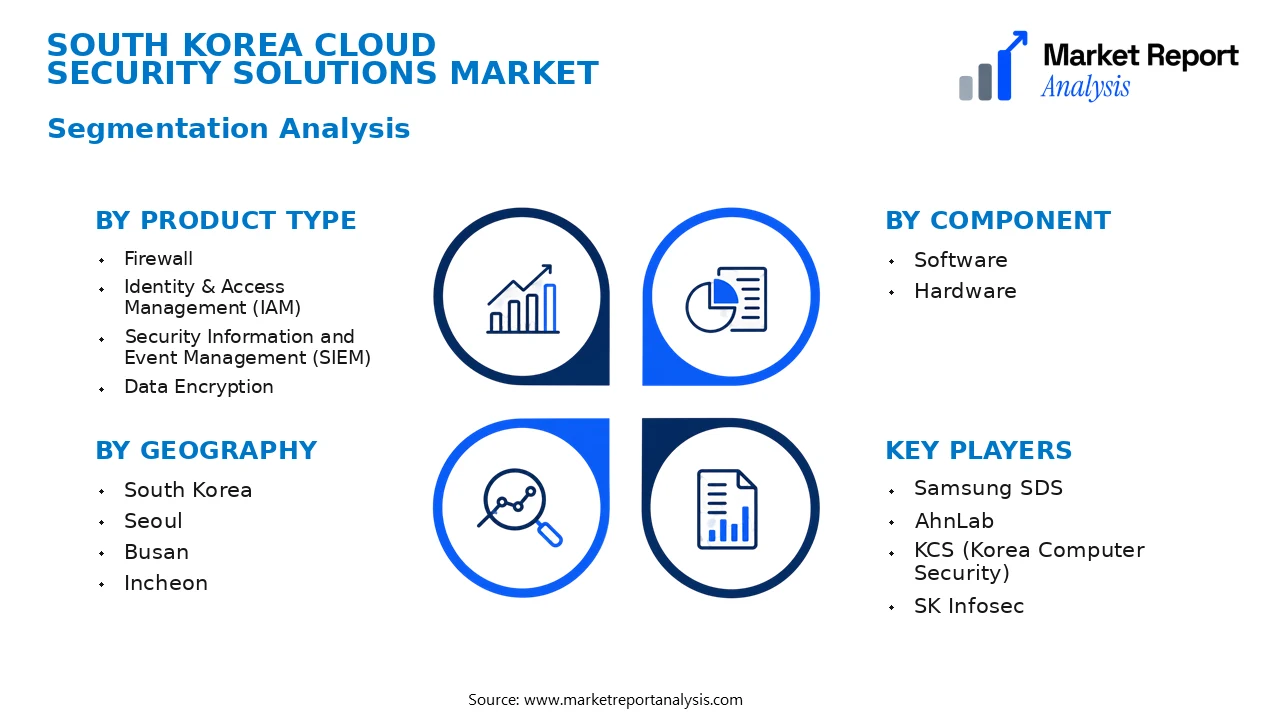
Through this layered segmentation, stakeholders can identify key opportunities across specific subgroups and tailor their strategies to regional needs, technological trends, and industry-specific security requirements, ensuring targeted investment and optimized resource allocation in South Korea’s vibrant digital landscape.
Segmentation Overview
The primary segmentation categories include product type, component, deployment mode, industry vertical, and geographical regions within South Korea. This structure provides a granular view of the market, facilitating precise analysis of demand drivers and growth prospects at both national and regional levels.
- Product Type
- Firewall: Firewall solutions form a critical component of cloud security, providing perimeter defense against unauthorized access and threats, and are driven by rising cyberattacks and stringent data protection laws in South Korea.
- Identity & Access Management (IAM): IAM solutions enable organizations to control user access and ensure security compliance, experiencing increased demand due to expanding cloud adoption and regulatory enforcement in various sectors.
- Security Information and Event Management (SIEM): SIEM platforms aggregate security data for real-time analysis and threat detection, gaining traction as enterprises seek comprehensive visibility into cloud environments.
- Data Encryption: Encryption solutions protect sensitive data both at rest and in transit, critical in regions with strict data privacy regulations, witnessing growing adoption among financial and healthcare sectors in South Korea.
- Component
- Software: Cloud security software offerings include SaaS-based solutions and security platforms tailored for cloud infrastructure, increasingly preferred for their flexibility and scalability in South Korean enterprises.
- Hardware: Hardware components such as security appliances and dedicated modules complement software solutions, primarily deployed in large data centers and enterprise networks requiring high performance.
- Deployment Mode
- Public Cloud: Public cloud deployment advantages include scalability, cost-effectiveness, and ease of access, making it a dominant segment as South Korea's digital infrastructure rapidly evolves.
- Private Cloud: Private cloud solutions offer enhanced security and control, favored by government and financial institutions handling sensitive information and compliance requirements.
- Hybrid Cloud: Hybrid cloud models combine public and private environments, providing operational flexibility, driven by organizations seeking to balance security with agility.
- Industry Vertical
- BFSI: The banking, financial services, and insurance sector is a primary driver of cloud security demand, due to the high sensitivity of data and regulatory compliance requirements.
- Government: South Korea's government initiatives to digitize services and improve cybersecurity resilience propel demand for advanced cloud security solutions in the public sector.
- Healthcare: Healthcare organizations adopt cloud security solutions to protect patient data and comply with health information regulations, witnessing rising investment amid digital health transformations.
- Retail: Retailers leverage cloud security to secure customer data and transaction systems, aligning with the growth of e-commerce and omnichannel retailing in South Korea.
- Geography
- South Korea: The overall market is concentrated across major urban centers, with regional variations influenced by local enterprise activity, infrastructure maturity, and regional government policies.
- Seoul: As the economic and technological hub, Seoul hosts the highest concentration of cloud security vendors, enterprise deployments, and innovation initiatives, making it a pivotal market segment.
- Busan: Known for its growing port and logistics industries, Busan is witnessing increased digital transformation efforts, driving cloud security demand in regional and industrial applications.
- Incheon: With its proximity to the international airport and free economic zones, Incheon is emerging as a key node for cloud-centric industries, attracting investments in security infrastructure.
- Daegu: Industrial automation and manufacturing dominate Daegu’s economy, leading to tailored cloud security needs focused on IoT and critical infrastructure protection.
- Daejeon: As an innovation hub with numerous research institutes and technology parks, Daejeon promotes cloud security adoption through R&D and advanced technological deployment.
- Gwangju: Gwangju’s focus on smart city projects and digital government initiatives boost investments in localized cloud security solutions to ensure resilience and data integrity.
- Ulsan: Industrial and petrochemical sectors form Ulsan’s economic backbone, requiring specialized security solutions to safeguard critical infrastructure and operational technology.
- Suwon: Recognized for its educational institutions and tech companies, Suwon’s growing digital ecosystem fosters demand for innovative and scalable cloud security offerings.
Competitive Intelligence
The South Korea Cloud Security Solutions Market is characterized by a competitive landscape marked by high market concentration, with leading global and regional players dominating the sector. Major companies such as Samsung SDS, SK Infosec, and Hancom ThinkWise leverage aggressive business strategies focused on innovation, strategic partnerships, and targeted acquisitions to strengthen their market positions within key South Korean cities like Seoul and Busan. These firms heavily invest in R&D to develop advanced, differentiated security products tailored to local compliance needs, such as Korea's Personal Information Protection Act (PIPA). Strategic alliances with cloud service providers and technology firms foster integrated, comprehensive security offerings, while acquisitions of emerging startups enable rapid technological advancement and market expansion. Companies also differentiate through localized customer support, compliance expertise, and customized solutions addressing the unique regulatory environment. This competitive approach ensures adaptation to rapid technological evolution and diverse enterprise needs, securing their leadership and fostering sustained growth within South Korea’s dynamic cloud security landscape.
Leading Company Profiles
The competitive landscape in the South Korea Cloud Security Solutions Market comprises a mix of local giants and international players, each leveraging advanced cybersecurity technologies, strategic alliances, and innovative product portfolios to secure market share.
- Samsung SDS
- AhnLab
- KCS (Korea Computer Security)
- SK Infosec
- Cyberlogitec
- Hancom Secure
- NCSoft
- Lotte Data Communication Company
- Hanwha Systems
- LG CNS
Samsung SDS
Samsung SDS specializes in enterprise cloud security solutions, including identity management and threat detection, with a focus on AI-driven cybersecurity analytics to preemptively identify vulnerabilities within cloud architectures.
AhnLab
AhnLab offers comprehensive cloud security services emphasizing malware detection, incident response, and compliance management, leveraging next-generation threat intelligence platforms to protect South Korean enterprises from sophisticated cyberattacks.
KCS (Korea Computer Security)
KCS provides tailor-made cloud security consulting, coupled with robust security software solutions, focusing on regulatory compliance and risk management to meet the evolving regulatory landscape in South Korea.
SK Infosec
SK Infosec delivers integrated security services including cloud security monitoring, vulnerability management, and threat intelligence to enterprise clients, emphasizing scalable solutions aligned with national cybersecurity policies.
Cyberlogitec
Primarily targeting logistics and transportation sectors, Cyberlogitec offers cloud-based security and fleet management solutions that ensure secure, compliant data exchanges, enhancing operational resilience and cybersecurity posture.
Hancom Secure
Hancom Secure develops secure cloud communication and data encryption solutions, with strategic R&D efforts aimed at expanding AI-powered security tools tailored for digital workplaces and government agencies.
NCSoft
Known for gaming, NCSoft has extended its expertise into secure cloud infrastructure for digital entertainment, focusing on user data protection and threat mitigation within its gaming cloud services.
Lotte Data Communication Company
Lotte Dacom offers comprehensive cloud security solutions including DDoS mitigation, firewall management, and endpoint security, targeting South Korean retail and telecom industries with tailored cybersecurity packages.
Hanwha Systems
Hanwha Systems focuses on military-grade cybersecurity solutions for cloud and on-premises environments, emphasizing encryption and secure communication for defense and government applications.
LG CNS
LG CNS provides end-to-end cloud security solutions, combining AI-based threat detection, compliance tools, and secure cloud migration services, supporting clients' digital transformation strategies in a highly regulated environment.
Strategic Business Developments

- Mar 2026 – Samsung SDS – Launches new AI-powered threat detection platform – Reinforces market position through innovative security solutions capable of proactively managing evolving cyber threats.
- Apr 2026 – AhnLab – Announces strategic partnership with cloud service providers – Enhances cloud security offerings and expands market reach across South Korean enterprises.
- Jul 2026 – SK Infosec – Completes capacity expansion of its cybersecurity operations center – Improves threat monitoring and incident response capabilities for cloud customers.
- Sep 2026 – Hancom Secure – Introduces new encrypted collaboration platform – Addresses increasing demand for secure remote work solutions amid rising cloud adoption in South Korea.
- Dec 2026 – LG CNS – Acquires local cybersecurity startup – Accelerates deployment of next-generation cloud security technologies, strengthening competitive edge in enterprise solutions.
Frequently Asked Questions
What is the South Korea Cloud Security Solutions Market?
The South Korea Cloud Security Solutions Market encompasses the deployment and adoption of security technologies that safeguard cloud-based infrastructures, data, and applications within South Korea. It is driven by increasing digital transformation and cybersecurity concerns among enterprises.
What is the current market size of South Korea Cloud Security Solutions Market?
As of 2026, the market size of South Korea Cloud Security Solutions is valued at approximately USD 4.2 Billion, reflecting rapid growth due to heightened awareness of cybersecurity threats and government initiatives promoting cloud adoption.
What factors are driving the South Korea Cloud Security Solutions Market?
Key drivers include the rising adoption of cloud services by small and large enterprises, stringent government regulations on data security, increasing cyber threats, and advancements in security technologies such as AI and machine learning that enhance cloud security capabilities.
Which South Korean city leads the South Korea Cloud Security Solutions Market?
Seoul leads the South Korea Cloud Security Solutions Market, benefitting from its status as the country’s business and technology hub, with the presence of most major cloud providers and a high concentration of enterprises adopting cloud security solutions.
Which segment is expected to grow the fastest?
The managed security services segment is projected to experience the fastest growth, driven by企業's need for cost-effective, expert-security management and the increasing complexity of cloud security infrastructures.
Who are the leading companies operating in the South Korea Cloud Security Solutions Market?
Major players include international firms such as Cisco, Palo Alto Networks, and Check Point, alongside prominent South Korean companies like Samsung SDS and SK Infosec, competing across various segments of the market.
Analyst Perspective
The South Korea Cloud Security Solutions Market exhibits a mature yet dynamically evolving landscape with sustained growth prospects driven by increasing digital transformation initiatives and heightened cyber threat concerns. Long-term, the market is expected to expand robustly, supported by government policies favoring cloud adoption and stringent regulatory frameworks demanding advanced security architectures. Commercial opportunities are abundant in deploying integrated security platforms, especially amid the rise of hybrid and multi-cloud environments. Technological evolution will favor innovations in AI-driven threat detection and zero-trust security models, emphasizing real-time analytics and automation. Investment priorities should include enhancing security scalability, interoperability, and compliance systems tailored to local regulatory demands. Competitive intensity remains high, with local incumbents expanding through strategic alliances and global players investing in R&D. City-level growth potential appears strongest in Seoul, where enterprise demand, digital infrastructure, and government initiatives converge, presenting strategic avenues for targeted security deployments and innovative offerings tailored to urban digital ecosystems.
