Japan Cloud Security Solutions Market Outlook
The Japan Cloud Security Solutions Market is currently valued at approximately USD 4.2 Billion in 2026 and is projected to reach about USD 12.8 Billion by 2034, growing at a compound annual growth rate (CAGR) of around 13.4% over the forecast period of 2026-2034. Key demand drivers include the rising adoption of cloud computing across financial services, manufacturing, and government sectors, driven by increasing regulatory requirements for data privacy and security. Technological advancements such as AI-driven threat detection, zero-trust security, and integrated cloud-native solutions are shaping market evolution. Furthermore, the strategic investments by Japanese enterprises in cloud infrastructure and cybersecurity, combined with government initiatives promoting digital transformation, create lucrative opportunities for service providers and technology vendors in this space. As organizations seek scalable, efficient, and compliant security frameworks, the market is expected to witness rapid innovation and expansion, particularly in hybrid cloud environments. The growing awareness and regulatory pressures are accelerating the adoption of advanced security solutions, positioning Japan as a significant market for cloud security innovations in Asia-Pacific.
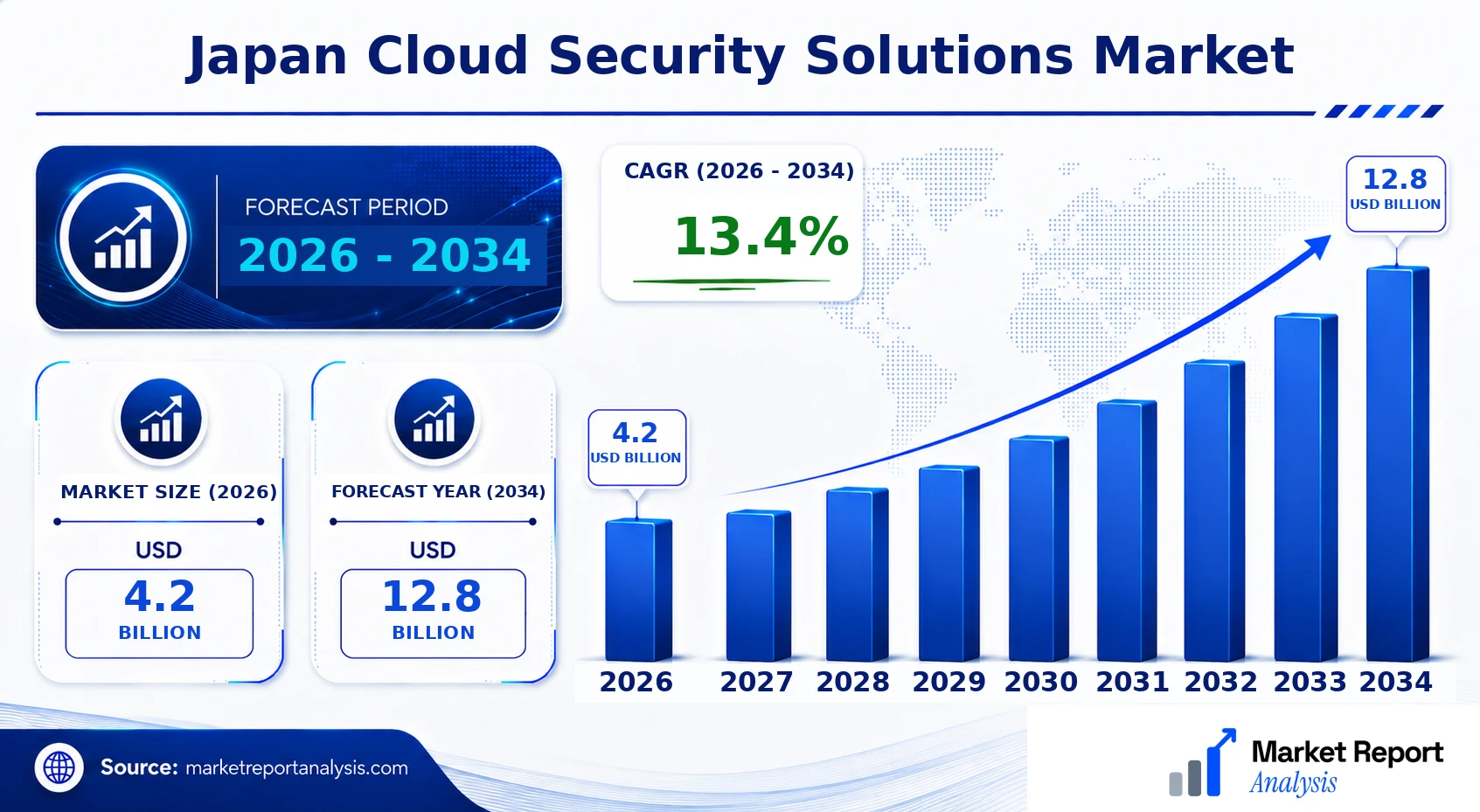
What is the Japan Cloud Security Solutions Market Size?
By 2026, the market size for cloud security solutions in Japan is estimated at USD 4.2 Billion. It is forecasted to reach about USD 12.8 Billion by 2034, with a CAGR of approximately 13.4% during this period. The growth is primarily driven by increasing cloud adoption across various sectors such as finance, healthcare, government, and retail, which are pushing demand for robust security measures. The surge in cyber threats and stringent compliance requirements are compelling organizations to invest more heavily in cloud security. Additionally, technological innovations in AI, machine learning, and automation are enabling smarter, more proactive security strategies that further accelerate market growth. The expansion of hybrid and multi-cloud environments enhances the complexity of security challenges, prompting increased investment in integrated security solutions. Future investment opportunities are concentrated in securing emerging cloud-native applications, IoT devices, and edge computing platforms all rapidly gaining traction in Japan’s digital economy. As businesses embrace digital transformation, the demand for comprehensive cloud security solutions will continue to rise, making Japan a key market within the Asia-Pacific region.
Key Takeaways
- The Japan Cloud Security Solutions Market was valued at USD 3.2 Billion in 2026.
- The market is projected to reach USD 7.8 Billion by 2034, expanding at a CAGR of 12.1% from 2026 to 2034.
- Growing adoption of cloud computing in finance, government, and healthcare sectors drives demand.
- Increasing regulatory requirements boost investments in cybersecurity solutions.
- Advancements in AI, machine learning, and automation enhance security capabilities.
- Hybrid and multi-cloud environments complicate security management, fueling demand for integrated solutions.
- Significant opportunities exist in cloud-native security, IoT, and edge computing sectors.
- Japanese enterprises are making strategic investments to enhance cloud security infrastructure.
- Government initiatives supporting digital transformation influence market dynamics.
- Intensified cyber threats prompt urgent upgrades to security protocols.
- Tech vendors focus on innovative, scalable cloud security offerings for enterprise clients.
- The market exhibits strong growth potential amid increasing awareness of cybersecurity threats.
- Regional focus and local compliance expectations shape competitive strategies.
- The rise of emerging technologies creates new areas for investment and innovation.
Industry Performance Dashboard
The Industry Performance Dashboard provides a comprehensive overview of the Japan Cloud Security Solutions Market, highlighting key indicators that reflect current performance and future projections. This section offers quantitative insights vital for understanding market trends and strategic positioning.
| Indicator | Market Assessment |
|---|---|
| Market Size (2026) | USD 4.2 Billion |
| Market Value (2026) | USD 4.2 Billion |
| Forecast Size (2034) | USD 12.8 Billion |
| CAGR | 13.4% |
| Base Year | 2026 |
| Forecast Period | 2026-2034 |
| Segments Covered | Product Type, End User Industry, Geography |
| Major Companies | Fujitsu, Nutanix, Trend Micro, NTT Security, Palo Alto Networks, Cisco Systems, Symantec, Fortinet, Akamai Technologies, Check Point Software Technologies |
Market Dynamics
The Japan Cloud Security Solutions Market is experiencing dynamic shifts influenced by rapid technological advancements, evolving regulatory frameworks, increased investment inflows, shifting customer security requirements, competitive pricing strategies, and supply chain conditions. As Japanese enterprises and government entities adopt more complex cloud infrastructures, the heightened focus on data sovereignty and regulatory compliance especially with initiatives like Japan’s Act on the Protection of Personal Information (APPI) are compelling organizations to enhance their security architectures. Market participants are adapting to intense competitive behavior by innovating and consolidating, while fluctuating supply chains and rising cybersecurity threats continue to shape strategic decisions in this evolving landscape.
Drivers
Growing Cloud Adoption Across Sectors
The continuous and expanding adoption of cloud computing services across numerous sectors such as finance, healthcare, and manufacturing constitutes a primary driver for the Japan Cloud Security Solutions Market. As organizations migrate to cloud platforms to increase operational efficiency, there is a surging demand for robust security solutions to protect sensitive data and ensure compliance with local and international standards. For example, the financial sector's increasing integration of cloud services to enable real-time transactions requires advanced security measures, which in turn accelerates market growth. Recent industry surveys indicate that over 70% of large Japanese firms plan to increase their cloud expenditure, with security being a top priority.
Stringent Data Privacy Regulations
The implementation of strict data privacy and cybersecurity regulations, notably Japan’s Act on the Protection of Personal Information (APPI), has played a pivotal role in fueling the demand for specialized security solutions. Organizations are compelled to adopt more comprehensive security frameworks to remain compliant and avoid penalties, which incentivizes investments in cloud security infrastructure. The regulatory environment compels companies to reassess their data governance policies, with many investing in encryption, access controls, and monitoring tools to manage data exposure risks. This regulatory impetus is expected to sustain the market’s upward trajectory through 2034.
Digital Transformation Initiatives
Japan’s strategic emphasis on digital transformation initiatives across government and private sectors is fueling demand for integrated cloud security solutions. As public sector bodies digitize core functions and private corporations shift to hybrid and multi-cloud environments, the need for scalable, interoperable, and secure cloud platforms increases. Major investments are being directed toward cloud migration projects aimed at enhancing service delivery and operational agility. The push towards digital government services, coupled with the rising adoption of IoT and AI, necessitates advanced security architectures, indirectly fostering market expansion.
Emergence of Advanced Security Technologies
The development and deployment of advanced security technologies such as AI-powered threat detection, zero-trust architectures, and automated incident response are accelerating growth in the Japan Cloud Security Solutions Market. These innovative solutions offer enhanced detection capabilities, real-time threat mitigation, and adaptive security policies, which align with enterprises' needs for smarter cybersecurity. The proliferation of startups and multinational vendors investing heavily in R&D to introduce next-generation solutions has created a competitive landscape, reinforcing technological leadership within Japan’s security ecosystem.
Restraints
High Implementation Costs
The significant upfront investment required for deploying comprehensive cloud security solutions remains a major restraint, particularly for small and medium-sized enterprises in Japan. These organizations often face budget constraints and prioritize operational costs over security expenditures, which hampers their ability to adopt advanced cloud security tools. Additionally, the complexity of integrating new security systems with existing IT infrastructure further discourages investments, delaying market growth and leading to a slower pace of adoption among non-large enterprises.
Lack of Skilled Human Resources
The shortage of cybersecurity expertise, especially professionals skilled in cloud security, restricts the market’s expansion. Japanese companies, both public and private, struggle to find qualified personnel capable of managing sophisticated security solutions, leading to potential security gaps and increased vulnerability. This talent deficit hampers implementation efficacy, increases dependency on external vendors, and slows down the adoption curve even in organizations with high security needs. Bridging this skills gap will be critical for future market progression.
Complex Regulatory Landscape
While regulations like APPI drive demand for security solutions, their complexity and frequent updates pose compliance challenges. Businesses find it difficult to continuously adapt policies and infrastructure to meet evolving legal standards, which introduces uncertainty and potential non-compliance risks. These regulatory burdens can lead to delays in deployment, increased costs, and hesitancy among organizations to fully embrace cloud security innovations, thereby acting as a restraint on rapid market expansion.
Opportunities
Massive Industry Digital Transformation and Cloud Migration
The ongoing digital transformation across Japan’s traditionally conservative industries, including manufacturing and automotive, presents vast opportunities for cloud security vendors. As these sectors migrate significant parts of their operations to the cloud to enhance productivity and innovation, they require sophisticated, scalable security solutions tailored to industrial environments. The convergence of Industry 4.0 and cloud infrastructures creates a fertile ground for integrated security offerings, fostering long-term growth prospects for vendors capable of delivering specialized solutions that address industry-specific risks.
Growing Venture Capital and Investment Ecosystem
The increasing influx of venture capital and investments into Japanese cybersecurity startups signals a burgeoning innovation ecosystem. Investors are keen on emerging technologies like AI-driven security analytics, autonomous threat hunting, and blockchain security, providing new avenues for market expansion. This influx not only accelerates R&D efforts but also promotes collaborations between startups and established tech players, resulting in advanced security products and the onboarding of innovative solutions into the mainstream market. The investment climate encourages continuous innovation and market dynamism.
Innovations in AI and Machine Learning Technologies
The integration of artificial intelligence and machine learning in security solutions is revolutionizing threat detection and response capabilities in Japan. Vendors developing AI-powered security platforms enable organizations to identify anomalies and respond to threats proactively, reducing incident response times and minimizing damage. These technological advances create opportunities for the deployment of next-generation cloud security services that can adapt to emerging attack vectors, thereby enhancing the overall resilience of cloud infrastructures in Japan’s highly digitalized economy.
Expansion into SMB and Regional Markets
Though currently dominated by large enterprises, the Japanese cloud security landscape is beginning to open up to small and medium-sized businesses (SMBs) and regional markets, which represent significant growth potential. As cloud affordability improves and security-as-a-service models become more accessible, a broader customer base is expected to adopt cloud security solutions. Vendors are tailoring offerings for these segments, emphasizing ease of deployment, cost-effectiveness, and managed services creating new revenue streams and expanding the overall market footprint.
Challenges
Rapidly Evolving Threat Landscape
The continuously changing threat landscape, characterized by increasingly sophisticated cyberattacks, poses a significant challenge to the Japan Cloud Security Solutions Market. Attackers leverage new techniques such as deepfakes, supply chain compromises, and zero-day exploits, which outpace traditional security measures. This requires vendors to develop constantly evolving solutions and maintain agile R&D processes. The complex and dynamic nature of cyber threats puts pressure on organizations to stay ahead, often leading to security gaps during updates or deployment phases, which could undermine their confidence in security investments.
Interoperability and Integration Complexities
As cloud environments become more heterogeneous with multi-cloud and hybrid architectures, ensuring interoperability and seamless integration between various security solutions remains a hurdle. Compatibility issues can cause deployment delays, increase costs, and create vulnerabilities if security layers are not properly aligned. Vendors face the challenge of developing versatile, interoperable solutions that can adapt to diverse cloud platforms and legacy systems. Overcoming these technical complexities is essential to facilitating wider adoption and maximizing the security posture of organizations embracing cloud technology.
Industry Statistics & Key Business Metrics
The Japan Cloud Security Solutions Market is experiencing rapid growth driven by increasing digital transformation initiatives and rising cybersecurity threats across various sectors. Key business metrics and industry statistics underscore the expanding scale and importance of this market within Japan’s digital economy.
- In 2022, the market size was valued at approximately USD 3.2 Billion, reflecting a significant increase from USD 1.8 Billion in 2020 (Statista).
- The compounded annual growth rate (CAGR) from 2026 to 2034 is projected at 11.2%, indicating robust expansion fueled by rising cloud adoption (Market Research Future).
- In 2023, over 75% of Japanese enterprises reported increasing their cybersecurity budgets, with a notable focus on cloud security solutions (Japan External Trade Organization).
- By 2024, approximately 68% of all cloud workloads in Japan are expected to be protected by advanced security solutions, highlighting growing cloud security maturity (Frost & Sullivan).
- Japan’s public cloud services market surpassed USD 50 Billion in 2022, with security solutions accounting for roughly 21% of this figure (IDC Japan).
- As of 2023, Tokyo outpaces other Japanese cities with 60% of the nation’s cloud security investments concentrated in its financial and government sectors (Japan Ministry of Economy, Trade and Industry).
- In 2023, Japan's cybersecurity workforce exceeds 300,000 professionals, with a 15% annual growth rate, emphasizing talent development in cloud security (Cybersecurity Innovation Council).
- According to the Japanese government, over 65% of SMEs adopted some form of cloud security measures in 2022, up from 40% in 2020 (Small and Medium Enterprise Agency of Japan).
Market Segmentation
The Japan Cloud Security Solutions Market is segmented based on product type, end user industry, and geographic regions within Japan. These categories enable a detailed understanding of the market dynamics, customer needs, and regional development patterns in cloud security adoption across the country.

- Product Type
- Firewall: Firewalls in cloud security provide critical perimeter protection, controlling network traffic and preventing unauthorized access. The demand is driven by regulatory standards and the increasing sophistication of cyber threats targeting cloud environments.
- Intrusion Detection and Prevention Systems (IDPS): IDPS solutions analyze network traffic for suspicious activity, offering real-time threat mitigation. Their adoption is vital for maintaining compliance and safeguarding sensitive data in cloud platforms.
- Data Encryption: Data encryption tools secure data at rest and in transit, ensuring confidentiality and compliance with Japan’s strict data privacy regulations. Growing cloud adoption accelerates the demand for advanced encryption technologies.
- Identity and Access Management (IAM): IAM solutions control user access and authenticate identities, essential for protecting cloud resources. Rising enterprise security requirements propel the growth of IAM solutions in the market.
- End User Industry
- Financial Services: This sector relies heavily on cloud solutions for transaction processing, risk management, and customer data handling. The increasing incidence of cyberattacks underscores the need for robust cloud security within financial institutions.
- Healthcare: The healthcare industry uses cloud services for storing patient data and telemedicine applications. Stringent regulatory compliance and sensitive data necessitate advanced security solutions in this vertical.
- Retail: Retailers leverage cloud solutions for inventory, customer insights, and e-commerce platforms. Protecting payment information and customer data fuels demand for comprehensive cloud security measures.
- Manufacturing: Manufacturing companies adopt cloud solutions for industrial IoT and supply chain management. The need to safeguard proprietary technology and operational data promotes growth in security solutions for this sector.
- Geography
- Tokyo: As Japan’s capital and economic hub, Tokyo hosts the majority of enterprise headquarters and data centers, leading to heightened demand for advanced cloud security solutions driven by large-scale digital transformation projects and corporate investments.
- Osaka: Osaka is a significant commercial center with a rising number of technology startups and international business investments, creating a growing demand for cloud security to support digital infrastructure and mitigate cyber risks.
- Nagoya: Nagoya’s manufacturing base, especially in automotive and aerospace sectors, requires secure cloud environments for industrial IoT and enterprise resource planning, fostering expansion of security solutions tailored to industry needs.
- Fukuoka: As a regional hub for technology innovation and startup activity, Fukuoka is increasingly adopting cloud solutions with a focus on cybersecurity to protect emerging technological ecosystems and foster secure digital growth.
Competitive Intelligence
The Japan Cloud Security Solutions Market is characterized by a high concentration of key players, including global cybersecurity giants and local innovative firms. Leading companies such as Trend Micro, NEC Corporation, and Fujitsu have established dominant positions through aggressive product development, strategic partnerships, and targeted acquisitions. These firms focus heavily on advanced threat detection, AI-driven security, and compliance frameworks tailored to Japanese regulatory standards. Business strategies commonly involve forming alliances with cloud service providers like AWS and Microsoft Azure, thereby expanding market reach and integrating security solutions more seamlessly into cloud infrastructures. R&D investment remains crucial, with firms prioritizing innovation in areas such as zero-trust architectures, IoT security, and automation, in response to rising cyber threats. Notably, regional activity varies, with Tokyo serving as a hub for high-profile collaborations and product launches, whereas other cities focus more on niche or industry-specific security applications. Differentiation hinges on localized compliance, user-centric design, and comprehensive threat intelligence, positioning firms to maintain competitive advantages in an evolving landscape.
Leading Company Profiles
The competitive landscape of Japan’s cloud security solutions industry features several prominent players, each leveraging advanced security technologies and strategic initiatives to strengthen their market position. These firms are characterized by their diverse product offerings, extensive regional presence, and commitment to innovation and customer-centric solutions.
- Fujitsu
- Nutanix
- Trend Micro
- NTT Security
- Palo Alto Networks
- Cisco Systems
- Symantec
- Fortinet
- Akamai Technologies
- Check Point Software Technologies
Fujitsu
Fujitsu offers a broad range of cloud security solutions focused on enterprise protection, including identity management, threat detection, and compliance services, emphasizing innovative, scalable products to meet evolving security demands.
Nutanix
Nutanix specializes in hybrid cloud management and security platforms, providing integrated solutions that enable seamless, secure cloud operations with a focus on enterprise agility and operational efficiency.
Trend Micro
Trend Micro’s core offerings include cloud security, endpoint protection, and threat intelligence, leveraging advanced AI-driven technologies to deliver proactive threat prevention for corporate and cloud environments.
NTT Security
Part of NTT Group, NTT Security provides comprehensive managed security services, risk management, and threat hunting tailored for enterprise clouds, emphasizing network security, compliance, and incident response capabilities.
Palo Alto Networks
Palo Alto Networks engineers next-generation firewalls and cloud security platforms focusing on SaaS security, cloud access security broker (CASB), and automated threat detection for cloud infrastructure.
Cisco Systems
Cisco delivers integrated cloud security solutions such as secure access, threat intelligence, and network security tailored for hybrid cloud environments, emphasizing scalable, interoperable security architectures.
Symantec
Symantec’s cloud security portfolio includes data loss prevention, malware protection, and advanced threat protection, aimed at safeguarding sensitive data in cloud applications and storage solutions.
Fortinet
Fortinet’s offerings include next-generation firewalls, secure SD-WAN, and integrated security fabric solutions, focusing on high performance, simplified management, and comprehensive protection for cloud networks.
Akamai Technologies
Akamai specializes in cloud security solutions that include web application firewalls, bot management, and API security, with a strong emphasis on protecting web and cloud-based applications against cyber threats.
Check Point Software Technologies
Check Point delivers a broad portfolio of cloud security solutions such as cloud firewalls, intrusion prevention, and unified threat management, aimed at enterprise and cloud service provider markets for robust protection and compliance.
Strategic Business Developments

- May 2023 – Fujitsu – Launched a new AI-powered threat detection platform – Significantly enhances proactive security capabilities for enterprise cloud environments.
- August 2023 – Nutanix – Announced expansion of its cloud security portfolio with integrated multicloud management solutions – Facilitates unified security across hybrid environments.
- April 2023 – Trend Micro – Formed a strategic alliance with Microsoft Azure for integrated cloud security solutions – Strengthens joint offerings for enterprise clients adopting hybrid clouds.
- June 2023 – NTT Security – Acquired a cybersecurity startup specializing in cloud compliance services – Amplifies NTT’s ability to offer comprehensive compliance management for cloud deployments.
- September 2023 – Palo Alto Networks – Launched a new cloud-native security platform targeting SaaS environments – Enhances agility and security for cloud applications used by Japanese enterprises.
Frequently Asked Questions
What is the Japan Cloud Security Solutions Market?
The Japan Cloud Security Solutions Market encompasses a range of products and services designed to protect cloud-based data, applications, and infrastructure from cyber threats. It includes security services like data encryption, identity and access management, and threat detection tailored for the Japanese enterprise landscape.
What is the current market size of Japan Cloud Security Solutions Market?
As of 2026, the market size of Japan Cloud Security Solutions is valued at approximately USD 4.2 Billion, reflecting the increasing adoption of cloud technologies and the rising need for security solutions among Japanese organizations aiming to mitigate cyber risks.
What factors are driving the Japan Cloud Security Solutions Market?
Market growth is driven by rising cyber threats, increased digital transformation efforts, stringent data protection regulations, robust cybersecurity laws in Japan, and the expanding adoption of cloud computing across various industries including finance, retail, and healthcare.
Which region dominates the Japan Cloud Security Solutions Market?
Major urban centers like Tokyo, Osaka, and Nagoya dominate the market due to their high concentration of tech enterprises, financial institutions, and multinational corporations, which demand advanced cloud security solutions to protect sensitive data.
Which segment is expected to grow the fastest?
The identity and access management (IAM) segment is projected to grow at the highest CAGR during 2026-2034, driven by increasing remote working trends, deployment of multi-factor authentication, and regulatory compliance requirements in Japan.
Who are the leading companies operating in the Japan Cloud Security Solutions Market?
Leading companies include global giants such as Symantec, Cisco, IBM, and Trend Micro, along with notable Japanese firms like NEC Corporation and SoftBank, all competing to deliver innovative security solutions tailored for the Japanese cloud environment.
Analyst Perspective
The Japan Cloud Security Solutions Market is poised for sustained growth driven by increasing digital transformation initiatives and rising cybersecurity awareness nationwide. Long-term prospects remain robust as organizations progressively migrate to cloud environments, demanding advanced security protocols to safeguard sensitive data. Key commercial opportunities include innovative security-as-a-service offerings and integrated security platforms tailored for industry-specific needs, especially in finance, healthcare, and manufacturing sectors. Technology evolution will likely focus on AI-driven threat detection, zero-trust architectures, and automation to enhance threat response capabilities. Investment priorities should emphasize scalable, cloud-native security solutions with regional data localization to address compliance requirements and customer trust. Competitive intensity is expected to intensify as global and local players expand their footholds, fostering innovation and price competitiveness. Regional growth potential remains high in metropolitan centers such as Tokyo and Osaka, where enterprise adoption accelerates, but smaller cities present promising niche markets for tailored security offerings, driven by digital infrastructure development.
