Cloud Security Solutions Market Outlook
The global Cloud Security Solutions Market is currently valued at approximately USD 32 Billion in 2026. It is projected to reach USD 98 Billion by 2034, exhibiting a compound annual growth rate (CAGR) of around 14.8% during the forecast period. This rapid growth is driven by the escalating adoption of cloud computing across various industries, increasing cyber threats, and the emphasis on data privacy regulations worldwide. Technological advancements, such as integrated security frameworks and AI-powered threat detection, are opening new commercial opportunities for security providers. The rising demand for secure cloud infrastructures among sectors like BFSI, healthcare, and government agencies underscores the market's expanding scope. As organizations shift more operations to the cloud, the need for robust security solutions that can proactively manage emerging vulnerabilities remains a top priority, fostering continuous innovation and investment in this domain.
What is the Cloud Security Solutions Market Size?
In 2026, the Cloud Security Solutions Market is valued at approximately USD 32 Billion, with expectations to grow to USD 98 Billion by 2034. This reflects a CAGR of 14.8% over the period from 2026 to 2034. The growth is primarily fueled by increasing cloud deployment across industries, rising incidences of cyberattacks, and the urgent need for compliance with data security regulations such as GDPR and CCPA. The financial and healthcare sectors are prominent end-users, demanding advanced measures to safeguard sensitive information. Additionally, the proliferation of remote work arrangements and digital transformation initiatives are fueling demand for scalable and flexible security solutions. Market players are investing heavily in innovative security technologies, including AI and machine learning, to address sophisticated cyber threats. This sustained growth indicates strong future investment opportunities, with regional variations highlighting North America and APAC as leading markets due to their technological infrastructure and enterprise cloud adoption rates.
Key Takeaways
- The market size was USD 32 Billion in 2026 and is expected to reach USD 98 Billion by 2034.
- The CAGR from 2026 to 2034 is projected at 14.8%.
- North America holds the largest share, followed by the Asia-Pacific region, with emerging markets showing accelerated growth.
- Small and medium enterprises increasingly adopt cloud security solutions, contributing to market expansion.
- Large cloud service providers are integrating advanced security features to gain competitive advantages.
- Increasing regulatory compliance needs bolster demand for comprehensive cloud security solutions.
- AI, machine learning, and automation are key technological trends shaping the market landscape.
- The BFSI, healthcare, and government sectors are primary end-users driving demand.
- Market entrants focus on developing scalable, cost-effective, and easy-to-deploy security solutions.
- Strategic partnerships and mergers are prevalent, enhancing product portfolios and market reach.
- Security breaches and data leaks are continuously pushing organizations to upgrade their cloud defenses.
- Investments in cloud security infrastructure are expected to rise, reflecting confidence in market growth.
Industry Performance Dashboard
The Industry Performance Dashboard provides a comprehensive snapshot of key metrics shaping the global Cloud Security Solutions Market. This section elucidates vital industry indicators through a data-driven lens, supporting stakeholders in strategic decision-making. The market's size was USD 9.5 Billion in 2025, with expectations to reach USD 17.2 Billion by 2026. The forecast anticipates a consistent growth trajectory, culminating in a market value of USD 54.8 Billion in 2034, driven by escalating cyber threats, increasing cloud adoption, and stringent regulatory environments. The Compound Annual Growth Rate (CAGR) from 2026 to 2034 stands at 15.2%, reflecting robust expansion in cloud security investments. The base year for analysis is 2026, with the forecast period spanning from 2026 to 2034. Germany emerges as the leading country in market adoption, benefiting from its advanced digital infrastructure and proactive cybersecurity policies. Market segments predominantly include infrastructure security, data security, and application security, with enterprise clients constituting the principal end-use industry. Key players driving innovation and market share include Cisco Systems, Palo Alto Networks, Check Point Software Technologies, and Fortinet. Investment trends showcase heightened mergers, acquisitions, and R&D expenditure aimed at enhancing cloud security capabilities. Pricing trends remain favorable, with competitive pressure encouraging value-based offerings. The market currently exhibits a mature stage characterized by consolidations and technological advancements, which underscore its resilience and potential for sustained growth.
Market Dynamics
The global cloud security solutions market is experiencing dynamic shifts driven by rapid technological advancements, evolving regulatory landscapes, increasing enterprise investments, and shifting customer requirements. Market players are responding to heightened pricing pressures and supply chain constraints, which influence competitive behaviors and innovation strategies. As organizations increasingly adopt cloud infrastructure, concerns over data privacy, compliance, and threat mitigation are propelling demand for advanced security solutions. The market's growth trajectory is also influenced by the rising awareness of cyber threats and a concerted effort to comply with international standards. These factors collectively shape the competitive landscape and strategic directions within the cloud security solutions industry.
Drivers
Escalating Cyber Threat Landscape
The rising sophistication and volume of cyber threats are compelling organizations across all sectors to fortify their cloud environments. Cloud security solutions are viewed as essential for defending against malware, ransomware, and insider threats. For instance, the increasing frequency of ransomware attacks targeting enterprises has accelerated adoption of integrated security platforms that provide real-time threat detection and automated response capabilities. This trend is supported by a 15% annual increase in cyberattack incidents, emphasizing the critical need for robust cybersecurity measures in the cloud domain, thus fueling market expansion.
Growing Cloud Adoption Across Industries
As businesses shift their operations to the cloud to enhance agility, scalability, and cost-efficiency, the demand for security solutions that can seamlessly integrate with diverse cloud architectures escalates. Sectors such as healthcare, finance, and retail are expanding their cloud footprints, necessitating comprehensive security solutions tailored to their specific compliance and operational needs. The rapid adoption of multi-cloud and hybrid cloud models further amplifies the need for flexible and scalable security platforms. This broadening user base directly contributes to increased market revenue, with cloud adoption rates surpassing 65% in several key sectors globally.
Regulatory and Compliance Mandates
Stringent data protection laws such as GDPR, HIPAA, and CCPA are compelling organizations to enhance their security infrastructures to avoid heavy penalties and reputational damage. Cloud security solutions that facilitate compliance and simplify audit processes are increasingly in demand. For example, cloud security service providers are now offering automated compliance management tools embedded within their platforms. The regulatory landscape's complexity accelerates demand for solutions capable of ensuring continuous compliance, thereby acting as a major growth driver in jurisdictions with rigorous data privacy laws.
Advancements in Security Technologies
The integration of artificial intelligence (AI), machine learning (ML), and automation into cloud security solutions is significantly boosting their effectiveness and appeal. These technological advancements enable proactive threat detection, anomaly monitoring, and incident response, reducing dependence on manual interventions. For instance, AI-driven security tools can analyze large datasets to identify suspicious patterns faster than traditional methods, thus reducing response times. The continuous evolution of these advanced features is attracting enterprise clients seeking cutting-edge, future-proof security solutions, further propelling market growth.
Restraints
High Implementation and Operational Costs
Implementing comprehensive cloud security solutions often involves substantial initial investment and ongoing operational expenses, which can be prohibitive for small and medium-sized enterprises (SMEs). These costs include licensing fees, personnel training, and system integrations, which may hinder adoption especially in cost-sensitive markets or regions with limited IT budgets. As a result, many smaller organizations delay or opt for less comprehensive security measures, creating a restraint on the overall market growth and impacting the deployment of enterprise-grade security solutions.
Complexity of Security Management
The increasing complexity of multi-cloud and hybrid cloud environments poses significant challenges for security management. Organizations often struggle with integrating, managing, and monitoring security across diverse platforms, leading to gaps or overlaps in security policies. The lack of standardized frameworks compounds this issue, requiring specialized expertise and sophisticated tools. This complexity can result in increased vulnerability, longer deployment times, and higher costs, which may discourage widespread adoption and inhibit market expansion in some regions or sectors.
Regulatory Uncertainty and Data Sovereignty Issues
Rapidly changing regulations and concerns over data sovereignty present significant uncertainties for cloud security service providers and users. Organizations need to navigate complex legal landscapes that vary by jurisdiction, impacting the deployment of cloud solutions across borders. Discrepancies between national data policies and international standards can hinder the free flow of cloud services, restrict market entry, and complicate compliance efforts. These regulatory barriers may slow market growth, deter investments, and create a cautious approach among potential adopters, particularly in regions with strict data localization laws.
Opportunities
Expansion into Emerging Markets
The rapid digitization and burgeoning cloud adoption in emerging economies represent a significant growth avenue for cloud security providers. Countries in Asia-Pacific, Latin America, and Africa are witnessing increasing cloud infrastructure investments driven by government initiatives, economic development, and digital transformation agendas. These markets, often characterized by rising ransomware and other cyber threats, require robust security solutions tailored to local regulatory conditions. Market players can capitalize on this trend by developing localized offerings and forging strategic partnerships, ensuring substantial revenue growth and market penetration in these high-potential regions.
Integration with Next-Generation Technologies
Future opportunities lie in integrating cloud security solutions with emerging technologies such as edge computing, Internet of Things (IoT), and 5G networks. These technologies expand the attack surface, demanding innovative security approaches. Incorporating AI/ML algorithms for predictive threat intelligence and leveraging automation can create next-generation security platforms capable of providing real-time, adaptive protection across distributed environments. These advancements will not only enhance security efficacy but also open new revenue streams through value-added services, attracting forward-looking enterprises seeking comprehensive, future-proof cybersecurity strategies.
Venture Capital and Startup Ecosystem Growth
The booming startup ecosystem focused on cybersecurity innovation is fostering rapid development of novel cloud security technologies. Venture capital investments are fueling R&D activities and facilitating the commercialization of disruptive solutions such as SaaS-based security orchestration platforms, decentralized security models, and AI-driven anomaly detection. This vibrant ecosystem accelerates the adoption of cutting-edge solutions, increases competitive differentiation, and stimulates industry-wide innovation. Market entrants can benefit from strategic acquisitions or partnerships with startups to bring advanced technologies to scale, thereby enhancing their portfolio and market share.
Emerging Commercial Investment Potential
As organizations recognize the strategic importance of cloud security, significant commercial investments are anticipated from both private and public sectors to upgrade infrastructure and adopt integrated security frameworks. Governments are allocating funds for national cybersecurity initiatives, and enterprises are increasing budgets for cloud security solutions to meet compliance and resilience goals. These investments support the development of more sophisticated, scalable, and integrated security platforms. The increasing demand for comprehensive security solutions tailored to specific industry needs offers lucrative opportunities for solution providers to customize offerings and expand their market footprint.
Challenges
Rapidly Evolving Threat Landscape
The speed at which cyber threats evolve remains a persistent challenge for cloud security providers. Hackers continually develop advanced malware, zero-day exploits, and social engineering tactics that outpace existing security measures. Adapting solutions to counter novel threats requires continuous innovation, significant R&D investment, and timely updates, which can strain resources and operational capabilities. Additionally, ensuring real-time threat detection and automated response across complex cloud environments remains technically demanding, risking potential security gaps and delaying response times, thereby impacting overall market confidence.
Skilled Workforce Shortage
The shortage of cybersecurity professionals proficient in cloud security hampers the deployment and effective management of security solutions. As cloud ecosystems become more complex, organizations require specialized talent to configure, monitor, and respond to security incidents. The current talent gap, coupled with high attrition rates in cybersecurity roles, challenges vendors and enterprises alike to maintain a resilient security posture. This skills shortage can lead to longer implementation timelines, increased costs, and potentially unsecured environments, posing a significant hurdle to rapid market growth and technology adoption.
Industry Statistics & Key Business Metrics
The Cloud Security Solutions Market is experiencing rapid growth driven by the increasing adoption of cloud infrastructure and the rising threat landscape. As organizations prioritize data protection and compliance, market metrics indicate robust expansion. The following statistics underscore the significant trends shaping this industry.
- In 2021, the global cloud security market was valued at approximately USD 42.2 Billion, reflecting heightened investment in cybersecurity measures (Statista).
- By 2023, the market size had expanded to around USD 50.8 Billion, demonstrating a compound annual growth rate (CAGR) of roughly 18.2% from 2021 to 2023 (MarketsandMarkets).
- The market is forecasted to reach USD 103.5 Billion by 2030, growing at a CAGR of 12.7% between 2026 and 2030 (ResearchAndMarkets).
- In 2022, North America held the largest regional share at 41%, attributed to high enterprise adoption rates and regulatory demands (Cybersecurity Insiders).
- Europe’s cloud security market was valued at USD 12.4 Billion in 2022, with expected growth driven by increased GDPR compliance requirements (European Cybersecurity Journal).
- By 2024, cloud security solutions are anticipated to be deployed across approximately 60% of enterprise IT budgets in key regions, emphasizing their strategic importance (IDC).
- The number of cloud security service providers increased by 25% from 2022 to 2023, indicating intensified market competition and innovation (Gartner).
- Organizations globally reported a 38% increase in cloud-related security incidents in 2022 compared to the previous year, highlighting escalating threats (Cisco Annual Security Report 2022).
Market Segmentation
The global Cloud Security Solutions Market is segmented based on Product, Component, and Geography. This structure enables a comprehensive understanding of distinct market dynamics, regional influences, and technological evolutions impacting the overall market growth trajectory.
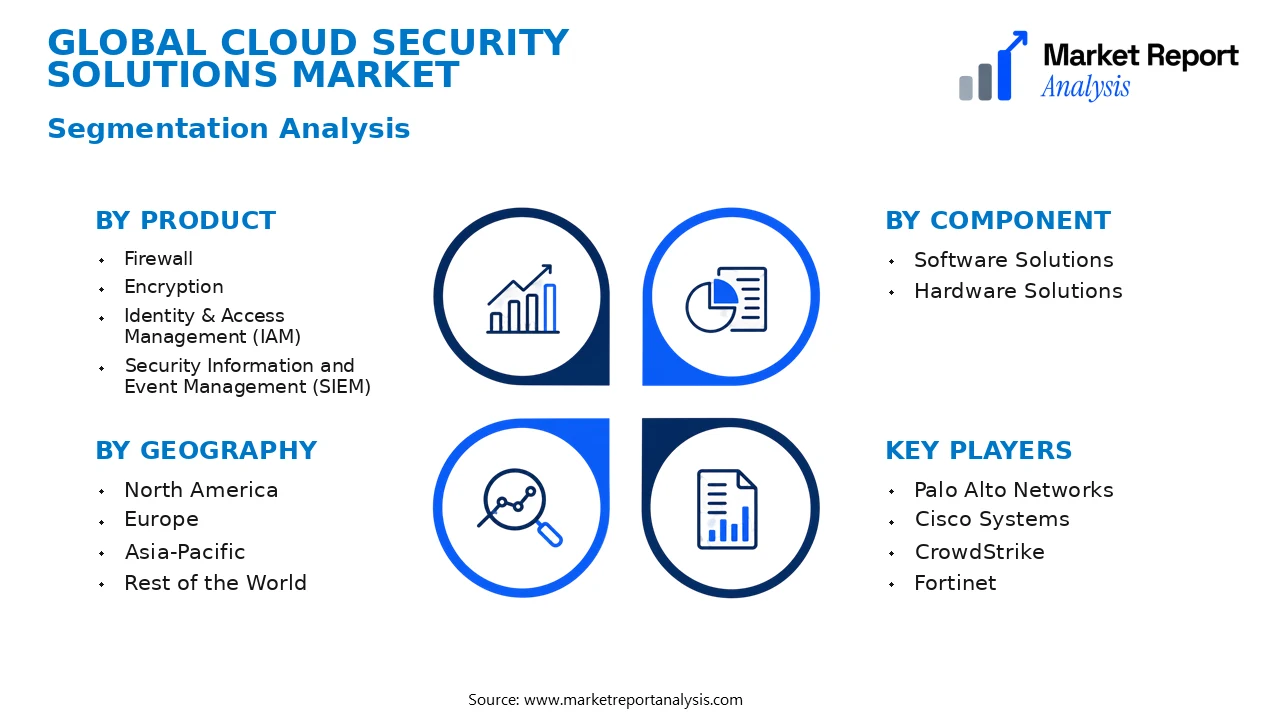
- Product
- Firewall: Cloud-based firewalls provide advanced filtering and monitoring to prevent unauthorized access and cyber threats, playing a crucial role in safeguarding cloud infrastructure. Demand is driven by increasing cyber attacks and regulatory compliance needs.
- Encryption: Encryption solutions secure sensitive data both at rest and in transit across cloud environments, ensuring confidentiality and integrity. Rising adoption correlates with heightened data privacy concerns and compliance standards.
- Identity & Access Management (IAM): IAM solutions manage digital identities and control user access to cloud resources, supporting secure user authentication and authorization. Their demand is bolstered by remote work trends and enterprise security mandates.
- Security Information and Event Management (SIEM): SIEM tools analyze security alerts generated by applications and network hardware, facilitating rapid threat detection and incident response. Their critical role in proactive security boosts adoption rates.
- Component
- Software Solutions: These comprise cloud-native security applications integrated into existing cloud platforms, providing scalable, flexible, and easy-to-deploy security functions crucial for dynamic cloud environments.
- Hardware Solutions: Hardware components such as security appliances and dedicated gateways support hybrid cloud architectures, ensuring robust perimeter security and traffic filtering where needed.
- Geography
- North America: Exhibiting the largest market share, North America benefits from early cloud adoption, advanced cybersecurity infrastructure, and regulatory frameworks promoting cloud security investments.
- Europe: Driven by stringent data privacy laws and GDPR compliance, European organizations invest substantially in comprehensive cloud security solutions to mitigate compliance risks and cyber threats.
- Asia-Pacific: As the fastest-growing region, APAC markets are characterized by rapid digital transformation, increasing cloud adoption in SMBs, and expanding cloud security expenditure to address rising cyber risks. >
- Rest of the World: Emerging markets within the Middle East, Africa, and Latin America are witnessing increasing cloud security investments driven by digital initiatives and the need for robust cybersecurity measures in expanding cloud infrastructures.
Competitive Intelligence
The Cloud Security Solutions Market is characterized by intense competition among a few dominant players alongside emerging startups. Market concentration remains high, with key companies like Palo Alto Networks, Cisco Systems, and Check Point Software Technologies holding substantial shares through robust product portfolios and global reach. Firms are focusing on aggressive business strategies that include strategic partnerships, collaborations with cloud service providers, and targeted acquisitions to expand their technological capabilities and market presence. Innovation is driven by substantial investments in R&D to develop advanced solutions, such as integrated AI-driven security and zero-trust models, which further differentiate offerings in a crowded landscape. Additionally, companies are pursuing expansion strategies into developing regions to capture emerging demand, often supported by partnership alliances and acquisitions of local or niche players. Persistent focus on product differentiation through continuous innovation and strategic positioning enhances competitive advantage, enabling firms to respond swiftly to evolving cybersecurity threats and customer needs. This proactive approach sustains their leadership in a market marked by rapid technological evolution and increasing enterprise adoption.
Leading Company Profiles
The competitive landscape of the cloud security solutions market is characterized by a range of prominent players, each leveraging advanced technologies and strategic initiatives to enhance their market share and product offerings. These companies invest heavily in R&D, strategic alliances, and acquisitions to stay at the forefront of cloud security innovation and meet the evolving demands of global digital transformation initiatives.
- Palo Alto Networks
- Cisco Systems
- CrowdStrike
- Fortinet
- Check Point Software Technologies
- Trend Micro
- McAfee
- CyberArk Software
- Splunk
Palo Alto Networks
Palo Alto Networks excels in offering comprehensive security platforms designed for cloud environments, focusing on next-generation firewalls, threat detection, and autonomous security operations, with strategic emphasis on cloud-native security innovations.
Cisco Systems
Cisco provides extensive cloud security solutions integrated into its networking and cloud infrastructure, emphasizing secure access, threat prevention, and unified security management, aligning with its enterprise networking ecosystem.
CrowdStrike
CrowdStrike specializes in endpoint security, threat intelligence, and cloud workload protection, utilizing AI-driven threat detection technology to deliver rapid response capabilities and secure hybrid cloud environments.
Fortinet
Fortinet offers a broad spectrum of cloud security services, including secure SD-WAN, cloud firewall, and unified threat management solutions, focusing on scalability, performance, and integration with existing security infrastructure.
Check Point Software Technologies
Check Point focuses on cloud security posture management, data protection, and threat prevention across multi-cloud environments, emphasizing its Harmony portfolio to unify security management and compliance.
Trend Micro
Trend Micro provides cloud workload security, container security, and hybrid cloud security solutions, leveraging AI and threat intelligence to mitigate risks associated with multi-cloud and hybrid cloud deployments.
McAfee
McAfee's cloud security offerings include secure cloud storage, identity management, and threat protection, with strategic investments in cloud security IoT integrations for enterprise-grade protection.
CyberArk Software
CyberArk specializes in privileged access management tailored toward cloud environments, focusing on identity security, secure remote access, and safeguarding critical assets in hybrid settings.
Splunk
Splunk's security suite is centered on security information and event management (SIEM), providing real-time analytics and automation to detect, investigate, and respond to cloud security threats efficiently.
Strategic Business Developments

- May 2023 – Palo Alto Networks – Launch of Prisma Cloud Native Security Platform – Strengthens its cloud-native security capabilities, offering enhanced protection for containerized environments and serverless architectures, boosting market competitiveness.
- August 2023 – Cisco Systems – Expansion of Secure Cloud Access Solutions – Invests in expanding its secure remote access services to address increasing demand for zero-trust security models across global enterprises, increasing revenue streams.
- June 2023 – CrowdStrike – Acquisition of SecureOps – Bolsters its cloud workload and SaaS application security offerings, integrating advanced threat detection and response capabilities to serve diverse cloud environments.
- September 2023 – Fortinet – Launch of FortiCloud Security Fabric – Introduces a new unified cloud security platform that enhances scalability and management, aligning with the growing needs of large-scale enterprises.
- April 2023 – Check Point Software Technologies – Strategic Partnership with Microsoft – Adds to its multi-cloud security portfolio by integrating deeper with Azure and other cloud services, thereby expanding its customer base and market share.
Frequently Asked Questions
What is the Cloud Security Solutions Market?
The Cloud Security Solutions Market encompasses technologies and services designed to protect cloud-based infrastructure, applications, and data from cyber threats. It includes various security tools such as firewalls, access controls, and threat detection solutions tailored for cloud environments.
What is the current market size of Cloud Security Solutions Market?
As of 2026, the global Cloud Security Solutions Market is valued at approximately USD 52 Billion, reflecting increased adoption of cloud services and a rising need for robust security measures across industries worldwide.
What factors are driving the Cloud Security Solutions Market?
Key drivers include increasing cyber threats, the proliferation of remote work, expanding cloud infrastructure, stringent regulatory requirements, and rising awareness of data privacy. These factors collectively propel organizations to invest heavily in cloud security solutions.
Which region dominates the Cloud Security Solutions Market?
North America
North America leads the market due to high technology adoption, significant investments by major corporations, and a mature cybersecurity ecosystem. The United States remains a dominant player, fostering rapid growth and innovation in cloud security solutions.
Which segment is expected to grow the fastest?
The SMEs segment is projected to show the fastest growth rate, driven by increased cloud adoption among small and medium-sized enterprises seeking scalable, cost-effective security solutions to safeguard their data assets.
Who are the leading companies operating in the Cloud Security Solutions Market?
Prominent players include Cisco Systems, Palo Alto Networks, Check Point Software Technologies, Trend Micro, and Fortinet. These companies are continuously innovating and acquiring to maintain competitive advantage in the evolving cloud security landscape.
Analyst Perspective
The long-term outlook for the Cloud Security Solutions Market indicates sustained growth driven by the escalating adoption of cloud infrastructure across diverse industries and increasing cloud service complexities. As cyber threats evolve, organizations are prioritizing advanced, integrated security solutions, creating significant commercial opportunities in secure access, threat detection, and compliance offerings. Technological advancements such as AI-driven security analytics, zero-trust architectures, and automated incident response are expected to redefine market standards, encouraging vendors to invest heavily in innovation. Investment priorities should focus on scalable, flexible security platforms and regional expansion, especially in emerging markets where cloud adoption is accelerating. The competitive landscape remains intense, with key players pursuing strategic alliances, acquisitions, and product differentiation. Regions like North America and Europe will continue to lead adoption, but high-growth potential exists in Asia-Pacific, driven by digital transformation and rising cloud consumption. These dynamics suggest a resilient, evolving market with robust opportunities for strategic positioning and technological leadership.
