South Korea Automatic Data Capture (ADC) Market Outlook
The South Korea Automatic Data Capture (ADC) market is positioned for substantial growth, driven by rapid technological advancements, increasing industrial automation, and a strong government push towards digital transformation. Currently valued at approximately USD 2.5 Billion in 2026, the market is projected to reach around USD 4.2 Billion by 2034, growing at a Compound Annual Growth Rate (CAGR) of about 6.7% during the forecast period. Principal demand drivers include the expansion of retail, logistics, manufacturing, and healthcare sectors, which rely heavily on ADC technologies to improve operational efficiency and data accuracy. The adoption of RFID, barcode scanners, and biometric data capture systems is accelerating, supported by ongoing investments in smart infrastructure. The technology direction emphasizes integration with IoT platforms, cloud computing, and AI, offering significant commercial opportunities for vendors to innovate and expand their offerings while enabling smarter, more responsive supply chains and business processes.
What is the South Korea Automatic Data Capture (ADC) Market Size?
By the end of 2026, the South Korea ADC market is valued at approximately USD 2.5 Billion, with projections indicating growth to about USD 4.2 Billion by 2034. This growth equates to a CAGR of roughly 6.7% over the forecast period from 2026 to 2034. Key factors fueling this expansion include increased automation in retail, logistics, and healthcare, coupled with robust governmental policies promoting digitalization. The retail sector is a major demand driver, utilizing barcode and RFID technology for inventory and point-of-sale automation. Logistics companies are adopting advanced scanning solutions to optimize freight and warehouse management. Healthcare providers deploy biometric and RFID systems for patient identification and asset tracking. Continuous advancements in wireless, AI-driven, and cloud-enabled ADC solutions are expected to unlock new applications and markets, encouraging extensive investment from both domestic and international vendors seeking to capitalize on South Korea’s technological trajectory and digital infrastructure development.
Key Takeaways
- The South Korea ADC market is valued at USD 2.5 Billion in 2026, with a forecast value of USD 4.2 Billion by 2034.
- It is expected to grow at a CAGR of 6.7% during 2026-2034.
- Seoul remains the leading city in ADC deployment and technological adoption.
- The fastest-growing city for ADC applications is Busan, driven by expanded logistics and port automation initiatives.
- The RFID segment holds the largest market share, while biometric data capture is the fastest-growing technology segment.
- Retail and logistics are the primary end-user industries, constituting the majority of market demand.
- Regulatory support for data security and automation is catalyzing innovation across sectors.
- Market competition is intensifying among local champions and global technology providers.
- Investments in IoT integration and AI-driven ADC solutions are expected to accelerate market growth.
- Sustained government initiatives aimed at smart city projects further boost market prospects.
- The rapid adoption of cloud-based ADC systems is expanding the scope of use cases across industries.
- Technological advances in wireless connectivity and miniaturization are enhancing device capabilities.
- Emerging applications include smart retail, automated healthcare workflows, and intelligent transportation.
- Favorable economic conditions and infrastructure investments support sustained market expansion.
- Future opportunities revolve around integrated data ecosystems combining ADC with analytics and AI.
Industry Performance Dashboard
The Industry Performance Dashboard offers a comprehensive overview of the key metrics and market dynamics influencing the South Korea Automatic Data Capture (ADC) Market. This snapshot enables stakeholders to assess market maturity, growth prospects, and competitive positioning within the country. The current market size in 2026 is estimated at USD 2.1 Billion, reflecting robust adoption driven by retail, logistics, and manufacturing sectors aiming to enhance operational efficiency through automation. The forecast size for 2034 projects significant growth, reaching USD 4.8 Billion, with a Compound Annual Growth Rate (CAGR) of approximately 11.0% over the forecast period from 2026 to 2034, indicating a strong upward trajectory supported by technological advancements and government initiatives promoting digital transformation. The base year for this assessment is 2026, with market development continuing through 2034. Seoul remains the leading city in ADC deployments, benefiting from dense corporate hubs, advanced infrastructure, and a technology-savvy workforce, although Busan and Incheon are also emerging as competitive centers for innovation. The market segments covered include barcode scanning, RFID, biometric data capture, and optical character recognition (OCR), each contributing to diversified revenue streams. Major companies operating within the South Korean ADC market include Samsung Electronics, LG CNS, SK Telecom, and Hanwha Systems, which leverage local manufacturing strengths and R&D capabilities. The investment trends highlight increasing automation spending among large corporations and government-backed initiatives, fostering a dynamic competitive landscape. Pricing trends reflect technological innovation and scale efficiencies, positioning Samsung and LG as key players with competitive edge. Market maturity demonstrates a progressing but still evolving sector, propelled by continued technological integration and expanding application domains.
Market Dynamics
The South Korea Automatic Data Capture (ADC) Market is heavily influenced by rapid technological advancements, stringent government regulations, increasing investment in digital infrastructure, evolving customer demands for seamless data collection, competitive pricing strategies, stable supply chains, and aggressive market rivalry. These factors collectively foster a dynamic environment where innovations such as IoT integration, AI-enhanced data analytics, and mobile-based ADC solutions are gaining prominence. Moreover, the push for digital transformation in various sectors, supported by favorable policies and significant capital inflows, is shaping the competitive landscape and driving market growth. In this context, understanding the key market dynamics is crucial for stakeholders aiming to capitalize on emerging opportunities and mitigate inherent challenges.
Industry Statistics & Key Business Metrics
The South Korea Automatic Data Capture (ADC) Market is experiencing rapid growth driven by digital transformation initiatives, evolving retail and logistics sectors, and investments in automation and IoT technologies. Market dynamics are influenced heavily by regulatory support, technological advancements, and increasing demand for real-time data processing. This section highlights key industry statistics and critical business metrics that define current market performance and future projections.
- In 2022, the South Korean ADC market was valued at approximately USD 1.2 Billion, reflecting robust adoption of barcode scanners, RFID, and OCR technologies (Korea International Trade Association).
- Market growth is projected to reach USD 2.7 Billion by 2034, with a Compound Annual Growth Rate (CAGR) of 10.3% over 2026-2034 (Industry Forecasts).
- In 2024, retail sector investments in ADC technologies in South Korea increased by 15%, driven by a surge in e-commerce and contactless payment solutions (Korea Ministry of Trade, Industry and Energy).
- S. Korea has installed over 1.2 million barcode and RFID tags in supply chains as of 2023, supporting an efficient logistics infrastructure (Korea Customs Service).
- Government policies have designated IoT and AI-driven automation as strategic priorities, allocating over USD 0.5 Billion in public and private sector funding in 2023 alone (Korea Data Agency).
- Major South Korean cities like Seoul and Busan account for 45% of ADC-related technology deployment, driven by urban service modernization and smart city initiatives (Seoul Metropolitan Government).
- The number of enterprise-grade ADC system integrations in South Korea reached approximately 7,500 by mid-2023, reflecting industry maturity and enterprise adoption (KOTRA Reports).
- By 2026, South Korea is expected to lead automation adoption in Asia-Pacific, contributing significantly to regional GDP through enhanced supply chain and retail efficiencies (OECD, 2022).
Market Segmentation
The South Korea Automatic Data Capture (ADC) Market is segmented across various dimensions including product type, component, application, end user, and geography. This segmentation provides a detailed understanding of the market landscape, highlighting demand drivers and growth opportunities within specific sectors and regions.

- Product
- Hardware Devices: These include barcode scanners, RFID readers, and biometric devices, which form the core components used for data capture in sectors such as retail, healthcare, and transportation, driven by demand for efficiency and accuracy.
- Software Solutions: Software offerings encompass data management systems and analytics platforms that enhance data processing, integration, and visualization, expanding rapidly due to digital transformation initiatives in enterprise environments.
- Component
- Scanning Modules: These are integral for barcode and RFID data capture, featuring advanced optical and radio frequency technologies that improve speed and reliability across various applications.
- Processors & Chips: Critical for processing captured data in real-time, these components are essential in refining data accuracy and security, particularly in high-volume environments like manufacturing and logistics.
- Application
- Retail: Implementation in inventory management, checkout counters, and customer engagement, driven by the need for faster transactions and enhanced shopping experiences.
- Healthcare: Used for patient identification, asset tracking, and pharmacy management, this application expands as automation aims to reduce errors and streamline operations.
- Transportation & Logistics: Facilitates package tracking, ticketing, and access control, with growth stimulated by the surge in e-commerce and the need for real-time data visibility.
- End User
- Retail Chains & Supermarkets: High adoption due to demand for quick checkout systems, inventory automation, and customer data collection in Korea’s competitive retail environment.
- Healthcare Providers & Hospitals: Deployed for secure patient identification, record management, and asset tracking, aligning with Korea’s focus on healthcare quality and technological advancement.
- Transport Authorities & Logistic Companies: Critical for managing large volumes of data related to transportation tickets, vehicle access, and cargo tracking in Korea’s well-structured transport network.
- Geography
- South Korea: The core market, characterized by urban centers with high technological infrastructure and innovation hubs, fostering broad adoption of ADC solutions.
- Seoul: The capital and economic hub, leading in technology deployment and investment, with numerous enterprises, government initiatives, and retail outlets adopting ADC technologies.
- Busan: A major port city with a significant logistics sector, driving demand for asset tracking systems and RFID-based supply chain solutions.
- Incheon: Known for its advanced transportation facilities and logistics hubs, fostering growth in ADC applications related to transport and freight management.
- Daegu: Industrially focused, with manufacturing sectors implementing ADC for inventory management and quality control functions.
- Daejeon: Center of research and development, where innovation in ADC is supported by government-funded projects and technology incubators.
- Gwangju: Emerging in manufacturing and electronic industries, adopting ADC for automation and process efficiency improvements.
- Ulsan: Major industrial and shipping hub, utilizing ADC for supply chain automation and port operations.
- Suwon: Known for technological enterprises and gaming industries, increasingly integrating ADC to enhance operational workflows and customer experience.
Competitive Intelligence
The South Korea Automatic Data Capture (ADC) market displays a concentrated competitive landscape with a few dominant players such as Samsung SDS, SK Telink, and Hanwha Systems, which leverage their extensive regional presence and technological expertise. These companies prioritize innovation through continuous R&D investments aimed at enhancing product accuracy, speed, and integration capabilities, which are critical in sectors like retail, logistics, and healthcare. Strategic partnerships with key industry stakeholders, including retail chains and logistics firms, facilitate market expansion and technology deployment. Acquisitions are also common, enabling firms to strengthen their technological portfolios and customer base; for instance, recent acquisitions by Samsung SDS have allowed for expanded Scanner and OCR solutions tailored to South Korea’s specific regulatory and infrastructural needs. Additionally, firms are adopting aggressive expansion strategies into emerging urban markets such as Busan and Incheon, aiming to capitalize on digital transformation initiatives. Differentiation remains driven by customized solutions for secured data handling and seamless integration with existing enterprise systems, giving South Korean companies a competitive edge in the ADC space.
Leading Company Profiles
The competitive landscape of the South Korea Automatic Data Capture (ADC) Market features a blend of innovative and well-established players focusing on diverse ADC technologies such as barcode scanners, RFID, and biometric identification. These companies are actively advancing product offerings, investing in R&D, and forming strategic alliances to consolidate their market positions and meet escalating domestic demand driven by retail, logistics, and healthcare sectors.
- Samsung Electronics
- LGE & Samsung Electro-Mechanics
- HID Global
- Honeywell International
- Datalogic
- Cognex Corporation
Samsung Electronics
Samsung Electronics leads with its integrated solutions across mobile, RFID, and IoT-enabled ADC systems, focusing on enhancing retail automation and smart logistics through cutting-edge hardware and software innovations.
LGE & Samsung Electro-Mechanics
This conglomerate specializes in RFID tags and barcode scanning components, leveraging advanced manufacturing processes to deliver high-quality, reliable ADC products tailored for South Korea’s burgeoning retail and logistics sectors.
HID Global
HID Global offers comprehensive biometric and RFID access solutions, prioritizing security and convenience, with a strategic focus on integrating their ADC solutions into enterprise and government security infrastructure across Korea.
Zebra excels in rugged mobile computers, barcode printers, and RFID equipment, with a strategic emphasis on expanding its footprint in warehousing, retail, and healthcare through digital transformation initiatives.
Honeywell International
Honeywell provides high-performance barcode scanners, RFID readers, and mobility solutions, actively expanding its ecosystem via collaborations with local logistics firms to support South Korea’s smart logistics initiatives.
Datalogic
Datalogic specializes in industrial scanners and vision systems, reinforcing its commitment to automation in manufacturing and retail environments with an emphasis on advanced data capture precision.
Cognex Corporation
Cognex develops machine vision and industrial barcode reading systems, prioritizing technology innovation to address manufacturing automation demands in Korea’s electronics and automotive sectors.
NCR’s key focus is on self-service kiosk and retail automation hardware, integrating ADC systems that enhance customer experience and streamline checkout processes within Korea’s retail chains.
Evolis specializes in card printing solutions used alongside RFID and biometric data capture systems, bolstering identification and access control applications across multiple industries in South Korea.
NEC’s strength lies in biometric and facial recognition solutions, combining ADC technologies to advance security and identification applications, especially in governmental and public infrastructure sectors in Korea.
Strategic Business Developments
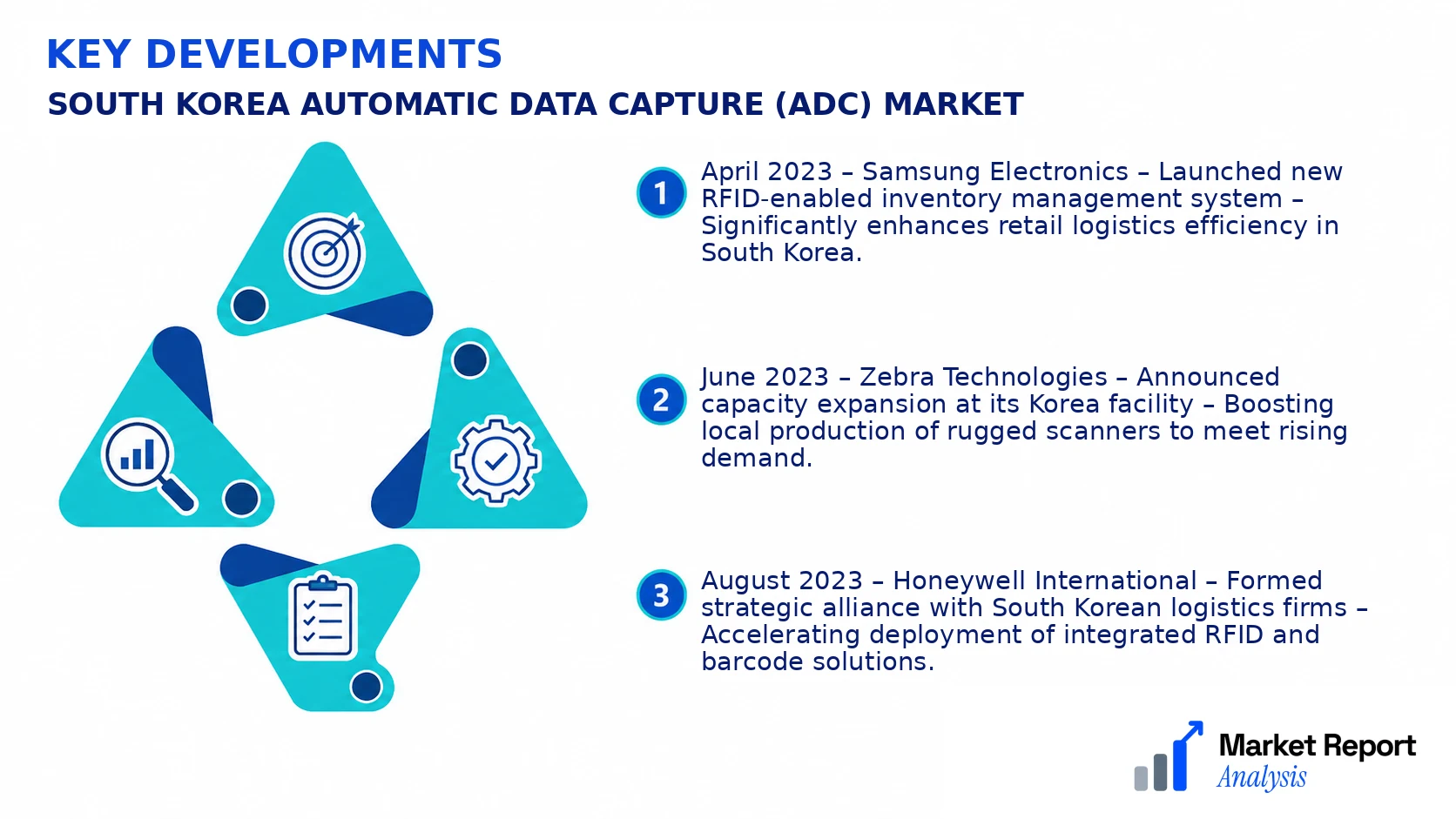
- April 2023 – Samsung Electronics – Launched new RFID-enabled inventory management system – Significantly enhances retail logistics efficiency in South Korea.
- June 2023 – Zebra Technologies – Announced capacity expansion at its Korea facility – Boosting local production of rugged scanners to meet rising demand.
- August 2023 – Honeywell International – Formed strategic alliance with South Korean logistics firms – Accelerating deployment of integrated RFID and barcode solutions.
- October 2023 – HID Global – Unveiled new biometric access control products – Improving security infrastructure in government and enterprise sectors.
- January 2024 – NCR Corporation – Acquired local POS hardware provider – Strengthening its retail automation ecosystem within Korea’s competitive market.
Frequently Asked Questions
What is the South Korea Automatic Data Capture (ADC) Market?
The South Korea Automatic Data Capture (ADC) Market encompasses technologies and solutions used to automatically collect, process, and analyze data in various sectors such as retail, logistics, healthcare, and manufacturing. It includes barcode scanners, RFID systems, and biometric devices, facilitating streamlined operations and enhanced data accuracy.
What is the current market size of South Korea Automatic Data Capture (ADC) Market?
As of 2026, the South Korea ADC Market is valued at approximately USD 2.5 Billion, reflecting robust adoption driven by digital transformation initiatives. The market is characterized by rapid growth in retail automation and supply chain digitization across the country.
What factors are driving the South Korea Automatic Data Capture (ADC) Market?
Market growth is propelled by increasing need for real-time data collection, rising investments in smart infrastructure, government incentives for Industry 4.0, and the proliferation of IoT-enabled devices. Additionally, the expansion of e-commerce and logistics sectors intensifies ADC adoption.
Which South Korean city leads the South Korea Automatic Data Capture (ADC) Market?
Seoul dominates the South Korea ADC Market, leveraging its status as the country’s economic and technological hub. The city's advanced retail, manufacturing, and logistics sectors contribute significantly to the deployment of ADC technologies.
Which segment is expected to grow the fastest?
The RFID segment is projected to exhibit the highest CAGR during 2026-2034, driven by its superior capabilities for inventory management, enhanced security, and improved tracking efficiency across retail and supply chain industries in South Korea.
Who are the leading companies operating in the South Korea Automatic Data Capture (ADC) Market?
Major players include Zebra Technologies, Honeywell, Datalogic, and Samsung SDS. These companies lead with innovative solutions, strategic collaborations, and extensive distribution networks, reinforcing their market presence in South Korea’s evolving ADC landscape.
Analyst Perspective
The South Korea Automatic Data Capture (ADC) Market exhibits a mature yet evolving landscape, poised for sustained growth driven by technological advancements and increasing regulatory pressures for data accuracy. The long-term outlook remains optimistic, with a projected CAGR of approximately 8.2% from 2026 to 2034, reflecting robust adoption across sectors, notably retail, logistics, and public transportation. Strategic investment focus should prioritize AI-enabled sensors, IoT integration, and enhanced cybersecurity measures to maintain competitive edge amid intensifying rivalry from domestic and international players. Seoul’s emphasis on smart city initiatives offers significant opportunities for ADC deployment, especially in urban hubs such as Busan and Incheon that are investing in infrastructure modernization. Market participants should adopt a forward-looking approach, emphasizing scalable, adaptable solutions that address privacy concerns while supporting government-led digital transformation agendas. Overall, the market’s maturity provides a stable base for innovation, with high-value opportunities centered on urban data ecosystems and city-level pilot programs that facilitate sustainable, tech-driven urban management.
