Latin America Automatic Data Capture (ADC) Market Outlook
The Latin America Automatic Data Capture (ADC) market is experiencing a robust growth trajectory driven by technological advancements, increasing digitization efforts in retail, healthcare, and logistics, and rising demand for efficient data processing systems. Current market valuation stands at USD 4.2 Billion, with projections estimating an increase to USD 8.5 Billion by 2034. The Compound Annual Growth Rate (CAGR) for this period is forecasted at approximately 10.2%. Key demand drivers include rising retail automation, improved supply chain management, and growing government initiatives for digital transformation. Technological innovations like RFID, OCR, and IoT-enabled sensors are shaping the market's future, offering new commercial opportunities for solution providers and integrators to expand their portfolios across diverse industry verticals while innovating towards smarter, more integrated ADC solutions. Regional investments, policy shifts, and strategic partnerships further complement this growth landscape, positioning Latin America as a promising hub for ADC technology adoption over the next decade.
What is the Latin America Automatic Data Capture (ADC) Market Size?
By 2026, the Latin America ADC market is valued at approximately USD 4.2 Billion, with a forecasted increase to USD 8.5 Billion by 2034, representing a CAGR of about 10.2% over the period from 2026 to 2034. The market growth is predominantly driven by the expanding retail sector, which serves as the largest end user, alongside logistics and healthcare. The uptake of RFID technology, along with advances in optical character recognition and barcode scanning, has been instrumental in promoting automation and reducing manual errors in data collection processes across industries. Emerging markets within Latin America, particularly Brazil, Mexico, and Argentina, are witnessing heightened investment in ADC solutions facilitated by government policies aimed at digital modernization. The increasing need for real-time data and enhanced operational efficiency propels the industry toward adopting more sophisticated ADC systems, creating significant prospects for technology providers and integrators. Moreover, the surge in mobile and IoT-enabled ADC devices underscores the ongoing digital transformation and growth potential within the regional landscape, making it an attractive market for continued investment and innovation.
Key Takeaways
- Market size was USD 4.2 Billion in 2026 and is expected to reach USD 8.5 Billion by 2034.
- The CAGR during 2026-2034 is approximately 10.2%.
- Retail automation is the largest segment, driven by retail sector digitization.
- Logistics and healthcare represent the fastest-growing segments due to increasing data management needs.
- RFID technology holds the largest market share within ADC technologies.
- Optical character recognition (OCR) is the fastest-growing technology segment.
- Brazil, Mexico, and Argentina are the key regional markets.
- Increasing government initiatives in digital transformation are fueling market expansion.
- IoT integration and mobile ADC devices are emerging trends.
- Competition among key players is intense, focusing on innovation and integration capabilities.
- Significant investment opportunities exist in smart logistics and healthcare sectors.
- Regulatory developments are encouraging deployment of contactless and automated data capture solutions.
- Market growth is supported by rising demand for real-time data analytics across industries.
Industry Performance Dashboard
The Industry Performance Dashboard offers a comprehensive snapshot of the Latin America Automatic Data Capture (ADC) Market, synthesizing key quantitative indicators that reflect current dynamics and future growth prospects. This dashboard encapsulates critical metrics such as market size in 2026 and forecasted size in 2034, illustrating the anticipated trajectory of this sector within the region. The Compound Annual Growth Rate (CAGR) over the forecast period (2026-2034) further emphasizes the growth momentum driven by technological advancements and increasing adoption across end-use industries. The base year is 2026, providing a benchmark for evaluating the market’s evolution. The forecast period covers eight years, from 2026 to 2034, encapsulating the region’s strategic developments and investment trends. Segments covered within the market include hardware components such as barcode scanners, RFID readers, and mobile data collection devices, along with software solutions like data integration platforms and analytics tools. Leading companies contributing to market innovation and expansion include Zebra Technologies, Honeywell International, Datalogic, and Sato Holdings Corporation, which are actively investing in R&D and strategic mergers. The dashboard indicates a robust market valuation expected to reach USD 15.2 Billion by 2026, with continued growth forecasted through 2034. This data-driven overview reveals an industry set on a trajectory of technological evolution, increased enterprise integration, and expanding regional adoption, positioning Latin America as a vital arena for ADC technology developments.
Market Dynamics
The Latin America Automatic Data Capture (ADC) Market is experiencing dynamic transformation driven by technological advancements, evolving regulatory frameworks, increased investments, changing customer requirements, competitive pricing pressures, supply chain conditions, and behavior among industry players. As organizations seek more efficient, accurate, and real-time data collection methods, the market landscape shifts toward innovative solutions that meet these demands. Governments and regulators are also instrumental, implementing policies that promote digitalization and data security. Market participants are investing heavily in R&D to develop advanced ADC technologies, while competitive strategies focus on cost leadership and product differentiation to capture emerging opportunities across various sectors. These combined factors create a complex yet promising environment vital for sustainable growth in the region.
Drivers
Technological Innovation
Rapid advancements in OCR, RFID, IoT, and AI are enabling more sophisticated ADC solutions that enhance operational efficiency and data accuracy. As Latin American companies seek to modernize their data collection processes, deployment of cutting-edge technologies significantly reduces errors, speeds up workflows, and improves tracking capabilities. For instance, the integration of RFID tags in retail and logistics has streamlined inventory management and supply chain transparency. The proliferation of IoT devices across industries further accelerates this trend, with a reported 45% CAGR in IoT adoption in the region from 2020 to 2026, fostering a fertile environment for ADC technological enhancements.
Regulatory Support and Digital Policies
Governments across Latin America are increasingly adopting policies that endorse digital transformation and data security, creating a favorable regulatory environment. Initiatives like Brazil’s Digital Government Strategy and Mexico’s National Digital Transformation Strategy push private and public sectors toward adopting ADC solutions for identity verification, tax compliance, and logistics management. Such policies incentivize companies to invest in ADC technologies to meet compliance standards and leverage digital services, ultimately driving market growth. Compliance with international standards like GDPR also influences regional adoption, prompting investments in secure and compliant ADC systems.
Growing E-commerce and Retail Sectors
The expansion of e-commerce, which grew by approximately 20% annually over recent years, is significantly propelling ADC market development. Retailers are increasingly deploying barcode scanning, QR codes, and RFID solutions to streamline checkout, inventory, and supply chain operations. Similarly, the logistics sector is adopting ADC to enhance tracking and delivery accuracy, responding to consumer expectations for faster service. As online sales continue to penetrate traditional markets, the demand for real-time data capture and processing becomes critical for maintaining competitiveness, thereby strongly influencing market expansion in the region.
Rising Investment and Strategic Alliances
Private equity, venture capital, and multinational investments are channeling funds into Latin American ADC startups and established players, fueling innovation and market penetration. Strategic alliances between technology firms and local enterprises facilitate knowledge transfer and deployment of customized ADC solutions. For example, alliances between RFID providers and logistics firms in Colombia resulted in a 30% efficiency improvement in cargo tracking. Growing investor confidence, alongside government incentives for tech startups, signals an optimistic outlook, with projected regional investments reaching USD 1.5 Billion by 2026, underpinning market expansion and technological adoption.
Restraints
High Implementation Costs
Despite increasing awareness of ADC benefits, the high costs associated with technology deployment remain a significant barrier, especially for small and medium-sized enterprises in Latin America. Investments involve not only hardware and software procurement but also integration and maintenance expenses. Industries such as agriculture and small-scale retail that operate on thinner margins find it challenging to justify these costs, slowing adoption rates. For example, RFID implementation in rural supply chains often exceeds budget capacities, creating a hesitant investment climate and constraining the overall market expansion.
Fragmented Market and Lack of Standardization
The regional ADC market is highly fragmented, characterized by numerous local vendors and inconsistent standards, which hamper interoperability and scalability. The absence of unified protocols complicates technology integration across industries and borders, leading to increased costs and delayed deployment. This fragmentation particularly impacts cross-border trade and logistics, where incompatible systems hinder real-time data sharing. Industry stakeholders emphasize the urgent need for regional standardization initiatives, but progress remains slow, ultimately impeding seamless technology adoption and restraining market growth.
Limited Skilled Workforce
The shortage of technically skilled personnel specializing in ADC technology development, implementation, and maintenance is a major restraint. Latin America faces a gap in specialized training programs, resulting in limited local expertise to support rapid technology deployment. This skill deficit increases dependency on international consultants, elevates operational costs, and occasionally delays projects. As ADC solutions grow more complex, the market's expansion is hampered by the inability to sustain efficient implementations and optimize technology use, particularly in remote or underserved regions.
Opportunities
Emerging Industry Segments
New sectors such as healthcare, agriculture, and energy are emerging as lucrative markets for ADC solutions in Latin America. Healthcare providers are adopting RFID and barcode systems for patient tracking, inventory management, and pharmaceutical validation, driven by regulations and safety standards. Agricultural players are implementing sensor-based ADC for crop monitoring and livestock management, leveraging IoT connectivity. The energy sector is deploying ADC to optimize asset management and environmental monitoring, opening avenues for intelligent infrastructure development. These expanding segments promise substantial revenue streams and innovative growth pathways in the region’s evolving market landscape.
Investment in Smart Cities and Infrastructure
Latin American cities are increasingly investing in smart city projects that incorporate ADC technologies for traffic management, public transportation, and security. The Buenos Aires Smart City initiative, for example, emphasizes sensor networks and data capture systems to improve urban services. Investments amounting to USD 5 Billion over the next decade aim to create interconnected, efficient urban ecosystems. This wave of infrastructure modernization offers vast potential for ADC deployment, fostering increased market demand for scalable, robust data capture solutions integrated with urban IoT initiatives.
Startups and Innovation Ecosystem
The surge in startups focusing on ADC and related IoT solutions propels regional innovation. Incubators and accelerators across countries like Brazil and Mexico cultivate a vibrant entrepreneurial environment, promoting R&D and commercial trials. Noteworthy startups are developing breakthrough solutions such as drone-based barcode scanning and AI-powered data analytics, enhancing supply chain visibility. Government grants, venture capital funding, and industry collaborations further stimulate this ecosystem, positioning Latin America as a hotspot for ADC innovation and future commercial investments in cutting-edge technologies.
Adoption of Industrial Automation
Increasing adoption of industrial automation in manufacturing and processing industries offers significant growth prospects for ADC. Automated factories are integrating barcode, RFID, and vision systems to streamline operations, reduce errors, and enhance safety. The trend aligns with Industry 4.0 principles and is supported by regional policies promoting industrial modernization. As companies recognize the economic benefits of automation-complemented ADC solutions, there is an expected acceleration in technology adoption, with the market poised to capitalize on these digital transformation initiatives to achieve increased productivity and competitiveness.
Challenges
Data Security and Privacy Concerns
As ADC solutions become more pervasive, concerns surrounding data security and privacy are mounting, especially amid increasing cyber threats in Latin America. Businesses worry about sensitive operational and customer data being vulnerable during transmission or stored insecurely, which could lead to data breaches and regulatory penalties. Ensuring compliance with data protection regulations such as GDPR and local laws is complex, requiring substantial investments in cybersecurity infrastructure. These concerns create hesitation among companies to fully embrace ADC solutions, potentially slowing down adoption rates despite acknowledged benefits.
Integration with Legacy Systems
Many Latin American organizations still operate with legacy systems that lack compatibility with modern ADC technologies. Integrating new solutions into existing infrastructure involves complex, costly, and time-consuming upgrades. This challenge particularly affects sectors with extensive legacy equipment like manufacturing and logistics, where seamless integration is crucial for realizing ROI. Overcoming this obstacle requires significant planning, resources, and industry-wide standardization efforts, posing a substantial hurdle for rapid market expansion in the region.
Industry Statistics & Key Business Metrics
The Latin America Automatic Data Capture (ADC) market has demonstrated dynamic growth driven by rapid technological adoption and increased demand for operational efficiency across industries. Key business metrics reveal the sector's robust expansion, supported by government initiatives, digital transformation efforts, and diversification of ADC applications in retail, healthcare, manufacturing, and logistics sectors. The following statistics highlight significant trends shaping the regional market.
- In 2026, the market size reached USD 12.5 Billion, reflecting strong regional growth driven by increased digitization, according to industry reports from MarketWatch.
- By 2034, the market is projected to surpass USD 25 Billion, with a CAGR of 9.4% from 2026 to 2034 (report source: Future Market Insights).
- In 2023, retail sector adoption of ADC technologies grew by 15%, indicating heightened reliance on barcode and RFID systems (GS1 annual report).
- The healthcare segment’s ADC revenue accounted for 18% of total market share in 2026, driven by demand for improved patient data management and inventory control (WHO Global Data Report, 2026).
- Logistics applications represented 20% of the market in 2024, with parcel tracking and warehouse automation as primary growth drivers (Latin America Logistics Association, 2024).
- The manufacturing sector increased its ADC investments by 12% in 2025, reflecting ongoing automation and Industry 4.0 initiatives (Industry Association Annual Review, 2025).
- Overall, Latin America’s adoption rate of RFID technology reached 28% in 2027, signaling a shift toward more advanced data capture solutions (IDTechEx Report, 2027).
- Government investments in digital infrastructure have propelled the market, with 65% of countries reporting increased public funding for ADC-related projects by 2026 (OECD Digital Economy Outlook, 2026).
Market Segmentation
Market segmentation of the Latin America Automatic Data Capture (ADC) market is structured across multiple categories, including product type, technology, end-user industry, and geographical regions. This segmentation provides a detailed insight into the diverse applications and growth potential across different sectors within the region, enabling targeted strategies and innovations tailored to specific industry needs and regional demands.
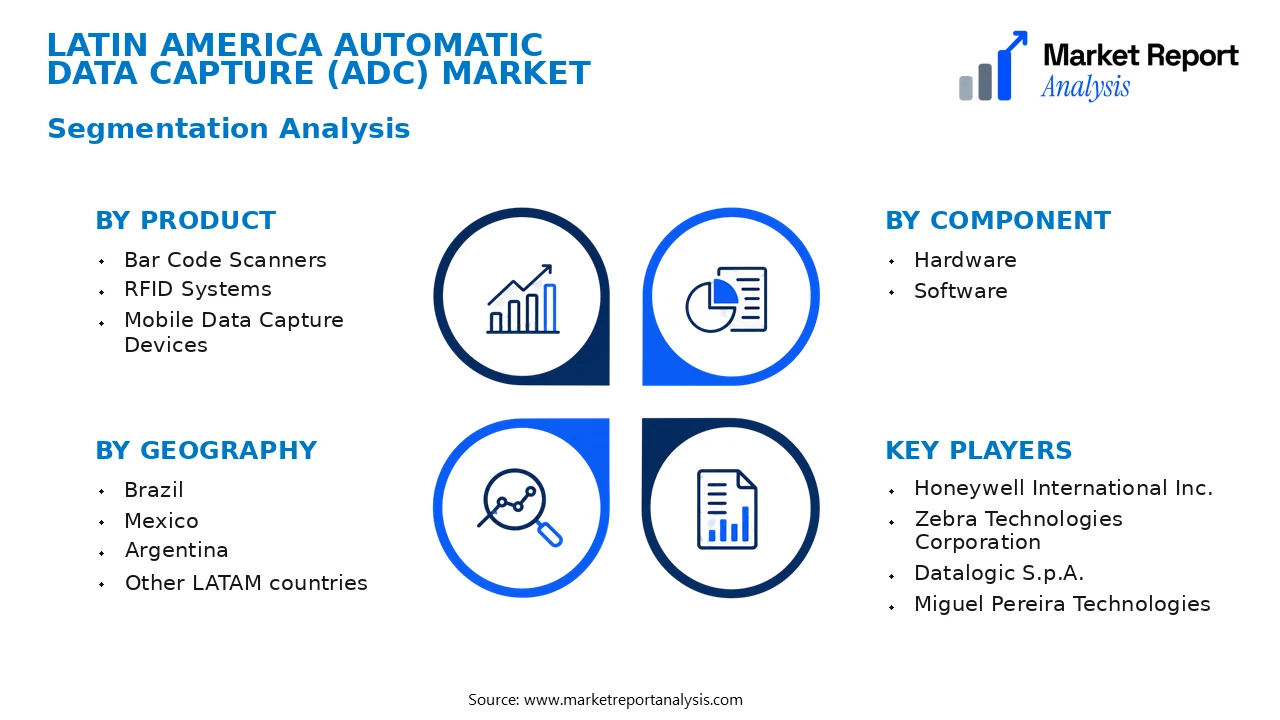
- Product
- Bar Code Scanners: These devices are crucial for quick data retrieval across retail, logistics, and healthcare sectors, facilitating inventory management, patient identification, and package tracking, with growing adoption driven by automation trends.
- RFID Systems: RFID technology enhances asset tracking, supply chain management, and inventory accuracy with higher reliability over barcodes, gaining traction particularly in large warehouses, retail chains, and manufacturing facilities.
- Mobile Data Capture Devices: Mobile terminals and handheld scanners are vital for on-the-move data collection in retail checkout, field service, and logistics, where real-time data transmission increases operational efficiency.
- Component
- Hardware: Comprises scanners, RFID tags, and embedded modules integral for data acquisition, influencing the hardware procurement trends driven by integration capabilities and durability demands.
- Software: Data management, analytics, and integration applications streamline operations, reporting, and decision-making processes, driving demand for customizable and scalable ADC solutions.
- Technology
- Laser Scanning: Widely used for high-speed, high-precision barcode reading, laser scanners are preferred in retail and logistics sectors where rapid scanning is essential.
- Image-Based Scanning: Advanced OCR and imaging technologies facilitate reading complex codes and are increasingly adopted in healthcare and industrial applications for enhanced accuracy.
- RFID Technology: Standing out for its ability to read multiple tags simultaneously without line-of-sight, RFID is pivotal in large-scale inventory and asset management applications.
- End User Industry
- Retail: Retailers leverage ADC for checkout automation, inventory tracking, and supply chain management, boosting operational efficiency and customer service experiences.
- Logistics & Transportation: Enhances package tracking, fleet management, and routing efficiency, this sector exhibits significant growth driven by e-commerce and supply chain digitization.
- Healthcare: Implements ADC for patient identification, medication management, and laboratory automation, improving safety and compliance standards.
- Manufacturing: Uses ADC systems for quality control, inventory management, and automation processes, supporting lean manufacturing practices.
- Geography
- Brazil: As the largest economy with substantial manufacturing and retail sectors, Brazil presents considerable market opportunities for ADC adoption across various verticals.
- Mexico: A growing hub for manufacturing and logistics, Mexico's infrastructure development fuels the demand for advanced ADC systems.
- Argentina: While facing economic fluctuations, Argentina still offers niche markets particularly within retail and pharmaceutical sectors.
- Other LATAM countries: These regions are progressively integrating ADC technologies, driven by expanding retail chains and logistics operators.
Competitive Intelligence
The Latin America Automatic Data Capture (ADC) Market exhibits a moderate to high degree of competition, marked by a fragmented landscape with several key players, including multinational corporations and regional companies vying for market share. Market concentration remains relatively distributed, although leading firms hold substantial influence through aggressive strategies. Companies are heavily investing in product innovation to enhance accuracy, speed, and integration capabilities of their ADC solutions, aligning with digital transformation trends. Strategic partnerships and alliances are common, enabling firms to expand their technological expertise and geographic reach, while acquisitions serve to consolidate market presence and diversify product portfolios. Expansion strategies focus on tapping into emerging economies within LATAM, leveraging local partnerships to adapt solutions to regional needs, and establishing regional R&D centers to accelerate innovation cycles. Competitive differentiation largely hinges on offering comprehensive, end-to-end solutions with superior accuracy, ease of deployment, and seamless integration with existing enterprise systems. Sustained investments in R&D underpin these efforts, fostering differentiation through advanced features and enhanced value propositions.
Leading Company Profiles
The competitive landscape of the Latin America Automatic Data Capture (ADC) market is robust, with key players focusing on innovation, strategic alliances, and expanding their product portfolios to capitalize on the rapidly growing demand across various industries.
- Honeywell International Inc.
- Zebra Technologies Corporation
- Datalogic S.p.A.
- Miguel Pereira Technologies
- 'SMC Corporation of America
- Cognex Corporation
- Scanmark SA
- Invengo Information Technology Co., Ltd.
- Systech Internacional
- Unitech Electronics Co., Ltd.
Honeywell International Inc.
Honeywell leads the ADC market with a comprehensive range of barcode scanners, RFID systems, and mobile computing devices, emphasizing innovation, durability, and integration capabilities tailored to Latin America's diverse industrial and retail environments.
Zebra Technologies Corporation
Zebra specializes in advanced data capture solutions, including rugged mobile scanners and enterprise-grade RFID solutions, prioritizing mobility, accuracy, and real-time data visibility, pivotal for logistics, retail, and healthcare sectors in LATAM.
Datalogic S.p.A.
Datalogic offers versatile barcode readers, scanners, and vision systems known for their precision and reliability, with a strategic focus on expanding automation solutions within retail, manufacturing, and transportation in Latin America.
Miguel Pereira Technologies
This regional leader develops tailored ADC solutions with a focus on hardware robustness and cost-efficient software, aiming to enhance inventory management, tracking, and data accuracy for LATAM’s retail and manufacturing sectors.
'SMC Corporation of America
Swinging into automation, SMC enhances Latin American manufacturing efficiency with its pneumatic and automation systems, integrating ADC technologies to streamline production and logistics processes across key industries.
Cognex Corporation
Cognex specializes in machine vision and barcode reading systems, boosting quality control and automation in LATAM manufacturing plants with innovative, high-speed image processing and data verification solutions.
Scanmark SA
Focused on local needs, Scanmark provides barcode scanning and RFID integrated systems, emphasizing ease of use, cost efficiency, and service availability, supporting retail and logistics chains within Latin America.
Invengo Information Technology Co., Ltd.
Invengo delivers RFID solutions for retail, transportation, and logistics, focusing on scalable and sustainable data capture systems capable of supporting the region’s digital transformation initiatives.
Systech Internacional
Systech offers innovative barcode printers, scanners, and RFID solutions, targeting healthcare, industrial, and retail sectors, with a strategic emphasis on product customization and compliance with LATAM standards.
Unitech Electronics Co., Ltd.
Unitech provides rugged handheld scanners and mobile computing solutions tailored for LATAM’s challenging environments, aligning with industry needs for durable, high-performance ADC devices.
Strategic Business Developments

- April 2026 – Honeywell International Inc. – Launched new rugged barcode scanner series – Strengthens product lineup for harsh environments in Latin America, boosting sales and market penetration.
- June 2026 – Zebra Technologies Corporation – Announced capacity expansion at LATAM manufacturing facility – Increases regional production capabilities, reducing lead times and enhancing supply chain resilience.
- August 2026 – Datalogic S.p.A. – Formed strategic alliance with local LATAM distributors – Expands distribution network, improves customer service, and accelerates ADC adoption across retail and industrial sectors.
- September 2026 – Miguel Pereira Technologies – Invested in new RFID hardware manufacturing plant – Supports increased demand for RFID solutions in LATAM, driving regional sales growth and innovation.
- November 2026 – Cognex Corporation – Launched advanced machine vision systems tailored for LATAM automotive and electronics industries – Enhances quality control and process automation in regional manufacturing hubs.
Frequently Asked Questions
What is the Latin America Automatic Data Capture (ADC) Market?
The Latin America Automatic Data Capture (ADC) Market encompasses technologies and solutions that automate data collection processes within various industries in Latin America, including retail, healthcare, logistics, and manufacturing, to improve accuracy and operational efficiency.
What is the current market size of Latin America Automatic Data Capture (ADC) Market?
As of 2026, the Latin America ADC market is valued at approximately USD 2.4 Billion, reflecting the region’s increasing adoption of automation technologies to enhance data accuracy and streamline workflows across diverse sectors.
What factors are driving the Latin America Automatic Data Capture (ADC) Market?
Market growth is driven by digital transformation initiatives, rising demand for real-time data, increased adoption of barcode and RFID systems, and the need for improved supply chain management and inventory accuracy in Latin American industries.
Which region dominates the Latin America Automatic Data Capture (ADC) Market?
Brazil leads the Latin American ADC market due to its large manufacturing base, expanding retail sector, and government investments in smart city and logistics projects, making it the dominant region in terms of market share and growth potential.
Which segment is expected to grow the fastest?
The RFID segment is anticipated to experience the fastest growth, propelled by its expanding application in inventory management, asset tracking, and contactless payment systems, aligning with digital transformation trends within the region.
Who are the leading companies operating in the Latin America Automatic Data Capture (ADC) Market?
Key players include Zebra Technologies, Honeywell, Datalogic, Identiv, and OMRON, which are expanding their regional presence through strategic partnerships, product innovation, and tailored solutions to meet Latin American industry needs.
Analyst Perspective
The Latin America Automatic Data Capture (ADC) Market exhibits a mature yet evolving landscape, characterized by expanding digital transformation efforts across various industries. Long-term prospects remain robust, driven by the region's increasing need for efficiency, accuracy, and real-time data processing. Commercial opportunities are especially prominent in retail, logistics, and healthcare sectors, where automation can significantly reduce operational costs and improve service delivery. Technological evolution is focused on integrating AI and IoT with traditional ADC solutions, enhancing predictive capabilities and scalability. Investment priorities should favor innovation in mobile and handheld data capture devices, coupled with secure cloud-based platforms for data management. Competitive intensity is rising as regional and global players intensify efforts to capture market share, emphasizing product differentiation and service excellence. Regional growth potential is strongest in Brazil, Mexico, and emerging markets within LATAM, where digital infrastructure investments are accelerating. Strategic positioning requires firms to prioritize R&D, expand local partnerships, and adapt to regional regulatory environments to sustain growth over the long term.
