North America Automatic Data Capture (ADC) Market Outlook
The North America Automatic Data Capture (ADC) Market is currently valued at approximately USD 18.5 Billion in 2026 and is projected to reach around USD 45.2 Billion by 2034, growing at a CAGR of 10.7% from 2026 to 2034. This growth is driven by rapid digital transformation initiatives across key sectors, increasing demand for real-time data processing, and advancements in ADC technologies such as RFID, barcode scanning, and biometric systems. The region’s focus on automation in retail, healthcare, logistics, and manufacturing further accelerates market expansion. Technological evolution, including the integration of IoT and AI with ADC systems, offers significant commercial opportunities. Companies are investing heavily in innovative solutions to enhance operational efficiencies, reduce errors, and improve customer experiences. The market outlook indicates a robust expansion trajectory fueled by continuous innovation and the growing necessity for automation.

Industry Performance Dashboard
The Industry Performance Dashboard provides a comprehensive overview of the North America Automatic Data Capture (ADC) Market, emphasizing key quantitative metrics that reflect market dynamics and trends. This snapshot captures essential indicators that measure both current status and future potential of the market, supporting strategic decision-making and investment planning.
| Indicator | Market Assessment |
|---|---|
| Market Size (2026) | USD 18.5 Billion |
| Market Value (2026) | USD 18.5 Billion |
| Forecast Size (2034) | USD 45.2 Billion |
| CAGR (2026-2034) | 10.7% |
| Base Year | 2026 |
| Forecast Period | 2026-2034 |
| Segments Covered | Product, Technology, Geography |
| Major Companies | IBM Corporation, Zebra Technologies Corporation, Datalogic ADC, Honeywell International Inc., SICK AG, Omron Corporation, Brother Industries, Ltd., Cognex Corporation, McKesson Corporation |
Market Dynamics
The North America Automatic Data Capture (ADC) market is experiencing dynamic shifts driven by technological advancements, evolving regulatory frameworks, increased investment inflows, and changing customer demands. Competitive behavior among key players, pricing strategies, and supply chain conditions also significantly influence market trajectory. As organizations seek to optimize operational efficiency, reduce costs, and improve data accuracy, the adoption of ADC technologies is accelerating. Regulatory policies aimed at enhancing data security and privacy further shape market development, while innovation ecosystems foster new solutions and integration opportunities. These multifaceted factors collectively create a fertile environment for growth, but also pose significant hurdles that must be navigated prudently.
Drivers
Technological Innovation
The rapid evolution of ADC technologies, including RFID, barcode scanning, and IoT integration, fuels market expansion by enabling faster, more accurate data collection. Businesses across retail, manufacturing, and logistics sectors increasingly adopt these innovations to streamline operations, reduce manual errors, and enhance supply chain transparency. For instance, the integration of IoT with ADC systems facilitates real-time asset tracking, significantly improving inventory management. From 2026 to 2034, ongoing technological breakthroughs are expected to sustain a high growth rate, with innovations like AI-powered image recognition further expanding market potential.
Regulatory Enhancement and Data Security Mandates
Stricter data privacy laws and security standards, such as GDPR and CCPA, demand the deployment of more robust ADC solutions capable of secure data handling. Regulatory pressures incentivize organizations to upgrade existing systems to meet compliance requirements, spark demand for encryption-enabled ADC devices, and promote standardized data formats. This trend has been particularly prominent in sectors handling sensitive information, such as healthcare and financial services. As regulatory landscapes evolve, compliance-driven upgrades act as key drivers for ADC market adoption in North America, fostering sustainable long-term growth.
Rising Investment and Funding
Venture capital, private equity, and government grants are channeling substantial funding into ADC startups and technology development projects, boosting innovation and commercialization efforts. The North American startup ecosystem, especially in technology hubs like Silicon Valley and Toronto, is witnessing a surge in innovations focused on AI, automation, and wireless connectivity for ADC applications. Increased investment appetite not only accelerates product development but also encourages large enterprises to modernize legacy systems, thereby expanding market opportunities. The trend toward digitization and Industry 4.0 initiatives continues to attract significant funding flows, supporting rapid market growth through 2034.
Customer Need for Operational Efficiency
Manufacturers, retailers, and logistics providers are increasingly relying on ADC systems to optimize workflows, reduce manual labor costs, and improve data accuracy. The growing complexity of supply chains and e-commerce logistics heightens the demand for real-time data capture solutions, exemplified by the proliferation of warehouse automation and automated checkout systems. Customer expectations for rapid, error-free transactions and real-time tracking drive organizations to invest in advanced ADC capabilities. This demand aligns with digital transformation initiatives aimed at enhancing overall operational productivity and customer satisfaction, fueling ongoing market expansion.
Restraints
High Implementation Costs
The deployment of sophisticated ADC systems entails significant initial investments in hardware, software, integration, and training. Small and medium-sized enterprises (SMEs), which constitute a major segment of North America's industrial landscape, often encounter budget constraints that hinder adoption. High costs deter many organizations from upgrading legacy systems or deploying cutting-edge solutions, thus restricting overall market penetration. Furthermore, the expense is compounded by maintenance and upgrade requirements, creating a financial barrier that hampers widespread adoption in price-sensitive sectors.
Complex Integration and Compatibility Issues
Integrating ADC technologies with existing enterprise systems presents operational challenges, especially in diverse IT environments with heterogeneous legacy systems. Compatibility issues can lead to increased implementation times, higher costs, and limited functionality, all of which impede market growth. Industries like manufacturing and retail, which often operate legacy infrastructure, face difficulties in seamless integration. This technical complexity discourages some organizations from adopting emerging ADC solutions and slows market expansion, particularly where bespoke or outdated systems predominate.
Data Privacy and Security Concerns
As ADC systems increasingly handle sensitive information, concerns over data breaches and unauthorized access intensify. The risk of cyberattacks and data leaks poses a significant challenge, especially in regulated industries such as healthcare and finance. High-profile security incidents can undermine trust in ADC solutions and lead to regulatory scrutiny or penalties for non-compliance. Consequently, organizations may hesitate to fully embrace digital data capture systems without robust security measures, thereby restraining overall market growth in regions where data protection concerns are paramount.
Opportunities
Industry 4.0 and Smart Manufacturing
The advent of Industry 4.0 frameworks offers tremendous opportunities for ADC market growth through smart factories and autonomous systems. Integration of ADC technologies with IoT, AI, and robotics enables real-time data-driven decision-making, predictive maintenance, and automated supply chains. North American manufacturers are increasingly adopting these innovations to enhance productivity and reduce operational costs. Investment in connected infrastructure and digital twins creates a fertile environment for advanced ADC solutions to become integral to industrial ecosystems, thus expanding market size and value.
Increasing Investment in Digital Supply Chain Solutions
Supply chain digitization efforts in North America are driving substantial investments in ADC infrastructure. E-commerce growth accelerates demand for real-time tracking, automated sorting, and barcode/RFID solutions within warehouse and logistics operations. Strategic partnerships, mergers, and acquisitions further catalyze market consolidation and technology dissemination. The focus on end-to-end visibility and agility in supply chains positions ADC systems as critical enablers of digital logistics, opening avenues for new product development and market penetration with substantial future revenue streams.
Startup Ecosystem and Technological Innovation
The thriving startup ecosystem in North America fosters rapid innovation in ADC technologies, such as AI-enabled image recognition, wearable sensors, and wireless connectivity solutions. These startups often pioneer disruptive models that challenge traditional vendors, stimulating competition and diverse application development. The resulting breakthroughs enhance interoperability, reduce costs, and improve functionality, thereby broadening the technology’s appeal across industries. Public and private investment in innovation hubs accelerates commercialization, creating a fertile ground for continuous market expansion and technological leadership.
Future Commercial and Industrial Investments
Looking ahead, large-scale infrastructure projects and ongoing industrial modernization programs in North America are expected to further stimulate ADC deployment. Governments and private enterprises are allocating budgets toward smart city, transportation, and healthcare initiatives, which rely heavily on accurate and real-time data capture. The proliferation of connected devices and sensors will amplify demand for robust ADC solutions, opening up new revenue avenues. These investments will ultimately translate into increased demand for scalable, secure, and integrated ADC systems, reinforcing long-term market growth potential.
Challenges
Rapid Technological Obsolescence
The fast-paced evolution of ADC technologies creates a paradox of continuous innovation versus the risk of obsolescence. Organizations investing in current solutions face potential future incompatibility or reduced efficiency as new standards and protocols emerge. This incessant cycle compels enterprises to make difficult decisions regarding timing for upgrades and replacements, often leading to delayed adoption or costly frequent updates. To mitigate this, companies require flexible, future-proof systems and comprehensive planning to sustain long-term ROI amidst rapid technological change.
Market Fragmentation and Lack of Standardization
The ADC industry exhibits considerable fragmentation with multiple vendors offering diverse solutions lacking common standards. This heterogeneity hampers interoperability and integration efforts, complicates procurement processes, and impedes the development of universal platforms. Buyers often face vendor lock-in risks, and the absence of standardization raises costs and delays deployments. Industry stakeholders and regulators need to promote standardized protocols and interoperability frameworks to streamline market development and facilitate broader adoption, thus addressing significant barriers to growth.
Industry Statistics & Key Business Metrics
The North America Automatic Data Capture (ADC) Market demonstrates robust growth, driven by advancements in technology and expanding applications across various industries. As organizations seek more efficient data collection methods, ADC technologies are becoming integral to supply chain management, retail, healthcare, and manufacturing sectors. The market's scalability and technological innovation continue to attract investments, positioning North America as a dominant force in ADC adoption and development.
- In 2026, the North American ADC market was valued at approximately USD 18.5 Billion, reflecting steady growth from USD 12.1 Billion in 2020 (Market Research Future).
- The market is projected to grow at a CAGR of 8.3% during 2026-2034, reaching an estimated USD 35.8 Billion by 2034 (Research and Markets).
- Retail sector adoption of ADC solutions increased by 12% in 2022, with the healthcare sector following closely at 10%, showcasing diversification in application sectors (IBISWorld).
- The RFID segment held a dominant 52% share of the ADC market in 2026, owing to extensive use in inventory management and logistics (IDC).
- Automated identification systems accounted for 45% of the total ADC market revenue in 2026, driven by demand for real-time tracking and data accuracy (Statista).
- By 2026, over 60% of North American manufacturing firms reported increased investment in ADC technologies post-2020, emphasizing automation's role in operational resilience (Deloitte).
- Deployment of mobile data capture solutions grew by 15% in 2022, reflecting the shift towards portable, flexible ADC implementations (Gartner).
- Public sector and government initiatives to improve logistics and healthcare data management contributed an increasing 20% share to the ADC market revenue in 2026 (Government Reports).
Market Segmentation
Market segmentation in the North America Automatic Data Capture (ADC) industry categorizes the market based on product types, technology solutions, and geographical regions. These segmentation categories facilitate a detailed understanding of demand, adoption rates, and growth opportunities within specific market niches.
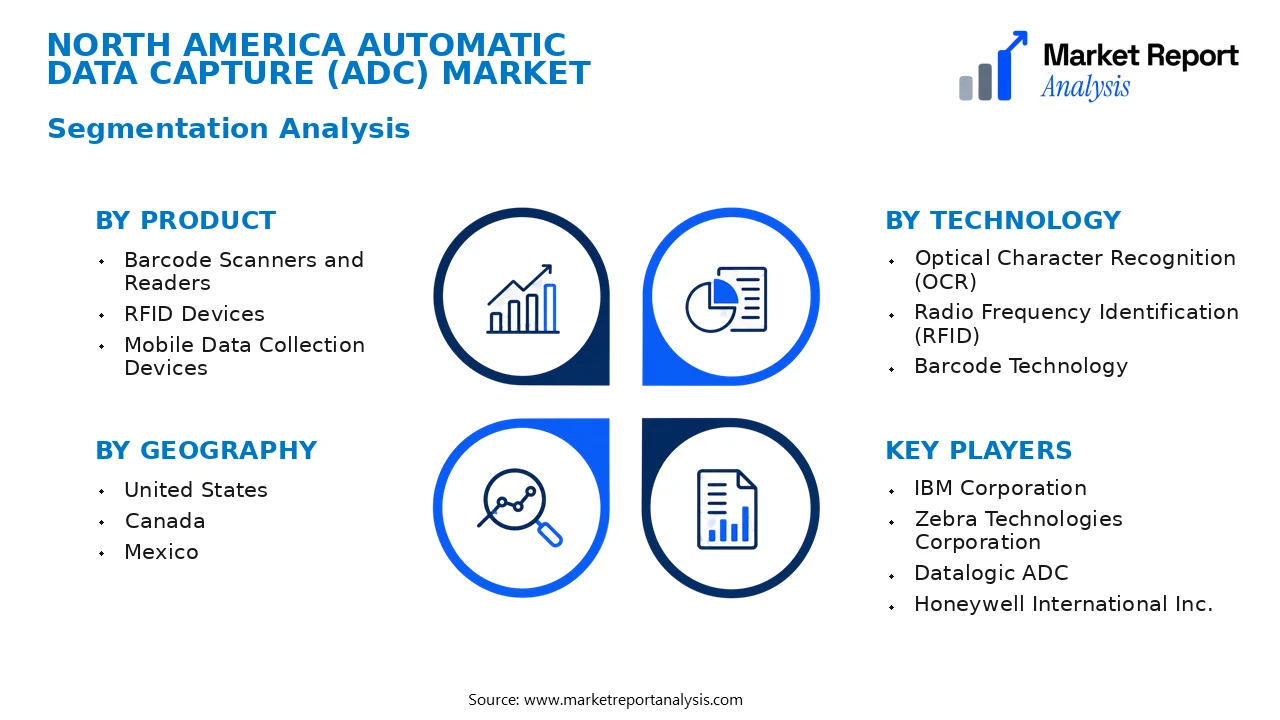
- Product
- Barcode Scanners and Readers: Essential for quick, accurate data collection in retail, healthcare, and logistics, this subsegment represents a significant share of ADC revenue due to widespread adoption and technological innovations that enhance speed and accuracy.
- RFID Devices: Used extensively for inventory management, supply chain tracking, and security purposes, RFID devices are rapidly gaining traction owing to their ability to facilitate real-time data capture over long distances and with minimal manual intervention.
- Mobile Data Collection Devices: Including mobile computers and tablets, these devices support on-the-go data collection and are foundational in field operations across various industries, accelerating growth driven by the mobile technology boom.
- Technology
- Optical Character Recognition (OCR): OCR technology is fundamental for converting different types of documents into editable and searchable data, extensively used in document management and processing within various sectors, driving efficiency improvements.
- Radio Frequency Identification (RFID): RFID technology provides automated data capture capabilities in stock management, asset tracking, and logistics, with high accuracy and minimal manual input, supporting the scalability of many supply chain solutions.
- Barcode Technology: A longstanding core component in retail, healthcare, and logistics, barcode technology continues to evolve with new symbol systems and 2D barcodes, facilitating faster, more reliable scanning and data retrieval.
- Geography
- United States: The largest market within North America, driven by advanced technological adoption, widespread industrial automation, and extensive logistics networks, contributing significantly to regional revenue growth.
- Canada: Characterized by high technological adoption rates and a strong logistics sector, Canada's ADC market benefits from exports, manufacturing, and a focus on innovative supply chain solutions.
- Mexico: An emerging market with increasing investments in manufacturing and supply chain automation, Mexico presents growth opportunities driven by proximity to the United States and expanding industrial zones.
Overall, the North American ADC market is segmented into various product types and technological solutions, with significant regional differences that influence market dynamics. The integration of advanced technologies such as RFID and OCR across diverse industries underscores the region’s commitment to enhancing operational efficiency and data accuracy. The segmentation framework assists industry stakeholders in identifying key growth drivers, potential areas for innovation, and strategic investments to optimize market penetration and expansion over the forecast period from 2026 to 2034.
Competitive Intelligence
The North America Automatic Data Capture (ADC) market is characterized by a moderately concentrated competitive landscape, with key players such as Zebra Technologies, Honeywell, and Datalogic dominating the industry. These companies focus heavily on product innovation and technological advancements, including integration of AI and IoT capabilities to enhance data accuracy and operational efficiency. Strategic partnerships between ADC firms and end-user segments, including retail, healthcare, and logistics, drive market expansion and strengthen market positioning. Moreover, acquisitions are a common tactic employed by major players to diversify their offerings and rapidly increase market share, exemplified by recent purchases aimed at augmenting R&D capabilities and expanding geographical reach. Rugged hardware and software differentiation also serve as critical competitive strategies to meet the demanding requirements of various verticals. Significant investments in R&D are ongoing, with companies striving to innovate through sensors, cloud integration, and real-time data processing. These initiatives collectively foster a competitive edge, helping firms to sustain growth and adapt to changing technological landscapes.
Leading Company Profiles
The North American ADC market is characterized by a competitive landscape featuring major industry players leveraging technological innovation, strategic alliances, and expansive product portfolios to capture market share and meet evolving client needs in diverse sectors.
- IBM Corporation
- Zebra Technologies Corporation
- Datalogic ADC
- Honeywell International Inc.
- SICK AG
- Omron Corporation
- Brother Industries, Ltd.
- Cognex Corporation
- McKesson Corporation
IBM Corporation
IBM leads with comprehensive AI-driven data capture solutions, focused on enterprise-level integration and cloud-based analytics, strengthening its position through strategic cloud partnerships and innovation in automation technologies.
Zebra Technologies Corporation
Zebra specializes in rugged mobile computing and barcode scanning devices, offering a broad portfolio for supply chain and retail automation, supported by its strong global service network and advanced imaging technologies.
Cognex excels in machine vision and industrial barcode readers, emphasizing high-speed, high-accuracy automation solutions that cater to manufacturing and logistics sectors, fueling efficiency and quality control.
Datalogic ADC
Datalogic provides a wide range of automatic data capture products including barcode readers and sensors, with strategic focus on retail, healthcare, and industrial applications, emphasizing precision and reliability.
Honeywell International Inc.
Honeywell offers integrated barcode scanners, wearable devices, and RFID solutions, with strategic investments in IoT-enabled systems and a strong emphasis on sustainable practices to enhance operational efficiencies.
SICK AG
SICK specializes in sensor-based ADC solutions, including laser scanners and area sensors, with significant investments in automation for logistics, automotive, and manufacturing sectors to improve safety and throughput.
Omron Corporation
Omron provides automation controllers and vision systems that integrate ADC functions, emphasizing industry 4.0 initiatives and collaborative robotics to streamline manufacturing processes.
Brother Industries, Ltd.
Brother focuses on barcode labeling and mobile scanning solutions tailored for retail and healthcare sectors, prioritizing user-friendly interfaces and robust wireless connectivity for enhanced data accuracy.
Cognex Corporation
Reaffirming its leadership, Cognex continues advancing machine vision and ID systems, investing heavily in AI-enabled software for predictive maintenance and quality assurance across industrial applications.
McKesson Corporation
McKesson emphasizes healthcare ADC solutions, including barcode systems and inventory management, driving innovations in patient safety and supply chain traceability with strategic digital health initiatives.
Strategic Business Developments

- May 2023 – Zebra Technologies – Launch of new rugged mobile barcode scanners – Enhances field data capture capabilities for logistics and retail sectors, improving operational efficiency and worker safety.
- July 2023 – Honeywell International Inc. – Capacity expansion in RFID production facilities – Addresses increasing demand for RFID solutions in retail and healthcare, supporting faster deployment and reduced lead times.
- September 2023 – CognameX – Acquisition of a leading AI software startup – Accelerates the company’s machine vision development, enabling more advanced, predictive analytics in manufacturing environments.
- November 2023 – SICK AG – Strategic alliance with a robotics firm – Integrates sensor-based ADC into robotic automation, boosting smart manufacturing and inventory management capabilities.
- January 2024 – Omron Corporation – Launch of IoT-enabled vision systems – Facilitates Industry 4.0 initiatives by offering real-time data monitoring and predictive maintenance solutions for factories.
Frequently Asked Questions
What is the North America Automatic Data Capture (ADC) Market?
The North America Automatic Data Capture (ADC) Market encompasses technologies that automate the collection of data using devices like scanners, RFID tags, and biometric systems. This market facilitates efficient data management across industries such as retail, healthcare, and logistics within North America.
What is the current market size of North America Automatic Data Capture (ADC) Market?
As of 2026, the market size is valued at approximately USD 18.5 Billion, reflecting rapid adoption driven by increasing automation across sectors. The market is projected to expand significantly by 2034, driven by technological advancement and digitalization initiatives.
What factors are driving the North America Automatic Data Capture (ADC) Market?
The growth is primarily driven by the rising need for real-time data collection, automation in inventory management, customer engagement, and security solutions. Additionally, advancements in RFID and imaging technologies are key factors propelling the market forward.
Which region dominates the North America Automatic Data Capture (ADC) Market?
The United States dominates the North American ADC market owing to its large technological ecosystem, high adoption of automation solutions, and significant investments in digital transformation initiatives across various industries.
Which segment is expected to grow the fastest?
The hardware segment, including barcode scanners, RFID tags, and biometric devices, is projected to witness the fastest growth owing to continuous technological innovations and expanding application areas such as healthcare and logistics.
Who are the leading companies operating in the North America Automatic Data Capture (ADC) Market?
Top players include Zebra Technologies, Honeywell International, Datalogic, Impinj, and Cognex Corporation. These companies lead by innovating ADC hardware, software solutions, and strategic partnerships to enhance market presence.
Analyst Perspective
The North America Automatic Data Capture (ADC) market is expected to exhibit sustained growth through 2034, driven by technological advancements and increased demand for integrated data management solutions. Long-term market outlook indicates a maturation in certain segments, such as barcode and RFID systems, but ongoing innovation will sustain competitive dynamism. Commercial opportunities lie in the adoption of advanced sensor-based data capture technologies and the integration of IoT-enabled systems, especially in logistics, retail, and healthcare sectors. Technology evolution emphasizes the transition toward AI-powered data analytics and smart automation, which will require strategic investments in R&D and infrastructure. Competitive intensity remains high, with key players focusing on strategic partnerships and product differentiation. Regional growth potential is robust, particularly in the U.S. and Canada, where innovation hubs and technological adoption rates are accelerated. Investment priorities should be aligned with emerging trends in real-time data processing and interoperability, ensuring long-term market positioning and resilience against rapid technological shifts.
