Saudi Arabia Automatic Data Capture (ADC) Market Outlook
The Saudi Arabia Automatic Data Capture (ADC) market is poised for significant growth, driven by the country’s strategic emphasis on digital transformation and modernization of business processes. As of 2026, the market was valued at approximately USD 2.3 Billion, with projections indicating a compounded annual growth rate (CAGR) of 9.2% over the forecast period ending in 2034. Factors fueling this expansion include increased government initiatives to enhance data integrity and operational efficiency, rising demand among retail, logistics, and government sectors, and technological trends favoring smarter, more integrated ADC solutions. Innovations such as RFID, biometric data capture, and mobile scanning are increasingly adopted to improve accuracy and throughput, creating extensive commercial opportunities for solution providers and integrators in Saudi Arabia.
What is the Saudi Arabia Automatic Data Capture (ADC) Market Size?
By 2034, the Saudi Arabian ADC market is expected to reach approximately USD 4.9 Billion, reflecting robust growth facilitated by governmental policies promoting digital infrastructure, increased adoption across retail, transportation, and public administration, and privatization of data management systems. Growth drivers include rising demand for real-time data processing, automation to reduce manual errors, and the expansion of smart city projects in cities like Riyadh and Jeddah. The retail sector’s digital transformation, including checkout automation and inventory management, significantly contributes to market expansion. Additionally, technological advancements, such as the integration of IoT devices and AI-powered data capture systems, offer new revenue streams and investment opportunities, making Saudi Arabia a key growth hotspot in the Middle East region.
Key Takeaways
- The Saudi Arabia ADC market was valued at approximately USD 2.3 Billion in 2026.
- It is projected to grow to around USD 4.9 Billion by 2034, with a CAGR of 9.2% from 2026 to 2034.
- Riyadh remains the leading city for ADC deployments, driven by extensive government and enterprise investments.
- Jeddah is the fastest-growing city, benefiting from its economic diversification initiatives and infrastructure upgrades.
- The retail segment holds the largest share, owing to widespread automation needs in inventory tracking and checkout solutions.
- The transportation and logistics segments are the fastest-growing, supported by port automation and supply chain digitization.
- Biometric and RFID technologies constitute the largest application areas for ADC solutions in Saudi Arabia.
- End users predominantly include government agencies, retail chains, financial institutions, and logistics providers.
- The ongoing push for smart city projects amplifies ADC demand, especially in urban areas.
- Government regulations favoring digitization further accelerate industry adoption.
- Investment in IoT and AI integration within ADC systems presents new growth opportunities.
- Competitive landscape is increasingly dynamic, with local and international players vying for market share.
- Future growth hinges on technological innovation, regulatory support, and expanding use cases across sectors.
- Continued infrastructure development and digital policy reforms will sustain market momentum.
Industry Performance Dashboard
The Industry Performance Dashboard provides a comprehensive overview of the Saudi Arabia Automatic Data Capture (ADC) Market, highlighting key metrics that shape its current state and future trajectory. The market size in 2026 is valued at USD 2.3 Billion, reflecting significant investment driven by expanding industries focused on digital transformation and automation. The forecast size for 2034 is projected at USD 4.8 Billion, demonstrating a robust compound annual growth rate (CAGR) of 10.2% over the period from 2026 to 2034. This growth is supported by increased regulatory emphasis on data security and the adoption of advanced ADC solutions across sectors including retail, logistics, and government services. The base year for the analysis is 2026, with projections extending through 2034. The forecast period underscores long-term industry confidence in Saudi Arabia’s digital infrastructure enhancement initiatives. Riyadh emerges as the leading city driving market demand, benefitting from government-backed digital economy strategies, urbanization, and smart city projects. Jeddah is identified as the fastest-growing city, propelled by port activities and logistics modernization efforts. The segment coverage includes barcode scanning, RFID systems, and facial recognition technologies, which dominate end-user implementation. Leading companies such as Zebra Technologies, Honeywell, and Impinj are key players shaping the competitive landscape. Trends indicate a shift towards more integrated, AI-powered ADC systems that optimize data accuracy and operational efficiency, aligning with national visions for economic diversification and technological advancement.
Market Dynamics
The Saudi Arabia Automatic Data Capture (ADC) Market is being significantly influenced by a confluence of technological advancements, evolving regulatory frameworks, increased investments, and shifting customer requirements. As digital transformation accelerates within the kingdom, enterprises seek efficient, accurate data collection solutions to streamline operations, ensure compliance, and enhance customer experience. Competitive pressures also drive innovation and pricing strategies, while supply chain dynamics impact the availability of ADC hardware and software. Regulatory policies aimed at digital security and data privacy further shape market pathways. These multifaceted factors collectively create a dynamic environment that propels the growth of the ADC market in Saudi Arabia, fostering unprecedented opportunities and challenges.
Drivers
Government Initiatives Supporting Digital Transformation
Saudi Arabia's government has actively promoted digital transformation through initiatives like Vision 2030, which emphasizes digital infrastructure development and enterprise automation. These policies encourage adoption of Automatic Data Capture (ADC) technologies to improve government service delivery, customs processes, and mobility operations. For example, the rollout of national identity verification systems and electronic payment integrations has accelerated ADC deployment across various sectors. Additionally, government grants and funding programs targeted at technology innovation bolster market growth, fostering an environment where ADC solutions are increasingly mandated or preferred in public projects.
Investment in Smart Infrastructure and IoT Ecosystems
Saudi Arabia's focus on developing smart cities and IoT ecosystems directly fuels the demand for ADC technologies. Large-scale projects such as NEOM and the Red Sea Development are integrating sensors, scanners, and automated data collection points to manage infrastructure, logistics, and security efficiently. The surge in IoT-enabled infrastructure necessitates advanced ADC systems capable of handling vast amounts of data, encouraging vendors to innovate with scalable and integrated solutions. These investments are supported by both public and private sectors, translating into significant growth opportunities for ADC providers and infrastructure developers alike, with the market expected to expand proportionally with IoT adoption rates.
Increasing Adoption of Digital Payment and E-commerce Platforms
The rapid growth of e-commerce and digital payment systems in Saudi Arabia significantly drives ADC market expansion. Retailers and financial institutions seek faster, more accurate point-of-sale data capture, tailing to the surge in online transactions and cashless payments. Market research indicates that the kingdom's digital payment volume is expected to grow at over 20% CAGR during 2026-2034, with ADC solutions playing a vital role in transaction verification, inventory management, and delivery tracking. This trend supports the deployment of barcode scanners, RFID, and biometric data capture devices at various customer touchpoints, further fueling the ADC market.
Expanding Logistics and Supply Chain Modernization
Saudi Arabia's strategic logistics hub ambitions, underpinned by the Saudi Logistics Strategy, emphasize rapid modernization and digitization of the supply chain. Automation and real-time data capture are critical to optimizing warehousing, freight movement, and customs clearance. Companies are investing heavily in RFID, barcode scanning, and automated tracking systems to enhance efficiency, reduce delays, and improve security. The ongoing development of multimodal transport infrastructure, including new ports and freight corridors, correlates with increased demand for sophisticated ADC solutions across logistics and freight sectors, further advancing market growth prospects.
Restraints
High Capital Expenditure and Implementation Costs
Adopting sophisticated ADC solutions requires significant upfront investment in hardware, software, and integration services, which can be prohibitive for smaller enterprises or public agencies with constrained budgets. The total cost of deployment, including system customization, maintenance, and staff training, can hinder rapid adoption, particularly in traditional industries resistant to change. As a consequence, market penetration may be slower in sectors like manufacturing and retail where cost sensitivity is high, causing delays in realizing the full potential of ADC technologies across the kingdom.
Limited Skilled Workforce and Technical Expertise
The successful deployment of ADC solutions hinges on a skilled workforce capable of installing, managing, and maintaining complex systems. Saudi Arabia faces a shortage of trained professionals in advanced data capture and processing technologies, which impedes swift implementation and scaling. This skills gap translates to higher operational risks and costs, which can discourage organizations from expanding their ADC infrastructure quickly. Addressing this challenge requires focused investment in education and vocational training programs tailored to digital and data-centric skills, a process that takes time to mature fully.
Regulatory Uncertainties and Data Privacy Concerns
While regulatory frameworks for data security and privacy are evolving in Saudi Arabia, uncertainties remain about compliance standards, cross-border data flows, and enforcement mechanisms. Companies may hesitate to deploy ADC solutions that involve sensitive customer data without clear legal protections and compliance protocols, fearing potential penalties or reputational damage. This regulatory ambiguity can slow down market adoption, especially in highly regulated sectors like finance and healthcare, until comprehensive policies are firmly established and communicated.
Opportunities
Integration of Artificial Intelligence and Machine Learning
The integration of AI and ML with ADC systems offers a transformative opportunity for Saudi Arabia's market. These technologies enable smarter data processing, anomaly detection, and predictive analytics, enhancing the accuracy and efficiency of operations. For instance, AI-powered OCR can automate document processing in government agencies, reducing manual effort and error rates. The rapid advancement and decreasing costs of AI tools make such integrations increasingly feasible, promising high-value applications in retail, logistics, and healthcare sectors. Saudi Arabia's push towards a knowledge-based economy positions AI-augmented ADC as a key growth driver.
Emergence of 5G Infrastructure Enabling Real-Time Data Capture
The deployment of 5G networks across Saudi Arabia provides a high-speed, reliable backbone for real-time data transmission, essential for advanced ADC applications. Faster networks support high-volume data streams from IoT devices, RFID sensors, and mobile scanners, facilitating immediate processing and decision-making. This connectivity unlocks opportunities for real-time asset tracking, smart manufacturing, and automated security systems, all reliant on robust ADC solutions. As 5G coverage expands, so too does the potential for innovative, latency-sensitive applications, marking a pivotal growth phase for the market.
Investment in Startup Ecosystems and Innovation Incubators
Saudi Arabia's focus on fostering innovation through dedicated startup hubs and government-backed incubators creates a fertile environment for ADC-related innovations. Startups developing novel scanning, facial recognition, or biometric solutions are attracting local and international investments, driven by government incentives and venture capital. This ecosystem accelerates the commercialization of emerging ADC technologies, offering tailored solutions for local needs, such as border security and Intelligent Transport Systems. The burgeoning innovation landscape ensures continuous product evolution and the cultivation of local expertise, paving the way for sustainable industry growth.
Expansion of E-Government Digital Services and Smart City Projects
Major government-led smart city initiatives and digital service enhancements expand the scope and scale of ADC deployment in Saudi Arabia. Projects like NEOM are integrating advanced sensor networks, contactless payment systems, and automated service kiosks, all reliant on efficient data capture methods. Such initiatives not only drive immediate demand but also establish benchmarks for future implementations across sectors like healthcare, transportation, and public safety. As the government continues to digitize services, the ADC market is poised to grow significantly, supported by increased capital expenditure and strategic planning.
Challenges
Technological Obsolescence and Rapid Innovation Cycles
The fast-paced evolution of ADC technologies creates a risk of rapid obsolescence, requiring continuous upgrades and investments. Companies face difficulties in maintaining a competitive edge if they do not keep pace with technological advancements, leading to increased costs and the potential mismatch of solutions with future needs. This challenge necessitates flexible and scalable solutions, as well as strategic partnerships with technology providers, to ensure long-term viability and relevance amidst a rapidly changing landscape.
Complexity of Integration with Existing Legacy Systems
Many organizations in Saudi Arabia operate with legacy systems that are incompatible with modern ADC technologies. Integrating new data capture solutions into these environments involves complex and costly customization, posing significant technical challenges. Such integration issues can lengthen deployment timelines and elevate costs, discouraging organizations from upgrading their data infrastructure promptly. Overcoming this barrier requires comprehensive planning, investment in middleware, and capacity-building efforts to enable seamless integration, which can delay overall market growth.
Industry Statistics & Key Business Metrics
The Saudi Arabia Automatic Data Capture (ADC) Market is witnessing significant growth driven by digital transformation initiatives, increasing adoption of automation technologies, and supportive regulatory frameworks. As businesses and government agencies aim to enhance operational efficiencies, the market size is projected to expand markedly through the forecast period. Industry statistics highlight the sector's rapid evolution, reflecting ongoing investments and technological advancements.
- In 2022, the Saudi ADC market was valued at approximately USD 1.2 Billion, with a compound annual growth rate (CAGR) of 11.5% from 2022 to the forecast year 2034 (Market Research Future).
- By 2026, the market is expected to reach around USD 2.1 Billion, driven by increased demand for automation in retail, logistics, and government sectors (Statista).
- The government’s Vision 2030 initiative includes substantial investments in digital infrastructure, expected to boost ADC deployment by 15% annually until 2030 (Saudi Ministry of Communications and Information Technology).
- In 2023, the retail sector accounted for roughly 35% of the ADC market share in Saudi Arabia, with the logistics sector comprising 25% (Saudi Customs Authority).
- Saudi Arabia’s investment in smart city projects, notably NEOM, is expected to generate USD 0.5 Billion in ADC-related contracts by 2025 (NEOM Company Reports).
- The automation and data capture segment grew at a CAGR of 10% between 2020 and 2022, reflecting the sector's resilience amidst regional economic shifts (Gulf Cooperation Council (GCC) Reports).
- Saudi Arabia’s e-commerce sector grew by 22% in 2022, accelerating demand for ADC solutions in inventory and order management (Saudi Commerce Ministry).
- As of 2023, there are approximately 150 active ADC solution providers in Saudi Arabia, indicating a rapidly expanding competitive landscape (industry analyst reports).
Market Segmentation
The Saudi Arabia Automatic Data Capture (ADC) Market is segmented across various categories that reflect the diverse applications and technological advancements within the country. These segments include product types, components, applications, end users, industry verticals, and geographic regions, each representing different market drivers and growth opportunities.
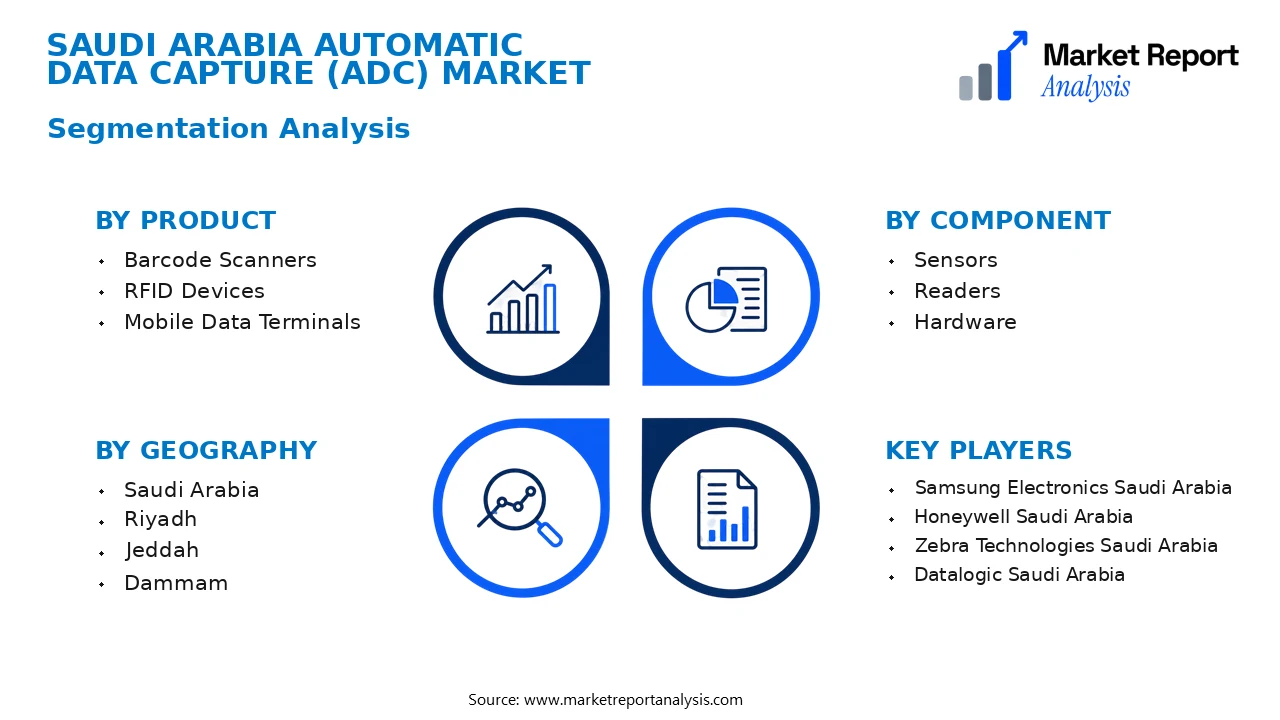
- Product
- Barcode Scanners: As essential tools for retail, logistics, and healthcare, barcode scanners enable quick identification and data collection, driving widespread adoption across commercial and industrial sectors in Saudi Arabia.
- RFID Devices: RFID technology's capacity for contactless data collection boosts inventory management, security, and tracking processes, promoting increased demand within supply chains and manufacturing environments, especially in high-value sectors.
- Mobile Data Terminals: Mobile data terminals support real-time data exchange in logistics, transportation, and field services, with a rising need for mobility solutions in automation and operational efficiency in Saudi markets.
- Component
- Sensors: Sensors are critical for detecting and measuring physical parameters, making them fundamental in embedded ADC systems used in industrial automation and smart infrastructure projects in the region.
- Readers: Readers facilitate data capture from various media, including barcodes and RFID tags, which are integral to automation systems in retail, healthcare, and logistics sectors with expanding digitalization efforts.
- Hardware: Hardware components include data collection terminals, printers, and controllers, essential for establishing robust ADC infrastructure in business operations and public sector projects.
- Application
- Retail: In retail, ADC solutions enhance checkout speed, inventory accuracy, and customer experience, fostering growth amid increasing consumer demand and retail expansion in Saudi Arabia.
- Healthcare: ADC applications in healthcare improve patient management, asset tracking, and medication adherence, contributing to national healthcare modernization efforts.
- Logistics & Warehousing: Critical for supply chain efficiency, ADC systems optimize inventory management, shipment tracking, and automation processes vital for Saudi Arabia’s growing e-commerce and trade sectors.
- End User
- Retailers: Major retail chains adopt ADC solutions to streamline operations, improve customer service, and reduce theft, reflecting a broader trend toward smart retail ecosystems within Saudi Arabia.
- Healthcare Providers: Hospitals, clinics, and pharmaceutical companies deploy ADC for asset management, patient safety, and regulatory compliance, driven by healthcare sector reforms.
- Logistics Companies: Logistics firms leverage ADC for real-time tracking, fleet management, and cargo handling, supporting Saudi Arabia’s strategic logistics and transportation ambitions.
- Industry Vertical
- Supply Chain & Logistics: Accelerating digital adoption in Saudi Arabia’s logistics industry, ADC supports automation, inventory control, and efficient freight management.
- Healthcare: As the healthcare system modernizes, ADC facilitates patient tracking, medication management, and asset security, which are essential for hospitals and clinics.
- Retail and FMCG: Retailers and FMCG companies implement ADC to enhance data accuracy, speed up checkout processes, and improve supply chain transparency driven by consumer expectations.
- Geography
- Saudi Arabia: The exploration of ADC adoption across the country highlights regional variations driven by urbanization, industry presence, and infrastructure development, with heightened activities in economic hubs.
- Riyadh: As the capital and economic hub, Riyadh exhibits the highest demand for ADC solutions driven by government initiatives, corporate investments, and the concentration of retail and healthcare institutions.
- Jeddah: Jeddah’s prominence as a commercial center and port city fosters significant ADC deployments in logistics, retail, and hospitality sectors, supported by regional infrastructure projects.
- Dammam: Dammam’s industrial zones and petrochemical industries fuel demand for ADC systems for asset management, safety, and operational efficiency, aligned with regional industrial growth.
- Mecca: The pilgrimage city’s large influx of visitors and religious institutions creates unique opportunities for ADC applications in hospitality, security, and retail sectors.
- Medina: With its religious significance and sizeable visitor volume, Medina necessitates advanced ADC systems for managing religious tourism, healthcare, and retail activities.
- Al Khobar: As part of the Eastern Province, Al Khobar’s industrial and economic activities drive demand from petrochemical, logistics, and retail sectors leveraging ADC technology.
- Jubail: Jubail’s focus on industrial development and manufacturing supports the adoption of ADC solutions for process automation and workforce management in the region’s extensive industrial complexes.
Competitive Intelligence
The Saudi Arabia Automatic Data Capture (ADC) Market is characterized by a concentrated competitive landscape dominated by a few key players who leverage strategic partnerships, acquisitions, and heavy R&D investments to maintain market leadership. Major companies focus on product innovation to enhance the accuracy, speed, and security of ADC solutions, differing according to regional requirements. In major urban centers like Riyadh and Jeddah, firms adopt aggressive expansion strategies, forming alliances with local technology providers to tailor offerings to governmental and private sector needs. Competitive differentiation primarily stems from the deployment of advanced RF I.D., OCR, and biometric systems that meet strict regulatory standards. Companies are increasingly investing in R&D to develop more integrated, user-friendly ADC solutions, with some seeking to expand their presence through regional acquisitions. Business strategies emphasize customization, innovation, and strategic joint ventures to navigate regulatory and infrastructural challenges, ensuring alignment with Saudi Vision 2030’s technological and economic diversification goals. Overall, competition remains intense, driven by rapid technological evolution and high demand from sectors such as banking, healthcare, and transportation.
Leading Company Profiles
The competitive landscape within Saudi Arabia's ADC market features several key players that leverage innovative technologies and strategic initiatives to capture growth opportunities in sectors such as retail, transportation, healthcare, and government infrastructure. These companies are distinguished by their extensive product portfolios, technological expertise, and strategic alliances, positioning them as vital contributors to digital transformation in the kingdom.
- Samsung Electronics Saudi Arabia
- Honeywell Saudi Arabia
- Zebra Technologies Saudi Arabia
- Datalogic Saudi Arabia
- Paxton Access Saudi Arabia
- NCR Corporation Saudi Arabia
- SGS Saudi Arabia
- SATO Holdings Saudi Arabia
- Cognex Corporation Saudi Arabia
- Brinks Global Services Saudi Arabia
Samsung Electronics Saudi Arabia
Samsung offers advanced barcode scanners, RFID solutions, and mobile computing devices tailored for retail and logistics sectors, emphasizing high-performance, durability, and integration capabilities aligned with Saudi Arabia’s Vision 2030 initiatives.
Honeywell Saudi Arabia
Honeywell specializes in secure data capture solutions, including RFID tags, barcode printers, and industrial automation systems, focusing on supply chain efficiency, asset management, and government security projects.
Zebra Technologies Saudi Arabia
Zebra provides comprehensive ADC solutions such as rugged handheld scanners, thermal printers, and asset tracking software, positioning as a market leader in operational efficiency enhancements for diverse industries.
Datalogic Saudi Arabia
Known for its smart imaging systems and barcode readers, Datalogic emphasizes precision and reliability, serving retail, healthcare, and manufacturing clients within Saudi Arabia’s evolving digital landscape.
Paxton Access Saudi Arabia
Specializing in access control systems integrated with RFID technologies, Paxton supports security infrastructure upgrades across commercial, governmental, and educational facilities in Saudi Arabia.
NCR Corporation Saudi Arabia
NCR is a prominent provider of self-service kiosks, point-of-sale systems, and mobile solutions that enhance retail and banking experiences in Saudi Arabia, aligned with modern digital transaction needs.
SGS Saudi Arabia
SGS offers testing, certification, and inspection services, including calibration of ADC devices, enabling compliance with Saudi regulatory standards and supporting product quality assurance in data capture markets.
SATO Holdings Saudi Arabia
SATO provides barcode printers, labeling solutions, and RFID systems, with a strategic focus on enhancing asset management and traceability across manufacturing and logistics sectors.
Cognex Corporation Saudi Arabia
Cognex specializes in machine vision systems and barcode verification solutions, facilitating quality control and automation integration within high-demand manufacturing environments in the kingdom.
Brinks Global Services Saudi Arabia
Brinks delivers cash logistics, secure transportation, and high-tech security solutions, employing ADC technologies to enhance security and operational efficiency across Saudi Arabia's financial and commercial sectors.
Strategic Business Developments
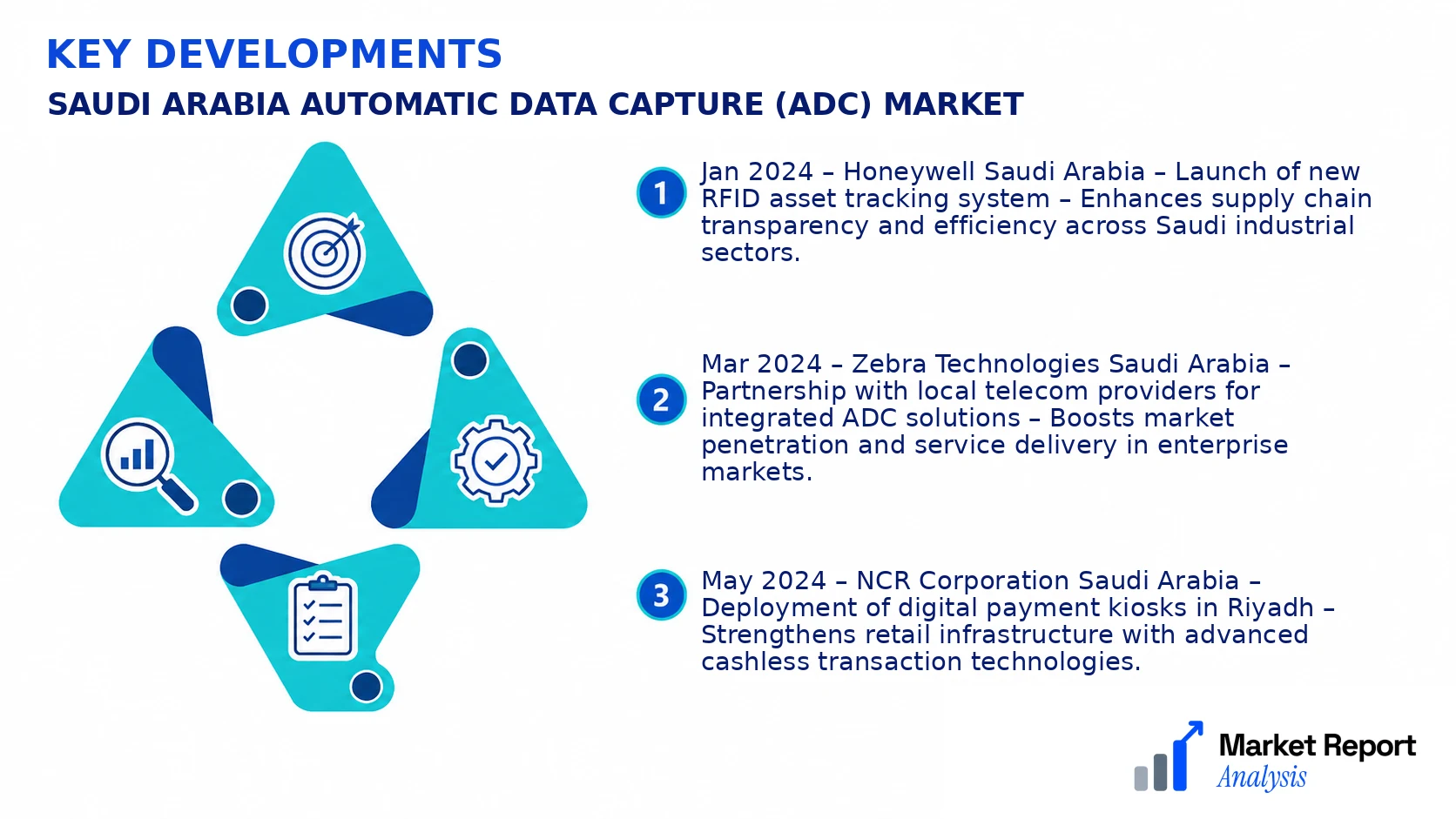
- Jan 2024 – Honeywell Saudi Arabia – Launch of new RFID asset tracking system – Enhances supply chain transparency and efficiency across Saudi industrial sectors.
- Mar 2024 – Zebra Technologies Saudi Arabia – Partnership with local telecom providers for integrated ADC solutions – Boosts market penetration and service delivery in enterprise markets.
- May 2024 – NCR Corporation Saudi Arabia – Deployment of digital payment kiosks in Riyadh – Strengthens retail infrastructure with advanced cashless transaction technologies.
- Jul 2024 – Samsung Electronics Saudi Arabia – Expansion of RFID solution portfolio with new rugged mobile scanners – Supports logistics and retail digital transformation strategies.
- Sep 2024 – SATO Holdings Saudi Arabia – Investment in new local manufacturing facility for barcode printers – Aims to reduce lead times and support regional demand growth within Saudi Arabia.
Frequently Asked Questions
What is the Saudi Arabia Automatic Data Capture (ADC) Market?
The Saudi Arabia Automatic Data Capture (ADC) Market encompasses the procurement, deployment, and utilization of automated systems for data collection across various sectors like retail, transportation, healthcare, and government. It aims to enhance efficiency, accuracy, and real-time data processing within the country.
What is the current market size of Saudi Arabia Automatic Data Capture (ADC) Market?
As of 2026, the Saudi Arabia ADC market is valued at approximately USD 1.4 Billion, reflecting rapid adoption due to government initiatives and infrastructure development. It remains poised for substantial growth over the forecast period driven by digital transformation efforts.
What factors are driving the Saudi Arabia Automatic Data Capture (ADC) Market?
Key drivers include government policies supporting digital infrastructure, increasing logistics and retail automation, and rising investments in smart city projects. Additionally, the need for real-time data management in health and transportation sectors further propels ADC adoption across Saudi Arabia.
Which Saudi city leads the Saudi Arabia Automatic Data Capture (ADC) Market?
Riyadh, the capital and largest city, leads the Saudi ADC market due to its extensive smart city projects, advanced logistics network, and concentration of retail and healthcare facilities adopting automated data capture solutions.
Which segment is expected to grow the fastest?
The retail segment is anticipated to exhibit the fastest growth, driven by increased demand for inventory management, customer analytics, and POS automation. The healthcare segment also shows promising expansion with the adoption of digital health records and patient data capture systems.
Who are the leading companies operating in the Saudi Arabia Automatic Data Capture (ADC) Market?
Leading market players include multinational firms such as Zebra Technologies, Honeywell, and Datalogic, alongside regional companies like Senta Solutions and Hikvision Saudi Arabia, all competing through innovations and strategic partnerships to deepen market penetration.
Analyst Perspective
The Saudi Arabia Automatic Data Capture (ADC) market is poised for sustained growth driven by government digitization initiatives, increasing retail automation, and logistics modernization. The long-term outlook remains favorable, with a CAGR exceeding 10% through 2034, supported by ongoing investments in smart city projects and regulatory reforms promoting technological adoption. Commercial opportunities are particularly attractive in transportation, healthcare, and government sectors, where data accuracy and efficiency are critical. Technology evolution toward integrated IoT and AI-enabled ADCS solutions will enhance system capabilities, fostering smarter infrastructure deployment. Investment priorities should focus on scalable, cloud-based solutions that accommodate city-specific needs, especially in Riyadh and Jeddah, which lead the market due to their economic activity and infrastructure development. Competitive intensity will intensify with both domestic and international players expanding their presence. City-level growth potential appears robust in Riyadh, expected to lead due to its strategic importance, followed by Jeddah and Dammam, where targeted innovation can unlock further market value. Overall, strategic positioning around technological leadership and regional customization will be key to capturing long-term value in Saudi Arabia’s ADC market.
