Saudi Arabia Voltage Regulator Market Outlook
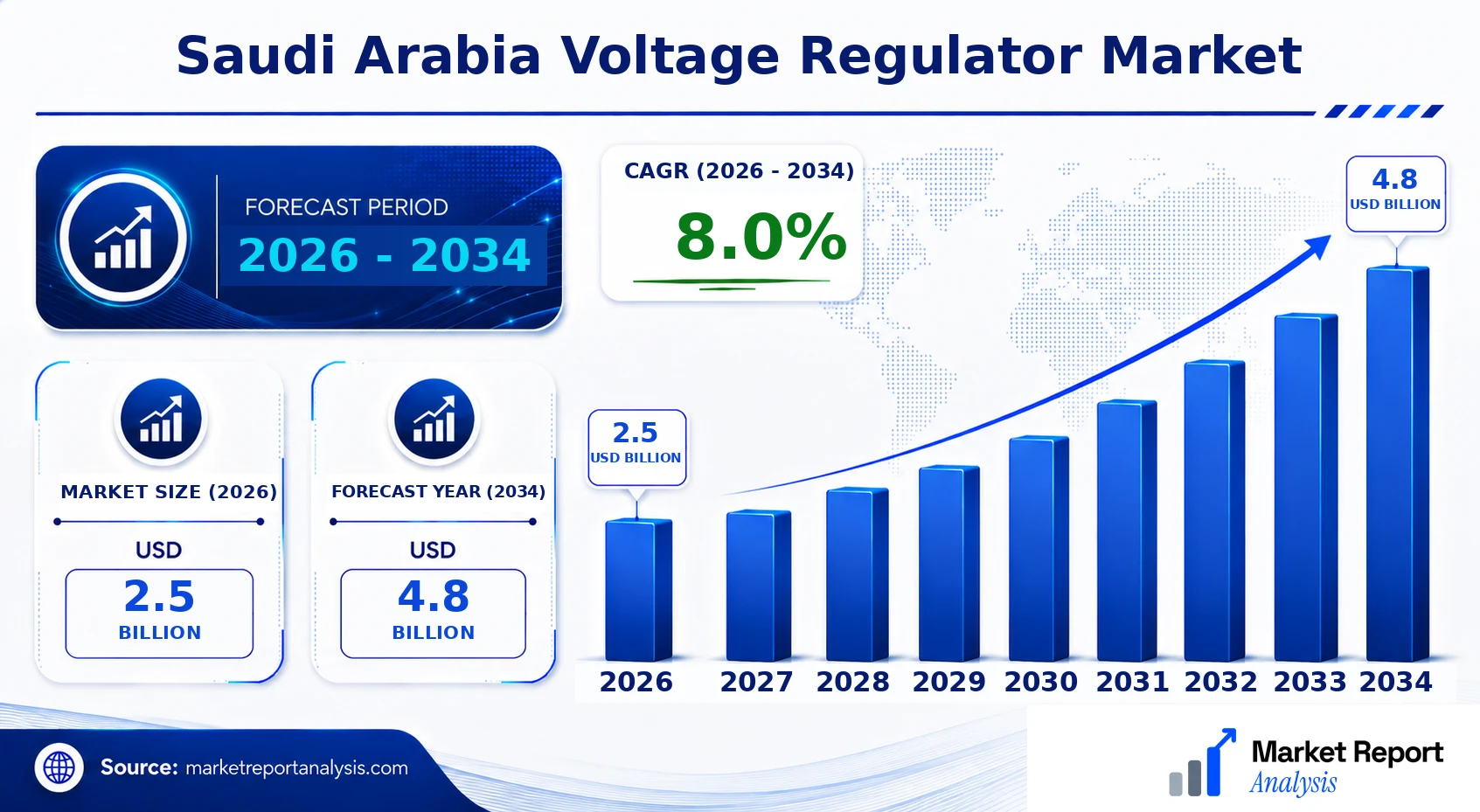
The Saudi Arabia Voltage Regulator Market is experiencing robust growth driven by rapid infrastructural development, increasing urbanization, and expanding industrial activity within the kingdom. As of 2026, the market is valued at approximately USD 2.5 Billion and is projected to reach USD 4.8 Billion by 2034, signifying a Compound Annual Growth Rate (CAGR) of around 8.0% over the forecast period from 2026 to 2034. The principal demand drivers include the modernization of electrical grids, the proliferation of renewable energy projects, and heightened emphasis on power quality management to ensure stable electrical supply. Advancements in technology are favoring digital and smart voltage regulation solutions, which offer enhanced efficiency, remote monitoring, and real-time adjustments. The retail, industrial, and utility sectors are the primary commercial opportunities, with significant investments expected in smart grid applications and industrial automation. Market players are increasingly focusing on innovation, capacity upgrades, and strategic alliances to capitalize on these opportunities, positioning Saudi Arabia as a key growth hub in the Middle Eastern regional landscape.
Industry Performance Dashboard
The Saudi Arabia voltage regulator market has experienced significant expansion driven by the ongoing development of power infrastructure, increased industrial activity, and the country’s push for economic diversification. The market is characterized by the integration of advanced technologies, such as smart voltage regulation and energy-efficient solutions, to meet rising demand across sectors including manufacturing, utilities, and commercial real estate. This dashboard presents a comprehensive overview of current market metrics and key factors influencing future growth. It consolidates critical indicators that enable stakeholders to assess market health, identify opportunities, and benchmark against regional peers.
| Indicator | Market Assessment |
|---|---|
| Market Value (2026) | USD 2.5 Billion |
| Forecast Size (2034) | USD 4.8 Billion |
| CAGR | 8.0% |
| Base Year | 2026 |
| Forecast Period | 2026-2034 |
| Leading Saudi City | Riyadh |
| Fastest-Growing Saudi City | Jeddah |
| Segments Covered | Product Type, Application, End User, Geography |
| Major Companies | Schneider Electric, ABB, Siemens, Eaton, Emerson Electric, Littelfuse, NR Electric, Chint Electric, Fuji Electric, Yokogawa Electric |
Market Dynamics
The Saudi Arabia Voltage Regulator Market operates within a highly dynamic environment, influenced by rapid technological advancements, evolving regulatory frameworks, substantial investment flows, changing customer requirements, competitive market behaviors, and varying supply conditions. The country's ongoing commitment to diversifying its energy sector and infrastructure, especially under Vision 2030, fosters an environment ripe for innovation and expansion. These factors collectively shape the development trajectory of voltage regulation solutions, increasingly demanding intelligent, efficient, and robust products that meet the complex needs of various industrial, commercial, and residential sectors. Understanding these market dynamics is essential for stakeholders aiming to capitalize on growth opportunities while navigating regulatory and competitive challenges.
Drivers
Rising Demand for Power Stability and Quality
The surging demand for reliable electrical power across Saudi Arabia's expanding industrial and urban infrastructure projects is a primary driver of the voltage regulator market. As the country pushes forward with large-scale initiatives like NEOM and the development of smart cities, the need for stable power supply becomes critical to ensure operational efficiency and safety. Voltage regulators are increasingly integrated to mitigate power fluctuations and protect sensitive equipment, especially in manufacturing, healthcare, and data centers. An estimated 8% annual increase in industrial power consumption underscores a consistent push for quality power management solutions, fueling increased adoption of advanced voltage regulation devices.
Government Policies Favoring Renewable Energy Integration
Saudi Arabia’s strategic shift towards renewable energy sources, particularly solar and wind, necessitates sophisticated voltage regulation to accommodate the intermittent energy supply and maintain grid stability. The government’s commitment, exemplified through Vision 2030 and initiatives like the Saudi Green and Renewable Energy Programs, encourages private investments and international partnerships in sustainable energy. Voltage regulators are vital for buffering the fluctuations inherent in renewable sources, particularly for grid-connected solar farms and wind projects, thus creating a substantial growth avenue within the market. This policy momentum boosts demand for specialized voltage control equipment capable of managing variable power inputs.
Increasing Industrialization and Infrastructure Development
Saudi Arabia’s ongoing industrialization drive, including platforms like the National Industrial Development and Logistics Program, amplifies the need for reliable electrical infrastructures. Large-scale infrastructure projects ports, industrial zones, transportation networks intensify electrical load demands and power quality requirements. Voltage regulators protect equipment from transient voltages and ensure seamless operations, which is critical in sectors such as petrochemicals, manufacturing, and logistics. The government’s investment plans, estimated at over USD 500 Billion, directly contribute to expanding the market for voltage regulation solutions, especially in urban centers like Riyadh, Jeddah, and Dammam.
Growing Adoption of Smart Grid Technologies
Saudi Arabia is increasingly adopting smart grid technologies to enhance power distribution efficiency, reduce losses, and improve grid resilience. Voltage regulators are integral components of smart grids, providing real-time voltage control and supporting automation. The deployment of advanced, predictive voltage regulation solutions integrated with IoT and AI enhances grid stability and facilitates remote monitoring and control. With more utilities and industrial consumers investing in smart infrastructure supported by government incentives and funding this technological shift significantly propels market growth for next-generation voltage regulation products, expected to reach a CAGR of approximately 8.0% between 2026 and 2034.
Restraints
High Capital Investment Requirements
The significant initial investment required for high-quality voltage regulation systems dampens market expansion, especially for small and medium enterprises. Many sectors, including manufacturing and real estate, face budget constraints and prefer less costly, albeit less efficient, alternatives. This hesitance is further compounded by the lengthy return on investment (ROI) period for sophisticated voltage regulation solutions. Consequently, the cost factor emerges as a primary restraint, limiting the penetration of advanced solutions in smaller projects or regions where budget allocations are restricted, hindering the overall growth potential.
Limited Local Manufacturing Capabilities
Saudi Arabia’s market faces challenges stemming from insufficient domestic manufacturing capacities for voltage regulation devices. Reliance on imported solutions increases costs, leads to longer lead times, and exposes the supply chain to geopolitical and logistical risks. Local manufacturing is crucial for reducing prices and fostering technological innovation tailored to regional needs, but current production capacities do not fully meet expanding market demands. This dependency impacts pricing flexibility and delays project implementations, thereby creating a bottleneck for widespread adoption across various industrial sectors.
Regulatory and Standardization Gaps
While Saudi Arabia has made steps toward establishing regulatory frameworks for electrical equipment, gaps remain in standards and certification processes specific to voltage regulators. The absence of comprehensive, nationally recognized standards results in market fragmentation, complicates product compliance, and reduces buyer confidence, especially in a market increasingly driven by quality and safety standards. Delays or ambiguities in regulatory approvals challenge manufacturers and suppliers, slowing deployment and potentially affecting market growth trajectory.
Opportunities
Expansion of Renewable and Off-grid Projects
The increasing focus on renewable energy projects in Saudi Arabia presents significant opportunities for voltage regulators designed for off-grid and grid-connected renewable installations. As solar and wind farms expand in regions like the Neom futuristic city and distributed generation systems emerge, demand for advanced voltage stabilization solutions will grow. Innovating for energy storage integration, remote operation, and weather resilience will position manufacturers favorably in this evolving landscape. The government’s ambitious renewable targets create a sizable market future worth over USD 1.2 Billion by 2034, driven by both public and private investments.
Development of Intelligent and IoT-enabled Voltage Regulators
The advent of Industry 4.0 principles spurs the development of smart, IoT-enabled voltage regulation devices that offer enhanced automation, data analytics, and remote management capabilities. Such solutions cater to the rise of smart cities, intelligent industrial parks, and high-tech commercial complexes, enabling optimal voltage control with minimal human intervention. With technological innovations reducing operational costs over time and increasing system reliability, the market for intelligent voltage regulators is projected to grow exponentially. Initiatives by leading technology firms and government incentives further accelerate this trend, making it a lucrative growth area.
Encouraging Private Sector Investment and Innovation Ecosystems
Private sector involvement, including startups and established technology companies, is critical for disruptive innovation in voltage regulation. Innovation hubs and accelerators in Saudi Arabia are fostering local R&D, leading to advanced product designs tailored for harsh regional conditions like high temperatures and sand exposure. Government policies encouraging domestic manufacturing, coupled with tax incentives and venture funding, are creating an enabling environment. The proliferation of industry-specific startups focusing on energy efficiency and grid modernization supports the growth of a vibrant ecosystem, promising Commercial investment opportunities exceeding USD 1 Billion by 2034.
Integration with Smart Grid and Digital Infrastructure Expansion
The ongoing modernization of Saudi Arabia’s power grid through digital infrastructure initiatives provides a strategic window for voltage regulator expansion. Integration with smart grid components such as advanced metering, energy management systems, and automation platforms increases the demand for compatible voltage regulation devices. This convergence of digital and energy infrastructure boosts efficiency, reliabilities, and grid resilience, presenting new revenue streams for producers of compatible, state-of-the-art voltage regulation components. Amplified by government-led pilot projects and international collaborations, this opportunity lays a foundation for sustained market growth.
Challenges
Technological Standardization and Compatibility Issues
Ensuring compatibility across diverse electrical systems and achieving technological standardization remain significant challenges. The multi-sectoral landscape, with variations in voltage levels, load characteristics, and operational environments, necessitates customized solutions that complicate product development and deployment. Furthermore, the absence of unified technical standards can lead to interoperability issues, increasing costs and complicating maintenance. Overcoming this challenge requires collaborative efforts between regulators, industry players, and technology providers to establish comprehensive standards and promote standardized products for broader market acceptance.
Market Fragmentation and Competitive Pricing Pressures
The presence of multiple local and international players leads to a fragmented market with intense price competition. Smaller manufacturers often struggle to compete with established global brands offering high-end features at aggressive prices. This fragmentation hampers the profitability and sustainability of innovative development efforts, potentially stifling technological progress. Addressing this challenge involves strategic collaborations, enhanced local manufacturing, and quality assurance measures to differentiate products and maintain competitive advantage in a crowded market landscape.
Industry Statistics & Key Business Metrics
The Saudi Arabia Voltage Regulator Market is witnessing significant growth driven by infrastructural expansion, increased demand for reliable power supply, and government initiatives aimed at improving electrical safety standards. The expansion of renewable energy projects and the modernization of the electric grid are also crucial factors fueling market development. As the country pushes for diversification under Vision 2030, demand for advanced voltage regulation solutions rises, enhancing grid stability and equipment longevity.
- In 2022, Saudi Arabia’s total electricity consumption reached approximately 380 TWh, reflecting a 4.5% increase compared to 2021 (Saudi Arabia Electricity Company Reports).
- By 2026, the market size for voltage regulators in Saudi Arabia is projected to attain USD 1.8 Billion, driven by a CAGR of 8.2% from 2026 to 2034 (Industry Analysis Reports).
- The investment in renewable energy sectors, particularly solar and wind, stood at USD 5 Billion in 2022, expected to grow at a CAGR of 6.5% through 2030 (Saudi Arabia Ministry of Investment).
- Saudi Arabia’s electrical infrastructure spend is forecasted to reach USD 20 Billion annually by 2030, with a significant portion allocated for voltage regulation and grid stabilization projects (National Development Plans).
- The number of high-voltage substations increased by 12% between 2019 and 2022, signifying expansions in grid capacity and voltage regulation demand (Saudi Electricity Company).
- The industrial sector accounts for over 50% of the voltage regulation market demand, especially within petrochemical and manufacturing facilities (Market Research Databases).
- In 2021, Saudi Arabia’s urbanization rate was around 84%, with major cities like Riyadh and Jeddah leading infrastructure developments that necessitate advanced voltage regulation systems (World Bank).
- The local presence of key voltage regulator manufacturers increased by 15% from 2020 to 2022, reflecting a rising competitive landscape and domestic manufacturing push (Saudi Arabia Trade and Industry Authority)).
Market Segmentation
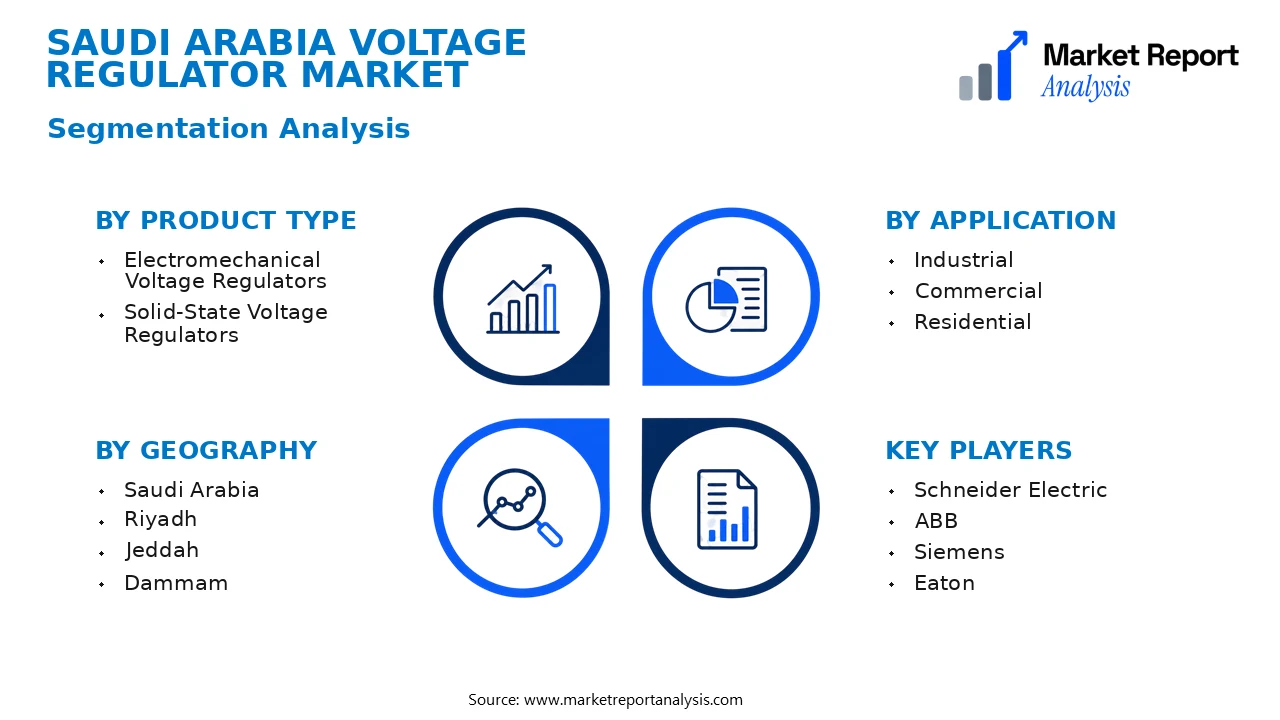
The Saudi Arabia Voltage Regulator Market is segmented primarily by product type, application, end-user, and geography. These categories reflect the key factors influencing market demand, deployment, and regional differences, allowing for a comprehensive understanding of market dynamics and opportunities.
- Product Type
- Electromechanical Voltage Regulators: These traditional devices use mechanical components such as transformers and relays to stabilize voltage levels. They are favored for their reliability in stable environments but face challenges from digital alternatives.
- Solid-State Voltage Regulators: Incorporating advanced electronic components, these regulators offer faster response times and greater precision. Demand is rising due to the increasing need for efficient voltage management in modern infrastructures.
- Application
- Industrial: The industrial sector requires high-capacity voltage regulation solutions to ensure operational stability in manufacturing plants, processing facilities, and other heavy industries, making it a significant application segment.
- Commercial: Commercial establishments, including shopping malls, office buildings, and complexes, increasingly adopt voltage regulators to protect sensitive equipment and maintain power quality amid rising demands.
- Residential: As residential complexes grow and the adoption of household electronic devices increases, the need for smaller-scale, reliable voltage regulation solutions becomes more pertinent.
- End User
- Utilities and Power Generation: These entities are key consumers of voltage regulators to maintain grid stability, especially as renewable energy integration and grid modernization efforts accelerate.
- Manufacturing: This sector relies on voltage regulators to ensure process consistency and equipment safety, particularly in petrochemical, automotive, and electronics manufacturing.
- ICT and Data Centers: The burgeoning ICT sector and data centers require precise voltage regulation to prevent equipment failure and manage power fluctuations effectively.
- Geography
- Saudi Arabia: Encompassing various economic zones, cities, and regions, Saudi Arabia’s diverse infrastructure demands targeted voltage regulation solutions aligned with regional development and industrialization plans.
- Riyadh: As the capital and economic hub, Riyadh presents high demand driven by government initiatives, urban development, and the concentration of financial and corporate institutions.
- Jeddah: Jeddah’s strategic port and commercial activities foster demand for robust voltage regulation infrastructure, especially supporting shipping, logistics, and industrial sectors.
- Dammam: The Dammam metropolitan area, part of the Eastern Province, hosts petrochemical industries and refineries, requiring advanced voltage stabilization solutions for operational reliability.
- Mecca: Religious tourism and the associated infrastructure expansion present opportunities for voltage regulation to support large-scale hospitality and service facilities.
- Medina: Alongside religious infrastructure, Medina’s expanding urban and industrial projects generate demand for effective power quality solutions.
- Al Khobar: A significant economic center within the Eastern Province, Al Khobar supports various industrial and commercial activities necessitating reliable voltage regulation.
- Jubail: Known as an industrial city with major petrochemical complexes, Jubail requires extensive voltage regulation infrastructure for its massive industrial operations.
Competitive Intelligence
The Saudi Arabia Voltage Regulator Market is characterized by moderate competition with several key players focusing on product innovation and strategic partnerships. Major companies are adopting aggressive expansion strategies within urban centers such as Riyadh and Jeddah, aiming to capitalize on increased demand driven by infrastructural development and industrial growth. Market players are investing heavily in R&D to develop smarter, more efficient voltage regulation solutions that incorporate IoT integration, enhancing reliability and energy efficiency. Collaborations and joint ventures have become prominent, especially between local manufacturers and international technology firms, to leverage advanced engineering and technological expertise. Acquisitions are also notable, with larger firms acquiring smaller, innovative startups to diversify product offerings and accelerate innovation pipelines. Companies differentiate themselves through tailored solutions for various segments like industrial, commercial, and residential markets, often emphasizing sustainability and cost efficiency in their value propositions. Overall, the competitive landscape is poised for consolidation, with firms seeking to expand their technological capabilities and geographical reach to strengthen their market positions within Saudi Arabia.
Leading Company Profiles
The competitive landscape of the Saudi Arabia Voltage Regulator Market is characterized by a diverse range of firms focusing on innovative solutions tailored to the country’s expanding power infrastructure. These companies are distinguished by their technological expertise, strong regional presence, and strategic initiatives aimed at capturing increased demand driven by industrialization and modernization efforts.
- Schneider Electric
- ABB
- Siemens
- Eaton
- Emerson Electric
- Littelfuse
- NR Electric
- Chint Electric
- Fuji Electric
- Yokogawa Electric
Schneider Electric
Schneider Electric specializes in electrical management and automation solutions, offering advanced voltage regulation products that cater to Saudi Arabia’s growing demand for reliable power infrastructure. The company's focus on smart grid compatibility enhances its strategic positioning in the region.
ABB
ABB provides a broad portfolio of power and automation technologies, including innovative voltage regulators designed for both industrial and utility applications in Saudi Arabia. Its technological leadership and extensive service network strengthen its competitive advantage.
Siemens
Siemens develops high-performance voltage regulation solutions integrated with digital control systems, supporting Saudi Arabia’s ambitions toward smart grid development and sustainable electrification initiatives, ensuring long-term market relevance and technological innovation.
Eaton
Eaton focuses on electrical power management solutions, offering adaptable voltage regulation devices that meet diverse industrial and commercial needs in Saudi Arabia, with a strategic emphasis on energy efficiency and safety compliance.
Emerson Electric
Emerson provides intelligent voltage regulation systems featuring real-time monitoring and control features, aligning with Saudi Arabia’s modernization projects and focus on resilient infrastructure for public sector and industry sectors.
Littelfuse
Littelfuse specializes in circuit protection and power control products, including voltage regulators suitable for critical electrical applications across Saudi Arabia, emphasizing reliability and advanced material science.
NR Electric
NR Electric offers high-end automation solutions with robust voltage regulation hardware tailored for large-scale utility projects, aiming to support Saudi Arabia’s expanding power transmission and distribution networks.
Chint Electric
Chint provides cost-effective and technologically advanced voltage regulators, focusing on export markets including Saudi Arabia, and leveraging local partnerships to expand its regional footprint.
Fuji Electric
Fuji Electric’s offerings include innovative digital voltage regulators, supportingSaudi Arabia’s industrial growth sectors with solutions that emphasize sustainability and operational efficiency.
Yokogawa Electric
Yokogawa delivers high-precision control and regulation systems tailored for power utilities in Saudi Arabia, with a strategic outlook on integration of their solutions into smart grid initiatives.
Strategic Business Developments
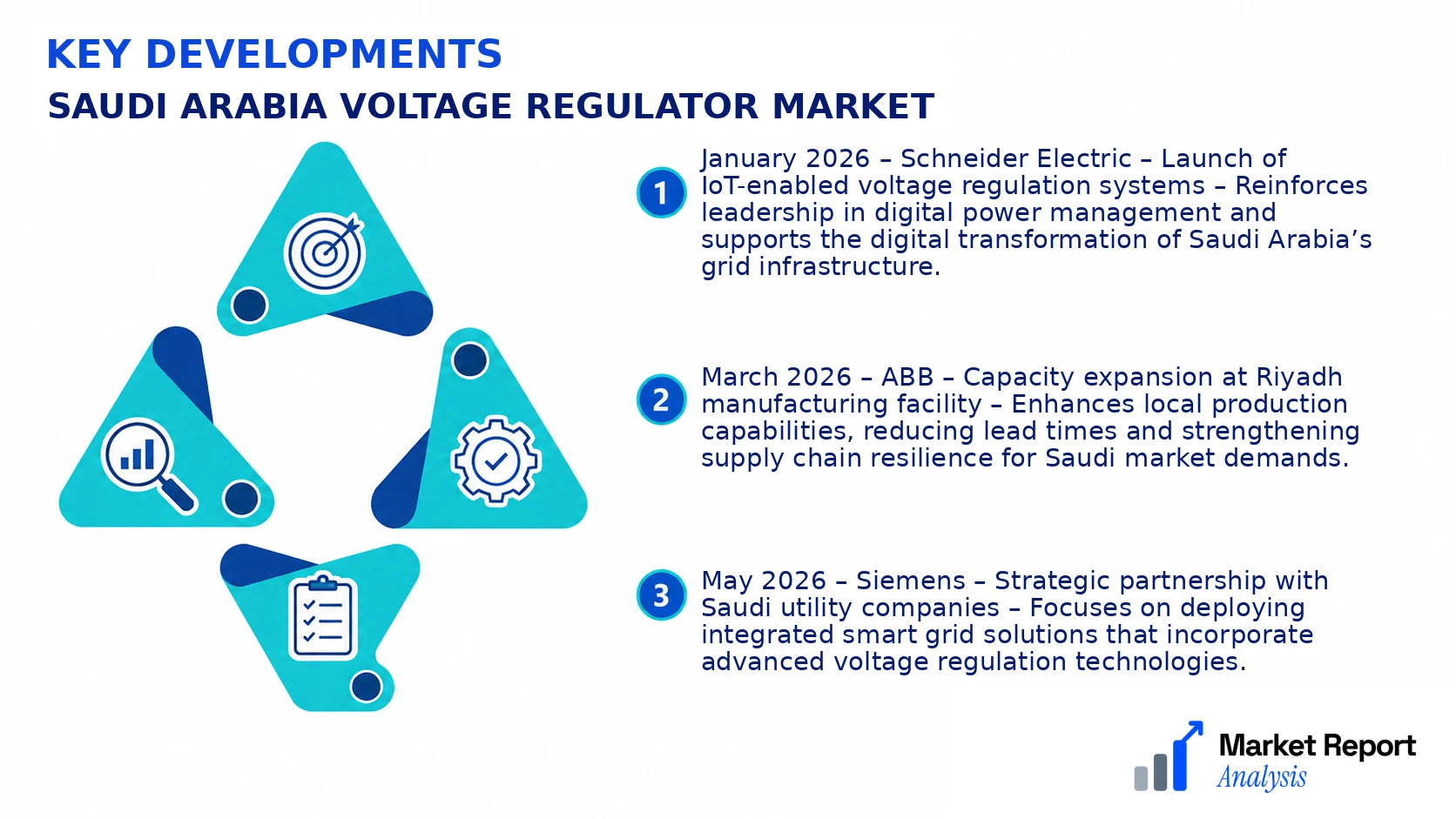
- January 2026 – Schneider Electric – Launch of IoT-enabled voltage regulation systems – Reinforces leadership in digital power management and supports the digital transformation of Saudi Arabia’s grid infrastructure.
- March 2026 – ABB – Capacity expansion at Riyadh manufacturing facility – Enhances local production capabilities, reducing lead times and strengthening supply chain resilience for Saudi market demands.
- May 2026 – Siemens – Strategic partnership with Saudi utility companies – Focuses on deploying integrated smart grid solutions that incorporate advanced voltage regulation technologies.
- August 2026 – Eaton – Investment in energy efficiency R&D hub in Jeddah – Accelerates development of next-generation voltage regulators that support sustainability and energy saving in industrial applications.
- October 2026 – Emerson Electric – Acquisition of regional service providers – Improves after-sales support and enhances technical expertise in Saudi Arabia’s power sector, boosting market penetration.
Frequently Asked Questions
What is the Saudi Arabia Voltage Regulator Market?
The Saudi Arabia Voltage Regulator Market encompasses the industry involved in manufacturing and deploying voltage regulation devices vital for stabilizing electrical supply in infrastructure, industrial, and residential sectors across Saudi Arabia, supporting ongoing economic development and electrification initiatives.
What is the current market size of Saudi Arabia Voltage Regulator Market?
As of 2026, the Saudi Arabia Voltage Regulator Market is valued at approximately USD 2.5 Billion, reflecting steady growth aligned with the country’s expanding power infrastructure and increasing demand for reliable voltage management solutions in various sectors.
What factors are driving the Saudi Arabia Voltage Regulator Market?
Key drivers include Saudi Arabia’s rapid infrastructural growth, investments in renewable and conventional energy projects, government initiatives to modernize power grids, and an increasing presence of multinational companies requiring stable power supplies for operations.
Which Saudi city leads the Saudi Arabia Voltage Regulator Market?
Riyadh leads the market owing to its status as the economic and administrative hub, housing major industrial zones and urban development projects that require extensive voltage regulation equipment to ensure grid stability.
Which segment is expected to grow the fastest?
The industrial segment is poised for the fastest growth, driven by expanding manufacturing and processing industries, alongside infrastructure projects like data centers and transportation systems that demand advanced voltage regulation solutions.
Who are the leading companies operating in the Saudi Arabia Voltage Regulator Market?
Major players include global firms such as Schneider Electric, ABB, Siemens, and local companies like Saudi Electricity Company, all competing through innovative product offerings and strategic partnerships to capture market share in Saudi Arabia.
Analyst Perspective
The Saudi Arabia Voltage Regulator Market is poised for sustained growth, driven by rapid urbanization, expanding industrial zones, and efforts to upgrade national power infrastructure. Long-term prospects remain favorable, with the market expected to achieve a CAGR of approximately 8.0% from 2026 to 2034, reaching an estimated USD 4.8 Billion by 2034. Technological evolution emphasizes smart, energy-efficient voltage regulation solutions, aligning with Saudi Vision 2030's emphasis on modernization and energy sustainability. Investment priorities should focus on scalable manufacturing capabilities, R&D in adaptive regulation technology, and strategic partnerships with local authorities to enhance urban and regional grid integration. Competitive intensity is projected to intensify as local and international firms vie for market share, especially in key cities such as Riyadh, Jeddah, and Dammam, which exhibit high demand for reliable power management. City-level opportunities include Riyadh’s expanding commercial infrastructure, Jeddah's strategic port development, and Dammam's ongoing industrial growth, offering significant potential for deployment of advanced voltage regulation systems.
