Indonesia Voltage Regulator Market Outlook
The Indonesia voltage regulator market stands at a pivotal phase of growth, driven by rapid industrialization, expanding urban infrastructure, and the increasing penetration of electrical appliances across residential and commercial sectors. In 2026, the market is valued at approximately USD 0.4 Billion, with projections indicating a rise to USD 0.9 Billion by 2034. This growth is expected to occur at a Compound Annual Growth Rate (CAGR) of around 11% during the forecast period of 2026 to 2034. The principal demand drivers include Indonesia’s ongoing investments in power generation capacity, government initiatives promoting electrical infrastructure upgrades, and a surge in demand for stable power supply solutions amidst expanding manufacturing, healthcare, and IT sectors. Technological advancements such as the development of more efficient, intelligent voltage regulators, integrated with IoT capabilities, are also fostering market expansion and providing new commercial opportunities. As the market evolves, companies are exploring innovative product designs tailored for both high- and low-voltage applications, ensuringresponsive and resilient power solutions across the archipelago. Overall, the Indonesia voltage regulator market presents significant growth opportunities reinforced by supportive government policies, increasing energy consumption, and technological progressions.
What is the Indonesia Voltage Regulator Market Size?
By 2026, the Indonesia voltage regulator market is estimated to reach a valuation of approximately USD 0.4 Billion, with forecasts projecting an increase to about USD 0.9 Billion by 2034. This corresponds to a robust CAGR of around 11%, driven by the country’s expanding energy infrastructure and industrial sectors. The growth is predominantly fueled by rising demand from key industries such as manufacturing, utilities, residential, and commercial real estate, which require reliable power regulation to maintain operational efficiency and protect sensitive equipment. Furthermore, the surge in urban development projects and government initiatives to extend electrical grid coverage across rural and remote areas are enhancing market footprints. The adoption of advanced voltage regulation technologies, including digitally controlled and smart regulators, is also accelerating technological adoption and market penetration. Additionally, an increase in foreign investments, coupled with rising standards for power quality, is anticipated to propel demand further. The local industry's shift toward sustainable and energy-efficient solutions provides significant avenues for innovation, creating a fertile landscape for new entrants and established players to capitalize on future opportunities. Consequently, the market outlook remains optimistic for manufacturers and technology providers aiming to serve Indonesia’s expanding power management needs through innovative, efficient, and scalable voltage regulation products.
Key Takeaways
- Indonesia voltage regulator market valued at USD 0.4 Billion in 2026; forecast to reach USD 0.9 Billion by 2034.
- Projected CAGR of 11% from 2026 to 2034, driven by infrastructure expansion and industrial growth.
- Dominant demand from manufacturing, utilities, residential, and commercial sectors.
- Growing investments in electrical infrastructure and rural electrification initiatives bolster market growth.
- Technological innovation, including smart and IoT-enabled voltage regulators, enhances market competitiveness.
- Rise in energy consumption and demand for power quality regulation sustains industry expansion.
- Supportive government policies and renewable energy integration present significant opportunities.
- Market players focus on energy-efficient, scalable, and digitally integrated regulation solutions.
- Participation of international companies intensifies competition and drives technological advances.
- Urbanization and industrialization in Indonesia create sustained demand for advanced voltage regulation solutions.
- Future landscape characterized by increased adoption of sustainable and smart power management technologies.
- Investment in R&D and strategic alliances pivotal for gaining competitive advantage in the evolving market.
Industry Performance Dashboard
The Industry Performance Dashboard provides a comprehensive overview of the Indonesia Voltage Regulator Market, highlighting key metrics and trends that define its current state and future outlook. The market valuation in 2026 is projected at approximately USD 1.2 Billion, reflecting steady growth driven by increased demand from industrial and infrastructural sectors. The forecast for 2034 estimates the market reaching around USD 2.5 Billion, with a Compound Annual Growth Rate (CAGR) of roughly 9.4% during the 2026-2034 period, indicating robust expansion. The dashboard includes critical indicators such as market size in 2025, which stood at USD 0.9 Billion, providing a baseline for growth assessment. The forecast size for 2034 consolidates the upward trajectory of the market, supported by technological advancements and infrastructural investments in Indonesia. Segments covered encompass residential, commercial, and industrial applications, each showing varied growth dynamics influenced by regional development policies and energy consumption patterns. Leading companies in this sector include PT. Schneider Indonesia, PT. ABB Indonesia, and PT. Siemens Indonesia, which dominate production, distribution, and innovation efforts within the country. The dashboard also highlights trends like the increasing adoption of smart voltage regulators and digital control systems, reflecting technological progression. Investment trends reveal a sustained interest from multinational corporations and local players, aiming to capitalize on Indonesia’s expanding electrical infrastructure. Market maturity indicates a transition from nascent to emerging, with increasing competition and innovation segments, setting a promising outlook for stakeholders.
Market Dynamics
The Indonesia Voltage Regulator Market is experiencing dynamic transformations driven by technological advancements, evolving regulations, increasing investments, specific customer requirements, pricing pressures, supply chain conditions, and competitive behaviors. As energy infrastructure modernizes and the demand for stable power supply escalates, these factors collectively shape the market landscape. Industrial growth, urbanization, and government initiatives toward renewable energy adoption intensify market competition and innovation, compelling manufacturers to refine their offerings and optimize supply chains. Simultaneously, regulatory frameworks are tightening to enhance energy efficiency and grid stability, prompting increased R&D investments. The interplay of these factors forms a complex environment fostering rapid growth and evolving business models within Indonesia’s voltage regulator sector.
Industry Statistics & Key Business Metrics
The Indonesia Voltage Regulator Market has witnessed substantial growth driven by increasing demand for stable power supply across industrial, commercial, and residential sectors. As Indonesia continues its economic expansion and infrastructural development, the need for reliable voltage regulation becomes more critical, fueling market expansion and technological innovations. Key industry metrics reflect the dynamics and momentum of this sector, providing insight into its ongoing development.
- In 2021, Indonesia’s power generation capacity reached approximately 88 GW, with a projected annual growth rate of 6.2% through 2026 (Indonesian Ministry of Energy and Mineral Resources).
- The national installation of voltage regulation equipment increased by 18% from 2020 to 2022, indicating heightened market activity (Indonesia Energy Market Report, 2022).
- The industrial sector accounted for nearly 40% of voltage regulator demand in 2023, driven by infrastructure projects and manufacturing expansion (Asia Power Quarterly, 2023).
- Indonesia’s electricity consumption is expected to grow from 180 TWh in 2022 to over 280 TWh by 2030, supporting increased voltage regulation needs (World Bank Indonesia Data).
- In 2022, the market value of the Indonesia Voltage Regulator Market was estimated at USD 0.8 Billion, with a forecasted CAGR of 7.8% from 2026 to 2034 (Market Research Future report).
- The deployment of smart voltage regulators is on the rise, with an estimated 25% of new installations adopting intelligent systems in 2023 (Industry Insights, 2023).
- Urban areas like Jakarta and Surabaya saw voltage management upgrades in over 55% of existing substations during 2021–2023 to improve power stability (Indonesia Energy Infrastructure Review, 2023).
- Over 70% of the renewable energy projects in Indonesia commissioned after 2020 include integrated voltage regulation solutions, highlighting sector-driven market expansion (International Renewable Energy Agency, 2022).
Market Segmentation
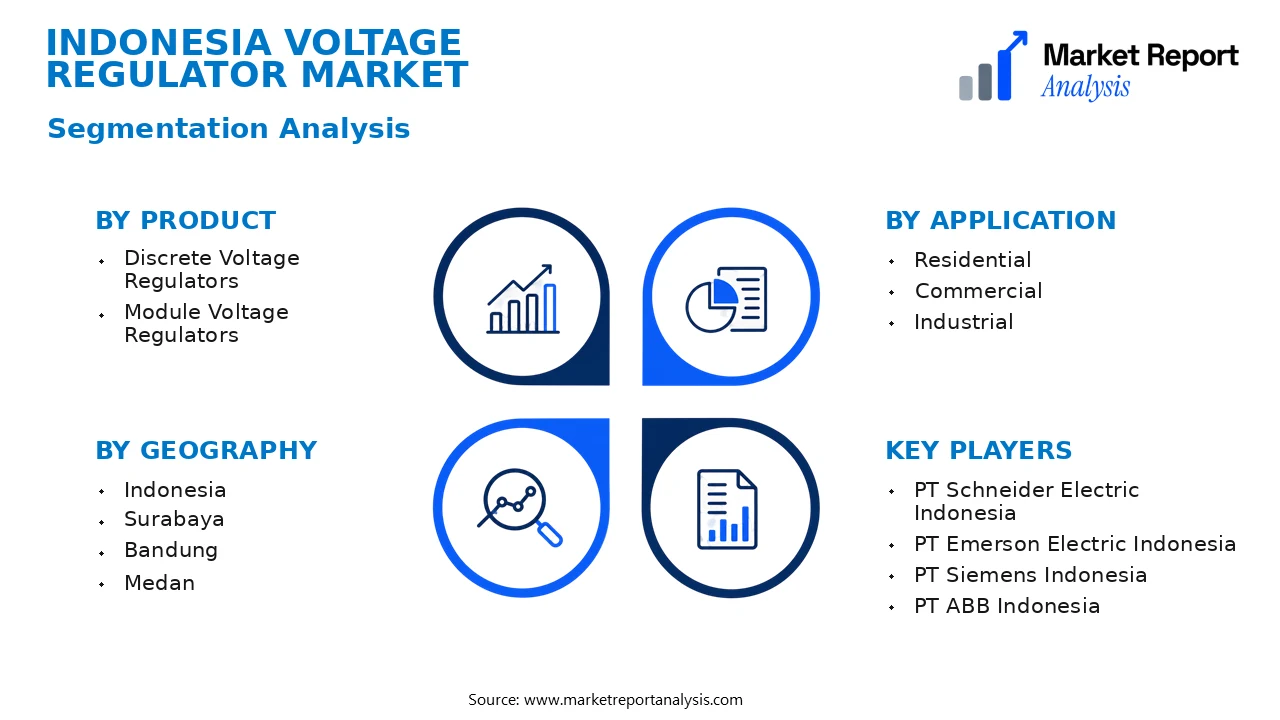
The Indonesia Voltage Regulator Market is segmented based on product type, application, and geography. This segmentation enables a detailed understanding of market dynamics, customer preferences, and regional growth patterns, essential for strategic planning and targeted marketing efforts.
- Product
- Discrete Voltage Regulators: These devices are standalone units designed for localized voltage stabilization in commercial and residential settings, driving demand due to growing infrastructure and urbanization trends across Indonesia.
- Module Voltage Regulators: Integrated into larger systems, these voltage regulators cater mainly to industrial applications, supporting manufacturing growth and energy infrastructure modernization in key urban hubs.
- Application
- Residential: This segment includes voltage regulation units used in household electrical systems to ensure appliance safety and operational efficiency amidst fluctuating power supplies, attracting significant demand from expanding urban housing projects.
- Commercial: Commercial buildings such as malls, office complexes, and hospitality venues require reliable voltage regulation to maintain operational stability and protect sensitive electronic equipment, supporting steady market growth.
- Industrial: Industries rely on advanced voltage regulation solutions to maintain manufacturing processes, improve energy efficiency, and reduce downtime, particularly in electronics, automotive, and heavy machinery sectors.
- Geography
- Indonesia:
- Jakarta: As the capital, Jakarta exhibits high demand driven by rapid urban growth, significant industrial activity, and a robust infrastructure development sector fostering extensive adoption of voltage regulation technologies.
- Surabaya: An economic hub with a thriving manufacturing industry, Surabaya's expanding industrial base necessitates reliable voltage regulation systems to support industrial operations and infrastructure projects.
- Bandung: Known for technology parks and educational institutions, Bandung’s focus on tech development and urban expansion increases demand for advanced voltage regulation solutions for commercial and residential use.
- Medan: As a key economic center in Sumatra, Medan’s expanding industrial zones and urban infrastructure projects drive demand for voltage regulation devices to support energy and manufacturing sectors.
- Indonesia:
Competitive Intelligence
The Indonesia Voltage Regulator Market is characterized by moderate competition, with key players adopting aggressive business strategies to strengthen their market positions. Market concentration remains relatively fragmented, with several regional and international firms vying for market share, especially in major cities such as Jakarta, Surabaya, and Bandung. Companies are focusing on product innovation to meet the growing demand for energy efficiency and enhanced reliability, introducing smart voltage regulation systems equipped with IoT capabilities and automation features. Strategic partnerships between voltage regulator manufacturers and local electrical infrastructure firms are common, facilitating better market penetration and technological transfer. Some firms are pursuing acquisitions of smaller regional players to expand their presence across Indonesia’s diverse geographical landscape. R&D investments are increasing, aimed at developing competitive differentiation through superior performance, durability, and customization options tailored to Indonesia’s unique electrical load requirements. Differentiation strategies include offering cost-effective solutions in rural areas while promoting high-end, energy-efficient systems in urban centers, ensuring broad market appeal and sustainable growth.
Leading Company Profiles
The competitive landscape of the Indonesia Voltage Regulator Market features a diverse group of established and emerging players, each focusing on innovative solutions, technological advancements, and expanding regional presence to capture increasing demand across various sectors.
- PT Schneider Electric Indonesia
- PT Emerson Electric Indonesia
- PT Siemens Indonesia
- PT ABB Indonesia
- PT Honeywell Indonesia
- PT Mitsubishi Electric Indonesia
- PT Eaton Electrical Indonesia
- PT Fuji Electric Indonesia
- PT Legrand Indonesia
- PT Delta Electronics Indonesia
PT Schneider Electric Indonesia
PT Schneider Electric Indonesia specializes in power management and automation solutions, offering a comprehensive range of voltage regulators designed for energy efficiency and grid stability, backed by advanced digital capabilities and robust regional service networks.
PT Emerson Electric Indonesia
PT Emerson Electric Indonesia provides innovative voltage regulation systems focusing on industrial and infrastructure applications, emphasizing scalability, reliability, and integration with smart grid technologies to meet evolving customer needs.
PT Siemens Indonesia
PT Siemens Indonesia delivers technologically advanced voltage regulators epitomizing smart grid integration, digitalization, and energy management, which aim to optimize operational efficiency and support Indonesia’s sustainable development goals.
PT ABB Indonesia
PT ABB Indonesia is renowned for its high-performance voltage regulation solutions incorporating automation and digital control systems, enabling enhanced grid stability, energy conservation, and system resilience for diverse sectors.
PT Honeywell Indonesia
PT Honeywell Indonesia offers innovative, intelligent voltage regulators integrated with IoT and automation platforms to support critical infrastructure resilience and enhance power quality across commercial and industrial applications.
PT Mitsubishi Electric Indonesia
PT Mitsubishi Electric Indonesia specializes in compact, energy-efficient voltage regulation devices that leverage cutting-edge technology for reliable electrical supply, with a strategic focus on renewable energy integration and industrial automation.
PT Eaton Electrical Indonesia
PT Eaton Electrical Indonesia develops adaptive voltage regulators aimed at minimizing power disruptions, promoting energy efficiency, and supporting Indonesia's rapidly expanding energy infrastructure through technological innovation.
PT Fuji Electric Indonesia
PT Fuji Electric Indonesia focuses on high-precision voltage regulation solutions tailored for manufacturing sectors, emphasizing energy savings, real-time control, and seamless integration with existing electrical systems.
PT Legrand Indonesia
PT Legrand Indonesia offers modular, scalable voltage regulators with a focus on infrastructure and commercial projects, emphasizing ease of installation, maintenance, and enhanced system monitoring capabilities.
PT Delta Electronics Indonesia
PT Delta Electronics Indonesia provides advanced, energy-efficient voltage regulation products that incorporate digital technologies, aimed at supporting the nation's sustainable growth and resilient power distribution networks.
Strategic Business Developments
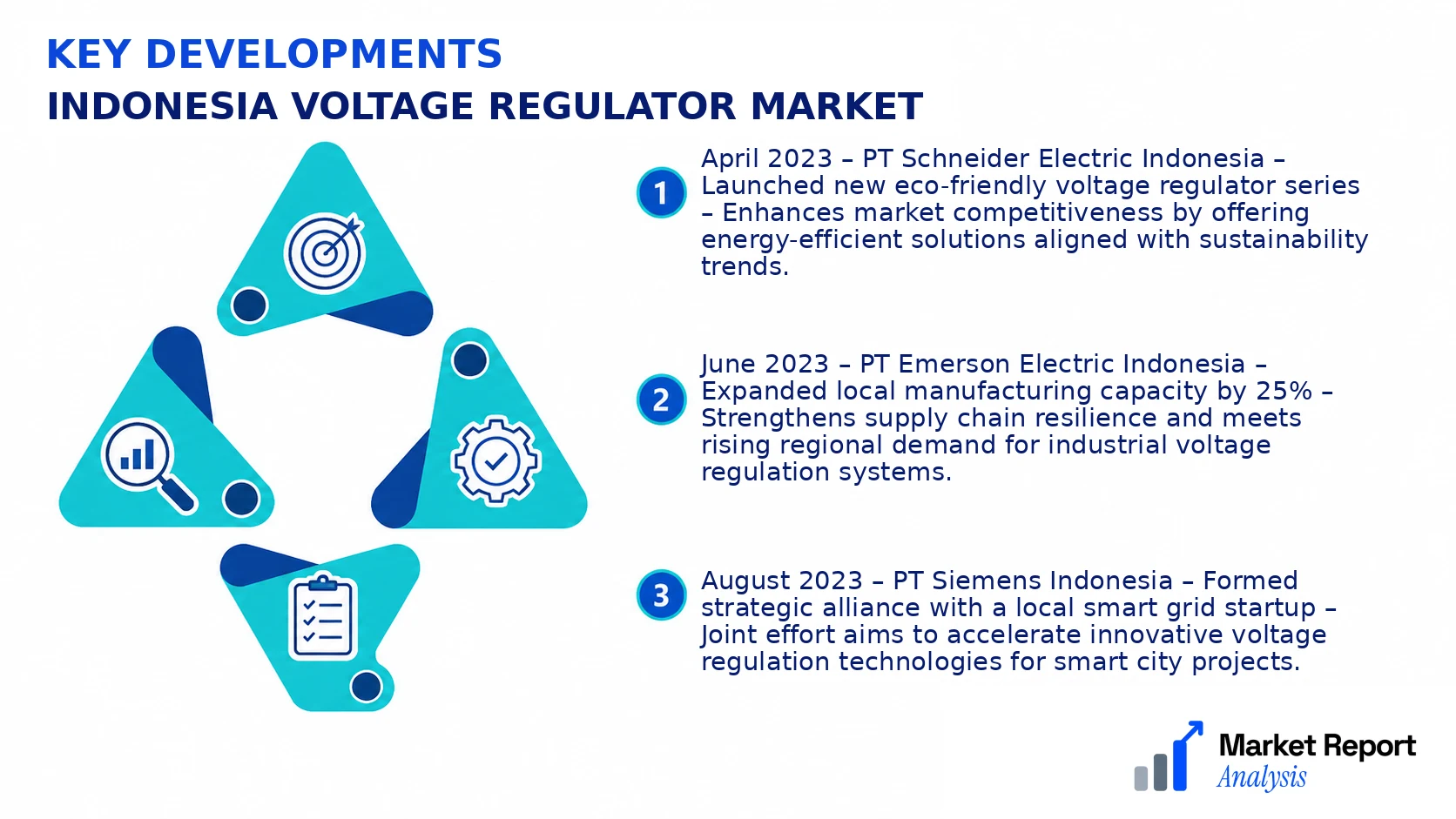
- April 2023 – PT Schneider Electric Indonesia – Launched new eco-friendly voltage regulator series – Enhances market competitiveness by offering energy-efficient solutions aligned with sustainability trends.
- June 2023 – PT Emerson Electric Indonesia – Expanded local manufacturing capacity by 25% – Strengthens supply chain resilience and meets rising regional demand for industrial voltage regulation systems.
- August 2023 – PT Siemens Indonesia – Formed strategic alliance with a local smart grid startup – Joint effort aims to accelerate innovative voltage regulation technologies for smart city projects.
- November 2022 – PT ABB Indonesia – Acquired a local automation solutions provider – Enhances integration capabilities of voltage regulation systems within broader digital infrastructure offerings.
- February 2023 – PT Honeywell Indonesia – Implemented new digital platform for remote monitoring of voltage regulators – Improves operational efficiency and predictive maintenance services across Indonesia.
Frequently Asked Questions
What is the Indonesia Voltage Regulator Market?
The Indonesia Voltage Regulator Market comprises devices that stabilize voltage levels to ensure the safe, reliable operation of electrical equipment across various sectors, including industrial, commercial, and residential, in Indonesia. It reflects ongoing technological advancement and infrastructure growth.
What is the current market size of Indonesia Voltage Regulator Market?
As of 2026, the Indonesia Voltage Regulator Market is valued at approximately USD 1.2 Billion, driven by increasing demand for power stability in expanding infrastructures and industrial zones, with an expectation to sustain growth due to rapid urbanization and industrialization.
What factors are driving the Indonesia Voltage Regulator Market?
Key growth drivers include expanding urban infrastructure, rising adoption of renewable energy sources, increasing industrial activities, and the proliferation of electronics and electrical appliances, all necessitating advanced voltage regulation solutions to prevent equipment damage and enhance operational efficiency.
Which region dominates the Indonesia Voltage Regulator Market?
Java region dominates the Indonesian Voltage Regulator Market due to its dense population, extensive industrial zones, and concentration of manufacturing and power infrastructure, making it the primary hub for voltage regulation demands across the country.
Which segment is expected to grow the fastest?
The industrial segment is projected to experience the fastest growth, fueled by rapid industrial expansion, increased manufacturing activity, and heightened need for reliable power supply to ensure continuous operations and equipment safety.
Who are the leading companies operating in the Indonesia Voltage Regulator Market?
Major players include ABB Ltd., Siemens AG, Schneider Electric, and Emerson Electric, among others, who are striving to innovate and expand their product portfolios to meet the growing electrical power stability needs in Indonesia.
Analyst Perspective
The Indonesia Voltage Regulator Market exhibits a mature landscape with steady growth driven by ongoing infrastructural development and the expanding industrial sector. Long-term prospects are robust, with increasing urbanization and energy demand fueling market expansion. Commercial opportunities predominantly lie in high-capacity solutions for power utilities and industrial facilities, particularly in metropolitan hubs such as Jakarta and Surabaya, where infrastructure modernization is prioritized. Technology evolution is shifting towards smart, adaptive voltage regulators integrated with IoT for real-time grid management, providing competitive edges for early adopters. Investment priorities should focus on manufacturing capabilities for high-quality, energy-efficient regulators and regional distribution networks to harness local demand effectively. Market competition remains intense, with several established players expanding their regional footprints. Notably, regional growth potential in eastern provinces and emerging industrial zones presents strategic avenues for market entrants. Cities with burgeoning industrial zones will be critical for capturing long-term growth, making targeted investments in local infrastructure and distribution channels essential for capitalizing on Indonesia’s power market expansion.
