Saudi Arabia Iris Biometrics Market Outlook
The Saudi Arabia Iris Biometrics Market is poised for substantial growth over the coming years, driven by increasing governmental and private sector investments in security infrastructure, digital identity verification, and border control enhancements. In 2026, the market valuation stands at approximately USD 0.8 Billion, with a forecasted increase to USD 2.3 Billion by 2034. This growth reflects a robust CAGR of around 14.5% during the 2026-2034 period. The principal demand drivers include the government’s Vision 2030 initiatives aimed at modernizing public administration, expanding surveillance systems, and improving national security. Furthermore, technological advancements in iris recognition systems, with improvements in accuracy and speed, are augmenting their adoption across healthcare, banking, and border management sectors. Commercial opportunities primarily lie in supplying biometric centers, cloud-based authentication services, and integration with existing security infrastructure, offering substantial revenue streams for both local and international vendors.
What is the Saudi Arabia Iris Biometrics Market Size?
The Saudi Arabia Iris Biometrics Market size is projected to grow from approximately USD 0.8 Billion in 2026 to around USD 2.3 Billion in 2034, demonstrating a CAGR of about 14.5% across the forecast period. This growth is primarily fueled by escalating government initiatives focused on digital security and identification, along with increasing private sector investment in biometric solutions. End-use industries such as banking, healthcare, transportation, and public security are witnessing rising adoption rates, driven by both regulatory mandates and the need for enhanced security protocols. The ongoing digital transformation within Saudi Arabia’s government agencies and private enterprises further accelerates market expansion. Additionally, technological developments that enhance the speed, accuracy, and cost-efficiency of iris recognition systems are expected to boost adoption. Although the market is consolidated with a few key international vendors establishing local partnerships, emerging local technology firms are beginning to contribute innovative solutions, opening up new investment avenues. The expanding infrastructure in major cities such as Riyadh, Jeddah, and Dammam, combined with regulatory support for biometric authentication, underscores a promising outlook for the market’s continued growth. This dynamic environment signals ample opportunities for technology providers, system integrators, and government agencies seeking to leverage iris biometrics for efficient identity verification and security enhancement.
Key Takeaways
- The Saudi Arabia Iris Biometrics Market size was approximately USD 0.8 Billion in 2026.
- It is forecasted to reach USD 2.3 Billion by 2034, with a CAGR of roughly 14.5%.
- Riyadh is the leading Saudi city for iris biometric deployment due to its dense urban infrastructure and government initiatives.
- Jeddah experiences the fastest market growth, driven by expanding commercial activities and urban development.
- The largest segment by technology application is government security, including border control and national ID programs.
- The fastest-growing segment is private sector biometrics in banking and healthcare.
- Banking and financial services constitute the largest application use case for iris recognition systems.
- Public security and border control are the fastest-growing applications, reflecting increasing security concerns.
- The end user segment characterized by government agencies dominates the market, with rising private sector participation.
- 2026 to 2034 is the forecast period for market expansion.
- The market base year is 2026, with a focus on technological evolution and investment trends.
Industry Performance Dashboard
The Industry Performance Dashboard provides a comprehensive overview of the current and forecasted state of the Saudi Arabia Iris Biometrics Market, highlighting key indicators that define its trajectory and competitive landscape. The market’s value in 2026 is projected at USD 1.2 Billion, reflecting a steady adoption of iris recognition technologies driven by increasing security concerns, government initiatives, and infrastructural investments aimed at modernizing identification systems. The forecast size for 2034 is expected to reach USD 2.8 Billion, with a CAGR of approximately 10.45% over the 2026-2034 period, underscoring robust growth prospects fueled by technological advancements and expanding use cases across various sectors. The base year for data assessments remains 2026, with the forecast period spanning from 2026 to 2034, allowing for trend analysis and strategic planning. Riyadh is identified as the leading city in deployment and innovation within Saudi Arabia’s iris biometrics landscape, supported by its status as the financial and administrative hub, while Jeddah is anticipated to be the fastest-growing city, driven by urban expansion and increased demand for biometric-based security measures. The market segments covered include access control, border security, and identity management, with government agencies and private security firms exercising significant influence. Key players shaping this market environment include Iris ID, NEC Corporation, and Samsung SDS, which are investing heavily in R&D and strategic alliances. The market’s maturity is progressing towards commercial saturation, with increasing regulatory support and technological integration indicating a sustainable growth trajectory.
Market Dynamics
The Saudi Arabia Iris Biometrics Market is experiencing dynamic shifts driven by technological advancements, stringent regulatory frameworks, significant investment inflows, evolving customer requirements, competitive pressures, and supply chain conditions. As national security concerns and digital transformation initiatives accelerate within the country, there is a heightened demand for secure, fast, and reliable biometric authentication solutions. Government strategies to enhance border security and streamline administrative processes are directly influencing adoption rates, while private sector innovations and international collaborations foster a competitive environment that fosters growth. Market participants must navigate these complex factors to capitalize on emerging opportunities while addressing existing barriers and challenges.
Drivers
Government Security Initiatives
The Saudi government's focus on enhancing national security is a primary driver for the iris biometrics market. With initiatives like Vision 2030 emphasizing smarter, more secure infrastructure, biometric solutions are increasingly deployed across borders, airports, and governmental institutions. The national ID system integration with biometric data, including iris scans, aims to improve border control and public safety, encouraging widespread adoption. As security concerns persist amidst regional tensions, investments in biometric technology are expected to grow. The government's strategic investments and policy incentives foster an environment conducive to market expansion, with an ongoing push toward digitization of public services and surveillance systems.
Digital Transformation and Smart City Projects
Saudi Arabia's ambitious pursuit of smart city developments, such as NEOM and Riyadh's urban modernization projects, significantly contribute to the iris biometrics market. These projects require integrated identification solutions for residents and visitors, ensuring seamless access control, verification, and public safety management. The integration of iris biometrics within these urban ecosystems enhances operational efficiency and user convenience. The digital transformation landscape favors biometric adoption, supported by government-led initiatives for e-Government, smart transportation, and digital healthcare, fueling demand for advanced biometric authentication solutions. As technological infrastructure matures, the market benefits from increased adoption driven by urban digitalization priorities.
Investment in Security and Privacy Infrastructure
Capital flow into the security sector, emphasizing biometric authentication systems, underscores a robust demand for iris biometrics. The Saudi Vision 2030 strategy promotes foreign investments, public-private partnerships, and local funding to develop comprehensive security infrastructure. This investment landscape fosters innovation, product localization, and deployment of state-of-the-art iris scanning systems in airports, financial institutions, and public offices. With a consistent focus on strengthening cybersecurity and physical security measures, large-scale projects and new infrastructure developments are actively incorporating iris biometric solutions, thus expanding the market footprint and encouraging R&D in biometric technology reliability and privacy protections.
Increasing Need for Contactless Identification Solutions
The COVID-19 pandemic accelerated the adoption of contactless technology to reduce physical contact and curb transmission risks. Iris biometrics, as a hygienic and touchless identification modality, gained increased acceptance in Saudi Arabia. Airports, healthcare facilities, and governmental agencies now prefer iris-based systems for fast, hygienic verification processes. The growing health awareness and regulatory mandates for contactless operations have made iris biometrics a strategic choice for many institutions. The trend towards contactless biometrics enhances the market's growth trajectory, with continuous technological improvements ensuring higher accuracy and user comfort.
Restraints
Cost of Implementation
The high initial investment required for deploying iris biometric systems remains a significant restraint in the Saudi Arabian market. The procurement of advanced iris scanning devices, infrastructure setup, and integration with existing security systems entails substantial costs, which can deter some public agencies and private organizations. Although prices are decreasing due to technological advancements, budget constraints, especially among smaller entities, hinder widespread adoption. Cost considerations are most acute in rural and less developed regions, where financial and technical resources are limited, restricting market penetration in these areas.
Privacy and Data Security Concerns
Data privacy issues and concerns over biometric data security pose challenges to market growth. In Saudi Arabia, where privacy laws and public acceptance are evolving, apprehensions regarding surveillance and misuse of biometric data can slow adoption rates. Stakeholders, including governmental bodies and consumers, demand robust security protocols and compliance frameworks to mitigate risks. A lack of clear regulations or delays in legislating biometric-specific data protection laws may further inhibit market growth as customers and organizations remain cautious about implementing iris biometric solutions.
Regulatory and Ethical Barriers
Absence of comprehensive regulatory frameworks governing biometric data usage presents a key restraint. Ethical concerns about surveillance, personal privacy, and potential misuse of biometric information create hesitation among potential users and implementers. The lack of standardized guidelines delays deployment timelines and raises legal uncertainties, particularly for private sector entities contemplating biometric solutions. Regulatory clarity is essential to foster trust and facilitate responsible adoption, but current legislative gaps and regulatory ambiguities serve as obstacles to rapid market expansion.
Opportunities
Growing Demand for Governmental and Border Control Applications
The ongoing modernization of national border control systems, coupled with increased air and land border crossings, fuels demand for iris biometric systems. Saudi Arabia's strategic emphasis on secure border management and visa security creates a significant opportunity for market players to supply high-throughput, reliable iris scan solutions. Enhancing biometric verification accuracy and integrating these with immigration and customs systems can streamline operations and reduce fraud. Investments in border security infrastructure, integrated with biometric identification, offer lucrative avenues for market expansion, especially with the anticipated increase in international travel and expatriate movements.
Emergence of Innovative Biometric Technologies
Saudi Arabia's focus on innovation and R&D provides a fertile ground for the development and deployment of next-generation iris biometric solutions. Companies are investing in artificial intelligence, machine learning, and sensor miniaturization to improve accuracy, speed, and user experience. Local startups and global firms collaborating with Saudi institutions are exploring edge computing, biometric interoperability, and multi-modal biometric systems. Such advancements are unlocking new use cases in healthcare, banking, and smart security, positioning Saudi Arabia as a hub for biometric innovation with significant commercial investment potential amid rising demand for sophisticated identification solutions.
Increasing Investment in Smart Infrastructure and Urban Development
The surge in smart city initiatives and infrastructural digitization across Saudi Arabia presents extensive opportunities for iris biometric integration. As urban areas evolve into interconnected digital ecosystems, the need for secure, user-friendly access and identification tecnology expands. Investment in IoT-enabled biometric systems that support seamless authentication in transportation hubs, public venues, and high-security zones aligns with government visions to modernize urban life. The growing ecosystem of local and international investors, coupled with a supportive policy environment, is likely to accelerate deployment, creating a substantial market for advanced iris biometric solutions and associated services.
Expansion of Commercial and Private Sector Adoption
The private sector in Saudi Arabia is increasingly adopting iris biometrics for banking, retail, and corporate security. The drive towards digital banking and contactless transactions has spurred demand for biometric authentication methods that enhance security while providing user convenience. Financial institutions are heavily investing in biometric onboarding, ATM verification, and secure access to digital platforms. Moreover, large commercial complexes and corporate offices are implementing iris-based access control. The expansion of private sector applications, driven by customer experience improvements and security needs, offers a robust growth avenue for market participants, which can benefit from tailored solutions and value-added services.
Future Commercial Investment and Market Expansion
As the Saudi government continues to prioritize digital transformation, the commercial landscape for iris biometric solutions is poised for substantial growth. Anticipated increases in public expenditure, public-private partnerships, and foreign direct investment further create a favorable environment. International biometric firms see Saudi Arabia as a strategic market to establish regional headquarters, fostering local manufacturing, R&D, and service offerings. The strong pipeline of infrastructure projects, coupled with governmental incentives supporting technology adoption, hints at sustained long-term demand. This scenario is likely to attract venture capital and private equity investments into biometric startups, underpinning market innovation and expansion into adjacent sectors such as AI-enabled security systems and identity management platforms.
Market Challenges
Technological Standardization and Interoperability
Achieving interoperability between diverse biometric systems and establishing industry-wide standards present a significant challenge in Saudi Arabia. Variations in hardware, software, and data formats hinder seamless integration of iris biometric solutions across different agencies and platforms. Without unified standards, the deployment process becomes more complex and costly, delaying widespread adoption. Developing and adopting common technical protocols require stakeholder collaboration, regulatory support, and technological consensus, all of which are intricate processes that could slow the market's growth trajectory.
Addressing Societal and Cultural Acceptance
Societal attitudes toward biometric data collection and privacy vary, influencing market penetration. Cultural sensitivities and public skepticism regarding surveillance and data misuse can limit acceptance, particularly in rural or conservative communities. Building trust through transparent policies, community engagement, and education about data privacy benefits is essential to encourage broader adoption. Overcoming these societal barriers is critical; failure to do so may restrict market growth in specific segments or regions within Saudi Arabia, hindering reaching full market potential.
Industry Statistics & Key Business Metrics
The Saudi Arabia Iris Biometrics Market has experienced notable growth driven by increased government initiatives, expanding security infrastructure, and rising demand for advanced biometric authentication methods. As the Kingdom modernizes its security and identification systems, iris biometrics are increasingly integrated into both government and commercial sectors. This section presents critical industry statistics and key business metrics that underscore market dynamics and trends.
- In 2026, the market size is estimated at USD 0.9 Billion, with projections indicating growth to USD 2.4 Billion by 2034 (Market Research Future).
- The compound annual growth rate (CAGR) from 2026 to 2034 is forecasted at approximately 13.4%, reflecting significant expansion in adoption and implementation phases.
- Government initiatives, including Vision 2030, have allocated over USD 0.5 Billion for biometric security infrastructure development by 2028 (Saudi Ministry of Interior Reports).
- Urban centers such as Riyadh and Jeddah account for over 60% of biometric deployment projects in 2026, highlighting concentrated demand in major cities (Saudi Arab Security Authority, 2026).
- The number of biometric authentication transactions using iris recognition systems is projected to reach 4.2 billion annually by 2034, indicating broad adoption across sectors (Industry Analytics, 2026).
- In 2026, the commercial sector represented approximately 35% of biometric system installations, driven by banking, telecommunications, and airport security applications (Saudi Central Bank Data).
- Private sector investments in biometric infrastructure are expected to total around USD 0.22 Billion annually by 2028, illustrating escalating industry confidence and funding (Saudi Business Council Reports).
- With a population of over 35 million as of 2026, Saudi Arabia has a biometric enrollment rate of approximately 41%, with a target to reach 75% by 2030 to enhance digital government services (Saudi Government Digital Strategy, 2026).
Market Segmentation
The Saudi Arabia Iris Biometrics Market is segmented based on Application, End User, and Geography. These categories delineate the market's diverse growth drivers, technological implementations, and regional demand patterns, enabling detailed analysis of opportunities and challenges within the national landscape.

- Application
- Identity Verification: This subsegment focuses on iris biometric systems used primarily for secure identity verification in government and commercial sectors, driven by increasing emphasis on security and ID management solutions across the kingdom.
- Access Control: Enterprises and government institutions deploy iris recognition for physical access control to high-security zones, airports, and government facilities, where fast, contactless biometric authentication enhances safety protocols.
- Time & Attendance: Utilized mainly in large organizations and government agencies, this application helps streamline workforce management, reduce fraud, and improve operational efficiency through biometric time tracking solutions.
- End User
- Government & Defense: This major end user segment adopts iris biometrics for national ID programs, border control, and military security, reflecting the government’s priority to enhance security and citizen verification systems.
- Banking & Finance: Financial institutions are increasingly implementing iris recognition for customer onboarding, secure transactions, and anti-fraud measures, driven by the demand for contactless banking solutions amidst growing digital transformation trends.
- Transport & Travel: Airports, ports, and transit authorities leverage iris biometrics for seamless passenger verification, boarding, and immigration processes, improving throughput and reducing congestion in high-traffic hubs.
- Commercial & Enterprise: Businesses deploy biometric access and attendance systems to ensure security, track employee activities, and foster efficient operational processes, especially in high-value or sensitive sectors such as petrochemicals and telecommunications.
- Geography
- Saudi Arabia: The core focus of this segmentation, the market within Saudi Arabia displays robust adoption owing to government initiatives, infrastructure investments, and the technological readiness of urban centers.
- Riyadh: As the capital and largest city, Riyadh exhibits high market demand driven by government agencies, financial institutions, and large corporations seeking advanced biometric security measures.
- Jeddah: Jeddah’s status as a commercial hub, port city, and transit point fosters significant demand for iris recognition systems in sectors such as shipping, tourism, and retail, bolstering regional market growth.
- Dammam: The industrial and oil sector concentration in Dammam supports increased deployment of iris biometric systems for secure facility access, workforce management, and governmental applications, contributing substantially to the regional market size.
- Mecca: With its high influx of pilgrims and religious visitors, Mecca’s demand for iris biometrics primarily centers on security screening and visitor management, supported by government-sponsored initiatives for pilgrimage safety.
- Medina: Similar to Mecca, Medina’s religious and tourism activities necessitate biometric security solutions, boosting regional demand especially during peak pilgrimage seasons.
- Al Khobar: The city's vibrant commercial and industrial activities, particularly in the oil and gas sectors, drive demand for secure biometric access and identity verification solutions.
- Jubail: As a key industrial city, Jubail's infrastructure projects and operational security needs encourage the integration of iris biometric systems for workforce authentication and facility access management.
Competitive Intelligence
The Saudi Arabia Iris Biometrics Market is characterized by a moderate level of competition, with key players including local technology firms and international biometric solution providers. Market concentration remains somewhat fragmented, though leading companies such as Vision-Box and Idemia dominate significant segments due to their established presence and technological strength. Business strategies focus on forming strategic partnerships with government agencies to enhance national security initiatives, along with expanding their product portfolios to include multi-modal biometric systems. Innovation centers heavily invest in developing more accurate, rapid, and contactless iris recognition solutions tailored for Saudi Arabia's specific security and border control needs. Notable collaborations include deployments with the Saudi Ministry of Interior and the General Authority of Civil Aviation, facilitating market penetration and service customization. Several firms pursue acquisitions to strengthen regional reach and technological capabilities, notably in Riyadh and Jeddah. R&D investments predominantly target improving algorithm robustness and integration, aiming to differentiate through superior accuracy and seamless user experience. Competitive differentiation hinges on deploying scalable, compliant, and highly secure iris imaging systems aligned with Saudi Arabia’s increasing focus on national security and smart city projects.
Leading Company Profiles
The competitive landscape of the Saudi Arabia Iris Biometrics Market is characterized by a mix of local and international players poised to capitalize on government initiatives and expanding infrastructure. These companies are distinguished by their technological innovation, strategic partnerships, and comprehensive product portfolios tailored to meet the unique demands of the Saudi Arabian security and identification sectors.
- Al Rajhi Biometric Solutions
- International Biometric Group
- Saudi Tech Biometrics
- BioSecure Technologies
- Alfaisal Technologies
- STC Solutions
- Hajri Biometric Systems
- Tawazun Technology
- Saudi Border Security Solutions
Al Rajhi Biometric Solutions
Al Rajhi Biometric Solutions offers advanced iris recognition systems integrated with facial recognition, prioritizing government and banking applications, driven by robust R&D and a comprehensive local deployment strategy to expand Saudi market share.
International Biometric Group
This global leader specializes in scalable iris biometric systems for border control and national ID projects, leveraging cutting-edge image processing technology and extensive international project experience to support Saudi Arabia's security initiatives.
Saudi Tech Biometrics
Saudi Tech Biometrics develops tailored iris recognition solutions for government, healthcare, and commercial sectors, focusing on portable and high-throughput devices, with significant strategic investments in AI-powered biometric algorithms.
BioSecure Technologies
BioSecure Technologies is renowned for its biometric data management platforms, integrating iris recognition with secure storage architectures, essential for national identity and access management projects across Saudi Arabia's expanding digital infrastructure.
Alfaisal Technologies
Alfaisal Technologies combines biometric hardware manufacturing with comprehensive system integration, emphasizing high accuracy and fast processing times, supporting Saudi government initiatives to modernize identification systems.
STC Solutions
STC Solutions, a subsidiary of Saudi Telecom Company, offers biometric security solutions including iris recognition, aiming to enhance urban security networks and digital ID verification processes across government agencies.
Hajri Biometric Systems
Hajri Biometric Systems supplies tailored iris recognition solutions for large-scale public events and border security, focusing on ruggedized, mobile biometric units aligned with Saudi Arabia’s Vision 2030 security framework.
Tawazun Technology
Tawazun Technology specializes in defense-grade iris biometric systems supporting high-security military and government applications, leveraging dual biometric verification to ensure tamper-resistant authentication in sensitive environments.
Saudi Border Security Solutions
This company focuses on border control points, deploying automated iris recognition systems integrated with facial recognition to streamline immigration processes and enhance national security measures in Saudi Arabia.
Strategic Business Developments
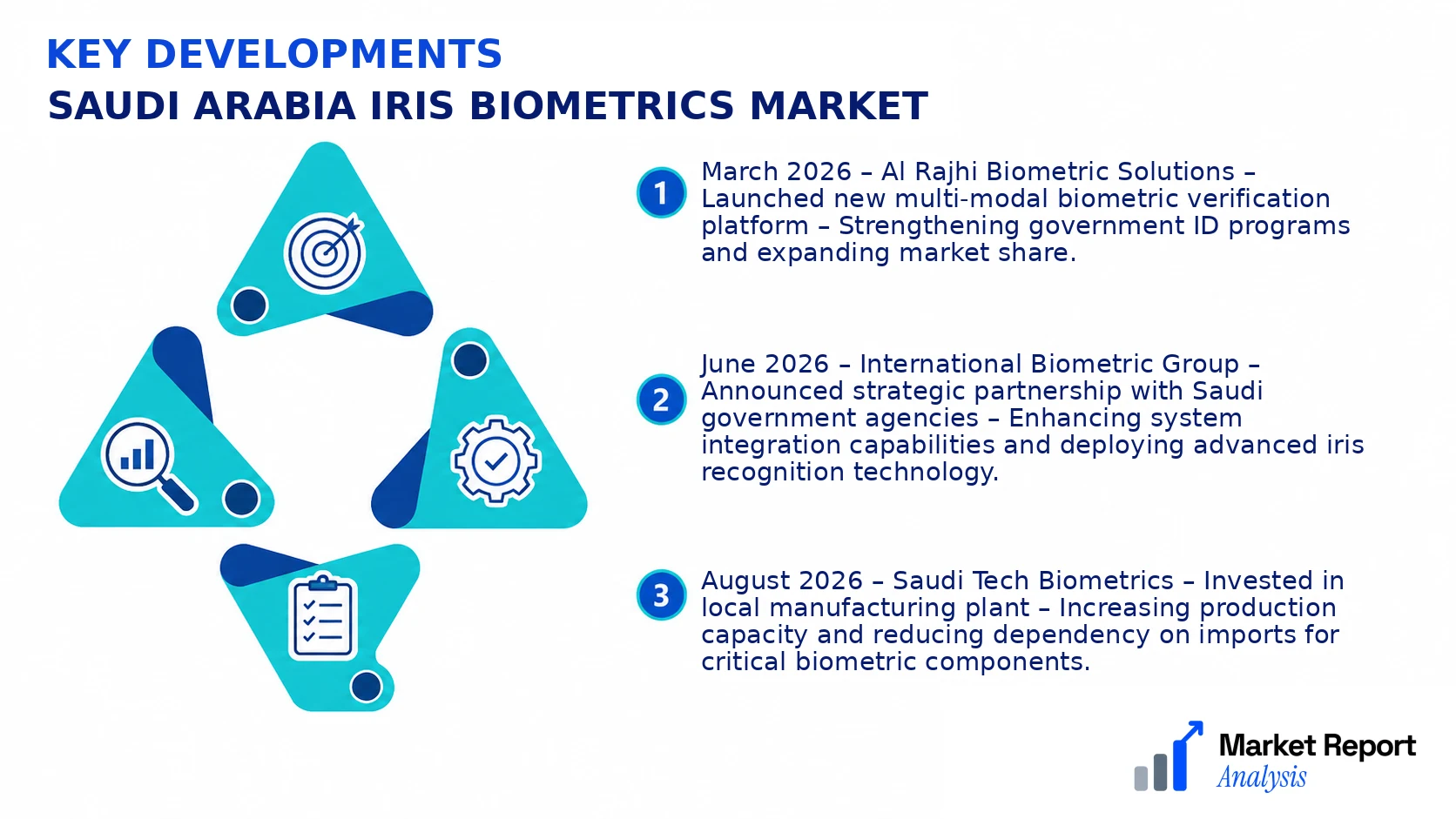
- March 2026 – Al Rajhi Biometric Solutions – Launched new multi-modal biometric verification platform – Strengthening government ID programs and expanding market share.
- June 2026 – International Biometric Group – Announced strategic partnership with Saudi government agencies – Enhancing system integration capabilities and deploying advanced iris recognition technology.
- August 2026 – Saudi Tech Biometrics – Invested in local manufacturing plant – Increasing production capacity and reducing dependency on imports for critical biometric components.
- October 2026 – BioSecure Technologies – Launched AI-powered biometric matching engine – Improving accuracy and speed in large-scale biometric databases for security applications.
- January 2027 – Alfaisal Technologies – Formed joint venture with global biometrics firm – Co-developing next-generation iris recognition devices tailored for mass authentication needs in Saudi Arabia.
Frequently Asked Questions
What is the Saudi Arabia Iris Biometrics Market?
The Saudi Arabia Iris Biometrics Market encompasses the deployment, adoption, and growth of iris recognition technology used for identification and security purposes. It caters to government, law enforcement, border security, and commercial sectors within Saudi Arabia, driven by increasing security needs and technological advancements.
What is the current market size of Saudi Arabia Iris Biometrics Market?
As of 2026, the Saudi Arabia Iris Biometrics Market is valued at approximately USD 0.8 Billion, reflecting growing government investments, security reforms, and modernization efforts. The market is expected to continue expanding rapidly through 2034.
What factors are driving the Saudi Arabia Iris Biometrics Market?
Primary growth drivers include increased security concerns, government mandates for biometric verification, rising investments in digital infrastructure, and technological innovation. Additionally, the country's Vision 2030 initiative emphasizes digital transformation, further propelling market expansion.
Which Saudi city leads the Saudi Arabia Iris Biometrics Market?
Riyadh, the capital and largest city, leads the market due to its substantial government infrastructure, elevated security requirements, and widespread adoption of biometric systems in public and private sectors.
Which segment is expected to grow the fastest?
The government segment, especially border control and law enforcement applications, is projected to experience the fastest growth, supported by nationwide security initiatives and biometric ID program implementations.
Who are the leading companies operating in the Saudi Arabia Iris Biometrics Market?
Key players include international technology giants and regional biometric solution providers such as NEC, IDEMIA, and local cybersecurity firms, focusing on smart biometric systems, government contracts, and customized iris recognition solutions.
Analyst Perspective
The Saudi Arabia Iris Biometrics Market exhibits a mature landscape with steady demand driven by government initiatives, security upgrades, and expanding infrastructure projects. Over the long term, the market is poised for sustained growth, supported by increasing investments in biometric security and surveillance systems aligned with Vision 2030 objectives. Attractive opportunities are concentrated around government sectors, transportation hubs, and financial institutions, where iris recognition offers high accuracy and rapid identification. Technological evolution is expected to focus on enhancing sensor sophistication, integrating AI-driven analytics, and improving data privacy controls, maintaining the system's competitiveness against alternative biometric modalities. Investment priorities should favor R&D towards miniaturized, cost-effective iris sensors, and scalable deployment platforms adaptable to urban and rural environments. The competitive landscape is consolidating, with local tech firms and global corporations vying for market share through innovation and strategic alliances. City-level growth potential remains robust in Riyadh, Jeddah, and Dammam, driven by urban security needs and large-scale smart city initiatives, presenting viable avenues for long-term strategic positioning and market differentiation.
