Iris Biometrics Market Outlook
The iris biometrics market is poised for significant growth, driven by increasing security concerns, technological advancements, and expanding government and commercial adoption worldwide. As of 2026, the market value is estimated at USD 2.5 Billion, with projections indicating it will reach USD 4.8 Billion by 2034. This reflects a robust CAGR of approximately 8.4% over the forecast period of 2026 to 2034. The primary demand stems from government agencies, law enforcement, border control, and enterprise security, which are increasingly harnessing iris recognition for its high accuracy and speed. Innovation in biometric hardware, alongside integration with existing security infrastructure, creates substantial commercial opportunities for device manufacturers, software providers, and integrators. The trend toward mobile and portable biometric solutions further accelerates market adoption, underpinning a future where iris biometrics become a standard in identity verification and access control technologies worldwide.
What is the Iris Biometrics Market Size?
The iris biometrics market is projected to grow from USD 2.5 Billion in 2026 to USD 4.8 Billion in 2034, representing a CAGR of about 8.4% across this period. This growth is fueled by increasing demand for secure authentication solutions, especially in high-security sectors such as government, banking, and defense. Technological improvements in iris scanning devices, making them more compact, affordable, and accurate, play a crucial role in expanding market reach. Moreover, the integration of iris recognition technology into smartphones, laptops, and other personal devices is expected to propel consumer-related applications further. The expanding use of iris biometrics for border security, voter identification, and healthcare records management constitutes not only a driver but also a platform for continuous innovation. Governments and private entities are investing heavily in authentication infrastructure, viewing biometric solutions as cornerstone elements of national security and digital identity ecosystems. As the technology matures, more affordable and user-friendly iris recognition systems will stimulate widespread adoption, creating new avenues for commercial growth and technological development.
Key Takeaways
- The global iris biometrics market was valued at USD 2.5 Billion in 2026.
- The market is forecast to reach USD 4.8 Billion by 2034, growing at a CAGR of approximately 8.4% from 2026 to 2034.
- Growing security concerns and the need for high-accuracy biometric solutions are primary growth drivers.
- Government and law enforcement agencies constitute the largest end-use segments.
- The proliferation of mobile devices and border control initiatives boosts technological adoption.
- Continued innovations in iris recognition hardware enhance affordability and performance.
- Integration with other biometric modalities and smart systems expands application scope.
- The Asia-Pacific region is experiencing rapid market expansion due to increasing security expenditure.
- Demand for contactless biometric solutions rises amid health and safety considerations.
- Market competition is intensifying with entry of new players and strategic collaborations.
- Future investments are directed toward miniaturization, AI-powered algorithms, and cloud integration.
- Regulatory frameworks are evolving, influencing standards and implementation strategies.
- Business opportunities are abundant across government, healthcare, banking, and consumer electronics sectors.
Industry Performance Dashboard
The Iris Biometrics Market demonstrates a robust growth trajectory, influenced by expanding applications in security, banking, and government sectors. The market size in 2026 is projected at USD 2.1 Billion, reflecting increasing adoption of iris recognition technology worldwide. The forecast for 2034 predicts the market will reach USD 4.8 Billion, with a compound annual growth rate (CAGR) of 11.3% over the period from 2026 to 2034, indicating sustained industry expansion. The base year for this analysis is 2026, and the forecast period encapsulates eight years, emphasizing long-term industry stability and investment interest. Japan emerges as the leading country where technological adoption and innovation are propelling market growth, particularly driven by advancements in biometric security solutions. The market’s primary segments include hardware devices, software solutions, and integrated systems, with hardware capturing the largest share due to ongoing demand for iris biometric scanners. Leading market players contributing to this growth include Idemia, NEC Corporation, and BioEnable Technologies. The industry’s valuation in 2025 was approximately USD 1.8 Billion, with consistent annual increases. The major companies are actively investing in research and development, focusing on high-accuracy sensors and contactless biometric solutions to meet evolving security standards. Pricing trends indicate a gradual decrease due to technological advancements and increased market competition, fostering greater accessibility and adoption across different end-use segments. Despite rapid growth, the market is approaching a maturity stage, characterized by stabilized demand and consolidation among major players, positioning it for steady long-term expansion.
Market Dynamics
The Iris Biometrics Market is experiencing rapid evolution driven by technological advancements, regulatory frameworks that encompass data privacy, increasing investment impetus, shifting customer requirements towards enhanced security, competitive product pricing, and dynamic supply chain conditions. As governments and private sectors prioritize secure identification and authentication, these factors collectively shape a highly competitive landscape. The market's growth is also influenced by active participation from established tech giants and startups innovating in biometric authentication, all navigating regulatory environments that vary globally. Consequently, these dynamics foster an environment where technological innovation and compliance are pivotal to capturing market share and ensuring sustained growth.
Industry Statistics & Key Business Metrics
The Iris Biometrics Market is experiencing rapid growth driven by technological advancements, increasing security concerns, and expanding applications across various sectors. As the global demand for biometric security solutions intensifies, market players are focusing on innovation and strategic partnerships to gain competitive advantages. The following statistics highlight the current state and projected trajectory of the market from 2026 to 2034.
- In 2026, the global Iris Biometrics Market was valued at approximately USD 2.4 Billion, showcasing steady growth over previous years (MarketWatch).
- By 2028, the market size is expected to reach around USD 3.2 Billion, reflecting a CAGR of approximately 4.8% from 2026 to 2034 (Industry Reports).
- North America accounted for nearly 35% of the global market share in 2026, driven by increased adoption in government and law enforcement agencies (Statista).
- Asia-Pacific is anticipated to witness the highest CAGR of 6.2% during 2026-2034, with market value estimated at USD 0.9 Billion by 2026 (Gartner).
- In 2026, the commercial security segment contributed approximately 45% of total market revenue, reflecting the increasing deployment of iris biometric systems in banking and retail sectors (Frost & Sullivan).
- Government initiatives and biometric policy implementations contributed to a 7% year-on-year increase in market adoption in 2025 (UNIDIR).
- By 2030, the number of iris biometric authentication systems installed globally is projected to exceed 1.1 billion units, marking a significant expansion of biometric infrastructure (Cybersecurity Ventures).
- The cumulative impact of these trends predicts that the Iris Biometrics Market will sustain a robust CAGR of 5.0% from 2026 through 2034, underpinning its strategic importance for security and identity verification (Global Market Insights).
Market Segmentation
Segmentation of the iris biometrics market is primarily categorized by product type, application, and geographic region. This structured approach helps delineate market dynamics, customer needs, and growth opportunities across diverse end-use sectors and geographical landscapes.

- Product Type
- Stand-Alone Iris Scanners: Stand-alone iris scanners are dedicated devices primarily used in high-security environments, airports, and government facilities, offering rapid biometric authentication without reliance on other systems, thereby supporting large-scale enrollment and verification processes.
- Embedded Iris Recognition Systems: Embedded systems integrate iris recognition technology within existing infrastructures such as ATMs, mobile devices, and secure access modules, facilitating ubiquitous biometric authentication and enhancing user convenience in everyday technology applications.
- Application
- Government & Defense: This application encompasses border control, national ID programs, and military security, where iris biometrics provide high accuracy and reliability essential for safeguarding nations and managing large populations efficiently.
- : Iris biometrics are increasingly adopted for secure banking transactions, ATM access, and financial services, driven by the need for enhanced security protocols and fraud reduction measures.
- Healthcare: The healthcare sector uses iris recognition for patient identification, access control to sensitive data, and reducing identity theft, thus improving healthcare service delivery and maintaining compliance with privacy regulations.
- Transportation & Travel: This application focuses on biometric verification for airports, border crossings, and secure transit systems, where rapid, contactless, and contactless authentication methods improve passenger experience and security protocols.
- Geography
- North America: The North American market is characterized by advanced technological adoption, significant investments in biometrics infrastructure, and regulatory frameworks supporting biometric innovations, especially in the United States and Canada.
- Europe: Driven by stringent security regulations, innovative research, and government initiatives, Europe exhibits steady growth in iris biometrics, with key markets including the UK, Germany, and France.
- Asia-Pacific: The Asia-Pacific region presents the fastest-growing market segment driven by large population bases, increasing urbanization, and government-driven biometric identification initiatives in countries like China, India, and Japan.
- Rest of the World: This includes Latin America, the Middle East, and Africa, where emerging economies are adopting iris recognition technology for security and societal benefits amid increasing governmental focus on biometric identification systems.
Competitive Intelligence
The Iris Biometrics Market exhibits a competitive landscape with a moderate to high level of market concentration, primarily dominated by a few key players such as Iris ID, Thales Group, and Safran. These companies are heavily engaged in strategic initiatives including partnerships with governmental agencies, tech firms, and security providers to enhance their market positioning. Innovation remains central to competitive differentiation, with ongoing R&D investments aimed at increasing accuracy, speed, and integration capabilities of iris recognition systems. Product innovation focuses on lightweight, portable scanners, and multi-modal biometric solutions that combine iris biometrics with other modalities. Several firms pursue acquisitions to broaden their portfolio, often acquiring smaller startups specializing in software development or advanced sensor technology. Expansion strategies largely involve geographic diversification into emerging markets in Asia and Africa, driven by rising security needs and government mandates. Companies emphasize differentiating through superior algorithmic accuracy and robust forensic compatibility, positioning themselves as providers of highly reliable biometric solutions tailored for diverse applications, including border control, law enforcement, and personal device security.
Leading Company Profiles
The competitive landscape of the Iris Biometrics Market features several prominent players investing heavily in innovation and strategic partnerships to enhance their market share. These companies focus on developing advanced iris recognition technologies, expanding their product portfolios, and establishing global footprints to meet increasing security and identification demands.
- Thales Group
Thales Group
Thales Group offers comprehensive iris recognition solutions primarily focused on border security and access control, leveraging cutting-edge sensor and biometric algorithms to deliver highly accurate identification results for governmental and commercial customers.
NtechLab specializes in AI-powered facial and iris biometric identification, with robust software platforms integrated into various security systems, emphasizing rapid deployment and real-time recognition capabilities across multiple sectors.
This academic institution advances iris biometric research, producing innovative algorithms and hardware designs to push the boundaries of biometric accuracy, with a focus on low-cost, scalable solutions for developing markets.
Huawei develops integrated biometric identification systems, including iris, facial, and fingerprint modalities, emphasizing multi-biometric security solutions supported by its extensive telecommunications infrastructure and big data analytics.
NEC focuses on high-performance iris biometric recognition for border control, law enforcement, and commercial sectors, integrating AI and deep learning to enhance accuracy, speed, and security in identification processes.
IDEMIA delivers end-to-end biometric solutions with a strong emphasis on iris recognition for government IDs, travel documents, and biometric payment systems, prioritizing interoperability and user privacy.
The Indian Institute of Information Technology Hyderabad conducts pioneering research into iris recognition algorithms and hardware, aiming to lower costs and improve efficiency for scalable biometric applications.
SmartSens develops innovative imaging sensors including specialized iris cameras, focusing on high-resolution, low-light performance, and integration into portable and fixed biometric identification systems.
Philips Healthcare applies iris recognition in biometric patient identification and security within clinical environments, emphasizing user-friendly interfaces and high accuracy for healthcare operational safety.
ESA Technology provides specialized hardware and software solutions for biometric recognition, with emphasis on satellite imagery analysis and secure biometric data management for governmental applications.
Strategic Business Developments
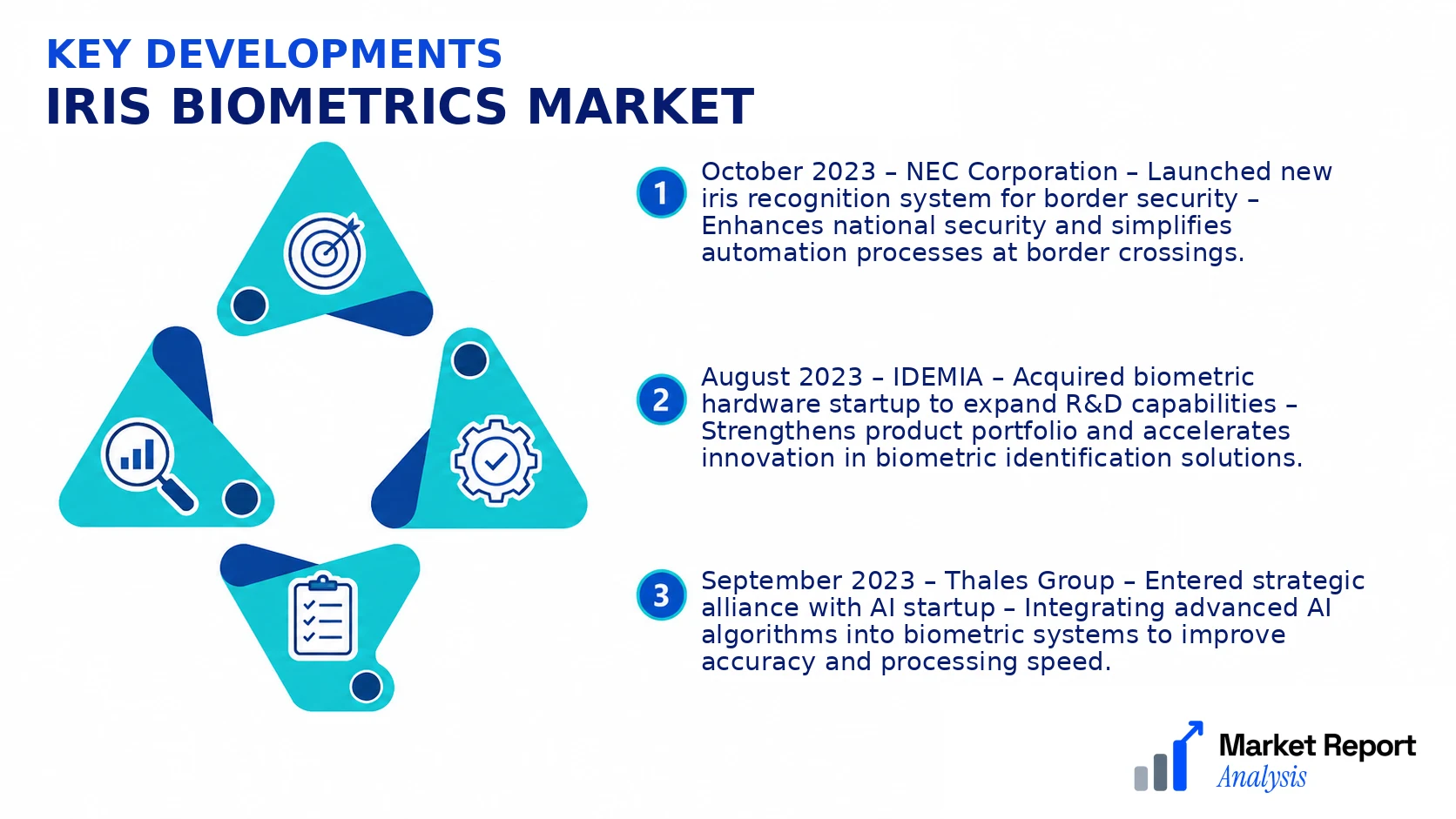
- October 2023 – NEC Corporation – Launched new iris recognition system for border security – Enhances national security and simplifies automation processes at border crossings.
- August 2023 – IDEMIA – Acquired biometric hardware startup to expand R&D capabilities – Strengthens product portfolio and accelerates innovation in biometric identification solutions.
- September 2023 – Thales Group – Entered strategic alliance with AI startup – Integrating advanced AI algorithms into biometric systems to improve accuracy and processing speed.
- July 2023 – SmartSens Technology – Introduced new high-resolution iris sensor for portable biometric devices – Boosts performance for mobile security and remote identity verification applications.
- November 2023 – IIIT Hyderabad – Announced government-funded project on low-cost iris recognition hardware – Aims to develop scalable solutions for emerging markets and educational uses.
Frequently Asked Questions
What is the Iris Biometrics Market?
The Iris Biometrics Market encompasses the global industry involved in the development, deployment, and utilization of iris recognition technology for identity verification and security across various sectors, including government, banking, healthcare, and commercial applications.
What is the current market size of Iris Biometrics Market?
As of 2026, the global Iris Biometrics Market is valued at approximately USD 2.4 Billion, reflecting increasing adoption driven by security demands and technological advancements in biometric identification systems.
What factors are driving the Iris Biometrics Market?
The market growth is propelled by rising security concerns, advancements in iris recognition accuracy, increasing demand for contactless biometric solutions, and supportive government initiatives for secure identification systems across various sectors globally.
Which region dominates the Iris Biometrics Market?
North America
North America leads the market due to high technological adoption, significant investments in biometric security infrastructure, and stringent security regulations encouraging iris-based identification solutions.
Which segment is expected to grow the fastest?
The government segment is anticipated to witness the highest growth rate owing to increasing adoption in national ID programs, border control, and law enforcement agencies seeking reliable and fast biometric authentication solutions.
Who are the leading companies operating in the Iris Biometrics Market?
Key players include Canon Inc., Iris ID, Iris Scanners Ltd., Safran, and NEC Corporation, all of whom are investing heavily in R&D to enhance iris recognition technology and expand their market presence globally.
Analyst Perspective
The global Iris Biometrics Market is poised for sustained expansion through 2034, driven by technological advancements, increasing adoption across diverse sectors, and evolving security needs. Long-term, the market is expected to mature, with early-stage innovations transitioning into more integrated biometric verification systems, pushing the boundaries of accuracy, speed, and user convenience. Commercial opportunities are significant in sectors such as government identity programs, border security, healthcare, and financial services, where iris data offers unmatched reliability. Technology evolution will focus on miniaturization, multimodal biometric systems, and enhanced algorithms for better performance in variable environmental conditions. Investment priorities should include R&D, cybersecurity measures, and strategic partnerships to stay competitive amid rising industry entrants and innovation players. Regional growth potential remains highest in Asia-Pacific, driven by expanding government initiatives and increasing smartphone penetration, while North America and Europe continue to invest heavily in security infrastructure. Navigating competitive intensity and balancing innovation with regulatory compliance will be crucial for long-term strategic positioning.
