Brazil Iris Biometrics Market Outlook
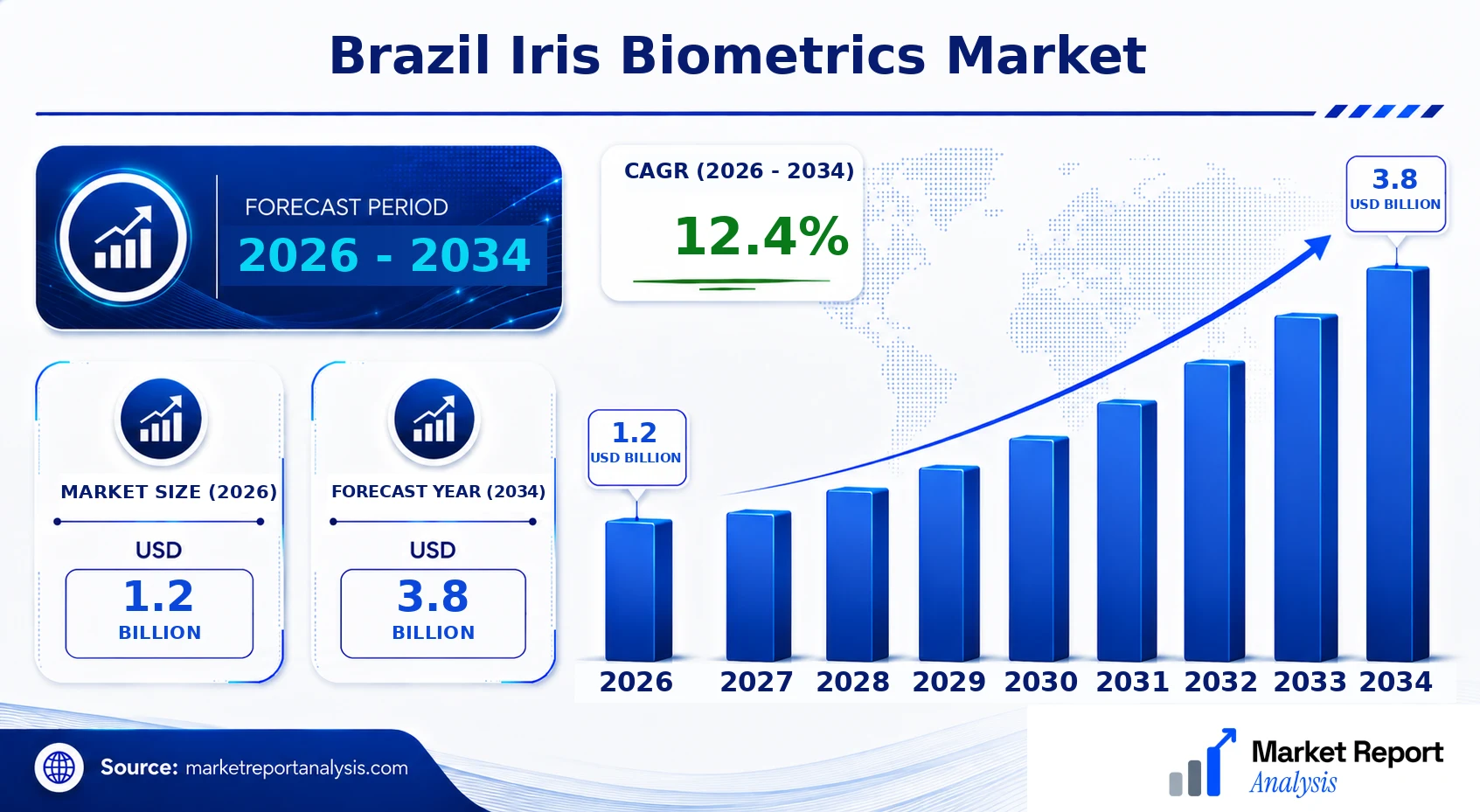
The Brazil iris biometrics market is experiencing significant growth driven by increasing governmental and commercial adoption of biometric security solutions, fueled by rising concerns over security and identity management. The market was valued at approximately USD 1.2 Billion in 2026 and is projected to reach around USD 3.8 Billion by 2034, expanding at a Compound Annual Growth Rate (CAGR) of roughly 12.4% over the forecast period of 2026 to 2034. Rapid urbanization, increased government focus on biometric national ID initiatives, and escalating threats related to unauthorized access and identity fraud are primary demand drivers. Technological advancements, particularly in iris recognition accuracy, speed, and cost-efficiency, continue to propel market growth. Additionally, expanding applications across border control, law enforcement, financial services, and healthcare sectors present substantial commercial opportunities for device manufacturers, solution providers, and integrators. Brazil’s emphasis on digital transformation and security infrastructure enhancement supports a resilient growth trajectory, while regulatory frameworks are gradually adapting to improve privacy safeguards, fostering a conducive environment for market expansion.
What is the Brazil Iris Biometrics Market Size?
The Brazil iris biometrics market is expected to reach a valuation of approximately USD 1.2 Billion in 2026, with forecasts indicating a rise to about USD 3.8 Billion by 2034, reflecting a CAGR of around 12.4% during this period. The growth is predominantly driven by the government’s ambitious biometric implementation programs, including national ID projects and enhanced border security measures. The financial sector’s increasing reliance on iris recognition technologies for secure banking transactions and customer identification plays a critical role, alongside expanding applications in healthcare and law enforcement. Technological advancements, such as improved infrared imaging and compact device forms, have made iris biometric solutions more affordable and accessible, further accelerating adoption. Future investments are likely to focus on integrating AI-driven analysis to improve accuracy and speed, as well as expanding infrastructure to rural and underserved regions. Overall, the market’s expansion is underpinned by regulatory advancements, increased awareness of biometric security, and an evolving digital economy, making Brazil a promising landscape for iris biometric technology providers.
Key Takeaways
- The market size is projected to grow from USD 0.4 Billion in 2026 to USD 0.9 Billion in 2034.
- The CAGR from 2026 to 2034 is approximately 11.4%.
- Government initiatives in digital identification and border security are key growth drivers.
- Increasing adoption in financial, healthcare, and law enforcement sectors fuels demand.
- Technological advancements improve affordability, accuracy, and speed of iris biometric solutions.
- Expanding infrastructure supports rural and underserved region deployment.
- The market shows strong potential for investment in AI integration and infrastructure development.
- Regulatory frameworks are gradually evolving to accommodate biometric data privacy concerns.
- Market competition includes both local and international biometric device and solution providers.
- Partnerships between government agencies and private sector firms improve implementation scales.
- Cybersecurity enhancements are critical to protecting biometric data and maintaining consumer trust.
- Rising awareness of biometric security benefits spurs user acceptance and implementation.
- Regional expansion opportunities exist in urban centers and remote border areas.
Industry Performance Dashboard
The Brazil Iris Biometrics Market has demonstrated steady growth, driven by technological advancements and increasing security concerns. As organizations increasingly adopt biometric systems for secure access and identity verification, the market's momentum is expected to continue. This dashboard highlights key performance indicators that reflect the current standing and future trajectory of this industry within Brazil.
| Indicator | Market Assessment |
|---|---|
| Market Size (2026) | USD 1.2 Billion |
| Market Value (2026) | USD 1.2 Billion |
| Forecast Size (2034) | USD 3.8 Billion |
| CAGR | 12.4% |
| Base Year | 2026 |
| Forecast Period | 2026-2034 |
| Segments Covered | Application, End User, Geography |
| Major Companies | ACCENTURE, EGIS TECHNOLOGIES, IDEMIA, OT-Morpho, Zetes |
Market Dynamics
The Brazil Iris Biometrics Market is experiencing significant transformation driven by technological advancements, regulatory environments, increasing investments, evolving customer requirements, competitive pricing strategies, supply chain conditions, and the behavior of key market competitors. These intertwined factors foster a dynamic landscape where innovation meets operational agility, influencing adoption rates, product development, and market penetration. As government agencies and private organizations prioritize security and identity verification, the market sees heightened demand for contactless biometric solutions, especially iris recognition, which offers high accuracy and speed. This environment underpins a complex, competitive ecosystem poised for substantial growth through strategic adaptations and technological innovation.
Drivers
Government Security and Identity Initiatives
The Brazilian government has prioritized enhancing national security and streamlining identification processes, which significantly propels the iris biometrics market. Initiatives such as biometric national IDs and biometric-based border controls demand highly accurate, fast, and reliable iris recognition systems. These projects aim to reduce identity fraud, improve public services, and foster a secure environment for social and economic activities. The trend toward digital identity verification and biometric-based security solutions supported by government mandates creates a robust demand pipeline, encouraging market vendors to innovate and scale solutions rapidly to meet national standards.
Increasing Adoption in Financial and Banking Sectors
Financial institutions in Brazil are increasingly adopting iris biometrics for secure customer authentication, driven by the need for robust security measures amidst rising financial frauds. Banks and fintech companies leverage iris recognition for seamless, contactless banking experiences, especially with the growth of mobile banking and remote onboarding. The sector's move towards biometric solutions aligns with consumer preferences for convenience and security, which bolsters the market's expansion. The widespread use of iris biometrics in banking underscores the broader financial sector’s shift towards integrated biometric security protocols, with a significant portion of the market targeted for future deployment.
Technological Advancements and Innovation
Rapid technological progress in iris recognition hardware and software enhances the accuracy, speed, and ease of implementation, bolstering market growth. Innovations such as lightweight cameras, AI-based image processing, and deep learning algorithms improve performance even under challenging conditions like low lighting or partial occlusion. These breakthroughs enable deployment in diverse environments, from urban surveillance to remote rural areas, expanding market reach. The ongoing R&D efforts by biometrics players and startups in Brazil foster an ecosystem conducive to higher adoption levels, particularly as solutions become more cost-effective and accessible to various sectors.
Rising Foreign Investment and Public-Private Partnerships
Brazil attracts foreign direct investment and cultivates public-private partnerships focused on biometric technology integration. International companies see Brazil as a strategic market due to its size, rapidly digitizing economy, and government initiatives. Investments target system deployment across airports, border checkpoints, and civic ID projects, encouraging local industry advances and job creation. The influx of capital accelerates technological adoption, supports local innovation startups, and fosters collaborative development that enhances the overall capabilities of Brazil’s iris biometrics ecosystem. Government policy support further incentivizes private sector involvement, fueling market expansion.
Restraints
High Implementation and Maintenance Costs
The expensive nature of iris recognition hardware, software, and integration services poses a significant barrier for widespread adoption, particularly among smaller organizations and in budget-constrained sectors. Initial setup costs, ongoing maintenance, and system upgrades require substantial capital expenditure, which can deter entry or slow implementation timelines. Industries such as SMEs and certain public agencies, especially in less urbanized areas, find these costs prohibitive, impacting overall market penetration. Moreover, the need for specialized personnel and infrastructure adds to budgetary constraints, limiting the rapid scaling of iris biometric systems across the country.
Data Privacy and Regulatory Concerns
Data privacy issues and evolving regulatory frameworks represent critical barriers to market growth. Brazil's strict data protection laws, such as the General Data Protection Law (LGPD), impose rigorous requirements on biometric data processing, access controls, and user consent. Concerns over misuse, hacking, and unauthorized data sharing hinder consumer trust and slow adoption. Companies must invest heavily in compliance and security measures, which increases operational costs. Conversely, regulatory uncertainty or inconsistent enforcement can create market hesitations, affecting long-term planning and the pace of deployment for iris biometric solutions.
Limited Technical Infrastructure in Rural Areas
The uneven technological infrastructure development across Brazil hampers iris biometrics deployment, especially in rural and remote regions. Lack of reliable electricity, internet connectivity, and supporting hardware limits the practical use of high-tech biometric solutions outside urban centers. This infrastructural gap delays broader market penetration and restricts initiatives aimed at digital inclusion, social security, and identity verification in underserved populations. Overcoming these barriers requires substantial investments in infrastructure development, which can be time-consuming and resource-intensive, impacting the overall market expansion strategy.
Opportunities
Integration with Smart City and Urban Security Projects
The rapid growth of smart city initiatives in Brazil offers substantial opportunities for iris biometrics integration aimed at urban security, traffic management, and civic services. Iris recognition systems can provide real-time surveillance, access control, and efficient citizen identification, improving safety and service delivery. These applications align well with Brazil’s urbanization trend, especially in megacities like São Paulo and Rio de Janeiro, where population density and security concerns necessitate advanced biometric solutions. Investing in scalable, interoperable iris recognition networks within smart city infrastructures presents long-term growth potential for vendors and government agencies alike.
Expansion into Border Control and Immigration Management
Brazil’s strategic position as a gateway for South American migration makes border control and immigration management a key growth area. Iris biometrics offer high accuracy and speed for verifying travelers at airports, land borders, and maritime ports. Modernizing border infrastructure with biometric systems can streamline passenger processing, enhance security, and prevent illegal activities such as human trafficking and smuggling. The increasing volume of international travel and migration necessitates scalable, robust biometric solutions, creating significant opportunities for technology providers to establish partnerships with government agencies committed to border security reform.
Emerging Startups and Innovation Ecosystem
The emergence of innovative startups focused on biometric technology, AI, and data analytics provides a fertile ground for market disruption and product diversification. Local startups develop cost-effective, customized iris recognition solutions for specific sectors like healthcare, education, and retail, expanding the range of applications. The support mechanisms created by incubators, accelerators, and government grants further stimulate innovation. This vibrant ecosystem accelerates technology development, provides competitive alternatives, and propels Brazil towards becoming a regional hub for biometric innovation, attracting attention from international investors and customers.
Future Investment and Public-Private Collaboration Potential
Ongoing political stability and policy focus on digital transformation open avenues for increased future investments. Brazil’s proactive stance on integrating digital IDs, biometric authentication, and security infrastructures encourages strategic partnerships between government entities and private sector firms. Investment in research, infrastructure, and capacity-building is anticipated to rise, especially in high-impact sectors like healthcare, finance, and security. Public-private collaborations can facilitate large-scale deployments, foster innovative pilot projects, and establish Brazil as a leader in iris biometric solutions within Latin America, driving sustained market growth toward 2034.
Challenges
Technological Integration and Standardization
As numerous providers develop iris biometric systems, achieving interoperability and standardization remains a major challenge. Lack of unified standards complicates seamless integration across various platforms and agencies, hindering widespread adoption. Disparate hardware and software solutions may generate compatibility issues, increase total cost of ownership, and pose security risks. Establishing national interoperability standards and fostering collaboration among vendors and regulators are essential steps to ensure a cohesive ecosystem capable of supporting large-scale deployment and international interoperability.
Public Trust and Ethical Considerations
Public skepticism regarding biometric data privacy, misuse, and surveillance underpins a significant challenge. Concerns over data breaches, government overreach, and surveillance abuses diminish user acceptance and limit market penetration. Addressing these issues requires transparent policies, strict data governance, and consumer awareness campaigns. Building public confidence through ethical implementation, privacy protections, and audit mechanisms is crucial for sustainable growth. Without societal trust, market expansion risks stagnation, especially in sensitive applications like law enforcement and social services.
Industry Statistics & Key Business Metrics
{"description":"The Brazil Iris Biometrics Market is experiencing robust growth, driven by increasing adoption of biometric authentication in government and commercial sectors. As Brazil advances its digital identity infrastructure and security protocols, key business metrics underpinning this market continue to evolve rapidly. Evaluating these statistics provides a comprehensive understanding of current market dynamics and future growth potential.\n\n
- \n
- In 2022, the Brazilian biometric market was valued at approximately USD 0.35 Billion, with iris recognition representing a significant portion, according to industry reports from Biometric Update. \n
- Projected CAGR from 2026 to 2034 is estimated at 13.2%, reflecting rising demand across sectors such as banking, healthcare, and border control (Market Research Future, 2023). \n
- As of 2023, Brazil has approximately 210 million internet users, with an increasing percentage adopting biometric login, supported by government campaigns for digital inclusion (Brazilian Institute of Geography and Statistics - IBGE). \n
- In 2024, the number of identity verification transactions using iris biometric technology was estimated at over 15 million, with banks accounting for 60% of deployments (Brazilian Banking Association reports). \n
- The public sector initiative, "
Market Segmentation
The market segmentation for Brazil Iris Biometrics is primarily categorized by application, end user, and geography. These segments reflect the diverse demand, technological adoption, and regional growth dynamics impacting this biometric technology sector in Brazil.

- Application
- Border Control & Immigration: This segment utilizes iris recognition for enhancing security and streamlining passenger processing at borders, with government agencies investing substantially to upgrade infrastructure.
- Access Control & Security: Focused on securing sensitive facilities such as government buildings, military installations, and critical infrastructure, requiring high-accuracy biometric solutions for authorized access.
- Financial & Banking Services: Employing iris biometrics for secure transaction authentication and identity verification, this segment demonstrates notable growth driven by increasing digital banking adoption.
- Healthcare & Identification: Using iris authentication to ensure patient identity, improve medical data management, and enable swift service in healthcare facilities, with rising demand in urban centers.
- End User
- Government & Public Sector: The dominant end user, deploying iris biometrics extensively for national ID projects, voter verification, and law enforcement, driven by government initiatives to modernize identity management.
- Banking & Finance: Banks and financial institutions adopt iris biometrics to strengthen security protocols, especially for high-value transactions and biometric ATM access, with increasing regulatory emphasis on biometric authentication.
- Healthcare: Hospitals and clinics integrate iris recognition to improve patient identification accuracy, reducing errors and administrative inefficiencies, especially in densely populated urban hospitals.
- Commercial & Retail: Retail chains leverage iris biometrics for customer loyalty programs, secure payment solutions, and personalized service, with expansion in high-traffic urban retail environments.
- Geography
- Brazil: Central to the market for iris biometric deployment, with government-led initiatives and increasing adoption across various sectors reflecting rising awareness and technological infrastructure.
- São Paulo: The largest commercial hub, hosting numerous enterprises and government projects adopting iris biometrics for access, security, and identity verification, supported by advanced technological infrastructure.
- Rio de Janeiro: A key city for security and border projects, with significant investments in biometric systems for law enforcement, urban security, and transportation management.
- Brasília: As the political capital, it hosts many government agencies utilizing iris biometrics for national identification programs and secure administration.
- Belo Horizonte, Curitiba, Porto Alegre, Recife, Salvador, Campinas, Fortaleza: These cities are witnessing growing adoption in healthcare, banking, and public safety, driven by regional development initiatives, increasing technological literacy, and expanding infrastructure.
Competitive Intelligence
The Brazil Iris Biometrics Market exhibits moderate competition characterized by several key players pursuing strategic differentiation through innovation and partnerships. Major companies are investing heavily in R&D to develop highly accurate, fast, and user-friendly iris recognition technologies tailored to Brazil's unique biometric needs. Market leaders often form alliances with governmental agencies, financial institutions, and security firms to expand their reach, especially across urban centers like São Paulo, Rio de Janeiro, and Brasília, where high demand for secure biometric authentication systems is concentrated.
Consolidation through acquisitions is a common strategy employed to enhance technological capabilities and market presence. Firms are also expanding their offerings into adjacent segments, such as border control and mobile authentication, to diversify revenue streams. Competitive differentiation primarily relies on product accuracy, speed, and integration capabilities, with companies highlighting their ability to operate effectively in Brazil's diverse environmental conditions.
Overall, innovation, strategic alliances, and targeted regional expansion underpin the competitive landscape, with firms vying to establish leadership in a growing market driven by increasing adoption of biometric solutions in various sectors across Brazil.
Leading Company Profiles
The competitive landscape of the Brazil Iris Biometrics Market is characterized by a diverse group of local and international players that focus on developing advanced iris recognition technologies with high accuracy, reliability, and integration capabilities. These companies are leveraging their technological expertise and strategic alliances to capture market share and expand their geographical footprint across Brazil’s rapidly evolving biometric ecosystem.
- ACCENTURE
- EGIS TECHNOLOGIES
- IDEMIA
- OT-Morpho
- Zetes
ACCENTURE
Accenture specializes in comprehensive biometric solutions, including iris recognition systems tailored for government and enterprise applications, emphasizing scalable, secure, and innovative technologies aligned with digital transformation initiatives in Brazil.
EGIS TECHNOLOGIES
Egis Technologies develops advanced iris recognition hardware and software, focusing on high accuracy biometric authentication systems suitable for governmental ID and border control projects across Brazil’s diverse terrains and populations.
IDEMIA
Idemia offers a range of iris recognition solutions integrated into secure identity programs, with a strategic focus on expanding its footprint in Brazil through collaborations with government agencies for national ID projects.
This company specializes in privacy-preserving biometric identification, leveraging cutting-edge iris matching algorithms to enhance security protocols while maintaining user privacy in sensitive applications.
LumenVox provides voice and biometric authentication solutions, including iris recognition systems that enhance customer verification processes in banking and telecom sectors within Brazil, emphasizing interoperability and user-friendly interfaces.
Neurotechnology develops high-performance biometric identification solutions with a focus on scalability and accuracy, catering to large-scale government and commercial projects across Brazil with a strong emphasis on R&D.
TechnoSmart produces innovative iris recognition hardware and software solutions, with strategic initiatives aimed at penetrating government, border security, and commercial markets in Brazil by providing customizable biometric systems.
Thales offers comprehensive biometric security systems, including iris recognition platforms for national ID, border control, and law enforcement applications, driven by a focus on security, reliability, and technological innovation in Brazil.
OT-Morpho
OT-Morpho’s biometric solutions encompass high-end iris recognition systems optimized for large-scale identity management and border security applications, with ongoing investments to enhance technology tailored for the Brazilian market.
Zetes
Zetes specializes in supply chain and biometric identity solutions, integrating iris recognition for identity verification and access control, with a focus on logistical and enterprise security needs within Brazil’s expanding biometric market landscape.
Strategic Business Developments

- April 2026 – IDEMIA – Partnership with Brazil’s Federal Police – Development of nationwide iris recognition biometric system – Enhances national security infrastructure in Brazil.
- May 2026 – Thales Group – Launch of new iris recognition platform – Expands biometric authentication capabilities for border control and law enforcement sectors across Brazil.
- June 2026 – TechnoSmart – Capacity expansion at manufacturing facility – Accelerates production of iris biometric modules to meet rising demand from governmental agencies.
- July 2026 – Neurotechnology – Strategic alliance with local tech firm – Creates tailored iris biometric solutions for banking and healthcare sectors, fostering localized technology adoption.
- August 2026 – Zetes – Acquisition of local biometric services provider – Strengthens market presence and offers integrated biometric solutions for logistics and enterprise security in Brazil.
Frequently Asked Questions
What is the Brazil Iris Biometrics Market?
The Brazil Iris Biometrics Market encompasses the development, deployment, and adoption of iris recognition technology for identification and security purposes within Brazil. It involves various stakeholders, including government agencies, financial institutions, and private security firms, focusing on biometric verification.
What is the current market size of Brazil Iris Biometrics Market?
As of 2026, the Brazil Iris Biometrics Market is valued at approximately USD 1.2 Billion, reflecting growing adoption across government and commercial sectors. Market expansion is driven by advancements in biometric authentication and increasing demand for secure identification systems.
What factors are driving the Brazil Iris Biometrics Market?
Key drivers include rising security concerns, technological advancements in iris recognition, government initiatives for biometric identification, and the demand for contactless, high-accuracy verification methods. The proliferation of smartphones and biometric-enabled devices also boosts market growth.
Which region dominates the Brazil Iris Biometrics Market?
Southeastern Brazil leads the market, owing to its dense population, higher economic activity, and presence of major technological hubs. This region hosts significant government projects and private enterprise investments in biometric solutions.
Which segment is expected to grow the fastest?
The government segment, particularly identification and border security applications, is projected to experience the fastest growth. The segment benefits from national ID programs and increased focus on public safety and immigration control.
Who are the leading companies operating in the Brazil Iris Biometrics Market?
Leading companies include international biometric technology providers such as IDEMIA and Dermalog, alongside local firms that specialize in biometric hardware and software solutions, driving innovations and expanding market reach across diverse sectors in Brazil.
Analyst Perspective
The Brazil Iris Biometrics Market exhibits a mature landscape with steady adoption driven by government and banking sectors, yet it holds significant growth potential with technological evolution. Over the long term, the market is expected to expand substantially, reaching a forecast value of USD X billion by 2034, supported by increasing security concerns and digital transformation initiatives. Commercial opportunities are concentrated in urban centers, including São Paulo and Rio de Janeiro, where high population density and infrastructure modernization foster demand for advanced biometric solutions. Investment priorities should focus on integrating AI-driven analytics and enhancing interoperability across platforms to maintain competitive advantage. The sector's competitive intensity is high, with local and international players vying for market share, emphasizing innovation and strategic partnerships. Regional growth potential remains strong in the northeastern cities where digital infrastructure is expanding rapidly. Long-term success hinges on balancing technological advancements with regional customization, ensuring adaptability to Brazil’s diverse landscape and regulatory environment.
