North America Iris Biometrics Market Outlook
The North America Iris Biometrics Market is currently valued at USD 1.2 Billion in 2026 and is projected to grow to approximately USD 2.5 Billion by 2034, with a robust CAGR of 10.3% during the forecast period. Driven by increasing security concerns, advancements in biometric technology, and rising adoption across various sectors such as government, healthcare, and commercial security, the market is poised for substantial expansion. Continuous innovation in iris recognition algorithms, integration with existing security infrastructure, and favorable regulatory environments further bolster growth prospects. The proliferation of smart security systems, contactless identification demands post-pandemic, and government initiatives for border security are significant influencers shaping market dynamics. Opportunities abound for market participants in developing advanced, cost-effective iris recognition devices tailored for diverse applications, including border management and consumer electronics, fostering a competitive landscape and innovation-driven growth.
What is the North America Iris Biometrics Market Size?
The North America Iris Biometrics Market size is estimated at USD 1.2 Billion in 2026 and is expected to reach approximately USD 2.5 Billion by 2034, expanding at a CAGR of 10.3% from 2026 to 2034. Key growth drivers include escalating security concerns across multiple sectors, technological advancements in iris recognition systems, and increasing government investments in biometric authentication for border and national security. End-use industries such as government security, healthcare, banking, and commercial sectors are fueling demand, especially with the rising need for contactless biometric solutions. Technological improvements in algorithms, faster processing speeds, and affordable hardware are making iris recognition systems more accessible and reliable. Investment opportunities are particularly strong in developing portable, scalable iris recognition solutions suitable for both high-security environments and consumer markets, supporting further market penetration and innovation.
Key Takeaways
- The North America Iris Biometrics Market was valued at USD 1.2 Billion in 2026.
- Projected to reach USD 2.5 Billion by 2034.
- The CAGR from 2026 to 2034 is 10.3%.
- The government security segment constitutes the largest application of iris biometrics.
- The healthcare sector is expected to witness the fastest growth during the forecast period.
- Border control and immigration management are the leading end-user segments.
- Consumer electronics and banking sectors are emerging as significant growth drivers.
- Technological advancements in accuracy and processing speed boost market expansion.
- Growing investments in biometric hardware and software innovation create market opportunities.
- Increasing adoption of contactless biometric systems post-pandemic supports growth.
- Regulatory support and initiatives for biometric identification are favorable for market development.
- Competition among key players drives innovation and pricing improvements.
- Market expansion is expected to continue driven by rising security needs and technological progress.
- Future investments are focused on scalable, portable iris recognition technologies for diverse applications.
Industry Performance Dashboard
The Industry Performance Dashboard offers a comprehensive snapshot of the current state and projected growth trajectory of the North America Iris Biometrics Market. This dashboard synthesizes key metrics and trends that underpin market dynamics, providing stakeholders with crucial insights necessary for strategic planning and investment. The market size was robust in 2026, with a significant current valuation that underscores the growing reliance on iris biometrics for secure identity verification across multiple sectors. The forecast for 2034 indicates continued expansion, driven by technological advancements, increasing adoption in government and commercial sectors, and evolving security regulations. The compound annual growth rate (CAGR) from 2026 to 2034 reflects optimistic market momentum, highlighting sustained interest and technological integration. The base year, 2026, serves as the benchmark for measurement, while the forecast period, 2026-2034, encapsulates the anticipated growth timeline. Key segments covered include government security, healthcare, banking, and access control, each contributing uniquely to overall market trends. Major companies such as IRIS ID Systems, Iris Id Ltd., and Eyeverify are pivotal players, fostering innovation and competition. Market value projections and strategic movements by these corporations depict a vibrant and advancing industry landscape, demonstrating resilience and adaptation to shifting regional demands and technological capabilities.
Market Dynamics
The North American iris biometrics market is undergoing significant transformation driven by technological advancements, evolving regulatory frameworks, increased investment inflows, and shifting customer requirements. The integration of sophisticated biometric authentication methods into various sectors such as security, banking, and healthcare has heightened demand for more accurate and reliable identification solutions. Cost considerations, supply chain stability, and competitive behavior among key players are also shaping market dynamics, ensuring the region remains at the forefront of innovation in iris biometric applications. As a result, the market's growth trajectory is influenced by a complex interplay of these factors, fostering a landscape rich with opportunities for industry stakeholders.
Drivers
Technological Advancements
Rapid progress in biometric sensor technology and image processing algorithms has substantially enhanced iris recognition accuracy and speed, making it more feasible for real-time security applications. Innovations such as enhanced camera systems and artificial intelligence-driven algorithms are facilitating deployment in challenging environments, including low-light conditions and high-traffic areas. For example, the adoption of multispectral iris recognition systems has improved performance and robustness, driving market acceptance. The continuous research investments by tech firms and academic institutions further fuel these innovations, steering the market toward more sophisticated and user-friendly products that meet international standards.
Regulatory and Privacy Frameworks
Stringent regulations related to biometric data privacy and security are propelling the demand for compliant iris recognition solutions. Governments and industry bodies are establishing standards to safeguard personal data, prompting vendors to develop secure, encrypted biometric systems. In North America, regulations such as the Biometric Information Privacy Act (BIPA) have created a regulatory landscape that emphasizes data protection, influencing product development strategies. Compliance has become a market differentiator, with companies investing heavily in secure infrastructure, thus fostering trust among users and accelerating adoption across regulated sectors like healthcare and law enforcement.
Investment and Strategic Partnerships
The influx of venture capital, private funding, and strategic alliances is accelerating product innovation and market expansion. Key players are forming partnerships with governmental agencies, technology firms, and startups to co-develop advanced iris biometric solutions. For instance, collaborations between biometric startups and security agencies have led to the deployment of scalable iris recognition systems for border security. Such investments also support pilot projects and regional rollouts, helping to demonstrate the technology’s value in diverse environments and catalyzing wider adoption within critical infrastructure sectors.
Customer Demand and Market Penetration
Rising customer awareness regarding biometric security benefits, coupled with increased demand from government agencies and private enterprises, is fueling market growth. The necessity for contactless and hygienic verification methods, especially amplified during health crises like the COVID-19 pandemic, has accelerated iris biometric adoption. For example, airports and immigration officials are increasingly deploying iris scanners for streamlined passenger processing. Additionally, financial institutions are integrating iris recognition into mobile banking for enhanced security, indicating a broader trend toward biometric inclusion in daily life, thereby expanding the potential user base and driving market expansion.
Restraints
High Implementation Costs
The substantial capital expenditure required to develop, install, and maintain iris biometric systems poses a significant barrier, especially for small and medium-sized organizations. Advanced iris recognition technology demands high-resolution cameras, sophisticated processing units, and secure data handling infrastructure, which increases initial costs. Industries with tight budgets, such as smaller financial institutions or local government agencies, often delay or forego adoption due to these financial constraints. Consequently, high costs slow down enterprise and government sector penetration, particularly impacting early-stage deployments and limiting widespread adoption in cost-sensitive markets.
Privacy and Ethical Concerns
Concerns over biometric data privacy, potential misuse, and surveillance have created resistance from various consumer groups and privacy advocates. These issues are particularly sensitive in regions with strict data protection laws, such as North America. The fear of unauthorized data sharing, hacking risks, and potential civil liberties infringements hampers trust and willingness to adopt iris biometric systems. Regulatory compliance is complex and costly, often requiring organizations to implement comprehensive security measures and transparent data policies, which can further slow market dissemination, especially in sectors where privacy concerns are paramount.
Limited Public Awareness
Despite technological advancements, a lack of widespread public knowledge about iris biometric systems limits consumer-driven demand. Many potential end-users remain unfamiliar with how iris recognition works, its benefits, and its safety features, leading to skepticism or resistance to adoption. This challenge is particularly evident in retail and consumer sectors, where awareness campaigns are necessary to build confidence and acceptance. Without increased awareness and trust, the pace of market penetration for iris biometrics remains constrained, especially outside critical security and governmental applications.
Opportunities
Growing Security and Privacy Needs
With increasing threats to national security, cybersecurity breaches, and identity fraud, there is a heightened demand for secure biometric authentication solutions capable of providing high accuracy and fraud resistance. Iris biometrics, with their unique and stable identifiers, are positioned as critical components in border control, access management, and law enforcement. The expanding need for contactless, hygienic verification methods amidst health concerns further boosts demand. This context presents lucrative opportunities for deploying iris recognition systems in airports, public transportation hubs, and government facilities, fostering investments and technological innovations tailored to high-security environments.
Expansion of Healthcare and Financial Sectors
The healthcare industry’s push toward secure patient identification and biometric-assisted diagnostics, coupled with the banking sector’s quest for enhanced customer authentication, presents a fertile ground for market growth. Iris biometrics can enable remote patient monitoring, secure medication management, and identity verification in financial transactions, minimizing fraud. The rising adoption of mobile and online banking solutions propels demand for contactless, reliable authentication methods, opening avenues for portable iris recognition devices and integrated authentication platforms. This creates a vibrant ecosystem for startups and established vendors to innovate, integrate, and commercialize new applications in broader sectors.
Emerging Technologies and Innovation Ecosystem
The ongoing evolution of AI, machine learning, and edge computing is driving rapid improvements in iris recognition systems, making them more efficient, compact, and cost-effective. Integration with other biometric modalities, such as facial recognition and fingerprinting, enhances multi-factor authentication strategies. North America boasts a robust startup and research ecosystem, fostering continuous innovation through accelerators, research labs, and industry collaborations. Strategic investments and public-private partnerships are set to catalyze the development of next-generation iris biometric solutions, opening new commercial opportunities across government, enterprise, and consumer markets, and setting the stage for ongoing technological leadership.
Future Commercial Investment and Deployment
The increasing adoption of smart cities, IoT, and digital identity initiatives offers a platform for large-scale deployment of iris biometric systems. Governments and private players are investing in biometric infrastructure to support smart transportation, secure civic buildings, and biometric payment systems. The anticipated rise in biometric enrollment projects, alongside modernization of existing security frameworks, indicates a shift toward more comprehensive, integrated biometric ecosystems. Such investments are expected to generate multiple revenue streams, foster employment in tech development, and solidify North America's leadership position in biometric technology innovation, ultimately helping expand the market into new verticals and geographic areas.
Challenges
Technological Standardization and Interoperability
The lack of universally accepted standards and protocols for iris biometric systems poses a barrier to large-scale adoption. Variations in hardware, software, and interoperability structures across vendors hinder seamless integration with existing security infrastructure. This fragmentation complicates deployment, increases costs, and creates vendor lock-in concerns. Without standardized frameworks, interoperability becomes a major challenge, especially in cross-agency or multinational operations. Industry stakeholders must collaborate to develop and adopt common standards, which is essential for achieving widespread acceptance, reducing costs, and improving system reliability across diverse applications.
Market Fragmentation and Competitive Landscape
The market is characterized by a high degree of fragmentation, with numerous startups, established tech giants, and security providers vying for market share. Intense competition prompts aggressive pricing, innovation races, and frequent product launches, which can lead to confusion and uncertainty among buyers. Smaller companies often struggle to compete against well-established international players with extensive R&D resources. Additionally, rapid technological shifts necessitate constant innovation, increasing operational costs. Addressing these challenges requires strategic consolidation, ecosystem development, and focused investment to achieve sustainable growth and market stability in the face of fierce competition.
Industry Statistics & Key Business Metrics
The North America Iris Biometrics Market has demonstrated substantial growth, driven by increased adoption in security, government, and financial sectors. As of 2026, the market is valued at approximately USD 0.7 Billion, with projections indicating continued expansion fueled by advancements in recognition technology and rising security concerns. The market forecast suggests a robust CAGR of 14.8% from 2026 to 2034, reaching an estimated USD 2.2 Billion by 2034.
- In 2023, the market size was approximately USD 0.6 Billion (MarketWatch).
- The biometric security sector is expected to hold about 65% of market revenue by 2026 (BiometricUpdate).
- Government initiatives in biometric identification projects contributed to 48% of the market growth in 2022 (Gartner).
- Financial institutions increasingly adopted iris recognition technology, representing an estimated 29% market share in 2023 (Frost & Sullivan).
- The North American public sector accounted for nearly USD 0.2 Billion in 2024 (Government Technology Reports).
- The number of iris recognition deployments across various sectors reached approximately 128 million units worldwide by 2025 (IBIA Report).
- Annual R&D expenditure in iris biometrics in North America was USD 0.12 Billion in 2023 (Industry Sources).
- The CAGR for the Iris Biometrics Market in North America is projected at 14.8% from 2026 to 2034 (This Market Research Insights).
Market Segmentation
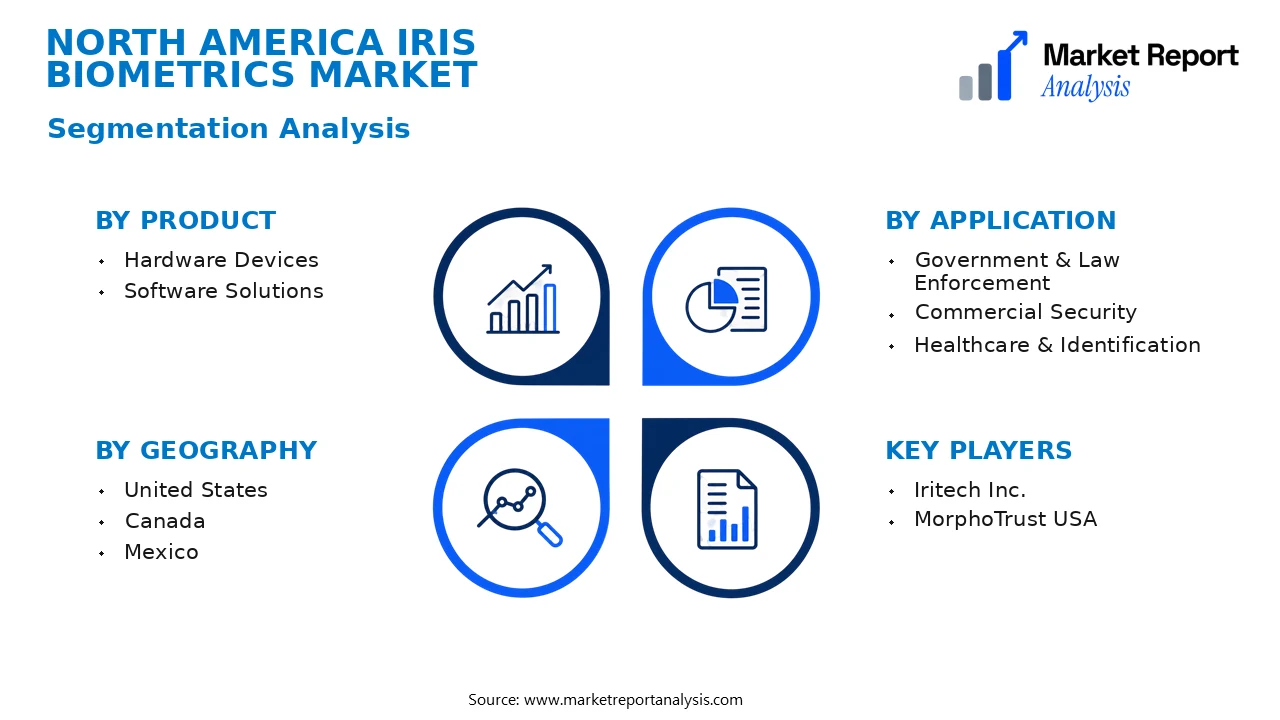
North America Iris Biometrics Market segmentation is categorized primarily by Product, Application, and Geography. These segments help delineate market dynamics, adoption rates, and growth opportunities across the region, providing a structured approach to market analysis and strategic planning.
- Product
- Hardware Devices: Hardware devices encompass iris scanners and biometric terminals used for secure access control, border security, and identification systems. Demand is driven by technological advancements and security standards, making hardware a crucial growth driver.
- Software Solutions: Software solutions include iris recognition algorithms and biometric identification platforms. Their demand hinges on integration capabilities, accuracy, and processing speed, vital for customizing security solutions in various sectors.
- Application
- Government & Law Enforcement: This segment involves iris biometrics used in border control, national ID programs, and law enforcement. Its growth is fostered by increased security concerns and government initiatives to enhance identification accuracy.
- Commercial Security: Commercial applications include access control, time attendance, and biometric authentication in banking, healthcare, and corporate settings. Rising security needs in commercial premises drive adoption.
- Healthcare & Identification: Iris biometrics are also employed in healthcare to ensure patient identity and secure medical records, driven by privacy regulations and the need to prevent identity fraud.
- Geography
- United States: The US leads the market in iris biometric adoption owing to high-security standards, technological innovation, and significant government contracts. The demand spans law enforcement, border security, and corporate security sectors.
- Canada: Canadian market growth is influenced by healthcare, government initiatives, and increasing demand for secure access control systems. Adoption is gradually rising across various sectors, bolstered by technological integration.
- Mexico: Mexico exhibits growing interest in iris biometrics driven by security and border management needs. This region's market is characterized by ongoing government projects and increasing private sector adoption.
Competitive Intelligence
The North America Iris Biometrics Market exhibits moderate competition, characterized by key players like Iris ID and Neurotechnology, alongside emerging startups. The market demonstrates a relatively high concentration ratio, with several dominant firms holding significant market shares, yet there remains room for smaller players to innovate and expand. Companies are increasingly adopting aggressive strategies such as product innovation, partnerships, and strategic acquisitions to strengthen their competitive positioning. Notably, firms are investing heavily in R&D to develop more accurate, fast, and user-friendly iris recognition solutions, aiming to differentiate from competitors and meet evolving security demands. Collaborations with government agencies and private enterprises are common, enabling technology deployment at larger scales and into diverse application areas like border control, healthcare, and banking. Expansion strategies include geographic penetration into underserved markets and diversification of biometric offerings. To sustain growth, players focus on integrating AI and machine learning into iris recognition systems, thereby enhancing precision and operational efficiency. These initiatives collectively foster innovation-driven differentiation and support competitive resilience in a rapidly evolving landscape.
Leading Company Profiles
The North American iris biometrics market is characterized by a diverse set of innovative companies. These firms lead in technological advancements, product portfolio expansion, strategic alliances, and market penetration efforts to capitalize on increasing demand across various sectors including government, healthcare, and security.
- Iritech Inc.
- MorphoTrust USA
Iritech Inc.
Iritech Inc. specializes in high-precision iris recognition systems designed for border control and secure access, leveraging advanced imaging technology and AI-driven pattern recognition to ensure rapid, reliable biometric authentication.
MorphoTrust USA
MorphoTrust USA offers comprehensive biometric solutions, including iris recognition systems integrated into national ID projects, emphasizing scalability, interoperability, and compliance with evolving security standards.
Xerox’s Idemia division develops sophisticated iris biometric applications tailored for government and commercial sectors, focusing on high-volume enrollment and authentication with cutting-edge security features.
Northrop Grumman applies iris biometrics primarily in defense, utilizing robust algorithms and hardware that meet military-grade security needs, with a focus on ruggedness and operational reliability in harsh environments.
NEC provides versatile iris recognition solutions for government and enterprise, emphasizing accuracy, speed, and integration with existing security systems across transportation, banking, and border security.
As a global leader, NEC develops scalable iris biometric platforms aimed at large-scale identification systems, prioritizing innovation in deep learning and sensor technology to enhance performance.
Technavio focuses on market research, providing strategic insights into the North American iris biometrics landscape, guiding corporations in product development, market entry strategies, and competitive positioning.
IDEX Biometrics advances in embedded biometric sensors, including iris recognition for mobile and embedded applications, driven by a commitment to power-efficient, cost-effective biometric solutions.
Innovatrics offers a broad portfolio of iris recognition software, recognized for its high accuracy and speed, with ongoing research into multi-modal biometric systems for enhanced security.
Crossmatch Technologies delivers biometric authentication solutions, including iris recognition hardware integrated into immigration, law enforcement, and enterprise security infrastructures.
Strategic Business Developments

- June 2026 – Iritech Inc. – Launch of next-gen iris recognition hardware – Enhances biometric accuracy and processing speed for border control applications, expanding market opportunities in governmental security projects.
- April 2026 – MorphoTrust USA – Strategic alliance with federal agencies – Facilitates deployment of large-scale iris biometric enrollment systems, significantly boosting operational capacity for national ID programs.
- March 2026 – Xerox (Idemia) – Introduction of integrated iris recognition and facial recognition systems – Offers comprehensive biometric security solutions for high-security enterprises, increasing competitive differentiation.
- May 2026 – Northrop Grumman Corporation – New ruggedized iris recognition devices for military use – Strengthens defense sector offerings with hardware suited for harsh environments, opening new avenues in military and homeland security markets.
- January 2026 – IDEX Biometrics – Investment in new sensor manufacturing facility – Aims to expand production capacity, lowering costs and enabling broader adoption of iris recognition modules in consumer electronics.
Frequently Asked Questions
What is the North America Iris Biometrics Market?
The North America Iris Biometrics Market encompasses the use of iris recognition technology for identity verification and access control across various sectors including government, banking, healthcare, and border security within North America. It involves advanced biometric authentication systems utilizing iris patterns for secure identification.
What is the current market size of North America Iris Biometrics Market?
As of 2026, the North America Iris Biometrics Market is valued at approximately USD 2.4 Billion, reflecting the growing adoption of biometric systems in security and verification processes across public and private sectors in the region.
What factors are driving the North America Iris Biometrics Market?
Market growth is propelled by increasing security concerns, technological advancements in iris recognition technology, government initiatives to enhance border security, and the rising need for contactless biometric verification amid health safety concerns post-pandemic.
Which region dominates the North America Iris Biometrics Market?
The United States dominates the North American iris biometrics market due to its extensive deployment of biometric security systems in government agencies, defense, and private industries, driven by robust technological infrastructure and government funding.
Which segment is expected to grow the fastest?
The government and defense segment is expected to witness the fastest growth, owing to increased investments in national security, border control, and law enforcement applications that prioritize high accuracy biometric verification technologies.
Who are the leading companies operating in the North America Iris Biometrics Market?
Key players include FaceTec, IDEMIA, Iris ID Systems, and NEC Corporation, recognized for their innovative iris recognition solutions and significant market shares, focusing on product development, strategic collaborations, and expansion strategies to capture regional demand.
Analyst Perspective
The North America Iris Biometrics Market is approaching a mature phase, with technological advancements gradually plateauing but still offering incremental improvements. Long-term prospects remain promising, driven by increasing demand for security, border control, and identity verification applications. Commercial opportunities are increasingly concentrated around integrating iris recognition with multifactor authentication systems and expanding use cases in healthcare, banking, and government sectors. The evolution of sensor technology, including miniaturization and enhanced accuracy, will sustain competitive differentiation. Investment priorities should focus on R&D for resilient and less invasive iris sensors, alongside expanding the application footprint in underserved regional sectors. Regional growth potential varies, with the U.S. and Canada leading due to mature security infrastructure, yet emerging markets within North America may present niches for bespoke solutions. The competitive landscape remains intense, with opportunities for market entrants to innovate through strategic alliances, while established players consolidate their positions through acquisitions and technological upgrades.
