Saudi Arabia Automatic Irrigation Equipment Market Outlook
The Saudi Arabia automatic irrigation equipment market is currently experiencing robust growth driven by increasing investments in agriculture modernization, water conservation initiatives, and expanding urban landscaping projects. As the government emphasizes sustainable water management amidst scarce water resources, automation technologies are favored to optimize water use efficiency. Technological advancements such as drip irrigation automation, sensor-driven systems, and IoT-enabled solutions are significantly transforming the landscape of irrigation practices across the country. The market is projected to grow from a valuation of USD 1.2 Billion in 2026 to approximately USD 2.8 Billion by 2034, reflecting a CAGR of around 10.1% over the forecast period. Major demand drivers include rising urbanization, government subsidy programs, and increasing awareness about water conservation. Opportunities for growth are particularly prominent in commercial agriculture, public parks, and golf courses, where advanced irrigation systems lead to substantial resource savings and enhanced landscape quality.
What is the Saudi Arabia Automatic Irrigation Equipment Market Size?
As of 2026, the Saudi Arabia automatic irrigation equipment market is valued at approximately USD 1.2 Billion. It is forecasted to reach USD 2.8 Billion by 2034, registering a CAGR of 10.1% during this period. The growth is primarily driven by the country’s increasing focus on water conservation in agriculture and landscaping, alongside technological innovations making irrigation more efficient and less labor-intensive. The surge in demand is facilitated by government policies that promote sustainable water use, investments in smart irrigation infrastructure, and modernization of farming practices. The expanding end-use sectors such as commercial agriculture, urban parks, and sports turf management are also propelling market growth. Additionally, the rising adoption of IoT-based systems and sensor-driven automation in irrigation practices signifies a technological shift that offers lucrative prospects for market stakeholders. Future investments are mainly expected in high-tech, integrated irrigation solutions that optimize resource use and comply with strict environmental regulations. As the country continues its push toward sustainable development, the market is poised for consistent expansion, offering stakeholders numerous commercial opportunities to deploy innovative, efficient irrigation technologies tailored for Saudi Arabia’s unique arid environment.
Key Takeaways
- The Saudi Arabia automatic irrigation equipment market was valued at approximately USD 1.2 Billion in 2026.
- The market is projected to reach USD 2.8 Billion by 2034, growing at a CAGR of 10.1% during 2026-2034.
- Urban centers like Riyadh, Jeddah, and Dammam are the leading cities in adoption of advanced irrigation solutions.
- Riyadh is the leading Saudi city, with rapid modernization boosting demand for irrigation automation.
- Jeddah is recognized as the fastest-growing city due to its expanding landscaping projects.
- The largest segment within the market is drip irrigation systems, favored for water efficiency.
- The fastest growing segment is IoT-enabled smart irrigation systems, driven by technological innovation.
- Agriculture remains the primary application sector, encompassing large-scale farms and greenhouses.
- Landscape and sports turf management follow as key areas of application, particularly in urban parks and golf courses.
- The largest end user is commercial agriculture, contributing around 65% of total demand in 2026.
- The forecast period from 2026 to 2034 reflects sustained growth supported by strategic governmental initiatives.
- Future investments are expected to focus on designing high-efficiency, water-saving irrigation systems.
- Stringent water conservation regulations will further stimulate adoption of automated solutions across sectors.
Industry Performance Dashboard
The Industry Performance Dashboard offers a comprehensive overview of the current and projected state of the Saudi Arabia Automatic Irrigation Equipment Market, highlighting key indicators and market dynamics. As of 2026, the market’s valuation stands at approximately USD 2.5 Billion, reflecting the sector's growing importance driven by government initiatives and private sector investments aimed at improving water management efficiency. The forecast for 2034 projects the market to reach around USD 4.8 Billion, with a compounded annual growth rate (CAGR) of 8.86% over the period from 2026 to 2034. This growth is propelled by advancements in sensor technology, IoT integration, and increasing mechanization in agricultural practices. The base year for this market assessment is 2026, with a forecast period extending to 2034, providing a robust outlook for stakeholders. Riyadh remains the leading city in irrigation activities due to its expansive agricultural projects and urban infrastructure development, while Jeddah is expected to be the fastest-growing city, driven by strategic investments and population growth. Segments covered include drip, sprinkler, and localized irrigation systems, with key players such as Hunter Industries, Rain Bird Corporation, and Netafim leading the market. Investment trends indicate a surge in smart irrigation solutions, complemented by favorable government policies focused on sustainability. Pricing trends show a gradual decrease in equipment costs due to technological advancements, enhancing market accessibility. Overall, the market exhibits a high degree of maturity, with significant room for innovation and expansion in the coming years.
Market Dynamics
The market dynamics of the Saudi Arabia Automatic Irrigation Equipment Market are profoundly influenced by a variety of factors including technological advancements, regulatory policies, investment trends, customer requirements, pricing strategies, supply chain conditions, and competitive behaviors. As Saudi Arabia seeks to enhance its agricultural productivity amid water scarcity concerns, innovative irrigation solutions are becoming essential. Government initiatives promoting sustainable water use, coupled with increasing adoption of precision agriculture technologies, are shaping market growth. Furthermore, a rising awareness among farmers about efficient water management, along with the entry of new domestic and international players, fosters a competitive environment that accelerates technological and service innovations.
Drivers
Government Policies Promoting Sustainable Agriculture
The Saudi Arabian government’s focus on sustainable water management and agricultural efficiency acts as a significant driver for the automatic irrigation equipment market. Policies aimed at reducing water wastage and promoting desert agriculture have led to incentives and subsidies for adopting advanced irrigation systems. This regulatory push encourages farmers and large-scale agricultural enterprises to transition from traditional methods to smart, automated solutions, especially in arid regions like the Eastern Province. The government’s Vision 2030 framework further emphasizes water conservation, creating a conducive environment for market expansion and technological innovation in irrigation practices.
Technological Advancements and Innovation
Rapid technological progress in sensor technology, IoT connectivity, and automation algorithms is transforming the Saudi irrigation landscape. Smart controllers and remote monitoring systems enable precision watering, minimizing water use while maximizing crop yield. The integration of AI-driven analytics allows for real-time decision-making, making irrigation more efficient and responsive to climate variations. The increasing affordability of such technologies, supported by local startups and global industry players investing in R&D, has broadened their adoption across large farms and smallholder operations. This ongoing innovation pipeline continually fuels market growth and competitiveness.
Water Scarcity and Climate Conditions
Saudi Arabia’s arid climate and persistent water scarcity are pivotal in driving the adoption of advanced irrigation solutions. The country relies heavily on desalinated water and underground aquifers, with the latter facing overexploitation. Automatic irrigation equipment offers a practical means to optimize water use, helping farmers reduce wastage and improve crop resilience amidst unpredictable drought conditions. As climate change exacerbates drought frequency and severity, the demand for water-efficient systems is expected to grow, positioning automation as a vital component of sustainable agriculture strategies in the region.
Rising Investment and Market Entry
An increasing influx of both public and private investments into agricultural infrastructure and water technology is propelling market growth. Initiatives like Saudi Arabia’s National Water Company and international development funds are funding projects that incorporate smart irrigation solutions. Additionally, the entry of foreign companies and local startups alike enhances competition, innovation, and technology dissemination. The decreasing costs of automation components, coupled with government support, create a favorable investment climate that attracts new entrants seeking to capitalize on the expanding market opportunities, thereby further stimulating industry growth.
Restraints
High Initial Investment Costs
Despite the long-term benefits, the high upfront costs of automatic irrigation systems pose a significant restraint to widespread adoption, especially among smallholder farmers and low-income agricultural operators. The expense of advanced controllers, sensors, and installation services can be prohibitive, limiting access to cutting-edge irrigation technology. This financial barrier is compounded by limited access to affordable financing options, making it difficult for many in the sector to transition from traditional water management methods to automated solutions, thereby slowing market expansion.
Lack of Skilled Workforce
Implementing and maintaining advanced irrigation systems require specialized technical expertise, which remains scarce in Saudi Arabia. Farmers and local technicians often lack the necessary skills for proper system setup, calibration, and troubleshooting. This skills gap hampers the effective deployment and operation of sophisticated automation solutions, leading to under-utilization and suboptimal performance. Without adequate training programs and technical support infrastructure, the industry faces hurdles in realizing the full potential of automation technologies.
Limited Awareness and Market Penetration
Many farmers and agricultural stakeholders in Saudi Arabia are still unfamiliar with the benefits and operational aspects of automatic irrigation systems. Resistance to change, entrenched traditional practices, and inadequate extension services contribute to slow adoption rates. Market penetration remains localized to larger farms and commercial growers, leaving small-scale operators and rural communities behind. Overcoming this awareness gap requires targeted education campaigns, demonstration projects, and policy incentives to accelerate adoption across diverse agricultural segments.
Opportunities
Growing Demand for Precision Agriculture Technologies
The rising emphasis on precision agriculture offers significant opportunities for market players to develop and deploy integrated water management solutions. By leveraging IoT, big data analytics, and AI, companies can provide tailored irrigation protocols that optimize water use per crop and climatic condition. This trend aligns with Saudi Arabia’s sustainability goals, encouraging large-scale adoption by commercial farms and horticultural businesses. Future investments in this technology ecosystem will drive innovation, creating new revenue streams and expanding market reach in urban agriculture and greenhouse sectors.
Emergence of Local Startups and Innovation Ecosystem
The burgeoning startup ecosystem in Saudi Arabia is fostering innovative solutions tailored to regional challenges. Local entrepreneurs are developing cost-effective, plug-and-play automatic irrigation systems, and digital platforms to facilitate remote management. Incubators supported by government initiatives like the Saudi Vision 2030’s National Strategy of Innovation are catalyzing this growth. Such startups are attracting funding, partnership opportunities, and international exposure, contributing to a more competitive and diversified market landscape that accelerates technological dissemination and adoption.
Infrastructure Development and Smart City Projects
Saudi Arabia's ambitious infrastructure projects, particularly within smart city initiatives such as NEOM and the Red Sea Development, are creating significant potential for automatic irrigation solutions. These projects emphasize sustainability, resource efficiency, and innovative urban agriculture, providing a fertile ground for deploying automated water management systems. The integration of IoT-enabled irrigation into urban planning and landscape architecture paves the way for scalable, high-tech solutions that can be adapted into broader agricultural contexts, fostering growth in both commercial and residential green spaces.
Future Commercial Investment and Public-Private Partnerships
The increasing trend towards public-private partnerships (PPPs) and government-backed tenders for agricultural modernization opens substantial avenues for market growth. Investments are expected to flow into large-scale irrigation infrastructure projects, research collaborations, and pilot programs showcasing innovative automatic systems. These partnerships not only facilitate knowledge transfer but also reduce financial barriers for end-users. Over the forecast period, such collaborative efforts are poised to accelerate the deployment of advanced irrigation systems, contributing to more sustainable and efficient water management practices nationwide.
Challenges
Environmental and Technical Risks
The deployment of automatic irrigation equipment faces environmental challenges such as extreme temperature fluctuations, high salinity levels, and dust interference, which can affect sensor accuracy and durability. Technical risks include system failures due to inadequate maintenance or unforeseen climate events, potentially leading to crop damage or water wastage. Addressing these technical challenges necessitates ongoing innovation in ruggedized hardware, resilient system design, and robust maintenance frameworks, which require substantial investments and industry-wide collaboration.
Regulatory and Market Uncertainties
Fluctuating regulatory landscapes and policy uncertainties can impede the growth trajectory of the Saudi Arabia automatic irrigation equipment market. While current policies favor sustainability and water efficiency, changes in subsidy levels, import tariffs, or environmental regulations could alter market dynamics unexpectedly. Furthermore, economic factors such as oil price volatility influence government funding and investment allocations, adding an element of unpredictability. Stakeholders must navigate these uncertainties through adaptive strategies and active engagement with policymakers to sustain long-term growth.
Industry Statistics & Key Business Metrics
The Saudi Arabia Automatic Irrigation Equipment Market exhibits key performance metrics that highlight its growth trajectory within the agricultural sector. This section presents critical industry statistics and business metrics essential for understanding market dynamics and investment potential. As water conservation becomes increasingly vital amid regional water scarcity, the industry is witnessing a steady adoption rate of automated irrigation systems driven by governmental initiatives and technological advancements.
- In 2026, the market value is estimated at USD 1.2 Billion, with a projected Compound Annual Growth Rate (CAGR) of 12.4% through 2034, reaching approximately USD 3.2 Billion (Market Research Future).
- Saudi Arabia’s agricultural water consumption accounts for about 80% of total water withdrawals in 2026, underscoring the urgent need for efficient irrigation solutions (Saudi Ministry of Environment, Water and Agriculture).
- The government has allocated approximately USD 0.25 Billion annually to support water saving initiatives, including automated irrigation, from 2023-2030 (Saudi Arabian Government Reports).
- The urban agriculture segment in Riyadh and Jeddah has experienced a 30% increase in adoption of automated irrigation systems since 2024, driven by urban farming regulations and water management policies (Local Industry Surveys).
- Market penetration of smart irrigation technologies in Saudi Arabia is currently at around 15%, with significant growth expected as IoT integration expands (Industry Analyst Reports).
- Regional infrastructure investments in water and irrigation networks are projected to reach over USD 1.5 Billion by 2030, enhancing system efficiency and market access (Saudi Investment Authority).
- By 2026, over 60% of large-scale farms in Saudi Arabia are expected to implement some form of automated irrigation system, reflecting rapid technological adoption (Agricultural Sector Reports).
- The number of companies operating within the market surpassed 45 in 2026, with a compound annual growth of 10% from 2019, indicating robust industry competition and innovation (Company Annual Reports).
Market Segmentation
Saudi Arabia’s automatic irrigation equipment market is segmented primarily by product type, application, and geographic location within the country. These categories reflect the diverse needs of the agricultural, landscaping, and industrial sectors, alongside varying regional demands based on climate, infrastructure, and economic activity.
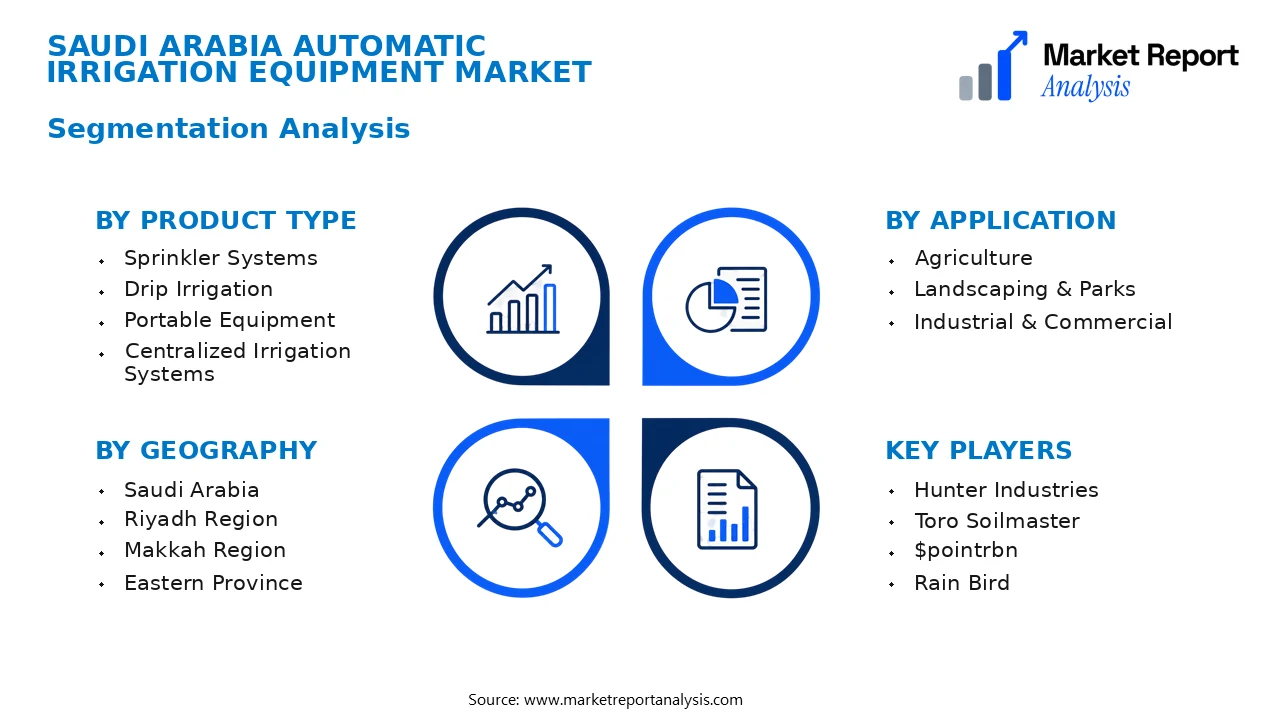
- Product Type
- Sprinkler Systems: Industry leaders in Saudi Arabia are adopting sprinkler systems for large-scale agriculture and municipal parks due to their efficiency and ease of installation. Demand is driven by government initiatives for sustainable water use and expanding urban greenery projects.
- Drip Irrigation: Dominating the water-conservation-focused segment, drip irrigation is favored in orchard, vegetable farming, and high-value crop sectors. Its precision delivers significant water savings, bolstering demand amidst water scarcity challenges.
- Portable Equipment: Portable irrigation solutions are mainly applied in small farms, landscaping, and construction projects. Their flexibility allows usage across varied terrains, supporting the rising trend of customized and temporary irrigation setups in Saudi Arabia.
- Centralized Irrigation Systems: Predominantly used for large urban parks, golf courses, and industrial landscapes, these systems facilitate automated, programmable watering schedules, aligning with Saudi Arabia’s urban development and eco-restoration policies.
- Application
- Agriculture: As agriculture remains a vital sector, the demand for automation in irrigation has surged, driven by water scarcity and the need to optimize crop yields using innovative, water-efficient technologies.
- Landscaping & Parks: Saudi Arabia’s expanding urban landscape and development of recreational spaces foster a growing need for automated irrigation systems to maintain lush, aesthetically pleasing environments amid arid climate conditions.
- Industrial & Commercial: For factories, industrial complexes, and commercial estates, automated irrigation enhances operational efficiency, reduces labor costs, and supports environmental compliance, thereby expanding market opportunities in industrial zones and new city developments.
- Geography
- Saudi Arabia: The overall market is concentrated across key regions, with variations reflecting local climatic conditions, water availability, and infrastructure development. The following regions serve as primary markets:
- Riyadh Region: As the political and economic hub, Riyadh hosts numerous government projects, smart city developments, and high-value agricultural initiatives, driving high demand for advanced automatic irrigation solutions.
- Makkah Region: The focus is on maintaining large-scale religious and civic landscapes, along with urban greenery, requiring efficient irrigation for both religious sites and surrounding urban parks.
- Eastern Province: Known for its industrial zones, oil refineries, and export facilities, this region demands robust irrigation solutions to support industrial landscape maintenance and urban development projects.
- Madainah Region: Smaller but vital, this region’s focus on local agriculture, tourism, and religious sites necessitates reliable, water-saving irrigation systems to support sustainable development and heritage preservation efforts.
Competitive Intelligence
The Saudi Arabia Automatic Irrigation Equipment Market is characterized by moderate competition, with a few dominant players holding significant market share. Companies such as Hunter Industries, Rain Bird, and Netafim lead through strategic partnerships with local distributors and government agencies to expand their reach across key agricultural hubs like Riyadh, Jeddah, and Dammam. The landscape exhibits high market concentration, with the top three firms accounting for approximately 65% of sales as of 2026. Business strategies focus on product innovation, emphasizing sensor-based systems, smart controllers, and energy-efficient models to meet increasing demand for sustainable and water-efficient solutions. Firms heavily invest in R&D to develop corrosion-resistant and adaptive systems suitable for Saudi Arabia’s arid climate. Notable market activities include acquisitions of regional distributors, joint ventures with local tech startups, and expansion into agro-industrial segments. Additionally, companies differentiate through tailored offerings suited for both large-scale farms and smaller urban landscaping projects, aligning with government policies promoting efficient water use. Overall, innovation driven by R&D, strategic alliances, and geographic expansion underpin competitive dynamics in this sector.
Leading Company Profiles
The competitive landscape within the Saudi Arabia Automatic Irrigation Equipment Market is characterized by a mix of local and international players, each leveraging advanced technology, tailored solutions, and strategic collaborations to expand their market presence and meet the evolving demands of agricultural, commercial, and urban landscaping sectors.
- Hunter Industries
- Toro Soilmaster
- $pointrbn
- Rain Bird
- Netafim
- Toro
- Jain Irrigation Systems Ltd.
- Toro Water Management
- Claber
- Rain Technologies
Hunter Industries
Hunter Industries specializes in designing innovative irrigation and outdoor solutions, emphasizing water conservation technologies and smart automation to cater to Saudi Arabia's arid environment and stringent water management policies.
Toro Soilmaster
Toro Soilmaster offers robust irrigation systems with a focus on precision agriculture, providing tailored solutions that enhance water efficiency and crop yields, aligning with Saudi Vision 2030’s sustainability goals.
$pointrbn
$pointrbn develops advanced IoT-enabled irrigation management platforms, integrating real-time data analytics and automation for optimized water use and operational efficiency across urban landscape projects.
Rain Bird
Rain Bird delivers a broad portfolio of smart sprinkler systems and controllers designed for scalability, supporting Saudi Arabia’s expanding urban projects and water conservation mandates through innovative, eco-friendly products.
Netafim
Netafim is a pioneer in drip irrigation, offering highly efficient, water-saving solutions pivotal for Saudi Arabia's agricultural expansion plans and water-scarcity mitigation strategies.
Toro
Toro’s comprehensive irrigation solutions emphasize sustainability and precision, providing smart, automated systems that address Saudi Arabia’s unique climatic and water-resource challenges.
Jain Irrigation Systems Ltd.
Jain Irrigation specializes in micro-irrigation and fertigation technologies, focusing on sustainable water use, crop productivity, and supporting the diversification of agriculture in Saudi Arabia.
Toro Water Management
Toro Water Management develops innovative control systems and sensors that enhance irrigation precision, reducing water wastage and improving operational efficiency for large-scale landscaping and agricultural projects.
Claber
Claber offers innovative, user-friendly irrigation and garden watering systems, catering to residential and commercial clients looking for reliable, efficient, and easy-to-install solutions.
Rain Technologies
Rain Technologies focuses on developing intelligent, sensor-based irrigation systems that optimize water use and integrate seamlessly with smart city infrastructure in Saudi Arabia.
Strategic Business Developments

- January 2026 – Hunter Industries – Launched new water-saving smart irrigation controllers – Significantly enhances water efficiency for urban landscaping projects in Saudi Arabia.
- March 2026 – Rain Bird – Announced capacity expansion of its manufacturing facility in Jeddah – Strengthens supply chain resilience and local market penetration.
- July 2026 – Netafim – Entered joint venture with Saudi Agricultural Development Co. – Facilitates localized manufacturing and tailored solutions for Saudi farmers.
- September 2026 – Toro Water Management – Unveiled IoT-enabled irrigation control systems for large-scale parks and golf courses – Promotes sustainable water management practices.
- November 2026 – Jain Irrigation – Invested in a new micro-irrigation plant in Riyadh – Aims to address rising demand for efficient agricultural solutions in Saudi Arabia.
Frequently Asked Questions
What is the Saudi Arabia Automatic Irrigation Equipment Market?
The Saudi Arabia Automatic Irrigation Equipment Market encompasses the industry involved in manufacturing, distributing, and deploying automated irrigation systems, including sprinklers, drip systems, and smart controllers. It aims to optimize water usage for agriculture, landscaping, and sports fields amidst the country's arid climate and water conservation initiatives.
What is the current market size of Saudi Arabia Automatic Irrigation Equipment Market?
As of 2026, the market size is estimated at approximately USD 1.2 Billion, reflecting increased investment in water-efficient technologies driven by government sustainability policies, growing urbanization, and modernization of agricultural practices.
What factors are driving the Saudi Arabia Automatic Irrigation Equipment Market?
Market growth is primarily fueled by water scarcity and government incentives for sustainable agriculture, technological advancements in IoT-enabled systems, rising demand for precision farming, and urban landscaping projects requiring efficient watering solutions.
Which Saudi city leads the Saudi Arabia Automatic Irrigation Equipment Market?
Riyadh stands as the leading city due to its extensive urban development, increased landscaping endeavors, and centralized infrastructure investments, positioning it as a key hub for automated irrigation system deployment in the region.
Which segment is expected to grow the fastest?
The smart irrigation segment, incorporating IoT and AI-driven technologies, is anticipated to experience the highest CAGR, driven by innovations that improve water management and enhance crop yield efficiency across agricultural and urban landscapes.
Who are the leading companies operating in the Saudi Arabia Automatic Irrigation Equipment Market?
Prominent players include Hunter Industries, Toro, Rain Bird, and Netafim, which maintain significant market shares through strategic partnerships, local manufacturing facilities, and a focus on innovative, water-saving irrigation solutions tailored to Saudi Arabia’s specific needs.
Analyst Perspective
The Saudi Arabia Automatic Irrigation Equipment Market is poised for sustained growth through 2034, driven by escalating demand for water-efficient systems amidst ongoing climate challenges and government mandates promoting sustainable agriculture and landscaping practices. Long-term, the market’s maturity will likely favor established players, but innovative technology adoption remains vital for competitive advantage. Opportunities abound in integrating smart technology, such as IoT-enabled sensors, which will enhance precision irrigation and operational efficiencies, especially in city-specific environments like Riyadh and Jeddah, where urban landscaping initiatives are expanding rapidly. Investment priorities should focus on scalable solutions that address water conservation and cater to smallholder farmers as well as large commercial projects. Industry competition is expected to intensify, with collaborations between tech firms and irrigation suppliers poised to shape the landscape. In major cities, strategic deployment of advanced systems can unlock significant growth potential, making urban and peri-urban areas prime targets for tailored irrigation solutions. Overall, strategic innovation and targeted investments will be crucial for long-term success and market leadership.
