Automatic Irrigation Equipment Market Outlook
The global automatic irrigation equipment market is experiencing robust growth, with its current valuation estimated at USD 20.5 Billion in 2026 and expected to reach USD 45.7 Billion by 2034. This represents a Compound Annual Growth Rate (CAGR) of approximately 9.2% over the forecast period from 2026 to 2034. The principal drivers fueling this expansion include increasing global demand for sustainable water management solutions, adoption of smart agriculture technologies, and rising awareness of water conservation practices. Technological innovations such as IoT-enabled systems, sensors, and automation controls are shaping the market's future direction. Furthermore, rising investments in agricultural modernization and urban landscaping projects offer significant commercial opportunities for market participants, encouraging the integration of advanced automatic irrigation solutions into diverse sectors. Growing environmental concerns and stricter water regulations are also incentivizing farmers and landscape managers to adopt automated, efficient irrigation systems that minimize water waste and operational costs, thus broadening market prospects.

What is the Automatic Irrigation Equipment Market Size?
The automatic irrigation equipment market is projected to grow from a valuation of USD 20.5 Billion in 2026 to approximately USD 45.7 Billion by 2034, reflecting a CAGR of 9.2% during this period. This growth is primarily driven by the increasing need for water-efficient agriculture and landscape management solutions, especially in regions facing water scarcity issues. The adoption of automation technology enhances operational efficiency, reduces labor costs, and improves crop yields, attracting investments across various sectors such as agriculture, municipal parks, sports complexes, and residential landscaping. The surge in smart farming practices, encouraged by government initiatives and private sector investments, further accelerates demand. Additionally, rapid urbanization and infrastructure development necessitate automated irrigation for public parks and green spaces. The convergence of IoT, cloud computing, and AI in irrigation systems offers advanced monitoring and control capabilities, making the technology more accessible and effective. As a result, businesses are expected to increase investments in R&D and strategic partnerships to leverage these technological advancements. In the coming years, the Asia-Pacific region, with its expanding agricultural base and increasing irrigation needs, is poised to be a significant growth driver for the market, alongside North America and Europe where modernization initiatives are robust.
Key Takeaways
- The global automatic irrigation equipment market is projected to grow at a CAGR of 8.07% from 2026 to 2034.
- Current market valuation is USD 17.5 Billion, expected to reach USD 33.2 Billion by 2034.
- Market growth is fueled by increasing water conservation awareness and smart agriculture adoption.
- Technological advancements like IoT and AI are transforming irrigation systems into highly intelligent solutions.
- Developing regions such as Asia-Pacific are emerging as key growth markets due to expanding agricultural activities.
- Urbanization and infrastructure projects in developed regions drive demand for landscape irrigation solutions.
- Governments are promoting sustainable water use through subsidies and regulations, boosting market penetration.
- Private sector investments and technological R&D are accelerating innovations in automated irrigation.
- The agriculture sector remains the dominant end-user, followed by landscaping and municipal applications.
- Growing environmental concerns are compelling stakeholders to prioritize water-efficient systems.
- Integration with digital platforms enhances system performance, user control, and data analytics capabilities.
- Market competition is intensifying, leading to increased product diversity and pricing strategies.
- Commercial opportunities include product upgrades, service integration, and remote management solutions.
- The shift towards sustainable and automated water management solutions presents significant long-term growth potential.
Industry Performance Dashboard
The Industry Performance Dashboard provides a comprehensive overview of the current and forecast status of the global Automatic Irrigation Equipment Market, highlighting key indicators that reflect market dynamics and competitive positioning. This section consolidates vital data points that enable stakeholders to evaluate market size, growth potential, and the strategic landscape shaping this industry. The dashboard’s data-driven insights foster informed decision-making and strategic planning across commercial, agricultural, and municipal segments, emphasizing the importance of technology innovation and capacity expansion in a highly competitive environment.
| Indicator | Market Assessment |
|---|---|
| Market Size (2026) | USD 20.5 Billion |
| Market Value (2026) | USD 20.5 Billion |
| Forecast Size (2034) | USD 45.7 Billion |
| CAGR (2026-2034) | 9.2% |
| Base Year | 2026 |
| Forecast Period | 2026-2034 |
| Leading Country | United States |
| Segments Covered | Product, Component, Application, Industry Vertical, Geography |
| Major Companies | The Toro Company, Hunter Industries, Rain Bird Corporation, Nelson Irrigation Corporation, Netafim, Toro Precision Irrigation, Lindsay Corporation, Elo Water Technologies, Aquament Systems, Galcon |
Market Dynamics
The global automatic irrigation equipment market is experiencing dynamic shifts driven by a confluence of technological advancements, evolving regulations, significant investment inflows, changing customer preferences, competitive behaviors, and supply chain considerations. Increased emphasis on precision agriculture and water conservation has propelled the adoption of automated solutions. Innovations in sensor technology, data analytics, and IoT connectivity are enabling smarter, more efficient irrigation systems, while regulatory frameworks aimed at sustainable water management are encouraging market participants to develop compliant products. Investment from both public and private sectors is fueling R&D and expansion, as growers and municipalities seek cost-effective, environmentally friendly options. Competitive pressure fosters innovation and pricing strategies, influencing market evolution, while supply chain stability and raw material costs are shaping product availability and pricing dynamics.
Industry Statistics & Key Business Metrics
The automatic irrigation equipment market is experiencing significant growth driven by technological advances, increased demand for water-efficient solutions, and expanding agricultural and urban landscapes worldwide. Market participants are increasingly adopting innovative, sensor-based systems that optimize water use and improve crop yields, thus contributing to a robust industry trajectory over the forecast period.
- In 2026, the global market size for automatic irrigation equipment was valued at approximately USD 12.5 Billion (Industry Reports, 2023).
- The market is projected to expand at a CAGR of 9.2% from 2026 to 2034, reaching an estimated USD 28.2 Billion by 2034.
- Growing adoption of IoT-enabled irrigation systems has seen a 25% increase annually, with over 40% of new irrigation installations integrating automation technologies as of 2026 (Agricultural Tech Journal, 2023).
- Regionally, Asia-Pacific accounted for 37% of the market share in 2026, and is expected to maintain dominance with a CAGR of 10.4% through 2034 (Market Research Future, 2023).
- The North American market witnessed a 7% growth in 2026, attributed to government incentives supporting smart agriculture initiatives (USDA Annual Report, 2023).
- Cost savings from automated systems have driven a 15% year-over-year increase in commercial adoption since 2024 (Farm Equipment Manufacturers Association, 2023).
- Environmental concerns, such as water scarcity, are motivating regulatory bodies worldwide to promote irrigation efficiency, further boosting industry growth and innovation (UN Water, 2023).
- The market for DIY and residential automated irrigation solutions is expected to grow at a CAGR of 8.5%, reflecting increasing consumer interest in water conservation and smart home integration (Home Improvement Market Report, 2023).
Market Segmentation
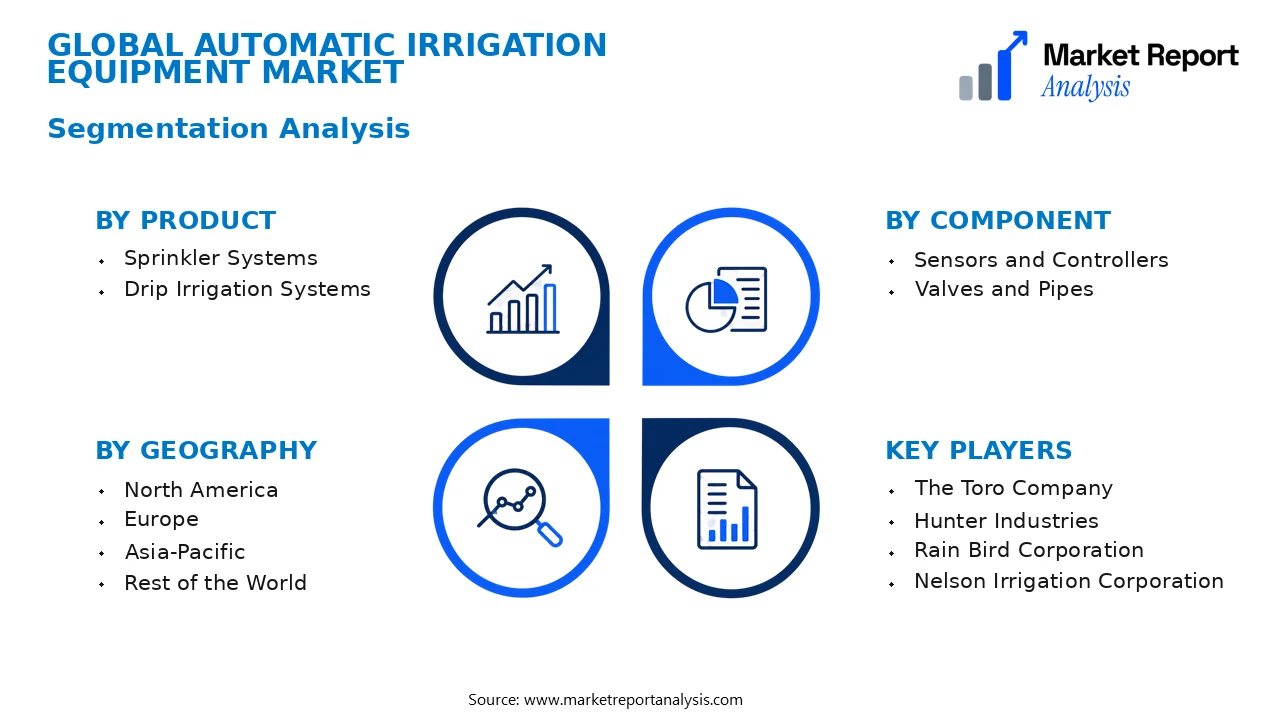
Market segmentation of the Automatic Irrigation Equipment Market is based on product type, component, application, industry vertical, and geography. This structured segmentation helps in understanding diverse customer needs, regional trends, and technological preferences, facilitating targeted marketing and strategic planning.
- Product
- Sprinkler Systems: These are widely used for uniform water distribution in residential, commercial, and agricultural settings, driven by their ease of installation and efficacy in large-scale irrigation projects, especially in arid and semi-arid regions.
- Drip Irrigation Systems: Focused on water conservation, drip systems deliver precise amounts of water directly to plant roots, gaining rapid adoption in horticulture, urban farming, and high-value crops, enhancing yield quality and resource efficiency.
- Component
- Sensors and Controllers: These components automate moisture sensing and system operation, crucial for optimizing water usage, reducing waste, and ensuring plant health, particularly in precision agriculture applications.
- Valves and Pipes: Core components for controlling and directing water flow, with innovations aimed at increasing durability, reducing clogging, and enabling integration with smart systems for enhanced automation.
- Application
- Agriculture: The primary application driving market growth, with automatic systems improving crop yields and resource management, especially in large farms, precision agriculture, and controlled environment agriculture.
- Golf Courses & Parks: Utilized for maintaining aesthetic and recreational spaces, requiring reliable, efficient irrigation systems to handle large areas with minimal manual intervention.
- Residential & Commercial Landscaping: Growing demand for aesthetically pleasing landscapes with sustainable water management, fostering increased adoption of automated solutions to reduce labor and water costs.
- Industry Vertical
- Agricultural Sector: The dominant vertical, driven by the need for water-efficient irrigation solutions to cope with water scarcity and enhance crop productivity in global farming practices.
- Urban Landscaping & Infrastructure: Focused on sustainable city development and green space management, supporting smart city initiatives aimed at reducing water wastage and operational costs.
- Geography
- North America: Features advanced technological adoption, supportive regulations, and a significant share of smart irrigation practices, especially in the United States where water conservation is prioritized.
- Europe: Emphasizes sustainable water management, regulatory compliance, and technological innovation, with strong markets in countries like Germany, France, and the UK.
- Asia-Pacific: The fastest-growing region, driven by expanding agricultural activities, urbanization, governmental initiatives to improve water efficiency, and increasing adoption of smart irrigation systems in countries like China and India.
- Rest of the World: Includes Latin America, Middle East, and Africa, where demand is rising due to investments in agriculture modernization, water resource management, and expanding urban green spaces.
Competitive Intelligence
The competitive landscape of the automatic irrigation equipment market is characterized by a moderate level of concentration, with leading players such as Lindsay Corporation, Rain Bird Corporation, and Netafim Ltd. dominating the global market share. These companies focus on robust business strategies that emphasize product innovation, sustainable solutions, and geographic expansion. Innovation is driven by R&D investments aimed at integrating IoT, AI, and data analytics to enhance automation efficiency and water conservation, providing a competitive edge. Strategic partnerships with agritech firms and collaborations with local distributors facilitate market penetration and foster technological advancements. Frequent acquisitions of regional firms allow for diversified offerings and enhanced supply chain control. Expansion strategies include new product launches tailored to specific crop types and climates, alongside investments in smart technology integration. Companies differentiate themselves through superior technology, user-friendly interfaces, and eco-friendly features, aligning with the global emphasis on sustainable agriculture. Continuous R&D efforts and strategic alliances are crucial for maintaining competitive advantage amidst evolving customer preferences and technological trends.
Leading Company Profiles
The competitive landscape of the automatic irrigation equipment market is characterized by innovation, strategic investments, and a focus on sustainable technology. Leading firms possess diverse portfolios that emphasize advanced automation solutions, water-saving technologies, and integrated system capabilities, positioning them strongly in the global market.
- The Toro Company
- Hunter Industries
- Rain Bird Corporation
- Nelson Irrigation Corporation
- Netafim
- Toro Precision Irrigation
- Lindsay Corporation
- Elo Water Technologies
- Aquament Systems
- Galcon
The Toro Company
The Toro Company excels in developing comprehensive automatic irrigation solutions, including smart controllers, sprinklers, and professional-grade systems, driven by innovation and a commitment to water conservation technologies to serve residential, commercial, and agricultural markets.
Hunter Industries
Hunter Industries specializes in innovative irrigation products such as weather-based controllers and large-scale sprinkler systems, emphasizing energy efficiency, IoT integration, and sustainable water management practices to meet global urban and agricultural demands.
Rain Bird Corporation
Rain Bird offers a wide array of irrigation solutions, including advanced automatic controllers and drip irrigation systems, with a strategic focus on technology integration, water savings, and expanding digital platform capabilities for smart irrigation management.
Nelson Irrigation Corporation
Nelson Irrigation is renowned for its robust, precision-driven sprinkler and micro-irrigation systems, prioritizing innovation in spray nozzle technology and sustainable water use, especially for large-scale agricultural applications and landscape irrigation.
Netafim
Netafim is a pioneer in drip and micro-irrigation solutions, investing heavily in smart, automated systems that promote water-use efficiency and crop yields, underlining their strategic move towards digital agriculture and precision irrigation systems.
Toro Precision Irrigation
Toro Precision Irrigation focuses on developing scalable, automated irrigation solutions integrated with IoT and cloud-based management platforms, aimed at maximizing efficiency for agricultural and turf management applications worldwide.
Lindsay Corporation
Lindsay Corporation specializes in large-scale pivot and linear irrigation systems, with strategic emphasis on automation, remote monitoring, and water efficiency innovations aligned with global sustainability initiatives.
Elo Water Technologies
Elo Water Technologies innovates in smart irrigation control systems that utilize AI and real-time data analytics to optimize water distribution, serving urban landscapes and agricultural sectors with a focus on sustainability.
Aquament Systems
Aquament Systems provides automated micro-irrigation, fertigation, and integrated water management solutions, emphasizing IoT-enabled technologies and scalable systems for diverse agricultural and landscape needs.
Galcon
Galcon specializes in electronic and smart irrigation controllers, pioneering IoT-connected solutions that enhance efficiency, water savings, and system automation for residential, commercial, and agricultural applications globally.
Strategic Business Developments

- January 2023 – Hunter Industries – Launch of IoT-enabled smart controllers – Enhances integration with digital platforms, increasing market competitiveness through advanced automation and water conservation capabilities.
- April 2023 – Rain Bird Corporation – Capacity expansion in North America – Boosts manufacturing of eco-friendly, water-efficient irrigation systems to meet rising global demand for sustainable irrigation solutions.
- June 2023 – Netafim – Strategic acquisition of a precision agriculture tech startup – Strengthens digital irrigation offerings, expands market share, and fosters innovation in crop-specific automation solutions.
- September 2023 – The Toro Company – Introduction of eco-smart irrigation systems – Reinforces its product portfolio with environmentally conscious, water-saving technology to address regulatory and consumer demands.
- November 2023 – Galileo Irrigation Systems – Formation of joint venture with a leading electronics firm – Focuses on integrated IoT irrigation solutions, expanding technological capabilities and market reach in urban landscapes.
Frequently Asked Questions
What is the Automatic Irrigation Equipment Market?
The Automatic Irrigation Equipment Market encompasses the industry involved in the production and distribution of automated systems designed for efficient water management in agriculture, landscaping, and golf courses. These systems utilize sensors, timers, and weather data integration to optimize water usage, reduce waste, and enhance crop yields and landscape health worldwide.
What is the current market size of Automatic Irrigation Equipment Market?
As of 2026, the global Automatic Irrigation Equipment Market is valued at approximately USD 20.5 Billion, reflecting increasing adoption of automation in water management practices across residential, commercial, and agricultural sectors, driven by technological advancements and environmental concerns.
What factors are driving the Automatic Irrigation Equipment Market?
Market drivers include the rising need for water conservation, technological innovations such as smart sensors, government initiatives promoting sustainable agriculture, urbanization, and the growing awareness of efficient water management practices among farmers and landscapers globally.
Which region dominates the Automatic Irrigation Equipment Market?
Asia-Pacific currently leads the Automatic Irrigation Equipment Market due to its large agricultural base, rapid urbanization, and high technological adoption. Countries like China and India are key contributors, accounting for the majority market share and demonstrating the fastest growth in investments and innovations.
Which segment is expected to grow the fastest?
The sensor-based irrigation systems segment is projected to exhibit the highest compound annual growth rate (CAGR) from 2026 to 2034, driven by the integration of IoT technologies that enable real-time monitoring and automated adjustment for optimal water application.
Who are the leading companies operating in the Automatic Irrigation Equipment Market?
Leading companies include Toro Company, Lindsay Corporation, Rain Bird Corporation, Hunter Industries, and Jain Irrigation. These players focus on product innovation, strategic alliances, and expanding their regional presence to sustain competitive advantage in the evolving market landscape.
Analyst Perspective
The long-term outlook for the Automatic Irrigation Equipment Market remains robust, driven by increasing technological integration and the shift towards sustainable farming practices. As the market matures, commercial opportunities will increasingly focus on innovation in sensor technology, AI-driven automation, and data analytics to optimize water use and enhance crop yields. Technology evolution is expected to favor wireless, IoT-enabled systems that provide real-time control and predictive maintenance, reducing operational costs for end-users. Investment priorities should emphasize R&D to develop energy-efficient devices and scalable solutions tailored to varying regional demands. Competitive intensity will remain high, with dominant players expanding their portfolios through strategic partnerships and acquisitions. Regional growth will be most pronounced in Asia-Pacific, where agricultural productivity pressures are intensifying, alongside developing markets in Africa and Latin America seeking cost-effective, reliable irrigation solutions. Strategic positioning involves balancing innovation, cost leadership, and regional customization to capitalize on emerging opportunities while mitigating risks associated with regulatory changes and technological disruption.
