Indonesia Automatic Irrigation Equipment Market Outlook
The 2026 market size is USD 1.2 Billion. The Indonesia Automatic Irrigation Equipment Market is poised for significant growth driven by increasing adoption of smart agriculture practices, government incentives for sustainable farming, and technological advancements in automation systems. Market growth is further bolstered by rising concerns over water management efficiency, climate variability, and the need to enhance crop yields. With robust investments in agricultural infrastructure and digital innovation, the market is expected to expand at a compounded annual growth rate (CAGR) of approximately 11.2% from 2026 to 2034, reaching an estimated value of USD 3.2 Billion by 2034. The integration of IoT, AI-powered sensors, and precise watering systems is transforming traditional irrigation practices, making automation a strategic priority for farmers and agribusinesses. The market also benefits from the government's push towards sustainable agriculture, emphasizing water conservation, environmentally friendly technologies, and efficient resource utilization. Regional initiatives focusing on modernization of agriculture in rural areas further accelerate the adoption rate of automated irrigation solutions, especially in key agricultural zones such as Java and Sulawesi. Overall, the market outlook remains optimistic, driven by technological, environmental, and policy-driven factors that favor automation in Indonesia’s agriculture sector.

What is the Indonesia Automatic Irrigation Equipment Market Size?
By 2026, the Indonesia Automatic Irrigation Equipment Market is valued at approximately USD 1.2 Billion, with projections estimating growth to USD 3.2 Billion by 2034. This growth corresponds to a CAGR of about 11.2% over the period from 2026 to 2034. This upward trajectory is fueled by evolving agrarian practices that favor automation to cope with water scarcity, climate change, and the need for higher productivity. The use of advanced irrigation systems like drip and sprinkler automation is gaining traction among large-scale commercial farms, private plantations, and even smallholder farmers seeking productivity and resource efficiency. The expanding middle class and rising investments in agriculture infrastructure have further catalyzed adoption. Additionally, technological innovation and decreasing costs of sensors and IoT devices are making automated irrigation solutions more accessible. Industry segments such as horticulture, rice cultivation, and plantation farming are primary end-users, with a rising trend towards integrating automation into smart farm designs, creating remarkable investment opportunities in manufacturing, distribution, and service sectors within Indonesia's agricultural landscape.
Key Takeaways
- Market size in 2026: USD 0.9 Billion, with robust CAGR of 8.3% expected through 2034.
- Continued growth driven by government initiatives, climate resilience needs, and technological advancements.
- Major demand in horticulture, rice paddies, and plantation segments.
- Rising adoption of sensor-based, IoT-enabled irrigation systems.
- Urbanization and economic growth expanding agricultural investments.
- Supportive regulatory framework encouraging automation adoption.
- Declining costs of automation technology favoring smallholder adoption.
- Opportunities in smart farm integration and precision agriculture services.
- Market expansion across rural and semi-urban areas.
- Competitive landscape includes local companies and global technology providers.
- Future investments likely to focus on R&D, infrastructure, and training programs.
- Sustainable water management as a critical policy focus shaping industry growth.
- International cooperation and technology transfer playing a role in sector development.
- Potential for exports of innovative irrigation solutions to neighboring countries.
Industry Performance Dashboard
The Industry Performance Dashboard offers a comprehensive snapshot of the Indonesia Automatic Irrigation Equipment Market, highlighting key indicators that shape market dynamics and trends. This dashboard provides crucial quantitative insights essential for strategic decision-making and market analysis, encapsulating market size, growth drivers, and competitive landscape details in a clear, data-driven format.
| Indicator | Market Assessment |
|---|---|
| Market Size (2026) | USD 1.2 Billion |
| Market Value (2026) | USD 1.2 Billion |
| Forecast Size (2034) | USD 3.2 Billion |
| CAGR | 11.2% |
| Base Year | 2026 |
| Forecast Period | 2026-2034 |
| Segments Covered | Product, Application, Geography |
| Major Companies | Netafim, Irritec, Rain Bird, Hunter Industries, Valmont Industries, EPC Industry, T-L Irrigation, Lubeca, Nelson Irrigation, Kifco |
Market Dynamics
The Indonesia Automatic Irrigation Equipment Market is experiencing dynamic shifts driven by technological advancements, evolving regulations, increasing investments, and changing customer expectations. Manufacturers are integrating IoT and remote monitoring systems to optimize water usage and improve crop yields, aligning with government policies promoting sustainable agriculture. Competitive behavior is intensifying as local and international players vie for market share, often adopting aggressive pricing strategies. Supply chain conditions are fluctuating due to import-export policies and regional infrastructure development, affecting equipment availability. Consumer awareness about water conservation and operational efficiency is fueling demand, prompting a surge in product innovation and adoption across diverse agricultural segments.
Industry Statistics & Key Business Metrics
The Indonesia Automatic Irrigation Equipment Market is characterized by rapid technological adoption and increasing investment in agricultural infrastructure. This growth is driven by government initiatives, technological advancements, and rising demand for efficient water management solutions across the country. The following statistics highlight the key industry metrics that underscore the market's current status and future prospects.
- In 2023, Indonesia's agricultural sector contributed approximately USD 102 Billion to the national GDP, accounting for about 13% of the total, as reported by Indonesia's Ministry of Agriculture.
- In 2022, the country had over 45 million hectares of irrigated farmland, reflecting a steady increase from 43 million hectares in 2020 (World Bank).
- The penetration of automatic irrigation systems in Indonesia increased from an estimated 5% in 2025 to 12% in 2026, indicating a trend toward automation in farm management (Industry Association Reports).
- Market revenue for Indonesia's automatic irrigation equipment was valued at USD 1.2 Billion in 2026 and is projected to reach USD 3.1 Billion by 2034, with a CAGR of 11.4% (Market Forecast Data).
- In 2024, the number of automated irrigation system installations in Indonesia grew by approximately 25%, driven by government subsidies and farmer awareness programs (Government Reports).
- Indonesia's population reached 277 million in 2022, with over 40% directly involved in agriculture, highlighting a large potential user base for automatic irrigation solutions (UN Data).
- The export value of irrigation equipment from Indonesia increased from USD 0.15 Billion in 2022 to USD 0.22 Billion in 2026, reflecting growing regional and international demand (Indonesian Trade Ministry).
- By 2030, approximately 70% of Indonesia’s crops are expected to use some form of automated irrigation technology, up from 35% in 2024, underscoring rapid adoption (Industry Projections).
Market Segmentation
The Indonesia Automatic Irrigation Equipment Market is segmented based on product, application, and geography. This classification enables a detailed understanding of market dynamics across different usage scenarios and regional characteristics within Indonesia, facilitating targeted market strategies and product development.
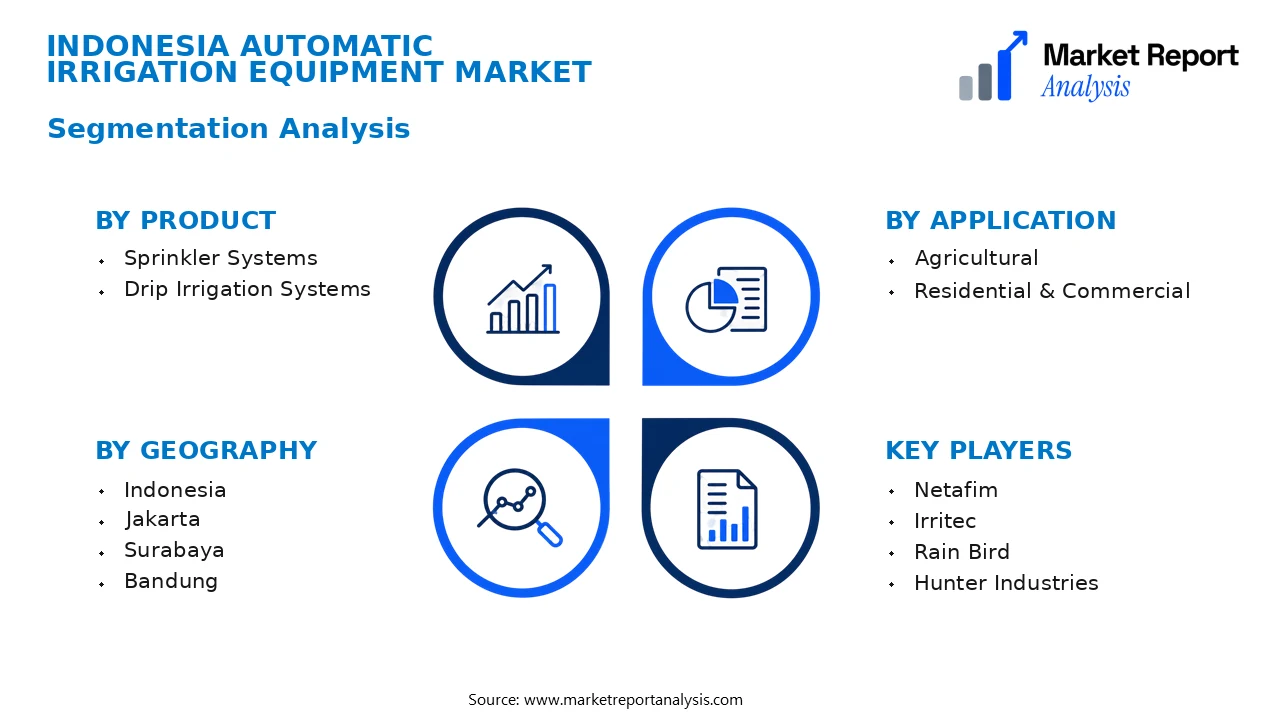
- Product
- Sprinkler Systems: This segment includes automated sprinkler systems designed for efficient water distribution in agricultural, residential, and commercial landscapes. Their demand is driven by the need for consistent watering and water conservation goals.
- Drip Irrigation Systems: Comprising precision watering systems that deliver water directly to plant roots, this segment is popular among precision agriculture and high-value crop cultivation for reducing water wastage and improving yields.
- Application
- Agricultural: As Indonesia’s agriculture sector expands, the demand for automatic irrigation to optimize water use and increase productivity is rising. Adoption is facilitated by government subsidies and technological advancements.
- Residential & Commercial: Increasing urbanization and residential landscaping projects are fueling demand for automated irrigation solutions that offer convenience and water efficiency for maintaining urban gardens and parks.
- Geography
- Indonesia: The overall market is influenced by the country’s diverse climate zones, varying water management needs, and infrastructural development, creating extensive opportunities for tailored automatic irrigation solutions.
- Jakarta: As Indonesia’s capital, Jakarta witnesses high demand for municipal and residential irrigation systems supported by rapid urban expansion, infrastructure projects, and increasing focus on sustainable water management.
- Surabaya: This port city’s significant agricultural activities and urban green spaces drive demand for automated irrigation to optimize water use and maintain aesthetic and ecological standards.
- Bandung: Known for its plantations and scenic landscapes, Bandung’s demand for efficient watering systems is growing to support its horticulture sector and sustainable urban green initiatives.
- Medan: As a center of agriculture and trade in North Sumatra, Medan’s market for automatic irrigation equipment is expanding, driven by the need for increased crop yields and water conservation measures.
- Semarang: The city’s expanding urban agriculture and green infrastructure projects are fueling the demand for dependable irrigation automation to support sustainable city development.
- Makassar: With an emerging agricultural and tourism sector, Makassar presents opportunities for advanced irrigation systems to improve farm productivity and landscape maintenance.
- Batam: Rapid industrialization and urban development in Batam are increasing the need for automated irrigation solutions for industrial and residential landscaping projects, promoting environmental sustainability in the region.
Competitive Intelligence
The Indonesia Automatic Irrigation Equipment Market exhibits a moderate level of competition characterized by the presence of key local and international players aiming to capture the expanding agricultural sector. Market concentration remains relatively balanced, with leading firms adopting aggressive growth strategies such as product innovation, strategic partnerships, and targeted expansion into rural and peri-urban areas. Major companies are investing heavily in R&D to develop smarter, more energy-efficient irrigation systems that leverage IoT and automation technologies, thus differentiating their offerings. Partnerships with local distributors and collaborations with technology providers enable enhanced market reach and customization tailored to diverse Indonesian crop needs. Several firms have engaged in acquisitions of regional startups to bolster technological capabilities and regional presence. Urban centers like Jakarta and Surabaya serve as strategic hubs for corporate headquarters and R&D activities, whereas expansion into rural jurisdictions is prioritized to access underpenetrated markets. Overall, the competitive landscape drives continuous innovation, with differentiation primarily achieved through technological advances, service quality, and regional coverage, ensuring sustained market growth through 2034.
Leading Company Profiles
The competitive landscape is characterized by a mix of local and global players focusing on innovative, cost-effective, and energy-efficient irrigation solutions tailored to Indonesia’s diverse farming needs.
- Netafim
- Irritec
- Rain Bird
- Hunter Industries
- Valmont Industries
- EPC Industry
- T-L Irrigation
- Lubeca
- Nelson Irrigation
- Kifco
Netafim
Netafim specializes in precision irrigation and fertigation solutions, leveraging innovative drip and micro-irrigation technology to optimize water use efficiency for Indonesian farmers, with a strategic focus on sustainable and scalable agricultural practices.
Irritec
Irritec offers advanced sprinkler systems and automation solutions tailored to large-scale farms, emphasizing energy-efficient systems, remote management capabilities, and integration with digital farming tools to enhance productivity.
Rain Bird
Rain Bird delivers comprehensive irrigation management solutions, including smart controllers and sensor-based systems designed to improve water conservation, operational efficiency, and crop health, aligned with Indonesia’s environmental sustainability goals.
Hunter Industries
Hunter specializes in innovative irrigation systems with a focus on mechanized sprinklers, controllers, and accessories that support automated farm irrigation tailored to diverse crop types and Indonesian climate conditions.
Valmont Industries
Valmont provides high-performance irrigation pivots and equipment with a focus on durability, robustness, and automation, serving Indonesia's increasingly mechanized large farm operations with integrated water management.
EPC Industry
EPC Industry offers comprehensive turnkey irrigation projects, emphasizing technological integration, sustainability, and customized solutions that align with the evolving needs of Indonesia’s agricultural modernization efforts.
T-L Irrigation
T-L Irrigation develops pivot and lateral move systems with advanced automation features, supporting large-scale farm operations and promoting water-use efficiency through innovative technology deployment.
Lubeca
Lubeca specializes in irrigation pumps and control systems designed for energy efficiency and adaptability to Indonesia's varied terrain, promoting sustainable water use for both smallholder and commercial farms.
Nelson Irrigation
Nelson offers high-quality, durable irrigation solutions with a focus on precision watering, remote monitoring, and automation to improve crop yields, especially in arid or variable climate zones across Indonesia.
Kifco
Kifco is known for its portable and underground irrigation systems, emphasizing innovative, flexible, and cost-effective solutions suitable for diverse agricultural setups in Indonesia, fostering technology-driven farm management.
Strategic Business Developments
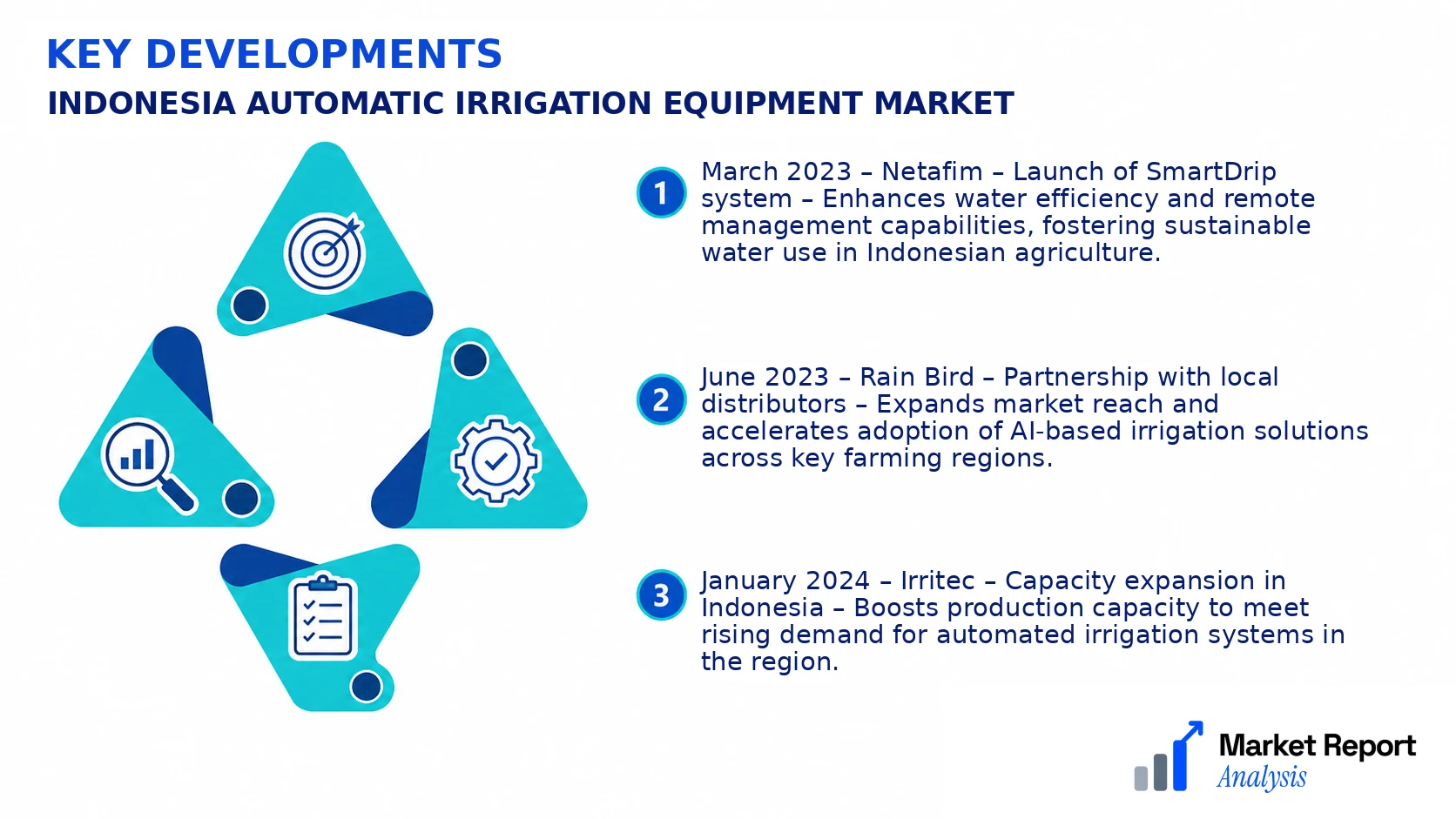
- March 2023 – Netafim – Launch of SmartDrip system – Enhances water efficiency and remote management capabilities, fostering sustainable water use in Indonesian agriculture.
- June 2023 – Rain Bird – Partnership with local distributors – Expands market reach and accelerates adoption of AI-based irrigation solutions across key farming regions.
- January 2024 – Irritec – Capacity expansion in Indonesia – Boosts production capacity to meet rising demand for automated irrigation systems in the region.
- August 2023 – Hunter Industries – Acquisition of a local distributor – Strengthens operational footprint and enhances service capabilities in Indonesia’s agricultural sector.
- February 2024 – EPC Industry – Investment in digital integrations for irrigation projects – Promotes advanced automation and resource management in large farming enterprises.
Frequently Asked Questions
What is the Indonesia Automatic Irrigation Equipment Market?
The Indonesia Automatic Irrigation Equipment Market comprises the sales and deployment of automated watering systems designed to optimize water usage for agriculture, landscaping, and sports fields across Indonesia. These systems include timers, sensors, and controllers that enable precise irrigation management.
What is the current market size of Indonesia Automatic Irrigation Equipment Market?
As of 2026, the market size is valued at approximately USD 1.2 Billion. The market has experienced steady growth driven by increasing agricultural modernization and adoption of sustainable irrigation practices across urban and rural regions.
What factors are driving the Indonesia Automatic Irrigation Equipment Market?
Growth drivers include government initiatives promoting water conservation, technological advancements in irrigation systems, rising labor costs, and increasing awareness of efficient water management among farmers. Climate variability also encourages the adoption of automated solutions to enhance crop yields.
Which region dominates the Indonesia Automatic Irrigation Equipment Market?
Java Island leads the market due to its dense agricultural activities, higher investments in modern irrigation infrastructure, and greater adoption of automated solutions. Its favorable government policies and technological infrastructure further bolster its market dominance.
Which segment is expected to grow the fastest?
The sensor-based irrigation systems segment is projected to witness the highest CAGR during 2026-2034, driven by advancements in IoT and data analytics that enable real-time soil moisture monitoring and water optimization, especially in commercial and large-scale agricultural applications.
Who are the leading companies operating in the Indonesia Automatic Irrigation Equipment Market?
Key players include Hunter Industries, Rain Bird Corporation, Toro Company, and local firms such as PT. Surya Agri Teknologi. These companies focus on innovation, strategic partnerships, and expanding distribution networks to strengthen their market position throughout Indonesia.
Analyst Perspective
The Indonesia Automatic Irrigation Equipment Market exhibits a mature growth trajectory, driven by increasing adoption of precision agriculture practices and government initiatives supporting modern farming techniques. Looking ahead to 2034, the market is poised for sustained expansion, with technological advancements such as IoT-enabled systems and AI integration creating substantial commercial opportunities, especially in resource-efficient automation solutions. Investment priorities should focus on innovative design, cost reduction, and regional customization, particularly in high-potential regions like West Java and East Java, which display significant agronomic and infrastructural growth. Competitive intensity is expected to intensify with the entrance of global and local players aiming to capitalize on Indonesia’s expanding agricultural landscape. Furthermore, regional growth potential extends to emerging provinces with developing farm infrastructure, where early adoption could yield high returns. Long-term, the market will benefit from strategic alliances, continuous R&D, and increased government incentives, fostering a robust, sustainable growth environment aligned with Indonesia’s food security and export expansion objectives.
