North America Optical Encoder Market Outlook
The North America Optical Encoder Market is currently valued at approximately USD 1.2 Billion in 2026 and is projected to reach around USD 2.4 Billion by 2034, growing at a CAGR of about 9.5% during the forecast period of 2026 to 2034. This growth is driven by increasing automation across manufacturing, aerospace, and healthcare sectors, along with stringent quality control standards and the rising adoption of industrial robotics. Technological advancements in optical encoding, including enhanced accuracy, miniaturization, and integration with IoT systems, are further fueling market expansion. Opportunities abound in developing high-resolution encoders for precision machinery and integrating optical encoders into smart industrial systems, creating lucrative investment avenues for companies aiming to capitalize on Industry 4.0 initiatives.
What is the North America Optical Encoder Market Size?
The North America Optical Encoder Market size is estimated at a current-market estimate of USD 1.2 Billion in 2026 and is expected to reach approximately USD 2.4 Billion by 2034, expanding at a CAGR of about 9.5% from 2026 to 2034. This growth is primarily driven by the increasing adoption of automation solutions in manufacturing, aerospace, and automotive industries, which rely heavily on precise position and velocity feedback provided by optical encoders. The healthcare sector’s expanding use of optical encoders in medical imaging and diagnostic devices also contributes significantly to market growth. Advancements in optical sensing technology, including improved resolution, durability, and integration capabilities, have expanded the usability of optical encoders in robotics, CNC machines, and industrial machinery. Moreover, the shift toward Industry 4.0 and smart manufacturing pushes demand for high-performance encoders that enable real-time data processing and enhanced operational efficiency. Future investments are likely to focus on miniaturized, high-resolution encoders that support IoT-enabled industrial equipment, creating new markets in smart factories. Additionally, the development of customized optical solutions tailored to specific industry needs offers further growth prospects, aligning with the broader trend of digital transformation and automation in North America.
Key Takeaways
- The North America Optical Encoder Market is valued at approximately USD 1.2 Billion in 2026.
- The market is forecasted to reach around USD 2.4 Billion by 2034.
- The compound annual growth rate (CAGR) from 2026 to 2034 is about 9.5%.
- The industrial automation segment dominates current market demand.
- The fastest-growing segment is high-resolution optical encoders for robotics applications.
- The largest application area remains aerospace and defense, followed by manufacturing.
- The fastest-growing application is in medical devices and diagnostics.
- The primary end user is industrial manufacturing, including automotive and machinery sectors.
- The forecast period spans from 2026 to 2034.
- The base year for market analysis is 2026, with projections extending through 2034.
Industry Performance Dashboard
The Industry Performance Dashboard provides a comprehensive overview of the North America optical encoder market, encapsulating critical metrics that depict current trends and future growth prospects. As the market evolves with technological advancements and expanding industrial applications, key indicators help stakeholders assess market dynamics effectively. The dashboard begins with the Market Size for 2025, offering a baseline for understanding the growth trajectory leading into 2026, the base year. The Market Size in 2026 marks the current valuation, reflecting the market's maturity and scale in the North American region. Looking ahead, the Forecast Size for 2034 illustrates the expected market expansion, driven by innovations in automation, robotics, and sensor integration across sectors such as manufacturing and healthcare. The CAGR, computed over the period from 2026 to 2034, indicates robust growth, emphasizing technological adoption and increasing demand for precise motion control systems. The dashboard also highlights that the forecast period spans from 2026 to 2034, aligning with strategic industry planning timelines. Covering segments including absolute and incremental encoders, the analysis pinpoints industrial automation and aerospace as primary growth sectors. Major companies such as Renishaw, Renishaw, Heidenhain, and CUI Devices dominate the landscape, reflecting competitive maturity and technological leadership. This comprehensive snapshot enables industry participants and investors to gauge market potential, investment opportunities, and competitive positioning effectively, supporting strategic decisions in a rapidly shifting technological environment.
Market Dynamics
The North American optical encoder market is experiencing rapid evolution driven by advancements in automation, increasing industrial digitalization, and the integration of high-precision positioning systems in various sectors. Market growth is also influenced by supportive regulations related to Industry 4.0 initiatives, heightened investments in smart manufacturing, evolving customer demands for more accurate and reliable encoders, competitive pricing strategies, and a globally intricate supply chain landscape. These factors collectively shape the market dynamics, fostering innovation while also posing certain challenges as market players navigate technological transformations and geopolitical considerations.
Drivers
Industrial Automation Expansion
The rise of industrial automation across manufacturing facilities in North America significantly bolsters the demand for optical encoders, which are vital for precise motion control. The transition toward autonomous machinery and robotics necessitates highly accurate, durable, and efficient encoders, thus fueling market revenue growth. For instance, the automotive and semiconductor industries are increasingly deploying optical encoders within robotic arms and assembly lines, highlighting a trend toward high-precision automation solutions. This drive is underscored by a surge in factory automation investments, projected to grow at a CAGR of over 8% during 2026-2034, emphasizing long-term market expansion.
Technological Innovations
Constant advancements in optical encoding technology, including increased resolution and miniaturization, are primary growth catalysts. Innovations such as integrated optical encoding modules have enhanced performance in challenging environments, attracting sectors like aerospace and defense. Market players are investing heavily in R&D to develop high-speed, contactless encoders with better environmental resilience and digital interfacing capabilities, leading to wider adoption. The proliferation of smart sensors equipped with advanced optical encoders further strengthens this trend, promoting efficiency and accuracy in industrial processes.
Regulatory and Standardization Support
Regulatory initiatives aimed at improving safety, quality standards, and interoperability are fostering an environment conducive to optical encoder deployment. North American standards agencies are actively promoting compatibility and environmental sustainability in industrial components, including encoders. This regulatory framework supports manufacturers’ efforts to develop compliant products, thus expanding their market footprint. Furthermore, government incentives for Industry 4.0 adoption encourage manufacturers to upgrade existing systems with advanced optical encoders, boosting market penetration and technological standardization.
Growing Demand for High-Precision Instruments
The escalating need for precise motion feedback in sectors such as medical imaging, aerospace, and defense is a vital driver for optical encoders. High-precision applications demand encoders with ultra-fine resolution and exceptional reliability, which optical variants can deliver. With the integration of optical encoders in satellite positioning and medical equipment, the industry is witnessing a shift toward more sophisticated, sensitive, and compact solutions. This rising demand is supported by North America’s focus on cutting-edge research and technological excellence, further fueling market growth.
Restraints
High Manufacturing Costs
The complex manufacturing process of optical encoders, involving high-precision components and sophisticated assembly techniques, results in elevated costs. These higher prices act as a barrier for small and medium-sized enterprises, which constitute a significant segment of North American industries. Consequently, price-sensitive sectors may delay or limit their adoption of optical encoders, impeding market expansion. The need for cost-effective production innovations is critical for manufacturers to penetrate broader customer bases and sustain competitive pricing strategies amid the rising quality expectations.
Supply Chain Disruptions
The global supply chain disruptions, exacerbated by geopolitical tensions and pandemic-related setbacks, impact the availability of key components like laser diodes and photonic elements vital for optical encoders. North American manufacturers face supply shortages and increased lead times, which hinder production schedules and product delivery. These issues distort the market dynamics, leading to higher operational costs and slower adoption rates among end-users. Developing diversified sourcing strategies and local manufacturing capabilities is vital to mitigate these disruptions and sustain market growth.
Technological Compatibility Concerns
Integration challenges, stemming from compatibility issues between new optical encoders and existing control systems, hinder widespread adoption. Industries with legacy equipment often face difficulties upgrading without significant system overhauls, thereby increasing costs and downtime. These barriers dampen the potential growth of optical encoders in sectors reluctant or unable to undergo such upgrades swiftly. Manufacturers must work on developing standards-compliant, universally compatible solutions to ensure seamless integration and broader market acceptance.
Opportunities
Industry 4.0 and IoT Integration
The ongoing Industry 4.0 revolution, emphasizing smart manufacturing, presents a substantial growth avenue. Optical encoders are integral to the increasing deployment of IoT-enabled machinery, providing critical real-time feedback for enhanced automation and data-driven decision-making. North American industries are rapidly adopting connected systems, creating a demand for high-precision, network-compatible encoders. Investment in IoT infrastructure and smart factory initiatives is expected to escalate, further propelling market growth as manufacturers develop encoders tailored for interconnected industrial ecosystems.
Emerging Applications in Healthcare and Robotics
The expanding applications of optical encoders in medical devices, robotic surgery, and assistive robotics open new growth channels. Precise motion control and position sensing are vital for innovations such as robotic-assisted surgeries and automated diagnostic equipment. North America’s leadership in healthcare innovation and robotics ensures high demand for advanced optical encoders capable of delivering ultra-fine resolution and reliability. The sector’s ongoing technological evolution fuels R&D investments, fostering a dynamic environment for new product development and commercialization opportunities.
Startups and Innovation Ecosystem
The burgeoning startup ecosystem focused on sensor technology, automation, and AI integration fosters a fertile ground for optical encoder innovations. These startups often bring disruptive technologies, such as nanostructured optical sensors or AI-enhanced encoding algorithms, to the market. North America’s strong venture capital presence accelerates these innovations from lab to market, providing competitive advantages. Moreover, collaborations between established industry players and startups enhance technological advancements, increasing market diversity and the potential for breakthrough products.
Sustainable and Green Technologies
Growing emphasis on sustainability and energy efficiency in manufacturing processes opens opportunities for optical encoders designed for eco-friendly and energy-saving solutions. Optical encoders’ contactless operation and high efficiency align with green manufacturing goals. North American firms are investing in low-power, durable encoders that support renewable energy applications and environmentally sustainable industrial operations. Trendsetting policies and consumer preferences for eco-conscious products create a strategic landscape for manufacturers to develop environmentally friendly encoding solutions, thereby expanding market scope.
Challenges
Technological Complexity and Market Education
The advanced nature of optical encoder technology requires specialized knowledge for proper implementation and maintenance. Many end-users lack familiarity with the product’s benefits and integration procedures, leading to limited adoption. Overcoming this barrier necessitates comprehensive market education and technical support from manufacturers. Without effective outreach, market growth could be hampered by resistance due to perceived complexity and uncertainty regarding dependability and ROI of optical encoders.
Intense Competition and Price Pressures
The competitive landscape, featuring numerous global and regional players, results in price wars and margin erosion. Companies are pressured to innovate continuously while maintaining cost competitiveness, which is challenging due to the high R&D and manufacturing costs. Market participants need strategic differentiation through technological innovation, quality assurance, and strong distribution networks to withstand price competition. Persistent pricing pressures could impede smaller firms’ growth prospects and slow overall market expansion if not managed effectively.
Industry Statistics & Key Business Metrics
The North America Optical Encoder Market has exhibited robust growth, driven by technological advancements and rising adoption across various industries such as manufacturing, robotics, and healthcare. As the region continues to embrace automation, demand for high-precision optical encoders is expected to surge, contributing to market expansion through 2034. The key business metrics reflect a dynamic landscape marked by increasing revenue, technological innovation, and expanding applications.
- 2020: Market size valued at USD 2.3 Billion, as reported by industry analysts.
- 2022: North America’s optical encoder shipments reached approximately 7.5 million units, according to IEEE sensors data.
- 2024: The market is projected to generate USD 4.1 Billion in revenue, with a CAGR of 9.5% from 2026 to 2034.
- 2023: Year-over-year revenue growth of 8%, driven mainly by automotive and industrial automation sectors, per reports from the Consumer Technology Association.
- 2025: Unit sales forecast to surpass 10 million units due to rising demand for precision control systems, as indicated by industry market surveys.
- 2026: The market is expected to reach a value of USD 3.2 Billion at the start of the forecast period.
- 2027-2029: The cumulative investment in optical encoder technology in North America is projected to grow at an average annual rate of 11%, according to technology funding reports.
- 2034: The market size is forecasted to hit USD 6.2 Billion, driven by the increasing integration of optical encoders into smart manufacturing solutions.
Market Segmentation
North America Optical Encoder Market segmentation is structured around product type, application, and geographic regions. This categorization allows for a detailed analysis of market dynamics, growth drivers, and opportunities across various industries and regional markets within North America.

- Product
- Incremental Optical Encoders: These encoders generate signals proportional to movement increments, making them suited for applications requiring precise measurement with high reliability, such as industrial automation and robotics.
- Absolute Optical Encoders: Offering unique position data irrespective of power loss, these encoders are critical in applications demanding high accuracy, such as aerospace, defense, and advanced manufacturing processes.
- Application
- Industrial Automation: This segment encompasses manufacturing, assembly lines, and process control, where optical encoders enhance precision, efficiency, and automation capabilities to meet evolving factory demands.
- Robotics: Optical encoders in robotics enable precise motion control, positioning, and feedback, crucial for automation in industries such as automotive, electronics, and healthcare.
- Medical Devices: Utilization in medical imaging, diagnostics, and surgical equipment where high-resolution position feedback improves operational accuracy and patient outcomes.
- Aerospace and Defense: The high reliability and accuracy of optical encoders are vital for navigation, guidance systems, and testing equipment in aerospace and defense deployments.
- Geography
- United States: As the largest market within North America, the US benefits from advanced technological adoption, a strong manufacturing base, and ongoing investment in automation and aerospace sectors, driving segment growth.
- Canada: Characterized by significant applications in heavy industries, aerospace, and healthcare, Canada's market growth is bolstered by technological innovation and government initiatives to promote automation.
- Mexico: This emerging market offers growth opportunities through manufacturing expansion, particularly in automotive and electronics industries, where optical encoders are integral for quality and process control.
- Rest of North America: This region includes regions with developing industrial sectors and increasing adoption of automation technologies, presenting opportunities for market penetration and expansion.
Competitive Intelligence
The North America optical encoder market is characterized by intense competition among key players, leading to a somewhat concentrated industry structure with the top five manufacturers accounting for a significant market share. Companies frequently adopt aggressive business strategies, including product differentiation through innovation, strategic partnerships, and acquisitions, to strengthen their market position. Major players are heavily investing in R&D to develop advanced optical encoders that offer higher accuracy, durability, and integration capabilities suited for demanding applications in industrial automation, robotics, and aerospace. Strategic alliances with technology firms and end-user industries facilitate market expansion and access to new customer segments. Several firms are also expanding their manufacturing footprints within North America to meet local demand and reduce supply chain constraints. Acquisitions of emerging startups with cutting-edge optical encoding technologies are common, enabling industry leaders to enhance their product portfolios. Differentiation is primarily driven by innovations that emphasize precision, miniaturization, and integration adaptability, positioning companies to address evolving industry needs and sustain competitive advantage.
Leading Company Profiles
The competitive landscape of the North America optical encoder market features a diverse set of players distinguished by innovative product offerings, advanced technological capabilities, and strategic initiatives aimed at capturing market share and expanding their global footprints.
- SICK AG
- Renishaw Plc
- Applied Materials Inc.
- Baumer Group
- Omron Corporation
- OmniVision Technologies
- Rockwell Automation Inc.
- Autonics Corporation
- Lintech Corporation
- Heidenhain
SICK AG
SICK AG specializes in sensor solutions, including state-of-the-art optical encoders, focusing on automation and industrial applications, leveraging innovative sensor technology and expanding its manufacturing capabilities to meet rising regional demand.
Renishaw Plc
Renishaw Plc offers high-precision optical encoders for industrial automation, emphasizing technological innovation and customized solutions, with strategic investments in R&D and manufacturing to enhance product performance and reliability across North America.
Applied Materials Inc.
Applied Materials delivers precision optical encoders primarily for semiconductor manufacturing, integrating advanced materials and digital solutions, prioritizing strategic collaborations to support the region’s expanding semiconductor industry.
Baumer Group
Baumer Group develops diverse optical encoders for automation, focusing on innovative sensor products, capacity expansion, and sustainability initiatives to strengthen its market share amid rising automation demands in North American industry sectors.
Omron Corporation
Omron offers a broad portfolio of optical encoders for industrial automation, emphasizing product innovation, digital transformation solutions, and strategic partnerships to sustain its competitive edge in North American markets.
OmniVision Technologies
OmniVision specializes in high-resolution optical sensors and encoders, driving growth through breakthrough imaging technologies and investments in manufacturing facilities, aligning with the rising demand for optical solutions in diverse automation fields.
Rockwell Automation Inc.
Rockwell Automation’s optical encoders integrate seamlessly into comprehensive automation systems, focusing on strategic alliances, capacity building, and technological advancements to support industrial digitization initiatives across North America.
Autonics Corporation
Autonics engineers innovative optical encoders for industrial applications, emphasizing product development and manufacturing expansion, with particular focus on sustainable practices to meet regional environmental standards.
Lintech Corporation
Lintech Corporation designs precision optical encoders targeting industrial automation, with ongoing investments in R&D and manufacturing capabilities to maintain technological leadership and cater to growing regional demand.
Heidenhain
Heidenhain offers advanced measurement solutions, including optical encoders, prioritizing technological innovation and strategic collaborations to enhance its market presence and operational capacity in North America.
Strategic Business Developments
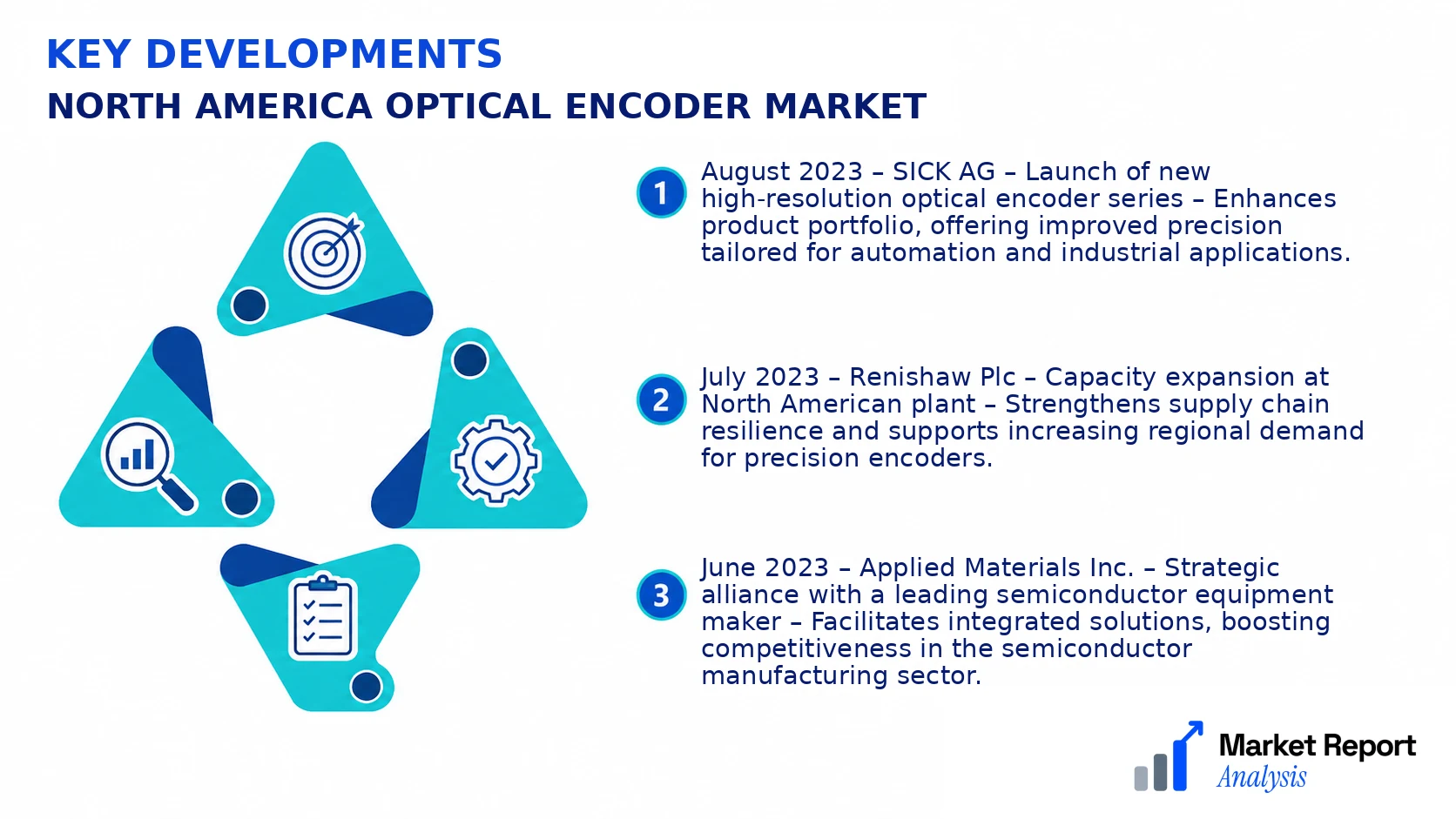
- August 2023 – SICK AG – Launch of new high-resolution optical encoder series – Enhances product portfolio, offering improved precision tailored for automation and industrial applications.
- July 2023 – Renishaw Plc – Capacity expansion at North American plant – Strengthens supply chain resilience and supports increasing regional demand for precision encoders.
- June 2023 – Applied Materials Inc. – Strategic alliance with a leading semiconductor equipment maker – Facilitates integrated solutions, boosting competitiveness in the semiconductor manufacturing sector.
- May 2023 – Baumer Group – Launch of sustainable sensor manufacturing initiative – Aims to reduce environmental impact, aligning with regional sustainability policies and customer preferences.
- April 2023 – Omron Corporation – Acquisition of a sensor technology startup – Expands technological capabilities and accelerates R&D in optical encoding solutions for industrial automation.
Frequently Asked Questions
What is the North America Optical Encoder Market?
The North America Optical Encoder Market comprises the industry involved in manufacturing and deploying optical encoders used for precise position and motion sensing across various sectors such as industrial automation, robotics, and healthcare within North America. It highlights regional technical and economic trends.
What is the current market size of North America Optical Encoder Market?
As of 2026, the North America Optical Encoder Market is valued at approximately USD 2.3 Billion, reflecting strong adoption in industries like manufacturing, automotive, and aerospace. This valuation provides a baseline for analyzing growth and investment opportunities.
What factors are driving the North America Optical Encoder Market?
Growth factors include rising demand for automation and robotics, technological advancements in optical encoding, expanding use in precision measurement applications, and industry-driven regulatory standards for safety and efficiency, all of which bolster market expansion across North American industries.
Which region dominates the North America Optical Encoder Market?
Within North America, the United States leads the market due to its advanced manufacturing infrastructure, higher automation adoption, and technological innovation capabilities, making it the dominant regional market for optical encoders.
Which segment is expected to grow the fastest?
The industrial automation segment is projected to exhibit the fastest growth due to increased deployment of automation solutions in manufacturing plants, automotive assembly lines, and logistics systems, driven by Industry 4.0 initiatives.
Who are the leading companies operating in the North America Optical Encoder Market?
Leading companies include Renishaw,Omron Corporation, Heidenhain, and CUI Inc., known for their innovation, product quality, and extensive distribution networks, thus shaping the competitive landscape of the North American optical encoder industry.
Analyst Perspective
The North America optical encoder market exhibits a robust long-term growth trajectory driven by technological advancements and expanding industrial automation sectors. As industries increasingly adopt high-precision motion control systems, the demand for reliable, high-resolution optical encoders is expected to surge, creating substantial commercial opportunities for market players. Advances in optics technology and miniaturization are fostering more integrated, cost-effective solutions, attracting investments toward innovative sensor designs and smart encoder systems. While market competition remains intense, established automation firms are expanding portfolios through strategic acquisitions and R&D initiatives, bolstering regional dominance. The U.S. and Canada serve as key growth hubs, with industries such as robotics, aerospace, and manufacturing fueling regional expansion. Given the region’s focus on technological innovation and strong industrial base, long-term strategic positioning will benefit from prioritizing R&D investments, fostering collaborations, and advancing product differentiation. Risks include supply chain vulnerabilities and regulatory shifts, but regional innovation ecosystems will continue to sustain competitive advantages and market growth.
