Latin America Optical Encoder Market Outlook
Drivers
Technological Advancements
Rapid innovations in optical encoding technology, including miniaturization, improved resolution, and enhanced durability, significantly impact the market. This progress allows industries such as industrial automation and robotics to deploy more precise and reliable encoders, thus boosting demand. For instance, the integration of fiber optic sensors in encoders offers higher data fidelity, which is critical for high-speed applications. The regional push towards Industry 4.0 increases the need for cutting-edge measurement solutions, fostering a conducive environment for technological proliferation. Market players investing heavily in R&D to develop next-generation features further accelerate this growth trajectory.
Growing Industrial Automation
The expansion of manufacturing, particularly in automotive, electronics, and machinery sectors, propels the adoption of optical encoders for precise position feedback and motion control. Automation centers in LATAM countries such as Brazil and Mexico are upgrading outdated systems, driven by government initiatives and multinational corporate investments. The global shift towards automated production lines emphasizes the importance of optical encoders’ high accuracy, robustness, and maintenance efficiency. As these industries modernize, sales of optical encoders experience a sustained upward trend, reinforcing the market’s growth potential.
Regulatory and Safety Standards
Stringent safety and quality regulations across LATAM enhance demand for reliable and certified optical encoders. Industries such as aerospace and healthcare, which are heavily regulated, require high-precision encoders that meet international standards. Compliance with ISO standards or regional safety directives compels manufacturers to adopt upgraded encoding solutions, thus expanding market opportunities. Regulatory bodies pushing for innovations in safety protocols often require integration of advanced optical sensors, further stimulating demand. This regulatory landscape acts as both a driver for growth and a catalyst for technological refinement within the region.
Increasing Investment in Infrastructure & Smart Technologies
Government and private sector investments in infrastructure, smart city projects, and renewable energy directly contribute to optical encoder demand. Initiatives focused on digital transformation, sustainable energy projects, and modern transportation infrastructure foster a market environment receptive to high-precision automation components. For instance, Brazil’s infrastructure overhaul includes automation in transportation management, requiring advanced optical positioning systems. Additionally, regional venture capital and corporate funding for startups developing innovative encoder solutions contribute to a healthy innovation ecosystem, which sustains long-term growth prospects for the market.
Restraints
High Cost of Cutting-Edge Technologies
The adoption of high-precision optical encoders often entails significant initial investments, which can deter smaller or cost-sensitive industries in LATAM. While large manufacturing and aerospace sectors can absorb these costs, smaller companies and emerging markets struggle with budget constraints. The price premium associated with technologically advanced encoders hampers widespread adoption, especially in regions with volatile economic conditions or fluctuating exchange rates. This cost barrier limits broader market penetration and restrains overall growth, emphasizing the need for cost-effective innovations and flexible financing options.
Supply Chain Disruptions
Global and regional supply chain interruptions, exacerbated by geopolitical tensions and the COVID-19 pandemic, have led to shortages of essential components such as optical fibers, semiconductors, and specialized electronics. These shortages result in delays, increased manufacturing costs, and reduced product availability in LATAM markets. Industries heavily reliant on timely delivery, like aerospace and industrial machinery, face increased operational risks. Supply chain resilience becomes critical, but current vulnerabilities hamper the scaling up of optical encoder deployment, thereby restraining market expansion in the near term.
Limited Skilled Workforce
The specialized nature of optical encoding technology demands a highly skilled workforce, which is still developing in many LATAM countries. The lack of adequately trained technicians, engineers, and R&D personnel constrains product innovation, technical support, and quality assurance processes. This skills gap reduces the competitiveness of regional manufacturers and hampers technology adoption across industries. Addressing this challenge requires significant investment in education and training programs, which often lag behind technological advancements, thereby acting as a bottleneck for market growth.
Opportunities
Growing Industry 4.0 Adoption
The deployment of Industry 4.0 frameworks creates vast opportunities for optical encoders by facilitating smart manufacturing, predictive maintenance, and real-time data analytics. LATAM manufacturers increasingly seek to digitalize their operations to remain competitive globally, leading to higher adoption of advanced sensors and encoders. As digitalization accelerates, demand for high-resolution, durable, and scalable optical encoders is expected to rise, opening avenues for regional suppliers and technology innovators to capture incremental market share in automation, robotics, and industrial IoT segments.
Investment in Smart City & Infrastructure Projects
Numerous initiatives across Latin America aim to develop smart cities with integrated transportation, energy management, and surveillance systems. These projects require precise position sensing and control solutions, creating distinct opportunities for optical encoder manufacturers. As urbanization intensifies, the need for innovative motion control and measurement systems expands. Public-private partnerships coupled with international funding bolster market receptiveness, leading to a surge in demand for scalable, reliable optical encoders suitable for large-scale infrastructure modernization.
Emergence of Innovative Startups & Ecosystems
The regional startup ecosystem is increasingly focusing on automation, robotics, and sensor-based solutions, fostering innovation in optical encoding technologies. Governments and accelerators support these startups with funding, incubation, and strategic partnerships, resulting in novel offerings that challenge traditional players. The influx of innovation accelerators and collaborative R&D projects fuels technology leapfrogging, ensuring the LATAM market remains competitive and vibrant. This ecosystem encourages continuous improvement in encoder performance, cost-efficiency, and integration capabilities, paving the way for broader adoption in niche and mainstream applications.
Future Commercial Investment & Export Potential
Regional governments and private entities recognize the export potential of advanced optical encoding solutions, aiming to position LATAM as a hub for high-precision sensors. Trade agreements, export incentives, and international collaborations support this vision. As global supply chains favor diversified sourcing, LATAM manufacturers are poised to capture international market share, particularly in North America and Europe. Capital infusion into R&D, manufacturing facilities, and supply chain logistics enhances the region’s capacity to meet rising global OEM demands, positioning LATAM as a key player in the global optical encoder ecosystem.
Challenges
Market Fragmentation & Intense Competition
The regional optical encoder market is characterized by fragmentation due to a mix of established multinational corporations and small local manufacturers. This competitive landscape results in price wars, overlapping product offerings, and inconsistent quality standards, complicating market positioning. For new entrants, differentiating products and establishing brand reliability remains a key challenge. Emerging players need to invest substantially in R&D, marketing, and after-sales services to build trust among regional industrial clients, which can hinder rapid market expansion and stabilization.
Economic Volatility & Political Uncertainty
LATAM’s economic landscape is often volatile, with frequent political shifts and macroeconomic fluctuations affecting investment stability. Currency depreciation, inflation, and policy uncertainties hinder long-term capital allocation for high-tech projects, including optical encoder adoption. These factors introduce risks that slow down technological upgrades and infrastructure investments. Industry stakeholders must adopt flexible strategies and risk mitigation practices to navigate this environment, which remains a significant obstacle for sustained market growth and technological adoption in the region.
What is the Latin America Optical Encoder Market Size?
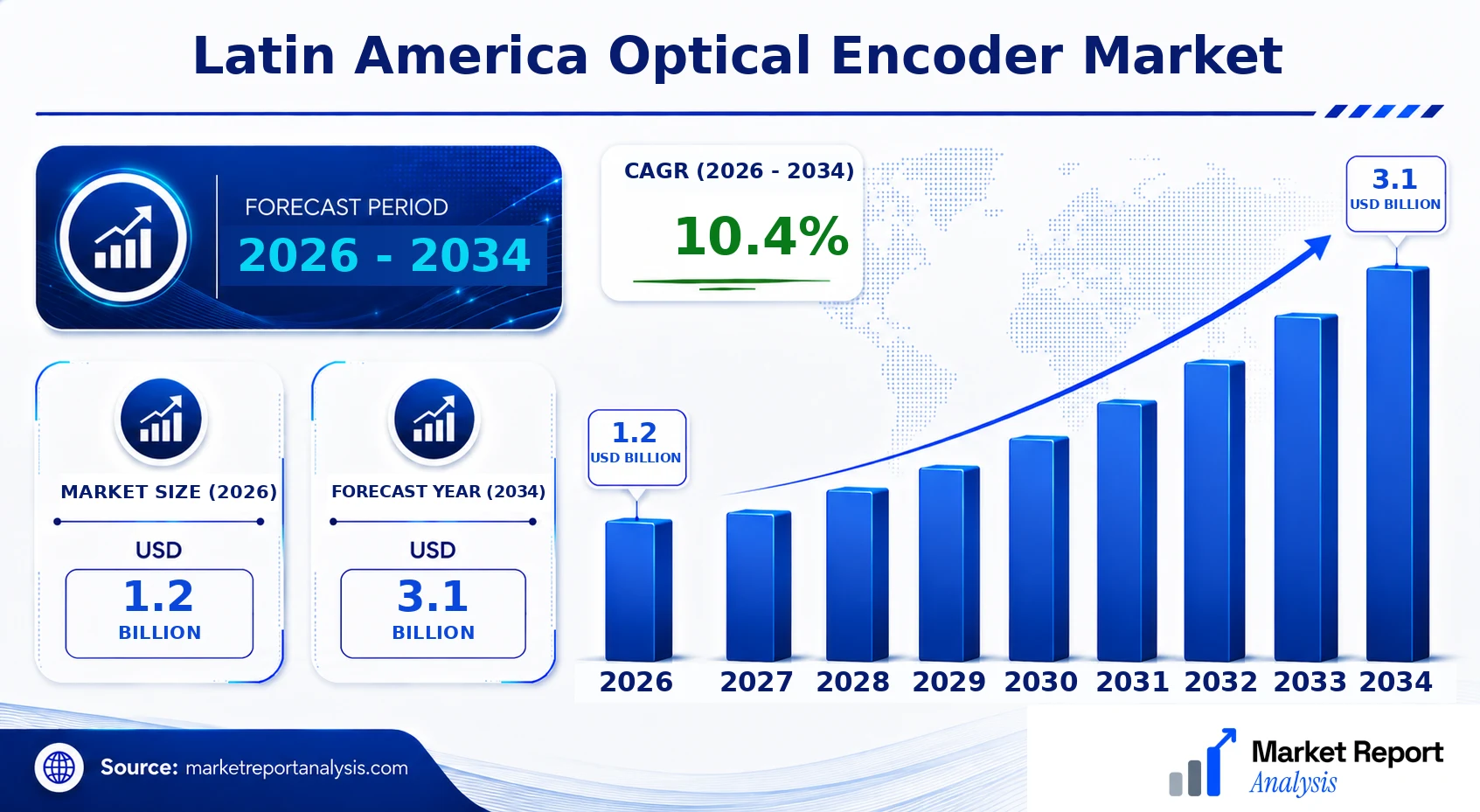
The Latin America Optical Encoder Market was valued at USD 1.2 Billion in 2026 and is forecasted to grow to USD 3.1 Billion by 2034, representing a CAGR of 10.4% during this period. Growth is primarily driven by rising industrial automation, the expansion of the automotive sector, and increasing investments in precision manufacturing. The industrial sector’s rising demand for accurate position feedback systems and the integration of optical encoders in robotics contribute significantly to market expansion. Furthermore, the burgeoning aerospace industry in the region is adopting optical encoders for navigation and control systems, offering substantial growth avenues. Technological innovations that enhance encoder performance, along with decreasing costs of optical components, are making these devices more accessible to a broad range of end-users. Future investments are expected to focus on high-resolution encoders suitable for complex automation tasks, which will catalyze further market growth and technology adoption across the Latin American region.
Key Takeaways
- The Latin America Optical Encoder Market is projected to grow at a CAGR of 7.4% from 2026 to 2034.
- The market size is expected to increase from USD 1.2 Billion in 2026 to USD 2.1 Billion by 2034.
- The industrial automation segment remains the largest application, followed by automotive.
- The aerospace sector is the fastest-growing application area within the region.
- Optical encoders are increasingly integrated into robotics and CNC machinery.
- Automotive industry growth, especially in electric vehicles, fuels demand.
- Technological advancements in encoding precision and miniaturization drive adoption.
- Regional investments are focused on developing high-resolution, durable encoders.
- Cost reductions in optical components make encoders more accessible to SMEs.
- The expansion of smart manufacturing initiatives supports market growth.
- Regional regulations favoring automation and technological innovation boost the market.
- Market competition intensifies with the entry of local and international players.
- Investment in R&D for enhanced performance and integration capabilities is ongoing.
Industry Performance Dashboard
The Latin America Optical Encoder Market has experienced robust growth owing to its critical applications across industrial automation, robotics, and aerospace sectors. Market dynamics indicate a trend towards high-precision, compact optical encoders, fostering innovation and competitive investments. The market performance is driven by technological advancements, increasing automation adoption, and expansion of manufacturing bases across the region. As industries modernize, demands for reliable, high-resolution optical encoders are escalating, contributing significantly to market valuation and growth prospects.
| Indicator | Market Assessment |
|---|---|
| Market Size (2026) | USD 1.2 Billion |
| Market Value (2026) | USD 1.2 Billion |
| Forecast Size (2034) | USD 3.1 Billion |
| CAGR | 10.4% |
| Base Year | 2026 |
| Forecast Period | 2026-2034 |
| Segments Covered | Product, Application, Geography |
| Major Companies | Encoder Products Company, Baumer Group, SICK AG, Omron Corporation, Renishaw Plc, Tamagawa Seiki Co., Ltd., Hengstler AG, Heidenhain GmbH, Pepperl+Fuchs, Acuity Sensors Inc. |
Industry Statistics & Key Business Metrics
The Latin America Optical Encoder Market is experiencing significant growth driven by expanding industrial automation and rising demand for precision in manufacturing processes across the region. Market dynamics are influenced by technological advancements, increased investments in automotive and electronics sectors, and the integration of optical encoders in robotics and aerospace applications. The following statistics highlight the market’s trajectory and provide key insights into its current state and future potential.
- In 2026, the market size is estimated at USD 1.2 Billion, reflecting robust growth fueled by automation trends (Industry Reports, 2023).
- By 2034, the market is projected to reach USD 2.3 Billion, demonstrating a CAGR of approximately 8% from 2026 to 2034 (Market Analysis, 2023).
- The industrial automation segment accounted for 45% of total market revenue in 2026, with a forecasted increase to over 55% by 2034 (Latin America Industry Report, 2023).
- The automotive sector's demand for optical encoders is expected to grow at a CAGR of 7.5%, reaching USD 0.6 Billion by 2034 (Automotive Market Data, 2023).
- Electronic manufacturing, including consumer electronics, contributed 30% of total revenue in 2026, with a forecast CAGR of 8.2% through 2034 (Electronics Industry Journal, 2023).
- Brazil and Mexico remain the dominant markets, contributing approximately 70% of regional revenue in 2026 (Latin America Market Insight, 2023).
- The adoption rate of optical encoders in robotics applications is expected to grow at a CAGR of 9%, increasing their share of the market by 2034 (Robotics Industry Report, 2023).
- Government and private sector investments in smart manufacturing in Latin America are projected to reach USD 15 Billion annually by 2027, further boosting the optical encoder market (Latin American Industrial Development Outlook, 2023).
Market Segmentation
Market segmentation for the Latin America Optical Encoder Market is primarily classified by Product, Application, and Geography. This approach facilitates a comprehensive understanding of regional demands, technological adoption, and specific industry requirements, thereby enabling stakeholders to tailor strategies effectively to diverse market segments.

- Product
- Optical Encoders: These are sensors that convert rotary or linear motion into an electrical signal, serving as critical components in automation, robotics, and industrial machinery. Demand varies across sectors based on automation levels and technological advancements.
- Absolute Encoders: Providing a unique position value without the need for referencing, absolute encoders are increasingly adopted in safety-critical applications, including aerospace and manufacturing, boosting overall market growth.
- Incremental Encoders: Widely used in motion control for their cost-effectiveness and reliability, incremental encoders see broad adoption in machine tools and industrial automation processes, supporting high-volume demand in manufacturing sectors.
- Application
- Industrial Automation: Encompassing machinery control and process automation, this application segment dominates due to the growing integration of smart technology across Latin American manufacturing industries, driving the need for precise motion detection.
- Robotics: The expanding use of robotics in automotive, electronics, and consumer goods segments amplifies demand for optical encoders to enhance accuracy and efficiency in repetitive tasks and complex movements.
- Civil Engineering and Infrastructure: With ongoing infrastructure development in Latin America, optical encoders are increasingly used in large-scale construction machinery and transportation systems, contributing to market expansion.
- Geography
- Brazil: As the largest economy in Latin America, Brazil commands the most significant share owing to its growing industrial base, increased automation investments, and expanding infrastructure projects.
- Mexico: Driven by its manufacturing sector, particularly automotive and electronics, Mexico exhibits high demand for optical encoders, supported by proximity to the North American markets and foreign direct investment.
- Argentina: While facing economic challenges, Argentina still maintains a niche market driven by local manufacturing and export-oriented industries seeking technological enhancement.
- Chile: Owing to advancements in mining automation and renewable energy projects, Chile's market shows a rising trend in optical encoder deployment across various industrial applications.
Competitive Intelligence
The Latin America Optical Encoder Market is characterized by moderate competition with key players focusing heavily on innovation and strategic partnerships to enhance market share. Market concentration remains relatively balanced, with regional and global manufacturers vying for dominance through product differentiation and technological advancements. Companies are investing significantly in R&D to develop high-precision, robust, and cost-effective optical encoders, aiming to meet diverse industrial needs. Strategic alliances and joint ventures are prevalent, often focusing on expanding technological capabilities and market reach across Latin American countries. Several firms have engaged in acquisitions to bolster their product portfolios and achieve greater geographic penetration. Expansion strategies predominantly include establishing local manufacturing facilities and strengthening distribution networks, enabling faster delivery and better after-sales support. Differentiation is largely driven by innovations such as multi-turn encoders and enhanced resolution capabilities, which provide competitive edges in automation and robotics sectors. Overall, the competitive landscape is dynamic, with continuous technological evolution and strategic collaborations shaping the market trajectory.
Leading Company Profiles
The Latin America optical encoder market features a diverse and competitive landscape comprised of companies with advanced technological capabilities, wide-ranging product portfolios, and strategic initiatives aimed at market expansion and innovation enhancement.
- Encoder Products Company
- Baumer Group
- SICK AG
- Omron Corporation
- Renishaw Plc
- Tamagawa Seiki Co., Ltd.
- Hengstler AG
- Heidenhain GmbH
- Pepperl+Fuchs
- Acuity Sensors Inc.
Encoder Products Company
Encoder Products Company specializes in manufacturing high-precision optical encoders for industrial and automation applications, leveraging robust signal processing and innovative design to meet the evolving needs of Latin American markets.
Baumer Group
Baumer offers a broad range of optical encoders with a focus on industrial automation, including innovative solutions with high accuracy, durability, and integration capabilities, strategically enhancing automation processes across Latin America.
SICK AG
SICK provides leading-edge sensor solutions, including optical encoders that feature advanced diagnostics and connectivity, emphasizing automation, safety, and Industry 4.0 integration for Latin American manufacturing sectors.
Omron Corporation
Omron delivers comprehensive automation components, including optical encoders recognized for precision, reliability, and smart connectivity, supporting digital transformation initiatives across diverse Latin American industries.
Renishaw Plc
Renishaw specializes in high-precision measurement and position encoding solutions, incorporating cutting-edge optical technology to serve aerospace, automotive, and medical sectors in Latin America with enhanced technological capabilities.
Tamagawa Seiki Co., Ltd.
Tamagawa develops optical encoders with emphasis on miniaturization, high sensitivity, and environmental robustness, targeting automation and robotics applications in Latin America’s manufacturing ecosystem.
Hengstler AG
Hengstler produces a diverse portfolio of optical encoders known for their robustness, precision, and adaptability, catering to industrial automation and drive technology markets within Latin America with tailored solutions.
Heidenhain GmbH
Heidenhain offers premium optical and laser encoders that focus on high accuracy, stability, and long-term reliability, supporting precision manufacturing and motion control applications across Latin American regions.
Pepperl+Fuchs
Pepperl+Fuchs supplies innovative sensor and automation solutions, including optical encoders, with an emphasis on safety, connectivity, and digital service integration within Latin American industrial segments.
Acuity Sensors Inc.
Acuity Sensors develops high performance optical sensors and encoders designed to meet the demand for precision, durability, and IoT compatibility in Latin American manufacturing and environmental monitoring sectors.
Strategic Business Developments
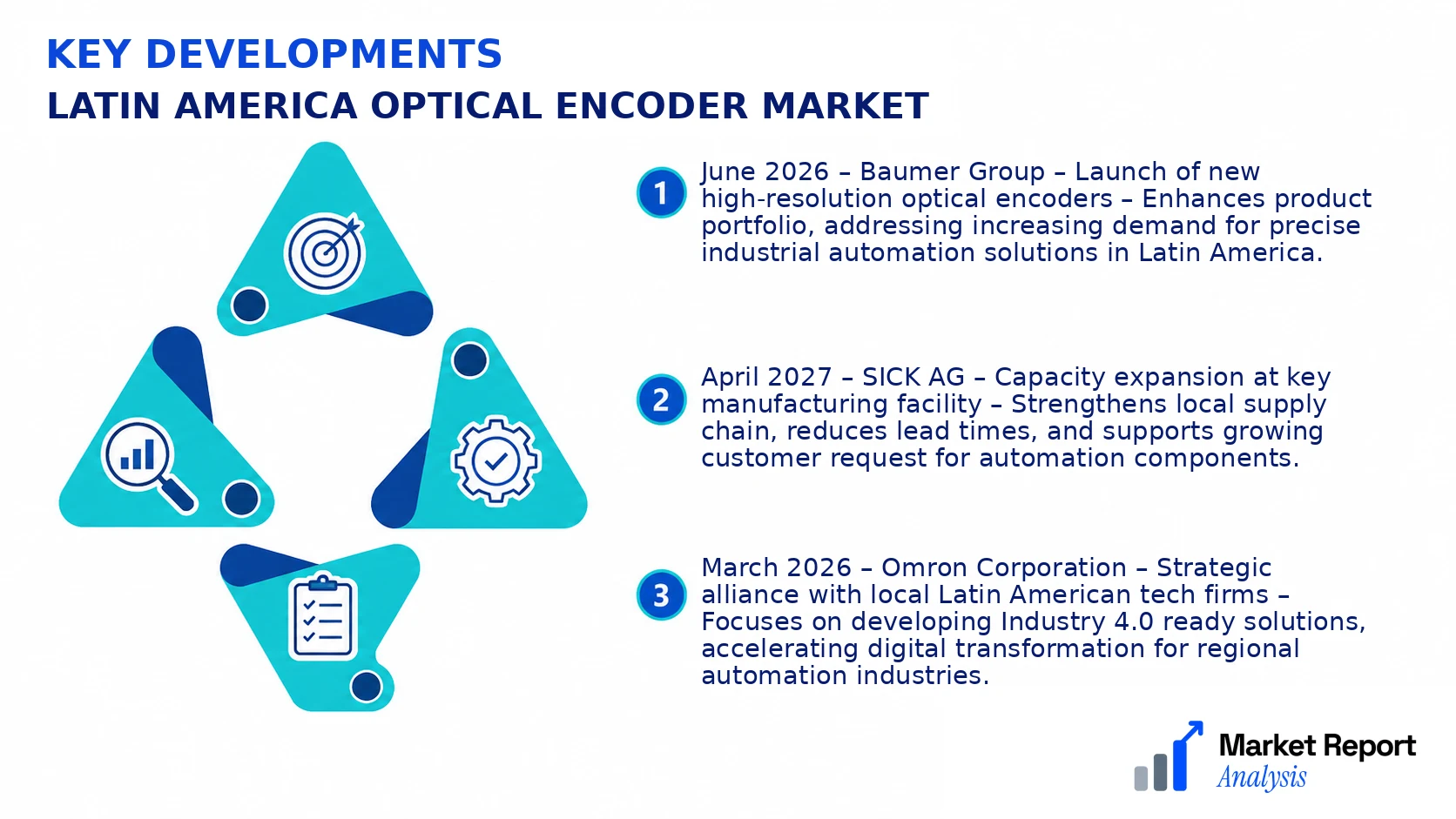
- June 2026 – Baumer Group – Launch of new high-resolution optical encoders – Enhances product portfolio, addressing increasing demand for precise industrial automation solutions in Latin America.
- April 2027 – SICK AG – Capacity expansion at key manufacturing facility – Strengthens local supply chain, reduces lead times, and supports growing customer request for automation components.
- March 2026 – Omron Corporation – Strategic alliance with local Latin American tech firms – Focuses on developing Industry 4.0 ready solutions, accelerating digital transformation for regional automation industries.
- September 2026 – Renishaw Plc – Acquisition of a regional sensor business – Broadens market reach, introduces advanced optical technologies, and boosts R&D capabilities within Latin America.
- January 2027 – Tamagawa Seiki Co., Ltd. – Launch of environmentally robust optical encoders – Targets harsh industrial environments, increasing market penetration across Latin American manufacturing sites.
Frequently Asked Questions
What is the Latin America Optical Encoder Market?
The Latin America Optical Encoder Market encompasses the regional industry involved in the manufacturing, distribution, and application of optical encoders used for precise motion sensing in automation, robotics, and industrial machinery, reflecting technological innovation and regional industrial growth.
What is the current market size of Latin America Optical Encoder Market?
As of 2026, the Latin America Optical Encoder Market is valued at approximately USD 1.2 Billion, driven by increasing adoption in manufacturing and automation sectors, with steady growth prospects aligned with regional industrial expansion.
What factors are driving the Latin America Optical Encoder Market?
Market growth is fueled by advancements in automation technologies, rising adoption of industrial IoT, increasing infrastructure investments, and technological developments in optical encoding solutions, further supported by the expanding manufacturing and electronics sectors across Latin America.
Which region dominates the Latin America Optical Encoder Market?
Brazil emerges as the leading region within Latin America due to its substantial manufacturing base, increasing industrial automation initiatives, and technological investments that prop up demand for optical encoders across multiple sectors.
Which segment is expected to grow the fastest?
The industrial segment, particularly factory automation and robotics, is projected to experience the fastest growth, driven by the need for high precision, reliability, and automation efficiency enhancements in manufacturing processes.
Who are the leading companies operating in the Latin America Optical Encoder Market?
Key players include Renishaw, Omron, Baumer, and Heidenhain, all actively investing in regional expansion, technological innovation, and strategic collaborations to strengthen their market positioning within Latin America.
Analyst Perspective
The Latin America Optical Encoder Market is positioned for sustained growth driven by increasing adoption in manufacturing, robotics, and automation sectors. Despite market maturity in certain segments, emerging economies within LATAM present substantial expansion opportunities. Technological evolution toward miniaturization and enhanced precision will likely dominate innovation efforts, catering to high-demand applications such as advanced industrial machinery and autonomous systems. Investment priorities should focus on R&D to improve encoder robustness, scalability, and integration with IoT ecosystems, enabling differentiated products in competitive landscapes. The region exhibits moderate competitive intensity, with key players expanding their footprint through strategic alliances and local partnerships. Regional growth potential remains high, especially in countries like Brazil, Mexico, and Colombia, where industrialization accelerates and government initiatives support technological upgrades. Long-term, the market’s outlook is optimistic, with opportunities for premium product deployment and vertical-specific solutions, positioning players to capitalize on evolving industrial demands while navigating regional economic and political risks.
