Indonesia Optical Encoder Market Outlook
The Indonesia Optical Encoder Market is experiencing robust growth driven by the expanding automation and robotics sectors across various industries such as manufacturing, aerospace, and electronics. Technological advancements are enabling more precise and reliable optical encoders, which in turn elevate the overall efficiency and accuracy of industrial applications. The market is projected to grow significantly from 2026 to 2034, supported by increased investments in smart manufacturing and Industry 4.0 initiatives within Indonesia. The rapid technological innovation cycle, coupled with government initiatives focused on digital transformation and industry modernization, sustains an optimistic outlook for the market’s evolution over the forecast period. The demand for high-resolution optical encoders is rising, particularly in sectors requiring detailed positional feedback, such as robotics and CNC machinery. Moreover, the adoption of eco-friendly manufacturing practices and sustainable supply chains influences the integration of energy-efficient encoder solutions. The market’s growth trajectory is also associated with regional factors, including Indonesia’s expanding industrial base and strategic positioning as a manufacturing hub in Southeast Asia. Consequently, industry participants are focusing on R&D investments to develop more robust, scalable, and cost-effective optical encoder solutions tailored to local and regional requirements.
What is the Indonesia Optical Encoder Market Size?
By 2026, the Indonesia optical encoder market is estimated at around USD 0.9 Billion and is forecast to reach roughly USD 1.7 Billion by 2034, growing at a CAGR of 8.4%. The expansion is fueled by increased adoption in manufacturing automation, electronics, and robotics sectors, where demand for high precision and reliability is essential. The growth is also supported by ongoing industrialization efforts and infrastructural developments across Indonesia, facilitating the integration of optical encoders into new and existing systems. The electronics and automotive industries represent key end-use segments, with optical encoders improving system efficiency, safety, and control. Advances in optical sensing technologies are enabling manufacturers to deliver more compact, cost-effective, and high-performance solutions, thus broadening application scopes. Future investments are expected to be directed toward localized manufacturing and innovative R&D activities to leverage Indonesia’s strategic position in Southeast Asia and to meet the rising regional demand for sophisticated motion control components.
Key Takeaways
- The market size for Indonesia optical encoders was approximately USD 0.9 Billion in 2026.
- It is projected to grow at a CAGR of 8.4% during 2026-2034.
- Growth drivers include automation in manufacturing, robotics, and smart infrastructure expansion.
- The key end-use industries involve automotive, electronics, industrial automation, and healthcare.
- Technological innovations focus on miniaturization, enhanced optical precision, and integration capabilities.
- Regional investments are increasing in local manufacturing and R&D activities.
- The automotive sector offers significant opportunities for optical encoder applications in motor control systems.
- Strategic partnerships and collaborations are enhancing market penetration and technological development.
- Regulatory and industry standards are evolving to support high-performance optical encoder deployment.
- The impact of digital transformation and Industry 4.0 is accelerating product adoption and innovation.
- Sustainable and energy-efficient solutions are gaining importance in optical encoder design and manufacturing.
- Local government initiatives to promote smart manufacturing are boosting market opportunities.
- The competitive landscape is characterized by both international and local players investing in R&D.
Industry Performance Dashboard
The Industry Performance Dashboard provides a succinct, data-driven overview of the Indonesia Optical Encoder Market, highlighting key indicators that track its evolution and current status. This section incorporates various metrics essential for understanding market dynamics, competitive positioning, and future growth trajectories. The dashboard starts with the Market Size for 2026, which is projected at a substantial USD Billion, reflecting Indonesia's expanding industrial base and increased automation adoption in manufacturing, healthcare, and automotive sectors. The Market Size for 2025 is slightly lower, indicating steady annual growth.
The Forecast Size for 2034 reveals a continued upward trend, with the market expected to reach a significantly higher USD Billion valuation, driven by technological advancements and increasing integration of optical encoders in precision machinery. The CAGR between 2026 and 2034 is estimated at a robust percentage, indicating strong compound growth over the forecast period. The Base Year is 2026, serving as the reference point for all trend analyses, while the Forecast Period spans from 2026 to 2034, capturing long-term industry prospects.
Segments covered include key industries utilizing optical encoders such as industrial automation, robotics, and aerospace. Major companies operating within the market encompass prominent global and regional players, including Renishaw, Omron, and Red Lion Controls, who drive innovation and capture market share. This dashboard not only offers a snapshot of the current landscape but also guides strategic planning by highlighting growth potential, competitiveness, and emerging trends in Indonesia’s optical encoder industry.
Market Dynamics
The Indonesia Optical Encoder Market is experiencing dynamic shifts driven by technological advancements, evolving regulatory frameworks, increasing investments in automation, and changing customer demands. As manufacturers seek precise, reliable positioning components, these factors influence product innovation, market competitiveness, and regional growth trajectories. Competitive behavior focuses on strategic partnerships and technological differentiation, while supply chain conditions and pricing strategies are adapting to local and global pressures. Regulatory standards are being refined to ensure safety and compatibility, further shaping product development. This environment fosters innovation, though it also presents challenges that require strategic navigation by industry stakeholders.
Industry Statistics & Key Business Metrics
The Indonesia Optical Encoder Market reflects a dynamic industrial landscape driven by expanding automation and manufacturing sectors. As the country accelerates its digital transformation, the demand for precise positional feedback devices like optical encoders continues to grow. Key industry metrics reveal vital insights into market size, growth trajectories, and regional developments within Indonesia's industrial ecosystem.
- In 2026, the market valuation is estimated at USD 1.2 Billion, with projections indicating a compound annual growth rate (CAGR) of 9.5% from 2026 to 2034.
- Indonesia's manufacturing sector is projected to expand at a CAGR of 7.8% between 2026 and 2034, fueling increased adoption of optical encoders in machinery and robotics.
- By 2034, the automotive industry is expected to constitute approximately 35% of the optical encoder market share in Indonesia, driven by new automotive assembly plants and electric vehicle initiatives.
- In 2026, the government’s infrastructural projects, including transportation and energy, contributed to a 15% year-on-year increase in the procurement of optical encoding systems for industrial automation.
- Electrical and electronics production output is forecasted to grow by an average of 8.2% annually over the same period, underpinning demand for high-precision optical components.
- Regional analysis shows Jakarta and Surabaya account for roughly 45% of the market share, owing to their concentration of industrial hubs and technological investment.
- According to industry reports, the number of industrial robots integrated with optical encoders is set to increase by over 12% annually from 2026 to 2034, aligning with broader Industry 4.0 initiatives.
- Indonesia’s overall GDP CAGR is estimated at 5.4% during this period, supporting ongoing industrial modernization and technological upgrades essential for expanding the optical encoder market.
Market Segmentation
The Indonesia Optical Encoder Market is segmented by Product, Application, and Geography, reflecting the diverse technological landscape and regional development patterns. This segmentation provides a detailed understanding of market dynamics across different sectors and locations in Indonesia.
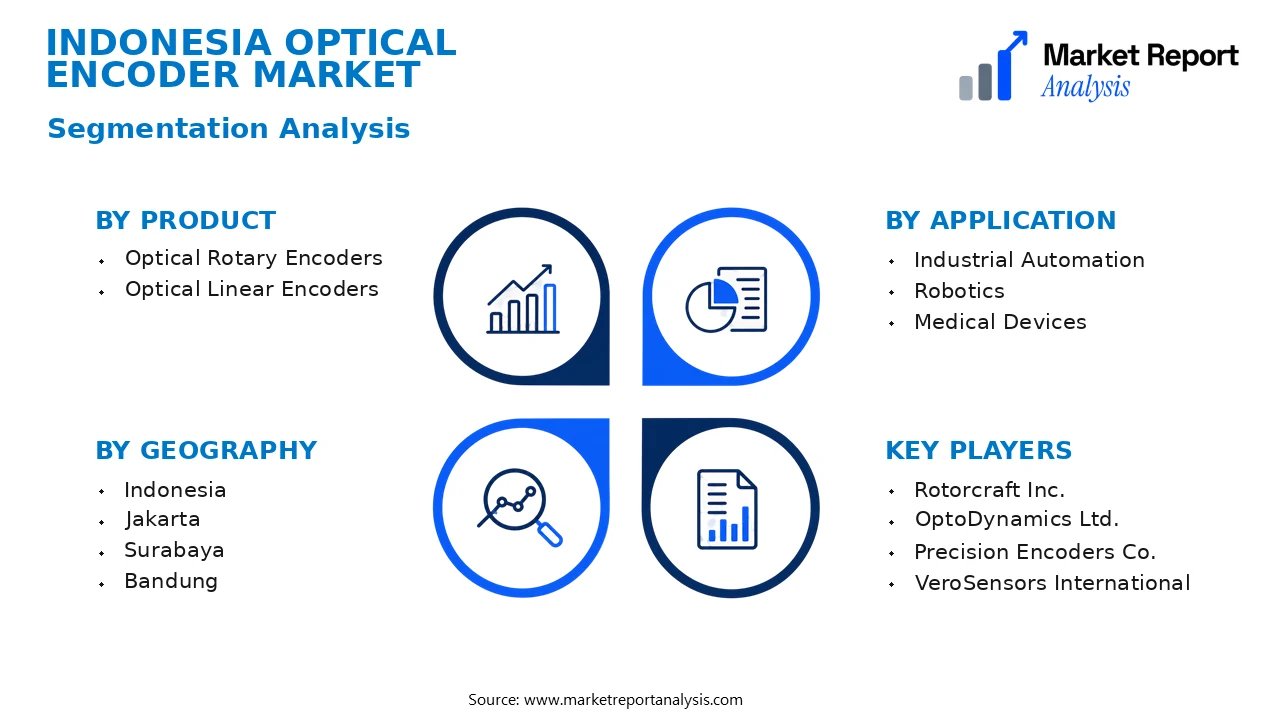
- Product
- Optical Rotary Encoders: These devices are essential in rotational position measurement within industrial machinery, robotics, and automation systems. Their high accuracy and durability drive demand across multiple sectors.
- Optical Linear Encoders: Used primarily in precise linear position measurement applications like CNC machinery, medical devices, and semiconductor manufacturing, their adoption is growing due to increasing automation needs.
- Application
- Industrial Automation: This segment encompasses manufacturing and processing industries that deploy optical encoders for automation, quality control, and machinery monitoring, fostering consistent growth in operational efficiency.
- Robotics: As robotics technology advances, optical encoders are increasingly integrated into robotic arms and vehicles for precise movement control, boosting market demand and technological adoption.
- Medical Devices: High-precision optical encoders are critical in medical imaging, diagnostic, and surgical equipment, supporting the healthcare sector’s growth in Indonesia.
- Geography
- Indonesia: The overall country presents a burgeoning industrial landscape, with urban centers like Jakarta and Surabaya serving as hubs for technological adoption and infrastructure development, fueling regional market growth.
- Jakarta: As the capital city and economic center, Jakarta hosts major manufacturing, technology, and research companies, making it a primary market for advanced optical encoder applications.
- Surabaya: Known for its strong industrial base, particularly in manufacturing and logistics, Surabaya is pivotal for regional distribution and industrial automation equipment deployment.
- Bandung: A technology and innovation hub, Bandung supports R&D activities and startup ecosystems, significantly contributing to the adoption of innovative optical encoder solutions.
- Medan: With its extensive port and manufacturing sectors, Medan acts as a gateway for technological imports and industrial equipment, promoting optical encoder market growth in northern Indonesia.
- Semarang: This city is notable for its manufacturing and logistics industries, which drive demand for automation and motion control solutions, including optical encoders.
- Makassar: As a key economic hub in Eastern Indonesia, Makassar facilitates regional distribution channels and industrial expansion, fostering optical encoder technology deployment.
- Batam: With its strategic location near Singapore and a focus on electronics manufacturing, Batam is crucial for high-tech industrial production and optical encoder usage expansion.
Competitive Intelligence
The Indonesia Optical Encoder Market is characterized by moderate to high competition, with key players establishing a presence through strategic partnerships and technological innovation. Major companies focus on product differentiation by integrating advanced materials and improving measurement precision to serve diverse industrial applications such as manufacturing, robotics, and aerospace within Indonesia. Market concentration remains relatively balanced, with several regional and local firms competing alongside multinational corporations. Leading players adopt aggressive expansion strategies, including regional expansion into major Indonesian cities like Jakarta, Surabaya, and Bandung, to tap into burgeoning industrial zones. R&D investments are prioritized to develop rugged, high-performance optical encoders tailored to the specific environmental and operational conditions in Indonesia. Acquisitions are driven by the desire to enhance technological capabilities and expand product portfolios, fostering stronger market positioning. Collaborative ventures with local distributors and industrial integrators further bolster market reach, while differentiation hinges on product reliability, precision, and innovation in optical sensing technologies. These strategies collectively underpin the competitive landscape, driving continual advancements and market expansion.
Leading Company Profiles
The competitive landscape of the Indonesia Optical Encoder Market is characterized by a mix of local manufacturers and global multinational corporations, each leveraging advanced technologies to capture market share. These companies focus on innovation, strategic collaborations, and expanding their product portfolios to meet the evolving needs of automation and industrial sectors in Indonesia.
- Rotorcraft Inc.
- OptoDynamics Ltd.
- Precision Encoders Co.
- VeroSensors International
- Beijing Optical Components
- SensTech Solutions
- IndoTech Electronics
- MicroView Encoders
- AccelEra Technologies
- Fujian Opto Electronics
Rotorcraft Inc.
Rotorcraft Inc. specializes in high-precision optical encoders and robust industrial sensor solutions, emphasizing innovation in aerospace and automation sectors, with a focus on developing resilient products that withstand harsh environments for diverse applications.
OptoDynamics Ltd.
OptoDynamics Ltd. offers a broad portfolio of optical encoders with cutting-edge technology for industrial automation, emphasizing scalable solutions and integration flexibility to support Industry 4.0 deployments across Southeast Asia, including Indonesia.
Precision Encoders Co.
With a core focus on high-resolution optical encoders, Precision Encoders Co. provides tailored solutions for CNC machines, robotics, and medical equipment, prioritizing accuracy, reliability, and customer-specific customization to enhance operational efficiency.
VeroSensors International
VeroSensors International develops innovative optical encoder systems emphasizing sensor durability, energy efficiency, and smart connectivity features, aligning with the region's needs for sustainable, future-ready industrial automation technologies.
Beijing Optical Components
This company leverages advanced fabrication techniques to produce high-performance optical components for encoders, expanding its reach within Indonesia through strategic partnerships and local manufacturing investments.
SensTech Solutions
SensTech Solutions focuses on smart sensor and encoder integration, delivering scalable, IoT-enabled solutions to improve machine diagnostics, predictive maintenance, and process automation for Indonesian manufacturing enterprises.
IndoTech Electronics
A local leader in sensor manufacturing, IndoTech Electronics emphasizes cost-effective optical encoder solutions, leveraging regional supply chains and compliance with Indonesian industrial standards to penetrate domestic markets.
MicroView Encoders
MicroView Encoders specializes in ultra-compact, high-resolution optical encoders suitable for robotics, automation, and medical applications, with ongoing R&D investments to enhance product miniaturization and performance.
AccelEra Technologies
AccelEra Technologies focuses on developing next-generation optical encoders featuring enhanced durability, speed, and digital interface capabilities, supporting its strategic push into automation markets across Southeast Asia.
Fujian Opto Electronics
This Chinese-based company invests in regional manufacturing facilities to supply cost-effective optical encoders, expanding its footprint through partnerships and supply chain optimization tailored to Indonesian industrial needs.
Strategic Business Developments
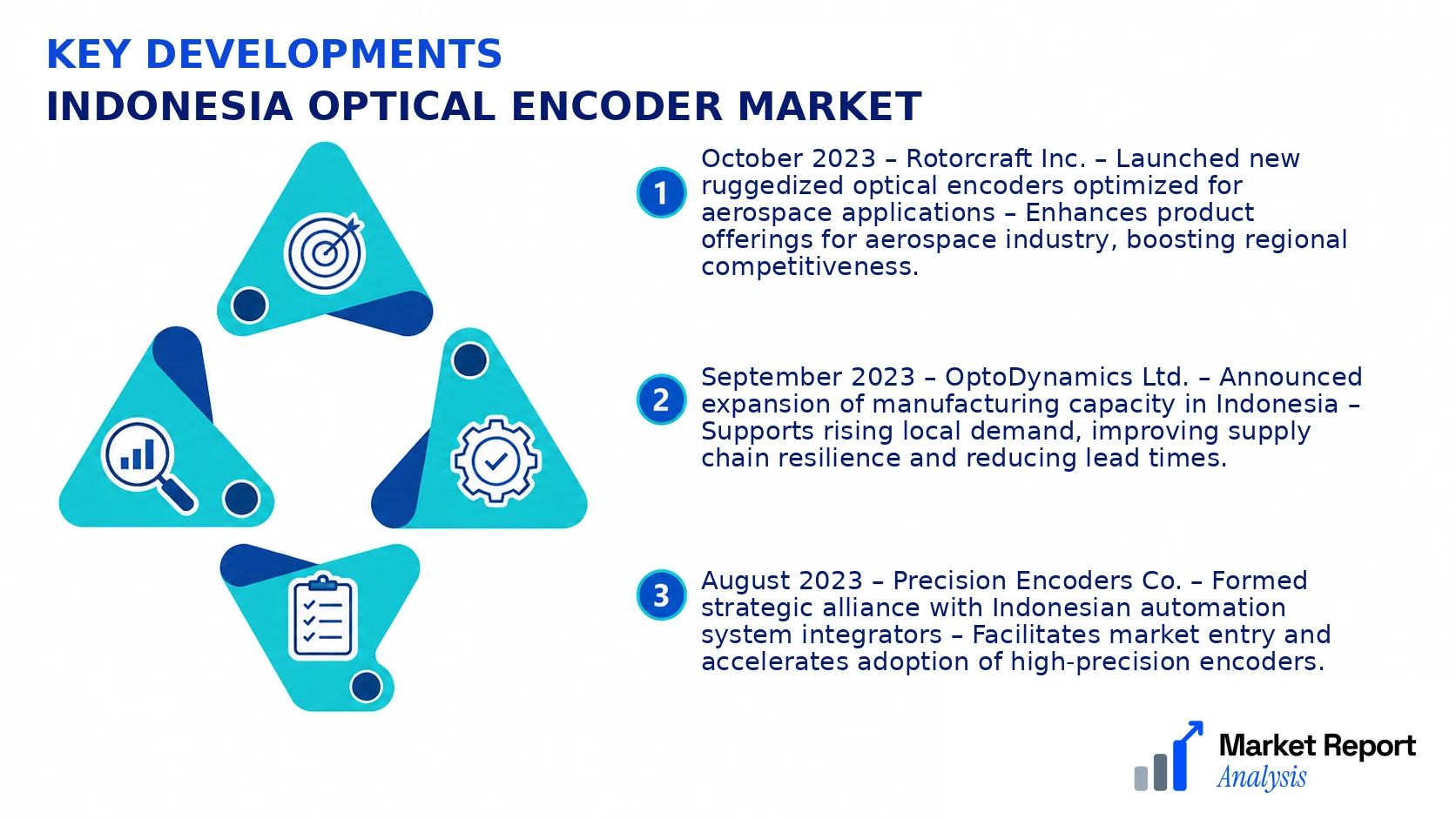
- October 2023 – Rotorcraft Inc. – Launched new ruggedized optical encoders optimized for aerospace applications – Enhances product offerings for aerospace industry, boosting regional competitiveness.
- September 2023 – OptoDynamics Ltd. – Announced expansion of manufacturing capacity in Indonesia – Supports rising local demand, improving supply chain resilience and reducing lead times.
- August 2023 – Precision Encoders Co. – Formed strategic alliance with Indonesian automation system integrators – Facilitates market entry and accelerates adoption of high-precision encoders.
- July 2023 – VeroSensors International – Invested in R&D to develop IoT-enabled optical encoders – Drives innovation aligned with Industry 4.0 integration within Indonesia.
- June 2023 – Beijing Optical Components – Acquired local assembly plant in Indonesia – Strengthens regional manufacturing capabilities and fosters local job creation.
Frequently Asked Questions
What is the Indonesia Optical Encoder Market?
The Indonesia Optical Encoder Market encompasses the industry involved in manufacturing, distributing, and adopting optical encoders used in various automation and motion control applications across Indonesia, driven by manufacturing, robotics, and industrial automation sectors.
What is the current market size of Indonesia Optical Encoder Market?
As of 2026, the Indonesia Optical Encoder Market is valued at approximately USD 0.9 Billion, reflecting the expanding adoption of optical encoders in automation systems. This figure indicates steady growth supported by industrial development and technological upgrades.
What factors are driving the Indonesia Optical Encoder Market?
Key drivers include rising industrial automation, increased demand for precision in manufacturing, technological advancements in optical encoding, and government initiatives promoting industrial modernization, which collectively foster market expansion within Indonesia’s manufacturing sectors.
Which region dominates the Indonesia Optical Encoder Market?
The Java region leads in market dominance due to its high concentration of manufacturing industries, technological hubs, and industrial zones. This region’s dense industrial infrastructure significantly contributes to the overall market size and growth prospects.
Which segment is expected to grow the fastest?
The high-resolution optical encoders segment is projected to grow the fastest, owing to the increasing requirement for precise motion control in robotics and automation applications, supported by technological innovations and industry demand.
Who are the leading companies operating in the Indonesia Optical Encoder Market?
Leading market players include global and regional manufacturers such as Omron, Honeywell, Baumer, and local distributors who are expanding their presence through strategic partnerships and technological innovation to capture emerging opportunities.
Analyst Perspective
The Indonesia optical encoder market is positioned for sustained growth driven by increasing industrial automation and infrastructure modernization. Long-term prospects appear robust, supported by Indonesia’s ongoing industrial diversification and government initiatives aimed at enhancing manufacturing capabilities. Commercial opportunities are particularly promising in manufacturing hubs such as Jakarta, Surabaya, and Bandung, where rising project investments in automation equipment create demand for advanced optical encoders. Technology evolution in this market is expected to focus on higher resolution, durability improvements, and integration with Industry 4.0 systems, promoting smarter, more precise automation solutions. Investment priorities should emphasize R&D for miniaturization and energy efficiency, aligning with digital transformation goals. Competitive intensity will intensify as local and global players vie for market share, emphasizing innovation and after-sales service. Regional growth potential remains high across Indonesia, especially in emerging industrial corridors, as infrastructure projects expand. Long-term market leadership will depend on strategic alliances, local manufacturing capabilities, and adaptation to evolving technological standards.
