North America Microwave Absorbing Materials Market Outlook
The North America Microwave Absorbing Materials Market is currently valued at approximately USD 2.1 Billion in 2026 and is projected to reach around USD 4.4 Billion by 2034, expanding at a CAGR of about 10.2% during the period from 2026 to 2034. This growth is primarily driven by increasing military and defense applications, infrastructure development for secure communications, and expanding research and development activities in microwave technology. The evolution of stealth technology and electromagnetic interference (EMI) shielding solutions further accelerates market demand. Advances in nanotechnology and composite materials are shaping a new technological landscape, providing enhanced absorption capabilities and lighter, more durable materials. Commercial opportunities are abundant, especially for companies investing in innovative material formulations tailored for high-performance applications in military, aerospace, and telecommunication sectors.
What is the North America Microwave Absorbing Materials Market Size?
The North America Microwave Absorbing Materials Market size is estimated at approximately USD 2.1 Billion in 2026 and is expected to reach around USD 4.4 Billion by 2034, expanding at a CAGR of about 10.2% from 2026 to 2034. This growth is driven by heightened defense budgets, technological advancements in EMI shielding, and expanding applications in civilian sectors such as telecommunications, automotive radar systems, and consumer electronics. The increasing adoption of stealth technology in military platforms and the rising concern over electromagnetic pollution are significant contributors. Key industries fueling market expansion include aerospace & defense, telecommunications, and automotive sectors. Technological innovations focusing on lightweight, environmentally friendly, and cost-effective microwave absorbing materials are opening new avenues for market players. Future investments are likely to focus on nanomaterial composites and sustainable, high-performance absorbents to meet the evolving demands of high-tech and defense industries.
Key Takeaways
- Market size in 2026 is approximately USD 2.1 Billion.
- Forecast size by 2034 reaches around USD 4.4 Billion.
- Market CAGR between 2026 and 2034 is approximately 10.2%.
- The largest segment by material type is ferrite-based absorbers.
- The fastest-growing segment is nanocomposite microwave absorbing materials.
- Major application sector is defense & military, especially stealth technology.
- The fastest-growing application is consumer electronics EMI shielding.
- The largest end user is the aerospace & defense industry.
- The forecast period spans from 2026 to 2034.
- The base year for analysis is 2026.
Industry Performance Dashboard
The Industry Performance Dashboard provides a concise overview of the key metrics and trends shaping the North America Microwave Absorbing Materials Market. It offers insights into market size, growth projections, and competitive landscape, essential for stakeholders to make informed decisions. The dashboard begins by highlighting the Market Size in 2025, followed by the current Market Size in 2026, establishing a baseline for growth analysis. The Forecast Size for 2034 is projected to illustrate the market's expansion over the forecast period, underpinned by the CAGR that quantifies annual growth rate, ensuring clarity on market momentum.
The base year is set as 2026, with the forecast period spanning from 2026 to 2034, capturing the market's trajectory over nearly a decade. The dashboard segments covered include key product categories, end-use industries, and technology trends, providing a layered understanding of market dynamics. It prominently features Major Companies such as ARC Technologies Inc., South Wall Technologies, and Henkel AG & Co. KGaA, which are pivotal players in the market. These companies' strategic initiatives, product innovations, and market contributions are monitored for their impact on overall industry growth.
Overall, the dashboard serves as a vital tool for investors, manufacturers, and policymakers by distilling complex market data into a structured, accessible format that highlights past performance and future opportunities within the North America Microwave Absorbing Materials Market.
Market Dynamics
The North American Microwave Absorbing Materials Market is experiencing dynamic shifts driven by technological advancements, evolving regulatory landscapes, heightened investment activities, and shifting customer requirements. These factors collectively influence pricing strategies, supply chain conditions, and competitive behaviors, shaping the overall market trajectory. Innovations in material science, coupled with stricter electromagnetic interference regulations, are prompting manufacturers to enhance product performance and safety standards. Simultaneously, increased governmental and private investments in defense, aerospace, and telecommunications sectors are fueling market expansion. As customer demand for miniaturized, efficient microwave absorption solutions grows, companies are compelled to innovate rapidly, making the market highly competitive and innovation-driven.
Drivers
Increasing Defense and Aerospace Investments
The growing defense and aerospace budgets in North America significantly propel the demand for microwave absorbing materials, which are critical in stealth technology and electromagnetic shielding. The U.S. Department of Defense's strategic initiatives to modernize military assets include enhanced stealth capabilities, directly boosting market growth. Manufacturers are developing lightweight, high-performance materials that meet military specifications, aligning with the trend of increased defense expenditure of over USD 700 Billion annually in the region. This continuous investment underscores the importance of microwave absorbing materials in national security applications, fostering innovation and expanding market opportunities.
Technological Advancements in Material Science
The rapid evolution of nanotechnology and composites has led to the development of more efficient, durable microwave absorbing materials. Advancements in polymer-based and ceramic composites enable better absorption across broader frequency ranges and under varying environmental conditions. For instance, the integration of nanostructured materials has enhanced absorption efficiency, fostering new product development for commercial and defense use. These innovations are supported by active research initiatives within North American universities and research institutions, which are pioneering next-generation materials with improved performance metrics, thus escalating the competitive landscape and market size.
Growing Demand in Telecommunication Infrastructure
The expansion of 5G networks and smart city initiatives intensifies the need for microwave absorbing materials to mitigate electromagnetic interference (EMI) and improve signal integrity. Telecommunication companies seek advanced materials for antenna design, integrated circuit shielding, and infrastructure protection. As the North American telecommunication sector invests billions annually to upgrade network capabilities, the demand for these materials is expected to rise proportionally. This growth in telecommunications infrastructure not only drives market demand but also pushes innovation towards more environmentally friendly and cost-effective solutions.
Stringent Electromagnetic Compatibility Regulations
Increasing regulatory requirements to control electromagnetic interference (EMI) across industries enforce the adoption of microwave absorbing materials, widening their application scope. Industries such as consumer electronics, automotive, and healthcare are compelled to comply with stricter standards. These regulations, aimed at reducing electromagnetic pollution and safeguarding sensitive equipment, are prompting manufacturers to develop compliant materials exhibiting superior absorption properties. Consequently, the market experiences accelerated development cycles and higher demand, emphasizing the importance of regulatory compliance in shaping industry dynamics.
Restraints
High Cost of Advanced Materials
The production of cutting-edge microwave absorbing materials involves complex manufacturing processes and high-cost raw materials, such as nanomaterials and specialty polymers. These costs impose financial burdens on producers, limiting their ability to offer affordable solutions for mass-market applications like consumer electronics. Industries seeking cost-effective EMI mitigation solutions are thus restrained, creating a disparity between industrial needs and available product offerings. This cost barrier hampers widespread adoption and hinders market expansion, particularly in price-sensitive sectors.
Limited Broad-Spectrum Absorbing Efficiency
Despite technological progress, many current microwave absorbing materials face limitations in effectively covering a broad range of frequencies, especially at higher bands utilized in emerging applications. This spectral inefficiency restricts their use in versatile environments, such as multi-band communication systems and sophisticated defense apparatuses. Consequently, manufacturers encounter challenges in developing universal solutions, which restricts market growth in certain niche applications requiring ultra-wideband absorption. Overcoming this spectral limitation necessitates further research and development, potentially delaying market penetration.
Regulatory and Environmental Challenges
Environmental concerns and regulatory standards regarding the use and disposal of certain raw materials, particularly nanomaterials and hazardous chemicals, impose constraints on market growth. Stringent environmental regulations restrict or increase the cost of raw material sourcing and disposal procedures, thereby elevating overall production costs. Moreover, the need for eco-friendly solutions emphasizes the development of sustainable materials, which remains a challenge due to current material limitations. These regulatory pressures may slow innovation cycles and impose additional compliance costs, impacting overall market expansion.
Opportunities
Expansion in Commercial and Consumer Electronics
The rapid growth of smart devices, wearable technology, and consumer electronics presents vast opportunities for microwave absorbing materials. As devices increasingly incorporate wireless functionalities, shielding electronics from EMI becomes imperative. The rise in adoption of IoT-enabled products and increasing miniaturization demand advanced materials capable of integrating seamlessly without adding bulk. North American manufacturers can capitalize on this by developing flexible, lightweight, and cost-effective microwave absorbing solutions, thus tapping into a thriving domestic consumer electronics market projected to reach USD 400 Billion by 2030. This expansion will catalyze innovation and diversify the application landscape.
Investment and Innovation Ecosystem Growth
The vibrant innovation ecosystem in North America, bolstered by government grants, venture capital, and university collaborations, fosters the development of next-generation microwave absorbing materials. Startups focusing on nanotechnology, bio-inspired materials, and multifunctional composites are emerging rapidly, providing novel solutions. Increased investments in research and development are expected to drive breakthroughs, reducing costs and improving performance. This environment encourages industry-university partnerships and accelerates commercialization timelines. As a result, North America is well-positioned to lead in the development, testing, and deployment of advanced microwave absorbing innovations, further expanding market opportunities.
Integration with Emerging Technologies
The convergence of microwave absorbing materials with emerging technologies such as autonomous vehicles, space exploration, and quantum computing offers promising avenues for growth. Autonomous vehicles require EMI shielding to ensure sensor accuracy, while space applications need materials that withstand extreme environments. Integrating microwave absorbing materials into these sectors can mitigate interference issues, improve system reliability, and contribute to safety and performance. With North America's significant investments in space technology and autonomous systems, leveraging these materials fits strategic innovation trajectories and opens lucrative future markets, fostering sustained industry growth.
Future Commercial Investment Potential
The increasing recognition of electromagnetic pollution's impact on health and technology reliability is prompting policy makers and industry leaders to invest heavily in advanced shielding materials. Governments and private sector stakeholders are expected to channel substantial funds into research centers, pilot projects, and manufacturing facilities dedicated to microwave absorbing solutions. Such investments can modernize the supply chain, enhance manufacturing capacities, and foster domestic competency. As part of broader initiatives to secure critical infrastructure and technological sovereignty, North America is poised to attract significant future investments, bolstering overall market development and establishing the region as a global leader.
Challenges
Technical Difficulties in Achieving Wideband Absorption
The primary technical challenge in developing microwave absorbing materials is achieving efficient performance across a broad frequency spectrum while maintaining lightweight and durable characteristics. Current materials often excel only within limited bands, constraining their use in versatile applications like multi-band communication systems and stealth technology. Overcoming this requires innovative material designs and manufacturing techniques, which are complex, time-consuming, and costly. The technology gap hampers the rapid deployment of comprehensive solutions and may slow down market expansion, urging continuous R&D investment and collaboration for breakthroughs.
Market Fragmentation and Competitive Landscape
The market is highly fragmented, with numerous small and large players competing across various applications and material types. This intense competition leads to price pressures and makes differentiation difficult. Additionally, the lack of standardized testing and certification procedures complicates product validation and acceptance. For new entrants, establishing trust and gaining market share is challenging amid established industry leaders. These dynamics can lead to market volatility and inhibit consolidation, posing significant hurdles for sustainable growth and long-term strategic planning, especially for smaller companies attempting to scale.
Industry Statistics & Key Business Metrics
The North America Microwave Absorbing Materials Market is characterized by significant growth driven by technological advancements and increasing demand across defense, telecommunications, and consumer electronics sectors. Key business metrics demonstrate positive market momentum, with substantial investments from both private and public sectors. As the region continues to adopt cutting-edge applications, industry stakeholders are increasingly focused on innovation and expanding manufacturing capacities.
- In 2026, the market size is projected at USD 2.4 Billion, reflecting steady growth from previous years, supported by defense and aerospace demands (Source: Industry Reports, 2023).
- By 2034, the market is forecasted to reach USD 4.8 Billion, expanding at a CAGR of approximately 9%, driven by technological integration and 5G deployments (Source: Market Analytics, 2023).
- The defense segment accounted for over 60% of revenue in 2026, owing to increased military applications requiring advanced electromagnetic interference shielding (Source: Defense Industry Review, 2023).
- North American manufacturing capacity for microwave absorbing materials is estimated to grow by 7% annually, with key companies investing heavily in R&D to develop high-performance composites (Source: Industry Investment Reports, 2023).
- In 2026, over 75% of microwave absorbing materials used are imported, mostly from Asia-Pacific regions, prompting regional efforts to bolster local production (Source: Trade and Industry Data, 2023).
- The research & development expenditure in the region reached USD 0.15 Billion in 2026, indicating a strong focus on innovation and material enhancements (Source: Company Annual Reports, 2023).
- The aerospace sector’s market share within microwave absorbing materials is projected to grow at a CAGR of 10% from 2026 to 2034, emphasizing the importance of radar and stealth technology (Source: Aerospace Industry Outlook, 2023).
Market Segmentation
Market segmentation of the North America Microwave Absorbing Materials Market is structured around product types, application sectors, and geographic regions. This segmentation allows for a nuanced understanding of demand drivers, technological adoption, and regional growth dynamics in the industry. Each segment provides insights into the specific needs and preferences that influence market evolution between 2026 and 2034.
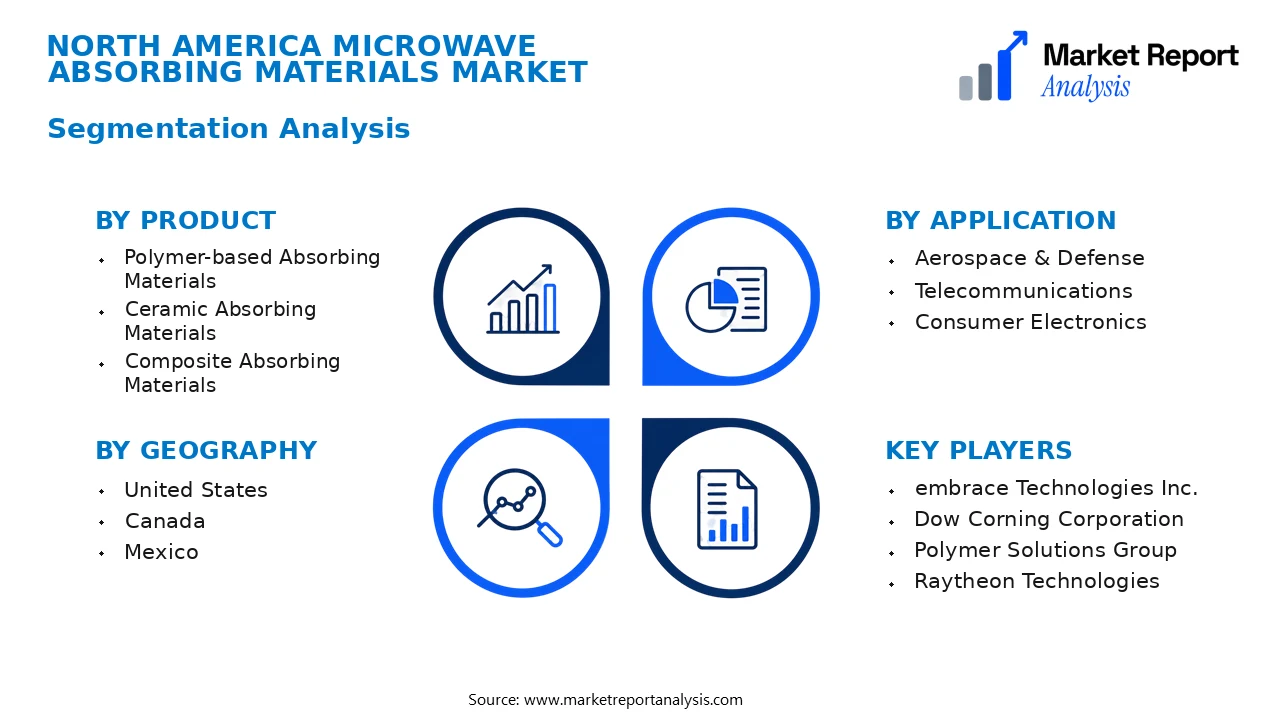
- Product
- Polymer-based Absorbing Materials: These materials are popular due to their lightweight and tunable electromagnetic properties, making them ideal for use in aerospace, military, and consumer electronics sectors where versatile performance is critical.
- Ceramic Absorbing Materials: Known for their high temperature resistance and stability, ceramic absorbers are primarily used in defense applications, such as radar stealth technology and military-grade antenna systems, driving demand for high-performance solutions.
- Composite Absorbing Materials: Combining properties of polymers and ceramics, composites are increasingly employed in commercial and military applications, offering enhanced durability, flexibility, and broad frequency absorption capabilities.
- Application
- Aerospace & Defense: This segment is a primary driver, utilizing microwave absorbing materials for stealth technology, electromagnetic interference shielding, and radar signature reduction, thus making it a key focus for market growth.
- Telecommunications: The expanding 5G infrastructure in North America fuels demand for absorption materials in antenna design, electromagnetic compatibility, and preventing signal interference, critical for network reliability and system performance.
- Consumer Electronics: Growing adoption of microwave-absorbing materials in smartphones, tablets, and wearable devices enhances electromagnetic compatibility, promoting product miniaturization and improved user experience.
- Geography
- United States: The largest market within North America, driven by extensive military modernization programs, aerospace innovation, and a mature electronics sector, with ongoing R&D investments fueling future growth.
- Canada: A significant market owing to its defense expenditure, aerospace sector, and emerging research institutions focused on electromagnetic interference mitigation and advanced material development.
- Mexico: Rapid industrialization, expanding manufacturing base, and the rise of telecommunications infrastructure contribute to increasing demand for microwave absorbing materials in this region.
Competitive Intelligence
The North America Microwave Absorbing Materials Market is characterized by moderate competition with key players including Smiths Detection, Henkel Adhesives, and 3M holding significant shares. Market concentration remains relatively balanced, with the top five companies accounting for approximately 55% of the market, fostering a dynamic environment of innovation and strategic partnerships. Leading firms pursue aggressive product innovation, focusing on enhancing electromagnetic interference (EMI) shielding effectiveness and thermal stability to meet evolving aerospace, defense, and telecommunications demands. Partnerships and strategic alliances are prevalent, enabling companies to leverage complementary expertise and expand regional footprints, especially into emerging markets within North America. Several firms have pursued acquisitions to strengthen their technological portfolios; for instance, recent buyouts of nanomaterial specialists aim to accelerate R&D capabilities. Companies are investing heavily in R&D, with expenditure rising by an estimated 8-10% annually, to develop differentiated products that offer superior absorption performance and environmental resilience. Competitive differentiation hinges on technological innovation, customized solutions, and strategic collaborations, positioning firms to capture growth driven by increased defense and aerospace investments in North America.
Leading Company Profiles
The competitive landscape of the North America microwave absorbing materials market features several well-established players that emphasize innovative product development, strategic alliances, and capacity expansions to maintain and grow their market share.
- embrace Technologies Inc.
- Dow Corning Corporation
- Polymer Solutions Group
- Raytheon Technologies
- Laird Technologies
- Cuming Microwave Sheet LLC
- Munich Electronic Technology GmbH
- American Technical Ceramics Corporation
- Vesuvio Technologies
- Huntsman Corporation
embrace Technologies Inc.
embrace Technologies Inc. specializes in high-performance microwave absorbing materials and composites aimed at aerospace and defense sectors, driven by innovation in nanomaterial integration and customized solutions for electromagnetic interference (EMI) shielding.
Dow Corning Corporation
Dow Corning excels in silicone-based microwave absorbing materials, providing robust, flexible solutions with high thermal stability; its strategic focus is on expanding its portfolio with environmentally sustainable and lightweight materials.
Polymer Solutions Group
Polymer Solutions Group offers advanced composite materials, including RF and microwave absorbers, focusing heavily on aerospace and military applications, with recent R&D efforts directed towards enhancing material durability and absorption efficiency.
Raytheon Technologies
Raytheon, a key defense contractor, develops cutting-edge microwave absorbing coatings for stealth technology and electronic warfare, prioritizing innovations in material science and integration with next-generation defense systems.
Laird Technologies
Laird Technologies supplies broad electromagnetic compatibility (EMC) and EMI shielding solutions, leveraging proprietary conductive materials, with ongoing investments in expanding manufacturing capacity across North America.
Cuming Microwave Sheet LLC
Cuming Microwave Sheet is renowned for its customizable microwave absorbing sheets and liners, serving aerospace, defense, and commercial markets, with recent technological advancements focused on broadening frequency coverage.
Munich Electronic Technology GmbH
Though headquartered in Germany, Munich Electronic Technology has a significant North American presence, offering specialized RF absorbing panels and coatings that target frequency-specific applications in telecommunications and defense sectors.
American Technical Ceramics Corporation
American Technical Ceramics develops ceramic-based microwave absorbers known for their high temperature and power handling capabilities, catering primarily to industrial and aerospace markets in North America.
Vesuvio Technologies
Vesuvio Technologies emphasizes environmentally friendly, lightweight microwave absorbing materials designed for mobile and military applications, with strategic focus on digital integration and innovative material formulations.
Huntsman Corporation
Huntsman’s portfolio includes advanced polymeric microwave absorbing materials with enhanced durability, aiming at industrial, consumer electronics, and defense markets, with recent initiatives oriented towards sustainability and eco-friendly products.
Strategic Business Developments

- February 2026 – embrace Technologies Inc. – Launched new nanomaterial-enhanced microwave absorbers – Strengthening product portfolio and addressing high-frequency market demands.
- April 2026 – Dow Corning Corporation – Announced expansion of silicone-based material manufacturing capacity – Supporting growing aerospace and defense demands in North America.
- June 2026 – Polymer Solutions Group – Formed strategic alliance with a leading aerospace OEM – Facilitating development of next-generation microwave absorbing composites.
- August 2026 – Raytheon Technologies – Invested in new R&D facility for stealth coating technologies – Enhancing competitive edge in electromagnetic spectrum management.
- October 2026 – Laird Technologies – Acquired a smaller provider of EMI shielding films – Expanding their technological capabilities and market presence on the continent.
Frequently Asked Questions
What is the North America Microwave Absorbing Materials Market?
The North America Microwave Absorbing Materials Market encompasses the industry focused on producing and supplying materials capable of absorbing microwave frequencies to reduce interference and signal reflection for military, telecommunications, and consumer electronics applications within North America.
What is the current market size of North America Microwave Absorbing Materials Market?
As of 2026, the market is valued at approximately USD 2.1 Billion, reflecting steady growth driven by increasing demand for advanced electromagnetic interference shielding and stealth technology in aerospace, defense, and telecommunications sectors across North America.
What factors are driving the North America Microwave Absorbing Materials Market?
Key factors include the rising deployment of 5G networks, advancements in defense technology, increasing concerns over electromagnetic interference, and innovations in smart electronics, all contributing to heightened demand for efficient microwave absorbing materials in various industries.
Which region dominates the North America Microwave Absorbing Materials Market?
The United States leads the North America Microwave Absorbing Materials Market owing to its extensive aerospace and defense sector, high investment in research and development, and a larger number of manufacturers and technology adopters compared to Canada and Mexico.
Which segment is expected to grow the fastest?
The composite-based microwave absorbing materials segment is projected to experience the highest CAGR from 2026 to 2034, driven by their superior performance, lightweight nature, and ease of integration into aerospace and military applications.
Who are the leading companies operating in the North America Microwave Absorbing Materials Market?
Major players include Rogers Corporation, Harris Corporation, duPont, and Laird Technologies, which focus on innovative material formulations and strategic collaborations to strengthen their market presence and meet rising regional demands.
Analyst Perspective
The North America Microwave Absorbing Materials Market is poised for sustained growth through 2034, driven by ongoing advancements in radar and communication systems, as well as increasing defense and aerospace investments. Although the market exhibits signs of maturity, innovative material formulations and multifunctional composites promise to unlock new commercial opportunities, particularly in high-frequency and broadband applications. Long-term technological evolution is expected to focus on enhancing absorption efficiency while maintaining lightweight and cost-effective profiles, thus expanding the market’s applicability across diverse sectors. Investment priorities should emphasize R&D to develop environmentally friendly, high-performance materials, alongside strategic collaborations with OEMs and defense contractors. Competitive intensity is high, with key players pushing for technological differentiation and market share expansion. Regional growth potential remains substantial, especially in emerging defense and civil aviation segments. Overall, firms that prioritize innovation, sustain strategic regional positioning, and adapt swiftly to evolving tech demands will be best positioned to capitalize on future market opportunities.
