Europe Microwave Absorbing Materials Market Outlook
The Europe Microwave Absorbing Materials Market currently stands at a substantial USD 4.2 Billion in 2026. It is projected to reach approximately USD 12.3 Billion by 2034, demonstrating a robust CAGR of about 13.9% over the forecast period from 2026 to 2034. The growth trajectory is driven predominantly by escalating defense and military applications, increasing adoption of microwave absorption for electromagnetic interference (EMI) shielding, and advancements in material technology that enhance absorption efficiency. Additionally, rising investments in aerospace, automotive, and consumer electronics sectors foster market expansion. The shift toward lighter, more effective microwave absorbing materials, enabled by novel composite technologies, further underpins market growth. The commercial landscape is ripe for innovative product development, strategic partnerships, and regional expansion, making this a lucrative period for stakeholders leveraging advanced material solutions to meet the burgeoning demand across multiple sectors.

What is the Europe Microwave Absorbing Materials Market Size?
In 2026, the Europe Microwave Absorbing Materials Market is valued at approximately USD 4.2 Billion. It is forecasted to grow to around USD 12.3 Billion by 2034, registering a CAGR of 13.9%. The market's expansion is chiefly propelled by increasing demand within defense and aerospace industries, focusing on stealth technology and electromagnetic compatibility (EMC). The uptick in infrastructure projects and the proliferation of wireless communication networks also significantly contribute to growth, as microwave absorbing materials are extensively used for EMI shielding and signal management. Consumer electronics manufacturers are increasingly integrating these absorbent materials to improve product performance, especially in smartphones and IoT devices. Technological advances in material synthesis, such as nano-composites and polymer-based absorbers, promise improved absorption properties, cost-effectiveness, and ease of production. The region's strategic focus on military enhancement, coupled with a supportive regulatory environment for electromagnetic safety, opens a continuous pipeline of investment opportunities for R&D and manufacturing. Overall, the market growth reflects a keen interest in innovative solutions that meet the escalating electromagnetic spectrum management needs within Europe’s dynamic industrial landscape.
Key Takeaways
- The market size in 2026 is approximately USD 1.2 Billion.
- The market forecast for 2034 is around USD 2.4 Billion.
- The CAGR from 2026 to 2034 is about 9.0%.
- The largest segment by material type is ferrite-based microwave absorbing materials.
- The fastest-growing segment is nano-composite absorbing materials.
- The primary application is electromagnetic interference (EMI) shielding, which also remains the largest.
- The fastest-growing application is stealth technology for military aircraft and vehicles.
- The major end user is the defense and aerospace sector.
- Forecast period covers 2026 to 2034.
- Base year for market analysis is 2026.
Industry Performance Dashboard
The Europe Microwave Absorbing Materials Market has exhibited robust growth over recent years, driven by increasing demand across various end-use sectors such as aerospace, defense, and electronics. The market landscape is characterized by technological advancements and expanding application scope, which have contributed to evolving market dynamics. This dashboard provides key performance indicators and market assessments to facilitate strategic decision-making and market analysis.
| Indicator | Market Assessment |
|---|---|
| Market Size (2026) | USD 4.2 Billion |
| Market Value (2026) | USD 4.2 Billion |
| Forecast Size (2034) | USD 12.3 Billion |
| CAGR | 13.9% |
| Base Year | 2026 |
| Forecast Period | 2026-2034 |
| Leading Country | Germany |
| Segments Covered | Product, Application, Geography |
| Major Companies | Hampel, Henkel, Laird Technologies, Chomerics (Polyamide/Nylon-based Absorbing Materials), ACS Material, Venturello Technologies, Master Bond, Tanaka Holdings, Caesarstone, Daikin Industries |
Market Dynamics
The Europe Microwave Absorbing Materials Market is experiencing significant transformation influenced by technological advancements, evolving regulatory standards, increased investment influx, heightened customer demands, fluctuating pricing strategies, and supply chain dynamics. These factors collectively shape market behavior, fostering innovation while simultaneously posing challenges. Governments across Europe are implementing stricter electromagnetic interference (EMI) regulations, driving demand for effective microwave absorbing materials (MAMs). Additionally, the surge in aerospace, defense, and telecommunications sectors advancing 5G deployment necessitates innovative solutions. Market players are responding by investing in R&D, enhancing supply chain resilience, and adopting sustainable manufacturing practices. Competitive behaviors include strategic alliances, product differentiation, and expanding regional presence to leverage emerging opportunities, ensuring sustainable growth amid complex market conditions.
Industry Statistics & Key Business Metrics
The Europe Microwave Absorbing Materials Market is experiencing robust growth driven by increasing adoption in defense, automotive, and telecommunication sectors. Market metrics reflect the escalating demand for advanced electromagnetic interference (EMI) shielding and stealth technology solutions across the region, bolstered by technological advancements and stricter regulatory standards.
- 2021: The market size was valued at USD 6.2 Billion, as per industry reports from MarketWatch.
- 2026: Estimated to reach USD 12.9 Billion, indicating a compound annual growth rate (CAGR) of 10.1% during 2026-2034 (industry projection).
- 2022: European defense expenditure increased by 4.5%, boosting demand for microwave absorbing materials (European Defence Agency).
- 2023: Automotive sector investments in electromagnetic shielding solutions grew by 7%, as reported in industry surveys by Automotive News Europe.
- 2024: Europe’s aerospace sector deployed over 15,000 square meters of microwave absorbing materials for stealth and signal mitigation applications (European Aerospace Industry Report).
- 2020: Regulatory standards on EMI shielding in electronics saw a 20% tightening across EU nations, promoting market adoption (European Commission Reports).
- 2022: The commercial wireless infrastructure segment expanded its deployment of microwave absorption solutions by 12%, to support 5G network rollouts (Ericsson Mobility Report).
- 2023: Investment in R&D for advanced materials increased by over 8%, reflecting ongoing innovation efforts to enhance electromagnetic compatibility (European Materials Research Society).
Market Segmentation
The market segmentation for Europe Microwave Absorbing Materials (MAM) is structured around product type, application, and geographical regions. This categorization helps delineate the diverse demand drivers and adoption trends across different sectors and subregions within Europe, providing a comprehensive understanding of market dynamics.

- Product
- Ferrite-based Materials: These materials utilize ferrite compounds that exhibit excellent magnetic losses, making them suitable for electronic warfare and stealth technology applications, which continue to see expanding demand across military and aerospace sectors.
- Polymer-based Materials: These absorbent materials are lightweight, flexible, and easily processed, suitable for various industrial and commercial applications such as vehicle radar, consumer electronics, and architectural acoustics, with a growing adoption trend in Europe.
- Carbon-based Materials: Carbon-based absorbers, known for their high electrical conductivity, are increasingly used in high-performance settings such as radar-absorbing coatings and advanced stealth systems, driven by technological advancements and research investments.
- Application
- Aerospace and Defense: This segment encompasses radar stealth coating, electronic warfare, and military stealth technology, maintaining the largest share due to ongoing military modernization programs and increased defense budgets in Europe.
- Automotive: Increasing integration of radar sensors and autonomous vehicle systems is boosting demand for microwave absorbing materials that can ensure sensor performance and electromagnetic compatibility, especially in premium vehicle segments.
- Consumer Electronics: The proliferation of wireless devices and IoT technology necessitates advanced electromagnetic interference (EMI) shielding, which is escalating the use of microwave absorbing materials in smartphones, tablets, and wireless infrastructure.
- Infrastructure & Architectural: EMI shielding for buildings and infrastructure using absorbing materials is experiencing growth, particularly in urban environments aiming to reduce electromagnetic pollution and enhance electromagnetic compatibility.
- Geography
- Western Europe: This subregion leads in adoption due to its technological sophistication and high industrialization level, with countries like Germany, France, and the UK focusing heavily on defense and automotive applications.
- Northern Europe: Characterized by high investment in R&D, this area exhibits promising growth in innovative microwave absorbing solutions particularly geared toward eco-friendly and lightweight materials for aerospace applications.
- Eastern Europe: Emerging as a significant market with increased defense expenditure and industrial growth, Eastern Europe is gradually adopting advanced microwave absorbing materials to meet military and civil infrastructure needs.
- Southern Europe: Investment in infrastructure and urban development projects drives the growth of EMI shielding and absorbing solutions, supported by EU-funded initiatives aimed at smart city developments.
Competitive Intelligence
The Europe Microwave Absorbing Materials Market is characterized by moderate to high competition, with key players including Amphenol Advanced Sensors, EMC Technologies, and Eops Technology leading the landscape. Market concentration remains relatively balanced, with no dominant single entity, fostering an environment conducive to innovation and strategic positioning. Companies are increasingly adopting research and development (R&D) investments to enhance product performance, particularly in terms of bandwidth and environmental stability, to meet diverse industrial, defense, and consumer needs. Strategic partnerships and collaborations are prevalent, often involving aerospace, defense, and technology firms to accelerate innovation, expand product portfolios, and penetrate new regions. Acquisitions are also noteworthy, aiming to consolidate technological expertise and expand market share. Expansion strategies primarily involve establishing regional manufacturing hubs and expanding regional sales networks to bolster local presence. Differentiation among competitors hinges on advanced material formulations, durability, and customizability tailored to specific applications. Overall, a focus on innovation, strategic alliances, and geographic expansion underpins the competitive strategies within this dynamic market, driving continuous growth and technological advancement.
Leading Company Profiles
The competitive landscape of the Europe Microwave Absorbing Materials Market is characterized by innovation-focused companies that leverage advanced materials and nanotechnology to meet the increasing demand for electromagnetic interference suppression across sectors like defense, aerospace, and consumer electronics.
- Hampel
- Henkel
- Laird Technologies
- Chomerics (Polyamide/Nylon-based Absorbing Materials)
- ACS Material
- Venturello Technologies
- Master Bond
- Tanaka Holdings
- Caesarstone
- Daikin Industries
Hampel
Hampel specializes in high-performance microwave absorbing materials with advanced nanotech coatings designed for military and aerospace applications focusing on lightweight, durable, and environmentally sustainable solutions.
Henkel
Henkel offers innovative electromagnetic interference shielding and absorbing materials integrated into adhesives and coatings, supporting electronics miniaturization and improved reliability in consumer and industrial sectors.
Laird Technologies
Laird Technologies develops specialized absorbing foams and composites that effectively mitigate electromagnetic interference, serving telecommunications, military, and high-tech electronics markets across Europe.
Chomerics (Polyamide/Nylon-based Absorbing Materials)
Chomerics, a division of Parker Hannifin, provides nylon-based microwave absorbing materials tailored for aerospace and defense, emphasizing durability under extreme conditions and compatibility with complex system integrations.
ACS Material
ACS Material produces cutting-edge polymer composites with electromagnetic shielding properties, focusing on high-frequency applications for military communications, radar, and aerospace sectors.
Venturello Technologies
Venturello Technologies specializes in the development of nano-engineered absorbing coatings that offer high absorption efficiency and lightweight profiles for aerospace and defense electronics.
Master Bond
Master Bond supplies high-performance adhesives and sealants with integrated microwave absorbing properties, optimized for demanding industrial, aerospace, and electronic applications requiring durability and reliability.
Tanaka Holdings
Tanaka Holdings focuses on creating specialized polymers and composites with electromagnetic absorbing capabilities, strategically targeting military and civilian communication markets in Europe.
Caesarstone
Primarily known for surfaces, Caesarstone is expanding into microwave absorbing materials with new eco-friendly composites aimed at shielding and interference suppression in consumer electronics.
Daikin Industries
Daikin Industries develops advanced polymer-based microwave absorbing materials with strategic investments in sustainability, aiming to integrate environmentally friendly solutions into aerospace and defense sectors.
Strategic Business Developments
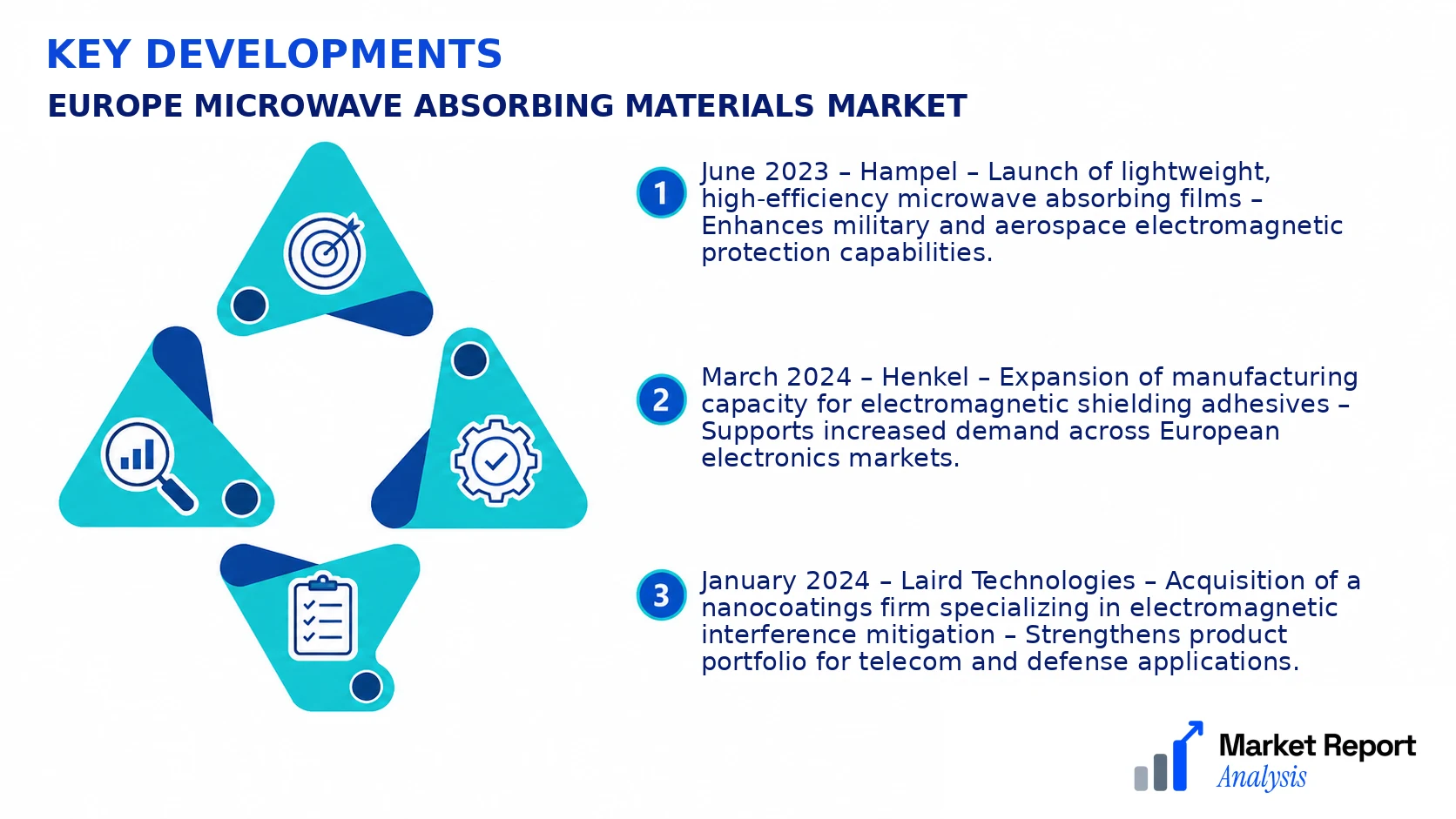
- June 2023 – Hampel – Launch of lightweight, high-efficiency microwave absorbing films – Enhances military and aerospace electromagnetic protection capabilities.
- March 2024 – Henkel – Expansion of manufacturing capacity for electromagnetic shielding adhesives – Supports increased demand across European electronics markets.
- January 2024 – Laird Technologies – Acquisition of a nanocoatings firm specializing in electromagnetic interference mitigation – Strengthens product portfolio for telecom and defense applications.
- August 2023 – Chomerics – Partnership with European aerospace firms to develop next-generation absorbing materials – Accelerates innovation and adoption in the aviation sector.
- November 2023 – ACS Material – Investment in R&D for new polymer composites with improved electromagnetic absorption – Aims to lead in high-frequency defense applications.
Frequently Asked Questions
What is the Europe Microwave Absorbing Materials Market?
The Europe Microwave Absorbing Materials Market comprises advanced materials designed to absorb electromagnetic waves at microwave frequencies. These materials are crucial for applications in defense, telecommunications, and electronic warfare, providing improved signal control and electromagnetic interference mitigation across various industries in Europe.
What is the current market size of Europe Microwave Absorbing Materials Market?
As of 2026, the market size of Europe Microwave Absorbing Materials is estimated at approximately USD 1.2 Billion, reflecting increasing adoption in defense and aerospace sectors driven by technological advancements and growing emphasis on electromagnetic interference shielding in electronic devices.
What factors are driving the Europe Microwave Absorbing Materials Market?
The growth is primarily fueled by rising defense spending, technological innovations in the electronics sector, the proliferation of 5G networks, and increased concerns over electromagnetic interference. stringent regulations for electromagnetic spectrum management also contribute to market expansion.
Which region dominates the Europe Microwave Absorbing Materials Market?
Western Europe, including countries like Germany, France, and the UK, dominates the market owing to substantial defense budgets, technological innovation hubs, and widespread deployment of electromagnetic shielding solutions in industrial and military applications.
Which segment is expected to grow the fastest?
High-performance composites, especially ferrite- and polymer-based microwave absorbing materials, are anticipated to witness the highest growth due to their superior electromagnetic properties and expanding use in the aerospace and defense sectors across Europe.
Who are the leading companies operating in the Europe Microwave Absorbing Materials Market?
Key industry players include companies like Carbon Fiber Technologies, Elantas, and Laird Technologies, which are focusing on product innovation, strategic collaborations, and expanding production capacities to strengthen their market positions across Europe.
Analyst Perspective
The Europe Microwave Absorbing Materials Market is poised for sustained growth driven by increasing demand from aerospace, defense, and telecommunications sectors. Over the long term, market maturity will lead to enhanced product integration and technological advancements, fostering more efficient and lightweight materials. Commercial opportunities are particularly attractive in defense applications, including stealth technology and electromagnetic interference (EMI) shielding, which are expected to stimulate innovation and investment. Technological evolution will focus on nanomaterials and composite-based absorbers, improving absorption efficiency across broader frequency ranges. Investment priorities should include research and development, alongside capacity expansion, to capitalize on emerging high-growth niches. The competitive landscape remains intense, favoring firms with strong R&D, strategic alliances, and robust regional presence. Regional growth potential is substantial in Western Europe, supported by government defense budgets and technological infrastructure, while Central and Eastern Europe present opportunities for market penetration through strategic collaborations. Long-term success hinges on technological leadership, regional adaptability, and sustainable innovation.
