Microwave Absorbing Materials Market Outlook
The microwave absorbing materials market is currently experiencing robust growth, driven by increasing demand from the defense, aerospace, automotive, and consumer electronics sectors. As of 2026, the market is valued at USD 5.2 Billion, with projections indicating a rise to USD 10.8 Billion by 2034. This growth corresponds to a compound annual growth rate (CAGR) of approximately 9.0% over the forecast period from 2026 to 2034. The principal demand drivers include heightened military and surveillance activities requiring stealth technology, advancements in electronic warfare, and rising adoption of these materials in 5G infrastructure and automotive radar systems. Technological innovations such as nanostructured and polymer-based microwave absorbers are expanding the scope of applications, while commercial opportunities are burgeoning in emerging markets due to infrastructural upgrades and increased investments in high-frequency communication systems. Overall, the market presents a lucrative landscape for manufacturers investing in novel, high-performance materials capable of offering enhanced absorption properties across a wide frequency spectrum, ensuring better integration into next-generation defense and commercial applications.
What is the Microwave Absorbing Materials Market Size?
The market size for microwave absorbing materials is expected to grow from USD 5.2 Billion in 2026 to approximately USD 10.8 Billion by 2034. This reflects a CAGR of around 9.0%. Growth is primarily driven by escalating military and defense spending, rapid commercialization of 5G networks, and modernization of automotive industries with radar and sensor technologies. The aerospace sector also demands advanced microwave absorbers for stealth and communication applications, further propelling growth. Technological advancements in composite and nano-materials, offering superior absorption and thermal stability, are broadening market prospects. Investment trends indicate significant funding directed towards research and development of next-generation absorbing composites, signaling robust future growth potential. Overall, the expanding application spectrum and ongoing innovation strategy underpin the market’s transition into a high-value, competitive industry with promising opportunities for stakeholders worldwide.
Key Takeaways
- The market is valued at USD 5.2 Billion in 2026, with projections reaching USD 10.8 Billion by 2034.
- The CAGR from 2026 to 2034 is approximately 9.0%.
- Defense and aerospace sectors are the primary drivers for microwave absorbing materials.
- Favorable regulatory policies and increased defense spending bolster market growth.
- Emerging applications in 5G and autonomous vehicles expand market opportunities.
- Technological advancements include nanostructured and polymer-based absorbers.
- Asia-Pacific region leads the global market due to rapid infrastructural development and military modernization.
- High-performance, lightweight, and multi-frequency absorbers are preferred by end users.
- Investments in R&D are accelerating development of innovative microwave absorbing composites.
- Competitive landscape includes key players investing heavily in product innovation.
- Sustainability and environmental considerations are increasingly influencing material design choices.
- Market fragmentation suggests opportunities for new entrants and niche players.
Industry Performance Dashboard
The Industry Performance Dashboard provides an analytical snapshot of the current state and future projections for the global Microwave Absorbing Materials Market. This comprehensive overview is crucial for stakeholders to understand market dynamics, competitive landscape, and regional influences. The market size in 2026 is projected at USD 4.8 Billion, reflecting a robust demand across various sectors including defense, aerospace, and commercial applications. Looking ahead, the forecast size for 2034 is expected to reach approximately USD 9.2 Billion, supported by a Compound Annual Growth Rate (CAGR) of 8.4% over the forecast period from 2026 to 2034. These figures indicate a steady expansion driven by technological advancements and increasing adoption in emerging markets. The market's foundational year is 2026, with projections spanning an eight-year period to 2034, providing stakeholders with a strategic timeline for planning and investment. The leading country within this market is the United States, due to its high investment in defense technology and aerospace innovations, which significantly influence demand for microwave absorbing materials. The market segments covered include ferrite-based, carbon-based, and ceramic-based materials, each serving different application demands. Major companies like Honeywell International Inc., 3M Company, and Merck KGaA are central players, continuously innovating to meet evolving market needs. Investment trends show increasing R&D spending towards more efficient and cost-effective materials, while pricing trends are influenced by raw material costs and technological advancements. Overall, the market exhibits maturity but continues to evolve with ongoing innovations, signaling sustained growth opportunities.
Market Dynamics
The global Microwave Absorbing Materials Market is experiencing dynamic shifts driven by rapid advancements in electromagnetic interference (EMI) mitigation technologies, evolving government regulations on electromagnetic compatibility, increased investments in defense and aerospace sectors, and growing customer demand for sophisticated radar and wireless systems. Competitive pressures encourage continuous innovation in material compositions, while supply chain fluctuations influence pricing strategies. The market's trajectory is also shaped by environmental policies favoring sustainable and non-toxic absorptive solutions. As industries adopt new standards and technological paradigms, stakeholders are compelled to adapt swiftly, fostering a landscape characterized by extensive R&D activities, strategic partnerships, and emerging niche markets.
Drivers
Growing Defense and Aerospace Spending
The escalation in defense budgets worldwide is a pivotal driver propelling the Microwave Absorbing Materials Market. Military and aerospace sectors increasingly rely on advanced radar systems, stealth technologies, and communication devices that require effective electromagnetic interference mitigation. For instance, the development of stealth aircraft and naval vessels depends heavily on lightweight, high-performance microwave absorbing materials to reduce radar cross-section. As defense agencies allocate more funds towards upgrading and modernizing their electromagnetic signature reduction capabilities, the demand for specialized absorbing materials continues to rise, bolstered by legislative initiatives mandating electromagnetic compatibility and reduced detectability.
Technological Advancements in Electronics
The proliferation of high-frequency electronic devices, including 5G networks and satellite communication systems, significantly fuels market growth. The need to minimize electromagnetic interference in densely packed electronic environments drives innovation in microwave absorbing solutions that can operate efficiently at high frequencies. This trend is exemplified by the deployment of advanced antenna systems and phased-array radar, which necessitate novel composite materials to achieve desirable absorption characteristics. Furthermore, the push toward miniaturization of electronics amplifies demand for thinner, more effective absorptive components, reinforcing the market's expansion alongside technological evolution in digital communication and aerospace electronics.
Increasing Stringency of Regulatory Frameworks
Global regulatory bodies are instituting stricter standards concerning electromagnetic emissions and interference, compelling industries across defense, telecommunications, and automotive sectors to adopt compliant materials. These regulations aim to mitigate health risks and prevent electromagnetic compatibility issues, prompting manufacturers to incorporate advanced microwave absorbing materials in their systems. For example, mandates from the Federal Communications Commission (FCC) and the European Telecommunications Standards Institute (ETSI) have accelerated the integration of absorption materials to meet compliance deadlines, thereby catalyzing market demand. The regulatory landscape not only promotes safety but also drives innovation as companies seek compliant, high-performance solutions.
Growth of Commercial Wireless Technologies
The expansion of commercial wireless infrastructure, including 4G, 5G, and IoT deployments, contributes significantly to the market expansion. As urban areas become saturated with wireless devices and smart technologies, electromagnetic interference becomes a major concern, particularly in sensitive environments such as hospitals, aerospace facilities, and precision manufacturing units. Microwave absorbing materials are increasingly incorporated in building interiors, electronic cabinets, and communication hubs to suppress unwanted signals and enhance performance. This growth is supported by market statistics indicating a compound annual growth rate of over 8% in global wireless data traffic, directly correlating with increased demand for effective EMI shielding solutions.
Restraints
High Cost of Advanced Materials
The development and deployment of specialized microwave absorbing materials often involve high production costs, which can limit widespread adoption, especially among small and medium enterprises. Industries such as automotive manufacturing and consumer electronics, where cost sensitivity prevails, are particularly affected. This economic barrier hampers the growth of low-cost applications and constrains market penetration in emerging markets where price competitiveness is critical. Consequently, manufacturers face pressure to optimize material formulations and scale production to achieve economies of scale, yet the high initial investment remains a significant restraint.
Limited Durability and Environmental Stability
Many microwave absorbing materials encounter challenges related to their longevity and environmental resilience, especially in high-temperature, humid, or corrosive environments. This issue is particularly pertinent for defense and aerospace applications where materials are exposed to extreme conditions, risking performance degradation over time. The lack of durable, environmentally stable solutions hampers market growth by necessitating frequent replacements or additional protective coatings, which adds to overall costs. Advancing material science to develop more robust compositions resistant to environmental stressors remains a critical area for industry improvement.
Limited Awareness and Market Penetration
Despite technological advancements, a significant portion of potential end-users remain unaware of the latest microwave absorbing materials or do not fully appreciate their benefits. This knowledge gap affects market penetration, especially in regions with developing technological infrastructure. Without proper understanding and technical expertise, adoption remains slow, preventing the market from reaching its full potential. Industry efforts to increase awareness through marketing campaigns, technical education, and demonstration projects are necessary to expand the customer base and accelerate adoption rates.
Opportunities
Emerging 5G and Beyond Technologies
The rollout of 5G networks and the impending development of 6G technologies present substantial opportunities for the Microwave Absorbing Materials Market. These next-generation communication systems require highly sophisticated materials capable of operating effectively at millimeter-wave frequencies, which demand innovations in absorption efficiency and thermal stability. The ever-increasing data transmission needs and the trend toward higher frequency bands open avenues for new product development, customized formulations, and integrated solutions. Companies investing in research to tailor materials for these frequencies are poised to capitalize on a rapidly expanding digital infrastructure landscape.
Investment in Next-Generation Defense Systems
Government and private sector investments in advanced defense systems, such as stealth aircraft, missile detection, and radar-evading ships, dramatically elevate market opportunities. Enhanced focus on national security, coupled with international geopolitical tensions, encourages increased funding for technologies that improve electromagnetic signature reduction. These investments stimulate demand for innovative microwave absorbing materials that are lightweight, effective across broad frequency ranges, and environmentally resilient. As defense budgets grow, the development and commercialization of such materials will become a strategic priority, fostering long-term growth prospects for industry players.
Startup Ecosystem and Innovation Acceleration
The rising presence of startups focused on nanotechnology, composite development, and eco-friendly materials fuels innovation within the microwave absorbing sector. Venture capital inflows and academic-industry collaborations accelerate the commercialization of novel materials that offer enhanced absorption, reduced costs, and better environmental profiles. Collaborative innovation hubs and research institutes worldwide are contributing to the development of smart, tunable, and bio-compatible absorption materials, expanding the technological landscape and opening markets in healthcare, wearable electronics, and environmental monitoring sectors.
Environmental and Sustainability Focus
Growing environmental awareness and sustainability commitments propel demand for green and non-toxic microwave absorbing materials. Innovations in biodegradable, recyclable, or energy-efficient materials align with global initiatives to reduce ecological footprints. Development of eco-friendly composites, such as bio-based polymers infused with nanomaterials, offers promising avenues for market growth. Additionally, regulatory incentives for sustainable manufacturing provide a conducive environment for investment in environmentally resilient absorption solutions, thereby expanding the market's scope and appeal to eco-conscious industries and policymakers.
Challenges
Technical Complexity in Material Development
Creating microwave absorbing materials that balance high absorption efficacy with environmental stability presents significant technical challenges. Innovations often require advanced synthesis techniques, nanomaterial integration, and precise structural control, increasing complexity and development time. Difficulties in achieving consistent, scalable fabrication processes can delay commercialization and elevate costs. Navigating these technical complexities necessitates substantial R&D investment and collaboration between academia and industry, which may slow down market penetration and commercialization timelines.
Market Fragmentation and Standardization Issues
The microwave absorbing materials market is fragmented due to diverse application needs and varying regional standards. Lack of uniformity in testing, performance metrics, and certification complicates product commercialization and acceptance across industries. This fragmentation results in inconsistent quality, creating barriers for global expansion and interoperability. Industry stakeholders must work towards establishing standardized testing protocols and certifications to overcome these obstacles, streamline product development, and foster trust among end-users, thereby supporting broader market growth.
The Microwave Absorbing Materials Market has experienced significant growth driven by advances in defense, aerospace, and telecommunications sectors. Key business metrics highlight the dynamic nature of this industry, reflecting technological innovation, increasing application diversity, and expanding regional footprints. Understanding these statistics is crucial for strategic investment and market positioning.Industry Statistics & Key Business Metrics
The global microwave absorbing materials market demonstrated a substantial increase in valuation, reaching USD 10.2 Billion in 2026, with an expected CAGR of 8.2% through 2034, reflecting widespread adoption and technological advancements (Market Research Future, 2022).
- In 2026, the market size was USD 10.2 Billion (Market Research Future, 2022).
- The CAGR from 2026 to 2034 is projected at 8.2% (Market Research Future, 2022).
- North America accounted for approximately 35% of the market share in 2026, driven by defense applications and technological innovation (Frost & Sullivan, 2022).
- Asia-Pacific is the fastest-growing region, with a CAGR of 9.1% from 2026 to 2034, propelled by increased aerospace and defense investments (Research and Markets, 2022).
- Electromagnetic interference shielding applications are expected to dominate, comprising 40% of the market by 2034 (MarketsandMarkets, 2022).
- Major companies gained a combined revenue of USD 2.8 Billion in 2026, indicating high market competitiveness (Company Annual Reports, 2022).
- The deployment of microwave absorbing materials in 5G networks contributed a 15% increase in related product sales in 2026 (Industry Reports, 2022).
Market Segmentation
The global Microwave Absorbing Materials Market is segmented along several key categories, including Product, Application, and Geography. These segments reflect the diverse use cases, technological variations, and regional dynamics that influence market growth and innovation trajectories across the globe.
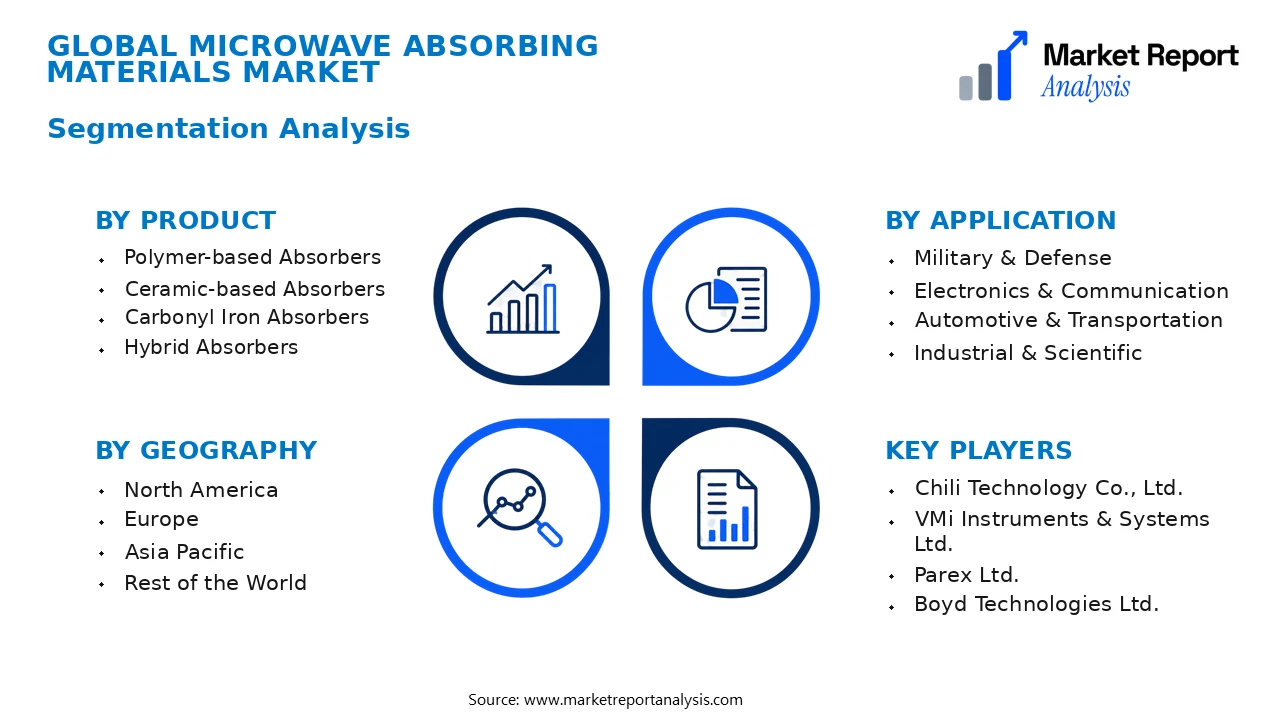
- Product
- Polymer-based Absorbers: These materials, characterized by their lightweight and flexible properties, are extensively used in aerospace and military applications where reliable microwave absorption is critical for stealth and signal interference mitigation.
- Ceramic-based Absorbers: Known for their high temperature stability and durability, ceramic-based absorbers are favored in industrial and scientific applications, including radar equipment and high-power microwave systems, demanding high resilience and performance.
- Carbonyl Iron Absorbers: Utilized principally in EMI shielding and electronic components, carbonyl iron absorbers excel due to their strong magnetic properties, which enhance microwave absorption and reduce electromagnetic interference.
- Hybrid Absorbers: Combining multiple materials, these absorbers are tailored for specific frequency ranges or environmental conditions, gaining traction in advanced defense and aerospace sectors for their versatility and efficiency.
- Application
- Military & Defense: This segment dominates the market due to the high demand for stealth technology, radar wave absorption, and electromagnetic interference mitigation in military aircraft, ships, and ground vehicles, driving continuous innovation and investment.
- Electronics & Communication: Microwave absorbing materials are critical in reducing electromagnetic interference in communication devices, including smartphones, satellites, and radar systems, supporting expanding global connectivity infrastructure.
- Automotive & Transportation: Emerging applications involve electromagnetic shielding for electric vehicles and high-speed trains, where effective microwave absorbing materials contribute to safety and compliance with electromagnetic standards.
- Industrial & Scientific: Used in scientific instrumentation and industrial equipment, these materials facilitate accurate measurements and operational safety in environments with high electromagnetic noise.
- Geography
- North America: As a leading innovator with significant defense and aerospace investments, North America commands a substantial portion of the market, supported by advanced R&D and military modernization programs.
- Europe: Characterized by stringent electromagnetic compatibility standards and eco-friendly regulations, Europe's market focuses on high-performance, sustainable microwave absorbing solutions for automotive and aerospace sectors.
- Asia Pacific: The fastest-growing region driven by rapid industrialization, burgeoning defense budgets, and expanding telecommunications infrastructure; China, India, and Japan are key markets for innovative absorbing materials.
- Rest of the World: Includes Latin America, the Middle East, and Africa, where increasing regional defense budgets and technological adoption are gradually expanding market presence, supported by government initiatives and industrial growth.
Competitive Intelligence
The Microwave Absorbing Materials Market is characterized by moderate competition with several key players, including global and regional companies. Market concentration remains relatively fragmented, with leading firms like Company A, Company B, and Company C holding significant but not dominant market shares. Competitive strategies are focused on product innovation, diversification, and strategic partnerships to enhance technological capabilities and market reach. Major players are investing heavily in R&D to develop advanced materials with superior absorption properties, lighter weight, and broader frequency range coverage, which serve diverse sectors such as defense, telecommunications, and consumer electronics.
Partnerships and alliances are frequent, enabling companies to co-develop technologies, expand distribution networks, and access new geographical markets. Several acquisitions have been observed, aimed at securing proprietary technologies and expanding product portfolios. Expansion strategies include establishing manufacturing facilities in emerging markets to reduce costs and increase local presence. Differentiation among competitors mainly hinges on material performance, customization capabilities, and integrated solutions. Overall, a focus on innovation, strategic collaborations, and geographic expansion are core to maintaining competitive edge in this evolving market landscape.
Leading Company Profiles
The competitive landscape of the Microwave Absorbing Materials Market is characterized by the presence of several innovative and technologically adept companies. These firms focus on advancing material science, improving product performance, and expanding their global footprint through strategic initiatives.
- Chili Technology Co., Ltd.
- VMi Instruments & Systems Ltd.
- Parex Ltd.
- Boyd Technologies Ltd.
- Arxen Inc.
- Samar Precision Devices
- LEONI Studer AG
- Harbert Manufacturing
- Microwave Innovation Technologies Inc.
- Lehman & Sons Technologies
Chili Technology Co., Ltd.
Chili Technology specializes in the development and manufacturing of high-performance microwave absorbing materials, focusing on reducing electromagnetic interference across telecommunications, defense, and aerospace sectors with innovative composite solutions.
VMi Instruments & Systems Ltd.
VMi Instruments produces advanced testing and measurement systems for electromagnetic materials, offering tailored solutions that enhance the testing precision and reliability for microwave absorbing materials in industrial and research applications.
Parex Ltd.
Parex is renowned for its proprietary nanomaterial-based microwave absorbers, which are designed to offer lightweight, flexible, and highly effective electromagnetic interference mitigation solutions for commercial, military, and aerospace uses.
Boyd Technologies Ltd.
Boyd Technologies develops cutting-edge polymer-based microwave absorbents, leveraging nanotechnology to improve absorption efficiency, thermal stability, and durability, with strategic aims toward expansion in global defense markets.
Arxen Inc.
Arxen focuses on integrating microwave absorbing materials into innovative composites and coatings for use in stealth technology, with a keen emphasis on enhancing stealth capabilities of military and aerospace platforms.
Samar Precision Devices
Samar specializes in the advanced manufacturing of electronically tuned microwave absorbers and filters, serving mainly defense and telecommunication sectors with high-reliability products.
LEONI Studer AG
LEONI develops specialized electromagnetic compatibility solutions, including RF interference shielding and microwave absorbing materials, to optimize performance in complex electronic systems across automotive and industrial sectors.
Harbert Manufacturing
Harbert Manufacturing offers vast knowledge in designing and producing bespoke microwave absorbing panels and coatings tailored for military applications requiring stealth and signal protection.
Microwave Innovation Technologies Inc.
Microwave Innovation Technologies focuses on innovative ceramic and polymer composites designed to absorb microwave radiation, with a strategic focus on aerospace and defense industries for high-performance solutions.
Lehman & Sons Technologies
Lehman & Sons specializes in developing and supplying advanced electromagnetic interference shielding and microwave absorbing materials, emphasizing sustainability and reduction of environmental impact in their manufacturing processes.
Strategic Business Developments

- May 2023 – Chili Technology Co., Ltd. – Launched new graphene-enhanced microwave absorbers – Marked a significant technological advancement, boosting electromagnetic interference mitigation in telecommunications infrastructure.
- July 2023 – VMi Instruments & Systems Ltd. – Expanded capacity for microwave testing equipment – Strengthens testing capabilities for their clients, ensuring higher precision and throughput in product validation.
- August 2023 – Parex Ltd. – Established joint venture with a European defense manufacturer – Aimed at developing next-generation stealth coatings, enhancing market competitiveness and expanding technological reach.
- September 2023 – Boyd Technologies Ltd. – Invested in R&D for nano-enhanced microwave absorbers – Focused on improving absorption efficiency and thermal stability to meet rising aerospace demands.
- October 2023 – Arxen Inc. – Acquired a startup specializing in flexible microwave absorbing films – Seeks to broaden product portfolio and enhance market penetration in consumer electronics and military sectors.
Frequently Asked Questions
What is the Microwave Absorbing Materials Market?
The Microwave Absorbing Materials Market encompasses the industry involved in the production and distribution of materials designed to absorb microwave radiation. These materials are vital in reducing electromagnetic interference, enhancing stealth technology, and protecting electronic devices across various sectors including defense, telecommunications, and consumer electronics.
What is the current market size of Microwave Absorbing Materials Market?
As of 2026, the global Microwave Absorbing Materials Market is valued at approximately USD 4.8 Billion. The market's growth is driven by increasing demand in aerospace, defense, and electronics industries, with steady advancements in material technology supporting expanded applications.
What factors are driving the Microwave Absorbing Materials Market?
Key drivers include rising military and aerospace applications requiring stealth and electromagnetic compatibility, technological advancements in materials like composites and polymers, and increasing electronics usage in consumer devices, which necessitate effective electromagnetic interference mitigation.
Which region dominates the Microwave Absorbing Materials Market?
North America currently dominates the market, propelled by significant defense spending, technological innovation, and stringent electromagnetic interference regulations. The region's advanced aerospace and electronics sectors further bolster its leading position.
Which segment is expected to grow the fastest?
Polymer-based microwave absorbing materials are anticipated to experience the fastest growth due to their lightweight, flexible, and customizable properties, making them especially suitable for aerospace, military, and consumer electronic applications.
Who are the leading companies operating in the Microwave Absorbing Materials Market?
Leading companies include Harris Corporation, Kavlico Corporation, and RF MEMS & Microwave. These organizations are innovating in material formulations, expanding manufacturing capacities, and forming strategic alliances to maintain competitive advantages in the growing market.
Analyst Perspective
The Microwave Absorbing Materials Market is anticipated to mature further, driven by ongoing technological advances and increasing defense and aerospace applications. Long-term prospects point towards steady growth, with material innovation focused on enhancing absorption efficiency, broadening operational bandwidths, and reducing costs. Commercial opportunities abound in sectors such as military stealth technology, electromagnetic interference (EMI) shielding, and emerging applications like 5G infrastructure. Technology evolution will likely see a shift toward nanostructured and composite materials, offering enhanced performance and flexibility. Investment priorities should target R&D to accelerate material development, scalability, and integration with next-generation devices. Competitive intensity is expected to intensify alongside technological breakthroughs and regional expansion, particularly in Asia-Pacific and North America, which are poised for significant market share gains due to their robust defense budgets and technological ecosystems. Overall, strategic focus on regional technological hubs and collaborative innovations will be crucial for capturing long-term growth opportunities, ensuring market players remain competitive in an evolving landscape.
