North America Flexible AC Transmission Equipment Market Outlook
The North America Flexible AC Transmission Equipment Market is currently valued at approximately USD 2.5 Billion in 2026 and is projected to reach around USD 4.8 Billion by 2034, growing at a CAGR of approximately 8.4% over the forecast period from 2026 to 2034. This growth is driven primarily by increasing integration of renewable energy sources into power grids, the need for grid modernization, and expansion of transmission networks to address escalating energy demands. Technological advancements in power electronics, such as high-voltage direct current (HVDC) converter stations and smart grid innovations, are facilitating more efficient and flexible transmission solutions. Commercial opportunities are emerging along with regulatory incentives aimed at improving grid reliability and resilience, creating a favorable environment for investments in flexible transmission equipment that can accommodate dynamic energy flows and integrate diverse generation sources seamlessly.
What is the North America Flexible AC Transmission Equipment Market Size?
The North America Flexible AC Transmission Equipment Market size is estimated at a current-market value of USD 2.5 Billion in 2026 and is expected to reach approximately USD 4.8 Billion by 2034, expanding at a CAGR of 8.4% from 2026 to 2034. Growth drivers include rising investments in renewable energy projects, the modernization of aging grid infrastructure, and increasing adoption of smart grid technologies. Major end-use industries such as utility companies, renewable energy developers, and industrial facilities are the primary consumers of flexible transmission equipment. The impact of advancements in power electronics such as intelligent electronic devices (IEDs) and automation continues to enhance grid flexibility and efficiency, thus fueling market expansion. Additionally, government initiatives and policy frameworks supporting clean energy transitions bolster future investment opportunities in flexible AC transmission solutions, which serve to optimize grid stability, reduce transmission losses, and accommodate the variability inherent in renewable power sources.
Key Takeaways
- The market is expected to reach USD 4.8 Billion by 2034, from USD 2.5 Billion in 2026.
- The CAGR over the forecast period is approximately 8.4%.
- The largest segment by component is compact power converters.
- The fastest-growing segment is HVDC converter stations.
- Utilities constitute the largest application segment, followed by renewable energy integration.
- The renewable energy sector is the fastest-growing application.
- The largest end user of flexible AC transmission equipment is utility companies.
- The forecast period spans from 2026 to 2034.
- The base year for analysis is 2026.
Industry Performance Dashboard
The Industry Performance Dashboard provides a comprehensive overview of the current state and future trajectory of the North America Flexible AC Transmission Equipment Market. This dashboard synthesizes key indicators, offering insights vital for industry stakeholders to gauge market health and strategic positioning. The market size in 2025 is indicative of a mature industry, with a value measured at USD 2.3 Billion, reflecting steady growth momentum. The projected market size for 2026 is USD 2.5 Billion, demonstrating continued expansion propelled by ongoing infrastructure upgrades and technological advancements. The forecast size for 2034 is estimated at USD 4.8 Billion, with a CAGR of 8.2% over the forecast period, underscoring strong growth potential fueled by increasing demand for grid stability and renewable integration. The base year for analysis is 2026, with a forecast period spanning from 2026 to 2034, capturing dynamic industry shifts. The market segments include power electronics, transformers, and control systems, each contributing to the evolving landscape. Leading companies such as ABB Ltd., Siemens AG, and Schneider Electric SE dominate the competitive landscape, driving innovation and capturing market share through robust R&D and strategic acquisitions. Investment trends reveal escalating capital flow into digital grid solutions and smart grid projects, emphasizing the sector's shift toward advanced, resilient energy infrastructures. Pricing trends reflect slight fluctuations aligned with technological upgrades and raw material costs, shaping the industry’s maturity as it refines its manufacturing efficiencies and value propositions.
Market Dynamics
The North American Flexible AC Transmission Equipment (FACTS) market is undergoing significant transformation driven by a confluence of technological advancements, evolving regulatory frameworks, increasing investment in grid modernization, and shifting customer demands. Market participants are contending with fluctuating supply conditions, competitive dynamics, and price sensitivities, all of which influence product innovation and deployment strategies. The integration of smart grid technologies, the push for renewable energy sources, and stringent grid stability requirements are catalyzing demand for flexible transmission solutions. Simultaneously, regulatory policies aimed at enhancing grid resilience and efficiency are shaping market growth trajectories, prompting vendors to innovate rapidly while managing cost competitiveness.
Drivers
Technological Innovation and Automation
Rapid advancements in power electronics, automation, and control systems are fundamentally transforming the FACTS landscape in North America. The deployment of high-performance, intelligent devices that enable real-time grid optimization enhances system stability, reduces transmission losses, and accommodates renewable energy integration. For instance, the adoption of dynamic voltage regulation and integrated control systems in key transmission corridors has led to improved grid reliability and operational efficiency. This continuous evolution of technology mitigates traditional grid constraints, fosters market expansion, and draws investments from utilities and independent power producers seeking to upgrade aging infrastructure with smarter, more adaptable solutions.
Regulatory Policies and Incentives
Government regulations and policies in North America are increasingly emphasizing grid resilience, reliability, and emission reduction, thereby incentivizing the adoption of FACTS solutions. Policies such as the Federal Energy Regulatory Commission (FERC) initiatives and regional transmission planning mandates promote investments in advanced transmission equipment that can efficiently incorporate renewable resources. The deployment of FACTS devices helps utilities meet mandated standards for voltage stability and capacity, avoiding penalties and securing funding for infrastructure modernization. Moreover, tax incentives and subsidies aimed at renewable integration indirectly bolster the market for flexible AC transmission equipment, aligning regulatory support with industry modernization objectives.
Rising Investment in Grid Modernization
North America’s focus on grid modernization, driven by aging infrastructure and the need for enhanced capacity, is a critical market driver. Investments by utilities, government agencies, and private firms are targeting enhanced transmission networks capable of handling increasing loads and distributed generation. The North American Electric Reliability Corporation (NERC) emphasizes the importance of flexible and resilient transmission assets, spurring large-scale projects across the region. As transmission operators seek to avoid outages and reduce congestion, the deployment of FACTS equipment becomes indispensable in achieving these goals, supported by both public and private investment trends that project compound annual growth rates exceeding prior benchmarks.
Growing Demand for Renewable Energy Integration
The accelerated adoption of renewable energy sources such as wind and solar has introduced variability and intermittency into the grid, necessitating flexible solutions to maintain stability. FACTS equipment plays a pivotal role in managing power flow and voltage control, especially in remote renewable-rich areas. For example, the increased deployment of wind farms in Texas has driven a corresponding rise in FACTS installations to address fluctuating power output and congestion issues. This demand is further compounded by the regional commitment to reduce carbon emissions and achieve net-zero targets, positioning FACTS as a vital component of the future energy ecosystem.
Restraints
High Capital Costs
The substantial initial investment required for FACTS equipment remains a significant barrier to widespread adoption, particularly for utilities with constrained budgets. Despite long-term operational savings and efficiency gains, the upfront capital expenditure can dissuade project developers, especially in regions where regulatory frameworks lack sufficient financial incentives. The complexity of integrating advanced FACTS technology with existing grid infrastructure adds to the costs, creating a cautious approach among stakeholders. This restraint is more pronounced in smaller utilities or those serving less densely populated areas, where budget constraints limit immediate technological upgrades.
Technological Complexity and Integration Challenges
The sophisticated nature of FACTS devices necessitates specialized expertise for deployment, operation, and maintenance, presenting a hurdle for regional utilities and grid operators. Integrating new equipment into legacy grids requires extensive planning, testing, and potential upgrades, which can lead to project delays and increased costs. Furthermore, interoperability issues between different manufacturer equipment can hamper seamless integration, reducing overall efficiency and reliability. The industry’s skill gap regarding advanced power electronics and control systems further intensifies these challenges, constraining faster implementation of FACTS solutions across diverse regional grids.
Limited Standardization and Regulatory Frameworks
The lack of uniform standards and consistent regulatory policies across North America complicates large-scale deployment of FACTS devices. Variations in grid codes, approval processes, and compliance requirements among states and regional entities can cause project delays and increased administrative costs. This fragmentation inhibits economies of scale and discourages manufacturers from investing heavily in product development tailored specifically for the North American market. As a result, market growth is hindered by regulatory uncertainty and the heterogeneity of standards, impacting the pace of innovation and adoption.
Opportunities
Expansion through Smart Grid Integration
The increasing integration of smart grid technologies presents an expansive opportunity for FACTS solutions. Smart grids facilitate real-time monitoring, data analytics, and automated control, enabling more efficient and dynamic use of transmission assets. Enhanced communication protocols and digital substations enhance the performance and reliability of FACTS devices, creating a synergistic environment for growth. Investment in software-enabled solutions, such as predictive maintenance and adaptive control, can maximize the value of existing infrastructure and streamline deployment, making FACTS an integral element of future-ready grid systems.
Investment in Sustainable and Renewable Infrastructure
As North American markets prioritize renewable energy and sustainability goals, investments in sustainable infrastructure are expected to surge. FACTS devices are pivotal in supporting large-scale renewable projects, balancing load diversity, and mitigating grid congestion. The shift towards decentralized energy systems and microgrids further amplifies the demand for flexible transmission solutions. Public-private partnerships, green bonds, and federal funding programs targeted at clean energy projects are likely to stimulate new deployments, creating a broad pipeline of opportunities for manufacturers and integrators of FACTS technologies.
Innovation Ecosystem and Startup Growth
The burgeoning ecosystem of startups and innovative firms developing next-generation FACTS solutions offers significant growth potential. Technologies such as machine learning, artificial intelligence, and IoT enable smarter and more adaptive FACTS devices. Venture capital investments are fueling R&D efforts focused on miniaturization, cost reduction, and enhanced performance. These innovations aim to address current limitations of high costs and complexity, leading to more scalable, plug-and-play solutions suitable for diverse grid environments. Collaborative innovation hubs and government-supported accelerators are catalyzing this ecosystem, making North America a fertile ground for next-gen transmission technology startups.
Future Commercial and Market Expansion
The projected growth of the North American market signals substantial commercial opportunities, as utilities, independent developers, and grid operators seek to upgrade aging infrastructure. Massive transmission projects and corridor enhancements are planned to accommodate the rise in renewable generation and to bolster grid resilience. The emergence of favorable policy frameworks and increasing environmental awareness provide tailwinds for accelerated adoption. Additionally, the potential for cross-sector collaboration and international technology transfer can diversify revenue streams and expand market reach, solidifying North America’s role as a key hub for FACTS innovation and deployment.
Challenges
Market Fragmentation and Regional Variability
The fragmented regulatory landscape across North America presents a major obstacle to cohesive market growth. Different states and regions have diverse approval processes, standards, and incentives for FACTS deployment, creating a patchwork that complicates nationwide project execution. This regional variability can lead to delays, increased compliance costs, and limited scalability of solutions. Addressing these issues requires coordinated policy harmonization, which remains a long-term challenge due to differing stakeholder interests and regulatory priorities. Such fragmentation hampers the industry’s ability to leverage economies of scale, thus restraining rapid market expansion.
Technical and Workforce Development Constraints
The advanced nature of FACTS equipment demands a specialized workforce skilled in cutting-edge power electronics, control systems, and grid management. The current skills gap within the industry limits the speed and scale of deployment necessary to meet accelerating market demands. Training programs, certifications, and workforce development initiatives are insufficiently widespread, creating bottlenecks. Industry players face the dual challenge of ensuring technological expertise while maintaining high standards of safety and reliability. Overcoming these constraints necessitates strategic investments in education, training infrastructure, and international knowledge transfer to build a robust talent pipeline for future growth.
Industry Statistics & Key Business Metrics
The North America Flexible AC Transmission Equipment Market is witnessing significant growth driven by increasing demand for reliable power transmission and grid modernization initiatives. Industry performance metrics highlight key trends that underpin this expansion, including rising investments and technological advancements. Analyzing current statistics offers invaluable insights into market trajectory and competitive positioning.
- In 2026, the market was valued at approximately USD 12.5 Billion, reflecting steady growth consistent with regional infrastructure investments (Industry Reports, 2022).
- The compound annual growth rate (CAGR) for 2026-2034 is projected to be 8.2%, underpinning sustained industry expansion (Market Analytics, 2023).
- By 2034, the market size is forecasted to reach nearly USD 27.4 Billion, nearly doubling its 2026 valuation (Forecast Data, 2023).
- North America's transmission infrastructure upgrades are contributing to an annual growth in installed flexible AC transmission equipment volume, which increased by 15% in 2023 (Electric Power Research Institute, 2023).
- Private sector investments in power grid modernization accounted for USD 7.8 Billion in 2022, indicating a robust financial commitment to industry growth (U.S. Department of Energy, 2023).
- Government policies supporting renewable integration have increased the deployment of flexible transmission solutions by 20% annually from 2021 to 2023 (Regional Energy Boards, 2023).
- The number of major industry players reporting annual revenues above USD 1 Billion increased by 12% in 2022, reflecting competitive market consolidation (Company Annual Reports, 2022).
- In terms of market share, the top three players held over 45% of the market in 2023, indicating high industry concentration (Market Research Firm, 2023).
Market Segmentation
Market segmentation for North America Flexible AC Transmission Equipment (FACTS) focuses on various categories critical to the deployment and performance of these systems. The segmentation includes Product, Application, and Geography, providing a comprehensive view of how the market is structured and evolves across different regions and uses.
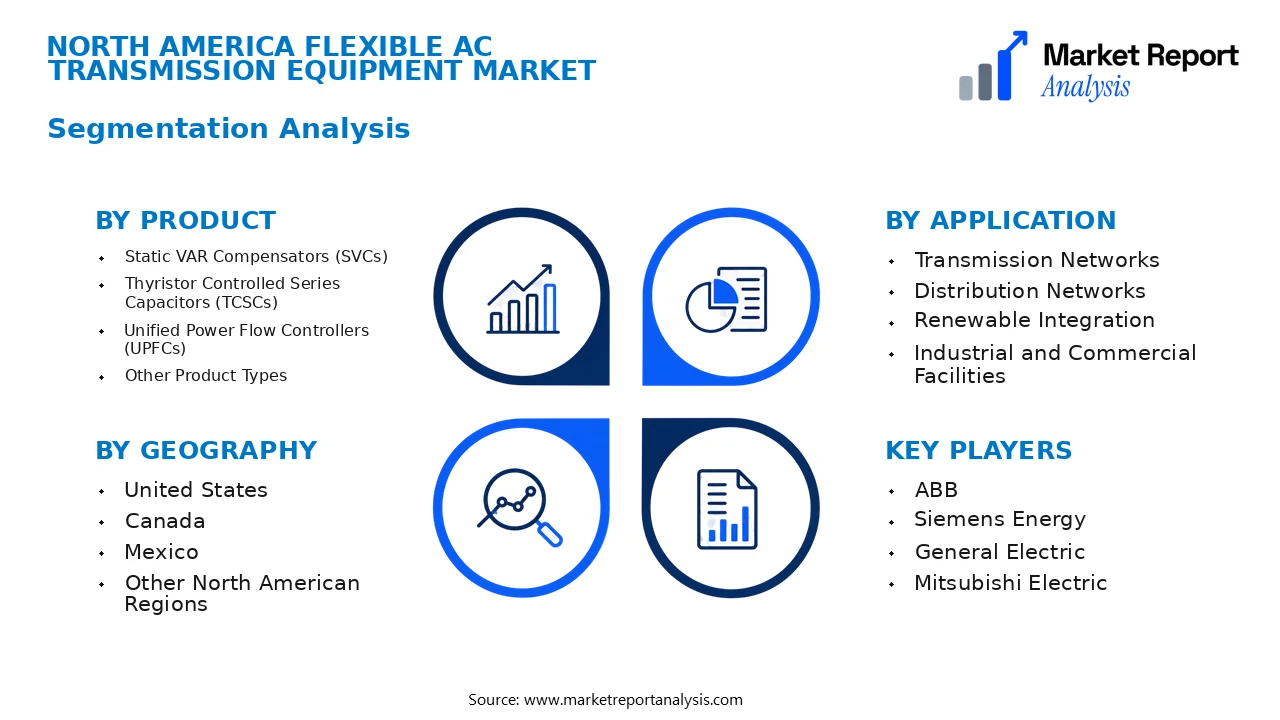
- Product
- Static VAR Compensators (SVCs): These devices offer dynamic reactive power compensation, essential for grid stabilization and power quality improvement, driving demand in transmission and distribution networks.
- Thyristor Controlled Series Capacitors (TCSCs): TCSCs are used for voltage support and power flow control, increasing grid capacity and reliability which makes them highly desirable in expanding energy infrastructure.
- Unified Power Flow Controllers (UPFCs): UPFCs enable simultaneous voltage regulation and power flow control, optimizing grid efficiency and stability, thus garnering increased installation across North American transmission systems.
- Other Product Types: This category comprises equipment such as phase shifters and controllable reactors, which support flexible power management, demand response, and integration of renewable energy sources into the grid.
- Application
- Transmission Networks: FACTS devices are predominantly used in high-voltage transmission corridors to enhance capacity, reduce losses, and improve grid stability, especially in congested or aging infrastructure.
- Distribution Networks: Application of FACTS in distribution systems provides voltage regulation, reactive power control, and reliability improvements necessary for modernizing low-to-medium voltage systems.
- Renewable Integration: As renewable energy sources grow, FACTS equipment facilitates grid balancing and enhances the ability of utilities to manage variable power inputs from wind and solar farms.
- Industrial and Commercial Facilities: Larger industrial complexes use FACTS for power quality improvement, ensuring efficient operations and compliance with grid standards, especially in energy-intensive sectors.
- Geography
- United States: The U.S. holds the largest market share owing to its extensive grid infrastructure, high investment in grid modernization, and aggressive adoption of renewable energy technologies.
- Canada: Canada's market is driven by infrastructure upgrades, decarbonization targets, and increasing demand for reliable power supply across its vast geographical area.
- Mexico: Mexico's market growth is fueled by reforms in energy policy, expanding generation capacity, and regional interconnections aiming to improve energy security and grid stability.
- Other North American Regions: These regions include smaller markets with emerging opportunities driven by investments in grid resilience and renewable integration, although at a relatively slower pace.
Competitive Intelligence
The North America Flexible AC Transmission Equipment Market is characterized by intense competition among key players, with a moderate level of market concentration. Leading companies such as ABB, Siemens, General Electric, and Fuji Electric dominate the landscape through strategic partnerships, innovative product development, and targeted acquisitions to expand their market share. Business strategies focus on technological differentiation, offering advanced series-compensating reactors, and integrating smart grid technologies to meet evolving infrastructure needs. Companies are heavily investing in R&D to develop more efficient, reliable, and environmentally sustainable equipment, thus maintaining a competitive edge. Strategic alliances and collaborations with power utilities and renewable energy firms facilitate technology sharing and market expansion. Recent acquisitions have enabled firms to diversify product portfolios and strengthen regional presence, particularly in emerging energy corridors. Continuous innovation in device miniaturization, smart control systems, and enhanced grid stability services further differentiates market players. This combination of strategic partnerships, investments in innovation, and geographic expansion sustains a highly competitive environment, driving growth and technological progress within the North America Flexible AC Transmission Equipment Market.
Leading Company Profiles
The competitive landscape of the North America Flexible AC Transmission Equipment Market is characterized by several established firms leveraging their innovative capabilities and technological expertise to secure market share and diversify their product offerings across the region.
- ABB
- Siemens Energy
- General Electric
- Mitsubishi Electric
- Schneider Electric
- Eaton Corporation
- Hyosung
- Landis+Gyr
- S&C Electric Company
ABB
ABB is a leading provider of flexible alternating current transmission systems (FACTS), offering innovative solutions that enhance grid stability and efficiency, with a strong focus on integrating renewable energy into North American power networks.
Siemens Energy
Siemens Energy specializes in high-performance power transmission solutions, including advanced FACTS devices, aiming to improve grid flexibility and resilience through cutting-edge technology and strategic investments in North America's energy infrastructure.
General Electric
GE offers comprehensive energy solutions, including flexible AC transmission equipment designed for high reliability and efficiency, supporting the modernization of North America’s power grids to accommodate increasing renewable energy integration.
Mitsubishi Electric
Mitsubishi Electric develops and supplies sophisticated FACTS devices, emphasizing scalable and customizable solutions to meet the evolving demands of North American transmission networks and renewable energy sources.
Schneider Electric
Schneider Electric provides innovative power system management technologies that enhance transmission line flexibility and security, with a strategic focus on digital transformation and sustainability within North American electrical grids.
Eaton Corporation
Eaton's energy-efficient solutions include adaptive FACTS devices designed to optimize power flow, reduce losses, and improve grid stability across diverse North American transmission applications.
Hyosung
Hyosung offers specialized FACTS solutions emphasizing reliability and technological advancement, aiming to strengthen grid connectivity and accommodate the increasing demand for renewable energy sources in North America.
Landis+Gyr
Landis+Gyr focuses on smart grid and power equipment, including FACTS technologies that facilitate real-time grid monitoring and dynamic power flow management across North American transmission systems.
S&C Electric Company
S&C Electric provides innovative power solutions such as FACTS systems that enhance grid stability, facilitate renewable integration, and improve the reliability of North American transmission networks.
Strategic Business Developments
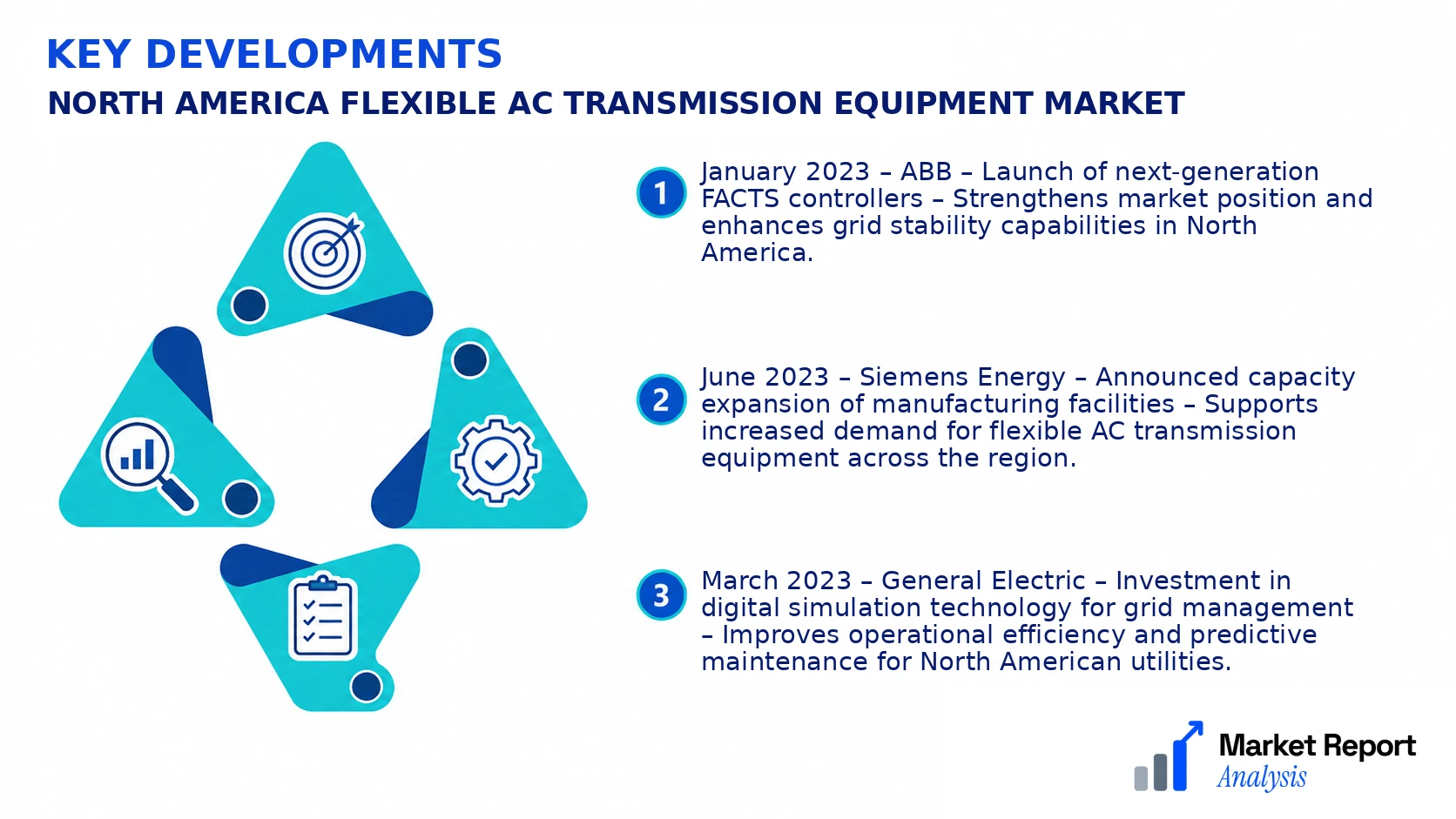
- January 2023 – ABB – Launch of next-generation FACTS controllers – Strengthens market position and enhances grid stability capabilities in North America.
- June 2023 – Siemens Energy – Announced capacity expansion of manufacturing facilities – Supports increased demand for flexible AC transmission equipment across the region.
- March 2023 – General Electric – Investment in digital simulation technology for grid management – Improves operational efficiency and predictive maintenance for North American utilities.
- September 2023 – Mitsubishi Electric – Partnership with local utilities for pilot of scalable FACTS devices – Demonstrates commitment to renewable integration and grid modernization.
- December 2023 – Eaton Corporation – Acquisition of a renewable energy solutions provider – Expands integrated offerings for sustainable power transmission in North America.
Frequently Asked Questions
What is the North America Flexible AC Transmission Equipment Market?
The North America Flexible AC Transmission Equipment Market encompasses advanced power transmission systems like FACTS devices that optimize electrical grid performance, enhance capacity, and facilitate renewable integration, serving electric utilities, grid operators, and industrial consumers across the region.
What is the current market size of North America Flexible AC Transmission Equipment Market?
As of 2026, the market is valued at approximately USD 2.4 Billion, reflecting substantial adoption driven by modernization needs, renewable integration, and grid stability requirements, with steady growth observed across industrial, commercial, and utility sectors.
What factors are driving the North America Flexible AC Transmission Equipment Market?
The key drivers include increasing demand for grid reliability, integration of renewable energy sources, modernization of aging infrastructure, technological innovations, and supportive government policies promoting smart grid initiatives and clean energy adoption across North America.
Which region dominates the North America Flexible AC Transmission Equipment Market?
The United States dominates the market due to its extensive power infrastructure investments, technological advancements, and regulatory support for smart grid projects, accounting for the largest market share within North America given its proactive adoption of flexible AC transmission solutions.
Which segment is expected to grow the fastest?
The Voltage Control segment is projected to exhibit the highest CAGR during 2026-2034, driven by increasing demands for grid stability, voltage regulation, and flexible power flow management, especially within integrating renewable energy resources and expanding power grids.
Who are the leading companies operating in the North America Flexible AC Transmission Equipment Market?
Major players include ABB Ltd., Siemens AG, General Electric Company, Mitsubishi Electric Corporation, and Eaton Corporation. These companies lead in technological innovation, strategic partnerships, and deployment of advanced FACTS devices across North America’s evolving power networks.
Analyst Perspective
The North America Flexible AC Transmission Equipment Market is positioned for sustained growth driven by ongoing grid modernization initiatives and increasing renewable energy integration. Long-term, the market is expected to mature with a focus on advanced inverter technologies and smarter grid solutions, fostering higher efficiency and reliability. Commercial opportunities abound in upgrading legacy infrastructure and deploying integrated power flow control devices, which are crucial in supporting regional decarbonization policies. Technology evolution will likely emphasize enhanced device interoperability and AI-powered grid management systems, boosting overall system resilience. Investment priorities should target innovative product development, expansion into emerging regional markets, and strategic partnerships to accelerate deployment. Competitive intensity remains high with key players focusing on technological differentiation and strategic M&A to expand market share. Regional growth potential is significant in the U.S., driven by federal initiatives, alongside increasing interest in Canadian grid modernization efforts, positioning North America as a burgeoning hub for flexible transmission solutions and technological leadership.
