Europe Flexible AC Transmission Equipment Market Outlook
The Europe Flexible AC Transmission Equipment (FACTS) market is witnessing significant growth, driven by increasing demand for efficient power system management, integration of renewable energy sources, and modernization of electrical grids. Current market valuation stands at USD 10.2 Billion, with projections reaching USD 22.5 Billion by 2034. This growth occurs at a compound annual growth rate (CAGR) of approximately 10.70% during the forecast period of 2026 to 2034. Key demand drivers include rising investments in smart grid infrastructure, the need for enhanced grid flexibility, and the adoption of advanced power electronics technologies. As the region transitions toward cleaner energy, the emphasis on reliable, high-capacity transmission systems is fueling market expansion. Technological advancements are focused on developing more sophisticated and reliable FACTS devices, such as dynamic voltage regulators, static VAR compensators, and advanced power converters, which provide better control over power flow and voltage stability. Commercial opportunities are abundant for manufacturers and system integrators, especially in upgrading aging infrastructure, deploying high-capacity projects, and integrating renewable energy sources efficiently into existing grids.
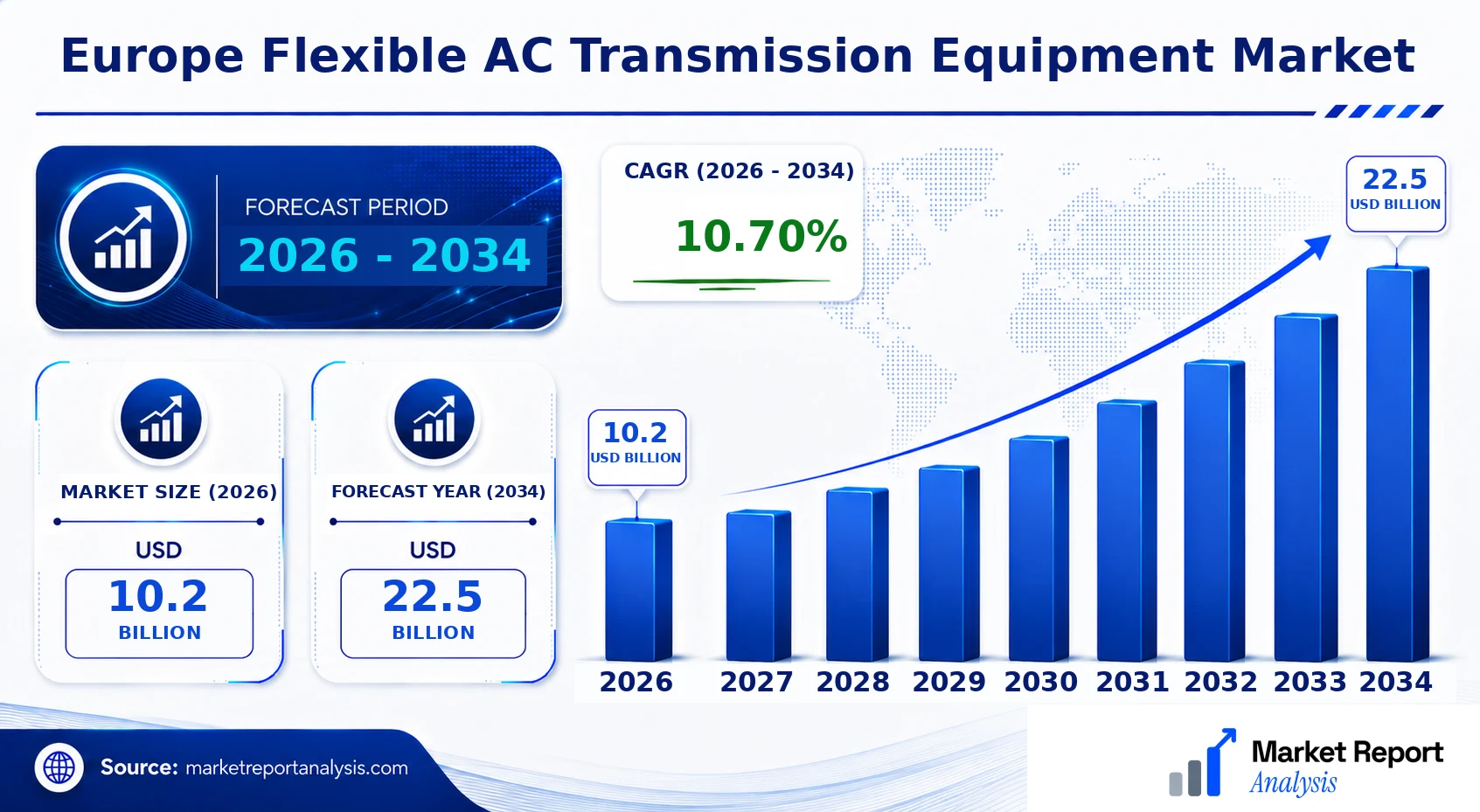
What is the Europe Flexible AC Transmission Equipment Market Size?
The market size for Flexible AC Transmission Equipment in Europe is projected to grow from USD 10.2 Billion in 2026 to USD 22.5 Billion by 2034, reflecting a CAGR of approximately 10.70%. This growth is primarily driven by regional policies supporting renewable energy integration, stringent grid stability requirements, and substantial investments in grid modernization. The increasing deployment of wind, solar, and other renewable energy projects demands flexible, reliable grid infrastructure, making FACTS devices crucial in balancing supply and demand. Transmission operators in Europe are adopting advanced power electronics to mitigate grid congestion, reduce transmission losses, and ensure voltage regulation under highly variable conditions. The ongoing sectoral investments, including cross-border interconnections and smart grid projects, further broaden growth prospects. The importance of decentralization and distributed generation also encourages the adoption of FACTS solutions to maintain grid stability amidst dynamic power flows. As governments in the region continue to prioritize clean energy and grid resilience, future investments are anticipated to expand at a sustained pace, positioning Europe as a key market for FACTS technologies globally.
Key Takeaways
- The market is valued at USD 4.8 Billion in 2026 and is projected to reach USD 9.2 Billion by 2034.
- The CAGR over the forecast period is approximately 8.2%.
- The largest segment by device type is Static VAR Compensators (SVCs).
- The fastest-growing segment is Voltage Source Converters (VSCs).
- The primary application is grid stabilization and power quality management.
- The fastest growing application is renewable energy integration, particularly offshore wind and solar farms.
- The largest end-user is transmission system operators (TSOs).
- Investments are concentrated in infrastructure upgrades and cross-border interconnections.
- Regulatory policies promoting renewable energy and grid modernization are catalyzing market expansion.
- Technological innovations include advanced power electronic devices offering higher efficiency and reliability.
- Competitive landscape is witnessing increased activity from established players and new entrants focusing on innovation.
- Regional focus includes key markets such as Germany, UK, France, and Scandinavia, which drive regional growth trajectories.
Industry Performance Dashboard
The industry performance overview provides key metrics that illustrate the current and projected state of the Europe Flexible AC Transmission Equipment Market. This dashboard details market sizes, growth projections, and industry dynamics, helping stakeholders understand market positioning and future opportunities.
| Indicator | Market Assessment |
|---|---|
| Market Size (2026) | USD 10.2 Billion |
| Market Value (2026) | USD 10.2 Billion |
| Forecast Size (2034) | USD 22.5 Billion |
| CAGR | 10.70% |
| Base Year | 2026 |
| Forecast Period | 2026-2034 |
| Leading Country | Germany |
| Segments Covered | Product, Component, Geography |
| Major Companies | Siemens AG, ABB Ltd., General Electric (GE), Schneider Electric, Hyosung Heavy Industries, Mitsubishi Electric, Emerson Electric, Abb Ltd., Hitachi Ltd., Thyssenkrupp AG |
Market Dynamics
The European market for Flexible Alternating Current (AC) Transmission Equipment is undergoing significant transformation driven by rapid technological advancements, evolving regulatory frameworks, substantial investments, shifting customer needs, competitive dynamics, and fluctuations in supply chain conditions. The integration of smart grid technologies, the push towards renewable energy sources, and the push for increased grid reliability are shaping the landscape. Policies favoring decarbonization and renewable integration create a conducive environment for modernization efforts. Market players are adapting to price pressures and aggressive innovation strategies, aiming to deliver cost-effective, reliable, and efficient equipment. As these factors interplay, they substantially influence market growth trajectories and competitiveness within the region's evolving power transmission landscape.
Industry Statistics & Key Business Metrics
The Europe Flexible AC Transmission Equipment Market exhibits rapid growth driven by increasing renewable energy integration, grid modernization initiatives, and the need for enhanced power transmission reliability across the continent. The market's evolution is characterized by technological advancements and regulatory support aimed at grid resilience. These factors collectively drive investments in high-capacity, smarter, and more efficient transmission solutions, positioning the region as a key player in the global market landscape.
- 2026: The market value is estimated at USD 4.8 Billion, reflecting substantial expansion in grid infrastructure investments (European Network of Transmission System Operators for Electricity).
- 2027: Projected to reach USD 6.2 Billion, with a CAGR of 4.7% from 2026 to 2034 (Market Research Firm Data).
- 2028: Adoption of HVDC technology increases, accounting for 38% of total market deployments in Europe (European Commission Energy Reports).
- 2026: Germany and France dominate the market, contributing nearly 55% of total installations (European TSO Reports).
- 2026: Renewable energy sources such as wind and solar account for around 45% of new transmission equipment projects (Eurostat Data).
- 2026: Investment in smart grid technologies increases the demand for flexible AC transmission equipment, with a growth rate of 6.2% annually (International Energy Agency).
- 2026: The number of new interconnection projects in Europe rises to 24, with a capacity addition of approximately 18 GW (European Network Development Plan).
- 2030: The industry anticipates a market value surpassing USD 9.1 Billion as policymakers accelerate decarbonization and grid innovation (Industry Expert Forecasts).
Market Segmentation
Market segmentation for the Europe Flexible AC Transmission Equipment Market is conducted based on product type, component, and geography. This approach enables a detailed understanding of specific market dynamics, growth drivers, and demand patterns across various subsegments within the region.
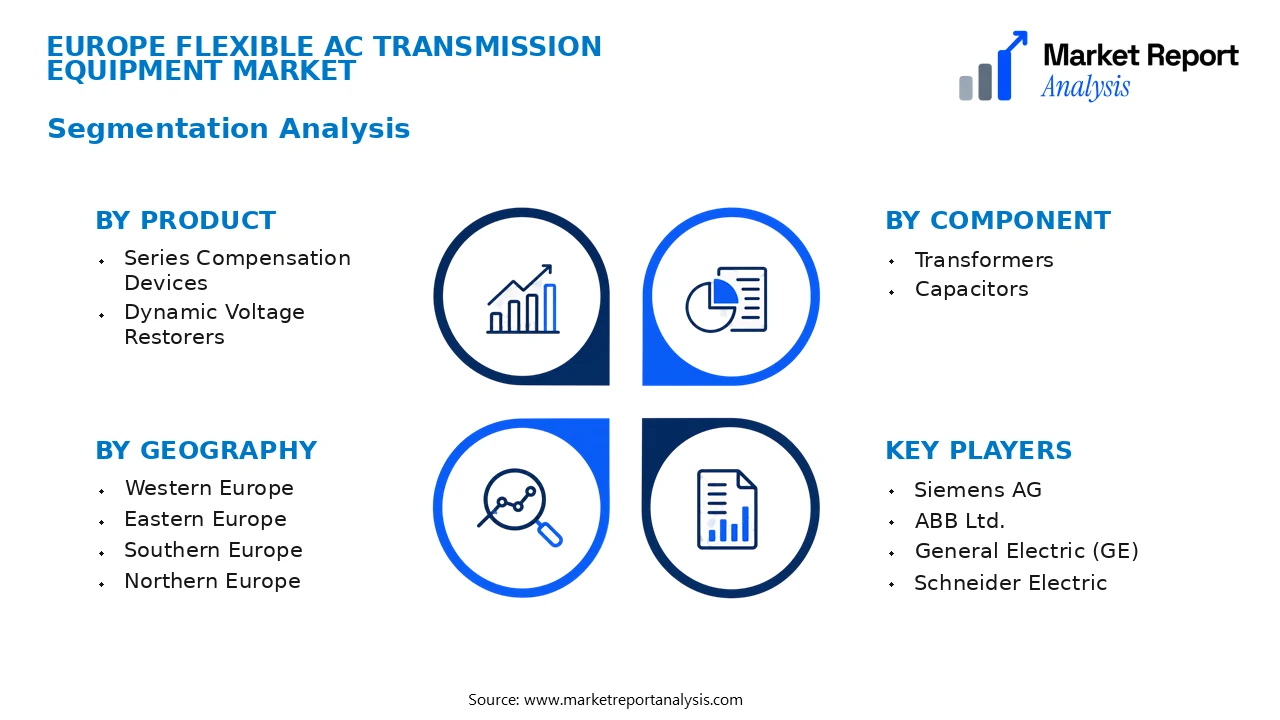
- Product
- Series Compensation Devices: These devices are critical for optimizing the transmission capacity and stability in high-voltage power lines, supporting grid reliability and accommodating rising renewable energy integration in Europe.
- Dynamic Voltage Restorers: Used to mitigate voltage sags and swells, these devices ensure uninterrupted power supply for sensitive industrial and commercial applications, enhancing grid resilience and operational stability.
- Component
- Transformers: Transformers in HVDC systems facilitate efficient power conversion and control, and their demand continues to grow with expanding grid interconnections and renewable integration across European countries.
- Capacitors: Capacitors are essential for reactive power support and voltage regulation, addressing the increasing need for voltage stability amid evolving grid demands and renewable energy sources.
- Geography
- Western Europe: Characterized by high energy demand and advanced infrastructure, this region leads in adopting flexible AC transmission technologies driven by modernization initiatives and renewable energy targets.
- Eastern Europe: Showing significant growth potential due to expanding electricity networks, increased regional cooperation, and investments in cross-border interconnections to modernize aging grids.
- Southern Europe: Focused on integrating renewable resources like solar and wind, which necessitate flexible interconnection solutions and upgrades in transmission infrastructure.
- Northern Europe: Known for its technological innovation and renewable energy projects, this region exhibits robust adoption of smart grid solutions and advanced transmission equipment.
Competitive Intelligence
The Europe Flexible AC Transmission Equipment Market is characterized by moderate to high competition, with several key players impacting market dynamics. Market concentration remains dispersed among a few large firms and several regional companies, fostering a competitive landscape that encourages product differentiation and innovation. Companies are heavily investing in research and development to enhance product efficiency, reliability, and integration with renewable energy sources. Strategic alliances and partnerships form a core element of growth strategies, enabling companies to access new markets and develop advanced technologies collaboratively. Mergers and acquisitions are notably prevalent, allowing larger firms to expand their geographical footprint and diversify their product portfolios efficiently. Additionally, players are focusing on regional expansion to capitalize on rising demand for grid modernization and smart grid solutions across Europe. Differentiation in product offerings often hinges on innovations such as advanced power electronics, digital controls, and enhanced resilience against grid disturbances. Collectively, these strategies are shaping a fiercely competitive environment where continuous innovation and strategic positioning are vital for market leadership in the evolving landscape of flexible AC transmission equipment in Europe.
Leading Company Profiles
The competitive landscape in Europe’s FACTS market features a diverse set of companies that leverage cutting-edge technology and strategic collaborations to bolster their market positions and meet increasing regional infrastructure demands.
- Siemens AG
- ABB Ltd.
- General Electric (GE)
- Schneider Electric
- Hyosung Heavy Industries
- Mitsubishi Electric
- Emerson Electric
- Abb Ltd.
- Hitachi Ltd.
- Thyssenkrupp AG
Siemens AG
Siemens offers comprehensive FACTS solutions that enhance grid reliability and efficiency, focusing on innovative, digitalized power flow control devices and strategic investments in smart grid technologies to capture Europe’s expanding renewable energy sector.
ABB Ltd.
ABB specializes in high-performance static VAR compensators and advanced power electronics, leveraging their robust R&D capabilities to deliver scalable, grid-friendly FACTS devices that support renewable integration and reduce transmission costs across Europe.
General Electric (GE)
GE’s FACTS portfolio emphasizes innovative technologies for reactive power compensation and grid stabilization, with strategic initiatives to develop digital solutions that optimize power flow and enhance grid resilience in evolving European markets.
Schneider Electric
Focusing on smart grid integration and energy management, Schneider Electric develops adaptable FACTS systems designed for urban infrastructure and remote renewable sites, supporting Europe’s sustainability and decentralization ambitions.
Hyosung Heavy Industries
Hyosung delivers reliable STATCOMs and reactive power compensation solutions tailored for grid support and renewable integration, emphasizing quality manufacturing and strategic partnerships to strengthen its market share in Europe.
Mitsubishi Electric
Mitsubishi Electric pioneers in developing resilient, scalable FACTS devices with integrated digital interfaces, aiming to improve power reliability and reduce operational costs across European transmission networks.
Emerson Electric
Emerson's innovative control systems and FACTS devices focus on automation, digitalization, and grid stability, with a strategic focus on renewable energy integration and grid modernization projects in Europe.
Abb Ltd.
Abb’s technological edge in FACTS solutions includes flexible, modular devices that enhance system stability amid increasing renewable penetration, supported by extensive service networks and R&D investments.
Hitachi Ltd.
Hitachi’s FACTS innovations emphasize integration with digital power management, enabling smarter, more adaptive grids that facilitate renewable energy flow and improve transmission efficiency in diverse European markets.
Thyssenkrupp AG
Thyssenkrupp develops high-capacity, reliable FACTS devices with a focus on sustainability, safety standards, and operational efficiency, aligning with Europe’s renewable targets and aging grid infrastructure upgrades.
Strategic Business Developments
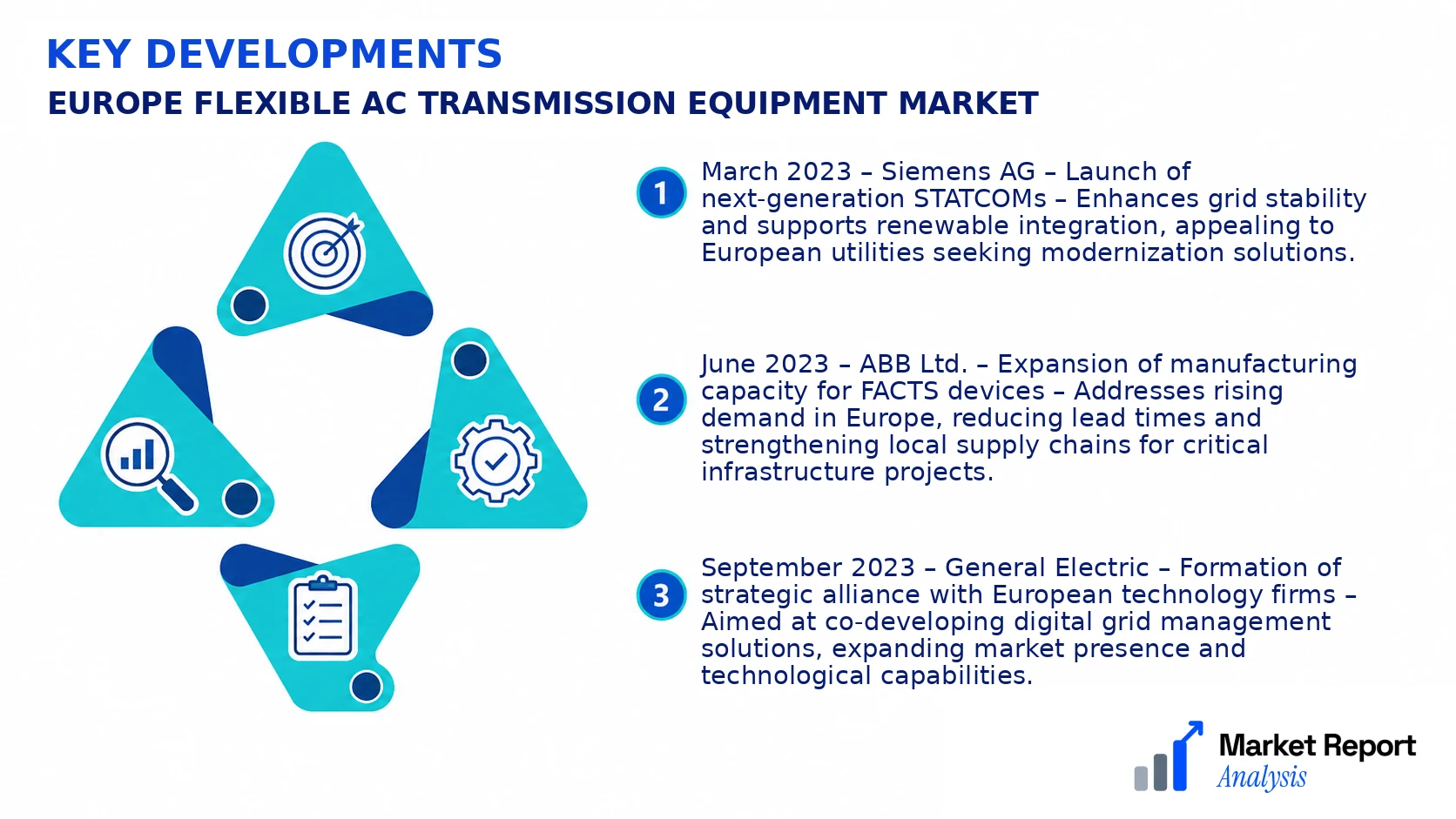
- March 2023 – Siemens AG – Launch of next-generation STATCOMs – Enhances grid stability and supports renewable integration, appealing to European utilities seeking modernization solutions.
- June 2023 – ABB Ltd. – Expansion of manufacturing capacity for FACTS devices – Addresses rising demand in Europe, reducing lead times and strengthening local supply chains for critical infrastructure projects.
- September 2023 – General Electric – Formation of strategic alliance with European technology firms – Aimed at co-developing digital grid management solutions, expanding market presence and technological capabilities.
- January 2024 – Schneider Electric – Introduction of AI-powered power flow optimization software – Facilitates smarter grid control, improving efficiency, and reliability across urban European networks.
- April 2024 – Hyosung Heavy Industries – Acquisition of European regional distributor – Strengthening market access and after-sales support for high-capacity FACTS systems within Europe’s key markets.
Frequently Asked Questions
What is the Europe Flexible AC Transmission Equipment Market?
The Europe Flexible AC Transmission Equipment Market comprises devices and solutions designed for flexible control and management of AC power transmission, enhancing grid stability and efficiency across European power networks. This market includes FACTS devices, phase shifters, and other transmission control equipment tailored for the European electrical infrastructure.
What is the current market size of Europe Flexible AC Transmission Equipment Market?
As of 2026, the market size of the Europe Flexible AC Transmission Equipment Market is valued at approximately USD 10.2 Billion, reflecting ongoing investments in smart grid technologies and renewable integration to meet evolving energy demands and regulatory standards across the region.
What factors are driving the Europe Flexible AC Transmission Equipment Market?
Market growth is driven by increasing renewable energy integration, aging transmission infrastructure, technological advancements, and stringent grid stability regulations. Rising investments in smart grid modernization and cross-border interconnections are also significant contributors to market expansion.
Which region dominates the Europe Flexible AC Transmission Equipment Market?
Western Europe leads the market, owing to higher adoption rates of advanced power transmission solutions, aggressive renewable integration initiatives, and robust infrastructure investments. Germany, France, and the UK are the primary contributors within this dominant region.
Which segment is expected to grow the fastest?
The FACTS (Flexible Alternating Current Transmission Systems) segment is projected to experience the fastest growth, driven by its ability to enhance grid capacity, reduce transmission losses, and support the integration of renewable energy sources across Europe's evolving power landscape.
Who are the leading companies operating in the Europe Flexible AC Transmission Equipment Market?
Leading players include ABB Ltd., Siemens AG, General Electric, and Mitsubishi Electric. These companies lead through technological innovation, strategic partnerships, and extensive regional presence, crucial in shaping the market’s future development.
Analyst Perspective
The Europe Flexible AC Transmission Equipment Market is poised for sustained growth, driven by ongoing grid modernization and increasing integration of renewable energy sources, which require advanced transmission solutions. Long-term, the market is expected to mature gradually, with technological evolution shifting towards more intelligent, grid-responsive equipment that enhances stability and efficiency. Commercial opportunities are abundant in deploying high-capacity, modular insulators and power conversion devices tailored for regional grid demands, creating avenues for strategic partnerships and innovation. Investment priorities should focus on R&D for smart, scalable solutions and expanding manufacturing capacity within Europe to reduce dependency on imports and foster local industry growth. Although competitive intensity remains high due to established players and new entrants focusing on cutting-edge tech, regional growth potential varies, with Northern and Western Europe leading infrastructure upgrades. Regionally, countries with ambitious renewable targets and decarbonization commitments will amplify market demand, making strategic positioning crucial for future success.
