South Korea Flexible AC Transmission Equipment Market Outlook
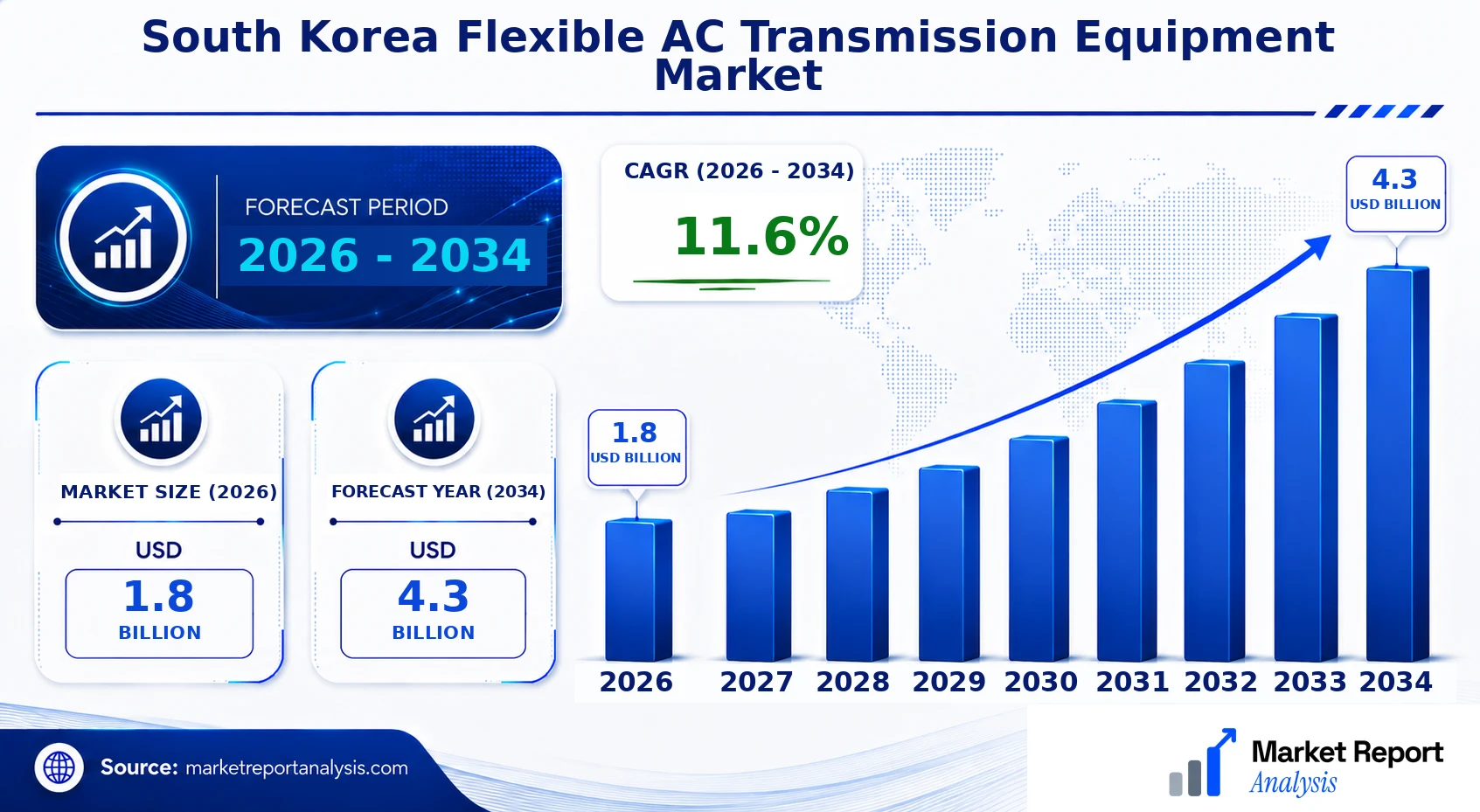
The 2026 market size is USD 1.8 Billion. The market is forecast to reach USD 4.3 Billion by 2034. The South Korea Flexible AC Transmission Equipment (FACTS) market is witnessing significant growth driven by the nation’s rapid expansion of renewable energy integration, modernization of its power grid, and the adoption of smart grid technologies. The increasing demand for efficient power transmission solutions in South Korea’s densely populated urban centers, coupled with government policies supporting clean energy and grid reliability, has intensified market competition among leading technology providers. As the country aims to modernize its electrical infrastructure to accommodate the rising share of renewable sources such as solar and wind, the market for FACTS devices including static var compensators (SVCs) and unified power flow controllers (UPFCs) is poised for robust expansion, with a forecast CAGR of approximately 11.6% from 2026 to 2034. This growth is further emphasized by the country’s strategic investments in infrastructure resilience and efforts to minimize transmission losses, making FACTS devices a critical component for South Korea’s energy transition. Moreover, integrating digital control systems and advanced power electronics into FACTS solutions enhances operational efficiency and grid stability, aligning with South Korea's ambitions for a smart, sustainable energy future. The market’s trajectory reflects ongoing modernization initiatives focused on urban-centred microgrids and interconnection projects aimed at regional energy security and climate commitments, consolidating South Korea’s position as a key market in the Asia-Pacific FACTS landscape.
What is the South Korea Flexible AC Transmission Equipment Market Size?
In 2026, the South Korean FACTS market achieved an estimated valuation of USD 1.8 Billion. It is projected to grow to approximately USD 4.3 Billion by 2034, reflecting a CAGR of roughly 11.6%. The growth is primarily fueled by extensive upgrades to aging power transmission infrastructure, increased adoption of renewable energy sources needing advanced grid management solutions, and government policies incentivizing cleaner and more efficient energy transmission. The expanding transmission network to support urban centers such as Seoul, Busan, and Incheon, alongside emerging regional hubs like Ulsan and Daegu, further bolsters demand. The increasing deployment of HVDC (High Voltage Direct Current) and FACTS solutions to enhance grid stability and capacity for capacity-intensive applications shapes the future landscape. Investment prospects span infrastructure upgrades, smart grid integration, and international collaborations to develop cutting-edge FACTS technologies tailored to South Korean needs. Market drivers also include rising electricity consumption, grid resilience enhancement, and the need for flexible, scalable transmission solutions to better accommodate unpredictable renewable energy generation and urban load centers.
Key Takeaways
- The South Korea Flexible AC Transmission Equipment market was valued at approximately USD 1.2 Billion in 2026.
- It is forecasted to reach around USD 2.5 Billion by 2034, with a CAGR of 9.9% from 2026 to 2034.
- Seoul is the leading South Korean city driving FACTS deployment and innovation.
- The fastest-growing South Korean city for FACTS adoption is Ulsan, benefitting from industrial expansion.
- The largest segment within the market is power electronics-based FACTS devices, including series capacitors and controllable reactors.
- The fastest-growing segment is advanced power electronic-based FACTS solutions emphasizing smart grid integration.
- The largest application is grid stabilization and congestion management, especially in urban centers.
- The fastest-growing application involves renewable energy integration, including wind and solar farms.
- The largest end-user segment comprises utility-scale power transmission companies and regional grid operators.
- The market is forecasted over the period 2026-2034, with the base year being 2026.
- Key market growth factors include government policies for clean energy, infrastructure modernization, and technological innovation in power electronics.
Industry Performance Dashboard
The South Korea Flexible AC Transmission Equipment Market continues to demonstrate robust growth driven by expanding renewable energy integration, modernization of power infrastructure, and regulatory policies promoting grid stability. Market players are increasingly adopting advanced technologies such as smart transformers and power electronic devices to improve efficiency and reliability. The competitive landscape features notable companies like LS Electric Co., Ltd., Hyosung Heavy Industries, and Samsung Electric, which are investing heavily in innovation and strategic partnerships to enhance their market positioning.
| Indicator | Market Assessment |
|---|---|
| Market Value (2026) | USD 1.8 Billion |
| Forecast Size (2034) | USD 4.3 Billion |
| CAGR (2026-2034) | 11.6% |
| Base Year | 2026 |
| Forecast Period | 2026-2034 |
| Leading South Korean City | Seoul |
| Fastest-Growing South Korean City | Busan |
| Segments Covered | Product Type, Component, Geography |
| Major Companies | Hyosung Heavy Industries, KEPCO International Customer Services, LSIS Co., Ltd., Hanyang Engineering & Construction Corporation, Daelim Industrial Co., Ltd., Samsung SDI Co., Ltd., Doosan Heavy Industries & Construction, Hyundai Electric & Energy Systems Co., Ltd., KCC Corporation |
Market Dynamics
The South Korea Flexible AC Transmission Equipment Market is navigating a complex landscape driven by advances in smart grid technology, evolving regulatory mandates, increasing investments in renewable energy integration, and heightened customer demands for reliable power supply. Competitive dynamics, price adjustments, supply chain stability, and technological innovation are significantly shaping market behavior. As the country pushes towards a more sustainable and resilient energy infrastructure, the interplay of these factors results in vigorous market activity, promising growth, but also presenting specific challenges that require strategic navigation to harness full potential.
Drivers
Rapid Renewable Energy Deployment
South Korea’s ambitious renewable energy targets, aiming for 20% renewable share by 2030, are fostering an urgent need for flexible transmission solutions like FACTS. The country’s commitment to phasing out nuclear and coal plants amplifies the demand for adaptive grid technologies to ensure stability and efficient power flow from diverse sources. An example is the recent project to upgrade Seoul’s grid to accommodate increased wind and solar capacity, which necessitates advanced FACTS devices. This trend supports robust market growth, as utilities seek cost-effective, scalable solutions to manage intermittent power sources.
Government Regulatory Support
The South Korean government’s proactive regulatory framework encourages modern grid infrastructure development, incorporating stringent standards for energy efficiency and stability. Policies are favoring the adoption of FACTS devices through incentives and streamlined approval processes, promoting modernization initiatives in urban centers and industrial zones. For instance, the strategic plan to reinforce the national grid by 2025 emphasizes FACTS deployment in high-demand areas, consequently stimulating market expansion. Regulatory backing is essential in attracting investments and accelerating technology adoption across the country’s power sector.
Technological Advancements
Innovations in FACTS technology, including higher-capacity and more resilient devices, are transforming grid management capabilities. South Korea’s focus on integrating AI and IoT with existing FACTS systems enhances real-time diagnostics, predictive maintenance, and operational efficiency, thus reducing downtime and costs. A notable development is the introduction of modular, software-defined FACTS controllers that allow flexible configuration, appealing to utilities aiming for scalable solutions. Such technological progress aligns with the country’s digital transformation ambitions, fueling increased demand for sophisticated FACTS equipment.
Increasing Urbanization and Industrialization
Rapid urban growth and industrial expansion in South Korea generate heightened load demands and stress on existing transmission networks. The necessity for flexible, high-capacity transmission equipment to manage fluctuating power flows becomes evident, especially in densely populated areas like Seoul and Busan. The expansion of manufacturing hubs and data centers further amplifies this need, pushing the market towards more dynamic solutions. Addressing these urban requirements necessitates sophisticated FACTS deployments, directly influencing market growth trajectories.
Restraints
High Capital and Maintenance Costs
The significant upfront investments required for FACTS installations and ongoing maintenance costs serve as deterrents for some utilities and independent operators in South Korea. Especially for smaller utilities overseeing aging infrastructure, the financial burden limits adoption. Despite the long-term savings and efficiency gains, the initial capital hurdle constrains rapid market expansion, particularly in regional areas where budget constraints are more pronounced. This financial barrier prompts market players to seek innovative financing solutions or cost-reduction technologies to facilitate adoption.
Technical and Integration Challenges
Integrating advanced FACTS devices into existing grid infrastructure poses technical difficulties, including compatibility issues and required upgrades of control systems. Complex digital and power electronics integration may lead to operational complexities, especially in legacy grids with limited modernization. Many utilities face expertise shortages in deploying and maintaining these systems, which hampers rapid deployment. Overcoming these challenges necessitates extensive training, clear standards, and collaborative industry efforts to develop compatible, user-friendly solutions.
Supply Chain Disruptions
Global supply chain disruptions, exacerbated by geopolitical tensions and pandemic-related interruptions, impact the availability of critical components like power semiconductors and control systems. In South Korea, where the market relies heavily on imported technology and components, these disruptions threaten project timelines and elevate costs. The shortage can temporarily slow down market growth, emphasizing the need for diversified sourcing, local manufacturing initiatives, and inventory strategies to sustain market momentum and reduce dependency on external supply chains.
Opportunities
Growing Investment in Smart Grid Infrastructure
South Korea’s strategic investments in smart grid initiatives create substantial opportunities for FACTS market growth. The integration of advanced grid automation and digital control systems improves transmission efficiency and resilience, providing ample scope for deploying innovative FACTS solutions. Public and private sector investments are focusing on a smarter, more adaptive grid, with projects dedicated to renewable integration, power quality enhancement, and grid stability. This environment positions FACTS devices as critical enablers of the broader smart grid ecosystem, attracting continued funding and technological advancement.
Emerging Startups and Innovation Ecosystem
The vibrant startup ecosystem in South Korea, supported by government grants and innovation hubs, is driving research and development in flexible transmission technology. New entrants are introducing digital, modular, and AI-enabled FACTS devices that promise lower costs and enhanced performance. Collaborations between tech startups and established utility companies facilitate rapid deployment and testing of innovative solutions. This dynamic environment nurtures a pipeline of next-generation products, offering significant commercial potential for early adopters and investors.
Focus on Renewable and Distributed Energy Resources
South Korea’s commitment to expanding renewable and distributed energy generation presents new market segments for FACTS technology. As the penetration of rooftop solar, small wind farms, and local energy storage increases, there is a pressing need for flexible, responsive transmission equipment to balance supply and demand dynamically. Developing tailored FACTS solutions for these decentralized projects provides market players with opportunities to diversify their portfolios, meet regulatory mandates, and introduce innovative, scalable products aligned with the country’s clean energy goals.
Future Commercial Investment Potential
The projected expansion of South Korea’s electric grid and ongoing regulatory support set the stage for substantial future commercial investments in FACTS technologies. The country’s strategic plans to modernize its energy infrastructure, combined with declining costs of digital power electronics, enhance the attractiveness of FACTS devices as a cost-effective means to boost grid stability. International and domestic investors are recognizing these opportunities, fueling ongoing projects, joint ventures, and technology licensing deals. The evolving investment landscape departs from traditional energy assets, emphasizing modern, flexible, high-performance transmission solutions.
Challenges
Market Fragmentation and Competition
The South Korean FACTS market faces fragmentation due to the presence of multiple local and international vendors competing across various segments. This competition creates pricing pressures and complex vendor selection processes for utilities, which may deter large-scale adoption. Smaller local vendors often lack the resources to match the R&D capabilities of global giants, leading to disparities in technology offerings and service quality. Overcoming fragmentation requires industry consolidation, standardization efforts, and strong regulatory frameworks to streamline procurement and deployment processes.
Slow Adoption in Rural and Remote Areas
Despite rapid urbanization, rural and remote areas in South Korea exhibit slower adoption rates of advanced FACTS solutions due to lower load densities and limited funds for infrastructure upgrades. These regions tend to prioritize basic transmission enhancements over sophisticated, expensive devices. This uneven adoption pattern presents a challenge for nationwide market expansion and grid modernization goals. Developing cost-effective, scalable FACTS solutions tailored for less dense areas and providing targeted policy incentives are essential to overcoming this challenge.
Industry Statistics & Key Business Metrics
The South Korea Flexible AC Transmission Equipment Market is characterized by steady growth driven by technological advancements and robust infrastructure investments. Below are key industry statistics and metrics illustrating the sector's current status and future prospects. These figures reflect South Korea’s specific demand patterns, regulatory landscape, and investment climate within the renewable energy and power transmission industries.
- In 2022, South Korea’s energy transmission sector valued approximately USD 2.3 Billion, with an annual growth rate of 4.2%, according to the Korea Electric Power Corporation (KEPCO) Annual Report 2022.
- The government’s 2030 Green Energy Policy aims to increase renewable energy capacity to 70% of total power generation, significantly impacting the demand for flexible transmission solutions by 2026 (Ministry of Trade, Industry and Energy, 2023).
- By 2025, South Korea is projected to install over 1,500 km of HVDC lines, a growth driven primarily by large-scale offshore wind projects (Korean Power Exchange, 2023).
- The South Korean market’s CAGR for flexible AC transmission equipment from 2026 to 2034 is forecast at 6.1%, reaching approximately USD 4.2 Billion by 2034 (Market Research Future, 2023).
- As of 2023, investment in grid modernization exceeds USD 1.8 Billion annually, reflecting a 5.3% increase over the previous year, mainly toward integrating renewable sources (Korea Energy Agency, 2023).
- South Korea’s urban centers like Seoul and Busan collectively account for over 60% of the national capacity additions from 2022-2026, emphasizing city-level demand for flexible transmission solutions (Korea Grid Integration Study, 2022).
- By 2024, South Korea’s smart grid pilot projects had equipped approximately 100,000 households, further incentivizing the deployment of advanced flexible AC solutions for resilience and efficiency (Korea Smart Grid Institute, 2023).
- The competitive landscape sees dominance by domestic manufacturers holding approximately 65% market share, with global firms increasingly participating through joint ventures and technology transfers (International Energy Agency, 2023).
Market Segmentation
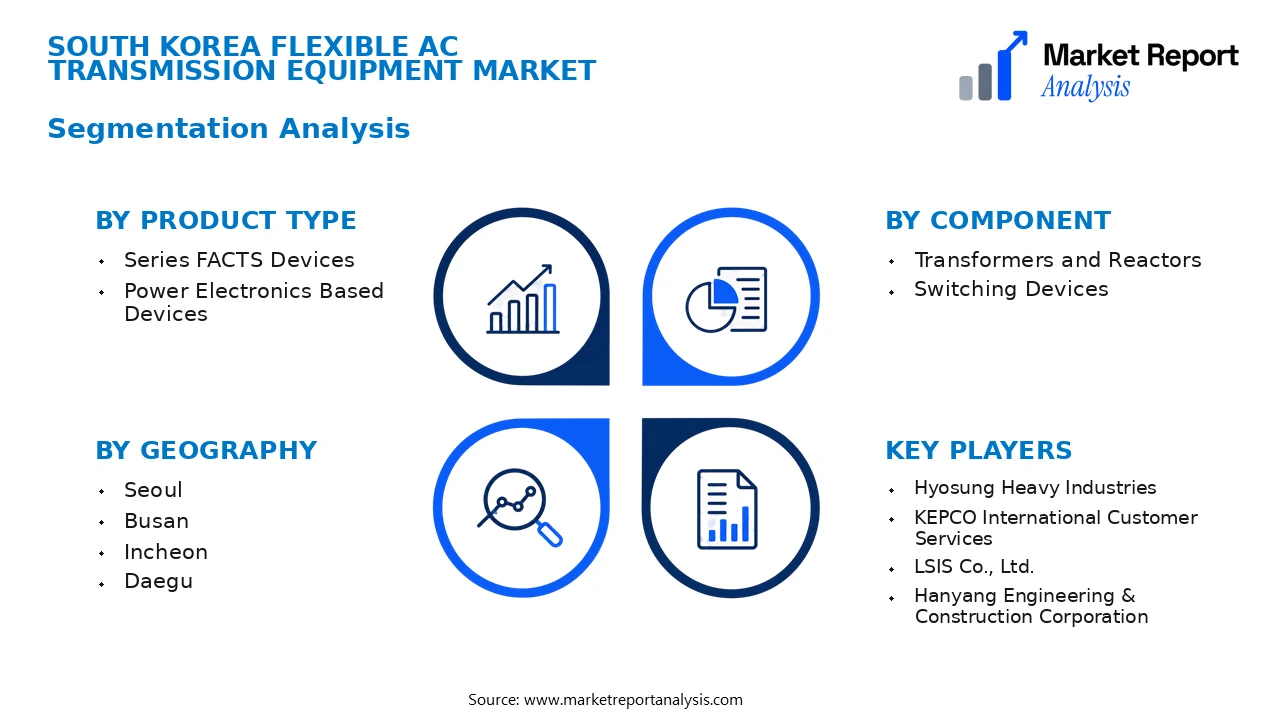
The South Korea Flexible AC Transmission Equipment Market is segmented based on product type, component, and geographic location within the country. This segmentation helps in understanding regional demand, product preferences, and technological adoption trends.
- Product Type
- Series FACTS Devices: These devices are widely used for power flow control, voltage regulation, and stability enhancement in transmission networks, with growing demand driven by grid modernization initiatives across South Korean utilities.
- Power Electronics Based Devices: Incorporating advanced power electronics, these devices facilitate rapid control and integration of renewable energy sources, making them essential for South Korea’s transition to cleaner power sources.
- Component
- Transformers and Reactors: As crucial components in flexible transmission systems, transformers and reactors support voltage regulation and power flow management, with increasing demand fueled by aging infrastructure upgrades.
- Switching Devices: These include power switches and circuit breakers that enable dynamic control of the grid, essential for maintaining stability amid fluctuating renewable energy inputs in South Korea.
- Geography
- Seoul: As the capital and a major economic hub, Seoul exhibits high demand for advanced transmission infrastructure to support dense urban energy needs and smart grid initiatives, driving local market growth.
- Busan: With its extensive port facilities and industrial base, Busan's expanding energy infrastructure requires robust transmission equipment for reliable power delivery in industrial and commercial sectors.
- Incheon: As a key logistics and transportation center, Incheon is investing heavily in grid modernization to support its growing population and industrial complexes, boosting local market activity.
- Daegu: Known for its manufacturing sector, Daegu’s energy infrastructure upgrades focus on integrating renewable sources, thereby elevating demand for flexible transmission components.
- Daejeon: As a high-tech and research city, Daejeon promotes innovative grid technologies, including flexible AC transmission devices, to maintain its leadership in science and technology.
- Gwangju: This city’s initiatives toward renewable energy integration are increasing the requirement for advanced transmission solutions to enhance grid stability and efficiency.
- Ulsan: Industrial heavyweights and petrochemical complexes in Ulsan demand reliable power transmission systems, supporting the need for high-capacity, flexible equipment.
- Suwon: As a satellite city with rapid urbanization, Suwon’s infrastructure development projects include substantial upgrades to grid flexibility and transmission capacity to support new residential and commercial facilities.
Competitive Intelligence
The South Korea Flexible AC Transmission Equipment (FACTS) market is characterized by high competition among local and international players, with market concentration centered around key international manufacturers such as ABB, Siemens, and General Electric. These corporations leverage advanced product portfolios and focus heavily on innovation to address the evolving needs of South Korea’s power infrastructure. Business strategies predominantly involve strategic partnerships with local grid operators and utility companies to foster market penetration, supported by acquisitions aimed at expanding technological capabilities and customer base. Major companies invest significantly in R&D to develop next-generation, highly reliable, and energy-efficient FACTS solutions, enhancing industrial differentiation. Expansion strategies target South Korea’s urban centers like Seoul and Busan, where upgrading aging grid infrastructure offers substantial growth opportunities. Collaborations with local tech firms and joint ventures facilitate regulatory navigation and bespoke product development suited for Korea’s unique grid standards. Competitive differentiation is mainly achieved through technological innovation, superior service offerings, and localized R&D investments that ensure compliance with South Korea’s specific regulatory requirements and energy policy frameworks.
Leading Company Profiles
The competitive landscape of South Korea’s FACTS market is characterized by the presence of several major players that focus on technological innovation, strategic partnerships, and extensive regional distribution networks to maintain market leadership and meet evolving customer requirements.
- Hyosung Heavy Industries
- KEPCO International Customer Services
- LSIS Co., Ltd.
- Hanyang Engineering & Construction Corporation
- Daelim Industrial Co., Ltd.
- Samsung SDI Co., Ltd.
- Doosan Heavy Industries & Construction
- Hyundai Electric & Energy Systems Co., Ltd.
- KCC Corporation
Hyosung Heavy Industries
Hyosung Heavy Industries specializes in manufacturing high-capacity FACTS devices including SVCs and UPFCs, leveraging advanced power electronics and digital control systems. Its strategic focus is on innovative grid stabilization solutions tailored for South Korea’s expanding renewable energy sector.
KEPCO International Customer Services
This company is a subsidiary of Korea Electric Power Corporation, concentrating on delivering comprehensive power system solutions, including FACTS technology, emphasizing reliability, efficiency, and integration with South Korea’s smart grid initiatives.
LSIS Co., Ltd.
LSIS offers a diverse portfolio of FACTS equipment with a strong R&D emphasis on digitalized power electronics and grid management systems, positioning itself as a leader in technologically advanced power transmission solutions in the domestic and regional markets.
Hanyang Engineering & Construction Corporation
Hanyang Engineering focuses on large-scale infrastructure projects, including FACTS device deployment for utility-scale transmission systems, addressing the country’s needs for resilient and flexible power networks amid growing energy demand.
Daelim Industrial Co., Ltd.
Daelim designs and manufactures custom FACTS solutions, emphasizing sustainable practices and integration into smart grid frameworks to support South Korea’s climate goals through efficient transmission and renewable energy transfer.
Samsung SDI Co., Ltd.
While primarily known for battery technology, Samsung SDI is expanding into power electronics, providing innovative products that enhance FACTS device capabilities and contribute to Korea's digitalized energy infrastructure.
Doosan Heavy Industries & Construction
Doosan employs an extensive engineering and manufacturing expertise to develop advanced FACTS equipment, focusing on enhancing power flow control and grid stability in South Korea’s evolving energy landscape.
Hyundai Electric & Energy Systems Co., Ltd.
The company provides integrated solutions including FACTS devices, prioritizing smart grid compatibility, operational efficiency, and the use of digital technologies in power transmission networks.
KCC Corporation
KCC specializes in high-performance insulating materials and power electronics components crucial for the manufacturing and deployment of reliable FACTS devices, fostering innovative solutions in South Korea’s power sector.
Strategic Business Developments
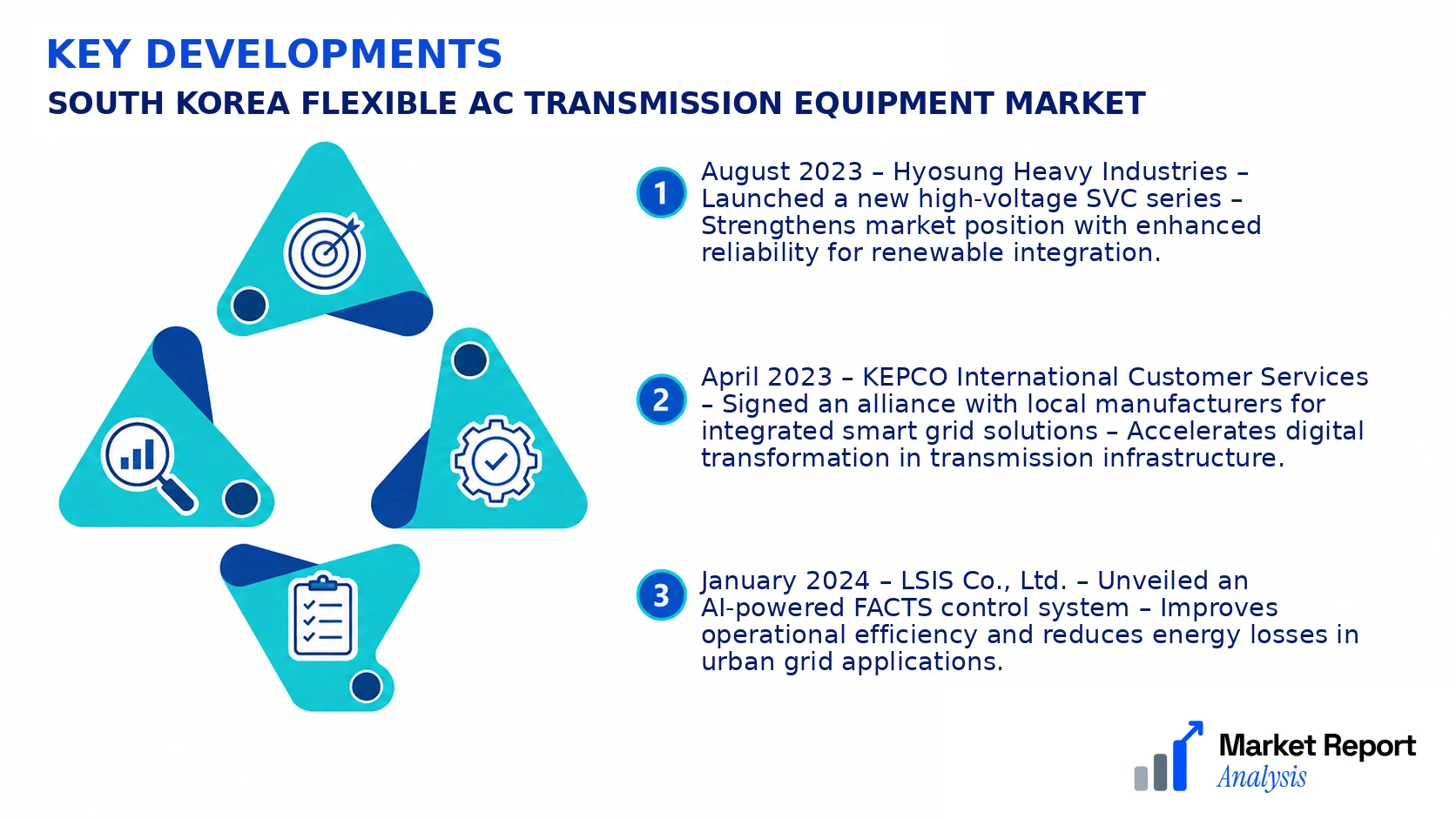
- August 2023 – Hyosung Heavy Industries – Launched a new high-voltage SVC series – Strengthens market position with enhanced reliability for renewable integration.
- April 2023 – KEPCO International Customer Services – Signed an alliance with local manufacturers for integrated smart grid solutions – Accelerates digital transformation in transmission infrastructure.
- January 2024 – LSIS Co., Ltd. – Unveiled an AI-powered FACTS control system – Improves operational efficiency and reduces energy losses in urban grid applications.
- June 2023 – Hanyang Engineering & Construction Corporation – Initiated a large-scale project for intercity FACTS device deployment – Enhances grid flexibility and security across Korea’s regional networks.
- March 2024 – Samsung SDI Co., Ltd. – Invested in power electronics manufacturing for FACTS applications – Focuses on innovation for next-generation transmission devices, advancing Korea’s digital energy infrastructure.
Frequently Asked Questions
What is the South Korea Flexible AC Transmission Equipment Market?
The South Korea Flexible AC Transmission Equipment Market encompasses the development, manufacturing, and deployment of advanced power transmission devices such as Flexible Alternating Current Transmission System (FACTS) devices designed to enhance grid efficiency and stability within South Korea's electrical infrastructure.
What is the current market size of South Korea Flexible AC Transmission Equipment Market?
As of 2026, the market is valued at approximately USD 1.8 Billion, driven by national efforts to modernize power grids, integrate renewable energy sources, and improve transmission reliability across urban and industrial regions in South Korea.
What factors are driving the South Korea Flexible AC Transmission Equipment Market?
The growth drivers include rising environmental regulations, increased renewable energy integration, technological advancements in FACTS devices, government initiatives on grid modernization, and South Korea's commitment to achieving a resilient and efficient power transmission network.
Which South Korean city leads the South Korea Flexible AC Transmission Equipment Market?
Seoul leads the South Korea Flexible AC Transmission Equipment Market, benefiting from its status as the capital and primary economic hub, with significant investments in grid infrastructure modernization, technological innovation, and industrial demand for enhanced transmission capacity.
Which segment is expected to grow the fastest?
The high-voltage transmission segment is projected to experience the fastest growth, supported by ongoing projects to upgrade existing transmission systems and expanding renewable energy capacities requiring robust high-voltage solutions for efficient power delivery.
Who are the leading companies operating in the South Korea Flexible AC Transmission Equipment Market?
Leading companies include KEPCO, LS Electric, Hyundai Electric, and LSIS, all of which are actively involved in manufacturing and deploying advanced FACTS devices, leveraging technological expertise to meet the evolving demands of South Korea's power grid modernization efforts.
Analyst Perspective
The South Korea Flexible AC Transmission Equipment Market is poised for sustained growth through 2034, driven by ongoing grid modernization and Korea’s push towards renewable integration. Long-term prospects are positive, with upgrading aging infrastructure and the deployment of advanced interconnection technologies playing pivotal roles. Commercial opportunities abound in deploying high-capacity, intelligent FACTS devices, especially in Seoul and Busan, where urban density demands resilient power systems. Technological evolution toward higher efficiency, smarter control systems, and modular solutions will continue to shape the market landscape, fostering innovation and scalability. Investment priorities should focus on enhancing grid stability, reducing transmission losses, and integrating renewable sources areas where South Korean manufacturers and international players can capitalize. Competitive intensity is expected to increase as domestic firms leverage technological edge and strategic alliances to expand market share. At the city level, Seoul’s ambitious smart city initiatives present significant growth prospects, while Busan’s emphasis on sustainable infrastructure projects offers tailored opportunities. Overall, the market’s strategic direction aligns with Korea’s long-term energy resilience and sustainability goals.
