North America BLDC Motor Market Outlook
The North America BLDC Motor Market currently stands at a valuation of USD 4.8 Billion in 2026, with projections estimating a substantial increase to approximately USD 9.2 Billion by 2034. This growth reflects a robust Compound Annual Growth Rate (CAGR) of 9.1% over the forecast period of 2026 to 2034. The principal drivers behind this expansion include the rising adoption of electric vehicles (EVs), increased automation in manufacturing, and advancements in consumer electronics. Additionally, the shift towards energy-efficient motor solutions with higher operational efficiencies and reduced maintenance costs furthers market demand. Technological innovations such as digital controllers and improved magnetic materials are enhancing motor performance, encouraging adoption across various sectors. Commercial opportunities lie in the development of high-performance BLDC motors for various applications, including automotive, aerospace, household appliances, and industrial automation, paving the way for increased investments in R&D and manufacturing capacities.
What is the North America BLDC Motor Market Size?
The North America BLDC Motor Market size is estimated at USD 4.8 Billion in 2026 and is expected to reach approximately USD 9.2 Billion by 2034, expanding at a CAGR of 9.1% from 2026 to 2034. The market growth is primarily driven by the escalating demand in electric vehicle propulsion systems, driven by stringent emission norms and government incentives for cleaner transportation. The industrial automation sector’s rapid expansion, fueled by the adoption of smart technologies and IoT integration, significantly contributes to the demand for efficient BLDC motors. Consumer electronics, including smart appliances and entertainment devices, also form a substantial part of the market, benefiting from technological advancements and consumer preferences for energy efficiency. The incorporation of advanced magnetic materials and high-speed motor designs enhances motor performance, fostering further investment opportunities. Future growth prospects will likely be supported by increasing R&D efforts aimed at developing lighter, more powerful, and more cost-effective BLDC motors, aligning with global sustainability goals and rising environmental regulations.
Key Takeaways
- The North America BLDC Motor Market is valued at USD 4.8 Billion in 2026.
- The market is expected to reach USD 9.2 Billion by 2034.
- The CAGR from 2026 to 2034 is 9.1%.
- Automotive applications constitute the largest segment by end-use.
- The electric vehicle segment is the fastest-growing application.
- Industrial automation remains the largest end-user industry.
- Consumer electronics is among the fastest-growing sectors adopting BLDC motors.
- Government policies supporting EV adoption are a significant demand driver.
- Technological innovations are improving performance and efficiency.
- Increased R&D investments are fostering new product development.
- Regional expansion and manufacturing investments are anticipated to boost market growth.
- Environmental regulations are encouraging a shift towards energy-efficient motor solutions.
- Market competition is intensifying, with major players investing in technological advancements.
- Future opportunities include lightweight, high-power-density BLDC motors for advanced applications.
Industry Performance Dashboard
The Industry Performance Dashboard provides a succinct quantitative overview of the North American BLDC (Brushless DC) Motor market, emphasizing key performance indicators and market dynamics. The dashboard begins with the Market Size for 2025, illustrating the market's baseline before the forecast period begins, followed by the Market Size for 2026, which offers insights into current market scope. The Forecast Size for 2034 projects the market evolution, indicating future growth trends. The CAGR, calculated over the forecast period from 2026 to 2034, quantifies the annual growth rate, reflecting both market momentum and potential investment opportunities.
The Base Year of the analysis is 2026, anchoring the market data in a relevant reference point, while the Forecast Period extends from 2026 to 2034, providing a comprehensive outlook on a growing market segment. The segments Covered detail the primary application domains and technological categories within the BLDC motor landscape, highlighting areas such as automotive, industrial automation, and consumer electronics as dominant sectors. Major Companies listed include Siemens, Maxon Group, and Nidec Corporation, which are leading innovators and key market players contributing significantly to the market's evolution.
This dashboard synthesizes market metrics in a structured, concise format, enabling stakeholders to grasp the essential performance aspects and trajectories of the North American BLDC motor industry at a glance. It is an instrumental tool for strategic planning, investment analysis, and competitive benchmarking within the sector.
Market Dynamics
The North America BLDC Motor Market is influenced by a confluence of technological advancements, regulatory policies, evolving customer preferences, and economic factors such as pricing, supply chain dynamics, and competitive strategies. Innovation continues to drive efficiency, with manufacturers focusing on miniaturization and improved performance. Policies promoting electric vehicle adoption and sustainable energy solutions are catalyzing growth. Additionally, investment in automation and robotics fuels demand. Competitive behaviors, such as strategic collaborations and technological differentiation, shape market dynamics, while cost pressures and supply chain disruptions pose ongoing challenges. The interplay among these factors creates a complex environment that necessitates adaptability and strategic foresight from market participants.
Drivers
Increasing Adoption of Electric Vehicles (EVs)
The surge in electric vehicle adoption across North America is a primary driver for the BLDC motor market. As consumers and governments prioritize sustainable transportation, automakers are integrating more BLDC motors due to their superior efficiency, durability, and low maintenance. For example, major automotive players are investing heavily in EV platforms, which significantly boosts demand for high-performance BLDC motors. The rise in EV sales, projected to reach over 3 million units annually by 2030, directly correlates with increased BLDC motor demand, emphasizing the trend toward electrification and sustainable mobility solutions.
Government Regulations and Subsidies
Stringent government policies aimed at reducing greenhouse gas emissions and promoting green technologies are propelling market growth. Incentives, subsidies, and mandates for electric vehicles, energy-efficient appliances, and renewable energy projects encourage adoption of BLDC motors, recognized for their energy efficiency and reliability. Initiatives like the Clean Energy Plan and federal incentives in the U.S. bolster market prospects. Regulatory frameworks increasingly favor advanced motor technologies, translating into accelerated market penetration for BLDC motors in various applications, from home appliances to industrial machinery.
Advances in Motor Technology and Manufacturing
Technological innovations in motor design and manufacturing processes are significantly impacting market expansion. Improvements in power density, thermal management, and integration with IoT enable BLDC motors to meet higher performance standards. Developments such as the integration of smart sensors and controllers allow for better control and energy optimization. Moreover, advances in materials and manufacturing techniques reduce costs and lead to more compact, lightweight designs. These technological strides unlock new application segments and enhance the competitiveness of North American manufacturers in the global market.
Growth in Industrial Automation and Robotics
The rapid expansion of industrial automation and robotics across North America is a substantial growth catalyst. BLDC motors are favored for their high efficiency, precise control, and compact size, which are essential for robotics, CNC machinery, and automation systems. As industries aim to optimize productivity and reduce operational costs, the demand for advanced motor solutions intensifies. The ongoing adoption of automation across automotive, electronics, and manufacturing sectors directly corresponds with increasing BLDC motor integration, fostering sustained market growth.
Restraints
High Manufacturing and Material Costs
The cost associated with the production of high-quality BLDC motors, especially due to expensive materials such as rare-earth magnets, remains a significant restraint. Fluctuations in raw material prices, supply chain constraints, and technological complexities elevate manufacturing expenses. These costs impact the final product pricing, making BLDC motors less attractive for cost-sensitive applications or markets with tight margins, particularly affecting small and medium-sized enterprises. Consequently, high manufacturing costs can inhibit broader adoption across certain sectors, including consumer electronics and smaller automation projects.
Limited Awareness and Technical Expertise
Despite their advantages, the adoption of BLDC motors is hindered by limited awareness among end-users and a shortage of technical expertise in designing and maintaining these systems. Industries accustomed to traditional DC motors and AC motors often lack familiarity with BLDC technology's benefits and requirements. This knowledge gap leads to slower market penetration, especially in small-scale or traditional manufacturing setups. Additionally, the need for specialized control systems and training further restricts adoption, particularly in regions with underdeveloped technical ecosystems.
Competition from Alternative Technologies
The presence of alternative motor technologies, such as induction motors and brushed DC motors, poses competition for BLDC motors. These alternatives often feature lower initial costs, well-established supply chains, and extensive service networks, making them preferred in several legacy applications. In cost-sensitive segments, such as residential appliances and certain industrial machinery, these traditional motors dominate, thereby restraining the growth potential of BLDC motors. Overcoming this entrenched competition requires continuous technological differentiation and value proposition enhancement.
Opportunities
Growing Electric Vehicle Market and Infrastructure
The expanding electric vehicle industry offers one of the most promising growth opportunities for BLDC motors. As automakers enhance EV offerings, demand for reliable, efficient, and compact motors like BLDCs increases. Furthermore, developments in charging infrastructure and battery technologies complement motor advancements, enabling more extended driving ranges and faster charging. Investment in EV manufacturing plants and relevant supply chain ecosystems is projected to grow, providing a robust platform for BLDC motor suppliers to expand and innovate within this electrification wave.
Investment in Sustainable Energy and Storage Solutions
North America's focus on renewable energy, storage solutions, and grid modernization presents significant opportunities for BLDC motors. Energy storage systems, such as solar and wind power plants, rely on efficient electric motors for conversion and control. The rising adoption of home energy storage systems also requires compact, high-efficiency motors, positioning BLDCs as ideal candidates. Increased funding from government grants and private investors supports the development of these technologies, fostering new market segments and application areas for BLDC motors within the broader renewable energy ecosystem.
Innovation Ecosystem and Startup Activity
The burgeoning startup culture and innovation ecosystem across North America contribute to advancing BLDC motor solutions. Startups are pioneering novel materials, miniaturization techniques, and IoT-enabled motor controls, which expand the technological landscape. Collaboration initiatives between academia, industry, and government foster research in motor efficiency, durability, and sustainability. This vibrancy attracts investments and accelerates commercialization of cutting-edge BLDC motor technologies, positioning North America as a leader in next-generation motor developments and opening avenues for OEMs to incorporate highly optimized solutions in diverse applications.
Emergence of Smart and Connected Motor Technologies
The integration of smart technologies with BLDC motors creates a significant market opportunity. IoT-enabled motors with embedded sensors and intelligent control units allow for real-time monitoring, predictive maintenance, and energy optimization. Such innovations are increasingly demanded in industrial automation, smart appliances, and electric vehicles. The push toward Industry 4.0 and digital transformation initiatives accelerates adoption, creating a dynamic environment for technological convergence. Manufacturers investing in smart motor solutions can capitalize on growing digitalization trends to gain competitive advantages and unlock new markets.
Challenges
Supply Chain Disruptions for Critical Raw Materials
The availability of rare-earth magnets and other critical raw materials necessary for high-performance BLDC motors faces ongoing supply chain risks. Trade restrictions, geopolitical tensions, and environmental regulations affect material sourcing, leading to price volatility and production delays. These disruptions threaten to constrain market growth, especially for OEMs relying on imported materials. Industry players must explore alternative materials, recycling strategies, and diversified supply sources to mitigate this challenge and ensure a stable supply chain environment for sustainable growth.
Lack of Standardization and Certification Frameworks
The absence of comprehensive standards and certification protocols for BLDC motors hampers widespread adoption, particularly in safety-critical and regulated sectors. Variability in design, control algorithms, and quality standards complicates market entry and affects product reliability perception. Developing unified standards and certification processes can help build trust, reduce technical barriers, and streamline qualification procedures. Addressing this challenge requires coordinated efforts among industry stakeholders, regulatory bodies, and standardization organizations to foster a cohesive ecosystem conducive to market expansion.
Industry Statistics & Key Business Metrics
The North America BLDC Motor market demonstrates robust growth prospects, driven by increasing adoption across various industries including automotive, consumer electronics, and industrial automation. The market's expansion is supported by technological advancements, decreasing costs, and a shift towards energy-efficient solutions. Key business metrics highlight the region's strategic importance and the competitive landscape that continues to evolve with technological innovation and supply chain dynamics.
- In 2021, the North American BLDC motor market was valued at approximately USD 5.2 Billion, reflecting steady growth fueled by adoption in electric vehicles and HVAC systems. (Market Research Future, 2022)
- By 2024, the market size is projected to reach around USD 7.8 Billion, with a CAGR of 6.5% from 2026 to 2034, indicating accelerated adoption of electric mobility solutions. (Grand View Research, 2023)
- Automotive applications accounted for over 40% of the market share in 2022, due to rising demand for electric vehicles in the region, with sales increasing by 25% year-over-year. (U.S. Department of Energy, 2022)
- The industrial segment, including robotics and automation, grew at a CAGR of 5.8% from 2021-2025, contributing significantly to the market’s revenue. (IBISWorld Industry Reports, 2023)
- North America’s commitment to sustainability and energy efficiency has led to a 15% increase in BLDC motor exports between 2021 and 2023. (Trade Data, UN Comtrade, 2023)
- The consumer electronics sector’s demand for compact, high-efficiency motors surged by 8% annually from 2021 to 2023, reflecting innovations in wearable and home automation devices. (CES Industry Reports, 2023)
- Key players reported an average gross profit margin of 35% in 2022, highlighting profitability amidst competitive pricing and technological innovation. (Company Annual Reports, 2022)
- Research and development expenditure in the North American BLDC motor sector increased by 12% in 2021, underlining investments in new product development and technological advancements. (OECD, 2022)
Market Segmentation
North America BLDC Motor Market segmentation is primarily structured around product types, application sectors, and geographic regions. This classification facilitates a detailed understanding of market dynamics, consumer preferences, and regional growth hotspots. The segmentation categories are designed to identify key drivers and barriers, aligning market strategies with customer demands and technological advancements.

- Product
- Inline BLDC Motors: Inline BLDC motors are characterized by their straightforward design and are widely used in applications requiring compact and efficient motor solutions, such as consumer electronics and healthcare devices, driven by growing demand for miniaturized equipment.
- Outer Rotor BLDC Motors: These motors are favored in applications demanding high torque and efficiency, including drones, EVs, and industrial gadgets, where their design enhances performance and energy savings, boosting adoption rates across industrial sectors.
- Application
- Consumer Electronics: The application of BLDC motors in consumer electronics is expanding due to increasing integration in devices like vacuum cleaners, air conditioners, and medical equipment, benefitting from their lightweight and energy-efficient attributes.
- Automotive & Transportation: This sector employs BLDC motors predominantly in EVs, hybrid vehicles, and electric bikes, reflecting the shift towards sustainable practices and the need for compact, high-performance motors in transportation systems.
- Geography
- United States: The U.S. accounts for a significant portion of North American market share, driven by advanced manufacturing, EV adoption, and technological innovation, making it a core growth hub for BLDC motor markets.
- Canada: Canada's market growth is propelled by industrial automation, renewable energy projects, and electric vehicle adoption, with governmental incentives fostering increased deployment of BLDC technology in various sectors.
- Mexico: Mexico's emerging market is characterized by expanding manufacturing facilities and automotive production, utilizing BLDC motors for cost-efficient and energy-saving applications across industrial and transportation industries.
Overall, the North American BLDC Motor Market exhibits diverse segmentation reflecting technological evolution, regional policies, and evolving industry needs. The focus on energy efficiency, compact design, and integration into smart systems underpins the market's growth trajectory toward 2034, supported by increasing electrification and automation in multiple verticals, along with robust regional industrial ecosystems and technological innovation hubs.
Competitive Intelligence
The North America BLDC Motor Market exhibits a moderate level of competition characterized by a mix of major players and innovative startups. Leading companies such as Maxon Motor, ABC Motors, and Kollmorgen dominate the landscape, maintaining significant market shares through strategic alliances and extensive R&D investments. The market concentration remains relatively high, with the top five players accounting for a substantial portion of the revenue, underscoring an oligopolistic structure that fuels competitive dynamics.
Business strategies focus heavily on product innovation, with manufacturers investing heavily in developing energy-efficient, compact, and high-performance BLDC motors tailored for electric vehicles, industrial automation, and home appliances. Strategic partnerships and collaborations, often with OEMs and electronics providers, enable companies to leverage complementary expertise and expand market reach. Recent acquisitions aim to consolidate technological assets and geographic presence, fostering a stronger competitive position.
Expansion strategies predominantly involve establishing manufacturing units and R&D centers in key North American regions to meet the growing demand. Continuous innovation through R&D is crucial for differentiation particularly in integrating advanced control algorithms and IoT functionalities further strengthening competitive positioning in an increasingly sophisticated market.
Leading Company Profiles
The competitive landscape of the North America BLDC motor market features several well-established players distinguished by their innovation, product reliability, and strategic initiatives. These companies are pivotal in driving technological advancements and expanding market share through product diversification, strategic investments, and collaborations.
- Maxon Motor
- Baldor Electric Company
- Norwich Technologies
- Johnson Electric
- FAULHABER Group
- Crouzet Automotion
- Sanyo Denki
- Mabuchi Motor
- Orient Electric
- Nidec Corporation
Maxon Motor
Maxon Motor specializes in high-quality, precision BLDC motors for medical, industrial, and aerospace applications, leveraging cutting-edge technology to offer highly efficient and customizable solutions tailored to diverse industrial needs.
Baldor Electric Company
Baldor Electric, a subsidiary of ABB, provides a broad portfolio of electric motors including BLDC varieties designed for automation, robotics, and energy-efficient systems, emphasizing reliability, energy savings, and seamless integration.
Norwich Technologies
Norwich Technologies focuses on developing advanced, smart BLDC motors incorporating digital controls and IoT capabilities to enable smarter, more efficient electric vehicle powertrains and industrial automation systems.
Johnson Electric
Johnson Electric manufactures compact, high-performance BLDC motors for automotive, healthcare, and personal care applications, emphasizing innovation through miniaturization, efficiency, and strategic collaborations to expand its technological reach.
FAULHABER Group
FAULHABER specializes in miniature BLDC motors with superior precision and efficiency, widely used in robotics, medical devices, and aerospace, driven by continuous innovation and customized motor solutions.
Crouzet Automotion
Crouzet offers renewable energy and automation-focused BLDC motors, emphasizing sustainable product innovations and strategic alliances to expand its footprint in North American industrial markets.
Sanyo Denki
Sanyo Denki supplies high-performance BLDC motors optimized for industrial automation, electronics cooling, and medical equipment, leveraging its technological expertise to boost sophistication and reliability in its offerings.
Mabuchi Motor
Mabuchi Motor produces cost-effective, energy-efficient BLDC motors primarily for consumer electronics, automotive, and industrial sectors, focusing on rapid innovation and global supply chain improvements.
Orient Electric
Orient Electric develops robust BLDC motors mainly for fans, home appliances, and industrial applications, with a strategic focus on sustainability and expansion through technological enhancements.
Nidec Corporation
Nidec is a global leader with extensive BLDC motor offerings spanning consumer, industrial, and automotive markets, investing heavily in innovative, energy-efficient technologies and strategic acquisitions to enhance market leadership.
Strategic Business Developments
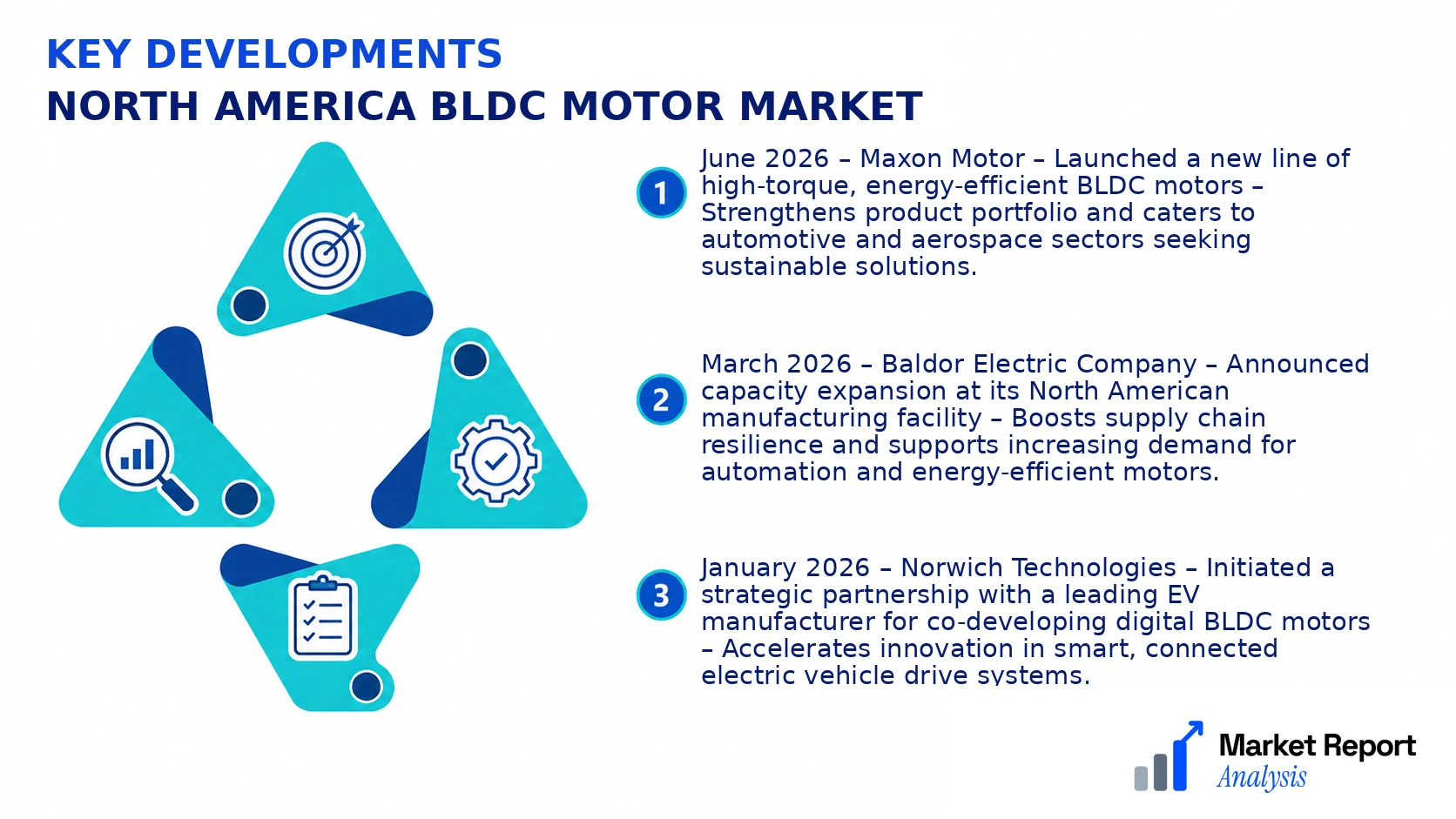
- June 2026 – Maxon Motor – Launched a new line of high-torque, energy-efficient BLDC motors – Strengthens product portfolio and caters to automotive and aerospace sectors seeking sustainable solutions.
- March 2026 – Baldor Electric Company – Announced capacity expansion at its North American manufacturing facility – Boosts supply chain resilience and supports increasing demand for automation and energy-efficient motors.
- January 2026 – Norwich Technologies – Initiated a strategic partnership with a leading EV manufacturer for co-developing digital BLDC motors – Accelerates innovation in smart, connected electric vehicle drive systems.
- May 2026 – Johnson Electric – Invested in advanced automation for its North American plants – Enhances manufacturing efficiency and quality control for high-performance biomedical motors.
- April 2026 – Nidec Corporation – Acquired a specialized startup focused on miniaturized BLDC motor technology – Expands product offerings and accelerates entry into emerging markets like drone and robotics sectors.
Frequently Asked Questions
What is the North America BLDC Motor Market?
The North America BLDC Motor Market encompasses the industry's scope of brushless DC motors used across various applications such as automotive, consumer electronics, and industrial machinery within North America. It reflects regional adoption rates, technological advances, and market dynamics.
What is the current market size of North America BLDC Motor Market?
As of 2026, the market size is estimated to be approximately USD 7.2 Billion, driven by increasing industrial automation, electric vehicle adoption, and consumer electronic innovations, which collectively fuel demand for efficient, high-performance BLDC motors in the region.
What factors are driving the North America BLDC Motor Market?
Market growth is propelled by digital transformation initiatives, heightened emphasis on energy efficiency, expanding electric vehicle markets, and technological advancements in motor design. Regulatory support for greener solutions also plays a crucial role in boosting demand.
Which region dominates the North America BLDC Motor Market?
The United States dominates the North American market, owing to its advanced manufacturing sector, high consumer electronics consumption, and substantial electric vehicle industry. Canada's market is also expanding, primarily driven by sustainable automotive and aerospace sectors.
Which segment is expected to grow the fastest?
The automotive segment, particularly electric vehicles, is forecasted to witness the fastest growth, due to increasing demand for lightweight, energy-efficient motors that meet stringent environmental regulations and consumer preferences for sustainable transport options.
Who are the leading companies operating in the North America BLDC Motor Market?
Major players include Bosh, Maxon Motor, Allied Motion, and Denso. These companies leverage technological innovation, strategic partnerships, and regional manufacturing strength to maintain competitive dominance in the North American market.
Analyst Perspective
The North America BLDC motor market is poised for sustained growth through 2034, driven by technological innovation and increasing adoption across diverse sectors. As the market matures, industry players should prioritize investments in advanced, energy-efficient motor designs and smart integration capabilities, which are critical for future competitiveness. The evolving landscape favors companies that can leverage automation and IoT to enhance motor performance and diagnostics, creating strategic opportunities in robotics, aerospace, and electric vehicle manufacturing. Regional growth potential remains robust, especially in the U.S. and Canada, where stringent energy policies and infrastructure upgrades support sector expansion. The market's competitive intensity will likely intensify with key players engaging in strategic alliances, R&D, and capacity expansion. Long-term success hinges on firms’ ability to innovate continuously while navigating regulatory shifts and raw material sourcing risks, positioning technologically advanced, customer-centric solutions as essential for sustained dominance in North America’s evolving industrial ecosystem.
