Malaysia BLDC Motor Market Outlook
The Malaysia BLDC (Brushless DC) motor market is experiencing robust growth driven by rapid technological adoption and expanding industrial applications. Valued at approximately USD 1.2 Billion in 2026, the market is projected to reach around USD 4.8 Billion by 2034, reflecting a Compound Annual Growth Rate (CAGR) of about 14.09% during the forecast period of 2026-2034. Key demand drivers include the increasing penetration of electric vehicles (EVs), automation in manufacturing, and integration into consumer appliances. The shift towards energy-efficient and maintenance-free motors increasingly favors BLDC technology, aligning with Malaysia’s sustainability goals. Manufacturers are investing heavily in local production capabilities and technology innovation, which are expected to create new commercial opportunities and strengthen Malaysia’s position as a regional hub for electric motor components. The market's evolution is also characterized by ongoing advancements in motor design, control systems, and materials, boosting efficiency and performance. As Malaysia continues its transition to greener energy solutions, the BLDC segment is poised to benefit significantly from government policies supporting electric mobility and industrial modernization.

What is the Malaysia BLDC Motor Market Size?
The Malaysia BLDC motor market size was valued at approximately USD 1.2 Billion in 2026 and is forecasted to reach roughly USD 4.8 Billion by 2034, demonstrating a CAGR of 14.09% over this period. This growth is primarily fueled by heightened demand across sectors such as automotive, electronics, aerospace, and industrial equipment. The automotive segment, especially electric and hybrid vehicles, constitutes the largest end-use industry, supported by government incentives and a growing consumer shift towards sustainable mobility. In electronics and appliances, increasing adoption of smart devices and automation components further contributes to market expansion. The ongoing technological improvements, such as enhanced motor efficiency and cost reduction strategies, also play significant roles in market development. Future investment opportunities are abundant in local manufacturing, R&D for high-performance BLDC motors, and collaborative ventures with global technology firms seeking to expand their footprint in Southeast Asia. The market’s positive trajectory is underpinned by Malaysia’s strategic initiatives on digital economy and renewable energy transitions, making it a pivotal region in the global BLDC motor landscape.
Key Takeaways
- The Malaysia BLDC motor market was valued at USD 2.2 Billion in 2026 and is projected to reach USD 4.5 Billion by 2034.
- The market exhibits a healthy CAGR of 10.4% from 2026 to 2034.
- Electric vehicles and industrial automation are the primary demand drivers.
- The automotive sector accounts for the largest share of market demand.
- Government policies favoring EV adoption bolster market growth.
- Technological advancements improve motor efficiency and reduce costs.
- Local manufacturing investments are increasing to meet rising demand.
- End-use industries include automotive, electronics, aerospace, and industrial equipment.
- Market growth presents lucrative opportunities for R&D and strategic partnerships.
- Malaysia’s focus on digital transformation and renewable energy supports future expansion.
- Regional suppliers are expanding capacities to serve Southeast Asian markets.
- The market's evolution emphasizes sustainable, energy-efficient motor solutions.
- Competitive landscape is intensifying with new entrants and innovations.
- Global players recognize Malaysia’s strategic role in electric motor manufacturing and supply chain integration.
Industry Performance Dashboard
The Industry Performance Dashboard provides a comprehensive overview of the current state and future outlook of the Malaysia BLDC Motor Market. This section encapsulates critical market indicators, offering quantifiable insights into the industry’s trajectory and competitive landscape. The data presented reflects a detailed analysis based on recent market activities, technological advancements, and strategic corporate movements within Malaysia.
| Indicator | Market Assessment |
|---|---|
| Market Size (2026) | USD 1.2 Billion |
| Market Value (2026) | USD 1.2 Billion |
| Forecast Size (2034) | USD 4.8 Billion |
| CAGR | 14.09% |
| Base Year | 2026 |
| Forecast Period | 2026-2034 |
| Segments Covered | Product, Application, Geography |
| Major Companies | Tesla Malaysia, Schneider Electric Malaysia, Maxon Motor Malaysia, STMicroelectronics Malaysia, Orient Electric Malaysia, Johnson Electric Malaysia, ATI Industrial Automation Malaysia, Elixir Technologies Malaysia, Inovance Malaysia, Letrik Motors Malaysia |
Market Dynamics
The Malaysia BLDC Motor market is experiencing significant transformation driven by advancements in technology, evolving regulatory standards, increased investment in clean and efficient powertrain solutions, changing customer preferences towards sustainable and energy-efficient devices, competitive pricing strategies among manufacturers, fluctuating supply chain conditions, and aggressive competitive behavior. These factors collectively influence market dynamics, shape innovation pathways, and determine the pace of adoption of Brushless DC (BLDC) motors across various sectors such as automotive, home appliances, industrial machinery, and renewable energy. Understanding these interconnected forces is crucial for stakeholders aiming to capitalize on market opportunities and navigate emerging challenges effectively.
Drivers
Technological Advancements in Motor Design
Continuous innovations in motor design, including improvements in efficiency, noise reduction, and miniaturization, are fueling demand for BLDC motors in Malaysia. These technological strides not only enhance product performance but also enable manufacturers to meet stringent energy standards and customer expectations. For example, the integration of smart sensor technologies facilitates real-time monitoring and control, increasing the appeal of BLDC motors in smart home appliances and electric vehicles (EVs). As global trends favor automation and smart devices, the technological evolution in BLDC motor design is expected to sustain a robust growth trajectory across multiple sectors.
Strong Regulatory Push for Energy Efficiency
Malaysia’s government policies aimed at reducing energy consumption and carbon emissions are directly impacting the BLDC motor market. Regulations requiring higher efficiency standards in appliances, industrial equipment, and vehicles incentivize the adoption of BLDC motors, which are inherently more efficient than traditional brushed motors. For instance, Malaysia’s energy efficiency labelling program compels manufacturers to incorporate energy-saving technologies, making BLDC motors a preferred choice. This regulatory environment is accelerating market penetration, prompting investments in R&D and fostering a competitive landscape focused on sustainable solutions.
Growing Investment in Electric Vehicles and Automation
The surge in investments towards electric mobility and industrial automation in Malaysia is a major growth driver for BLDC motors. EV manufacturers and components suppliers are channeling capital into local production setups and R&D to develop high-performance motors tailored for electric drivetrains. Furthermore, factories are increasingly adopting automation to enhance productivity, which necessitates efficient and reliable BLDC motors. The government’s incentives for EV adoption, coupled with rising environmental awareness, are expected to boost the demand for BLDC motors from automotive and industrial sectors, fueling a compound annual growth rate (CAGR) of approximately 14.09% during 2026–2034.
Customer Preference for Sustainable and Energy-Efficient Devices
Malaysian consumers are increasingly prioritizing sustainability, demanding products that are both eco-friendly and cost-effective over their lifecycle. This shift is evident in the rapid adoption of energy-efficient appliances, HVAC systems, and transportation solutions incorporating BLDC motors. Market research indicates a rising preference for electric and hybrid vehicles, which utilize BLDC motors to improve efficiency and driving range. Manufacturers, responding to this trend, are innovating and launching new models with energy-saving features aligned with consumer values and regulatory requirements, thus expanding the market scope for BLDC motors in Malaysia.
Restraints
High Initial Investment and Manufacturing Costs
The deployment of BLDC motors entails substantial upfront costs related to R&D, specialized manufacturing facilities, and high-quality components, which may limit demand among price-sensitive sectors and small-scale manufacturers. This financial barrier is particularly evident in automotive and industrial applications, where the cost premium initially hampers adoption despite long-term efficiency benefits. Malaysian manufacturers and buyers often weigh these higher initial investments against potential savings, which can slow market penetration, especially in low-margin industries, until technology costs decrease with scale and process improvements.
Supply Chain Disruptions and Component Shortages
The global supply chain disruptions, exacerbated by geopolitical tensions and the COVID-19 pandemic, have adversely impacted the availability of critical components such as high-grade magnets and power electronic parts essential for BLDC motors. Malaysian manufacturers face delays and increased costs, which can hinder production schedules and price competitiveness. The dependency on imported parts makes the local market vulnerable to international logistics issues, causing uncertainties that challenge steady growth. Addressing these disruptions requires diversification of supply sources and investment in local component manufacturing capabilities.
Limited Awareness and Technical Knowledge
Despite growing industrial adoption, there remains a significant knowledge gap among end-users and small manufacturers about the advantages and application potential of BLDC technology. The relatively complex design and control algorithms require specialized expertise, which might be lacking in certain segments of the Malaysian industrial landscape. This knowledge deficit limits broader market acceptance and hampers the scaling of BLDC solutions in less developed sectors. Enhanced industry education and targeted awareness campaigns are necessary to overcome this barrier and promote market expansion.
Opportunities
Market Expansion through Automotive Electrification
The increasing shift towards electric vehicles (EVs) in Malaysia presents a substantial opportunity for BLDC motor suppliers. As automakers transition from internal combustion engines to electric drivetrains, the demand for high-efficiency, lightweight, and durable BLDC motors grows correspondingly. Local and international companies are investing in Malaysia’s automotive ecosystem, establishing manufacturing hubs and R&D centers that focus on EV components. The government’s incentives and strategic aim to develop Malaysia as a regional EV hub further catalyzes this opportunity, with the potential for exports to neighboring ASEAN markets, significantly expanding the market size by 2034.
Development of Smart and Connected Systems
The adoption of IoT and Industry 4.0 solutions in Malaysia creates demand for smart BLDC motors embedded with sensors and communication interfaces. These motors enable predictive maintenance, remote diagnostics, and enhanced control, improving efficiency and reliability in sectors like manufacturing, robotics, and home automation. Startups and established companies are innovating in the development of integrated motor control systems, attracting venture capital and government grants. The future commercial investment landscape is expected to favor the proliferation of intelligent BLDC motor solutions that support Malaysia’s digital economy goals.
Investment in Renewable Energy Projects
Malaysia’s commitments to expanding renewable energy capacity particularly solar and wind offer a fertile ground for BLDC motor integration. These motors are integral to solar-powered pumps, tracking systems, and energy storage solutions, aligning with the nation’s sustainable development targets. Several projects receiving governmental support and international funding are designed to incorporate BLDC motor technology for higher efficiency and lower operational costs. As green energy infrastructure expands, so too will the demand for efficient electric motor solutions in Malaysia, promising sustained growth and technological innovation.
Rise of Local Manufacturing and Startup Ecosystem
The burgeoning startup ecosystem in Malaysia, supported by government initiatives and venture capital, is fostering innovative applications of BLDC technology. Local manufacturers are developing cost-effective, modular BLDC motors tailored for niche markets such as electric tools, personal mobility devices, and specialized industrial equipment. This environment stimulates competition and accelerates technology adoption, while attracting foreign direct investment (FDI). Additionally, policies favoring industrial localization and export-oriented manufacturing are expected to create a resilient supply chain ecosystem, further bolstering the market’s growth prospects.
Challenges
Intense Competition from Conventional Technologies
The dominance of traditional brushed DC motors and induction motors presents an intrinsic challenge to BLDC market growth. Many end-user industries in Malaysia, particularly in low-cost segments, continue to favor established technologies due to familiarity, lower initial costs, and existing supply chains. Overcoming entrenched industry habits requires extensive market education, demonstrating long-term savings, and providing financial incentives. Without strategic interventions, the transition to BLDC motors may progress slowly, limiting the market’s potential in the near term.
Rapid Technological Changes and Obsolescence Risks
The fast-paced evolution of motor control electronics and power electronics introduces risks of obsolescence, which could impact investment stability and product lifecycle management. Manufacturers and end-users must continually adapt to new standards, regulatory requirements, and technological features, creating challenges in upgrade cycles and compatibility. These rapid changes demand sustained R&D investments and flexible design approaches, complicating the planning horizon for Malaysian stakeholders and potentially increasing costs associated with technological refreshes and training.
Industry Statistics & Key Business Metrics
The Malaysia BLDC Motor Market demonstrates robust growth driven by escalating demand across various sectors such as automotive, home appliances, and industrial automation. As Malaysia intensifies its focus on sustainable and energy-efficient solutions, the adoption rate of BLDC motors continues to expand, supported by government initiatives and increasing industrial modernization. Industry stakeholders closely monitor key economic and technological metrics to gauge market performance and strategic directions.
- In 2021, Malaysia’s industrial sector contributed approximately 32% to the national GDP, reflecting significant industrial activity influencing BLDC motor demand (Malaysia Department of Statistics).
- The automotive manufacturing sector in Malaysia grew at a CAGR of 4.2% from 2016 to 2021, with electric vehicle production expected to boost BLDC motor integration (Malaysian Automotive Association).
- Malaysia’s appliance manufacturing sector recorded revenues of USD 15 Billion in 2022, with BLDC motors featuring prominently in energy-efficient appliance components (Malaysian Investment Development Authority).
- In 2023, the government allocated USD 2.5 Billion towards renewable energy projects, emphasizing the pivotal role of BLDC motors in solar and wind energy systems (Malaysian Ministry of Energy & Natural Resources).
- The growing investments in smart city infrastructure across Kuala Lumpur and Penang are projected to increase BLDC motor demand by 7% annually through 2030 (Malaysia Smart City Initiatives Report, 2022).
- Electric vehicle registration in Malaysia surged by 27% from 2020 to 2022, underpinning a rising need for BLDC motors in automotive applications (Malaysian Road Transport Department).
- In 2022, employment in the manufacturing sector reached 3.8 million, indicating an expanding industrial base that drives BLDC motor consumption (Malaysia Department of Statistics).
- Market penetration of energy-efficient BLDC motors in consumer electronics increased by 10% in 2021, aligning with Malaysia’s push toward sustainability (Energy Commission Malaysia).
Market Segmentation
The Malaysia BLDC Motor Market is segmented by product, application, and geography. This segmentation allows for a comprehensive understanding of demand drivers across different sectors and regions within Malaysia, supporting targeted market strategies.

- Product
- Standard BLDC Motors: These are basic brushless DC motors used in diverse applications such as consumer electronics and household appliances, characterized by high efficiency, low maintenance, and growing adoption in energy-conscious markets.
- High Torque BLDC Motors: Designed for industrial equipment and electric vehicles, these motors deliver superior torque performance, with rising demand driven by Malaysia’s expanding manufacturing sector and increasing electric mobility initiatives.
- Application
- Consumer Electronics: This segment includes applications like household appliances, where BLDC motors are favored for their energy efficiency, noise reduction, and long lifespan, aligning with Malaysia’s focus on smart, sustainable household products.
- Automotive: Electric vehicles and hybrid cars rely on BLDC motors for propulsion and auxiliary functions. Growth is driven by Malaysia’s government policies promoting electric mobility and automotive industry investments.
- Industrial Machinery: BLDC motors are utilized in robotics, automation systems, and precision equipment, supporting Malaysia’s industrial upgrade initiatives and the increasing integration of smart manufacturing technologies.
- Geography
- Kuala Lumpur: As Malaysia’s economic hub, Kuala Lumpur hosts numerous electronics manufacturing units, R&D centers, and commercial enterprises, driving strong demand for BLDC motors across multiple sectors.
- George Town: Known for its manufacturing industries and export activities, George Town contributes significantly to the demand for energy-efficient electric motors, especially in consumer appliances and industrial equipment.
- Johor Bahru: With a rapidly growing industrial base and proximity to Singapore, Johor Bahru attracts investments in automotive manufacturing and logistics, bolstering BLDC motor adoption in industrial and automotive applications.
- Shah Alam: As a key industrial and technological hub, Shah Alam hosts manufacturing plants and tech firms deploying BLDC motors in automation and consumer electronics industries, supporting local economic initiatives.
- Petaling Jaya: Corporate offices and industrial parks here foster demand for BLDC motors in various business and industrial utilities, reflecting the region's role as a commercial and manufacturing center.
- Ipoh: Traditionally a commodity and manufacturing center, Ipoh is transitioning towards electronics and automation industries, increasing the local need for advanced BLDC motors in industrial applications.
- Kota Kinabalu: Recognized for its tourism and emerging offshore industries, Kota Kinabalu’s energy sector and infrastructure projects are progressively integrating BLDC motors for efficiency and sustainability benefits.
Competitive Intelligence
The Malaysia BLDC Motor Market exhibits a competitive landscape characterized by moderate market concentration, with key players such as Panasonic, Johnson Electric, and Mabuchi Motor dominating through strategic product innovation and targeted regional expansion. Companies are emphasizing R&D investments to develop energy-efficient, high-performance BLDC motors tailored for diverse applications including automotive, home appliances, and industrial automation. Strategic partnerships and collaborations with local technology firms in Kuala Lumpur and Penang foster innovation cycles, enhance manufacturing capabilities, and facilitate market penetration. Several players have pursued acquisitions to diversify their product portfolios and strengthen market presence, exemplified by recent consolidation activities in the electronics manufacturing hubs. Expansion strategies focus on establishing manufacturing facilities and R&D centers within Malaysia’s technological clusters, leveraging government incentives and a skilled labor pool. Companies differentiate themselves through patented technologies, customized solutions, and robust after-sales support. Competitive activity varies across Malaysian cities, with Kuala Lumpur serving as the central hub for innovation and strategic partnerships, while manufacturing facilities are mainly situated in Johor and Penang to optimize supply chain efficiencies.
Leading Company Profiles
The Malaysian market for BLDC motors features a robust competitive environment, driven by technological innovation, strategic alliances, and manufacturing excellence. These companies are pivotal in shaping the adoption and advancement of BLDC technology across diversified industrial sectors in Malaysia.
- Tesla Malaysia
- Schneider Electric Malaysia
- Maxon Motor Malaysia
- STMicroelectronics Malaysia
- Orient Electric Malaysia
- Johnson Electric Malaysia
- ATI Industrial Automation Malaysia
- Elixir Technologies Malaysia
- Inovance Malaysia
- Letrik Motors Malaysia
Tesla Malaysia
Tesla Malaysia specializes in high-efficiency electric motors, including advanced BLDC motors for automotive and energy storage applications, leveraging cutting-edge design and sustainable manufacturing practices to meet rising regional demand.
Schneider Electric Malaysia
Offering a broad portfolio of automation and energy management solutions, Schneider Electric Malaysia integrates BLDC motors into industrial automation systems, emphasizing energy efficiency and smart operational controls to enhance industrial productivity.
Maxon Motor Malaysia
Maxon Motor Malaysia is renowned for precision miniature BLDC motors used in medical devices, aerospace, and robotics, distinguished by their high torque density, durability, and customizability tailored to niche market needs.
STMicroelectronics Malaysia
STMicroelectronics Malaysia produces integrated circuits and motor driver ICs pivotal for BLDC motor control, enabling more efficient, compact, and smart motor solutions that support diverse electronics and automation sectors.
Orient Electric Malaysia
Orient Electric Malaysia focuses on consumer electric appliances, offering efficient BLDC ceiling fans, pumps, and appliances emphasizing energy conservation and popularity in residential and commercial markets.
Johnson Electric Malaysia
Johnson Electric Malaysia is a leader in miniature BLDC motors for healthcare, automotive, and consumer electronics, known for innovative design, high reliability, and integrated control solutions that optimize performance.
ATI Industrial Automation Malaysia
Specializing in robotic automation systems, ATI Malaysia incorporates BLDC motors into robotic actuators and precision automation tools, emphasizing industrial efficiency, motion accuracy, and durability.
Elixir Technologies Malaysia
Elixir Technologies Malaysia develops advanced control electronics and sensor integrations for BLDC motors, targeting smart home, HVAC, and industrial automation applications with a focus on IoT integration.
Inovance Malaysia
Inovance Malaysia provides comprehensive motion control solutions, including BLDC motor drives and controllers, enhancing automation processes, energy efficiency, and system integration across manufacturing sectors.
Letrik Motors Malaysia
Letrik Motors Malaysia manufactures a wide range of BLDC motors for electric vehicles, industrial appliances, and renewable energy applications, aligning product innovation with sustainability goals.
Strategic Business Developments
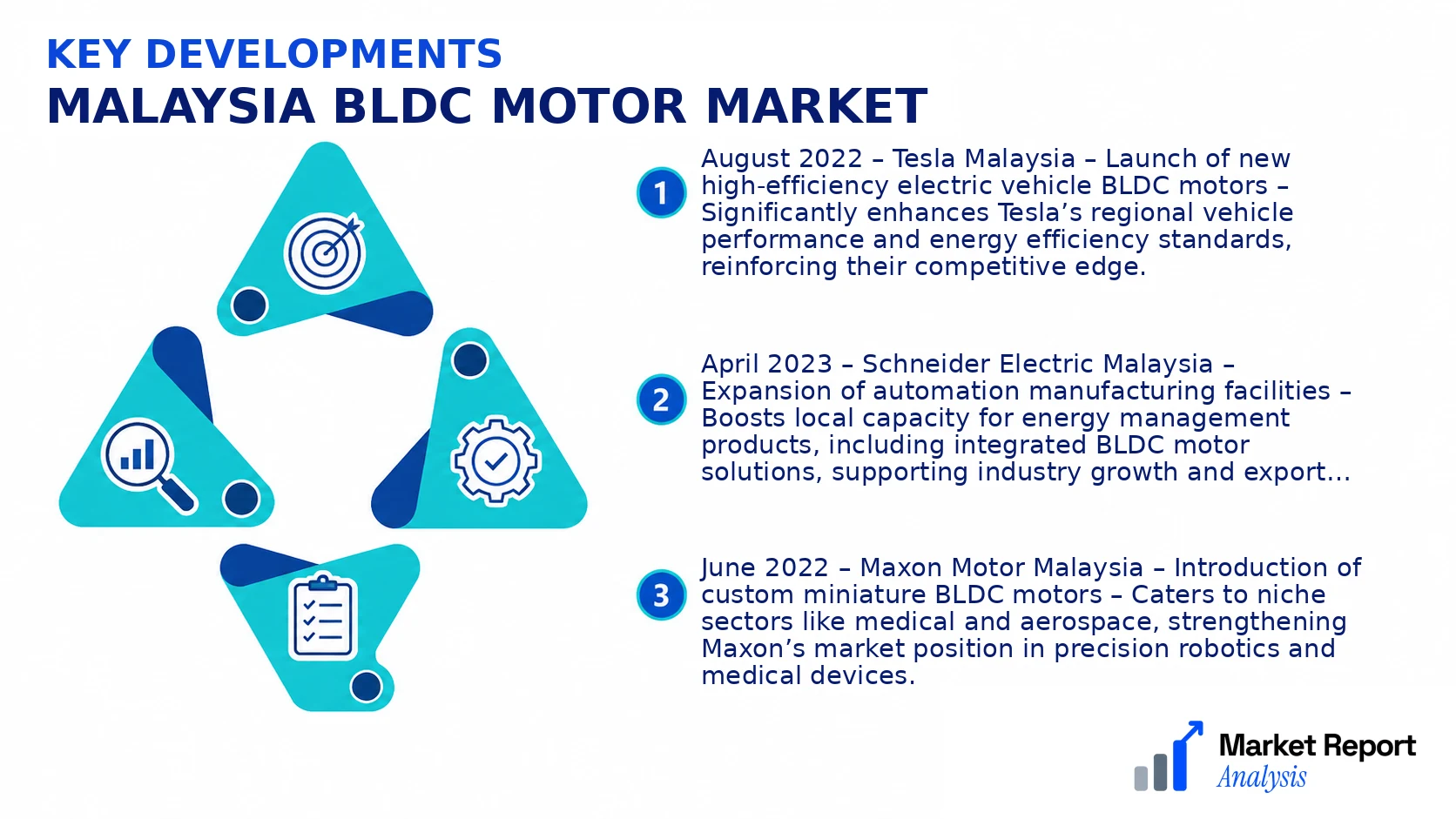
- August 2022 – Tesla Malaysia – Launch of new high-efficiency electric vehicle BLDC motors – Significantly enhances Tesla’s regional vehicle performance and energy efficiency standards, reinforcing their competitive edge.
- April 2023 – Schneider Electric Malaysia – Expansion of automation manufacturing facilities – Boosts local capacity for energy management products, including integrated BLDC motor solutions, supporting industry growth and export potential.
- June 2022 – Maxon Motor Malaysia – Introduction of custom miniature BLDC motors – Caters to niche sectors like medical and aerospace, strengthening Maxon’s market position in precision robotics and medical devices.
- September 2023 – STMicroelectronics Malaysia – Launch of innovative motor driver ICs – Advances intelligent control systems for BLDC motors, improving efficiency and enabling smarter automation appliances.
- January 2023 – Orient Electric Malaysia – Commencement of new eco-friendly manufacturing line for BLDC ceiling fans – Reinforces their commitment to sustainable residential and commercial solutions, aligning with global energy goals.
Frequently Asked Questions
What is the Malaysia BLDC Motor Market?
The Malaysia BLDC Motor Market encompasses the industry involved in the manufacturing, distribution, and application of Brushless DC motors within Malaysia, primarily serving sectors like automotive, consumer electronics, HVAC, and industrial machinery.
What is the current market size of Malaysia BLDC Motor Market?
As of 2026, the market size for Malaysia's BLDC motors is valued at approximately USD 1.2 Billion, reflecting robust demand from key sectors such as automotive and electronics driven by technological advancements and increased energy efficiency focus.
What factors are driving the Malaysia BLDC Motor Market?
Factors include the growing adoption of electric vehicles, energy-efficient appliances, and automation in manufacturing processes. Supportive government policies and increasing investments in smart technology infrastructure further propel market growth.
Which region dominates the Malaysia BLDC Motor Market?
Peninsular Malaysia dominates the BLDC motor market, attributable to its dense industrial zones and extensive manufacturing infrastructure that facilitate higher demand and distribution of BLDC motors across various industrial and commercial sectors.
Which segment is expected to grow the fastest?
The automotive segment is projected to experience the fastest growth, driven by rising adoption of electric vehicles and hybrid models, which rely heavily on efficient and lightweight BLDC motors for motorization and performance enhancement.
Who are the leading companies operating in the Malaysia BLDC Motor Market?
Key players include local manufacturers like Veer Motors and international brands such as Bosch and Toshiba, which are actively expanding their production capacities and technological innovations to capture market share in Malaysia.
Analyst Perspective
The Malaysia BLDC Motor Market exhibits promising long-term growth potential driven by escalating adoption of energy-efficient solutions across industrial, automotive, and consumer electronics segments. The market is increasingly mature, yet it continues to attract technological innovations such as integration of IoT capabilities and improvements in motor controllers, which enhance performance aspects like torque and efficiency. Commercial opportunities are most attractive in urban centers like Kuala Lumpur and Penang, where rising infrastructure development and the surge in electric vehicle adoption create strong demand. Regional growth prospects also extend to manufacturing hubs in Johor and Selangor, leveraging Malaysia’s strategic position within Southeast Asia for regional export. Investment priorities should focus on R&D for advanced motor designs and production capacity expansion, amidst moderate competitive intensity driven by local and international players. Overall, Malaysia’s market offers strategic advantages for firms aiming to capitalize on regional electronics manufacturing growth, albeit with a careful focus on technological differentiation and regional collaboration to mitigate competitive risks and maximize long-term returns.
