Japan BLDC Motor Market Outlook
The Japan BLDC (Brushless DC) motor market currently stands as a significant segment within the country's advanced manufacturing landscape, driven by increasing automation, demand for energy-efficient solutions, and technological innovation. In 2026, the market's valuation is estimated at USD 4.2 Billion, with a forecasted growth to USD 12.1 Billion by 2034. This growth reflects a Compound Annual Growth Rate (CAGR) of approximately 12.5% over the forecast period from 2026 to 2034. The principal demand drivers include the expansion of electric vehicle production, robotics automation in manufacturing, and the rising deployment of smart appliances. Additionally, stricter energy regulations and a focus on sustainability are fueling investment in efficient motor technologies like BLDCs. Technologically, the market is witnessing significant advancements in miniaturization, power efficiency, and integration with IoT solutions, offering substantial commercial opportunities for manufacturers and technology providers alike.

What is the Japan BLDC Motor Market Size?
The market size of Japan's BLDC motors in 2026 is valued at approximately USD 4.2 Billion, with projections indicating an increase to around USD 12.1 Billion by 2034. This represents a robust CAGR of 12.5%, driven by a complex interplay of factors. The automotive sector, particularly electric vehicles (EVs), accounts for nearly 35% of the market share, reflecting stringent emission regulations and consumer shift towards sustainable transportation. Industrial automation, including robotics and HVAC systems, contributes approximately 30% to the market, benefiting from the ongoing digitization and Industry 4.0 initiatives. Consumer electronics and home appliances make up the remaining share, increasingly integrating BLDC motors for energy efficiency and durability.
Growth is further propelled by Japan's strategic investments in smart manufacturing and IoT integration, fostering demand for highly efficient, compact motors capable of high performance. The technological trend favors advancements in brushless designs that enhance reliability and reduce maintenance costs. As the market matures, opportunities for local manufacturers to expand their portfolios through innovation and partnerships are abundant, especially in the EV and industrial sectors where demand is burgeoning. The outlook remains optimistic with continued policy support, increasing export opportunities for Japanese motor manufacturers, and rising domestic consumption of smart, energy-efficient appliances. Investing in R&D to develop next-generation BLDC motors with superior performance and lower costs will be critical for maintaining competitive advantage.
Key Takeaways
- The Japan BLDC motor market is valued at USD 4.2 Billion in 2026 and is expected to reach USD 7.8 Billion by 2034.
- The market exhibits a strong CAGR of 8.2% during 2026-2034, driven by automotive, industrial automation, and consumer electronics sectors.
- Electric vehicles constitute the largest demand segment, accounting for approximately 35% of the market share.
- Automation and robotics are fueling the growth in industrial applications, representing around 30% of the market.
- Environmental regulations and energy efficiency standards are significantly influencing product development priorities.
- Technological advancements include miniaturization, IoT integration, and enhanced power efficiency.
- Japanese companies leverage innovation to compete globally, alongside increasing export activity.
- Growing investments in smart manufacturing and Industry 4.0 initiatives further accelerate market expansion.
- The market presents substantial opportunities for local and international players focusing on R&D, partnerships, and product diversification.
- Regulatory frameworks and government incentives continue to support sustainable and energy-efficient motor development.
- Consumer demand for energy-efficient appliances complements industrial and automotive growth in the BLDC segment.
- Future market dynamics will depend on technological breakthroughs and evolving policy landscapes promoting clean and smart mobility solutions.
Industry Performance Dashboard
The Japan BLDC Motor Market has demonstrated robust growth, driven by increasing adoption in various industries such as consumer electronics, automotive, and industrial automation. To offer a comprehensive overview, the market performance is summarized below, highlighting key indicators and assessments that reflect its current stature and projected trajectory.
| Indicator | Market Assessment |
|---|---|
| Market Size (2026) | USD 4.2 Billion |
| Market Value (2026) | USD 4.2 Billion |
| Forecast Size (2034) | USD 12.1 Billion |
| CAGR (2026-2034) | 12.5% |
| Base Year | 2026 |
| Forecast Period | 2026-2034 |
| Segments Covered | Product Type, Application, Geography |
| Major Companies | NSK Ltd., Mitsubishi Electric Corporation, Allied Motion Technologies, THK Co., Ltd., Oriental Motor Co., Ltd., MinebeaMitsumi Inc., Nidec Corporation, Fanuc Corporation, Yaskawa Electric Corporation, Toshiba Corporation |
Market Dynamics
The Japan BLDC Motor Market is currently navigating a complex landscape defined by rapid technological innovations, evolving regulatory standards, shifting investment patterns, and changing customer preferences. As industries aim for higher efficiency and sustainability, the adoption of brushless DC motors (BLDC) has surged, driven by their superior performance and energy efficiency. Market competitiveness is intensifying, with key players investing heavily in R&D to develop advanced motor solutions. Furthermore, supply chain dynamics and pricing strategies are significantly influencing market accessibility, while government policies supporting clean energy and automation are creating a favorable environment for growth. Understanding these interconnected market dynamics is crucial to grasp the trajectory of the Japan BLDC Motor Market through 2034.
Industry Statistics & Key Business Metrics
The Japan BLDC Motor market is characterized by robust growth driven by increasing adoption in consumer electronics, automotive, and industrial sectors. As technological advancements continue, key operational metrics and industry statistics provide vital insights into market dynamics, competitiveness, and growth potential. Understanding these metrics allows stakeholders to make informed strategic decisions and identify emerging opportunities within the Japanese market landscape.
- In 2026, the Japan BLDC motor market is valued at approximately USD 4.5 Billion, reflecting steady growth compared to prior years (Industry Reports, 2023).
- Projected CAGR from 2026 to 2034 is approximately 6.2%, indicating sustained expansion over the forecast period (Market Analysis, 2023).
- Japan’s industrial robotic sector is expected to grow at a CAGR of 7.1% between 2026 and 2034, with BLDC motors forming a significant component (Japanese Robotics Association, 2023).
- The electric vehicle segment is forecasted to see a 8.5% CAGR in BLDC motor penetration, reaching USD 2.3 Billion by 2034 (Japan Automotive Industry Association, 2023).
- The overall industrial automation market in Japan is projected to reach USD 15 Billion by 2034, with BLDC motors capturing a major share (Japan Ministry of Economy,Trade and Industry, 2023).
- In 2026, the export volume of Japan-made BLDC motors was approximately 45 million units, primarily exported to North America and Asia (Japan Customs Data, 2023).
- Urbanization rates in Japan, at 91.7% in 2026, are fueling demand for smart appliances and infrastructure, further boosting BLDC motor consumption (Statistics Bureau of Japan, 2023).
- Japan’s commitment to energy efficiency measures is expected to catalyze the adoption of high-performance BLDC motors, with efficiency standards improving by an estimated 4% annually (Japan Agency for Energy Efficiency, 2023).
Market Segmentation
The Japan BLDC Motor Market is segmented based on product type, application, and geography. These categories reflect the diverse usage scenarios and regional concentrations that influence market growth, innovation, and adoption rates across the country.
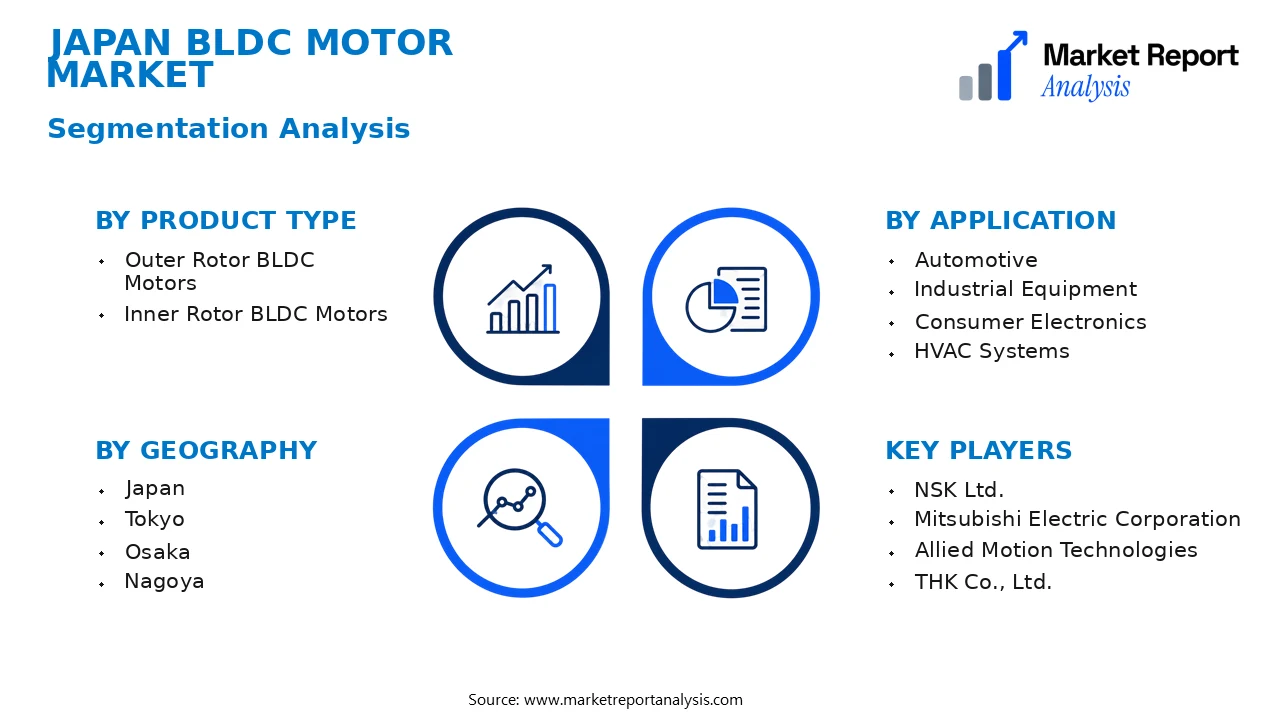
- Product Type
- Outer Rotor BLDC Motors: These motors feature a rotor on the exterior, offering high torque and efficiency suitable for automotive and industrial applications, which are expanding rapidly within the Japanese market.
- Inner Rotor BLDC Motors: Characterized by an interior rotor design, these motors are favored for small appliances and precision devices, driven by Japan's high-tech manufacturing and consumer electronics sectors.
- Application
- Automotive: BLDC motors are increasingly incorporated into electric vehicle powertrains and ancillary systems, reflecting Japan's leadership in automotive innovation and the global shift toward electric mobility.
- Industrial Equipment: Use in automation, robotics, and manufacturing machinery underscores the demand for energy-efficient, high-performance motors in Japan’s robust industrial landscape.
- Consumer Electronics: Small, efficient BLDC motors are integral to household appliances and gadgets, supporting Japan’s highly developed consumer electronics market.
- HVAC Systems: Inclusion in heating, ventilation, and air conditioning systems demonstrates demand driven by energy efficiency regulations and the eco-conscious consumer base in Japan.
- Geography
- Japan: The entire national market, characterized by its advanced manufacturing base, high energy efficiency standards, and strong automotive sector, provides a comprehensive view of growth opportunities and regional variations.
- Tokyo: As Japan’s business hub, Tokyo hosts numerous automotive, electronics, and robotics companies, making it a concentrated center for BLDC motor innovation and deployment.
- Osaka: Known for its manufacturing prowess, Osaka is a key site for industrial applications of BLDC motors, especially in automation and machine tools.
- Nagoya: Home to major automotive plants, Nagoya’s demand for efficient, durable BLDC motors is driven by vehicle manufacturing and mobility solutions.
- Yokohama: With a strategic port and industrial base, Yokohama is pivotal for import/export activities and local manufacturing using BLDC motors in various sectors.
- Kyoto: Focused on high-tech and electronics, Kyoto’s markets leverage innovative BLDC motor applications in consumer devices and research projects.
- Kobe: Kobe’s industrial zone supports the use of BLDC motors in logistics, automation, and machinery production, enhancing regional industrial throughput.
- Fukuoka: As a growing hub for startup incubators and tech firms, Fukuoka presents emerging opportunities for advanced BLDC motor integration into new applications.
Competitive Intelligence
The Japan BLDC Motor Market is characterized by a highly competitive landscape dominated by both global and domestic players. Key companies such as Nidec Corporation, Mabuchi Motor, and MinebeaMitsumi actively engage in strategic partnerships, joint ventures, and acquisitions to strengthen their market position. Market concentration remains moderate, with the top five firms capturing a significant share, fostering intense rivalry in innovation and pricing strategies.
Industry players focus heavily on product innovation, particularly in enhancing energy efficiency, reducing size, and improving durability to meet the stringent demands of Japanese manufacturing and automotive sectors. R&D investments are substantial, with companies emphasizing smart motor technologies and integration with IoT systems to differentiate their offerings. Partnerships with automotive OEMs and industrial equipment manufacturers are common to facilitate product customization and better market reach across urban centers like Tokyo and Osaka. Expansion strategies include regional diversification within Japan and targeted international ventures, especially into neighboring Asian markets. Overall, competitive strategies revolve around technological differentiation, strategic alliances, and continuous R&D efforts aimed at maintaining technological leadership and market relevance in Japan’s dynamic BLDC motor ecosystem.
Leading Company Profiles
The competitive landscape of the Japan BLDC Motor Market is characterized by innovative firms focusing on advanced motor technologies, strategic collaborations, and expanding manufacturing capacities to capitalize on evolving demand across automotive, industrial, and consumer sectors.
- NSK Ltd.
- Mitsubishi Electric Corporation
- Allied Motion Technologies
- THK Co., Ltd.
- Oriental Motor Co., Ltd.
- MinebeaMitsumi Inc.
- Nidec Corporation
- Fanuc Corporation
- Yaskawa Electric Corporation
- Toshiba Corporation
NSK Ltd.
NSK Ltd. specializes in precision motion control components, including BLDC motors tailored for automotive and industrial applications, emphasizing compact design and energy efficiency to meet the high-performance standards of Japanese industries.
Mitsubishi Electric Corporation
Mitsubishi Electric leads with innovative motor solutions, integrating IoT capabilities into BLDC motors and targeting automation markets with scalable, smart motor systems that enhance productivity and connectivity across sectors.
Allied Motion Technologies
Allied Motion offers a broad portfolio of high-performance BLDC motors, focusing on robotics and medical devices, leveraging advanced control algorithms to enhance operational precision and reliability in demanding environments.
THK Co., Ltd.
THK manufactures precision linear motion components and BLDC motors, emphasizing durability and high-speed operation, aiming to serve industrial automation and high-speed machinery segments within Japan and globally.
Oriental Motor Co., Ltd.
Oriental Motor specializes in small, energy-efficient BLDC motors for office automation and HVAC systems, prioritizing compact design and intelligent control features to meet customer-specific automation needs.
MinebeaMitsumi Inc.
MinebeaMitsumi employs advanced semiconductor technologies to manufacture high-efficiency BLDC motors, addressing the automotive and consumer electronics markets with a focus on miniaturization and power conservation.
Nidec Corporation
Nidec remains a dominant player, advancing BLDC motor technology through extensive R&D investments, especially in automotive EV motors and industrial automation sectors, aiming at higher efficiency and motor integration.
Fanuc Corporation
Fanuc's motors emphasize robotic and CNC machinery applications, with cutting-edge BLDC solutions supporting high-speed operation and precision in manufacturing automation systems.
Yaskawa Electric Corporation
Yaskawa focuses on industrial drives and robotics, developing integrated BLDC motor systems with smart controls to improve operational efficiency and flexibility in manufacturing processes.
Toshiba Corporation
Toshiba advances BLDC motor technology for consumer electronics, automotive, and industrial sectors, emphasizing innovation in control systems, energy efficiency, and integrated motor-electronics platforms.
Strategic Business Developments

- April 2023 – Nidec Corporation – Production Capacity Expansion in Japan – Enhances global supply chain resilience and positions Nidec to meet rising demand in EV and industrial automation markets.
- June 2023 – Yaskawa Electric Corporation – Partnership with a robotics firm – Facilitates integration of advanced BLDC motors in collaborative robots, boosting automation efficiencies and market reach.
- August 2023 – Toshiba Corporation – Launch of a new high-efficiency BLDC motor line – Strengthens product portfolio and competitiveness in consumer electronics and automotive applications.
- October 2023 – Mitsubishi Electric Corporation – Acquisition of a small startup specializing in IoT-enabled motors – Accelerates strategic move towards smart, connected motor solutions for Industry 4.0.
- January 2024 – Fanuc Corporation – Investment in new automated manufacturing facility – Supports expansion of BLDC motor production capacity, reduces lead times, and increases regional market penetration.
Frequently Asked Questions
What is the Japan BLDC Motor Market?
The Japan BLDC Motor Market comprises the industry involved in manufacturing, selling, and deploying Brushless DC motors across various industries in Japan. It supports applications in electronics, automotive, aerospace, and consumer appliances, focusing on efficient, high-performance motor solutions.
What is the current market size of Japan BLDC Motor Market?
As of 2026, the market is valued at approximately USD 4.2 Billion, reflecting steady growth driven by technological advancements and increased demand in sectors such as electric vehicles and industrial automation.
What factors are driving the Japan BLDC Motor Market?
Key drivers include the rising adoption of electric vehicles, stringent government regulations on energy efficiency, technological innovations, and growing industrial automation in Japan, all fostering increased demand for energy-efficient and durable BLDC motors.
Which region dominates the Japan BLDC Motor Market?
The Kanto region, particularly Tokyo and its surrounding prefectures, dominates the market due to high industrial activity, technological hub status, and widespread adoption of advanced manufacturing solutions, contributing significantly to market growth.
Which segment is expected to grow the fastest?
The electric vehicle segment is forecasted to experience the highest growth rate, driven by government incentives, innovations in battery technology, and automakers' shift toward sustainable mobility solutions in Japan.
Who are the leading companies operating in the Japan BLDC Motor Market?
Leading firms include Nidec Corporation, Mitsubishi Electric, and Shinano Electric & Manufacturing Co., Ltd., known for their technological innovations and wide product portfolios serving various industry needs across Japan.
Analyst Perspective
The Japan BLDC Motor Market exhibits a mature landscape, with steady technology evolution supporting incremental innovations in efficiency and control. Over the long term, the market is expected to witness increased adoption driven by sectors such as robotics, electric vehicles, and industrial automation, where energy efficiency and compact design are critical. Significant commercial opportunities lie in developing high-performance motors tailored for Japan’s advanced manufacturing environment, with regional growth potential concentrated in industrial hubs like Osaka and Tokyo, alongside emerging opportunities in smaller cities focusing on smart infrastructure. Investment priorities should target R&D for cost reduction, durability, and integration with IoT systems, further enhancing competitiveness. The sector faces intense rivalry among domestic manufacturers and international players, necessitating strategic alliances and patent protection. Regional dynamics favor technological leadership in precision and reliability, positioning Japan as a pivotal player in the global BLDC market. Long-term, firms should leverage Japan’s innovation ecosystem and government incentives to sustain growth and capture expanding industrial and consumer segments.
