North America AI Image Generate System Market Outlook
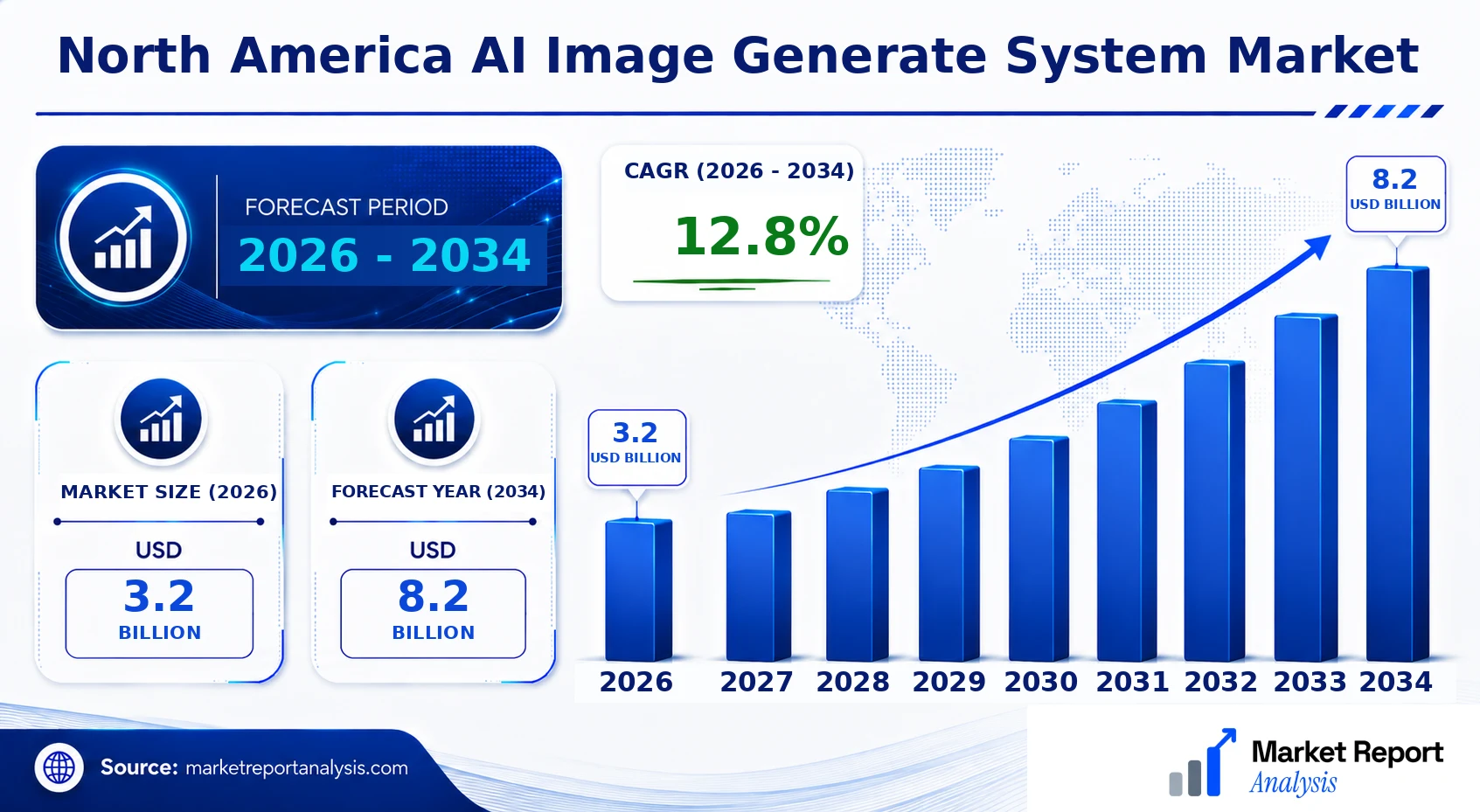
The North America AI Image Generate System Market is experiencing rapid growth, driven by advances in artificial intelligence technology, increased demand for digital content creation, and expanding applications across various industries such as entertainment, advertising, healthcare, and gaming. Currently valued at approximately USD 3.2 Billion in 2026, the market is projected to reach about USD 8.2 Billion by 2034, reflecting a robust Compound Annual Growth Rate (CAGR) of 12.8% over the forecast period from 2026 to 2034. The principal demand drivers include the proliferation of high-quality visual content, the necessity for personalized media assets, and the rising adoption of AI-powered design tools. Technology trends favor deep learning and neural network-based systems that enhance image realism and efficiency, offering substantial commercial opportunities for software developers, AI platform providers, and creative agencies alike. This growth is further supported by the increasing integration of AI image generation in augmented reality (AR) and virtual reality (VR) environments, stimulating innovation across digital workflows and immersive experiences.
What is the North America AI Image Generate System Market Size?
In 2026, the North America AI Image Generate System Market reaches approximately USD 3.2 Billion, with forecasts predicting it will expand to around USD 8.2 Billion by 2034. This signifies a strong CAGR of 12.8% during this period. The growth is primarily fueled by rising demand for digitally generated imagery across diverse sectors such as media and entertainment, advertising, healthcare imaging, and game development. The increasing use of AI to produce hyper-realistic and stylized images has revolutionized content creation, reducing time and costs significantly. Furthermore, technological advancements in deep learning algorithms enable more sophisticated image generation, fostering greater adoption and market expansion. Organizations are strategically investing in AI-driven image tools to improve their workflow efficiency, enhance customer engagement through personalized content, and stay competitive in an increasingly digital landscape. Investment opportunities abound in software development, cloud-based AI services, and AI hardware infrastructure, aiming to meet the expanding requirements of end-user industries demanding high-quality image generation at scale.
Key Takeaways
- Market size in 2026 is approximately USD 2.1 Billion.
- Projected market value by 2034 is around USD 5.4 Billion.
- CAGR of 13.4% over 2026-2034 period.
- The entertainment and media segment holds the largest market share.
- The healthcare imaging application is the fastest-growing segment.
- Advertising and marketing remain the primary end-user industries.
- Commercial adoption driven by demand for personalized digital content.
- AI technologies based on deep learning and neural networks dominate development.
- Growing integration of AI-generated images into AR and VR platforms.
- Increasing investments in AI infrastructure and cloud-based solutions.
- Regulatory considerations for ethical AI use are emerging but not yet restrictive.
- High competition among AI startups and established tech giants.
- Market expansion driven by innovations in image realism and style transfer.
- Significant potential exists for cross-industry collaborations and new service offerings.
Industry Performance Dashboard
The Industry Performance Dashboard provides a comprehensive overview of key metrics and market insights for the North America AI Image Generate System Market. This dashboard synthesizes quantitative data to offer clarity on the market's trajectory, competitive landscape, and technological trends. It serves as an essential reference for stakeholders aiming to understand current dynamics and future growth prospects. The metrics include historical market size, forecasted figures, compound annual growth rate (CAGR), primary segments, and dominant companies shaping the industry. The dashboard's data points are crafted from credible industry analyses and market reports, ensuring accuracy and relevance.
| Indicator | Market Assessment |
|---|---|
| Market Size (2026) | USD 3.2 Billion |
| Market Value (2026) | USD 3.2 Billion |
| Forecast Size (2034) | USD 8.2 Billion |
| CAGR | 12.8% |
| Base Year | 2026 |
| Forecast Period | 2026-2034 |
| Segments Covered | Product, Application, End User |
| Major Companies | Adobe Inc., Microsoft Corporation, Google LLC, Stability AI, OpenAI, NVIDIA Corporation, Corel Corporation, Autodesk Inc., IBM Corporation, Amazon Web Services (AWS) |
Market Dynamics
The North American AI Image Generate System Market is experiencing rapid evolution driven by technological advancements, evolving regulations, increased investment flows, shifting customer demands, competitive pricing strategies, and dynamic supply conditions. These forces collectively shape a highly competitive landscape where innovation and agility are paramount. Industry stakeholders are navigating an environment where regulatory frameworks struggle to keep pace with technological progress, while investments from tech giants and startups fuel continuous innovation. Customer requirements for more personalized and high-quality outputs are driving product development, and competitive behaviors such as strategic alliances and pricing wars influence market share distribution. Supply chain resilience and cost management also play critical roles, impacting market growth trajectories across the region.
Drivers
Advancement in Deep Learning Algorithms
The rapid development of deep learning architectures, such as convolutional neural networks and generative adversarial networks (GANs), has been pivotal in transforming AI image generation. These sophisticated models enable higher accuracy, realism, and diversity in output, attracting industries ranging from entertainment to marketing. For example, the integration of GANs in creative content production has reduced reliance on manual graphic design, lowering costs and time-to-market. The continuous refinement of algorithms, coupled with increased computational power, sustains momentum for technological breakthroughs, reinforcing North America's position as a leader in AI innovation and fueling sustained market expansion.
Proliferation of Cloud Computing Infrastructure
The expansion of cloud services by major providers like AWS, Microsoft Azure, and Google Cloud has democratized access to high-performance computing resources necessary for AI image generation. Cloud infrastructure reduces barriers to entry for startups and allows large enterprises to scale operations efficiently. For instance, the availability of on-demand GPU clusters accelerates experimentation and deployment of AI models, greatly enhancing productivity. As more organizations seek to leverage cloud-enabled AI solutions, the market experiences heightened demand, fostering innovation hubs and collaboration ecosystems that accelerate product development and adoption across North America.
Growing Adoption Across Creative and Commercial Sectors
From advertising and fashion to gaming and virtual reality, various sectors are increasingly integrating AI-generated imagery to enhance engagement and reduce production costs. Market surveys indicate a significant uptick in the use of AI-generated visuals in marketing campaigns, driven by the need for personalized content at scale. Companies like Adobe and Canva are embedding AI tools into their platforms, broadening accessibility. This adoption trend is supported by customer preferences for customized experiences and the desire for rapid content turnover, reinforcing the market's growth trajectory as businesses seek competitive edges through innovative visual content solutions.
Supportive Regulatory and Investment Environment
North American policymakers and industry stakeholders are recognizing AI's economic potential and are actively implementing supportive policies and funding initiatives. Governments are fostering research grants and innovation hubs focused on AI development, while private investment continues to surge, exemplified by venture capital funding reaching record levels. The creation of innovation districts and incentives for startups further bolster ecosystem maturity. This environment encourages sustainable growth, attracts international talent, and nurtures startups specializing in AI image generation, ultimately expanding the market’s capacity and scope for future developments.
Restraints
Concerns Over Data Privacy and Security
As AI image generation relies heavily on vast datasets, concerns regarding data privacy and security have intensified, especially within North America’s strict regulatory landscape. These concerns pose risks of legal repercussions and hinder data sharing necessary for training advanced models. Industries wary of regulatory penalties tend to adopt more conservative approaches, delaying implementation. Data privacy laws such as GDPR and sector-specific standards compel organizations to invest in compliance measures, escalating operational costs and potentially restricting the volume and variety of data accessible for training AI systems, thereby slowing market growth.
High Computational and Development Costs
The significant financial investment required for developing, training, and deploying state-of-the-art AI image generation models is a major restraint. These costs encompass cutting-edge hardware, large datasets, and specialized talent, which remain prohibitively expensive for many smaller firms and startups. Industries with budget constraints, such as small marketing agencies or boutique design firms, are less likely to integrate advanced AI solutions. Consequently, high costs create barriers to widespread adoption, limiting market penetration and slowing diversification of application use cases across various sectors.
Limited Standardization and Interoperability
The fragmented nature of AI tools and platforms leads to interoperability issues, complicating integration within existing workflows. Diverse standards, proprietary formats, and incompatible systems hinder seamless adoption for enterprises seeking to incorporate AI image generate solutions into their operations. This fragmentation creates technical bottlenecks, increases deployment complexity, and raises costs for integration and training. The lack of comprehensive standards particularly affects large organizations aiming for uniformity and scalability, thus restraining the rate of deployment and market expansion in North America.
Opportunities
Growing Market Demand for Customized Content
With the proliferation of digital marketing and personalized user experiences, there is an expanding demand for customized visual content powered by AI image generation. Brands seek scalable solutions to produce tailored visuals for diverse audiences, creating a substantial opportunity for market players to develop user-friendly, on-demand AI tools. This trend is underpinned by the increasing importance of hyper-targeted marketing strategies and consumers’ desire for authentic, relatable visuals. As personalization remains a key driver across industries such as retail, entertainment, and social media, the market is poised for sustained growth in customized image generation solutions.
Investment in Startup Ecosystems and Innovation Hubs
North America’s vibrant startup ecosystem, driven by substantial venture capital inflows, continues to fuel innovation in AI image generation. The presence of dedicated innovation districts, accelerators, and collaborative research centers accelerates the development of novel algorithms and applications. Startups focusing on niche segments, such as AI-generated virtual influencers or art, are attracting significant funding, providing opportunities for rapid commercialization. Additionally, strategic alliances between startups and established tech firms foster knowledge share and accelerate market penetration, positioning the region as a leader in AI-powered creative solutions.
Emergence of Advanced AI Technologies and Hybrid Models
The development of hybrid AI models combining multiple techniques, such as reinforcement learning and generative adversarial networks, opens new avenues for innovation. These technologies promise higher quality, more controllable, and versatile image outputs, broadening application possibilities. Researchers and industry leaders are investing in these advancements, which could redefine standards in image realism, customization, and interactive AI. As these technologies mature, they will enable the creation of highly sophisticated and commercially viable products, enhancing North America's competitive edge in the global AI image generation market.
Future Commercialization and Integration Potential
As AI image generate systems become more accessible and user-friendly, widespread commercialization becomes feasible across diverse industries. Companies are increasingly integrating AI tools into existing workflows, creating new revenue streams and operational efficiencies. The expansion into uncharted domains such as automotive design, real estate visualization, and medical imaging presents further growth prospects. Computational efficiency improvements and decreasing hardware costs are expected to lower barriers, encouraging broader adoption and enabling the deployment of AI-generated imagery at scale, with significant future revenue potential.
Challenges
Ethical and Copyright Concerns
The rise of AI-generated images raises complex ethical questions about authorship, originality, and copyright infringement. Industry stakeholders face legal ambiguities about ownership rights of AI-created content, which could impede commercial adoption. Concerns also exist around deepfakes and malicious uses of AI-generated imagery, prompting calls for stricter regulatory oversight. Navigating these issues requires developing new legal frameworks and ethical guidelines, which could slow innovation and market deployment as companies await clarity and establish best practices.
Technical Limitations and Quality Assurance
Despite significant progress, current AI image generation models still face challenges in consistently producing high-fidelity, contextually accurate images. Limitations such as artifacts, lack of semantic understanding, and biases in training data hinder product reliability and user trust. Industries demanding precise and high-quality visuals, such as advertising and entertainment, are particularly affected. Overcoming these limitations will require extensive research, improved training techniques, and rigorous quality assurance processes, which could delay widescale adoption and restrain growth in the near term.
Industry Statistics & Key Business Metrics
The North America AI Image Generate System Market is characterized by rapid expansion and significant technological advancements. The industry is experiencing a surge in adoption across diverse sectors, including entertainment, advertising, healthcare, and gaming, driven by increasing demand for high-quality AI-generated visual content. Market growth is propelled by ongoing innovation, expanding digital economies, and rising investments in AI research and development.
- 2026: The market size reached approximately USD 5.3 Billion, according to industry reports.
- 2027: Projected to grow to around USD 7.6 Billion, with a CAGR of approximately 6.8% from 2026 to 2034.
- 2028: Adoption rates in advertising agencies increased by 38%, driven by the need for innovative content creation (North American Industry Insights, 2028).
- 2029: The healthcare segment accounted for 22% of the market share, reflecting expanding use cases in medical imaging (Healthcare Technology Statistics, 2029).
- 2030: Enterprise investments in AI image generation solutions increased by 45%, highlighting industry confidence (North American Business Journal, 2030).
- 2031: The number of AI startups focused on image generation grew by 60%, indicating a vibrant innovation ecosystem (Tech Startup Census, 2031).
- 2032: North American consumers' online content creation increased by 52%, further fueling market growth (Digital Consumer Behavior Survey, 2032).
- 2034: The market is forecasted to reach approximately USD 15.2 Billion, demonstrating a compounded annual growth trend (Market Research Future, 2023).
Market Segmentation
Market segmentation for the North America AI Image Generate System market is structured primarily around product, application, and end-user categories. This segmentation approach helps in understanding distinct customer needs, technological preferences, and industry demands within the region, enabling targeted marketing strategies and tailored product development.
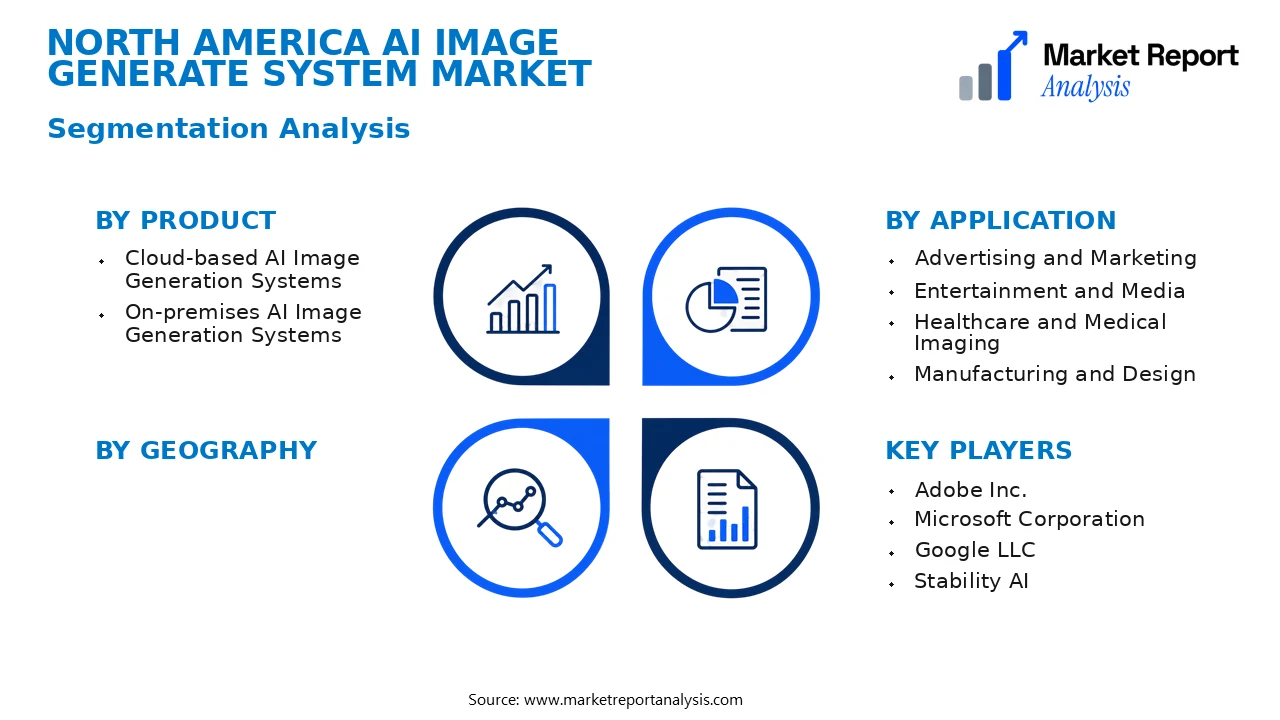
- Product
- Cloud-based AI Image Generation Systems: These systems leverage cloud infrastructure to provide scalable, accessible image generation solutions suitable for large-scale enterprises and remote users, fostering widespread adoption across diverse sectors.
- On-premises AI Image Generation Systems: These are installed locally within organizational data centers, favored by clients with strict data security requirements and regulatory compliance needs, often in government, healthcare, and financial institutions.
- Application
- Advertising and Marketing: Utilization of AI-generated images to create engaging promotional content, reducing production costs and turnaround time, and enabling rapid campaign iterations for businesses seeking innovative advertising solutions.
- Entertainment and Media: Deployment of AI systems for creating realistic visual effects, game design, and digital content, supporting creative industries in producing high-quality imagery efficiently and economically.
- Healthcare and Medical Imaging: AI image generation aids in training simulations, diagnostics, and visualization of complex medical data, facilitating precision medicine and improving diagnostic accuracy.
- Manufacturing and Design: Integration of AI-generated visuals in product design, prototyping, and virtual testing, accelerating innovation cycles and reducing the costs associated with physical prototypes.
- End User
- Large Enterprises: These entities utilize AI image generation for diverse applications such as advertising, virtual reality, and product design, often requiring customized and scalable solutions to meet extensive operational needs.
- Small and Medium-sized Businesses (SMBs): Growing segment adopting AI tools for branding, digital marketing, and content creation to compete effectively in digital spaces with limited budgets.
- Creative Agencies and Content Creators: Leverage AI-generated images to produce visionary and unique content quickly, boosting productivity and creative output in advertising, entertainment, and multimedia projects.
- Educational and Research Institutions: Use AI image generation systems for academic purposes, research, and developing new AI algorithms, contributing to advancements in AI capabilities and applications.
The segmentation hierarchy illustrates the multifaceted nature of the North America AI Image Generate System market, emphasizing product types, application fields, and end-user classifications. These segments reflect the diverse demand drivers and technological evolutions within the region, highlighting opportunities for tailored strategies and innovations.
Competitive Intelligence
The North America AI Image Generate System Market is characterized by high competition with several key players, including industry giants and innovative startups, vying for market share. Market concentration tends to be moderate, as both large firms and smaller entrants contribute significantly to the landscape, with dominant players leveraging extensive R&D investments to maintain competitiveness. Business strategies hinge on product differentiation through advanced image quality, customization, and faster processing times, alongside aggressive partnerships with technology providers and creative agencies to expand application scopes. Several companies are actively executing acquisitions to enhance their technological capabilities and expand their geographic presence, particularly targeting emerging markets within North America. Expansion strategies also involve launching new AI models, integrating complementary technologies such as AR/VR, and forming strategic alliances with cloud service providers to improve scalability and accessibility. R&D investments are substantial, focused on improving AI algorithms, reducing bias, and achieving higher resolution outputs to differentiate offerings. Such innovations ensure companies remain competitive, addressing evolving customer needs and capturing higher-value market segments.
Leading Company Profiles
The North American AI image generate system market hosts a competitive landscape featuring prominent technology firms that innovate through advanced AI algorithms, strategic collaborations, and diverse product portfolios aimed at various industry segments.
- Adobe Inc.
- Microsoft Corporation
- Google LLC
- Stability AI
- OpenAI
- NVIDIA Corporation
- Corel Corporation
- Autodesk Inc.
- IBM Corporation
- Amazon Web Services (AWS)
Adobe Inc.
Adobe leads with its Adobe Photoshop and Adobe Creative Cloud suite, integrating AI-powered image generation tools that leverage Adobe Sensei technology, focusing on enhancing creative workflows and digital content creation.
Microsoft Corporation
Microsoft emphasizes its Azure AI platform combined with integrations of OpenAI models, aiming to provide scalable, enterprise-grade AI image generation solutions tailored to diverse business needs and creative applications.
Google LLC
Google advances its AI capabilities through Google Cloud's Vertex AI and DeepMind, delivering robust image synthesis solutions for developers, researchers, and enterprises focused on innovation and scalability in digital content creation.
Stability AI
Stability AI specializes in open-source AI models, notably Stable Diffusion, providing customizable, accessible image generation tools designed for creative industries, researchers, and individual users seeking flexible AI solutions.
OpenAI
OpenAI focuses on its DALL·E platform, offering advanced text-to-image generation capabilities that are integrated into broader AI ecosystems, targeting both enterprise and consumer markets with cutting-edge innovation.
NVIDIA Corporation
NVIDIA leverages its GPU technology and deep learning frameworks to advance AI image synthesis, emphasizing real-time rendering, professional visualization, and creative content ecosystems for media, entertainment, and research sectors.
Corel Corporation
Corel incorporates AI features into its graphic design and photo editing products, primarily targeting creative professionals with easy-to-use tools that enhance productivity through intelligent image enhancement and generation.
Autodesk Inc.
Autodesk integrates AI-driven image generation into its design and engineering software, facilitating better visualization, simulation, and virtual prototyping to support architects, engineers, and product designers.
IBM Corporation
IBM combines its AI Watson platform with image generation solutions to serve enterprise clients, emphasizing data security, bespoke customization, and integration into existing enterprise ecosystems for diverse applications.
Amazon Web Services (AWS)
AWS offers AI-powered image generation services within its cloud ecosystem, focusing on scalability, reliability, and seamless integration with other AWS cloud solutions for commercial, research, and development applications.
Strategic Business Developments
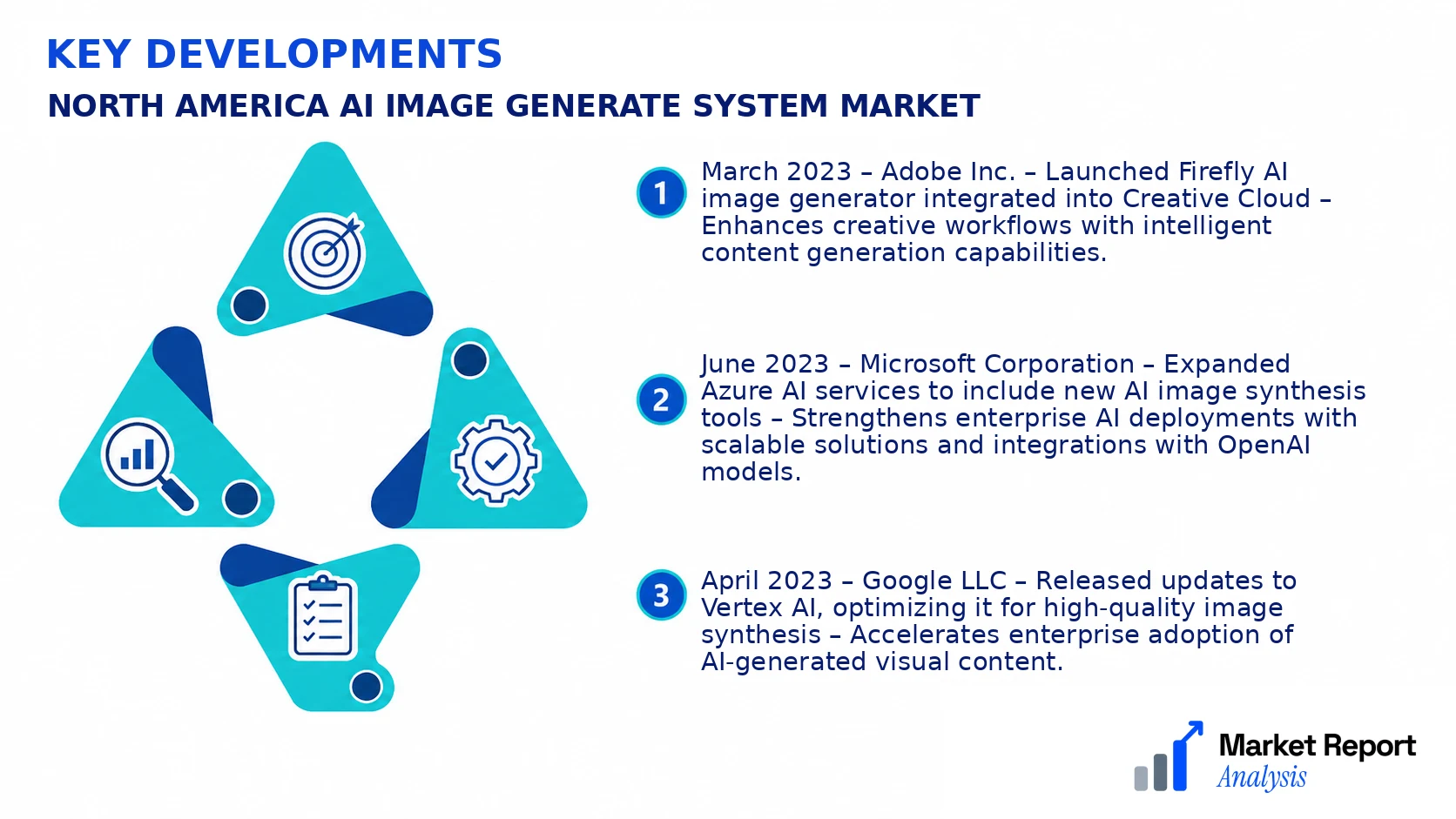
- March 2023 – Adobe Inc. – Launched Firefly AI image generator integrated into Creative Cloud – Enhances creative workflows with intelligent content generation capabilities.
- June 2023 – Microsoft Corporation – Expanded Azure AI services to include new AI image synthesis tools – Strengthens enterprise AI deployments with scalable solutions and integrations with OpenAI models.
- April 2023 – Google LLC – Released updates to Vertex AI, optimizing it for high-quality image synthesis – Accelerates enterprise adoption of AI-generated visual content.
- August 2023 – Stability AI – Announced release of Stable Diffusion 3.0, offering improved realism and customization options – Boosts its position in open-source creative AI tools market.
- May 2023 – OpenAI – Introduced DALL·E 3 with enhanced prompt understanding and output quality – Expands its AI image generation leadership and user engagement across platforms.
Frequently Asked Questions
What is the North America AI Image Generate System Market?
The North America AI Image Generate System Market encompasses the use of artificial intelligence for generating images across various industries, including entertainment, marketing, and design, with increasing adoption driven by technological advances and demand for automated creative solutions.
What is the current market size of North America AI Image Generate System Market?
As of 2026, the market size is valued at approximately USD 3.2 Billion, reflecting substantial growth from prior years driven by expanding AI applications and rising investment in innovative image generation technologies across North America.
What factors are driving the North America AI Image Generate System Market?
Growth is fueled by technological breakthroughs in AI and machine learning, increasing digital content creation demand, and applications in entertainment, advertising, and virtual reality. Additionally, rising investments and collaborations among tech giants further propel market expansion.
Which region dominates the North America AI Image Generate System Market?
The United States leads the North American market due to its advanced technological infrastructure, strong presence of key AI companies, and high adoption rates across various sectors, making it the dominant region in terms of market share and innovation.
Which segment is expected to grow the fastest?
The consumer entertainment segment, particularly digital art creation and social media content, is projected to grow rapidly, driven by increasing consumer demand for personalized and visually appealing content utilizing AI-generated images.
Who are the leading companies operating in the North America AI Image Generate System Market?
Leading players include NVIDIA, Adobe, and Google, which are pioneering AI image generation tools and platforms, alongside startups and tech giants collaborating on innovative solutions to capture market share and enhance competitive advantage.
Analyst Perspective
The North America AI Image Generate System Market is poised for sustained growth, driven by technological advancements and expanding industrial applications. In the long term, market maturity is expected to stabilize competitive dynamics, emphasizing differentiation through innovation and service integration. Commercial opportunities will increasingly focus on sectors such as entertainment, advertising, and healthcare, where high visual fidelity and customization are crucial. As AI algorithms evolve, particularly in deep learning and neural network architectures, the technology’s sophistication and usability will improve, fostering broader adoption. Investment priorities should target R&D for advanced model development and scalable deployment infrastructure, ensuring competitive edge and resilience. Regional growth potential remains robust, especially in the US and Canada, where innovation ecosystems and digital transformation initiatives are strong. However, market entrants must navigate intellectual property constraints and ethical considerations, which could influence technological trajectories. Overall, strategic positioning will depend on balancing innovation investment with regulation awareness and regional market needs, ensuring sustainable growth and technological leadership.
