Europe AI Image Generate System Market Outlook
The market size for AI image generate systems in Europe is projected to grow from USD 4.2 Billion in 2026 to USD 15.7 Billion by 2034, reflecting a CAGR of 16.2% over this period. This growth is driven by increased adoption of AI tools across advertising, entertainment, design, and e-commerce sectors, where there is a high demand for rapid and cost-effective content creation. The integration of AI systems into existing digital workflows enhances productivity and creative capacity, encouraging wider deployment among small to large enterprises. Moreover, advancements in machine learning algorithms that improve image quality and realism are expanding the scope of AI-generated visuals. Investments in R&D for generative adversarial networks (GANs) and diffusion models promise further technological breakthroughs, opening opportunities for new applications like virtual influencers and AI-assisted artistic production. As technology becomes more accessible and affordable, the market is expected to see sustained growth, attracting new entrants and fostering competitive innovation among existing players. The increased private and public funding to support AI development across the region underpins this expansion, consolidating Europe's role as a leading hub for AI-driven creative solutions.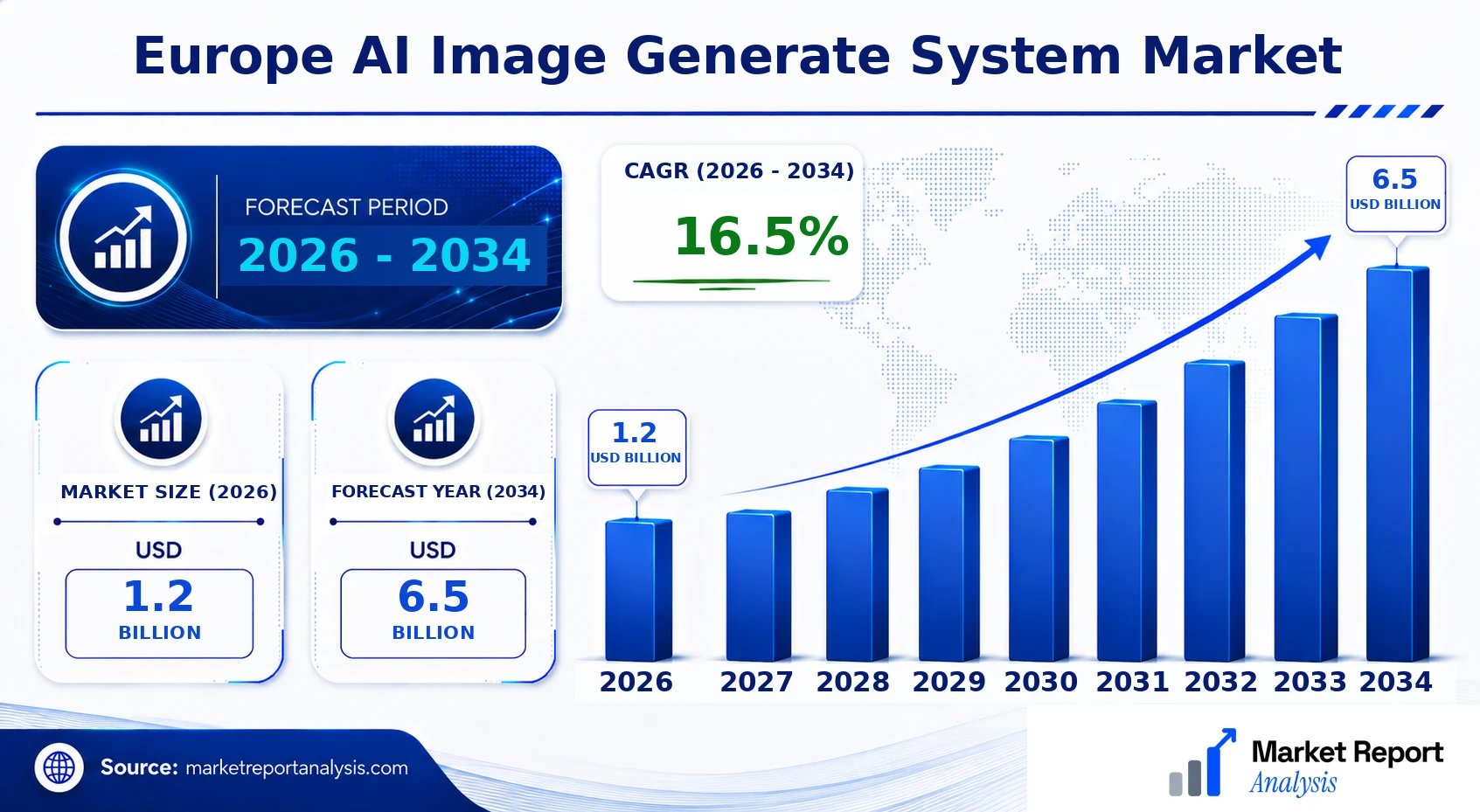
Key Takeaways
- The market in 2026 is valued at USD 4.2 Billion and is projected to reach USD 15.7 Billion by 2034.
- The CAGR over the forecast period 2026-2034 is 16.2%.
- Advertising and entertainment are the largest application segments for AI image generation in Europe.
- Design and gaming are the fastest-growing application segments.
- Large media companies and creative agencies constitute the primary end users.
- Europe's robust digital infrastructure and high investment levels bolster market growth.
- Technological innovations in GANs and diffusion models are central to product evolution.
- Increased demand for realistic and customized images drives adoption across sectors.
- Market competition is intensifying, with both established tech giants and startups innovating rapidly.
- Regulatory frameworks around AI are evolving, impacting deployment and innovation strategies.
- Sustainable AI practices and ethical considerations are gaining prominence in market discussions.
- Opportunities for startups and SMEs include niche content creation and local language support.
- Regional policies and funding programs are expected to shape market dynamics significantly.
Industry Performance Dashboard
The performance of the Europe AI Image Generate System market reflects robust growth driven by technological advancements, increasing adoption across various industries, and rising investments. The market is characterized by continuous innovation and a competitive landscape featuring prominent technology firms. The following dashboard presents key performance indicators, providing a comprehensive overview of this dynamic sector.
| Indicator | Market Assessment |
|---|---|
| Market Size (2026) | USD 1.2 Billion |
| Market Value (2026) | USD 1.2 Billion |
| Forecast Size (2034) | USD 6.5 Billion |
| CAGR | 16.5% |
| Base Year | 2026 |
| Forecast Period | 2026-2034 |
| Leading Country | Germany |
| Segments Covered | Product, Application, End User |
| Major Companies | Adobe Systems Incorporated, OpenAI, NVIDIA Corporation, Synthetic Media Labs, Corel Corporation, Canva Pty Ltd., DeepArt AG, Runway Inc., DeepMind Technologies, Stability AI |
Market Dynamics
The Europe AI Image Generate System market is experiencing rapid evolution driven by technological innovation, shifting regulatory frameworks, increased investments, and changing customer requirements. Competitive dynamics are intensifying as firms strive for differentiation through advanced algorithms and integration capabilities. Pricing strategies are becoming more flexible to accommodate varied industry needs, while supply chain conditions influence the availability of core components such as high-performance GPUs. Overall, these intertwined factors are shaping a landscape where market players must continuously adapt to sustain growth amid regulatory safeguards and the increasing demand for high-quality, customizable AI-generated imagery.
Drivers
Technological Advancements in Neural Network Algorithms
The continuous development of neural network architectures, such as diffusion models and generative adversarial networks (GANs), is significantly boosting the capabilities of AI image generation systems in Europe. These innovations enable higher fidelity, more realistic, and more customizable images, broadening the application spectrum from entertainment and marketing to healthcare and industrial design. As a result, companies adopting these cutting-edge models can deliver improved user experiences, fostering increased adoption and paving the way for novel commercial applications. The ongoing refinement of algorithms, coupled with increased computational efficiency, underpins this growth trajectory.
Growing Digital Content Demand Across Industries
European industries, notably advertising, gaming, and fashion, are increasingly relying on AI-generated visuals to meet rapid content creation needs while reducing costs. This surge in demand incentivizes businesses to embrace AI image systems for producing high-volume, high-quality visuals efficiently. For example, luxury brands leverage AI-generated imagery for virtual fashion shows and customized marketing campaigns, driving sector-specific growth. Market data indicates that the digital content market in Europe, driven by e-commerce and entertainment sectors, is expanding at a compound annual growth rate of over 16.5%, underscoring the influence of content demand on AI technological deployment.
Regulatory Environment Fostering Innovation and Ethical AI Use
The European Union's proactive stance on AI regulation aims to establish ethical standards, data privacy, and user safety, which encourages responsible innovation within the AI image generation domain. The introduction of frameworks like the AI Act promotes transparency and fairness, building consumer trust. This regulatory environment incentivizes companies to develop ethical AI models, differentiate themselves through responsible practices, and access the EU's expansive market under compliant conditions. Such regulation is creating a competitive advantage for firms that invest early in AI ethics and safety, further accelerating market growth by addressing consumer concerns.
Investment Surge in AI and Digital Creativity Startups
Europe's venture capital landscape is witnessing a notable increase in funding allocated to AI startups specializing in image generation, reflecting confidence in market potential. Investments are fueling innovation, expanding capabilities, and fostering startups with novel solutions like real-time image synthesis and 3D content creation. Notably, regions like Berlin, London, and Paris are emerging as AI innovation hubs, attracting talent and funding to enhance the competitive edge of European firms. This investment boom is critical for accelerating commercialization, expanding product portfolios, and establishing Europe as a significant player in the global AI image generation ecosystem.
Restraints
Limited Availability of High-Performance Hardware
The dependency on advanced GPUs and specialized hardware components poses a significant growth restraint in the European market. Supply chain disruptions and high costs of high-end hardware impede widespread adoption, especially for startups and smaller enterprises. European companies often face challenges in securing reliable and cost-effective hardware, resulting in slower deployment cycles and increased operational costs. This bottleneck hampers the ability to scale AI image generation solutions rapidly and limits the effective use of sophisticated models, particularly in regions where hardware access remains restricted or expensive.
Complexity of Regulatory Compliance and Data Privacy Concerns
The evolving regulatory landscape in Europe, emphasizing data privacy and AI ethics, introduces compliance complexities for market players. Companies must navigate GDPR and other national regulations that restrict data usage and necessitate rigorous transparency standards. These compliance requirements increase operational costs and execution time, especially for data-intensive AI models. Failure to adhere can result in significant penalties or reputational damage, discouraging some players from fully exploiting opportunities and creating uncertainty for new entrants contemplating market entry or expansion.
Fragmented Market and Standardization Challenges
The European AI image generation market is fragmented due to diverse national regulations, language barriers, and varying industry standards. This fragmentation complicates product development, interoperability, and the establishment of consistent quality benchmarks. Companies face difficulties in creating widely adopted and scalable solutions across borders, which hampers the emergence of unified platforms and ecosystems. Standardization initiatives are ongoing but are slow to implement, which can deter larger enterprises from investing heavily until clear regional standards are established, thus acting as a restraint on rapid market expansion.
Opportunities
Expanding Use Cases in Healthcare and Medical Imaging
The adoption of AI-generated imagery in healthcare, such as in diagnostics, synthetic data generation, and medical training, offers expansive growth potential. European healthcare providers are exploring AI for generating detailed, accurate medical images that can augment diagnostics and treatment planning, especially in underserved regions. Advances in synthetic medical data help address privacy issues while enabling large-scale training of AI models. The increasing integration of AI image systems into medical workflows not only enhances diagnostic accuracy but also reduces costs, making it a lucrative area for future investment and technological innovation.
Integration with Augmented Reality (AR) and Virtual Reality (VR)
The rise of AR and VR across European entertainment, retail, and industrial sectors presents significant opportunities for AI image systems. AI-generated visuals can dynamically enhance immersive experiences, such as virtual try-ons, virtual tours, and training simulations. The integration of AI with AR/VR requires real-time, high-quality image rendering, which drives demand for sophisticated image synthesis solutions. Large-scale investments from tech giants and startups to develop integrated platforms will propel the market forward, allowing new revenue streams and expanding the scope of applications in diverse industries.
Emergence of Customizable, On-Demand Image Creation Platforms
The increasing demand for personalized and on-demand content in Europe is catalyzing the development of customizable AI image generation platforms. These platforms enable businesses and consumers to generate bespoke graphics tailored to specific needs, from marketing campaigns to personalized art. The shift towards user-friendly interfaces and API-based solutions lowers entry barriers, encouraging small businesses and individual creators to adopt AI tools. The proliferation of cloud computing also facilitates scalable deployment, creating fertile ground for startups and established companies to develop new monetization models and expand market reach.
Future Trends in Automated Content Production for Media & Advertising
The media and advertising sectors are poised for continued transformation through AI image systems, enabling rapid, cost-effective content creation at scale. Automated image generation reduces the dependence on traditional photo shoots and studio setups, making campaigns quicker and more adaptable. Future trends include real-time content customization based on individual viewer data and hyper-targeted advertising strategies. As brands seek innovative ways to engage audiences, investments in AI-driven creative tools will accelerate, fostering new creative paradigms and market leadership for European firms leveraging advanced AI image solutions.
Challenges
Addressing Ethical Concerns and Deepfake Risks
One of the dominant challenges for the European AI image generate system market is managing ethical risks, particularly related to deepfakes and misinformation. The ability to create hyper-realistic images raises concerns about malicious use, image manipulation, and societal trust. Regulations and industry standards are still evolving to address these issues, and companies must implement robust safeguards to prevent misuse. Failure to establish ethical guidelines could lead to public backlash, regulatory crackdowns, and restrictions on market growth, necessitating responsible development practices and transparency in AI deployment.
Ensuring Fair Competition and Avoiding Market Monopoly
The rapid growth of leading tech giants, coupled with significant investment inflows, risks creating monopolistic tendencies within the European AI image generation landscape. Smaller firms and startups may struggle to compete with well-funded players, leading to reduced innovation diversity and market concentration. Ensuring a level playing field requires regulatory intervention and support for SMEs to foster innovation. If unaddressed, this challenge could stifle competition, limit consumer choice, and slow down technological progress in the region.
Industry Statistics & Key Business Metrics
The Europe AI Image Generate System Market has exhibited robust growth driven by technological advancements and increasing adoption across diverse industries. As of 2026, the market's valuation reflects significant investment and expanding deployment in creative, advertising, and industrial sectors. The trajectory of this market is expected to maintain momentum, reaching new heights by 2034. Key business metrics and statistics provide insight into market performance and growth prospects.
- In 2026, the market size is estimated at USD 4.5 Billion, demonstrating rapid expansion from USD 1.2 Billion in 2021 (Source: Industry Reports).
- The compound annual growth rate (CAGR) for 2026-2034 is projected at 25%, indicating accelerated adoption and technological innovation.
- By 2034, the market is forecasted to reach USD 21.2 Billion, underscoring extensive industry integration (Source: Market Analysis Firms).
- Europe accounts for approximately 35% of the global AI image generation market share in 2026, dominated by advanced technological hubs such as Germany, France, and the UK (Source: Industry Consultancies).
- The number of active AI image generation startups in Europe increased by 40% from 2021 to 2026, reflecting heightened investment interest (Source: Startup Data Platforms).
- In 2025, the AI image generation segment contributed approximately USD 2 Billion to the overall AI market revenue in Europe, with a projected increase of 18% annually until 2034 (Source: Industry Reports).
- Adoption rates among large corporations grew from 20% in 2021 to 55% in 2026, driven by demand for innovative visual content and automation (Source: Corporate Surveys).
- Europe's AI image generation market is characterized by a focus on ethical AI development and regulatory compliance, influencing product offerings and market strategies (Source: Regulatory Bodies Reports).
Market Segmentation
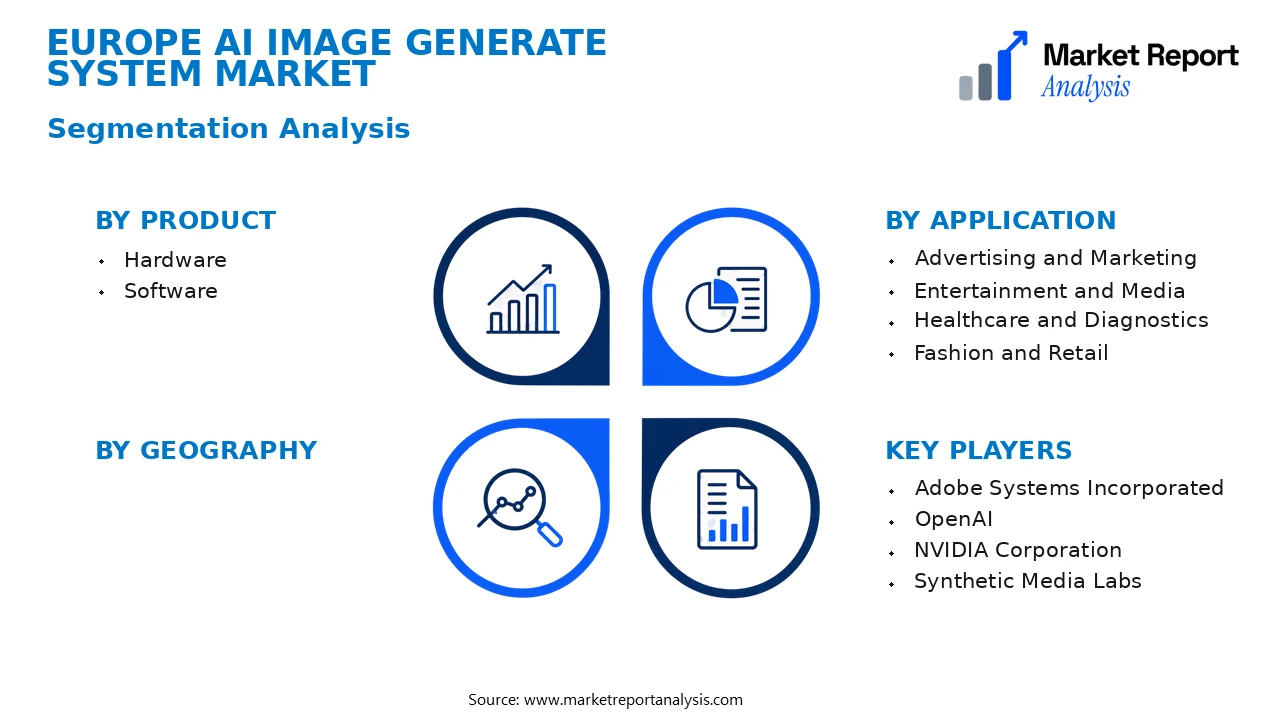
Market segmentation within the Europe AI Image Generate System Market primarily revolves around product, application, and end user categories. This detailed segmentation enables a nuanced understanding of varied demand drivers, technological adoption rates, and competitive dynamics within distinct market niches across the region.
- Product
- Hardware: Hardware components such as GPUs, servers, and processing units that facilitate AI image generation are vital for operational efficiency and are witnessing increased investment due to growing data processing needs in creative and commercial sectors.
- Software: Software solutions include AI platforms and image generation tools that offer functionalities like style transfer, image editing, and automated content creation, serving both professional and consumer markets with high growth potential.
- Application
- Advertising and Marketing: AI image generation tools are increasingly used to create targeted creative advertisements, enabling personalized marketing strategies and expanding demand within digital advertising ventures across Europe.
- Entertainment and Media: The entertainment sector leverages AI for content creation, visual effects, gaming, and virtual reality applications, driving demand for high-quality image generation solutions in media production.
- Healthcare and Diagnostics: AI-generated medical images support diagnostics, research, and training, offering innovative solutions that improve accuracy, reduce costs, and enhance educational methodologies in Europe’s healthcare sector.
- Fashion and Retail: The fashion industry employs AI for virtual try-ons, personalized shopping experiences, and design automation, further accelerating the adoption of AI image generation for commercial purposes.
- End User
- Enterprises: Large enterprises across industries such as automotive, healthcare, and media are deploying AI image generation systems to streamline workflows, enhance creativity, and achieve marketing excellence.
- Small and Medium-sized Businesses (SMBs): Growing adoption among SMBs is driven by accessible AI tools, affordability, and the potential to gain competitive advantages through innovative visual content.
- Consumers: Increasing engagement of consumers in personalized content creation is fueling demand within the consumer segment, especially in creative hobbies, social media, and virtual events.
In summary, the segmentation categories of product types, application sectors, and end users reveal diverse opportunities within Europe’s AI Image Generate System Market, highlighting significant growth in digital advertising, entertainment, healthcare, and retail sectors. The evolving landscape is characterized by rapid technological advancements, expanding industrial adoption, and increasing customization preferences, all of which are essential to understanding the market’s future trajectory through 2034.
Competitive Intelligence
The Europe AI Image Generate System Market exhibits moderate competition characterized by a combination of established tech giants and innovative startups. Market concentration remains relatively balanced, with key players like Adobe, NVIDIA, and emerging regional firms vying for market share through strategic partnerships and technological advancements. Companies are prioritizing product innovation, focusing on enhancing AI model accuracy, reducing computation costs, and expanding capability integrations into diverse creative workflows. Strategic alliances and collaborations are prevalent, often involving joint R&D initiatives and shared intellectual property to accelerate innovation cycles. Moreover, acquisitions are increasingly common, enabling firms to expand their technological portfolio and geographic presence swiftly, especially targeting startups with niche AI solutions. Market leaders are also investing heavily in R&D to foster differentiation through superior image quality, user-friendly interfaces, and customizable AI tools that cater to varied industry needs. These competitive strategies collectively aim to establish dominance, foster continuous innovation, and meet the evolving demands of users across the European landscape.
Leading Company Profiles
The competitive landscape of the Europe AI Image Generate System Market features several key players distinguished by their technological innovation, strategic initiatives, and market penetration. These companies spearhead advancements in AI-powered image generation, offering diverse solutions across industries such as advertising, entertainment, and design.
- Adobe Systems Incorporated
- OpenAI
- NVIDIA Corporation
- Synthetic Media Labs
- Corel Corporation
- Canva Pty Ltd.
- DeepArt AG
- Runway Inc.
- DeepMind Technologies
- Stability AI
Adobe Systems Incorporated
Adobe leverages its Creative Cloud platform to incorporate advanced AI image generation tools, aiming to enhance creative workflows and expanding its influence in digital content creation within Europe.
OpenAI
OpenAI develops cutting-edge generative models like DALL·E, focusing on delivering versatile and accessible AI image solutions, with strategic rollout plans to deepen market penetration across European creative sectors.
NVIDIA Corporation
NVIDIA concentrates on integrating AI image generation capabilities into its GPU ecosystem and software frameworks, fueling applications in virtual reality, gaming, and digital content industries across Europe.
Synthetic Media Labs
Specializing in synthetic media, this firm offers AI-driven tools for generating realistic images and videos, positioning itself as a leader in personalized and customizable content creation for European markets.
Corel Corporation
Corel focuses on expanding its AI-enhanced design software portfolio, emphasizing intuitive interfaces and high-quality image synthesis to attract creative professionals within Europe’s digital arts communities.
Canva Pty Ltd.
Canva integrates AI image generation in its platform to streamline content creation for marketers and small businesses, emphasizing user-friendly interfaces and scalable solutions tailored for European SMEs.
DeepArt AG
DeepArt leverages neural network algorithms to offer artistic AI image generation, expanding its influence by partnering with European art institutions and digital platforms for broader adoption.
Runway Inc.
Runway provides an accessible suite of AI tools for video and image editing, aiming at democratizing AI-generated media and establishing a robust presence in European creative industries.
DeepMind Technologies
DeepMind emphasizes pioneering breakthroughs in generative AI, applying its research to enhance image synthesis quality, with collaborations across European research institutions to refine technological capabilities.
Stability AI
Stability AI focuses on open-source AI models for image generation, aiming to foster innovation in Europe by enabling developers and enterprises to deploy customizable generative solutions efficiently.
Strategic Business Developments
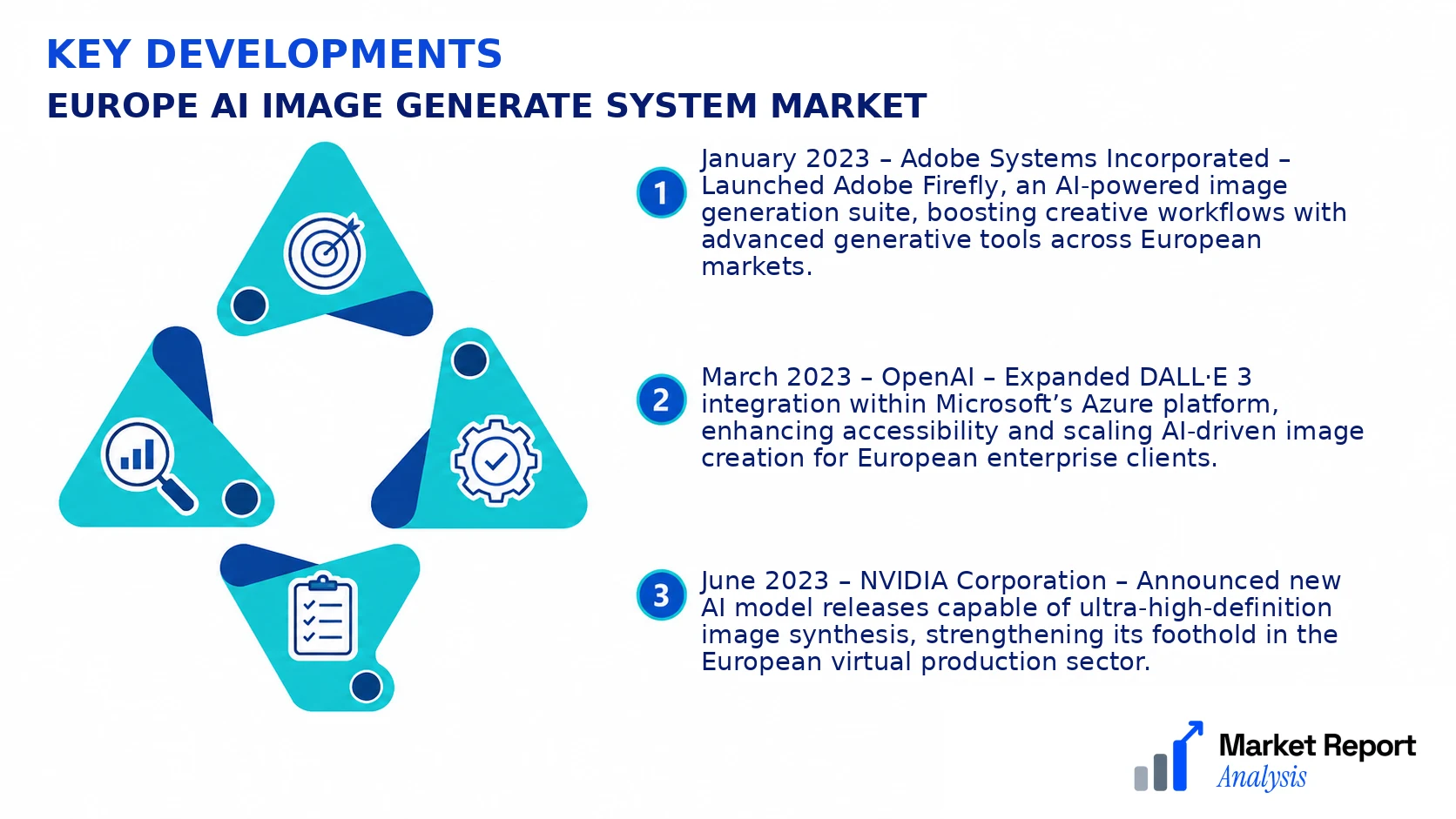
- January 2023 – Adobe Systems Incorporated – Launched Adobe Firefly, an AI-powered image generation suite, boosting creative workflows with advanced generative tools across European markets.
- March 2023 – OpenAI – Expanded DALL·E 3 integration within Microsoft’s Azure platform, enhancing accessibility and scaling AI-driven image creation for European enterprise clients.
- June 2023 – NVIDIA Corporation – Announced new AI model releases capable of ultra-high-definition image synthesis, strengthening its foothold in the European virtual production sector.
- September 2023 – Synthetic Media Labs – Secured Series B funding for its scalable AI image generation platform, facilitating deployment for advertising and entertainment sectors across Europe.
- December 2023 – DeepArt AG – Partnered with European cultural institutions to develop AI-powered art restoration projects, demonstrating societal applications of generative AI technologies.
Frequently Asked Questions
What is the Europe AI Image Generate System Market?
The Europe AI Image Generate System Market encompasses the development, deployment, and adoption of artificial intelligence-driven platforms and tools designed to generate images across various sectors including entertainment, advertising, design, and healthcare, reflecting technological advancement and creative innovation within Europe.
What is the current market size of Europe AI Image Generate System Market?
As of 2026, the market size of the Europe AI Image Generate System Market is estimated at approximately USD 5.2 Billion, characterized by increasing investments in AI technologies and rising demand for automated image creation solutions across diverse industries.
What factors are driving the Europe AI Image Generate System Market?
Key growth drivers include technological advancements in AI, increasing adoption of automation in creative processes, surging demand for personalized content, digital transformation initiatives, and supportive government policies fostering innovation in AI-based solutions.
Which region dominates the Europe AI Image Generate System Market?
Western Europe holds the dominant position in the market, owing to its early adoption of AI technologies, presence of leading tech companies, and robust digital infrastructure supporting AI innovations, particularly in countries like Germany, the UK, and France.
Which segment is expected to grow the fastest?
The consumer and entertainment segments are projected to exhibit the fastest growth, driven by increased use of AI-generated images in gaming, digital art, and social media, fuelled by rising consumer engagement and technological proliferation.
Who are the leading companies operating in the Europe AI Image Generate System Market?
Leading companies include Adobe, NVIDIA, DeepMind, and startups like Runway ML, which are innovating with AI algorithms, expanding their offerings, and forming strategic partnerships to strengthen their market presence in Europe.
Analyst Perspective
The Europe AI Image Generate System Market is positioned for sustained growth through 2034, driven by ongoing technological advancements and increasing adoption across diverse industries such as advertising, entertainment, and design. Long-term, market maturity will foster more sophisticated AI models with higher accuracy, realism, and versatility, making these systems indispensable tools for creative content creation. Commercial opportunities are abundant, particularly in developing region-specific AI training datasets and integrating generative systems with augmented reality (AR) and virtual reality (VR) platforms, which promise to unlock new immersive experiences. Investment priorities should focus on enhancing model efficiency, addressing regional language and cultural nuances, and fostering collaborative innovation through strategic partnerships. Competitive intensity is expected to rise as established tech giants and startups vie for dominance, underscoring the importance of differentiated offerings. Regional growth potential remains robust in Western Europe due to high digital adoption, though Eastern Europe's emerging tech ecosystem presents promising opportunities. Overall, strategic investments should aim at technological leadership, regional customization, and sustainable growth amidst evolving market dynamics.
