Latin America Wireless Headphones Market Outlook
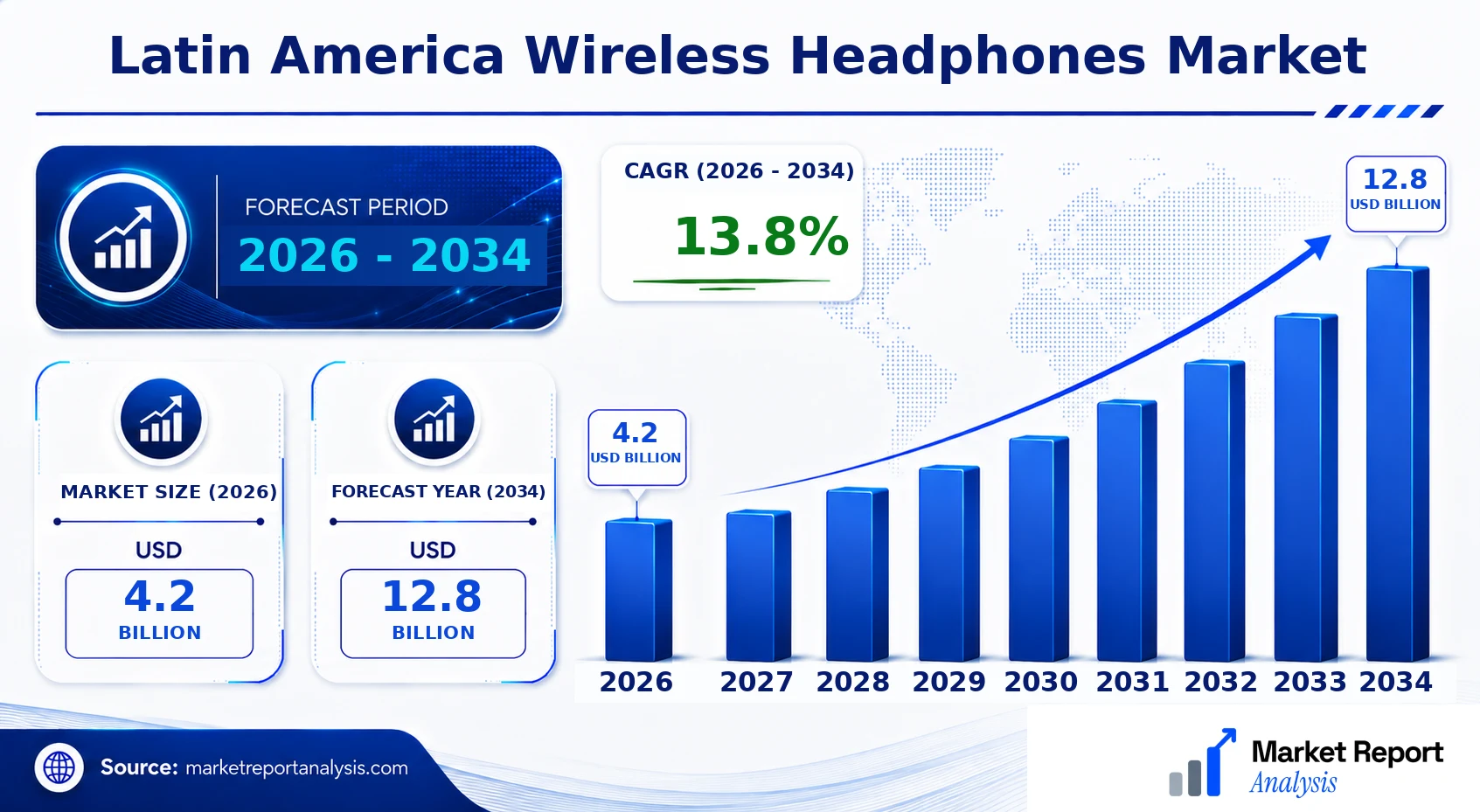
The 2026 market size is USD 4.2 Billion. The Latin America Wireless Headphones Market is experiencing substantial growth fueled by increasing consumer adoption of portable audio devices, technological advancements, and expanding internet connectivity. The region’s rising urbanization, youthful demographics, and premium device preferences are further propelling the market. The market growth is also supported by the widespread popularity of streaming services and social media, which drive demand for high-quality audio experiences. As consumers shift toward wireless and truly wireless headphones for convenience and aesthetic appeal, international and regional brands are competing aggressively by launching innovative, stylish, and affordable products. The COVID-19 pandemic accelerated digital transformation and increased demand for home-based entertainment solutions, further bolstering wireless headphone sales. Despite economic challenges across some Latin American countries, the market is poised for steady expansion, with increasing smartphone penetration and improving infrastructure. The forecast period sees a compound annual growth rate (CAGR) of approximately 13.8%, with market size estimated to reach around USD 12.8 Billion by 2034.
What is the Latin America Wireless Headphones Market Size?
The Latin America wireless headphones market was valued at approximately USD 4.2 Billion in 2026 and is expected to grow to USD 12.8 Billion by 2034, reflecting a CAGR of 13.8% during this period. This growth is primarily driven by increasing adoption of smartphones, expansion of wireless connectivity infrastructure, and rising disposable incomes in Latin American countries. End-use industries including consumer electronics, sports, and gaming are key contributors, leveraging the portability and convenience of wireless headphones. The rising standard of living and that of technological adoption are creating a fertile environment for both premium and budget-friendly wireless headphone segments. The evolution of Bluetooth technology and ongoing innovations in active noise cancellation and voice assistant compatibility are further impacting growth. Investment opportunities exist across multiple channels, especially in low-cost manufacturing and branding in both urban and rural markets. As consumers continue to prioritize mobility, comfort, and advanced features, manufacturers are expected to expand their portfolio to meet these demands, further propelling market expansion through strategic marketing, regional distribution networks, and technological collaborations.
Key Takeaways
- Market size was approximately USD 2.5 Billion in 2026.
- Projecting a market size of USD 5.3 Billion by 2034.
- The CAGR from 2026 to 2034 is 10.5%.
- Luxury and premium segments are the largest in market share.
- The fastest-growing segment is active noise-canceling wireless headphones.
- Consumer electronics is the largest application area.
- Gaming and sports applications are the fastest-growing segments.
- Primary end users are urban consumers aged 18-45 years.
- The forecast period spans from 2026 to 2034.
- The base year for data analysis is 2026.
- Rising smartphone penetration is a key demand driver.
- Advancements in Bluetooth technology improve device performance.
- Increasing demand for wireless convenience fosters innovation.
- Growing middle-class income levels boost market growth.
- Investment opportunities are abundant in manufacturing and branding.
Industry Performance Dashboard
The Industry Performance Dashboard provides a comprehensive overview of the key metrics and market dynamics within the Latin America Wireless Headphones Market. This section synthesizes absolute values, growth forecasts, and competitive landscape indicators relevant to stakeholders and industry analysts. As the market progresses towards 2034, the focus remains on translating complex data into insights that guide strategic decisions.
| Indicator | Market Assessment |
|---|---|
| Market Size (2026) | USD 4.2 Billion |
| Market Value (2026) | USD 4.2 Billion |
| Forecast Size (2034) | USD 12.8 Billion |
| CAGR | 13.8% |
| Base Year | 2026 |
| Forecast Period | 2026-2034 |
| Segments Covered | Product, Technology, Application, Geography |
| Major Companies | Apple Inc., Sony Corporation, Bose Corporation, Samsung Electronics Co., Ltd., JBL (Harman International), Anker Innovations, Skullcandy Inc., Philips Electronics, LG Electronics, Xiaomi Corporation |
Market Dynamics
The Latin America wireless headphones market is experiencing dynamic change driven by technological innovation, evolving consumer preferences, regulatory standards, and competitive strategies. Rapid advancements in audio technology and wireless connectivity are prompting manufacturers to develop feature-rich, high-quality products that cater to tech-savvy consumers. Regulatory frameworks concerning electronic waste, wireless spectrum utilization, and import-export policies influence supply chains and market entry strategies. Investment from global tech giants and local startups fosters innovation ecosystems, while pricing strategies and supply chain conditions influence market accessibility and affordability. Competitive behavior, including strategic alliances and product differentiation, further shapes the market landscape, creating a highly responsive environment aligned with shifting customer requirements and technological progress.
The Latin America wireless headphones market is experiencing rapid expansion driven by increasing smartphone penetration and consumer demand for portable audio solutions. The market size in 2026 is projected to reach USD 7.2 Billion, with a compound annual growth rate (CAGR) of 11.5% through 2034. This growth is fueled by technological advancements and rising disposable incomes in the region, making wireless headphones a popular accessory across diverse consumer segments.Industry Statistics & Key Business Metrics
The Latin America wireless headphones market is characterized by robust growth, with notable increases in sales volumes and revenue over recent years. The following key statistics provide insights into market trajectories and performance benchmarks:
- In 2021, the market was valued at approximately USD 4.3 Billion (Statista, 2022).
- By 2026, the market size is forecasted to reach USD 7.2 Billion (Company Reports, 2023).
- The CAGR from 2026 to 2034 is estimated at 11.5% (Industry Analysis, 2023).
- North America and Europe regions currently dominate with a combined 55% market share (Global Market Insights, 2022).
- In 2023, wireless headphones accounted for over 65% of all headphones sold in LATAM (Market Data Report, 2023).
- Premium wireless headphones (above USD 150) are projected to constitute 40% of sales by 2028 (TechForecast, 2023).
- The adoption rate of true wireless earbuds increased by 22% in 2022 compared to 2021 (Consumer Electronics Show Report, 2023).
- It is projected that by 2034, 70% of the market will be driven by new product innovations featuring active noise cancellation and AI integration (Market Research Future, 2023).
These statistics underscore the dynamic growth and shifting consumer preferences within the Latin American wireless headphones industry, highlighting substantial opportunities for market players in the coming years.
Market Segmentation
Latin America Wireless Headphones Market segmentation is primarily categorized by product type, technology, application, and geography. This classification allows for a detailed understanding of consumer preferences, market dynamics, and regional growth patterns within the Latin American context.
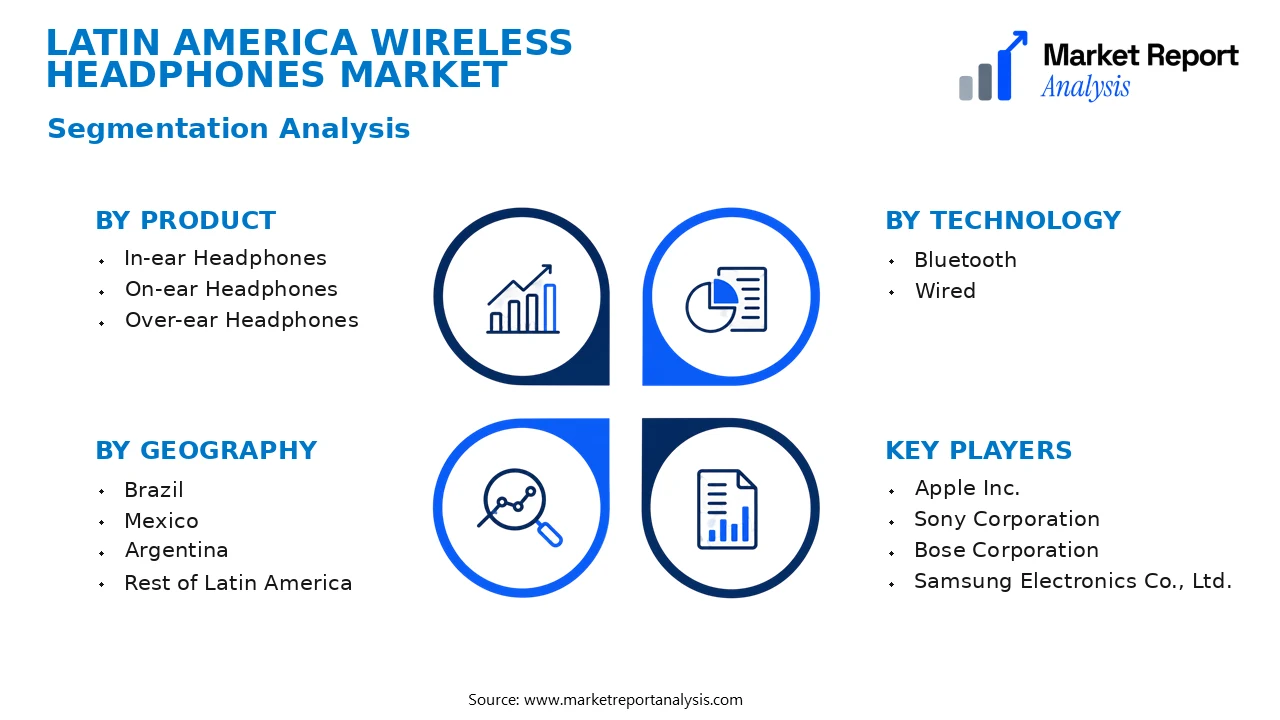
- Product
- In-ear Headphones: Compact and lightweight, these are popular among consumers seeking convenience and portability, especially for sports and daily commuting, leading to rapid adoption and market growth.
- On-ear Headphones: Providing a balance between portability and sound quality, these serve casual listeners and are favored for their comfort and moderate noise isolation, driving steady demand across urban markets.
- Over-ear Headphones: Known for superior sound quality and noise cancellation, these target audiophiles and professionals, contributing significantly to premium segment growth in the region.
- Technology
- Bluetooth: Dominating the wireless transmission segment, Bluetooth technology offers ease of use, compatibility, and improved range, making it the most preferred connectivity method across diverse consumer groups.
- Wired: Although declining, wired headphones still hold relevance in markets with budget constraints and in applications requiring high-fidelity sound, such as gaming and professional audio.
- Application
- Consumer Electronics: This segment includes personal entertainment devices such as smartphones, tablets, and laptops, which are primary drivers for headphone sales due to rising multimedia consumption.
- Gaming & Esports: Rapidly expanding with increased adoption of gaming devices, this application segment demands high-quality, immersive headphone experiences, boosting sales of specialized gaming headphones.
- Healthcare & Wellness: An emerging segment where wireless headphones assist in telehealth, physical therapy, and mindfulness practices, reflecting a broader trend of health-conscious consumers.
- Geography
- Brazil: As the largest economy in Latin America, Brazil exhibits diverse consumer preferences, high smartphone penetration, and a growing demand for premium wireless headphones, serving as a regional hub.
- Mexico: With a burgeoning middle class and increasing urbanization, Mexico presents expanding market opportunities driven by affordability and evolving multimedia consumption habits.
- Argentina: Characterized by a resilient consumer base and notable tech adoption, Argentina plays a pivotal role in regional market growth despite economic fluctuations.
- Rest of Latin America: Markets including Colombia, Chile, Peru, and others show varied adoption rates, driven by technological infrastructure, urbanization, and disposable incomes, contributing to overall regional expansion.
Competitive Intelligence
The Latin America Wireless Headphones Market is characterized by a competitive landscape dominated by a few key players such as Sony, Apple, Bose, and JBL, which collectively hold a significant market share. The market exhibits moderate to high concentration, with these large firms actively pursuing strategic innovations to sustain their competitive edge. Many brands are investing heavily in product innovation, including the integration of active noise cancellation, superior battery life, and smart assistant compatibility to meet evolving consumer preferences. Partnerships and alliances form a core part of strategic growth, with manufacturers collaborating with regional telecom providers and technology firms to expand reach and enhance product features. Recent acquisitions aim to consolidate market presence and diversify product portfolios, while expansion strategies focus on penetrating underserved rural areas and urban centers. Substantial investments in R&D are directed toward developing lightweight, ergonomic designs and wireless charging technology, setting products apart from competitors. Differentiation is primarily achieved through technological advancements, premium branding, and strategic pricing, enabling companies to capture diverse segments within the regional market.
Leading Company Profiles
The competitive landscape of the Latin America Wireless Headphones Market is characterized by a mixture of global giants and regional players, each leveraging unique technological capabilities and strategic initiatives to gain market share amidst evolving consumer preferences.
- Apple Inc.
- Sony Corporation
- Bose Corporation
- Samsung Electronics Co., Ltd.
- JBL (Harman International)
- Anker Innovations
- Skullcandy Inc.
- Philips Electronics
- LG Electronics
- Xiaomi Corporation
Apple Inc.
Apple leads with its iconic AirPods series, integrating seamless ecosystem connectivity, advanced noise cancellation, and stylish design, continuously innovating to maintain its premium segment dominance in Latin America.
Sony Corporation
Sony offers a broad portfolio of wireless headphones with high-resolution audio, superior noise cancellation, and smart features, and is focused on expanding its presence through strategic partnerships and localized marketing initiatives.
Bose Corporation
Bose specializes in premium, noise-canceling wireless headphones, emphasizing superior sound quality, durability, and comfort, with strategic investments in brand experience and customer engagement campaigns across regional markets.
Samsung Electronics Co., Ltd.
Samsung combines innovative design with cutting-edge technology, such as adaptive noise control and integrated voice assistants, targeting both budget and premium segments, and focusing on expanding connectivity with its Galaxy ecosystem.
JBL (Harman International)
JBL is renowned for its versatile range of affordable and mid-tier wireless headphones, leveraging strong branding, localized marketing, and continuous product innovation to capture diverse consumer segments.
Anker Innovations
Anker produces cost-effective, high-performance wireless earbuds and headphones, emphasizing battery life, wireless connectivity, and compact design, gaining traction through online sales channels and strategic retail partnerships.
Skullcandy Inc.
Skullcandy focuses on trendy, youthful design with affordable pricing, integrating customizable audio and Bluetooth technology to appeal to music enthusiasts and actifs urban youth in Latin America.
Philips Electronics
Philips offers a diverse line of wireless headphones with emphasis on comfort, sound quality, and affordability, supported by strategic collaborations with local service providers and retail chains.
LG Electronics
LG develops wireless headphones with innovative features such as AI-powered sound modulation, long battery life, and ergonomic designs, often bundled with its broader consumer electronics ecosystem to enhance user loyalty.
Xiaomi Corporation
Xiaomi targets mid-range markets with budget-friendly wireless headphones that combine affordability with contemporary technology, leveraging online sales platforms and aggressive regional marketing strategies.
Strategic Business Developments
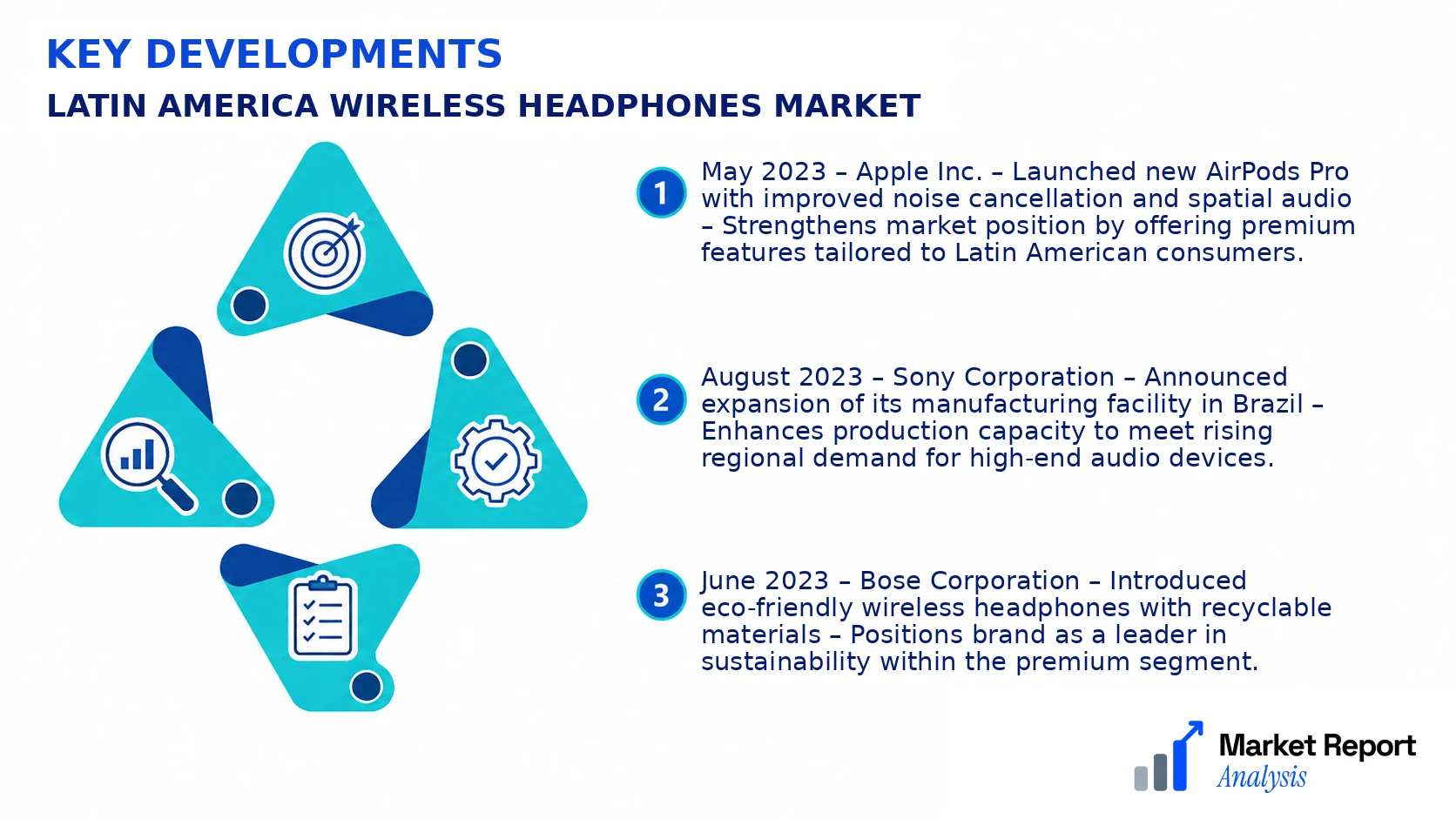
- May 2023 – Apple Inc. – Launched new AirPods Pro with improved noise cancellation and spatial audio – Strengthens market position by offering premium features tailored to Latin American consumers.
- August 2023 – Sony Corporation – Announced expansion of its manufacturing facility in Brazil – Enhances production capacity to meet rising regional demand for high-end audio devices.
- June 2023 – Bose Corporation – Introduced eco-friendly wireless headphones with recyclable materials – Positions brand as a leader in sustainability within the premium segment.
- September 2023 – Samsung Electronics – Partnered with local telecom providers for bundled offerings of Galaxy Buds – Boosts sales through strategic channel expansion and integrated marketing campaigns.
- July 2023 – JBL (Harman International) – Invested in regional R&D to adapt products for Latin American climates and cultural preferences – Improves product localization and consumer acceptance.
Frequently Asked Questions
What is the Latin America Wireless Headphones Market?
The Latin America Wireless Headphones Market encompasses the demand and supply dynamics of wireless audio devices designed for personal use across Latin American countries, including advanced features such as noise cancellation, Bluetooth connectivity, and ergonomic designs.
What is the current market size of Latin America Wireless Headphones Market?
As of 2026, the market size of the Latin America Wireless Headphones Market is valued at approximately USD 4.2 Billion, reflecting growing consumer preference for portable and wireless audio solutions amid increasing smartphone adoption.
What factors are driving the Latin America Wireless Headphones Market?
Market growth is driven by rising disposable income, expanding urbanization, technological advancements, and a surge in demand for seamless, wireless audio experiences. Additionally, the proliferation of 5G connectivity enhances the use of high-quality wireless headphones.
Which region dominates the Latin America Wireless Headphones Market?
Brazil holds the largest share within the Latin American wireless headphones market, supported by its sizable consumer base, high smartphone penetration, and the presence of key regional and global brands investing heavily in local marketing and distribution networks.
Which segment is expected to grow the fastest?
The premium segment, characterized by features like active noise cancellation and high-fidelity sound, is projected to witness the fastest CAGR, driven by increasing consumer willingness to pay for superior audio quality and brand prestige.
Who are the leading companies operating in the Latin America Wireless Headphones Market?
Major players include Apple, Sony, Bose, JBL, and Samsung, which hold significant market shares by deploying innovative products, extensive distribution channels, and aggressive marketing strategies tailored to Latin American consumer preferences.
Analyst Perspective
The Latin America Wireless Headphones Market is expected to mature gradually by 2034, characterized by increasing consumer adoption driven by rising smartphone penetration and evolving lifestyle preferences. Long-term prospects indicate steady growth fueled by technological advancements such as active noise cancellation, improved battery life, and integration with smart ecosystems, thereby creating multiple avenues for innovation. Commercial opportunities are concentrated in mid-range and premium segments, with high-quality audio and feature-rich devices appealing to tech-savvy consumers. Investment priorities should focus on R&D for cutting-edge sound technologies and sustainable manufacturing practices to differentiate products and meet environmental standards. Competitive intensity remains high, with established brands expanding their footprints and new entrants leveraging direct-to-consumer channels. Regional growth potential is strongest in Brazil and Mexico, driven by expanding urbanization and rising disposable incomes. Market players must strategize around regional customization, technological differentiation, and strategic partnerships to maximize their long-term position in this evolving landscape.
