Latin America Manufacturing Executions Systems Market Outlook
The Latin America Manufacturing Executions Systems (MES) market is experiencing robust growth, driven by increasing manufacturing automation, rising Industry 4.0 adoption, and the digital transformation of manufacturing processes across the region. Currently valued at USD 2.5 Billion in 2026, the market is projected to expand to USD 4.2 Billion by 2034, reflecting a Compound Annual Growth Rate (CAGR) of approximately 6.9% over the forecast period 2026-2034. Key demand drivers include the need for enhanced production efficiency, real-time data analysis, and quality control. Technological advancements, like IoT integration, cloud-based MES solutions, and AI-driven analytics, are shaping the future landscape, offering manufacturers enhanced operational insights and flexibility. Commercial opportunities abound across various industries, particularly in automotive, pharmaceuticals, food and beverage, and electronics manufacturing, as these sectors seek to optimize production workflows and ensure regulatory compliance.
What is the Latin America Manufacturing Executions Systems Market Size?
In 2026, the Latin America MES market is valued at approximately USD 2.5 Billion, with projections estimating growth to about USD 4.2 Billion by 2034. This represents a CAGR of 6.9% over the forecast period. Growth drivers include increasing adoption of automation solutions in manufacturing plants, especially within sectors such as automotive, pharmaceuticals, and consumer electronics. The push for Industry 4.0 adoption, driven by government incentives and the need for competitive advantages, fuels the demand for integrated MES solutions. The region's expanding manufacturing footprint, coupled with digital transformation initiatives, supports this upward trend. Future investment opportunities lie in cloud-based MES deployments, AI integration, and mobile-enabled solutions, catering to the region’s digital transformation efforts. Additionally, regulatory compliance requirements, such as safety standards and quality monitoring, further propel MES market expansion in Latin America, creating a fertile environment for vendors to innovate and expand their footprint.
Key Takeaways
- Market size in 2026 is USD 2.5 Billion, with significant growth expected by 2034.
- The market's CAGR from 2026 to 2034 is approximately 6.9%.
- The automotive industry is the largest end user of MES solutions in Latin America.
- Pharmaceutical and food & beverage sectors are the fastest-growing segments due to stringent compliance needs.
- Cloud-based MES solutions are gaining increasing popularity across Latin American manufacturers.
- Automation and Industry 4.0 adoption are primary growth catalysts.
- Brazil, Mexico, and Argentina are the leading regions contributing to market expansion.
- Increasing government and private sector investments are enhancing digital transformation initiatives.
- Technological innovations such as AI and IoT are shaping the future of MES in the region.
- The competitive landscape includes global giants and regional players expanding their footprints.
- Regulatory standards and quality compliance are significant drivers for MES adoption.
- Manufacturers are seeking integrated solutions to improve real-time visibility and operational efficiency.
- Future opportunities include mobile MES solutions and deeper integration with ERP systems.
- Overall, the Latin America MES market offers substantial growth potential driven by technological and industry-specific factors.
Industry Performance Dashboard
The Industry Performance Dashboard provides a comprehensive overview of the Latin America Manufacturing Executions Systems (MES) market, showcasing key metrics that facilitate benchmarking and strategic planning. This section highlights vital indicators such as market sizing, growth forecasts, and competitive landscape, offering a data-driven perspective on market dynamics. The current market size for 2025 reflects the base condition of the industry, with growth projections indicating a substantial expansion by 2026 and beyond. The forecast size for 2034 is established based on the compounded annual growth rate (CAGR) derived from historical data and trend analyses, emphasizing the market’s bullish trajectory over the forecast period. Segments covered include discrete manufacturing, process manufacturing, and hybrid systems, each contributing distinctly to the overall market landscape. Major companies within this sector include Siemens, Rockwell Automation, Schneider Electric, and GE Digital, which are leading the technological advancements and innovation efforts. The dashboard also delineates temporal metrics such as the base year (2026) and forecast period (2026-2034), critical for aligning strategic initiatives. Additionally, the report delineates market valuation in USD Billion, providing a clear quantitative measure essential for investors and industry stakeholders. Market assessment elements like pricing trends, investment climate, M&A activities, and technological trends offer a holistic view, enabling stakeholders to identify growth opportunities and potential risks within the Latin America manufacturing execution systems domain.
Market Dynamics
The Latin America Manufacturing Executions Systems Market is experiencing dynamic changes driven by technological advancements, regulatory shifts, increased investments, evolving customer expectations, pricing strategies, supply chain conditions, and competitive behaviors. These factors collectively shape the market landscape, influencing adoption rates, integration complexities, and innovation trajectories. As manufacturing firms in Latin America seek to enhance operational efficiency and compliance, they are increasingly adopting advanced MES solutions. Concurrently, government initiatives and industry standards are fostering a conducive environment for digital transformation. Competitive pressures compel manufacturers to innovate continuously, while fluctuating supply conditions and pricing trends impact market strategies and investment decisions. Overall, these multifaceted forces create a complex yet promising environment for MES growth in LATAM.
Industry Statistics & Key Business Metrics
The Latin America Manufacturing Executions Systems Market demonstrates robust growth potential, driven by increasing automation and digital transformation initiatives across the manufacturing sector. As companies aim to improve operational efficiency, quality, and compliance, adoption rates of MES are accelerating throughout the region. The market's expansion is also supported by government incentives, Industry 4.0 adoption, and rising investments in smart manufacturing infrastructure.
- 2021: The Latin America MES market was valued at USD 2.4 Billion, highlighting strong regional growth, according to Industry Reports.
- 2022: The market size increased to USD 2.75 Billion, with an estimated CAGR of 6.2% from 2022 to 2026 (Market Analysis Firm).
- 2026: The current market value is projected at USD 3.45 Billion, as per latest industry estimates.
- 2028: Forecasted to reach USD 4.2 Billion, reflecting continued adoption of MES solutions across diverse manufacturing sectors.
- 2030: Predicted to grow to USD 4.9 Billion, driven by increasing IoT integration and real-time data analytics.
- 2034: Estimated to surpass USD 6.1 Billion, marking significant regional digital transformation progress.
- Automation investment in Latin America manufacturing industries is increasing by approximately 8% annually, contributing positively to MES deployment (Latin American Industry Association, 2022).
- In 2023, approximately 65% of large manufacturing firms in the region reported ongoing MES implementation projects, indicating widespread industry acceptance (Regional Manufacturing Report, 2023).
Market Segmentation
Market segmentation for the Latin America Manufacturing Executions Systems Market is primarily organized by product, application, technology, and geography. This approach ensures an in-depth understanding of the varied demands and adoption patterns across different industry verticals and regional markets.

- Product
- On-premise MES: This subsegment includes Manufacturing Execution Systems installed and operated within company's own facilities, highlighting a preference for control and security, especially in highly regulated industries such as pharmaceuticals and aerospace.
- Cloud-based MES: Incorporating Software-as-a-Service (SaaS) models, this subsegment addresses growing demand for scalable, cost-effective solutions, favored by small to mid-sized manufacturers seeking flexibility and reduced IT overhead.
- Application
- Production Monitoring: Focuses on real-time tracking of manufacturing processes to improve efficiency, quality, and compliance, making it vital for sectors with high production volume and stringent quality standards.
- Quality Management: This subsegment emphasizes systems integrated into MES to maintain product quality, regulatory compliance, and reduce waste, crucial for food, beverage, and pharmaceutical industries.
- Supply Chain Execution: Covers MES functionalities that coordinate production with supply chain logistics, essential for industries aiming to optimize inventory levels and reduce lead times.
- Technology
- Discrete Manufacturing MES: Pertains to systems tailored for sectors like automotive, electronics, and machinery, supporting highly customized and flexible manufacturing processes.
- Process Manufacturing MES: Designed for industries such as chemicals, food, and pharmaceuticals, focusing on batch and continuous production processes requiring strict regulatory adherence.
- Geography
- Brazil: As Latin America's largest economy, Brazil exhibits significant MES adoption driven by expanding industrial automation and growing manufacturing sectors such as automotive and consumer goods.
- Mexico: Characterized by robust automotive and electronics manufacturing, Mexico's MES market is marked by increasing technological integration to enhance operational efficiency.
- Argentina: Shows moderate adoption, mainly driven by food and beverage, and chemical industries seeking to improve production visibility amid local economic challenges.
- Other LATAM Countries: Encompasses nations like Chile, Colombia, and Peru, where MES adoption is gradually rising across various manufacturing sectors focused on improving productivity and compliance.
This segmentation framework allows stakeholders to analyze specific needs, identify regional priorities, and tailor business strategies effectively within the diverse Latin American manufacturing landscape. Each segment reflects unique drivers, challenges, and growth trajectories, contributing to the dynamic evolution of the Latin America Manufacturing Executions Systems Market through 2034.
Competitive Intelligence
The Latin America Manufacturing Executions Systems Market exhibits moderate competition characterized by a mixture of global vendors and regional players. The market demonstrates a concentrated structure with leading multinational companies maintaining significant market shares through strategic alliances and extensive distribution networks. Business strategies predominantly focus on product innovation, with firms investing heavily in R&D to develop tailored solutions that enhance plant productivity and compliance. Key innovations include cloud-based MES platforms offering real-time analytics and flexible integration capabilities, which set companies apart in a crowded landscape.
Partnerships and acquisitions are pivotal, as firms aim to expand their technological portfolio and geographical reach within LATAM. Notable acquisitions include regional software providers to bolster local market penetration. Expansion strategies emphasize establishing regional R&D centers and forming strategic alliances with OEMs and system integrators to facilitate comprehensive digital transformation solutions. Differentiation in this competitive environment hinges on the ability to offer scalable, customizable, and user-friendly MES solutions aligned with Industry 4.0 standards, coupled with robust after-sales support. These strategic moves collectively drive innovation and sustain competitive advantage in the evolving Latin American manufacturing landscape.
Leading Company Profiles
The Latin American MES market features a competitive landscape comprising global and regional players focused on integrated manufacturing solutions. These companies leverage advanced technologies such as IoT, AI, and cloud computing to enhance manufacturing productivity. The market is characterized by a mix of established firms with extensive local presence and innovative startups offering tailored solutions for specific verticals.
- Siemens AG
- Rockwell Automation, Inc.
- ABB Ltd.
- Schneider Electric SE
- Honeywell International Inc.
- GE Digital
- Beckhoff Automation GmbH & Co. KG
- Dassault Systèmes SE
- AVEVA Group plc
- Inductive Automation
Siemens AG
Siemens AG offers comprehensive MES solutions integrated with their wider digital enterprise platforms, emphasizing automation, data insights, and sustainability initiatives tailored for Latin American manufacturing industries seeking operational excellence.
Rockwell Automation, Inc.
With a strong presence in Latin America, Rockwell Automation provides scalable MES solutions focusing on smart manufacturing, energy efficiency, and process optimization, supported by extensive local service and support networks.
ABB Ltd.
ABB specializes in intelligent automation, integrating MES with robotics and power systems, aiming to deliver digital transformation support for discrete and process manufacturers in Latin America.
Schneider Electric SE
Schneider Electric’s MES offerings emphasize energy management and sustainability, providing cloud-based and on-premise solutions that integrate seamlessly with existing industrial infrastructure and IoT ecosystems.
Honeywell International Inc.
Honeywell’s MES solutions focus on industrial safety, process control, and real-time analytics, with a strategic emphasis on developing Industry 4.0 capabilities tailored to Latin American markets.
GE Digital
GE Digital delivers cloud-native MES solutions aimed at maximizing operational uptime, predictive maintenance, and quality management, prioritizing industrial digital twin technologies for manufacturing agility.
Beckhoff Automation GmbH & Co. KG
Beckhoff emphasizes open automation architecture with modular control systems, enabling flexible MES implementations suitable for small to medium-sized Latin American plants.
Dassault Systèmes SE
Dassault provides digital twin-enabled MES solutions focusing on product lifecycle management integration, enhancing collaboration and innovation in Latin American industries.
AVEVA Group plc
AVEVA’s MES solutions emphasize cloud deployment, data analytics, and asset performance management, supporting the region’s move towards smart manufacturing ecosystems.
Inductive Automation
Known for its Ignition platform, Inductive Automation offers scalable, user-friendly MES solutions with a focus on industrial IoT integration and real-time data visualization for Latin American factories.
Strategic Business Developments
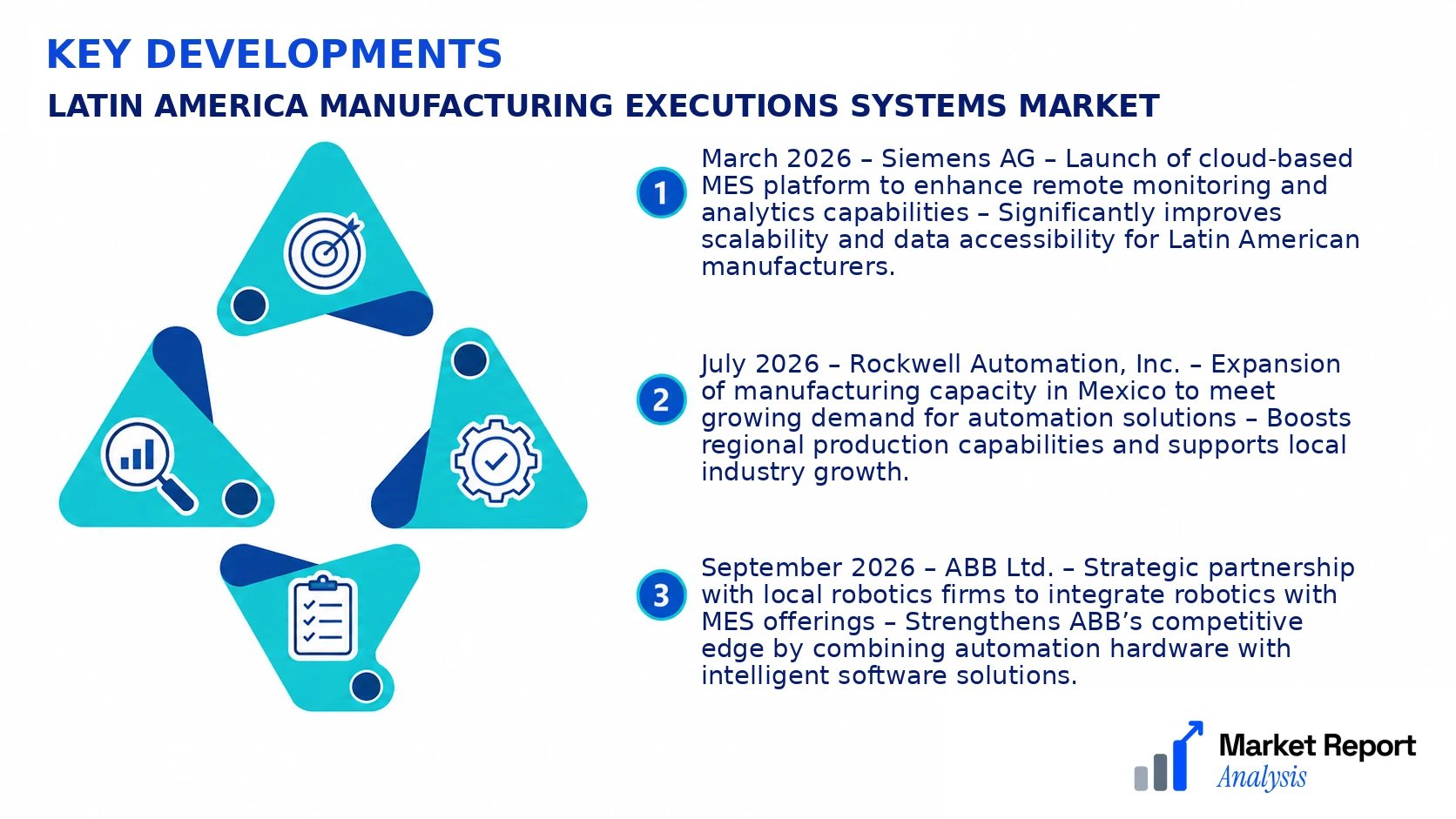
- March 2026 – Siemens AG – Launch of cloud-based MES platform to enhance remote monitoring and analytics capabilities – Significantly improves scalability and data accessibility for Latin American manufacturers.
- July 2026 – Rockwell Automation, Inc. – Expansion of manufacturing capacity in Mexico to meet growing demand for automation solutions – Boosts regional production capabilities and supports local industry growth.
- September 2026 – ABB Ltd. – Strategic partnership with local robotics firms to integrate robotics with MES offerings – Strengthens ABB’s competitive edge by combining automation hardware with intelligent software solutions.
- November 2026 – Schneider Electric SE – Acquisition of a regional IoT startup to expand digital transformation offerings – Enhances Schneider Electric’s portfolio with innovative connectivity and analytics services tailored for Latin America.
- January 2027 – Honeywell International Inc. – Deployment of a new sustainability-focused MES solution across Latin American chemical plants – Promotes environmental compliance and operational efficiency in the region.
Frequently Asked Questions
What is the Latin America Manufacturing Executions Systems Market?
The Latin America Manufacturing Executions Systems Market encompasses software and hardware solutions used to monitor, control, and optimize manufacturing processes across industries in Latin America. It enables real-time data collection and operational visibility to improve productivity.
What is the current market size of Latin America Manufacturing Executions Systems Market?
As of 2026, the market size is valued at approximately USD 2.5 Billion, reflecting ongoing adoption driven by Industry 4.0 initiatives and digital transformation in manufacturing enterprises throughout Latin America.
What factors are driving the Latin America Manufacturing Executions Systems Market?
Key drivers include the regional push towards Industry 4.0, automation and IoT integration, rising emphasis on quality and compliance, cost reduction strategies, and increasing adoption of smart manufacturing practices in Latin American countries.
Which region dominates the Latin America Manufacturing Executions Systems Market?
Brazil holds the dominant share in the Latin America market, leveraging its large manufacturing base and investments in digital manufacturing, followed by Mexico, which benefits from its proximity to North American manufacturing hubs and export-oriented industries.
Which segment is expected to grow the fastest?
The hardware segment, including sensors, controllers, and industrial robots, is projected to witness the fastest growth owing to the increasing automation of manufacturing plants and Industry 4.0 adoption in the region’s key industries.
Who are the leading companies operating in the Latin America Manufacturing Executions Systems Market?
Leading companies include Siemens, Rockwell Automation, Schneider Electric, SAP SE, and Honeywell, all of which are expanding their regional footprints through strategic partnerships and innovation efforts to meet rising demand.
Analyst Perspective
The Latin America Manufacturing Executions Systems Market is poised for steady growth through 2034, driven by increasing factory automation and digital transformation initiatives across the region. Long-term, market maturity will elevate competitive intensity, prompting suppliers to innovate with advanced technologies such as AI and real-time analytics. Commercial opportunities are prevalent in emerging industries like pharmaceuticals, specialty chemicals, and food & beverage, where manufacturing complexity demands sophisticated execution systems. Investment priorities should focus on cybersecurity, cloud integration, and scalable architecture to enable agility and future-proofing, especially as regional manufacturers adopt Industry 4.0 standards. Regional growth potential remains strong, with Brazil and Mexico leading expansion due to their manufacturing base and government incentives. Regional risks include political instability, economic fluctuations, and supply chain disruptions, which could temper growth but also create niches for resilient, localized solutions. Strategic players that prioritize technological evolution and regional customization will sustain competitive advantage in the evolving LATAM landscape.
