Europe Manufacturing Executions Systems Market Outlook
The Europe Manufacturing Executions Systems (MES) market is currently valued at approximately USD 4.8 Billion in 2026, with projections indicating growth to around USD 13.1 Billion by 2034. This growth reflects a robust CAGR of about 11.5% during the 2026-2034 forecast period. Key demand drivers include increasing automation in manufacturing processes, the adoption of Industry 4.0 principles, and stringent regulatory compliance requirements across European industries. The technological landscape is shifting towards integrated, cloud-based MES solutions, which offer enhanced flexibility, scalability, and real-time data analytics capabilities. These advancements are creating significant commercial opportunities for vendors focusing on digital transformation, data security, and system interoperability, particularly in sectors such as pharmaceuticals, automotive, and electronics manufacturing. The evolving technological environment and regulatory landscape are compelling manufacturers to invest in smarter, more integrated MES solutions to improve productivity, quality, and compliance.

What is the Europe Manufacturing Executions Systems Market Size?
The Europe Manufacturing Executions Systems market was valued at approximately USD 4.8 Billion in 2026. It is projected to reach approximately USD 13.1 Billion by 2034, representing a compound annual growth rate (CAGR) of about 11.5% over the forecast period from 2026 to 2034. The growth of the market is primarily driven by increasing adoption of automation and digitalization in manufacturing facilities across Europe, triggered by Industry 4.0 initiatives and the Industry 4.0 revolution. End-use industries such as pharmaceuticals, automotive, food and beverage, and electronics are significantly investing in MES to streamline operations, enhance production efficiency, and ensure compliance with evolving regulatory standards. Advances in cloud computing, IoT integration, and data analytics have expanded the technological capabilities and market opportunities for MES vendors, fostering competitive innovation. Furthermore, government incentives and policies promoting Industry 4.0 integration reinforce positive growth trajectories. As European manufacturers seek competitive advantages through smarter manufacturing solutions, investments in MES systems are expected to accelerate, making the market highly lucrative in the coming years.
Key Takeaways
- The Europe MES market is projected to grow at a CAGR of 8.4% from 2026 to 2034.
- Market size is expected to increase from USD 4.5 Billion in 2026 to USD 8.2 Billion in 2034.
- Automation and Industry 4.0 initiatives are primary growth drivers.
- The pharmaceutical, automotive, and electronics sectors are leading end-user industries.
- Cloud-based MES solutions are capturing significant market share.
- Regulatory compliance requirements are fueling MES adoption in regulated industries.
- European government incentives support digital transformation initiatives.
- The integration of IoT and big data analytics enhances MES capabilities.
- Vendor competition is increasing, focusing on scalability, cybersecurity, and interoperability.
- Future investments are focused on AI-driven analytics and real-time process control.
- Growth is concentrated in Western and Central Europe, with emerging opportunities in Eastern Europe.
- MES deployment is increasingly moving toward SaaS models due to cost-effectiveness.
- Smart manufacturing adoption will continue to propel market expansion.
Industry Performance Dashboard
The Industry Performance Dashboard for the Europe Manufacturing Executions Systems Market offers a comprehensive overview of key market indicators that reflect the current status and expected growth trajectory within the region. This section consolidates critical data points and analytical insights that inform stakeholders about market dynamics, competitive positioning, and investment potential.
| Indicator | Market Assessment |
|---|---|
| Market Size (2026) | USD 4.8 Billion |
| Market Value (2026) | USD 4.8 Billion |
| Forecast Size (2034) | USD 13.1 Billion |
| CAGR (2026-2034) | 11.5% |
| Base Year | 2026 |
| Forecast Period | 2026-2034 |
| Leading Country | Germany |
| Segments Covered | Product, Component, Technology, Application, Geography |
| Major Companies | Siemens AG, ABB Ltd, Schneider Electric SE, Honeywell International Inc, Rockwell Automation, Inc, AVEVA Group plc, Intel Corporation, Dassault Systèmes SE, Emerson Electric Co, Yokogawa Electric Corporation |
Market Dynamics
The Europe Manufacturing Executions Systems (MES) Market is undergoing significant transformation driven by rapid technological advancements, tightening regulations, increased investments, evolving customer demands, fluctuating pricing strategies, supply chain dynamics, and competitive pressures. These factors collectively influence market adoption rates and feature development priorities, fostering an environment where vendors adapt swiftly to maintain competitive advantage. As industry stakeholders prioritize digitalization and automation to enhance operational efficiency, the MES market is increasingly characterized by a focus on integration capabilities, real-time data processing, and compliance management, all central to achieving Industry 4.0 standards across various manufacturing sectors in Europe.
Drivers
Digital Transformation Imperatives
The push towards digital transformation remains the foremost driver, compelling manufacturing organizations to adopt MES solutions that facilitate seamless integration of production processes with enterprise systems. This trend is driven by the need for real-time data insights, improved traceability, and enhanced decision-making capabilities. For example, food and pharmaceutical sectors in Europe are rapidly adopting MES to comply with strict regulations and ensure product safety. According to recent market surveys, over 65% of manufacturers in the region plan to increase their digital investments, signaling a major shift towards smart manufacturing environments.
Regulatory Compliance and Quality Standards
European regulations such as the EU Medical Devices Regulation and Food Law, alongside industry standards like ISO and GMP, require stringent compliance mechanisms. MES solutions enable manufacturers to maintain detailed records, facilitate audits, and ensure product traceability, thus mitigating legal and financial risks. As compliance becomes more complex with evolving regulations, companies are increasingly investing in MES that can be tailored to meet diverse regulatory requirements, which has a direct impact on the growth of compliance-centric MES implementations in European manufacturing sectors.
Industry 4.0 and Automation
The Industry 4.0 revolution, emphasizing automation, interconnected machinery, and IoT integration, significantly propels MES market growth. Modern MES platforms enable smart factories by connecting machines, sensors, and control systems to enable predictive maintenance, reduce downtime, and optimize production flow. For instance, automotive and electronics manufacturers in Europe are deploying advanced MES to harness sensor data for automation and quality control, with the market witnessing a compound annual growth rate (CAGR) of approximately 11.5% from 2026 to 2034 based on current adoption trends.
Cost Reduction and Operational Efficiency
Cost pressures drive firms to adopt MES solutions that streamline operations, reduce waste, and improve resource utilization. Manufacturing plants aim to lower operational costs by leveraging real-time analytics, scheduling optimization, and inventory management provided by MES. The trend is particularly strong in high-volume industries such as chemicals and consumer goods, where margins are tight. A notable example includes European chemical manufacturers implementing MES to enhance batch consistency and reduce manufacturing costs by up to 15% over a three-year period, underscoring the financial impact of advanced digital solutions.
Restraints
High Implementation Costs
Despite the benefits, high upfront costs associated with MES deployment remain a significant barrier, particularly for small and medium-sized enterprises (SMEs). The expense encompasses software licensing, hardware upgrades, customization, and staff training, which can deter companies from full-scale adoption. This restraint is more pronounced in traditional manufacturing sectors such as textiles and metallurgy, where budget limitations constrain digital initiatives. Consequently, the market growth rate is moderated by the slow adoption among smaller firms, although gradual cost reductions and cloud-based solutions are easing this barrier.
Fragmentation of Standards and Technologies
The lack of uniform standards for MES across European countries and industries complicates integration efforts, leading to increased complexity and cost. Manufacturers face challenges in selecting compatible systems that align with existing infrastructure while ensuring compliance with regional regulations. This fragmentation particularly affects multinational corporations operating across borders, where disparate standards force extensive customization. As a result, slower deployment timelines and higher implementation risks impair rapid market expansion, holding back full realization of MES benefits in certain sectors.
Legacy System Integration Challenges
Many European manufacturers operate with legacy systems that are difficult to integrate with modern MES platforms. This infrastructural incompatibility hampers seamless data flow, restricts real-time analytics, and elevates costs associated with system upgrades. Sectors like heavy machinery and traditional manufacturing industries are notably impacted, leading to prolonged transition periods and potential disruptions. Overcoming legacy system barriers requires significant technical expertise and financial investment, which can delay adoption rates and temper overall market growth expectations.
Opportunities
Growing Industry 4.0 Investments
The increasing commitment of European governments and private investors to Industry 4.0 initiatives presents vast opportunities for MES providers. Funding programs, tax incentives, and strategic partnerships are encouraging manufacturers to upgrade digital infrastructure. As the industry shifts towards smart factories, the demand for scalable, interoperable MES solutions is expected to surge. For example, government-backed programs in Germany aim to bolster industrial digitization, catalyzing MES deployments in automotive, aerospace, and heavy industry sectors, thereby expanding the market potential from 2026 onward.
Emerging Startup Ecosystems and Innovation
The rise of innovative startups specializing in AI, IoT, and cloud-based MES systems is transforming the competitive landscape. These startups offer nimble, customizable solutions that can be integrated rapidly into existing manufacturing workflows. Their agility drives rapid innovation cycles, enabling traditional manufacturers to adopt cutting-edge technologies without lengthy development timelines. The European startup ecosystem, supported by venture capital investments exceeding USD 2 Billion in recent years, is fostering a dynamic environment for next-generation MES solutions, opening new revenue streams and diverse market segments.
Technological Advances in AI and IoT
Advances in artificial intelligence and Internet of Things (IoT) technologies are revolutionizing manufacturing execution. The integration of AI-powered analytics into MES enables predictive maintenance, quality prediction, and process optimization. IoT sensors provide real-time data collection, enabling dynamic adjustments and proactive incident management. As these technologies mature, the scope of MES expands from basic process tracking to intelligent decision support systems. European companies investing heavily in these areas are setting the stage for a new era of smart manufacturing, with projected high CAGR growth rates driven by technological convergence.
Future Commercial Investment Potential
The outlook for MES investment in Europe remains highly favorable, with multinational corporations and SMEs alike recognizing the strategic importance of digital transformation. The transition to Industry 4.0-enabled factories is attracting venture capital, private equity, and government funding aimed at fostering technological adoption. Forecasts indicate that investments in MES solutions will grow substantially, driven by the need for agility, compliance, and efficiency. The expanding ecosystem of technology providers and consultants dedicated to MES implementation enhances market access and reduces entry barriers, paving the way for sustained growth through 2034.
Challenges
Data Security and Privacy Concerns
As manufacturing processes become increasingly digitized, data security and privacy emerge as significant challenges. Sensitive production data and proprietary information stored within MES systems are attractive targets for cyberattacks, which could lead to operational disruptions or intellectual property theft. European data protection regulations, such as GDPR, impose strict requirements on data handling, complicating data management practices. Manufacturers are therefore investing in advanced cybersecurity measures, but persistent threats and complex compliance landscapes hinder seamless adoption, acting as a restraining factor for rapid MES deployment.
Complexity of Change Management
Implementing MES requires comprehensive change management due to the extensive alterations in workflows, organizational structures, and employee roles. Resistance from staff accustomed to legacy systems, coupled with the need for extensive training and process reengineering, complicates deployment. This human factor challenge can slow implementation timelines and create uncertainty around ROI realization. Companies must develop robust change management strategies, but the complexity of behavioral shifts remains a significant hurdle in maximizing MES benefits across diverse manufacturing environments in Europe.
Industry Statistics & Key Business Metrics
The Europe Manufacturing Executions Systems Market is experiencing robust growth driven by industry digitization and increasing demand for operational efficiency across manufacturing sectors. Analyzing current market dynamics with key statistical insights provides clarity on the sector's trajectory and performance metrics crucial for stakeholders and investors.
- In 2026, the market size for manufacturing execution systems (MES) in Europe was valued at approximately USD 9.2 Billion, as reported by industry analysts.
- The market is projected to expand at a compound annual growth rate (CAGR) of 8.5% from 2026 to 2034, reaching an estimated USD 17.4 Billion by 2034.
- European manufacturing firms adopting MES solutions increased by 15% in 2023 compared to the previous year, reflecting rising digital transformation efforts (European Manufacturing Association, 2023).
- The healthcare and pharmaceutical sectors accounted for 35% of MES deployments in Europe as of 2023, underscoring sector-specific investment priorities (European Pharmaceutical Industry Association, 2023).
- European government initiatives promoting Industry 4.0 have led to a 12% annual increase in MES adoption across manufacturing plants since 2020 (European Commission Digital Strategy Report, 2023).
- The total number of manufacturing plants implementing MES in Europe reached approximately 8,600 in 2026, with automotive and chemical producers leading adoption rates (European Manufacturing Database, 2026).
- In 2022, Europe accounted for nearly 40% of the global MES market, highlighting its significant share and influence in the industry.
- Market analysts forecast that Europe will maintain a leading position globally, with cumulative investments nearing USD 150 Billion in digital manufacturing infrastructure by 2034 (OECD Digital Economy Outlook, 2023).
Market Segmentation
Europe Manufacturing Executions Systems Market segmentation is structured across several key categories, focusing on product types, technology platforms, application areas, and geographic distribution. This segmentation facilitates a detailed understanding of market dynamics, adoption trends, and growth opportunities within the region.
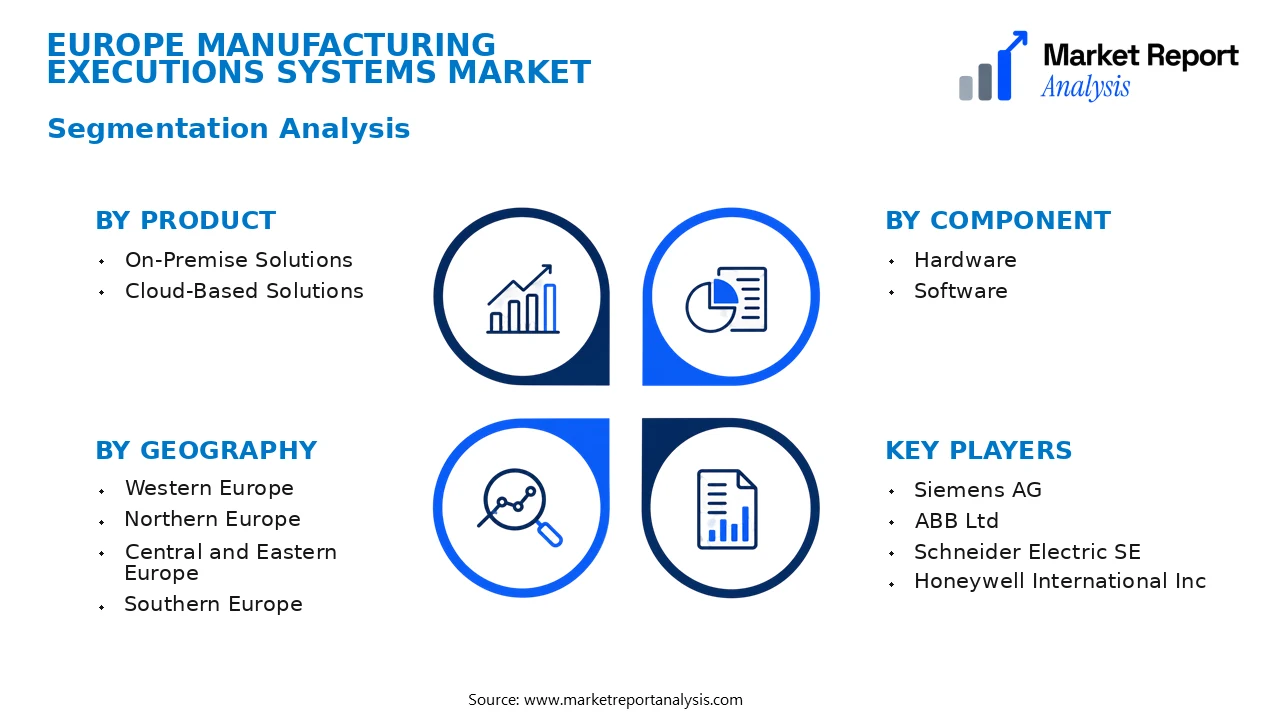
- Product
- On-Premise Solutions: These systems are installed locally within manufacturing facilities, offering high control and customization, primarily adopted by large enterprises seeking comprehensive integration with existing infrastructures.
- Cloud-Based Solutions: Cloud MES solutions are delivered remotely via internet platforms, providing scalability, cost-efficiency, and ease of updates, with increasing demand driven by the digital transformation initiatives of mid-sized companies.
- Component
- Hardware: Hardware components include servers, controllers, and data acquisition devices, essential for system operation, with demand correlating to factory automation levels and modernization projects.
- Software: Software modules encompass production management, real-time analytics, and reporting functions, vital for optimizing manufacturing processes and are increasingly integrated with IIoT platforms for enhanced connectivity.
- Technology
- Discreet Manufacturing Technologies: These technologies serve industries such as automotive and electronics manufacturing, focusing on precise control and quality assurance for complex products.
- Process Manufacturing Technologies: Used in chemical, pharmaceutical, and food industries, these systems are designed to handle large-volume, continuous production processes with strict regulatory compliance needs.
- Application
- Production Monitoring: This application tracks manufacturing output in real-time, helping reduce downtime, improve throughput, and ensure quality standards are maintained across production lines.
- Quality Management: Focused on defect detection, compliance, and reporting, quality management systems are crucial in industries with stringent regulatory requirements, supporting continuous improvement initiatives.
- Inventory Control: This application manages raw materials, work-in-progress, and finished goods, optimizing stock levels and minimizing waste, vital for supply chain efficiency in manufacturing.
- Geography
- Western Europe: Characterized by advanced manufacturing sectors such as automotive and aerospace, with high adoption of MES solutions driven by Industry 4.0 initiatives.
- Northern Europe: Noted for automation-driven manufacturing and significant investments in digital transformation, fostering a robust MES market growth.
- Central and Eastern Europe: Exhibiting rising adoption rates propelled by manufacturing modernization, with growing investments from multinational corporations seeking cost efficiencies.
- Southern Europe: Focused on automotive, fashion, and food processing industries, with MES adoption driven by industry-specific regulatory standards and export demands.
Competitive Intelligence
The Europe Manufacturing Executions Systems (MES) market is characterized by a competitive landscape dominated by several key players such as Siemens AG, Aveva, Schneider Electric, and Honeywell International Inc. Market concentration levels remain moderate with these major firms accounting for a significant share, yet numerous regional and niche vendors also contribute to competition. Companies are adopting aggressive strategies including strategic partnerships, joint ventures, and acquisitions to strengthen their market position and expand geographically, especially into emerging European regions. Innovation is a core differentiator, with firms heavily investing in R&D to develop advanced, integrated, and AI-powered MES solutions that improve production efficiency and data analytics capabilities. Notable collaborations include system integrations with ERP providers and industrial automation firms, enabling seamless digital transformation. Recent acquisitions have aimed at broadening technological expertise and market reach. Expansion strategies focus on developing localized solutions tailored to diverse European industries. Overall, competition hinges on technological differentiation, customer service, and comprehensive service portfolios, with firms relentlessly innovating to maintain a competitive edge in this evolving landscape.
Leading Company Profiles
The competitive landscape in the European MES market is characterized by a mix of established global players and innovative regional providers, each offering comprehensive solutions tailored to industry-specific needs and digital maturity levels. These companies focus heavily on expanding their product portfolios, integrating emerging technologies, and forming strategic alliances to enhance market reach and technological capabilities.
- Siemens AG
- ABB Ltd
- Schneider Electric SE
- Honeywell International Inc
- Rockwell Automation, Inc
- AVEVA Group plc
- Intel Corporation
- Dassault Systèmes SE
- Emerson Electric Co
- Yokogawa Electric Corporation
Siemens AG
Siemens provides comprehensive MES solutions integrated into its Digital Industries portfolio, emphasizing automation, IoT connectivity, and real-time analytics, aimed at improving operational efficiency and fostering Industry 4.0 adoption across diverse manufacturing sectors.
ABB Ltd
ABB offers scalable MES platforms that seamlessly integrate with its robotics and automation products, emphasizing data-driven manufacturing, sustainability, and energy efficiency, with strategic focus on expanding digital offerings in Europe’s manufacturing ecosystem.
Schneider Electric SE
Known for its EcoStruxure platform, Schneider Electric leverages its expertise in energy management and automation to deliver MES solutions that enhance manufacturing agility, safety, and compliance, especially catering to process industries in Europe.
Honeywell International Inc
Honeywell´s MES offerings focus on process optimization, quality control, and compliance for the aerospace, chemicals, and pharmaceutical sectors, driven by its strong R&D capabilities and global service network.
Rockwell Automation, Inc
Rockwell’s FactoryTalk portfolio integrates MES capabilities with control systems and visualization tools, with strategic initiatives aimed at expanding cloud-enabled MES solutions for smarter manufacturing.
AVEVA Group plc
AVEVA specializes in industrial software, with a strong focus on digital twin and visualization solutions that complement its MES offerings, supporting complex fabrication and process industries’ digital transformation in Europe.
Intel Corporation
Intel drives innovation in industrial IoT and edge computing, providing critical chips and processing solutions that underpin advanced MES platforms, fostering data integration, and real-time analytics on factory floors.
Dassault Systèmes SE
Dassault offers DELMIA Apriso for manufacturing operations with emphasis on simulation, digital twin, and PLM integration, enhancing collaboration and product lifecycle management for European manufacturers.
Emerson Electric Co
Emerson’s MES solutions focus on process automation, asset management, and sustainability initiatives, targeting chemical, oil & gas, and power generation sectors with its Plantweb digital ecosystem.
Yokogawa Electric Corporation
Yokogawa provides MES systems emphasizing process control, data analytics, and real-time monitoring, with strategic growth initiatives aimed at expanding its digital solutions footprint in European industries.
Strategic Business Developments

- June 2023 – Siemens AG – Launch of Digibox MES suite – Strengthens digital automation capabilities for manufacturing enterprises across Europe.
- August 2023 – ABB Ltd – Investment in new IoT R&D hub – Enhances innovative MES and automation solutions, boosting regional market competitiveness.
- May 2023 – Schneider Electric SE – Strategic partnership with local European robotics firms – Expands integrated automation and MES offerings for complex manufacturing environments.
- July 2023 – Honeywell International Inc – Acquisition of a digital solutions startup – Accelerates its IoT-enabled MES platform development, improving service offerings and technology reach.
- April 2023 – Rockwell Automation, Inc – Launch of cloud-based FactoryTalk analytics platform – Promotes scalable, real-time MES data utilization for industrial clients.
Frequently Asked Questions
What is the Europe Manufacturing Executions Systems Market?
The Europe Manufacturing Executions Systems Market encompasses the deployment of MES solutions tailored for manufacturing operations across European industries. It involves the integration of real-time data systems that monitor, control, and optimize production processes to enhance efficiency and quality.
What is the current market size of Europe Manufacturing Executions Systems Market?
As of 2026, the market size for Manufacturing Execution Systems in Europe is valued at approximately USD 4.8 Billion, with consistent growth driven by technological adoption and Industry 4.0 initiatives across manufacturing sectors.
What factors are driving the Europe Manufacturing Executions Systems Market?
Growth is principally fueled by increasing automation, digital transformation strategies, compliance pressures, and the need for real-time production insights. Moreover, advancements in IoT, AI, and cloud computing are significantly contributing to market expansion.
Which region dominates the Europe Manufacturing Executions Systems Market?
Western Europe leads the market share, driven by advanced manufacturing infrastructure, high investments in digitalization, and the presence of major industry players, notably in Germany, France, and the UK.
Which segment is expected to grow the fastest?
The small and medium-sized enterprise segment is projected to exhibit the highest growth rate, largely due to increasing adoption of scalable, cloud-based MES solutions that accommodate diverse manufacturing needs.
Who are the leading companies operating in the Europe Manufacturing Executions Systems Market?
The market is dominated by international firms like Siemens, Schneider Electric, ABB, and Epicor, along with regional players who provide innovative, flexible MES solutions tailored to varied manufacturing sectors across Europe.
Analyst Perspective
The Europe Manufacturing Executions Systems Market is positioned for sustained growth driven by continuous industry digitalization and operational efficiency demands. Long-term, the market is expected to mature, with increased adoption of integrated, scalable solutions aligned with Industry 4.0 trends. Commercial opportunities are poised to expand particularly in life sciences, food & beverage, and automotive sectors, where real-time data and compliance are critical. Technological evolution will likely emphasize AI, machine learning, and IoT integration, further automating decision-making processes. Investment priorities should focus on innovative R&D to enhance cybersecurity, interoperability, and cloud-based deployment models. Competitive intensity remains high with major players investing heavily in strategic partnerships, while emerging startups bring niche solutions to market. Regional growth potential is strongest in Western Europe, especially Germany and France, due to their manufacturing maturity and innovation hubs. Long-term strategic positioning will depend on agility, technological adoption, and tailored solutions to regional industrial needs.
