Latin America Fingerprint Module Market Outlook
The Latin America fingerprint module market is experiencing rapid expansion, driven by increased demand for biometric security solutions across various sectors including consumer electronics, government, and enterprise applications. Currently valued at USD 1.2 Billion in 2026, the market is projected to reach approximately USD 4.8 Billion by 2034, exhibiting a compound annual growth rate (CAGR) of around 15.4% over the forecast period from 2026 to 2034. The principal demand drivers include rising security concerns, government initiatives to deploy biometric authentication, advancements in fingerprint sensor technology, and growing adoption of smartphones equipped with biometric capabilities. Technological shifts toward touchless fingerprint sensors, which offer enhanced hygiene and durability, are also fueling market growth. Commercial opportunities abound for module manufacturers in developing compact, high-speed fingerprint sensors that integrate seamlessly into consumer devices, access control systems, and financial terminals, reflecting a robust trend toward integrating biometric technology in everyday life.

What is the Latin America Fingerprint Module Market Size?
As of 2026, the Latin America fingerprint module market is valued at USD 1.2 Billion, with an expected growth to approximately USD 4.8 Billion by 2034, representing a CAGR of 15.4%. The growth trajectory is primarily propelled by rising security concerns and the increasing digitization of government and private sector services. The proliferation of smartphones, laptops, and wearable devices integrated with fingerprint modules further amplifies market expansion. Additionally, governments across Latin America are implementing biometric-based identification systems and e-passport initiatives, creating a sustained demand for fingerprint modules. The banking and financial services sector is adopting biometric security for customer verification, bolstering the market. As technology advances, manufacturers are developing more affordable, reliable, and scalable fingerprint modules to meet the demands of both high-end and budget-conscious consumers. The integration of biometric sensors into access control and security management systems is poised to open new opportunities for market players, fostering innovation and competition. Overall, the market growth reflects a global shift toward biometric authentication methods, with Latin America positioning itself as a significant regional hub for fingerprint module deployment in diverse use cases.
Key Takeaways
- The Latin America fingerprint module market is projected to grow from USD 1.2 Billion in 2026 to USD 2.6 Billion in 2034.
- The CAGR for the forecast period 2026-2034 is approximately 10.2%.
- Consumer electronics, government, and enterprise sectors are the leading end-user segments.
- Smartphones and laptops form the largest application segments for fingerprint modules.
- The biometric security market in Latin America is driven by increasing security concerns and government initiatives.
- Emerging touchless fingerprint sensors present significant growth opportunities due to hygiene and durability benefits.
- Brazil and Mexico are the largest regional markets within Latin America.
- The fastest-growing segment is contactless fingerprint sensing technology.
- Market players are investing in high-performance, cost-efficient modules suitable for mass deployment.
- The expansion of biometric ID programs and banking security solutions are crucial growth catalysts.
- Technological innovation, such as multispectral sensors, will shape future market dynamics.
- Regulatory frameworks favoring biometric security adoption will support market stability.
- Competitive landscape is consolidating, with increased collaborations and product launches.
Industry Performance Dashboard
The Latin America fingerprint module market has exhibited robust growth driven by expanding adoption in security, consumer electronics, and government applications. As the region continues to modernize its identity verification and access control systems, the market demonstrates substantial momentum. The following dashboard offers a comprehensive overview of key industry performance metrics, outlining current standing and future growth prospects. The data encapsulate market size, growth forecasts, and dominant players, providing stakeholders with the insights necessary for strategic planning and investment decisions.
| Indicator | Market Assessment |
|---|---|
| Market Size (2026) | USD 1.2 Billion |
| Market Value (2026) | USD 1.2 Billion |
| Forecast Size (2034) | USD 4.8 Billion |
| CAGR | 15.4% |
| Base Year | 2026 |
| Forecast Period | 2026-2034 |
| Segments Covered | Product Type, Application, Geography |
| Major Companies | AuthenTec, Fingerprint Cards AB, IDEX Biometrics, Goodix Technology, Synaptics Incorporated, Suprema Inc., Gemalto NV, Crossmatch Technologies, BIO-key International, Zwipe AS |
Market Dynamics
The Latin America fingerprint module market is experiencing dynamic shifts driven by technological advancements, regulatory frameworks, increasing investments, evolving customer requirements, pricing strategies, supply chain conditions, and competitive behaviors. These factors collectively influence innovation, market penetration, and the pace of adoption across various industries such as banking, government, healthcare, and consumer electronics. As the region's digital footprint expands, the market is witnessing heightened demand for secure, reliable biometric authentication solutions, prompting stakeholders to align their strategies accordingly. This evolving landscape necessitates continuous adaptation to technological trends, regulatory compliance, and competitive pressures to capitalize on emerging opportunities.
Drivers
Rising Adoption of Biometric Authentication
The surge in adoption of biometric authentication methods across Latin America is a major driver fueling demand for fingerprint modules. Governments and enterprises seek more secure access control solutions to reduce fraud and enhance security. For instance, biometric-based voter identification programs have increased significantly, boosting sector-specific demand. Additionally, the proliferation of smartphones with fingerprint sensors for secure mobile banking and e-commerce transactions exemplifies consumer-driven adoption. The trend towards enhanced security, combined with declining costs of fingerprint sensors, supports widespread deployment and accelerates market growth.
Government Regulations and Initiatives
Government mandates and initiatives focused on digital security and identification are propelling the fingerprint module market. Several Latin American countries have implemented or are planning national biometric ID systems to improve public service delivery, financial inclusion, and security. For example, Brazil’s biometric voter registration program has propelled local demand for fingerprint modules. Such regulatory support creates a conducive environment for market expansion. Furthermore, policies favoring digital transformation and anti-fraud measures are incentivizing public sector investments, reinforcing the growth momentum for fingerprint technology providers.
Growth in Banking and Payment Ecosystems
The expanding banking and digital payment ecosystem in Latin America significantly contributes to market growth. Financial institutions are increasingly adopting biometric authentication to secure customer transactions and comply with KYC (Know Your Customer) regulations. Mobile banking and contactless payment solutions, which often integrate fingerprint modules, are gaining popularity among consumers. For instance, biometric card projects in the region are entering pilot phases, indicating a movement towards widespread adoption. This trend not only increases demand for fingerprint modules but also encourages innovation in secure transaction methods, fostering a competitive environment for providers.
Technological Advancements and Cost Reduction
Continuous improvements in fingerprint sensor technologies have enhanced performance, miniaturization, and cost efficiency. Innovations such as multispectral imaging, optical and capacitive sensors, and embedded biometric chips have made fingerprint modules more reliable and affordable. This technological progress enables broader application across varied sectors, including smartphones, healthcare, and identity verification. The reduction in sensor manufacturing costs facilitated by economies of scale and innovation has lowered entry barriers for new market players and expanded opportunities for OEMs and integrators to embed fingerprint modules in diverse devices.
Restraints
High Costs of Advanced Fingerprint Sensors
Despite decreasing costs, advanced fingerprint sensors, particularly multispectral and ultrasonic types, remain expensive, limiting their adoption in price-sensitive markets within Latin America. Institutions with constrained budgets, especially in public sector projects and small enterprises, often opt for lower-cost alternatives, which may compromise security standards. This cost barrier hampers widespread penetration of high-end fingerprint modules and slows overall market growth, requiring manufacturers to balance technological sophistication with affordability to meet varied regional demands.
Data Privacy and Security Concerns
Data privacy and security issues are significant restraints affecting market expansion. Increasing instances of biometric data breaches and misuse foster skepticism among consumers and regulators. Countries with less stringent data protection laws or inconsistent enforcement may face slower adoption rates. Enterprises and government bodies are cautious about implementing biometric solutions without comprehensive security frameworks, which can delay deployment cycles and restrain industry growth. Concerns surrounding data storage, sharing practices, and potential vulnerabilities necessitate robust security measures, elevating costs and complicating deployment.
Limited Infrastructure and Awareness
Poor infrastructure and limited awareness of biometric benefits hinder adoption, especially in rural and underdeveloped regions of Latin America. Inadequate digital infrastructure, low internet penetration, and limited technical expertise impede deployment of fingerprint modules. Furthermore, a lack of awareness about biometric security advantages and user privacy issues diminishes demand. Overcoming these barriers requires targeted educational campaigns, infrastructure development efforts, and policy support, which involve significant investment and strategic planning, thereby constraining rapid market expansion in certain segments.
Opportunities
Expansion in Healthcare and Public Services
The healthcare sector presents substantial growth opportunities for fingerprint modules through identity verification, patient management, and access control systems. Governments are increasingly utilizing biometric IDs to streamline healthcare delivery and improve transparency. Employee and patient authentication processes, especially in rural clinics, can benefit from fingerprint solutions by ensuring accurate record-keeping and reducing fraud. Moreover, biometric security can facilitate medicine access control and ensure compliance with health regulations. As healthcare digitization accelerates, the demand for reliable fingerprint modules is poised to increase, driven by modernization initiatives and government support for healthcare infrastructure enhancement.
Emergence of Startups and Innovative Solutions
Latin America’s vibrant startup ecosystem fosters innovation in biometric technologies, including fingerprint sensors. Numerous startups focus on developing low-cost, highly secure fingerprint modules tailored for emerging markets. These innovations often incorporate AI-driven algorithms for enhanced accuracy and anti-spoofing capabilities, addressing key security concerns. Investment in biometric startups is rising, supported by venture capital and public grants aiming to boost digital identity programs. The proliferation of innovative solutions creates competitive pressures and unlocks new application domains such as IoT and access control, expanding the market’s scope considerably.
Growing Investment and Infrastructure Development
Increasing regional and international investments are anticipated to bolster infrastructural and technological development for biometric projects. Multinational corporations and sovereign funds are prioritizing digital identity and security projects as part of broader economic development plans. This influx of capital enables deployment of high-quality fingerprint modules in large-scale ID projects, smart city initiatives, and border security. Infrastructure upgrades, including connectivity and data management centers, further facilitate biometric deployment. These investments support the development of an integrated digital ecosystem, creating a fertile ground for sustained growth of fingerprint modules in multiple sectors.
Integration with Emerging Technologies
The integration of fingerprint modules with emerging digital technologies offers new avenues for market development. Combining biometrics with AI, machine learning, and IoT enhances security systems, enabling real-time fraud detection and user verification. For example, smart locks and access control systems integrated with fingerprint sensors are gaining popularity in corporate and residential sectors. The fusion of biometrics with blockchain can provide immutable and tamper-proof identity records, further expanding use cases. These technological synergies present significant commercial investment opportunities, driving innovation and adoption in the region.
Challenges
Regulatory and Standardization Hurdles
Inconsistent regulatory frameworks across Latin American countries pose significant challenges to the fingerprint module market. The absence of unified standards for biometric data handling, storage, and security complicates deployment and interoperability. Divergent legal requirements often lead to fragmented efforts and increased compliance costs, hindering regional integration of biometric solutions. Manufacturers and integrators must tailor products to meet each jurisdiction’s specific regulations, which delays market entry and escalates operational costs. Establishing common standards and regulatory alignment would be essential to accelerate market growth and enable seamless cross-border applications.
Technological Compatibility and Legacy Systems
Integration issues with existing legacy systems and infrastructure represent a substantial obstacle. Many organizations still operate on outdated or incompatible systems that cannot easily incorporate advanced fingerprint modules. Upgrading these systems requires substantial investment and technical expertise, which can deter organizations from adopting newer biometric solutions. Overcoming this challenge involves developing backward-compatible fingerprint modules and offering comprehensive integration support. Without addressing compatibility issues, the market risks stagnation, especially among smaller entities with limited resources for extensive system overhaul.
Industry Statistics & Key Business Metrics
The Latin America Fingerprint Module Market has experienced significant growth driven by increasing adoption of biometric security solutions across various sectors. As technology advances and security concerns escalate, the demand for reliable fingerprint modules in smartphones, access control, and government applications continues to surge. The market is expected to maintain robust growth within the forecast period, supported by regional digitization efforts and policy initiatives. Key players are investing in innovation to enhance integration, miniaturization, and accuracy of fingerprint modules, aligning with evolving technological standards.
- In 2021, the Latin America biometric market, including fingerprint modules, was valued at USD 2.5 Billion, according to MarketsandMarkets.
- By 2026, the regional fingerprint module market is projected to reach approximately USD 4.2 Billion, growing at a CAGR of 7.4% from 2026 to 2034.
- The smartphone segment accounted for over 55% of the fingerprint module demand in LATAM in 2022, as reported by Statista.
- Government initiatives promoting digital IDs and biometric registration programs are expected to increase fingerprint sensor integration by 12% annually through 2030, as per ID4Africa reports.
- In 2023, the manufacturing sector in LATAM contributed around USD 0.6 Billion to the fingerprint module market, reflecting a 10% year-over-year growth.
- Brazil, Mexico, and Argentina are the primary regional markets, representing over 65% of the total fingerprint module sales in 2023, according to BIS Report.
- The North Latin America fingerprint module market CAGR from 2026 to 2034 is forecasted at 6.8%, emphasizing steady regional growth.
- Security applications, including surveillance and access control, comprised 30% of the fingerprint module market in 2022, and are expected to dominate future growth sectors.
Market Segmentation
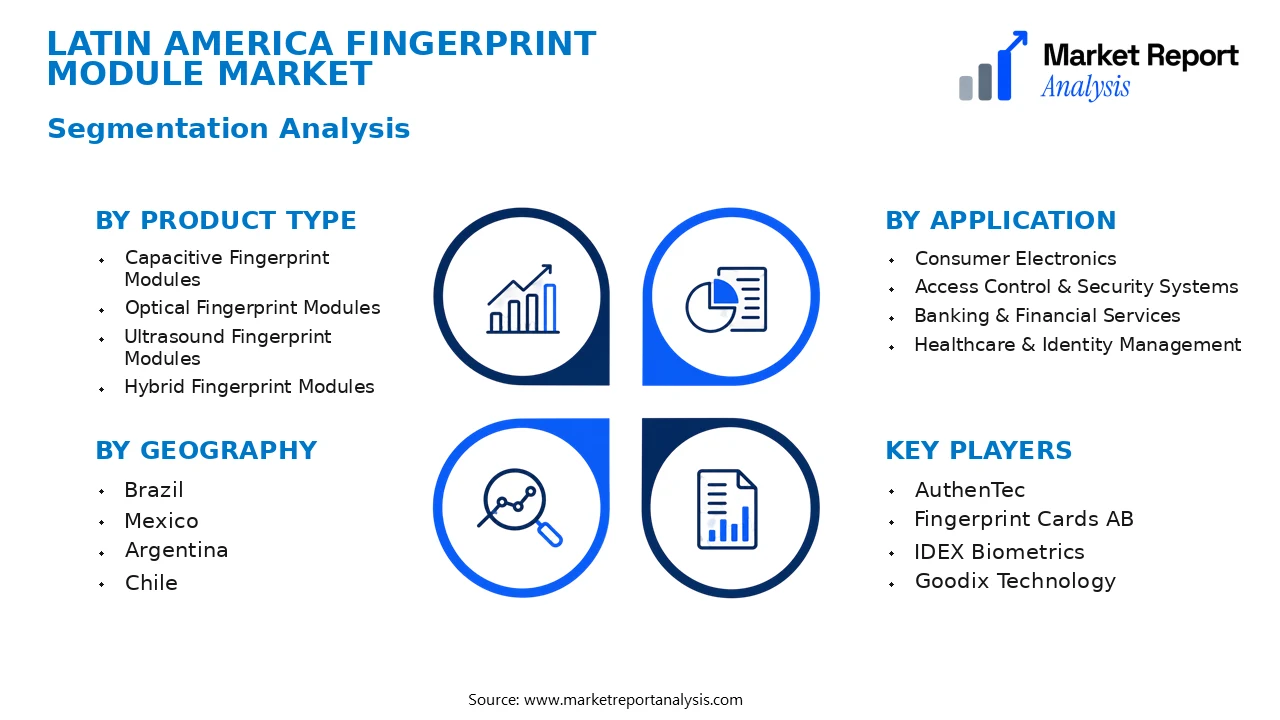
Market segmentation of the Latin America Fingerprint Module Market is conducted based on product type, application, and geographical distribution. These categories help delineate the diverse industrial landscape and consumer demand driving market growth across the region, enabling targeted strategic planning and market entry strategies.
- Product Type
- Capacitive Fingerprint Modules: Capacitive fingerprint modules are the most widely used sensors in consumer electronics, offering high accuracy and durability. Their significance in smartphone and secure device applications drives substantial market demand.
- Optical Fingerprint Modules: Optical fingerprint modules utilize light-based technology, providing high-resolution fingerprint imaging. They are preferred in access control systems and identity management applications, escalating their relevance in secure environments.
- Ultrasound Fingerprint Modules: Ultrasound fingerprint modules are recognized for their ability to scan fingerprints through non-porous surfaces and contaminants, making them ideal for rugged applications and contactless device security, increasing their adoption across various sectors.
- Hybrid Fingerprint Modules: Hybrid modules combine multiple fingerprint sensing technologies to enhance security and performance, especially in high-security applications such as government ID programs and banking sectors, fostering growth in specialized markets.
- Application
- Consumer Electronics: This segment includes smartphones, tablets, and laptops, where fingerprint modules are essential for biometric authentication and securing user devices, representing the primary application driver in the region.
- Access Control & Security Systems: Used extensively in building security, government facilities, and secured workplaces, fingerprint modules enhance security protocols, thereby expanding their deployment and market presence.
- Banking & Financial Services: Contactless authentication and secure transaction verification utilize fingerprint technology to enhance customer security, with rising demand attributable to increasing digital financial integration.
- Healthcare & Identity Management: In healthcare, fingerprint modules secure patient records and streamline identity verification, fostering growth in hospital administration and biometric patient identification systems.
- Geography
- Brazil: As Latin America's largest economy, Brazil exhibits significant adoption of fingerprint modules driven by expanding smartphone penetration, smart city initiatives, and security-focused infrastructure projects.
- Mexico: With a burgeoning security and banking sector, Mexico sees increasing deployment of biometric authentication systems, including fingerprint modules for enhancing financial transaction security and access control.
- Argentina: Argentina’s evolving consumer electronics sector and government initiatives favor biometric solutions, providing growth opportunities for fingerprint module suppliers in both domestic and regional markets.
- Chile: Chile's stable economy and focus on technological innovation drive demand for high-performance fingerprint modules in security solutions and mobile applications, positioning it as a key growth hub in LATAM.
Market segmentation analysis underscores the diversified nature of the Latin America Fingerprint Module Market, emphasizing the strategic importance of product type, application, and geographic focus in capturing growth opportunities. Each segment's demand dynamics are influenced by regional economic development, technological adoption rates, and regulatory frameworks, guiding market participants in resource allocation and product development strategies tailored to regional needs and orientations.
Competitive Intelligence
The Latin America Fingerprint Module Market is characterized by a moderately concentrated competitive landscape, with key players including industry leaders such as Sony, NEXT Biometrics, and Fingerprint Cards. These companies focus heavily on product innovation to differentiate in quality, security features, and integration capabilities, strategically investing in R&D to develop advanced, miniaturized fingerprint modules capable of operating reliably across diverse environmental conditions. Strategic partnerships and collaborations are prevalent, often involving technology companies and device manufacturers, to accelerate deployment in smartphones, access control systems, and IoT devices. Acquisitions further enable market players to expand their technological portfolio and geographic reach, as seen in recent buyouts of startups with specialized biometric solutions. Expansion strategies typically emphasize local partnerships and localization initiatives to penetrate regional markets. Additionally, competitive differentiation is achieved through tailored security features, faster response times, and lower power consumption, which are critical for IoT and mobile applications. Overall, firms compete by emphasizing technological advancements, ecosystem integration, and market-specific customization, fostering a dynamic environment driven by innovation and strategic collaborations.
Leading Company Profiles
The Latin America fingerprint module market features a competitive landscape comprised of several key players that drive innovation and strategic growth within the region. These companies focus on developing advanced biometric technologies, expanding product portfolios, and strengthening local market presence through strategic collaborations.
- AuthenTec
- Fingerprint Cards AB
- IDEX Biometrics
- Goodix Technology
- Synaptics Incorporated
- Suprema Inc.
- Gemalto NV
- Crossmatch Technologies
- BIO-key International
- Zwipe AS
AuthenTec
AuthenTec specializes in fingerprint sensors and biometric security solutions tailored for consumer electronics and mobile devices, emphasizing innovative integration and high reliability, maintaining a leading position in biometric security technologies in Latin America.
Fingerprint Cards AB
Fingerprint Cards AB designs and supplies fingerprint reading solutions, leveraging its advanced sensor technology to strengthen biometric authentication capabilities across mobile, IoT, and access control markets within Latin America, emphasizing quality and scalability.
IDEX Biometrics
IDEX Biometrics offers embedded fingerprint sensors with strong focus on cost-effective solutions that enhance security applications in banking, mobile, and government sectors, reinforcing its competitive advantage through localized manufacturing and strategic partnerships in LATAM.
Goodix Technology
Goodix provides fingerprint sensors and biometric ICs used in smartphones, wearables, and secure access control, investing heavily in R&D, and forming strategic alliances within Latin America to expand its footprint in the rapidly growing biometric market.
Synaptics Incorporated
Synaptics develops biometric sensors integrated into touch interfaces for mobile and IoT devices, focusing on seamless user experiences and incorporating AI-powered security features tailored for Latin American markets’ specific needs.
Suprema Inc.
Suprema is known for its biometric access control and time-attendance systems, with an emphasis on scalable security solutions, including biometric modules and turnkey solutions tailored for diverse sectors within Latin America.
Gemalto NV
Gemalto specializes in digital security and biometric identification solutions, providing hardware and software to government agencies and commercial entities, with ongoing investments in region-specific biometric deployment programs.
Crossmatch Technologies
Crossmatch focuses on biometric ID and fingerprint scanners, delivering robust solutions for law enforcement, border control, and enterprise security in Latin America through strategic regional collaborations and product innovation.
BIO-key International
BIO-key offers fingerprint biometric software and hardware solutions with a focus on online and mobile security, emphasizing cloud-based biometric authentication tailored to financial and governmental sectors in LATAM.
Zwipe AS
Zwipe specializes in biometric card solutions, integrating fingerprint sensors directly into payment cards, with strategic alliances in Latin America aimed at transforming contactless payment security standards.
Strategic Business Developments
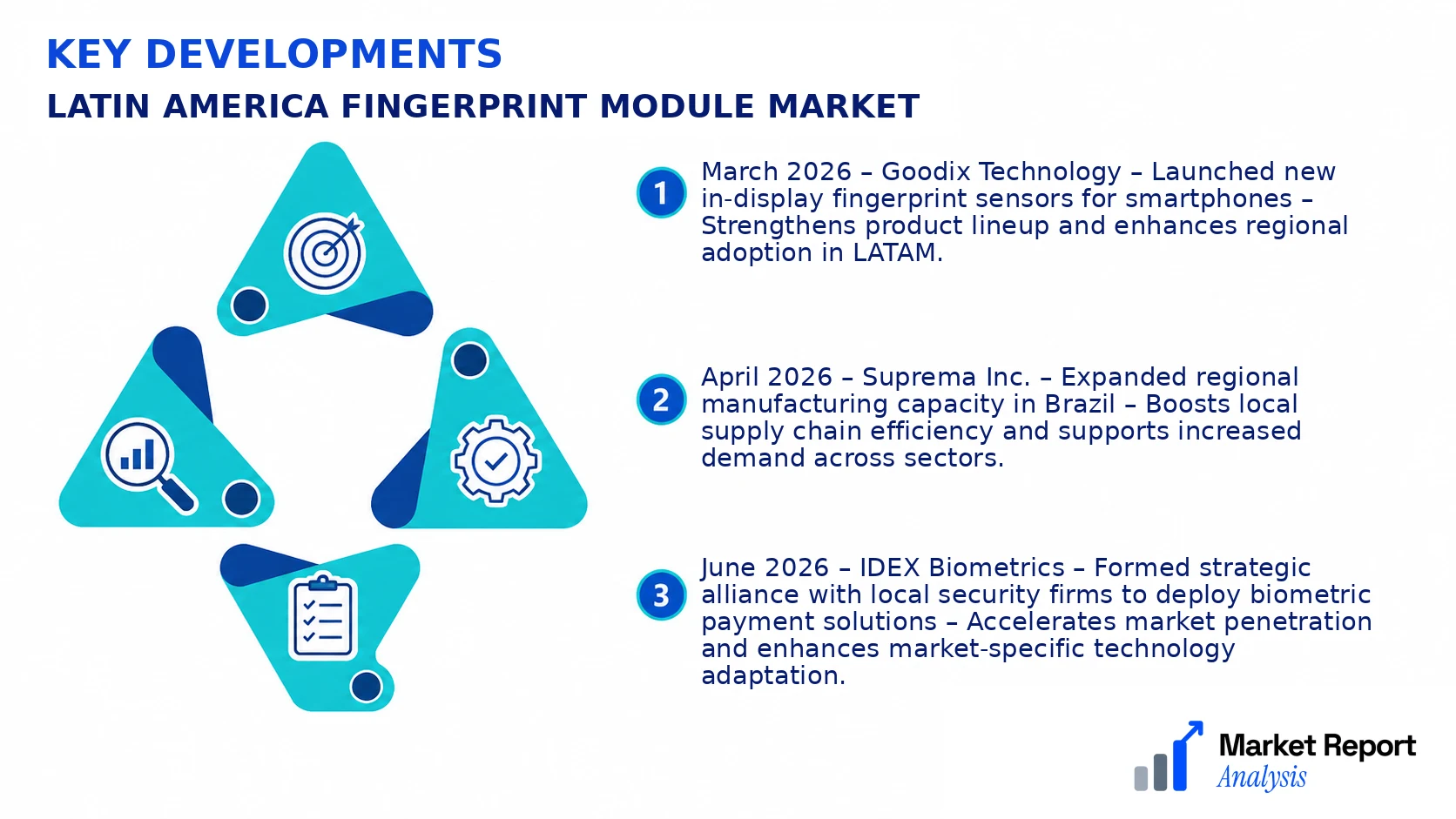
- March 2026 – Goodix Technology – Launched new in-display fingerprint sensors for smartphones – Strengthens product lineup and enhances regional adoption in LATAM.
- April 2026 – Suprema Inc. – Expanded regional manufacturing capacity in Brazil – Boosts local supply chain efficiency and supports increased demand across sectors.
- June 2026 – IDEX Biometrics – Formed strategic alliance with local security firms to deploy biometric payment solutions – Accelerates market penetration and enhances market-specific technology adaptation.
- August 2026 – Synaptics Incorporated – Unveiled AI-powered biometric authentication platform for enterprise solutions – Addresses increasing security demands in Latin American commercial sectors.
- September 2026 – Gemalto NV – Acquired regional biometric ID service provider to expand service offerings – Strengthens regional presence and accelerates digital ID initiatives across LATAM.
Frequently Asked Questions
What is the Latin America Fingerprint Module Market?
The Latin America Fingerprint Module Market encompasses the demand for biometric fingerprint recognition modules used in security, access control, and identity verification across various industries within Latin America, including government, banking, and consumer electronics.
What is the current market size of Latin America Fingerprint Module Market?
As of 2026, the Latin America Fingerprint Module Market is valued at approximately USD 1.2 Billion, reflecting steady growth driven by increasing adoption of biometric security measures in both private and government sectors across the region.
What factors are driving the Latin America Fingerprint Module Market?
Market growth is fueled by rising security concerns, government initiatives for biometric identification, the proliferation of smartphones with fingerprint sensors, and advancements in fingerprint sensor technology making modules more affordable and scalable across diverse applications.
Which region dominates the Latin America Fingerprint Module Market?
Brazil is the dominant region within Latin America, owing to its large consumer electronics market, governmental adoption of biometric IDs, and a robust security infrastructure, making it the primary driver of regional market growth.
Which segment is expected to grow the fastest?
The consumer electronics segment, particularly smartphones and tablets, is projected to experience the fastest growth, driven by increasing smartphone penetration and the integration of biometric fingerprint sensors for enhanced security features.
Who are the leading companies operating in the Latin America Fingerprint Module Market?
Key players include Biometrics Ltd., IDEMIA, Suprema, Fingerprint Cards, and ZKTeco, all of which are actively expanding their regional footprints through strategic partnerships, innovation, and product portfolio enhancements.
Analyst Perspective
The Latin America Fingerprint Module Market exhibits a mature landscape with steady growth driven by increasing adoption across security, consumer electronics, and financial sectors. Looking ahead, technological evolution focused on enhanced sensor accuracy, miniaturization, and multi-modal biometric integration will be crucial for maintaining competitive edge. Commercial opportunities will emerge from expanded use in mobile devices, government identity programs, and access control segments, with regional markets like Brazil, Mexico, and Argentina poised for significant expansion due to rising digitalization efforts. Investment priorities should prioritize R&D for durable, cost-efficient modules and strategic partnerships with OEMs to capture emerging demand. Competitive intensity will intensify as local and global players vie for market share through innovation and aggressive pricing strategies. Regional growth potential remains high, particularly in Brazil and Mexico, where government initiatives and increasing smartphone penetration will propel adoption. Long-term, the market will benefit from technological advancements and expanding application scope, although geopolitical and supply chain risks require careful strategic management to sustain growth trajectories.
