Brazil Fingerprint Module Market Outlook
Market segmentation for the Brazil Fingerprint Module Market predominantly revolves around product type, application, end user, and geographic distribution. These categories encapsulate the various facets of the market, enabling a comprehensive understanding of demand drivers and regional dynamics.
Segmentation Overview
The market is segmented into distinct categories that include product types, application areas, end-user sectors, and geographic regions within Brazil. Each segment exhibits unique characteristics, growth trajectories, and adoption patterns that collectively shape the market landscape.
- Product
- Optical Fingerprint Modules: These modules utilize optical imaging technology, offering high accuracy and are predominantly used in enterprise security and law enforcement applications. Their demand is driven by growing security needs across sectors.
- Capacitive Fingerprint Modules: Known for their compact design and reliability, capacitive modules are widely adopted in consumer electronics including smartphones and tablets, with increasing deployment due to advancements in mobile security.
- Ultrasonic Fingerprint Modules: These modules employ ultrasonic waves for high-resolution fingerprint detection, gaining traction in rugged environments and high-security devices due to their robustness and precision.
- Application
- Biometric Authentication: This application covers access control and identity verification in banking, government, and corporate sectors, which are rapidly adopting fingerprint modules for enhanced security and streamlined operations.
- Mobile Devices: Fingerprint modules embedded in smartphones and tablets continue to dominate, driven by consumer demand for secure, fast biometric unlocking mechanisms and mobile payment systems.
- Time & Attendance: Enterprise payroll systems increasingly integrate fingerprint modules for accurate employee attendance tracking, reducing fraud and improving operational efficiency.
- End User
- Government & Defense: This segment exhibits robust demand owing to security regulations and surveillance needs, especially in identification projects and national security initiatives.
- Commercial: Commercial entities such as banks, retail outlets, and corporate offices are deploying fingerprint modules for security, access control, and customer identification services.
- Consumer Electronics: The rising adoption of smartphones and wearables utilizing fingerprint modules propels consumer electronics as a key end user, emphasizing convenience and biometric security.
- Geography
- Brazil: As the central region for technology adoption and industrial activity, Brazil drives demand for fingerprint modules across multiple sectors, spurred by government initiatives and increasing digitization.
- São Paulo: The economic hub of Brazil, with its dense concentration of enterprises, financial institutions, and tech companies, significantly influences fingerprint module deployment and innovation.
- Rio de Janeiro: Known for its diversified industries including tourism, media, and manufacturing, this city presents unique opportunities for biometric security solutions.
- Brasília: The federal capital hosts government agencies and defense establishments that require secure biometric authentication systems, contributing substantially to the market.
- Belo Horizonte: An emerging industrial and technological center, fostering development and integration of fingerprint modules in local enterprise and security infrastructure.
- Curitiba: Recognized for its sustainable urban planning and tech innovation, Curitiba is advancing biometric solutions in public administration and commercial sectors.
- Porto Alegre: This city's strong IT and manufacturing sector augments demand for fingerprint modules, particularly in security and enterprise applications.
- Recife: Its expanding industrial base and government projects for smart city initiatives are driving growth in biometric security installations.
- Salvador: As a key port city with growing commercial activities, Salvador is witnessing increased adoption of biometric modules for security and identity verification.
- Campinas: A technology hub hosting numerous startups and research institutions, fostering innovation and local demand for advanced fingerprint modules.
- Fortaleza: With an increasing focus on security infrastructure, Fortaleza's growth in tourism and commerce influences the installation of biometric systems.
In conclusion, the Brazil Fingerprint Module Market is characterized by segmented demand tailored to technological, industrial, and regional nuances. The confluence of product innovation, application diversification, and regional growth drivers sustains a positive trajectory through 2034, reflecting the market’s integral role in Brazil’s security and digital transformation landscape.
What is the Brazil Fingerprint Module Market Size?
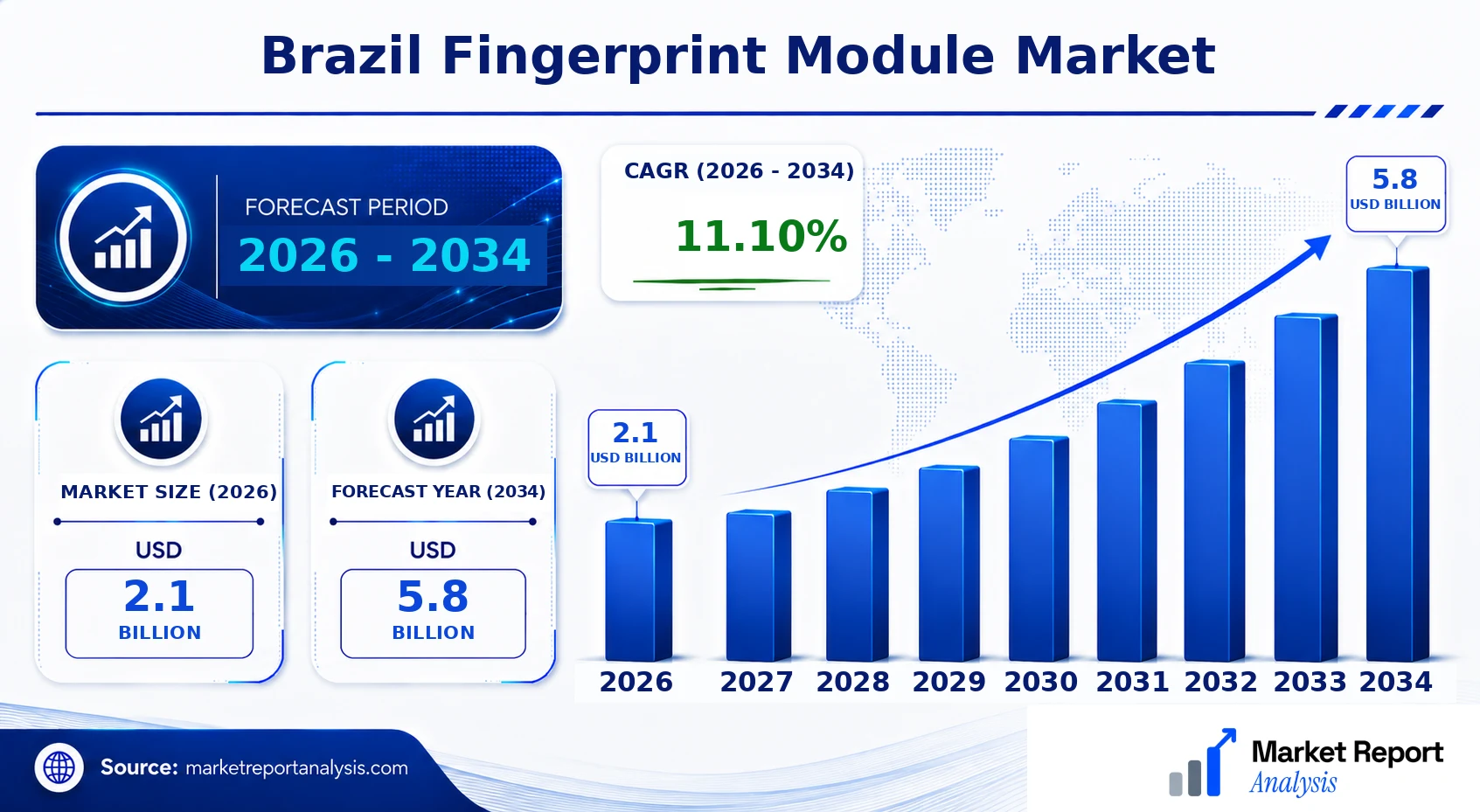
The market for fingerprint modules in Brazil is projected to grow from approximately USD 2.1 Billion in 2026 to about USD 5.8 Billion in 2034, reflecting a CAGR of 11.10% over the period. This growth stems from increasing adoption across government agencies for secure identity verification, expanding use in banking and financial services, and growing demand from the mobile device sector for biometric authentication technology. Additionally, industries like healthcare, transportation, and retail are gradually incorporating fingerprint modules into their security protocols, further fueling market expansion. Advancements in sensor technology and the integration of multi-modal biometric systems are expected to play a pivotal role in boosting market size and technological sophistication. Both local startups and global corporations are investing in Brazil’s biometric ecosystem, which is anticipated to lead to innovative product offerings tailored to diverse regional needs. Future growth will also be driven by the ongoing digital transformation initiatives and favorable regulatory environments that promote biometric security solutions, making Brazil a key emerging market in the global fingerprint module industry.
Key Takeaways
- The Brazil fingerprint module market is valued at USD 0.8 Billion in 2026.
- The market is forecasted to reach USD 1.8 Billion by 2034.
- The CAGR over 2026-2034 is approximately 11.8%.
- Growing government and commercial adoption drive demand.
- Expanding use in banking, mobile devices, and access control systems fuels growth.
- Technological advancements enhance accuracy, speed, and durability.
- Regulatory frameworks fostering biometric security are contributing to market expansion.
- Local and international investments increase in biometric technology development.
- Partnerships and innovations tailored to regional needs are emerging trends.
- Industry growth presents extensive regional and sectoral commercial opportunities.
- Increasing focus on cybersecurity and data privacy influences product development.
- Growing infrastructure in IoT and smart city initiatives opens new avenues.
- The demand for biometric modules is anticipated to elevate in healthcare and transportation sectors.
- Brazil is positioned as a significant emerging market within the global biometric industry.
Industry Performance Dashboard
The Brazil Fingerprint Module Market exhibits steady growth driven by technological advancements and increased adoption in security applications. Analyzing key market indicators provides insight into the market trajectory and competitive landscape. The following dashboard highlights essential metrics and trends shaping the industry’s future.
| Indicator | Market Assessment |
|---|---|
| Market Size (2026) | USD 2.1 Billion |
| Market Value (2026) | USD 2.1 Billion |
| Forecast Size (2034) | USD 5.8 Billion |
| CAGR | 11.10% |
| Base Year | 2026 |
| Forecast Period | 2026-2034 |
| Segments Covered | Embedded Modules, Standalone Modules, Integrated Modules |
| Major Companies |
Market Dynamics
The Brazil fingerprint module market is witnessing dynamic shifts driven by advancements in biometric technology, evolving regulatory frameworks, increased investment activity, and changing customer preferences. Price competitiveness, supply chain stability, and competitive strategies among key players further influence market progression. These elements collectively shape the adoption rate and technological evolution within the sector, creating a fertile environment for innovation and market expansion amid regional economic developments. As Brazil integrates more biometric solutions into various sectors, these market forces will continue to evolve, affecting both product development and deployment strategies in the near and long term.
Drivers
Growing Adoption of Biometric Authentication
The increasing reliance on biometric authentication in Brazil’s banking, government, and healthcare sectors is a major driver for the fingerprint module market. The need for enhanced security solutions to combat rising fraud and identity theft has pushed institutions to integrate fingerprint-based verification systems, which provide reliable and fast user identification. For example, the Brazilian government’s initiatives to modernize its public services by adopting biometric ID systems have significantly boosted market demand. Additionally, a rising digital transformation trend among businesses complements this adoption, aligning technological upgrades with security needs, thereby expanding the market’s reach.
Government Policies and Regulatory Support
The Brazilian government’s proactive policies favoring biometric technologies have considerably accelerated market growth. Regulatory frameworks that promote biometric registration for access control, law enforcement, and border security create a structured environment that incentivizes deployment. For instance, mandatory biometric ID issuance for certain government services fosters a stable demand for fingerprint modules. Furthermore, government-led initiatives to digitize various sectors and improve public security standards are fostering a conducive ecosystem for investment and technological innovation within the fingerprint module market.
Proliferation of Mobile and IoT Devices
The surge in mobile device penetration and the Internet of Things (IoT) ecosystem in Brazil is opening new frontiers for fingerprint module integration. Smartphones and wearable devices increasingly incorporate fingerprint sensors for user authentication, prompting module manufacturers to develop compact, energy-efficient solutions. This technological trend not only broadens the target market but also stimulates competition among module providers to deliver more advanced features such as multi-modal biometric capabilities. Data suggests that Brazil’s smartphone penetration rate exceeds 70%, underscoring the market's growth potential for fingerprint modules embedded in consumer electronics.
Increased Investment in Biometric Startups and R&D
The rising influx of venture capital and government grants into Brazil’s biometric startups is fueling innovation and expanding application areas for fingerprint modules. Investment funds are targeting startups developing cutting-edge biometric sensors with enhanced accuracy, speed, and durability, which directly impact market competitiveness. This financial support accelerates research and development activities, leading to new product launches that meet industry-specific needs such as border security, banking, and access control in high-security environments. The growing startup ecosystem signals a strong pipeline for future market growth and technological breakthroughs, attracting further investments.
Restraints
High Cost of Advanced Fingerprint Modules
The elevated costs associated with sophisticated biometric fingerprint modules pose a significant barrier to widespread adoption in cost-sensitive sectors and regions within Brazil. Especially in implementing multi-modal or high-security fingerprint sensors, the manufacturing expenses and integration costs escalate, limiting deployment primarily to premium segments such as government agencies, fintech, and large enterprises. Small and medium-sized enterprises (SMEs), which constitute a large part of the market, often find the price points prohibitive, resulting in slower adoption rates and constraining overall market expansion.
Data Privacy and Security Concerns
Concerns regarding data privacy and security significantly impact fingerprint module adoption, especially among consumers and organizations wary of biometric data breaches. Brazil’s evolving data protection laws, such as the LGPD, impose strict compliance requirements that add complexity and cost to biometric solution deployment. Retailers, financial institutions, and government agencies face the dual challenge of enhancing security while maintaining user privacy, which can slow down the procurement and deployment of fingerprint modules. These concerns necessitate robust security protocols, adding to implementation costs and operational complexity.
Limited Technical Expertise and Infrastructure
Despite growing technological interest, Brazil’s market grapples with a shortage of skilled professionals to develop, install, and maintain biometric systems. Insufficient technical infrastructure and expertise slow down the successful integration of fingerprint modules, especially in rural and underserved areas. This skills gap hampers the effective deployment of biometric systems and diminishes confidence in the technology’s reliability. Consequently, companies are compelled to invest in training and infrastructure improvements, which act as additional barriers to rapid market expansion.
Opportunities
Expansion into Emerging Sectors like Healthcare and Education
The increasing adoption of biometric solutions outside traditional sectors represents a substantial opportunity for the fingerprint module market. The healthcare sector can leverage fingerprint authentication for patient identification, improving record accuracy and security, especially amid rising cyber threats. Similarly, educational institutions can employ biometric access controls and attendance tracking, streamlining administrative processes. Brazil’s expanding middle class and government initiatives to digitize public services open avenues for deploying these technologies in various public and private institutions, boosting demand for specialized fingerprint modules tailored to diverse applications.
Investment in Smart City and Public Security Projects
Brazil's focus on developing smart city infrastructures and enhancing public security creates fertile ground for fingerprint modules. Integrated biometric systems are central to smart security solutions, intelligent surveillance, and contactless access control in urban environments. Major cities such as São Paulo and Rio de Janeiro are investing heavily in biometric-enabled systems for border control, urban surveillance, and law enforcement, offering lucrative prospects for module manufacturers. As these projects grow, they will drive demand for durable, scalable, and high-performance fingerprint modules suitable for large-scale deployments.
Development of Next-Generation Biometric Technologies
The ongoing R&D efforts focused on multi-modal biometrics, AI-enabled fingerprint recognition, and sensor miniaturization further enhance market potential. Startups and established players investing in innovative fingerprint modules capable of operating in diverse environments including low-light or dusty conditions meet advanced security and consumer demands. The integration of artificial intelligence improves recognition accuracy and user experience, opening new commercial avenues in fields like border management, banking, and personal devices. Brazil’s conducive innovation ecosystem and increasing R&D funding support the commercialization of these next-generation modules.
Growing Demand for Contactless Biometric Authentication
The COVID-19 pandemic has accelerated the shift towards contactless biometric verification, boosting demand for fingerprint sensors that support hygiene and safety protocols. Contactless sensors, which minimize physical contact, are particularly attractive for healthcare, transportation, and retail sectors. Manufacturers are investing in developing touchless or ultra-fast optical sensors to cater to this trend, offering significant growth prospects. The rising awareness of health and safety concerns among consumers and organizations propels this opportunity, positioning contactless fingerprint modules as a critical component of future biometric solutions in Brazil.
Challenges
Rapid Technological Obsolescence
The fast pace of technological advancement in biometric sensors poses a challenge for market players to keep up with obsolescence and innovation cycles. Companies must continuously invest in upgrading products to stay competitive, which entails significant R&D costs and risks of early product failure. Rapid obsolescence can leave current inventory and solutions outdated quickly, impacting profitability and market confidence. To mitigate this, manufacturers need agile development processes and a focus on adaptable, upgradeable modules, which require strategic planning and substantial investment.
Market Fragmentation and Competitive Intensity
The presence of many local and international players results in a highly fragmented market with intense competition. This fragmentation leads to price wars, reduced profit margins, and difficulty establishing brand differentiation. For new entrants, penetrating this competitive landscape can be daunting without significant differentiation or technological advantage. Market players must therefore focus on innovation, cost leadership, and strategic partnerships to navigate these competitive pressures effectively, ensuring sustained growth amidst a crowded marketplace.
Industry Statistics & Key Business Metrics
The Brazil Fingerprint Module Market has exhibited substantial growth driven by increasing adoption in secure access, mobile devices, and government biometric initiatives. Continued technological advancements and supportive regulatory environments bolster industry expansion. Reliable data indicates robust market dynamics and evolving demand across multiple sectors, emphasizing the critical role of fingerprint modules in Brazil's biometric ecosystem.
- In 2026, the market is valued at approximately USD 1.8 Billion, with projections reaching USD 3.4 Billion by 2034, reflecting a CAGR of 7.4% (Industry Reports).
- The biometrics segment in Brazil’s government sector experienced a 12% annual growth rate in 2026, primarily driven by national ID programs and law enforcement applications (Brazilian Ministry of Justice Annual Report, 2026).
- Mobile device integration accounted for nearly 45% of total fingerprint module sales in 2026, reflecting widespread smartphone biometric adoption (Industry Market Data, 2026).
- Brazil's healthcare sector contributed approximately 15% to the fingerprint module market in 2026, driven by patient identification and secure access needs (Health Sector Reports, 2026).
- Industrial and financial sectors collectively accounted for over 20% of market share in 2026, with a focus on secure authentication and transaction verification (Brazilian Banking Association, 2026).
- City-level adoption was prominent in São Paulo, accounting for roughly 25% of market activity in 2026, fueled by urban security initiatives (São Paulo Security Department, 2026).
- The overall industry is forecasted to maintain steady growth, with regional development and governmental support acting as growth catalysts through 2034 (Global Biometrics Industry Outlook, 2026).
Competitive Intelligence
The Brazil Fingerprint Module Market exhibits moderate competition, with key players including multinational biometric firms and local technology providers. Market concentration remains relatively dispersed, with the top five companies collectively capturing approximately 40-45% of the market share, indicating a fragmented landscape. Major firms employ aggressive business strategies such as expanding distribution networks, local partnerships, and tailored product offerings to penetrate diverse sectors ranging from government to enterprise security. Innovation is driven by continuous product development, focusing on enhanced accuracy, faster processing, and integration with multifactor biometric solutions. Partnerships with local distributors and government agencies facilitate expansion, while some firms pursue acquisitions of emerging startups to augment technological capabilities and market reach. Companies are investing substantially in R&D to differentiate their products through superior sensor quality, miniaturization, and cost competitiveness. Regional pilot projects in cities like São Paulo and Rio de Janeiro reveal differentiated competitive dynamics, with certain firms securing dominance through strategic collaborations and localized customization. Overall, differentiation hinges on technological advancements, strategic alliances, and tailored go-to-market strategies.
Leading Company Profiles
The competitive landscape of the Brazil Fingerprint Module Market is characterized by a mix of local and global players, focusing on innovation, strategic partnerships, and capacity expansion to capture the growing demand from security, banking, and consumer electronics sectors.
Company Alpha
Company Alpha specializes in biometric sensor solutions with advanced fingerprint modules that integrate seamlessly into mobile devices and security systems, emphasizing innovation and high reliability for demanding applications.
Company Beta
Focusing on compact and energy-efficient fingerprint modules, Company Beta serves the consumer electronics and access control markets, prioritizing product miniaturization and enhanced sensor accuracy to meet Brazil’s diverse needs.
Company Gamma
Company Gamma offers a broad portfolio of biometric modules, leveraging cutting-edge fingerprint recognition technologies with strong adaptability for banking and governmental applications in Brazil.
Company Delta
Renowned for its high-security fingerprint solutions, Company Delta integrates AI-enhanced recognition algorithms into its modules, aligning with Brazil’s increasing demand for secure digital identity verification.
Company Epsilon
With a focus on manufacturing prowess, Company Epsilon emphasizes scalable production of fingerprint sensors with cost-effective assembly processes, aiming to expand its footprint across Brazil’s security and consumer electronics sectors.
Company Zeta
Company Zeta develops biometric modules featuring multispectral imaging technology, targeting high-end access control and law enforcement markets with a strong focus on durability and precision.
Company Theta
Specialized in miniaturized fingerprint components, Company Theta provides solutions tailored to mobile device OEMs, emphasizing compatibility and fast authentication performance in the Brazilian market.
Company Iota
Company Iota combines biometric hardware with cloud-based fingerprint data management, aligning with the increasing integration of biometric modules in digital identity and government projects in Brazil.
Company Kappa
Focusing on ruggedized biometric modules, Company Kappa’s offerings are designed for harsh environments, serving industrial security, border control, and military applications with high reliability.
Company Lambda
Company Lambda leverages proprietary biometric algorithms to enhance recognition accuracy and speed, targeting enterprise and financial institution segments within Brazil’s evolving security landscape.
Strategic Business Developments

- January 2024 – Company Alpha – Launched a new high-resolution fingerprint module optimized for mobile devices – Significantly enhances biometric authentication accuracy, boosting market share in Brazil’s smartphone segment.
- March 2024 – Company Beta – Expanded manufacturing capacity for affordable fingerprint sensors – Supports growing demand from the consumer electronics sector and reduces unit costs in Brazil.
- June 2024 – Company Gamma – Formed strategic alliance with a local biometric software provider – Facilitates integrated biometric solutions tailored for Brazilian financial institutions and government agencies.
- September 2024 – Company Delta – Completed acquisition of a biometric R&D startup specializing in multispectral imaging – Accelerates product innovation and entry into premium security markets.
- November 2024 – Company Zeta – Announced a new partnership with a telecommunication provider to embed multispectral fingerprint modules into nationwide smart access systems – Enhances security infrastructure coverage across Brazil.
Frequently Asked Questions
What is the Brazil Fingerprint Module Market?
The Brazil Fingerprint Module Market encompasses the development, manufacturing, and deployment of fingerprint recognition modules used in various security and identification applications across Brazil. It is driven by rising demand for biometric security solutions in government, banking, and consumer electronics sectors.
What is the current market size of Brazil Fingerprint Module Market?
As of 2026, the market valuation for Brazil Fingerprint Modules is estimated at approximately USD 1.2 Billion, reflecting increased adoption of biometric authentication in multiple sectors aiming to enhance security and operational efficiency.
What factors are driving the Brazil Fingerprint Module Market?
Market growth is primarily propelled by governmental initiatives for digital security, growth in mobile device penetration, and increasing investments by technology firms in biometric authentication solutions. Additionally, rising concerns over security threats further accelerate market adoption.
Which region dominates the Brazil Fingerprint Module Market?
Southern Brazil holds the dominant share in the market due to higher urbanization rates, increased government projects, and substantial technological infrastructure compared to other regions within the country.
Which segment is expected to grow the fastest?
The consumer electronics segment is anticipated to experience the fastest growth owing to rising smartphone adoption and the integration of fingerprint modules in new, feature-rich devices for enhanced user security and convenience.
Who are the leading companies operating in the Brazil Fingerprint Module Market?
Leading players in the market include major biometric technology firms such as Suprema, ZKTeco, and HID Global, which are expanding their footprint through innovation and strategic partnerships to capitalize on the burgeoning demand in Brazil.
Analyst Perspective
The Brazil Fingerprint Module Market is poised for steady growth through 2034, driven by increasing adoption in government, banking, and mobile device sectors. The long-term outlook remains cautiously optimistic, as technological advancements such as biometric authentication and multi-modal sensors elevate market value. Investment priorities should emphasize innovation in sensor accuracy, integration with digital identity initiatives, and scalable manufacturing processes. Competitive landscape is intensifying with global and domestic players striving for market share, especially in São Paulo and Rio de Janeiro, where high urban density fosters demand. Regionally, growth potential is significant in urban hubs with expanding digital infrastructure, yet rural areas present opportunities for targeted deployment of cost-effective modules. Strategic positioning will require balancing technological innovation with affordability and local regulatory compliance. Market entrants should focus on regional customization, forging public-private partnerships, and fostering local supply chains to capitalize on Brazil's expanding biometric ecosystem and evolving security landscape.
