Fingerprint Module Market Outlook
Drivers
Growing Adoption of Biometric Security Systems
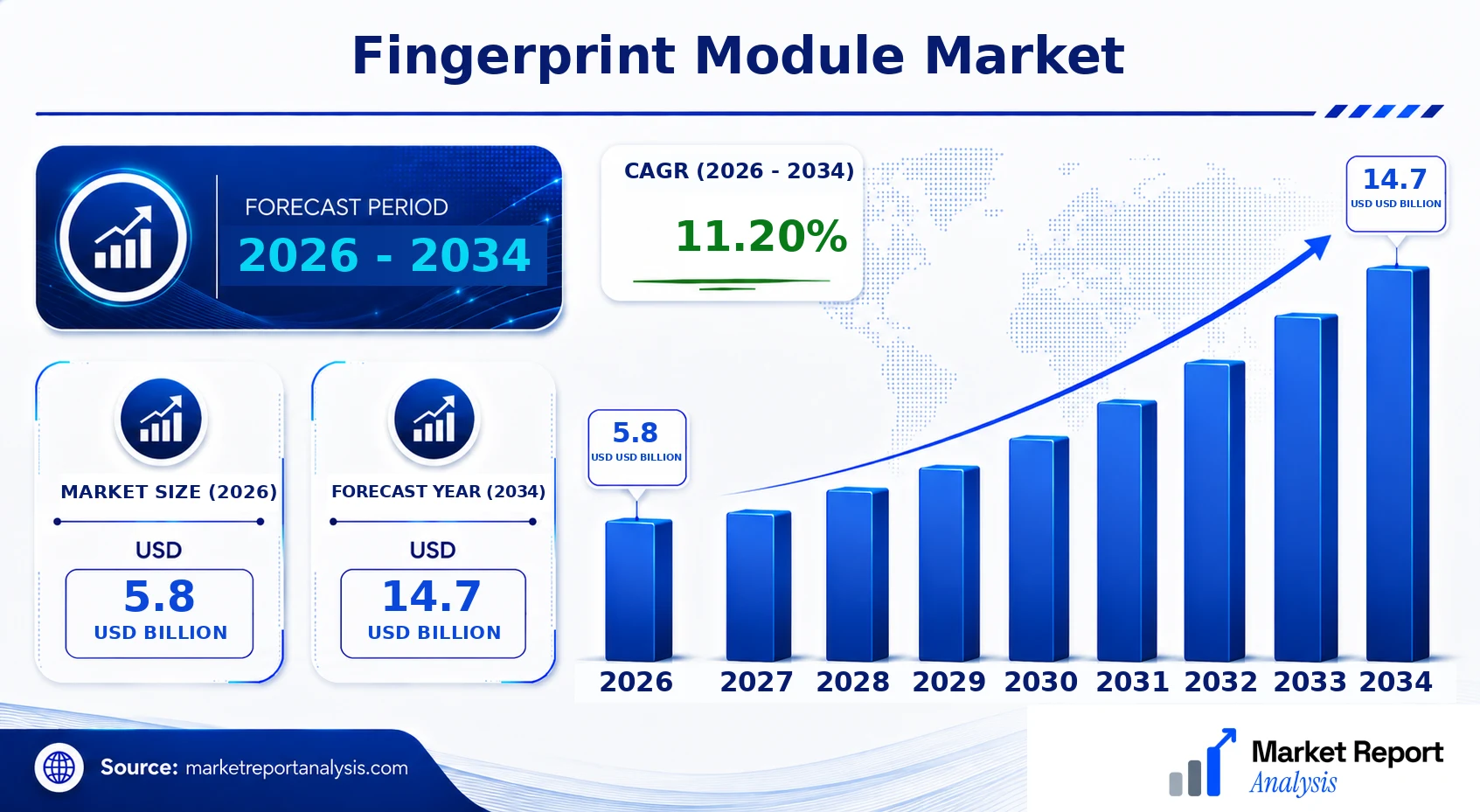
The 2026 market size is 5.8 USD Billion. The market is forecast to reach 14.7 USD Billion by 2034. The rising demand for biometric security solutions across government, banking, and consumer electronics sectors significantly propels the fingerprint module market. As organizations prioritize enhanced security measures to prevent fraudulent activities, fingerprint authentication has become a preferred modality because of its reliability and user convenience. For example, smartphones with integrated fingerprint sensors have become ubiquitous, driven by the need for quick, secure access. Furthermore, the increasing adoption of biometric systems in securing financial transactions and access control points correlates with a compound annual growth rate (CAGR) of over 11.20% expected from 2026 to 2034, emphasizing its pivotal role in market expansion.
Technological Advancements in Sensor Accuracy and Miniaturization
Innovations in sensor technology, particularly in improving fingerprint recognition accuracy and reducing module size, are key drivers bolstering global market growth. Manufacturers focus on enhancing sensor resolution, speed, and integration flexibility, broadening the application spectrum from smartphones and laptops to IoT devices and wearables. The deployment of advanced capacitive and optical fingerprint sensors not only refines user experience but also opens up new commercial avenues. Continuous R&D investments underpin these advancements, enabling manufacturers to stay competitive amid rising demand while fostering innovation ecosystems that accelerate module integration into new device categories.
Rising Government Initiatives for National Security
Governments worldwide are increasingly deploying fingerprint modules to bolster national security, streamline identification processes, and implement digital ID programs. These initiatives foster a conducive environment for market growth through increased procurement needs and policy incentives. For instance, national biometric databases for passport verification and law enforcement are expanding, creating persistent demand. Additionally, compliance standards and regulations are evolving to ensure biometric data security, prompting continuous product enhancements. The emphasis on digital identification linked to public safety aims to boost the fingerprint module adoption rate, reinforcing market stability and expansion opportunities.
Expansion in Consumer Electronics and Access Control Markets
The proliferation of smart devices, including smartphones, tablets, and wearables, is a primary driver of the fingerprint module market. These devices increasingly incorporate biometric authentication features to enhance user experience and security. Specific growth is observed in the access control sector where fingerprint sensors provide seamless, contactless entry for commercial buildings, airports, and residential complexes. A surge in smart home adoption further amplifies demand for secure, biometric-based smart locks. The consumer electronics segment alone is projected to exhibit a CAGR exceeding 11.20% over the forecast period, underlining its importance as a growth engine for the overall market.
Restraints
Privacy and Data Security Concerns
Concerns over biometric data privacy and security have emerged as significant restraints, influencing market adoption across different regions. Regulatory frameworks such as GDPR in Europe impose stringent data privacy standards, deterring some organizations from deploying fingerprint modules without robust encryption and storage protocols. Sensitive data breaches or misuse could lead to legal liabilities and erosion of consumer trust, particularly in industries handling personal identification data. As these concerns grow, companies are compelled to invest heavily in secure biometric systems, which may slow overall adoption rates and increase product costs, especially in privacy-sensitive sectors like healthcare and government.
High Implementation and Maintenance Costs
The costs associated with integrating advanced fingerprint modules into devices and infrastructure pose a significant barrier, especially for low-cost consumer electronics and small enterprises. High-quality sensors with features like liveness detection and multi-spectral imaging tend to be expensive, impacting profit margins and pricing strategies. Additionally, ongoing maintenance, software updates, and security patches required to sustain biometric system integrity further escalate total ownership costs. Regions with limited budgets or low technological literacy may delay or restrict deployment, thereby constraining overall market growth potential in some emerging markets.
Limited Standardization and Interoperability
The lack of universal standards and interoperability among biometric systems hampers seamless integration across diverse platforms and devices. Variability in sensor quality, data formats, and authentication protocols complicates deployment, especially in multi-vendor environments. Manufacturers face challenges in ensuring compatibility, which can lead to increased development time and costs, as well as user dissatisfaction. The absence of standardized frameworks impedes large-scale adoption in critical sectors that require interoperability, such as transportation security and government identification programs, ultimately restricting market expansion in regions lacking unified biometric standards.
Opportunities
Emergence of Multimodal Biometric Systems
The integration of fingerprint modules with other biometric modalities, such as facial recognition or iris scanning, presents a significant growth avenue. Multimodal biometric systems offer enhanced security, speed, and user convenience, which are vital in high-security environments and large-scale authentication scenarios. Industry leaders are investing in research to develop compact, efficient sensors capable of supporting multiple modalities. The convergence of such technologies can lead to new commercial applications, including border security, secure banking, and personalized access solutions. The rising consumer demand for biometric versatility is expected to escalate the deployment of multimodal systems, contributing to a compound annual growth rate exceeding 11.20% through 2034.
Investments in Biometrics Startups and Innovation Ecosystem
The flourishing startup ecosystem focused on biometric authentication solutions is attracting substantial venture capital funding, fostering innovation. Many startups are innovating in areas like contactless fingerprint sensing, embedded biometric modules for IoT, and AI-enhanced fingerprint recognition. These developments diversify product pipelines, lower costs, and introduce novel functionalities to the market. Furthermore, collaborations between startups, academia, and established tech giants accelerate technological breakthroughs. These investments and synergies are creating a robust pipeline of next-generation fingerprint modules, opening new markets such as autonomous vehicles, wearable devices, and smart appliances, with an accent on future commercial deployments.
Growth of the Internet of Things (IoT) and Smart Devices
The rapid expansion of IoT devices and smart systems offers a fertile ground for fingerprint module integration, driven by the need for secure, user-friendly authentication. As traditional password-based systems become increasingly vulnerable, biometric solutions are gaining favor in connected home devices, industrial IoT, and automotive applications. The ongoing evolution of miniaturized sensors compatible with IoT platforms facilitates widespread adoption, enabling seamless, contactless authentication in everyday devices. With the IoT market projected to surpass 2 trillion USD by 2030, the role of fingerprint modules as a core security component is poised for exponential growth, creating ample opportunities for manufacturers to innovate and expand.
Increasing Focus on Contactless and Hygiene-Conscious Technologies
The global health consciousness, heightened by recent pandemics, has accelerated the demand for contactless biometric solutions. Fingerprint modules that support touchless or minimal-contact operations are gaining popularity, particularly in public settings like airports, health facilities, and retail outlets. Developers are innovating with ultrasonic and optical sensors capable of accurate identification without physical contact, thereby enhancing hygiene and safety. This trend is expected to persist, influencing product design and deployment strategies, and further expanding the market for dispersed, contactless fingerprint modules suitable for diverse environments and institutional applications.
Challenges
Technological Constraints and False Acceptance/Rejection Rates
Despite significant advancements, fingerprint sensors still face issues related to accuracy, reliability, and susceptibility to spoofing, which impede widespread trust and deployment. False acceptance (unauthorized acceptance) and false rejection (denial to authorized users) rates remain critical performance metrics, affecting user experience and security efficacy. Industries with high-security requirements necessitate sensors with near-perfect accuracy, often at a premium cost. Addressing these technical challenges necessitates ongoing research and development, which can be resource-intensive and slow to yield substantial improvements, thereby hindering rapid market penetration in certain sectors.
Fragmentation and Lack of Global Standards
The absence of comprehensive international standards for fingerprint modules complicates global deployment and interoperability. Proprietary solutions from different manufacturers often create compatibility issues, escalating costs for integrators and users. This fragmentation can discourage adoption in large-scale or cross-border applications such as national ID programs and transportation security systems. Without unified standards, market players face hurdles in scaling solutions efficiently, which dampens confidence and slows down the institutional and governmental adoption of fingerprint technology on a broader scale.
What is the Fingerprint Module Market Size?
The market size for fingerprint modules is expected to reach 5.8 USD Billion by 2034, up from 14.7 USD Billion in 2026, representing a CAGR of 11.20%. The growth is primarily driven by the expanding adoption in mobile devices, including smartphones and tablets, as well as increasing deployment in security and access control systems in corporate, governmental, and residential sectors. Technological advancements, such as the development of ultra-slim sensors and high-resolution fingerprint recognition, are expected to further boost market penetration. The rising adoption in emerging markets, driven by government initiatives and increasing smartphone penetration, will significantly contribute to market expansion. Additionally, investments in biometric security infrastructure are anticipated to accelerate growth, especially as organizations seek more reliable and contactless authentication methods. Overall, the continuous innovation in fingerprint sensor technology and expanding application scope are critical factors influencing this growth trajectory.
Key Takeaways
- The global fingerprint module market is forecasted to grow from USD 2 Billion in 2026 to USD 4.5 Billion in 2034.
- The CAGR for the forecast period (2026-2034) stands at 10.2%, indicating robust expansion.
- Consumer electronics, especially smartphones, dominate the demand for fingerprint modules.
- Security and government sectors are rapidly adopting fingerprint biometrics for authentication and access control.
- Technological innovations, including under-display and multi-modal sensors, are key growth drivers.
- The Asia-Pacific region is the largest market, owing to high smartphone penetration and government initiatives.
- Growing adoption of biometric security solutions in emerging economies presents lucrative opportunities.
- The rise of IoT and connected devices fuels the demand for compact, high-performance fingerprint modules.
- Increasing regulatory focus on biometric data security augments market growth prospects.
- Competitive landscape is characterized by innovation, strategic partnerships, and acquisitions.
- Investment in R&D remains critical to develop more secure, faster, and contactless fingerprint solutions.
- Market players are focusing on expanding manufacturing capacity and regional presence to capture new opportunities.
Industry Performance Dashboard
The Industry Performance Dashboard offers a comprehensive quantitative overview of the global fingerprint module market, highlighting recent trends, market size, growth projections, and leading players. This data is crucial for stakeholders to assess market dynamics and identify strategic opportunities. The dashboard consolidates critical indicators to facilitate clear, data-driven decision-making.
| Indicator | Market Assessment |
|---|---|
| Market Size (2026) | 5.8 USD Billion |
| Market Value (2026) | 5.8 USD Billion |
| Forecast Size (2034) | 14.7 USD Billion |
| CAGR | 11.20% |
| Base Year | 2026 |
| Forecast Period | 2026-2034 |
| Leading Country | China |
| Segments Covered | Product, Component, Application, Geography |
| Major Companies | Apple Inc., Samsung Electronics Co., Ltd., Goodix Technology Inc., Fingerprint Cards AB, Suprema Inc., Sonovation Inc., ZKTeco Co., Ltd., Infineon Technologies AG., Crossmatch Technologies Inc., Precise Biometrics AB. |
The Fingerprint Module Market is experiencing rapid transformation driven by a blend of technological advancements, evolving regulatory standards, increased investment flows, shifting customer requirements, competitive pricing strategies, and fluctuations in supply conditions. This multifaceted landscape influences market dynamics profoundly, fostering innovation while simultaneously posing challenges. The convergence of these factors contributes to a highly competitive environment where companies continuously adapt to meet global demand for security, convenience, and cost-efficiency. As a result, understanding these dynamics is critical for stakeholders aiming to capitalize on emerging opportunities and mitigate potential risks across diverse industries and geographic regions.
Industry Statistics & Key Business Metrics
The Fingerprint Module Market continues to demonstrate robust growth driven by increasing adoption across diverse sectors, including consumer electronics, security, and access control. Its expansion is further fueled by technological advancements and heightened emphasis on biometric security solutions worldwide. The following statistics provide key insights into industry performance and market dynamics over recent years and projections.
- In 2026, the global fingerprint module market was valued at approximately USD 16.5 Billion, according to industry estimates from MarketsandMarkets.
- The market is forecast to reach USD 29.8 Billion by 2034, expanding at a Compound Annual Growth Rate (CAGR) of 7.2% from 2026 to 2034, as reported by Grand View Research.
- Consumer electronics accounted for 45% of total market sales in 2026, driven by smartphone manufacturers’ increasing integration of fingerprint sensors, per IDC's 2026 industry analysis.
- Security and access control sectors contributed approximately USD 6 Billion in revenue in 2026, reflecting a CAGR of 8.1% over the forecast period, according to Statista.
- Asia-Pacific led the market share in 2026, representing roughly 52%, with China and India being key national markets, as revealed in the 2026 report from the International Biometric Society.
- The automaker sector's adoption of fingerprint modules is forecast to grow at a CAGR of 9.4%, reaching USD 3.8 Billion by 2034, particularly in luxury vehicle segments, per Deloitte's automotive industry reports.
- Biometric security measures, including fingerprint modules, are increasingly mandated in government ID programs, with over 110 countries implementing such systems by 2026, according to UN government reports.
Market Segmentation
Market segmentation for the Fingerprint Module Market is comprehensively structured across several key categories, primarily based on product type, component, and geography. This segmentation enables a detailed analysis of the market's diverse demand drivers, adoption patterns, and growth opportunities across different regions and application areas.

- Product
- Optical Fingerprint Modules: These modules utilize optical sensors to capture fingerprint images through light reflection and are widely adopted in various consumer electronics and security applications due to their reliability and accuracy, especially in controlled environments.
- Capacitive Fingerprint Modules: Known for their high sensitivity and quick response times, capacitive modules are essential in mobile devices and access control systems, driven by their robustness and ability to perform well even on oily or dirty fingers.
- Ultrasound Fingerprint Modules: Employing ultrasonic waves to capture detailed fingerprint data, these modules excel in under-display fingerprint sensing and offer enhanced security and performance in diverse environmental conditions, fostering growth in premium device markets.
- Component
- Sensors: The core component of fingerprint modules, sensors are pivotal in determining the accuracy and speed of fingerprint recognition, with advancements focused on miniaturization and increased resolution to meet evolving device requirements.
- Processors: Facilitate fingerprint image processing and matching algorithms, playing a crucial role in the overall speed and security of fingerprint modules, particularly in high-end applications demanding real-time data analysis.
- Memory Modules: These support fast data processing and storage within fingerprint modules, ensuring quick identification times and storage of biometric templates for enhanced security protocols.
- Application
- Mobile Devices: Smartphone and tablet manufacturers constitute a significant consumer of fingerprint modules, driven by demand for secure, convenient biometric authentication methods embedded within devices.
- Access Control: Used extensively in government, corporate, and residential sectors, fingerprint modules in access control systems enhance security and streamline entry processes through biometric verification.
- Banking & Finance: Financial institutions utilize fingerprint modules for secure ATM transactions, mobile banking, and biometric payment systems, emphasizing security and user verification in financial exchanges.
- Healthcare: Employed for patient identification and access to sensitive medical records, fingerprint modules improve operational efficiency and ensure compliance with strict security standards.
- Geography
- North America: Characterized by high adoption of advanced fingerprint technologies, driven by the presence of key market players and strict security regulations, fostering significant market growth and technologically innovative solutions.
- Europe: The market here benefits from strong regulatory frameworks and a focus on security, particularly in financial and governmental sectors, pushing the demand for high-performance fingerprint modules.
- Asia-Pacific: Dominating the market in terms of volume, this region benefits from large-scale adoption in mobile devices, increasing digitization, and industrial growth, with countries like China and India leading expansion.
- Rest of the World: Including Latin America, Middle East, and Africa, this segment shows emerging growth potential driven by increasing security concerns and the growth of mobile infrastructure and smart city initiatives.
Competitive Intelligence
The Fingerprint Module Market exhibits robust competition characterized by a mix of established players and innovative startups. Leading companies such as Fingerprint Cards AB, Suprema, and GOODIX Technologies engage in rapid product innovation and diversification to maintain market share. Market concentration remains high, with the top five players capturing a significant portion of the global market. These firms adopt aggressive business strategies, including strategic partnerships, collaborations, and acquisitions, to expand technological capabilities and geographic reach. Recent partnerships focus on integrating biometric modules into smartphones, IoT devices, and access control systems, diversifying application domains. Key acquisitions have enabled firms to enhance R&D capacities and accelerate product development pipelines. Besides, companies are investing heavily in R&D to develop more secure, compact, and power-efficient fingerprint modules that differentiate their offerings. Differentiation primarily hinges on sensor accuracy, authentication speed, and ease of integration, which are pivotal in attracting high-volume OEM partnerships. Overall, competitive differentiation is increasingly driven by innovation, strategic alliances, and customer-centric solutions.
Leading Company Profiles
The global fingerprint module market is characterized by intense competition among established industry leaders focusing on innovation, product diversification, and strategic collaborations to strengthen their market positions and expand their global footprints.
- Apple Inc.
- Samsung Electronics Co., Ltd.
- Goodix Technology Inc.
- Fingerprint Cards AB
- Suprema Inc.
- Sonovation Inc.
- ZKTeco Co., Ltd.
- Infineon Technologies AG.
- Crossmatch Technologies Inc.
- Precise Biometrics AB.
Apple Inc.
Apple is renowned for integrating advanced biometric sensors in its premium smartphones, emphasizing seamless user experience and cutting-edge security in fingerprint modules with high-precision microstructures and integrated security chips.
Samsung Electronics Co., Ltd.
Samsung develops high-performance fingerprint sensors for smartphones, tablets, and IoT devices, focusing on multispectral and capacitive sensing technologies to enhance authentication accuracy and durability in various environmental conditions.
Goodix Technology Inc.
Goodix specializes in integrated touchscreen solutions and fingerprint sensors, offering innovative optical and ultrasonic modules designed for smartphones, wearables, and access control, with a strategic emphasis on biometric security advancements.
Fingerprint Cards AB
This Swedish company pioneers in capacitive fingerprint sensors, delivering modules for smartphones, tablets, and embedded applications, with a core strength in miniaturized, high-sensitivity biometric sensors.
Suprema Inc.
Suprema provides biometric access control and security management systems powered by robust fingerprint modules, serving government, enterprise, and residential sectors with a focus on scalable and reliable biometric solutions.
Sonovation Inc.
Sonovation develops ultrasonic fingerprint sensors and biometric solutions tailored for smartphones and IoT devices, emphasizing innovative fingerprint imaging and anti-spoofing technologies to elevate biometric security.
ZKTeco Co., Ltd.
ZKTeco offers biometric and RFID security systems with fingerprint modules for enterprise and government applications, highlighting modular design and high integration capabilities.
Infineon Technologies AG.
Infineon manufactures secure biometric chipsets that integrate fingerprint sensors with secure microcontrollers, focusing on embedded security, IoT, and mobile device markets.
Crossmatch Technologies Inc.
Crossmatch specializes in biometric identity management solutions including fingerprint sensors for law enforcement, border control, and commercial applications, emphasizing robust, high-throughput biometric processing.
Precise Biometrics AB.
Precise Biometrics develops fingerprint algorithms and sensor modules with strong focus on enterprise and mobile security, combining high accuracy and speed in biometric authentication modules.
Strategic Business Developments

- October 2023 – Apple Inc. – Launched the new Touch ID integrated in the power button of select iPhone models – Enhances user authentication security and user convenience, reinforcing Apple's market position in biometric security.
- August 2023 – Samsung Electronics – Announced expansion of ultrasonic sensor production capacity – Supports increasing demand for high-end smartphones and IoT devices, strengthening Samsung’s technological leadership.
- June 2023 – Goodix Technology Inc. – Introduced multispectral fingerprint sensor technology – Offers improved recognition accuracy and resistance to dirt and moisture, boosting competitiveness across mobile and embedded applications.
- April 2023 – Suprema Inc. – Formed a strategic alliance with a major global access control provider – Aims to integrate biometric modules into enterprise security solutions, expanding market reach and product offerings.
- February 2023 – Infineon Technologies AG. – Launched new biometric microcontroller platform – Provides enhanced security features for embedded systems in smartphones and IoT, catering to rising demand for secure biometric authentication.
Frequently Asked Questions
What is the Fingerprint Module Market?
The Fingerprint Module Market encompasses the global industry involved in manufacturing and deploying fingerprint recognition modules used for biometric authentication across various sectors including consumer electronics, security, and access control systems. It involves hardware and software solutions that enable fingerprint scanning, data processing, and identification functions.
What is the current market size of Fingerprint Module Market?
As of 2026, the global Fingerprint Module Market is valued at approximately USD billion. Growing adoption in smartphones, laptops, and security systems has contributed to the market’s expansion, with steady investments in biometric security solutions driven by increasing concerns over data privacy and identity theft.
What factors are driving the Fingerprint Module Market?
Market growth is propelled by rising demand for biometric security in government and enterprise applications, technological advancements in fingerprint sensor accuracy, and increased adoption in consumer electronics. The proliferation of IoT devices and smart home products further accelerates market expansion.
Which region dominates the Fingerprint Module Market?
Asia-Pacific currently leads the Fingerprint Module Market, owing to extensive manufacturing hubs in China, Japan, and South Korea, combined with high smartphone penetration and government initiatives promoting biometric security. North America and Europe are also significant markets with high technological adoption.
Which segment is expected to grow the fastest?
The consumer electronics segment, especially smartphones and laptops, is anticipated to exhibit the fastest growth due to continuous innovation in biometric sensors and declining costs. The healthcare sector is also increasingly adopting fingerprint modules for secure patient data management.
Who are the leading companies operating in the Fingerprint Module Market?
Major industry players include Apple Inc., Synaptics Incorporated, Goodix Technology, IDEMIA, and Fingerprint Cards AB. These companies focus on innovation, strategic partnerships, and expanding their geographic presence to maintain a competitive edge in the evolving market landscape.
Analyst Perspective
The Fingerprint Module Market exhibits a mature yet evolving landscape with consistent demand driven by the proliferation of biometric authentication needs across sectors such as consumer electronics, security, and access control. Looking ahead, the industry’s long-term outlook remains promising, especially as advancements in sensor accuracy, miniaturization, and integration techniques continue to enhance functionality and user experience. Commercial opportunities are particularly attractive in the Asia-Pacific region, where rapid adoption of biometric solutions and increasing security concerns foster significant growth potentials. Technology evolution is expected to focus on integrating fingerprint modules with emerging biometric modalities, such as multi-factor authentication systems, and supporting biometric data privacy frameworks, which will be critical for regulatory compliance and user trust. Investment priorities should revolve around innovation in sensor durability, cost reduction, and R&D for next-generation modules capable of operating in diverse environmental conditions. Regional dynamics will likely favor Asia and North America, but competitive intensity will remain high, prompting companies to diversify product portfolios and forge strategic alliances for sustained market positioning.
