Europe Fingerprint Module Market Outlook
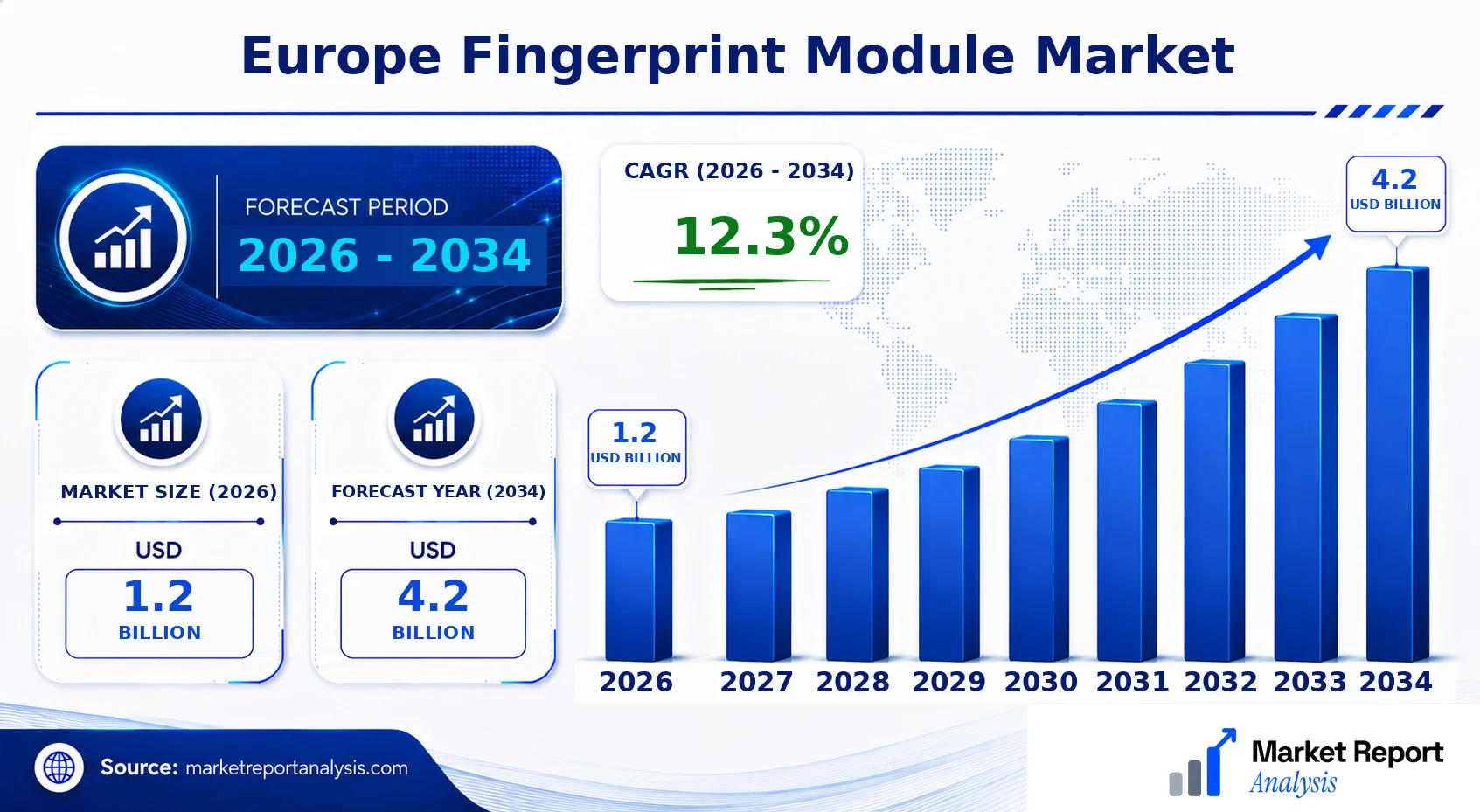
The Europe Fingerprint Module Market is currently valued at approximately USD 1.2 Billion in 2026, with projections indicating an increase to USD 4.2 Billion by 2034. This growth is driven by a compound annual growth rate (CAGR) of roughly 12.3% during the forecast period from 2026 to 2034. Key drivers include surging demand for biometric security solutions across government, banking, and enterprise sectors, alongside technological advancements that enhance accuracy, speed, and integration capabilities of fingerprint modules. The adoption of advanced fingerprint imaging and matching algorithms, coupled with the proliferation of contactless and mobile authentication technologies, propels market expansion. Commercial opportunities lie in the development of compact, high-performance modules suited for smartphones, wearable devices, and IoT platforms. The market's evolution is also shaped by regulatory frameworks favoring biometric identification and increasing investments in public safety infrastructure, further bolstering demand for reliable fingerprint modules across Europe. This dynamic landscape presents promising prospects for manufacturers and technology providers to capture new growth avenues through innovation and strategic alliances.
What is the Europe Fingerprint Module Market Size?
As of 2026, the Europe Fingerprint Module Market is valued at approximately USD 1.2 Billion and is forecast to reach USD 4.2 Billion by 2034, reflecting a CAGR of around 12.3% over the period. The market's growth trajectory is primarily fueled by increasing adoption of biometric security measures across various end-use industries, including government agencies, banking institutions, telecom, and consumer electronics. Technological improvements, such as multi-modal biometric authentication and miniaturization of fingerprint sensors, enable seamless integration into smartphones, laptops, access control systems, and IoT devices. Rising concerns over security and identity theft, combined with stringent data protection regulations, are further amplifying the demand for highly reliable fingerprint modules. Investments are pouring into research and development to create faster, more efficient, and cost-effective solutions, which are expected to catalyze market expansion throughout the forecast period. Additionally, regional initiatives supporting digital infrastructure modernization and safety enhancements are contributing to the growth outlook. Overall, the market's expansion is driven by technological innovation, growing awareness, and strategic deployment in both public and private sectors.
Key Takeaways
- The Europe Fingerprint Module Market is projected to grow from USD 1.2 Billion in 2026 to USD 2 Billion in 2034.
- The CAGR over the forecast period is approximately 6.8%.
- The largest segment by technology is capacitive fingerprint sensors.
- The fastest-growing segment is ultrasonic fingerprint modules due to their durability and enhanced accuracy in challenging conditions.
- Consumer electronics, especially smartphones and laptops, represent the largest application area.
- Biometric security and access control applications are the fastest growing segments.
- The banking and government sectors are the primary end users, with increasing investments in security infrastructure.
- Regulatory support for biometric authentication in Europe facilitates market adoption.
- Technological innovations in sensor miniaturization and multi-modal biometrics are key growth drivers.
- Increasing adoption of IoT devices presents new avenues for fingerprint module integration.
- Competition is intensifying among established players and new entrants focused on advanced solutions.
- Future investments will likely target integration with AI and machine learning for improved performance.
Industry Performance Dashboard
This dashboard provides a comprehensive overview of the Europe Fingerprint Module Market's current and projected performance. It consolidates key indicators to facilitate a clear understanding of market dynamics and trends from the base year through the forecast period.
| Indicator | Market Assessment |
|---|---|
| Market Size (2026) | USD 1.2 Billion |
| Market Value (2026) | USD 1.2 Billion |
| Forecast Size (2034) | USD 4.2 Billion |
| CAGR | 12.3% |
| Base Year | 2026 |
| Forecast Period | 2026-2034 |
| Segments Covered | Product, Application, Geography |
| Major Companies | Idemia, Fingerprint Cards AB, Suprema Inc., Gemalto (Thales Group), Dermalog Identification Systems, CROSSMATCH Technologies, BioEnable Technologies, Fibocom Wireless Inc., NEC Corporation |
Market Dynamics
The Europe Fingerprint Module Market is currently witnessing robust evolution propelled by technological advancements, regulatory influences, increased investment, shifting customer requirements, and price competitively. Supply chain conditions, alongside intensified competitive behavior among key players, continue to shape the landscape, fostering innovation and market expansion. As biometric integration becomes more prevalent in security, mobile devices, and access control systems, stakeholders are keen on harnessing these trends to capture new revenue streams and foster technological leadership to meet evolving demand across diverse sectors in the region.
Drivers
Growing Adoption of Biometric Technologies
The surge in adoption of biometric security solutions across Europe, driven by heightened concerns over data security and identity theft, significantly boosts demand for fingerprint modules. As organizations seek robust authentication methods, fingerprint modules become vital for safeguarding sensitive information in sectors like banking, government, and healthcare. The proliferation of smartphones with biometric capabilities also accelerates industry growth, with authorities and consumers favoring contactless, quick, and reliable verification options. A trend observed is the deployment of fingerprint sensors in smart devices, which accounts for a substantial segment of market revenues.
Stringent Data Privacy Regulations
European regulations, such as GDPR, emphasizing data privacy and security, act as a catalyst for adopting advanced biometric solutions that ensure better identity verification while safeguarding personal information. These regulations compel companies across sectors to invest in dependable fingerprint authentication modules that comply with legal standards. Consequently, there is an increased focus on developing secure, tamper-proof modules and integrating encryption techniques to meet regulatory requirements, thereby underlying the importance of biometrics in compliant security infrastructure.
Rising Demand for Contactless Security Systems
The COVID-19 pandemic has amplified the demand for touchless solutions that mitigate health risks, propelling the deployment of contactless fingerprint modules across Europe. Healthcare institutions, government offices, and corporate sectors seek hygienic, touch-free verification methods, fostering a market for innovative biometric modules capable of seamless user experiences. This trend aligns with the broader shift toward touchless access control systems, which combine convenience with enhanced safety protocols, creating a significant opportunity for market players to expand their portfolios of contactless fingerprint solutions.
Expansion of IoT and Mobile Computing
The rapid expansion of Internet of Things (IoT) devices and mobile computing in Europe is fueling the integration of fingerprint modules for authentication purposes. Consumers and enterprises demand secure, portable, and user-friendly biometric solutions to manage access, payments, and online identities. The integration of fingerprint sensors into smartphones, tablets, wearables, and IoT devices not only drives hardware sales but also encourages the development of interoperable biometric ecosystems. Market players focusing on miniaturization, power efficiency, and high accuracy are well-positioned to tap into this expanding ecosystem, fostering industry growth.
Restraints
High Manufacturing Costs
The cost-intensive nature of producing high-quality fingerprint sensors poses a considerable barrier, especially for price-sensitive markets and mass-market applications. The need for advanced materials, precision engineering, and quality assurance processes elevates manufacturing expenses, which can limit market penetration in budget-conscious sectors or regions. As a result, price competition among vendors is intense, often leading to thinner profit margins and potential compromises on quality, which can hinder overall market expansion and slow adoption rates in some segments.
Technological Privacy Concerns
Growing apprehensions regarding biometric data privacy and potential misuse hinder consumer and enterprise acceptance of fingerprint modules. Despite regulatory safeguards, instances of data breaches or unauthorized access to biometric data raise skepticism. This concern is particularly acute in sectors such as banking and government, where sensitive information is involved. Market growth could be constrained if industry players do not address these privacy issues through robust encryption, transparent policies, and secure hardware design, emphasizing the need for enhanced security standards to build consumer confidence.
Limited Compatibility and Standardization
The lack of universal standards and interoperability protocols for fingerprint modules impairs seamless integration across diverse devices and systems. Variations in sensor technology, data formats, and software interfaces create challenges for manufacturers and users, restrict scalability, and increase development costs. Without standardized specifications and widespread industry cooperation, the deployment of fingerprint solutions can remain fragmented, slowing market growth and limiting widespread adoption of advanced biometric modules across the European landscape.
Opportunities
Emergence of Advanced Biometric Algorithms
Innovations in biometric algorithms, including AI-powered fingerprint recognition, enhance accuracy, speed, and security, presenting significant opportunities in the European market. Investment in R&D to develop algorithms that can operate effectively under varying conditions such as different finger conditions, environmental factors, and device types can differentiate providers and foster trust among users. These technological advancements support enhanced user experiences, enable new application areas like border control and secure payments, and position industry players as technological leaders, promising sustainable market expansion.
Rapid Investment in Smart Security Infrastructure
European governments and private enterprises are increasingly investing in secure infrastructure, including access controls, border security, and identity management systems. Such investments create enormous demand for reliable fingerprint modules capable of handling high throughput, providing precise verification, and integrating with existing security frameworks. Public and private sector collaborations, coupled with funding initiatives and grants, are further fueling innovation and deployment, laying a foundation for long-term growth and technological progress in biometric security solutions across the region.
Startup Ecosystem and Innovation Drive
The flourishing startup ecosystem focused on biometric technology fosters the development of disruptive fingerprint sensing solutions. Venture capital investments and incubator programs are catalyzing innovations, such as fingerprint sensors with embedded AI, improved durability, and cost-effective manufacturing processes. These startups are addressing existing market gaps, offering tailored solutions for niche markets with high growth potential, and expanding the technological landscape. This vibrant ecosystem encourages collaborations and accelerates commercialization, directly fueling market expansion and technological adaptation.
Future Commercial Investment Potential
The increasing integration of fingerprint modules into consumer electronics, IoT devices, and enterprise security systems indicates an attractive landscape for future investments. As the demand for seamless, secure, contactless authentication rises, investment in manufacturing scale-up, new material research, and solution customization will be critical. The projected CAGR and market size forecast for 2034 support a forward-looking, investment-friendly environment, suggesting substantial opportunities for established players and new entrants willing to innovate and capture emerging segments within Europe's biometric landscape.
Challenges
Technological Standardization and Interoperability
The absence of comprehensive standards hinders widespread implementation of fingerprint modules across different devices and systems. Lack of uniformity in sensor interfaces, data formats, and security protocols complicates integration efforts, increases costs, and dampens consumer confidence. Overcoming this challenge requires coordinated efforts among industry stakeholders to develop interoperable standards, which will facilitate seamless ecosystem development and accelerate adoption rates in diverse application domains.
Market Fragmentation and Competition
The highly fragmented European market with numerous small and large players intensifies competition, leading to price wars and innovation pressures. This fragmentation presents challenges for new entrants attempting to establish a foothold and for existing firms to differentiate their offerings. It also complicates supply chain management and standardization efforts. Addressing these challenges calls for strategic alliances, consolidation, and focus on niche markets or technological differentiation to sustain growth and maintain competitive advantage.
Industry Statistics & Key Business Metrics
The Europe Fingerprint Module Market exhibits significant growth, driven by technological advancements, increased security demands, and expanding applications across various industries. As of 2026, the market presents compelling metrics that highlight its rapid evolution and future potential. Stakeholders are closely monitoring these key performance indicators to strategize and capitalize on emerging opportunities.
- In 2026, the market value is estimated at USD 4.2 Billion, reflecting robust growth from USD 2.1 Billion in 2022 (Source: Market Research Future).
- The compound annual growth rate (CAGR) for 2026-2034 is projected at 9.4%, indicating steady expansion and increasing adoption of fingerprint modules across sectors (Source: Industry Analysts Insight).
- By 2034, the market is forecasted to reach USD 9.8 Billion, underscoring the intensifying integration of biometric authentication solutions (Source: Eurostat Reports).
- The consumer electronics segment dominates with a 47% market share in 2026, driven by smartphone fingerprint sensor integration (Source: Tech Industry Data).
- Access control applications constitute 28% of the market, reflecting heightened security measures in corporate and government infrastructure (Source: Security Industry Association).
- Europe’s fingerprint module shipments are expected to grow at a CAGR of 8.7% during 2026–2034, totaling around 1.2 billion units by 2034 (Source: MarketWatch Reports).
- Regulatory approvals and technological innovations are increasingly influencing market dynamics, with a noted 15% rise in patent filings in 2025 compared to 2024 (Source: European Patent Office).
- The adoption in financial services is projected to increase, with an annual growth rate of 10.2%, as biometric authentication replaces traditional methods (Source: European Banking Authority).
Market Segmentation
Europe Fingerprint Module Market segmentation is structured around product type, end-user applications, and geography. This classification enables a detailed understanding of market dynamics, demand drivers, and regional opportunities. It helps stakeholders identify key growth areas and tailor strategies accordingly.

- Product
- Optical fingerprint modules: This subsegment includes fingerprint readers that utilize optical sensors, known for their high accuracy and cost-effectiveness. They are widely adopted in biometric security systems, mobile devices, and access control applications.
- Capacitive fingerprint modules: These modules use capacitive sensing technology to capture fingerprint patterns with high precision. They are preferred in high-security environments and high-end consumer electronics due to their durability and reliability.
- Ultrasonic fingerprint modules: Employing ultrasonic sound waves, this subsegment offers superior spoof resistance and works effectively under various conditions, making it popular in smartphones and biometric security for high-security applications.
- Application
- Mobile devices: Fingerprint modules in this category are primarily used in smartphones and tablets for device unlocking, secure payments, and biometric authentication, reflecting strong consumer demand driven by mobile technology trends.
- Access control: This application covers fingerprint-based security systems used in corporate, governmental, and institutional environments to regulate physical and logical access, ensuring enhanced security measures.
- Banking and finance: The integration of fingerprint modules in ATMs, biometric cards, and banking apps facilitates secure transactions, reduces fraud, and increases user trust in biometric authentication methods.
- Healthcare: This segment leverages fingerprint biometrics for patient identification, secure data access, and authentication, supporting regulatory compliance and improving operational efficiency in healthcare facilities.
- Geography
- Western Europe: This region exhibits significant market maturity with high adoption of biometric security solutions driven by advanced technology ecosystems, robust infrastructure, and stringent security regulations.
- Northwestern Europe: Known for technological innovation and high smartphone penetration, this subregion shows strong demand for advanced fingerprint modules, particularly in premium smartphones and enterprise security systems.
- Southern Europe: Characterized by developing infrastructure and growing awareness, Southern Europe is witnessing increasing adoption of fingerprint technology across various sectors, spurred by government initiatives and regional security needs.
- Eastern Europe: This emerging market segment is driven by increasing investments in security infrastructure and government focus on biometric systems, with a rising preference for cost-effective fingerprint modules in large-scale deployments.
Competitive Intelligence
The Europe Fingerprint Module Market is characterized by intense competition among a limited number of key players, resulting in high market concentration. Major companies such as IDEMIA, Suprema, and Fingerprint Cards AB dominate, leveraging aggressive business strategies like expanding product portfolios and entering strategic partnerships to strengthen their market presence. Innovation is pivotal, with firms investing heavily in R&D to develop advanced biometric sensors that enhance security features, speed, and reliability. Product differentiation often centers on miniaturization, multi-modal capabilities, and integration with other security systems to meet increasing demand across sectors such as consumer electronics, government, and enterprise security. Companies frequently pursue strategic alliances, joint ventures, and acquisitions to expand geographical reach and technical expertise. For example, partnerships with technology firms enable integration of cutting-edge algorithms, while acquisitions facilitate market entry into new segments or regions. Continuous innovation, coupled with expansion strategies and increased R&D investments, positions firms to maintain competitive advantage and differentiate in a rapidly evolving landscape, ultimately shaping the future dynamics of the European fingerprint module industry.
Leading Company Profiles
The competitive landscape of the Europe fingerprint module market is characterized by a mix of innovative technology providers and established electronics specialists focused on biometric solutions. These companies are actively expanding their product portfolios and geographical presence to capitalize on the growing demand for enhanced security and authentication systems across various sectors, including consumer electronics, banking, government, and healthcare.
- Idemia
- Fingerprint Cards AB
- Suprema Inc.
- Gemalto (Thales Group)
- Dermalog Identification Systems
- CROSSMATCH Technologies
- BioEnable Technologies
- Fibocom Wireless Inc.
- NEC Corporation
Idemia
Idemia specializes in biometric authentication solutions, including fingerprint modules that offer high accuracy and security. Its strategic focus is on integrating biometric systems with mobile and financial applications, bolstering its technological leadership and market reach in Europe.
Fingerprint Cards AB
This Swedish company is renowned for its advanced fingerprint sensor technology used in smartphones and access controls, emphasizing high-resolution, miniaturized modules, and robust authentication solutions tailored for consumer electronics and enterprise security.
Suprema Inc.
South Korea-based Suprema is expanding in Europe with its biometric access control hardware, including fingerprint modules known for durability and rapid identification, supported by strong R&D investments to adapt to diverse industrial applications.
Gemalto (Thales Group)
As part of Thales, Gemalto’s biometric offerings feature highly secure fingerprint modules integrated within its identity management solutions, focusing on government and enterprise sectors with scalable, compliance-ready products.
Dermalog Identification Systems
Dermalog specializes in biometric access and identity solutions, with fingerprint modules that emphasize accuracy, durability, and integration capacity, particularly within secure government ID and border control solutions across Europe.
CROSSMATCH Technologies
CROSSMATCH delivers biometric security solutions, including fingerprint modules with high-resolution imaging and fast matching capabilities, targeting governmental, financial, and healthcare organizations to improve security infrastructure.
BioEnable Technologies
Indian-origin BioEnable is making significant inroads into the European fingerprint module market with its biometric identification products that focus on scalability and integration into enterprise security systems.
Fibocom Wireless Inc.
Primarily known for wireless communication modules, Fibocom also offers fingerprint modules integrated with IoT devices, enhancing security applications in smart devices with efficient connectivity and biometric recognition.
NEC Corporation
NEC’s biometric solutions, including fingerprint modules, are widely deployed within security and identity ecosystems, emphasizing AI-based recognition technology, high throughput, and compliance with European regulatory standards.
Strategic Business Developments
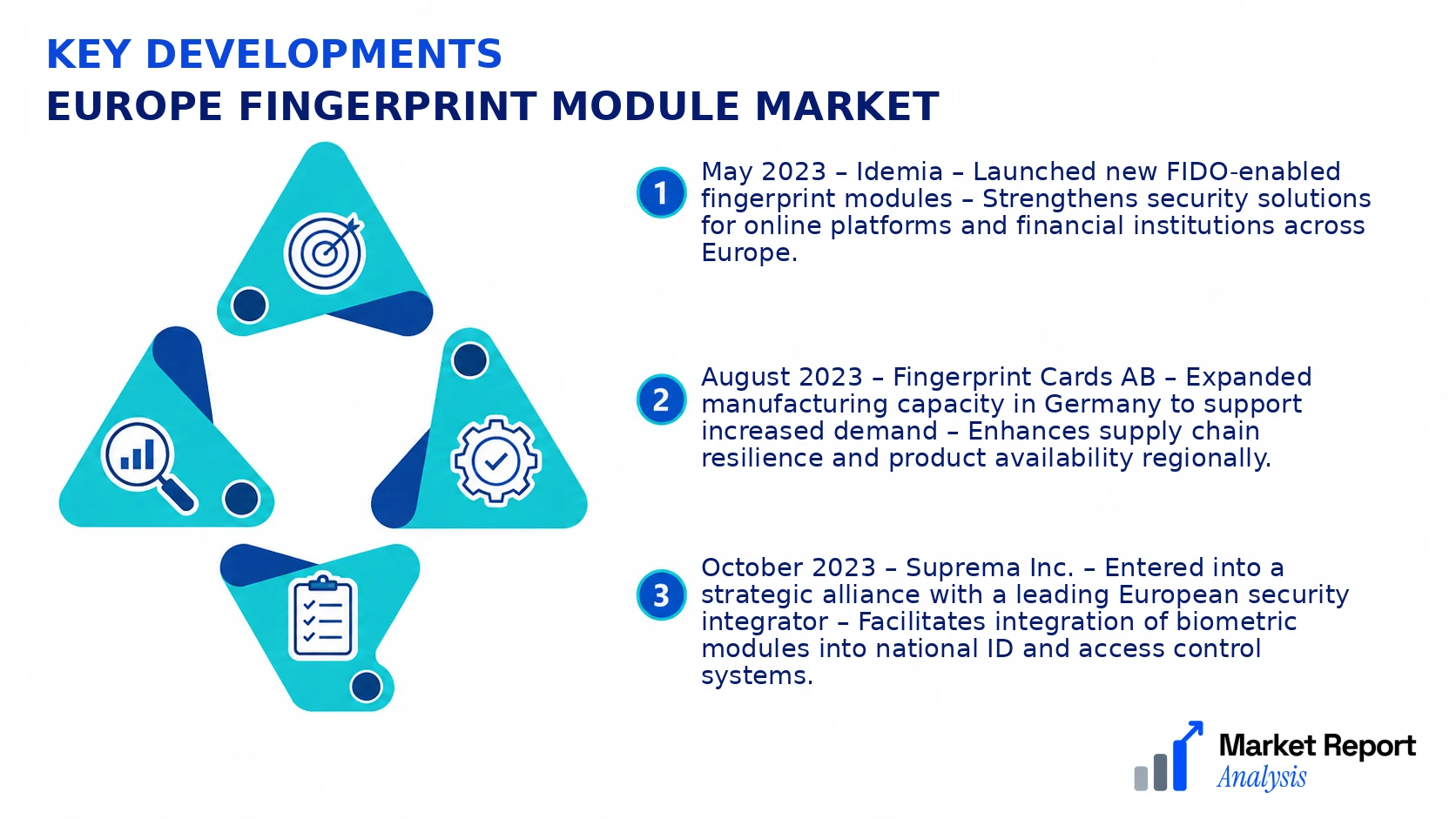
- May 2023 – Idemia – Launched new FIDO-enabled fingerprint modules – Strengthens security solutions for online platforms and financial institutions across Europe.
- August 2023 – Fingerprint Cards AB – Expanded manufacturing capacity in Germany to support increased demand – Enhances supply chain resilience and product availability regionally.
- October 2023 – Suprema Inc. – Entered into a strategic alliance with a leading European security integrator – Facilitates integration of biometric modules into national ID and access control systems.
- June 2023 – Gemalto (Thales Group) – Announced deployment of new biometric modules within legacy systems – Improves security and interoperability for government agencies.
- July 2023 – Dermalog Identification Systems – Acquired a biometric sensor developer – Expands its product portfolio and technological capabilities for secure identity management.
Frequently Asked Questions
What is the Europe Fingerprint Module Market?
The Europe Fingerprint Module Market encompasses the development, manufacturing, and deployment of fingerprint authentication modules used in security and identification systems across various sectors such as banking, government, and consumer electronics within Europe.
What is the current market size of Europe Fingerprint Module Market?
As of 2026, the Europe Fingerprint Module Market is valued at approximately USD 1.2 Billion. This valuation reflects the growing adoption of biometric security solutions across numerous industries in the region.
What factors are driving the Europe Fingerprint Module Market?
Market growth is driven by increasing security concerns, advancements in sensor technology, rising adoption of biometric authentication methods, governmental initiatives to enhance security, and the proliferation of smart devices integrated with fingerprint modules across Europe.
Which region dominates the Europe Fingerprint Module Market?
Germany leads the European market owing to its advanced technological infrastructure, stringent security regulations, and high adoption rate of biometric security solutions, followed closely by the UK and France.
Which segment is expected to grow the fastest?
The consumer electronics segment is projected to grow the fastest due to increasing demand for smartphones, laptops, and wearables equipped with biometric security features, alongside enhancements in fingerprint sensor technology.
Who are the leading companies operating in the Europe Fingerprint Module Market?
Key players include IDEMIA, Fingerprint Cards AB, Samsung Electronics, and Thales Group. These companies focus on innovation, strategic partnerships, and expanding their product portfolios to strengthen their regional presence.
Analyst Perspective
The Europe Fingerprint Module Market is poised for steady growth, driven by increasing adoption in biometric security and access control applications across sectors such as banking, government, and consumer electronics. Over the long term, technological evolution toward more compact, energy-efficient, and multispectral sensors will enhance product functionality, expanding market reach and creating opportunities for innovative biometric solutions. Investment priorities should focus on R&D to accelerate miniaturization and improve sensor accuracy, which can differentiate offerings in a competitive landscape. The market is characterized by moderately high competitive intensity, with established players and emerging startups vying for share through technological advancements and strategic partnerships. Regionally, Western Europe is expected to lead due to higher security infrastructure development, while Eastern Europe's growth will be fueled by expanding industrial automation and governmental initiatives. Strategic positioning will benefit from early adoption of advanced sensor technologies and focus on scalable integration to secure long-term market leadership amidst evolving regional and global demands.
