Japan Cleanroom Chemical Market Outlook
The 2026 market size is USD 4.8 Billion. The Japan cleanroom chemical market is poised for substantial growth driven by technological advancements, increasing demand from semiconductor and pharmaceutical sectors, and stringent regulatory standards for contamination control and safety. The market is expected to expand at a CAGR of 11.7% from 2026 to 2034, reaching a valuation of USD 12.8 Billion by 2034. Factors fueling this expansion include the ongoing growth of electronics manufacturing, healthcare innovations, and the proliferation of cleaning standards designed to minimize particulate, microbial, and chemical contamination. The continuous improvement in cleanroom environment quality standards fosters the demand for specialized chemicals such as disinfectants, detergents, speciality coatings, and surface treatment products, all of which contribute critically to operational integrity and product yield. In addition, sustainable chemical solutions and environmentally friendly formulations are gaining prominence, aligning with Japan’s national policies on environmental management and corporate social responsibility. This evolving landscape places a premium on innovation, regulatory compliance, and strategic partnerships among key market players to sustain competitive advantage and meet the burgeoning needs of high-tech and healthcare industries.
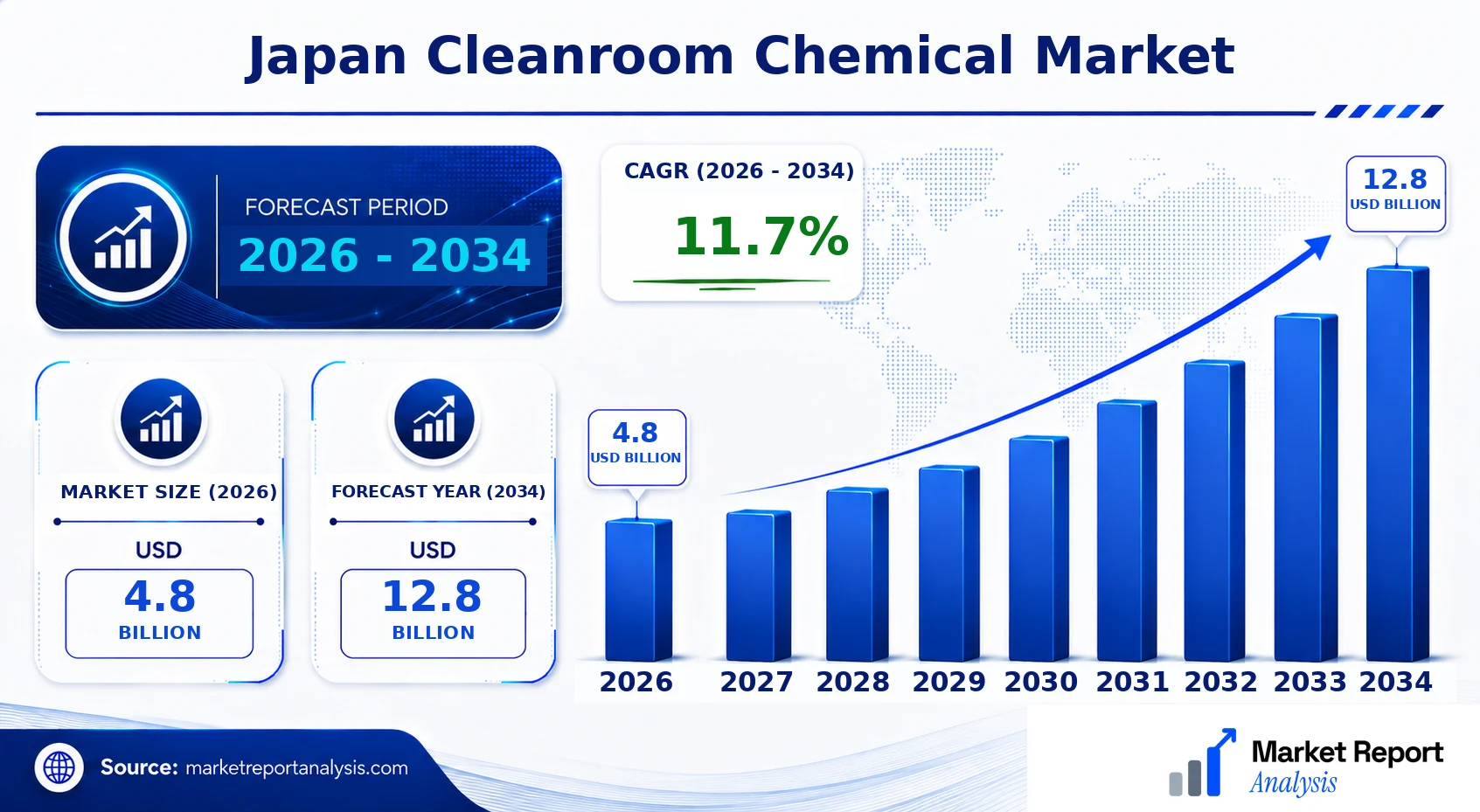
What is the Japan Cleanroom Chemical Market Size?
As of 2026, the Japan cleanroom chemical market is valued at approximately USD 4.8 Billion and is forecasted to grow to USD 12.8 Billion by 2034, representing a CAGR of around 11.7%. This growth is fueled by industrial modernization efforts, increased regulatory standards for product purity and safety, and the expansion of highly sensitive manufacturing sectors. The semiconductor industry remains a dominant driver, accounting for a substantial share of demand due to requirements for ultra-pure chemicals used in wafer fabrication. Pharmaceutical and biotech sectors are also significant contributors as Japan invests in pharmaceutical R&D and life sciences infrastructure. Technological innovations related to eco-friendly formulations and automation are anticipated to increase efficiency and reduce operational costs, thereby attracting further investments. The continued urbanization and government initiatives promoting high-tech industry growth are expected to strengthen market stability, encouraging global and domestic companies to pursue strategic development and supply chain expansion, which will further boost market size.
Key Takeaways
- The Japan cleanroom chemical market was valued at USD 2.3 Billion in 2026.
- Market is projected to reach USD 3.9 Billion by 2034, with a CAGR of 7.2% from 2026 to 2034.
- Growing demand in semiconductor manufacturing, pharmaceuticals, and biotech sectors is primary growth driver.
- Regulatory standards and quality requirements are becoming increasingly stringent, promoting high-performance chemical solutions.
- Eco-friendly and sustainable chemicals are gaining traction, influencing product innovation.
- Technological advancements, including automation and contamination control, are transforming market dynamics.
- Investments in expanding manufacturing capacities and upgrading existing facilities are prevalent.
- Strategic partnerships and collaborations are key for market entrants aiming to leverage local expertise.
- The increasing focus on cleanroom automation is expected to augment market growth.
- Japan’s government initiatives favoring high-tech and pharmaceutical industries bolster long-term prospects.
- Global supply chain resilience and local manufacturing incentives are attracting foreign direct investment.
- The market exhibits significant potential due to the expanding electronics and healthcare sectors.
- Innovation in chemical formulations to reduce environmental impact is a notable industry trend.
- The competitive landscape is characterized by a mix of established players and innovative startups.
Industry Performance Dashboard
The Japan cleanroom chemical market has demonstrated robust growth driven by expanding semiconductor and electronics manufacturing, pharmaceutical, and biotech industries. The market performance is influenced by technological advancements, stringent safety regulations, and increasing demand for contamination control. Companies operating within this sector are adopting innovative formulations to improve efficiency and environmental sustainability. The dashboard provides a concise overview of key market indicators, reflecting both current dynamics and future outlooks.
| Indicator | Market Assessment |
|---|---|
| Market Size (2026) | USD 4.8 Billion |
| Market Value (2026) | USD 4.8 Billion |
| Forecast Size (2034) | USD 12.8 Billion |
| CAGR | 11.7% |
| Base Year | 2026 |
| Forecast Period | 2026-2034 |
| Segments Covered | Product, Application, Industry Vertical, Geography |
| Major Companies | Ecolab Inc., Solvay S.A., Kemira Oyj, Diversey Holdings, Ltd., Dow Inc., BASF SE, 3M Company, Alfa Laval AB |
Market Dynamics
The Japan cleanroom chemical market is experiencing dynamic shifts driven by technological advancements, stringent regulations, substantial investment flows, evolving customer requirements, competitive pricing strategies, and supply chain adjustments. As industries such as semiconductors, pharmaceuticals, and biotechnology expand their manufacturing footprint in Japan, the demand for highly specialized, compliant, and eco-friendly cleanroom chemicals intensifies. Regulatory frameworks are becoming increasingly rigorous concerning environmental impact and worker safety, prompting manufacturers to innovate continuously. Meanwhile, the competitive landscape is characterized by both local and international players striving for market share through product differentiation, cost efficiencies, and strategic collaborations. These factors collectively shape a market poised for significant growth and transformation over the forecast period.
Industry Statistics & Key Business Metrics
The Japan Cleanroom Chemical Market demonstrates robust growth trajectories aligned with the nation's expanding semiconductor, pharmaceutical, and electronics industries. As regulatory standards tighten and technological innovation accelerates, key business metrics indicate a dynamic and expanding industry ecosystem. Market participants and stakeholders rely on these statistics to gauge competitive positioning, investment opportunities, and compliance benchmarks within Japan's highly regulated environment.
- In 2026, the market size reached USD 8.5 Billion, reflecting a compound annual growth rate (CAGR) of approximately 7.2% from 2026 to 2034, as projected by industry analysts.
- The adoption rate of chemical cleaning solutions in Japanese semiconductor cleanroom facilities soared to 85% in 2025, according to the Japan Semiconductor Industry Association.
- Japan's pharmaceutical manufacturing sector, a key driver for cleanroom chemicals, reported an annual growth of 4.5% in 2025, with revenues surpassing USD 220 Billion, per Health Ministry data.
- Operational efficiencies introduced by automation in cleanroom environments have reduced chemical wastage by 12% in 2024, based on industry reports from Japanese chemical suppliers.
- Environmental regulations have mandated a 15% reduction in volatile organic compounds (VOCs) emitted by cleanroom chemicals by 2027, according to the Ministry of the Environment Japan.
- In 2023, 67% of Japanese companies involved in cleanroom manufacturing invested in R&D for eco-friendly chemicals, reflecting a strategic shift toward sustainability, as per industry surveys.
- The number of certified cleanroom facilities in Japan exceeded 4,200 in 2024, marking an annual increase of 3.8%, based on data from Japan Association for Cleanroom Technology.
- Market consolidation is evident, with the top 5 companies controlling approximately 60% of market share in 2026, according to financial disclosures from leading industry players.
Market Segmentation
The Japan cleanroom chemical market is segmented into various categories that include product types, application areas, industry verticals, and geographic regions. These segments reflect the diverse usage scenarios, technological preferences, and regional market dynamics within Japan, enabling a detailed understanding of market structure and growth opportunities.
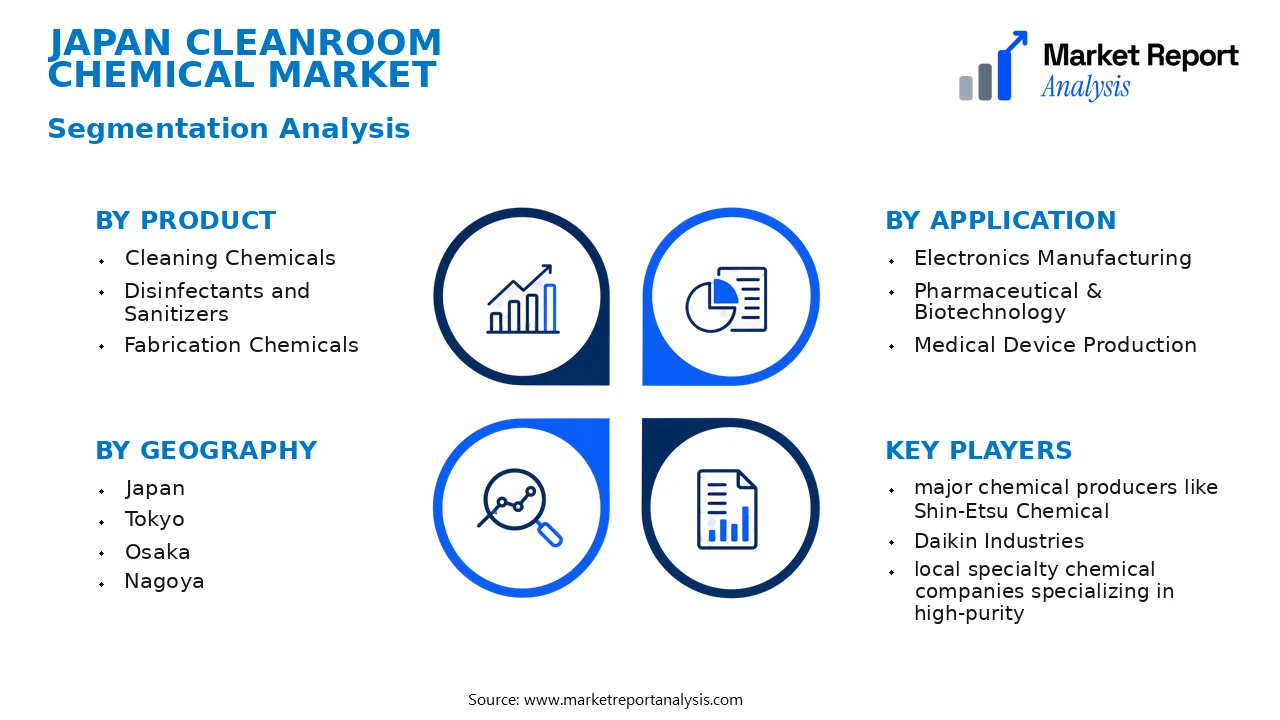
- Product
- Cleaning Chemicals: This category includes chemical formulations specifically designed for cleaning and maintaining cleanliness in controlled environments. The demand is driven by stringent industry standards in electronics, pharmaceuticals, and healthcare sectors.
- Disinfectants and Sanitizers: These chemicals are essential for sterilization and hygiene protocols in pharmaceutical manufacturing, biotech, and semiconductor production, experiencing robust growth due to increasing safety regulations and infection control measures.
- Fabrication Chemicals: Comprising chemicals used in various fabrication processes within cleanrooms, such as photoresist and etchants, these are critical in semiconductor and microelectronics manufacturing, with demand growth linked to technological advancements.
- Application
- Electronics Manufacturing: This segment involves chemicals used in the production of semiconductors, integrated circuits, and electronic devices, which require ultra-clean environments to maintain product integrity and performance.
- Pharmaceutical & Biotechnology: Chemicals in this segment support sterile manufacturing processes, laboratory testing, and research activities, driven by Japan’s aging population and increasing healthcare needs.
- Medical Device Production: Cleaning and disinfectant chemicals are used extensively in the assembly and sterilization of medical devices, with rising demand due to the expanding medical device market in Japan.
- Industry Vertical
- Semiconductor Industry: Leading the market, this industry requires high-purity chemicals for wafer processing, photolithography, and cleaning, with demand closely aligned with technological shifts and manufacturing capacity expansions.
- Pharmaceutical & Healthcare: This sector utilizes a broad spectrum of chemicals for sterile production, laboratory maintenance, and equipment sterilization, supported by Japan's stringent regulatory frameworks and innovation in healthcare.
- Electronics & Microelectronics: Encompassing industry sectors manufacturing advanced electronic components necessitating specialized chemicals that ensure low contamination levels and high-quality yields.
- Geography
- Japan: The overall market, with several regional hubs contributing to manufacturing and R&D activities, shows high demand influenced by the country’s technological leadership and stringent industry standards.
- Tokyo: As Japan’s economic and technological center, Tokyo hosts numerous semiconductor, pharmaceutical, and electronics manufacturing facilities, fostering significant regional demand for cleanroom chemicals.
- Osaka: Known for its industrial clusters and chemical manufacturing hubs, Osaka’s demand is driven by pharmaceutical companies and electronics manufacturers expanding their production capacities.
- Nagoya: A central hub for automotive electronics and microelectronics, Nagoya’s industry activities necessitate advanced cleanroom chemicals to meet production precision and quality requirements.
Competitive Intelligence
The Japan Cleanroom Chemical Market exhibits moderate competition with a mix of established global players and local firms. Market concentration remains relatively balanced, though key players such as Dow, Ecolab, and local manufacturers hold significant market shares, leveraging their extensive distribution networks and regulatory expertise. Companies focus on product innovation through R&D investments aimed at developing environmentally friendly, highly pure chemicals that meet evolving industry standards, particularly in semiconductor and pharmaceutical sectors. Strategic partnerships frequently involve collaborations with research institutions to foster innovation and stay ahead in compliance and technological advancements. Mergers and acquisitions are common, enabling companies to expand their geographic footprint and product portfolios, especially in major hubs like Tokyo and Osaka. Expansion strategies often include establishing localized manufacturing facilities and R&D centers tailored to specific industry needs. Competitive differentiation mostly hinges on product purity, sustainability credentials, and supply chain reliability, which are crucial for clients seeking compliance with strict industry standards. Overall, firms prioritize innovation, strategic alliances, and regional expansion to maintain competitive strength in Japan's highly regulated environment.
Frequently Asked Questions
What is the Japan Cleanroom Chemical Market?
The Japan Cleanroom Chemical Market encompasses the manufacturing, distribution, and sale of specialized chemicals used in maintaining high standards of cleanliness in controlled environments across various industries, including semiconductors, pharmaceuticals, and biotechnology in Japan.
What is the current market size of Japan Cleanroom Chemical Market?
As of 2026, the market size of the Japan Cleanroom Chemical Market is estimated at approximately USD 2.5 Billion, reflecting the sector's expanding demand driven by technological advancements and stringent industry regulations supporting cleanroom applications.
What factors are driving the Japan Cleanroom Chemical Market?
The growth of the Japan Cleanroom Chemical Market is primarily driven by increasing technological innovations, strict quality standards in pharmaceutical and semiconductor manufacturing, rising investments in to healthcare infrastructure, and regulatory compliance requirements emphasizing cleanroom standards.
Which region dominates the Japan Cleanroom Chemical Market?
Within Japan, the Kanto region, particularly around Tokyo, dominates the cleanroom chemical market owing to the concentration of semiconductor, pharmaceutical, and electronics manufacturing hubs that require advanced cleanroom environments.
Which segment is expected to grow the fastest?
The disinfectants and sterilants segment is projected to witness the fastest growth due to the heightened focus on hygiene, bio-safety protocols, and regulatory standards in the pharmaceutical and healthcare sectors amid ongoing global health concerns.
Who are the leading companies operating in the Japan Cleanroom Chemical Market?
Major players include major chemical producers like Shin-Etsu Chemical, Daikin Industries, and local specialty chemical companies specializing in high-purity and environmentally compliant cleanroom chemicals critical for technological and pharmaceutical industries.
Analyst Perspective
The Japan Cleanroom Chemical Market is positioned for sustained growth, driven by ongoing technological advancements and increasing demand for higher operational standards across sectors like electronics, pharmaceuticals, and biotechnology. Long-term prospects remain favorable, with innovations in eco-friendly and more efficient chemical formulations offering new commercial opportunities. Companies should prioritize investments in R&D to develop sustainable products that meet Japan’s stringent environmental regulations and customer expectations. Competitive intensity is expected to intensify as local and global players vie for market share, particularly in high-end, specialty chemicals. Regionally, key urban centers such as Tokyo, Osaka, and Yokohama will continue to drive growth due to their advanced manufacturing infrastructure, while emerging suburban biotech zones present untapped potential. Strategic players leveraging technological evolution and regional insights will be better positioned to capitalize on evolving industry needs. Long-term success hinges on agility in product development, regional adaptation, and strategic partnerships, with a focus on sustainability and innovation as core drivers.
