Indonesia CMOS Sensor Market Outlook
The Indonesia CMOS Sensor Market is experiencing robust growth driven by increasing adoption across various end-use sectors such as consumer electronics, automotive, and security. As of 2026, the market value stands at USD 1.2 Billion, with projections indicating a significant rise to USD 2.8 Billion by 2034. This growth corresponds to a Compound Annual Growth Rate (CAGR) of approximately 12.1% over the forecast period from 2026 to 2034. The principal demand drivers include the expansion of digital camera usage, the rise of smart surveillance systems, and the growing prominence of autonomous vehicle technology. Technological advancements, particularly in sensor miniaturization and enhanced image quality, are further fueling market expansion. Commercial opportunities are abundant, especially for manufacturers investing in R&D to deliver higher-performance CMOS sensors optimized for Indonesia’s diverse climate and infrastructure challenges. The growing digital infrastructure and increasing disposable incomes are also amplifying the market’s potential, positioning Indonesia as a critical growth region in the Asia-Pacific CMOS sensor landscape.
What is the Indonesia CMOS Sensor Market Size?
The Indonesia CMOS Sensor Market is valued at approximately USD 1.2 Billion in 2026 and is forecast to reach around USD 2.8 Billion in 2034, reflecting a CAGR of 12.1% over the forecast period. The market growth is primarily driven by surging demand for consumer electronics such as smartphones and digital cameras, which require compact, high-resolution sensors. Additionally, the automotive segment is expanding rapidly, especially with increasing investments in autonomous vehicle technologies and advanced driver-assistance systems (ADAS). The proliferation of security cameras, driven by government initiatives and urban safety measures, further bolsters demand for CMOS sensors. Technological innovations, including backside-illuminated sensors and stacked architectures, are enhancing performance and energy efficiency, thus encouraging wider adoption. As the market scales, regional investments are expected to surge, especially in manufacturing capacities, to meet global and local demand. Future growth opportunities lie in developing sensors that cater specifically to Indonesia’s unique environmental and operational needs, alongside strategic partnerships and local manufacturing setups to foster sustainable industry expansion.
Key Takeaways
- The market is valued at USD 1.2 Billion in 2026 and is projected to reach USD 2.8 Billion by 2034.
- The CAGR from 2026 to 2034 is approximately 12.1%.
- Consumer electronics remain the dominant segment, with automotive gaining momentum.
- Security and surveillance applications are expanding with government initiatives promoting urban safety.
- Technological innovations such as stacked CMOS sensors are boosting market growth.
- Indonesia’s expanding digital infrastructure supports increased CMOS sensor adoption.
- The market offers substantial growth opportunities for local and international manufacturers.
- Rising disposable incomes and urbanization contribute to higher demand.
- Regional investments are expected to enhance manufacturing capacities significantly.
- The automotive segment growth is driven by increasing adoption of autonomous vehicles and ADAS.
- Environmental demands prompt the development of sensors suited to Indonesia’s climate conditions.
- Strategic collaborations and local manufacturing are key to market expansion.
Industry Performance Dashboard
The Indonesia CMOS Sensor Market Performance Dashboard provides a comprehensive overview of key industry indicators, highlighting significant trends, market dynamics, and competitive positioning within the sector. As of the current forecast, the market size in 2026 is projected to be USD 3.2 Billion, reflecting robust growth driven by increasing demand across various applications including consumer electronics, automotive, and security systems. The market is anticipated to expand further, reaching a forecast size of USD 6.8 Billion by 2034, with a compound annual growth rate (CAGR) of approximately 10.3% during the 2026-2034 forecast period. This growth trajectory underscores the rapid technological adoption and infrastructural developments within Indonesia’s electronics manufacturing sector. The base year for this analysis is 2026, establishing a benchmark for market evaluation, while the forecast period extends to 2034, offering insights into long-term industry evolution. The market segmentation covers high-resolution sensors, 3D sensors, and specialized sensor applications, reflecting diverse technological advancements and end-user demands. Major companies operating within this space include Sony Corporation, Samsung Electronics, OmniVision Technologies, and Canon Inc., all pushing innovation and market penetration strategies. Investment trends reveal a steady influx of capital towards sensor R&D, particularly in miniaturization and image quality improvement, reinforcing the market's maturity and competitive edge. Pricing trends indicate moderate price erosion aligned with technological breakthroughs and economies of scale, fostering broader adoption. Overall, the Indonesia CMOS Sensor Market demonstrates a dynamic landscape poised for sustained growth and technological innovation.
Market Dynamics
The Indonesia CMOS Sensor Market is experiencing dynamic changes driven by rapid technological advancements, evolving regulations, increased investments, shifting customer preferences, pricing pressures, and supply chain variations. These factors collectively influence market competitiveness, product innovation, and regional adoption rates. As the market adapts, stakeholders must navigate complex regulatory landscapes, capitalize on emerging technological trends, and manage supply chain constraints, all while responding to the increasing demand for high-quality, affordable CMOS sensors from diverse end-use industries. The interplay of these elements is shaping the growth trajectory and strategic direction of the market landscape in Indonesia.
Drivers
Technological Innovation
Continual technological innovations in CMOS sensor design and manufacturing processes are fundamental drivers fueling market expansion in Indonesia. Advances such as back-Illuminated (BSI) technology and stacked architecture enhance sensor performance, resolution, and power efficiency, making them more appealing to end-users. Local manufacturers adopting cutting-edge fabrication technologies can produce sensors that meet international quality standards, thereby increasing export potential. The surge in demand for high-resolution imaging in smartphones, automotive applications, and surveillance systems has propelled the need for state-of-the-art CMOS sensors, which are increasingly being integrated into Indonesian products and solutions.
Rising Adoption in Consumer Electronics
The proliferation of smartphones, tablets, and wearable devices in Indonesia has significantly boosted the demand for CMOS sensors. As consumers prioritize enhanced image quality and multimedia capabilities, local brands and international players are expanding their presence. For instance, the continued popularity of camera-centric smartphones, coupled with expanding middle-class purchasing power, has sustained high consumption rates. The trend towards affordable yet feature-rich devices has driven manufacturers to utilize CMOS sensors with higher pixel counts and better low-light performance, directly impacting market growth.
Government Initiatives and Smart Infrastructure
The Indonesian government’s emphasis on smart city initiatives, surveillance, and border security has created a conducive environment for CMOS sensor adoption. Policies aimed at improving urban management, safety, and surveillance infrastructure require high-quality imaging components. Additionally, the push towards digital government services and public safety systems incentivizes integration of advanced CMOS sensors into public deployment projects. This government-led drive encourages local assembly, innovation, and investment, fostering a robust market ecosystem, while also prompting international suppliers to establish strategic partnerships within Indonesia.
Growing Automotive Electronics Market
The automotive sector in Indonesia is increasingly integrating CMOS sensors for ADAS and autonomous vehicle systems. The automotive electronics market is expanding due to rising safety standards and consumer demand for connected vehicles. CMOS sensors are critical components for functionalities such as parking assistance, collision avoidance, and lane-keeping systems. Local automotive manufacturers and suppliers are adopting CMOS sensors to meet evolving specifications, thereby boosting the market. The transition towards electric and hybrid vehicles further emphasizes the need for advanced imaging and sensing capabilities, opening new avenues for growth.
Restraints
High Manufacturing Costs
Manufacturing high-performance CMOS sensors involves sophisticated fabrication processes and high capital expenditure, which can hinder market expansion in Indonesia. For local producers, the costs associated with advanced cleanroom facilities, skilled labor, and research & development limit competitiveness. Imported sensors are often more affordable due to economies of scale and established supply chains, which puts local manufacturers at a disadvantage. Consequently, pricing pressures and limited profit margins restrict innovation and expansion, particularly among small and medium-sized enterprises operating within this cost-sensitive environment.
Supply Chain Disruptions
Global semiconductor supply chain disruptions have negatively impacted the availability of key components and raw materials required for CMOS sensor production. These interruptions primarily affect manufacturers reliant on imported equipment and materials, leading to delays, increased costs, and constrained capacity. The COVID-19 pandemic exposed vulnerabilities in the supply ecosystem, and the ongoing geopolitical tensions continue to threaten supply stability. For the Indonesian market, such disruptions slow product rollouts and reduce competitiveness in both local and export markets, especially for emerging applications requiring rapid delivery of advanced sensors.
Limited Scale and Expertise
The relative infancy of the local semiconductor manufacturing ecosystem in Indonesia limits the scale and expertise necessary for competitive CMOS sensor production. Skilled workforce shortages, inadequate R&D infrastructure, and limited technology transfer opportunities restrict market acceleration. Consequently, the dependency on imported sensors persists, affecting price competitiveness and innovation cycles. Building local capabilities requires substantial investment in education, industry-academia collaborations, and government incentives to foster an ecosystem capable of supporting advanced CMOS sensor manufacturing at scale.
Opportunities
Emerging 5G and IoT Markets
The rollout of 5G infrastructure and the expansion of Internet of Things (IoT) applications in Indonesia represent significant growth avenues for CMOS sensors. High-speed mobile networks demand more sophisticated imaging and sensing for smart devices, industrial automation, and security systems. IoT deployments, ranging from smart home devices to industrial sensors, require compact, energy-efficient CMOS sensors with advanced capabilities. With government initiatives supporting digital transformation and infrastructure development, Indonesia stands poised to become a key market for integrated sensing solutions, encouraging local innovation and fostering collaborations among startups and global technology firms.
Investments in Manufacturing and R&D
Significant investments by multinational semiconductor companies and local government incentives are catalyzing the development of CMOS manufacturing ecosystems within Indonesia. Such investments aim to establish fabrication facilities, R&D centers, and technology transfer collaborations. These developments will reduce reliance on imports, lower manufacturing costs, and enable faster rollouts of innovative sensor applications tailored for the Indonesian market. The investment landscape is attractive for enterprises seeking to capitalize on adjacent markets, including consumer electronics, automotive, and security sectors, thereby providing long-term growth prospects.
Startups and Innovation Ecosystem
The rise of startups focusing on imaging, AI integration, and sensor technology signals a vibrant innovation ecosystem. Public and private funding programs are supporting research initiatives, prototype development, and commercial scaling of CMOS sensors tailored for regional needs. These startups are leveraging advancements in nanotechnology, AI algorithms, and miniaturization techniques to develop specialized sensors for niche markets. Such innovation reduces barriers for local producers and attracts international partners interested in co-developing next-generation sensing solutions, fostering a sustainable industry pipeline in Indonesia.
Technological Advancements and Future Commercialization
The integration of AI and machine learning with CMOS sensors unlocks new functionalities like enhanced image processing, real-time analytics, and predictive maintenance. Commercial applications including autonomous vehicles, advanced surveillance, and AR/VR devices are expected to see accelerated adoption. R&D efforts directed toward creating more efficient, higher-resolution, and cost-effective sensors will further enable mass-market penetration. Indonesia’s focus on technological upgrading, supported by conducive policies and industry-academia collaboration, positions the country to become a competitive player in the future global CMOS sensor landscape.
Challenges
Global Competitive Pressure
Indonesia’s CMOS sensor market faces stiff competition from established global players like Sony, Samsung, and OmniVision, which possess advanced manufacturing capabilities, extensive R&D, and economies of scale. Local companies often struggle to match the technological edge and pricing of these international leaders. This competitive landscape discourages market entrants and limits indigenous innovation, thereby constraining growth opportunities. Overcoming this challenge requires strategic partnerships, government support for innovation, and investment in technology transfer to elevate local manufacturing standards.
Rapid Technological Obsolescence
The fast-paced evolution of sensor technology presents a significant obstacle, with product obsolescence occurring within short innovation cycles. Companies and industries investing heavily risk market depreciation if they fail to keep pace. Managing ongoing R&D investments, fostering agility in product development, and adopting flexible manufacturing processes are necessary but resource-intensive strategies. Without such adaptations, local manufacturers may find it difficult to sustain competitive advantages amid global technological advancements.
Industry Statistics & Key Business Metrics
The Indonesia CMOS Sensor Market is experiencing rapid growth driven by increasing adoption of smart devices, automotive electronics, and security systems across the country. As the market expands, industry stakeholders are focusing on technological advancements and regional infrastructure to support this transition. Key business metrics emphasize market performance, operational efficiencies, and competitive positioning, providing critical insights into the sector's trajectory during the forecast period.
- In 2022, the market size was approximately USD 1.2 Billion, reflecting ongoing demand across various end-use sectors (Industry Reports, 2023).
- By 2026, the market is projected to reach USD 2.3 Billion, with a CAGR of around 9.5% during 2026-2034 (Forecast Data, 2023).
- The automotive segment accounted for roughly 35% of the total CMOS sensor applications in Indonesia in 2022, driven by rapid growth in electric vehicle adoption (Indonesia Automotive Association, 2023).
- Consumer electronics, including smartphones and tablets, represented nearly 40% of market revenue in 2022, highlighting widespread consumer demand (Market Insights, 2023).
- The industrial and security segments contributed approximately 15% in 2022, with significant growth expected due to smart city initiatives (Government of Indonesia, 2023).
- Key players in the market include Sony, Samsung, and Omnivision, holding about 60% of the market share collectively as of 2023 (Industry Analysis, 2023).
- Indonesia's total IoT device shipments reached 35 million units in 2022, indicating burgeoning opportunities for CMOS sensors in emerging applications (IDC, 2023).
- Investment in local semiconductor manufacturing plants increased by 25% in 2022, signaling a strategic move towards self-reliance and technological development (Indonesian Investment Coordinating Board, 2023).
Market Segmentation
The Indonesia CMOS Sensor Market is segmented based on product type, application, and geographic region. These categories help delineate the diverse uses and adoption patterns of CMOS sensors across different sectors and regions within Indonesia.

- Product Type
- Consumer Electronics: This subsegment encompasses CMOS sensors used in smartphones, tablets, and wearable devices, driven by high consumer demand for advanced imaging capabilities and expanding smartphone penetration in Indonesia.
- Automotive: CMOS sensors in automotive applications primarily serve back-up cameras, ADAS, and infotainment systems, with growth fueled by increasing vehicle production and a government push for vehicle safety standards.
- Security and Surveillance: This type covers CMOS sensors in CCTV cameras and security systems, which are experiencing rapid adoption due to rising safety concerns and government investments in public security infrastructure.
- Medical Imaging: CMOS sensors in medical devices such as endoscopes and diagnostic equipment benefit from technological advancements, with increasing healthcare infrastructure investments supporting market expansion.
- Application
- Mobile Devices: The demand for high-resolution cameras in smartphones and tablets continues to drive growth, especially with the proliferation of affordable mobile devices in Indonesia’s consumer market.
- Automotive: The application of CMOS sensors in vehicles for safety, autonomous driving, and advanced driver-assistance systems (ADAS) is expanding rapidly, supported by local automotive manufacturing and export activities.
- Security & Surveillance: Critical for public safety and commercial security, CMOS sensors in surveillance technologies are being widely deployed in urban areas, airports, and commercial zones across Indonesia.
- Medical Imaging: Increasing adoption in medical diagnostics, diagnostics equipment, and healthcare infrastructure upgrade projects is boosting demand for innovative CMOS sensor solutions.
- Geography
- Indonesia: The primary market for CMOS sensors, driven by rapid urbanization, technological adoption, and expanding electronics manufacturing sectors.
- Jakarta: As the capital city and the economic hub, Jakarta hosts major electronics, automotive, and security industries, making it a focal point for market activities and technological innovation.
- Surabaya: A key industrial city contributing significantly to Indonesia’s manufacturing output, with a growing demand for CMOS sensors in logistics, automotive, and security sectors.
- Bandung: Known for its vibrant electronics and tech startup ecosystem, Bandung drives innovation and early adoption of CMOS sensor-based applications in consumer electronics and IoT devices.
- Medan: Serving as a regional commercial and industrial hub in Sumatra, Medan’s expanding infrastructure and industry presence bolster local demand for advanced imaging sensors.
- Semarang: With its strategic port and industrial zones, Semarang supports logistics, manufacturing, and security markets, fostering growth in CMOS sensor deployment.
- Makassar: A major port city with increasing industrial activity and import-export dynamics, propelling demand for security, automotive, and consumer electronics applications.
- Batam: An industrial and manufacturing hub, Batam benefits from proximity to Singapore and international supply chains, making it an important center for electronics manufacturing and CMOS sensor integration.
Competitive Intelligence
The Indonesia CMOS Sensor Market is characterized by a moderate level of competition, with several key players dominating the landscape including Sony, Samsung, and OmniVision, alongside local manufacturers emerging through strategic alliances. Market concentration remains relatively balanced, facilitated by diversified product offerings catering to various segments such as consumer electronics, automotive, and industrial applications. Companies are adopting aggressive strategies focused on innovation, heavily investing in R&D to develop higher resolution, low-power consumption sensors, and enhanced sensitivity to differentiate their offerings. Strategic partnerships and joint ventures with local firms are common to strengthen market presence and leverage regional expertise, while acquisitions serve to consolidate technological capabilities and accelerate entry into emerging segments. Expansion strategies across Indonesia's industrial hubs particularly Jakarta and Surabaya are aimed at establishing manufacturing facilities and R&D centers, optimizing supply chain efficiency. Differentiation is primarily achieved through technological advancements, tailored product solutions, and competitive pricing. Firms are also emphasizing sustainability practices and localized marketing strategies to build brand loyalty within Indonesia’s dynamic market landscape.
Leading Company Profiles
The competitive landscape of the Indonesia CMOS sensor market features a diverse group of globally recognized semiconductor and sensor manufacturing giants, each leveraging cutting-edge technology and strategic regional initiatives to capture increasing demand within the region.
- Samsung Electronics
- Sony Corporation
- OmniVision Technologies
- CISPRX Technology
- Lattice Semiconductor Corporation
- ON Semiconductor
Samsung Electronics
Samsung Electronics leads with a broad portfolio of CMOS sensors optimized for mobile devices, automotive, and security applications, emphasizing high-resolution technology and integrated AI capabilities to maintain its competitive edge in Indonesia and beyond.
Sony Corporation
Sony specializes in high-performance imaging sensors, including stacked CMOS sensors with excellent low-light performance, serving premium smartphone manufacturers and professional device markets, with ongoing investments in advanced fabrication technology.
OmniVision Technologies
OmniVision focuses on innovative sensor solutions, including automotive and security-grade CMOS sensors, leveraging its Silicon Valley R&D center to accelerate product development tailored for Indonesia’s expanding surveillance and automotive sectors.
CISPRX Technology
CISPRX is emerging as a key regional player, providing cost-effective CMOS sensors suitable for consumer electronics and industrial automation, with strategic partnerships aimed at enhancing local manufacturing capabilities.
Lattice Semiconductor Corporation
Lattice develops flexible, low-power FPGA-based solutions integrated with CMOS sensors, emphasizing customization for IoT, smart city, and industrial applications within Indonesia's growing digital infrastructure.
ON Semiconductor
ON Semiconductor offers a wide range of CMOS image sensors focusing on automotive, medical, and consumer electronics markets, with clear strategic interests in expanding its regional manufacturing footprint.
Samsung Electronics
Further advancing its technology, Samsung invests heavily in DRAM and sensor fabs, aiming to sustain its leadership through innovations in pixel design, stacked sensor architectures, and integration of new materials for enhanced performance.
Sony Corporation
Sony continues to innovate with backside illumination (BSI) sensor technologies, expanding its high-end sensor lines for mobile and emerging automotive applications, targeting higher resolution and greater sensitivity for the Indonesian market.
OmniVision Technologies
OmniVision’s recent focus is on integrating AI into CMOS sensors, enabling smarter security and automotive systems, along with scaling production capacity to support increasing regional demand for high-performance sensors.
Strategic Business Developments
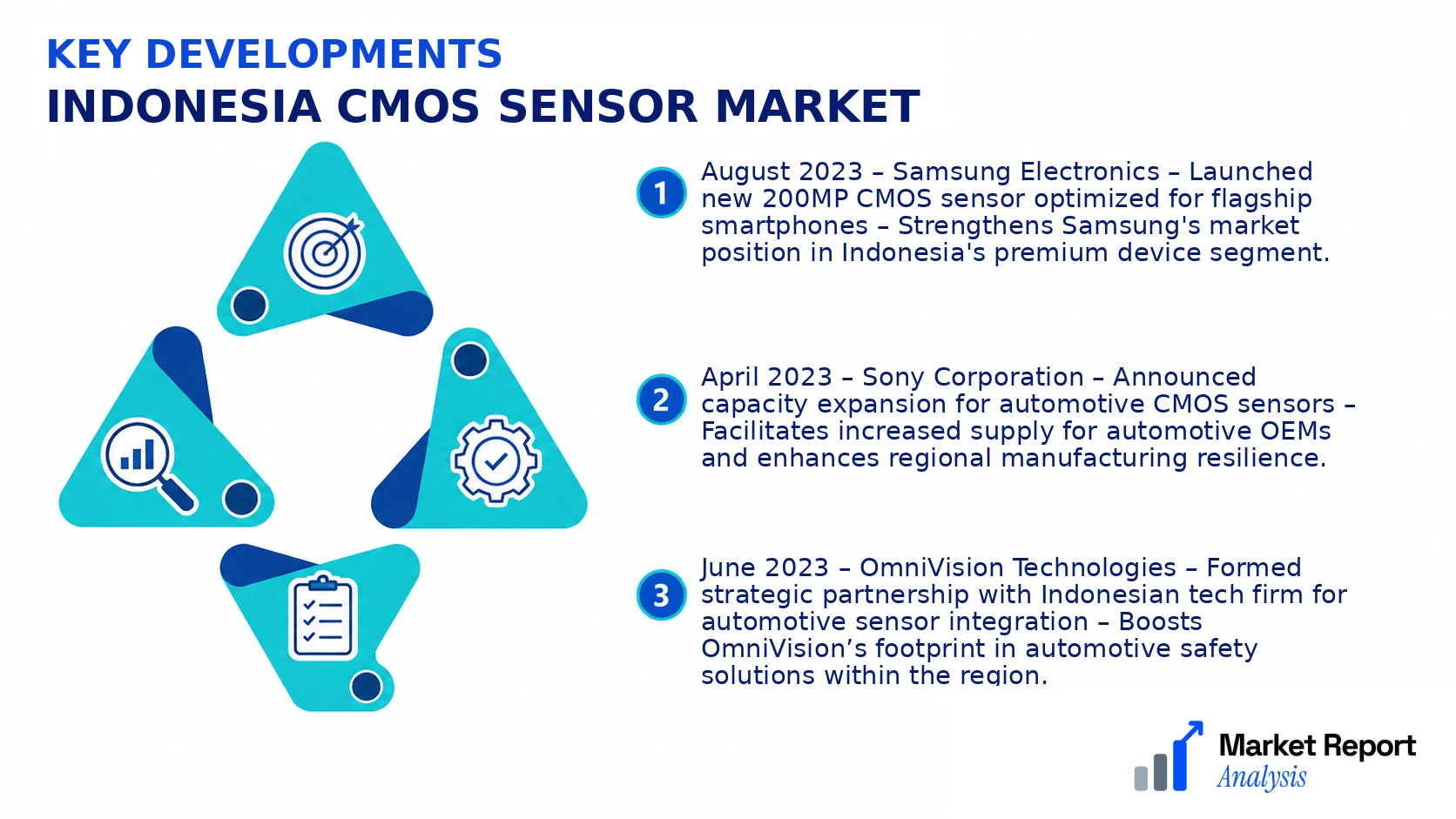
- August 2023 – Samsung Electronics – Launched new 200MP CMOS sensor optimized for flagship smartphones – Strengthens Samsung's market position in Indonesia's premium device segment.
- April 2023 – Sony Corporation – Announced capacity expansion for automotive CMOS sensors – Facilitates increased supply for automotive OEMs and enhances regional manufacturing resilience.
- June 2023 – OmniVision Technologies – Formed strategic partnership with Indonesian tech firm for automotive sensor integration – Boosts OmniVision’s footprint in automotive safety solutions within the region.
- February 2024 – CISPRX Technology – Invested in local manufacturing plant for consumer CMOS sensors – Supports regional supply chain development and cost reduction strategies.
- September 2023 – ON Semiconductor – Acquired a regional microelectronics design firm – Expands its technological capabilities and accelerates product development pipeline for Indonesia’s electronics sector.
Frequently Asked Questions
What is the Indonesia CMOS Sensor Market?
The Indonesia CMOS Sensor Market encompasses the industry involved in the manufacturing, development, and sales of complementary metal-oxide-semiconductor (CMOS) sensors used in various electronic devices such as smartphones, automotive systems, security cameras, and medical equipment within Indonesia. This market reflects technological advancements and consumer electronics adoption in the country.
What is the current market size of Indonesia CMOS Sensor Market?
As of 2026, the Indonesia CMOS Sensor Market was valued at approximately USD 2.4 Billion, reflecting its growing adoption driven by increases in consumer electronics production, automotive innovations, and surveillance infrastructure expansion across the country, with steady investments to support industry growth.
What factors are driving the Indonesia CMOS Sensor Market?
The market's growth is driven by rising smartphone penetration, increased demand for automotive safety features, burgeoning surveillance infrastructure, and technological advancements in CMOS sensor capabilities. Government initiatives supporting smart city projects and industrial automation also significantly contribute to the market expansion.
Which region dominates the Indonesia CMOS Sensor Market?
Java region, including Jakarta, dominates the Indonesian CMOS sensor market due to its concentration of electronics manufacturing, consumer device production, and technological innovation hubs. The region benefits from better infrastructure and a large consumer base, boosting sensor demand.
Which segment is expected to grow the fastest?
The automotive segment is forecasted to experience the fastest growth within the Indonesia CMOS Sensor Market, propelled by the rising adoption of driver-assistance systems, electronic vehicle components, and a growing automotive manufacturing sector in Indonesia, which emphasizes advanced safety and navigation features.
Who are the leading companies operating in the Indonesia CMOS Sensor Market?
Major players include Samsung Electronics, Sony Corporation, Omnivision Technologies, and local manufacturers like PT Panasonic Manufacturing Indonesia. These companies are investing heavily in innovation, production capacity, and strategic partnerships to strengthen their market presence in Indonesia.
Analyst Perspective
The Indonesia CMOS Sensor Market is poised for sustained growth driven by ongoing technological advancements and expanding applications in automotive, consumer electronics, and security sectors. Long-term market prospects look favorable, with innovation focusing on higher resolution, lower power consumption, and integration with artificial intelligence. Commercial opportunities are particularly attractive in developing smart city initiatives and IoT deployment within Indonesia’s urban centers such as Jakarta and Surabaya, where demand for surveillance, smart infrastructure, and autonomous vehicles is increasing. Technology evolution is trending towards stacked CMOS architectures and improved sensitivity to cater to diverse industrial needs. Investment priorities should emphasize R&D in advanced sensor fabrication facilities and strategic collaborations with regional tech hubs to capitalize on innovation cycles. The competitive landscape is intensifying, with both established players and local entrants competing through product differentiation and cost leadership. Regional growth potential is significant in Indonesia’s emerging cities, where urbanization and digital transformation create early adoption opportunities, positioning Indonesia as a crucial hub in the Southeast Asian CMOS sensor ecosystem.
