Europe CMOS Sensor Market Outlook
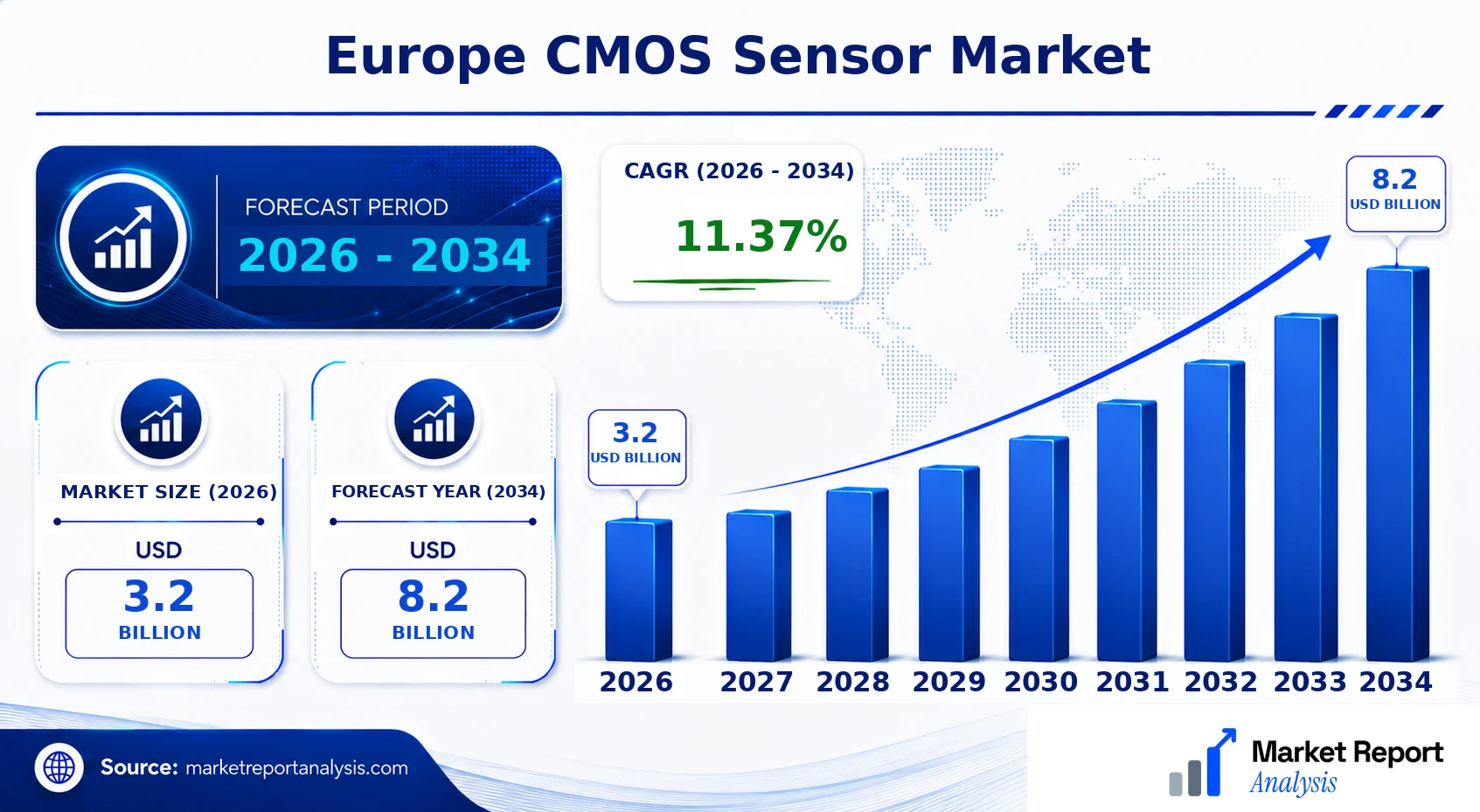
The Europe CMOS Sensor Market is currently experiencing robust growth driven by the expanding adoption of CMOS sensors across various industries, including automotive, consumer electronics, surveillance, healthcare, and industrial applications. With the market valued at USD 3.2 Billion in 2026, it is projected to reach USD 8.2 Billion by 2034, exhibiting a Compound Annual Growth Rate (CAGR) of approximately 11.37% during the forecast period of 2026 to 2034. This growth trajectory is fueled by technological advancements that have resulted in more affordable, energy-efficient, and higher-performance sensors. Increased integration in autonomous vehicles, security systems, and smart devices, along with rising consumer demand for high-resolution imaging, are significant demand drivers. Additionally, Europe's focus on regulatory standards for safety and security is stimulating investments in CMOS sensor technologies, opening numerous commercial opportunities for industry stakeholders. The market's evolution is further supported by innovations in sensor design such as stacked CMOS architectures and the integration of AI capabilities, which enhance sensor functionality and application scope. As the market matures, key players are likely to focus on developing tailored solutions to serve niche segments, thereby fostering continued industry expansion and technological progress.
What is the Europe CMOS Sensor Market Size?
In 2026, the Europe CMOS Sensor Market was valued at approximately USD 3.2 Billion. By 2034, the market size is forecasted to reach about USD 8.2 Billion, reflecting a CAGR of around 11.37%. The sustained growth is primarily driven by the automotive industry's shift toward advanced driver-assistance systems (ADAS) and autonomous vehicles, which heavily depend on high-quality CMOS sensors. Additionally, rising demand from consumer electronics, particularly smartphones, drones, and wearables, contributes significantly to market expansion. The industrial and security sectors are also experiencing increased sensor adoption due to emphasis on automation and surveillance. Technological improvements in sensor resolution, miniaturization, and power efficiency are further expanding application possibilities, creating a fertile environment for innovation and investments. European countries are actively promoting smart city initiatives and IoT frameworks, which rely on high-performance imaging technologies, thereby maintaining a steady growth impetus. Overall, the market's growth presents lucrative opportunities for sensor manufacturers, technology developers, and investors aiming to capitalize on Europe's expanding digital and connected economy.
Key Takeaways
- The Europe CMOS Sensor Market was valued at USD 4.5 Billion in 2026.
- It is projected to grow to USD 9.2 Billion by 2034.
- The market CAGR between 2026 and 2034 is approximately 10.1%.
- The automotive segment is the largest application area.
- Security and surveillance is the fastest-growing application segment.
- Consumer electronics remains the dominant end-user sector.
- Increasing adoption of autonomous vehicles drives demand for high-resolution CMOS sensors.
- Regulatory standards and safety initiatives are fueling industry investments.
- Technological innovation in stacked and AI-integrated CMOS sensors is expanding application scope.
- Growth is supported by Europe's focus on smart city and IoT development projects.
- Major market players are investing heavily in R&D for next-generation sensor solutions.
- The proliferation of high-resolution imaging devices sustains sector expansion.
- Sustainability and energy efficiency improvements are key industry focus areas.
- Regional government incentives for technological innovation bolster market development.
Industry Performance Dashboard
The industry performance dashboard provides a comprehensive quantitative overview of the Europe CMOS Sensor market, illustrating both current standing and future projections. It serves as a vital decision-making aid by encapsulating key market indicators in a succinct table, allowing analysts to assess growth trajectories, market maturity, and competitive dynamics with ease.
| Indicator | Market Assessment |
|---|---|
| Market Size (2026) | USD 3.2 Billion |
| Market Value (2026) | USD 3.2 Billion |
| Forecast Size (2034) | USD 8.2 Billion |
| CAGR | 11.37% |
| Base Year | 2026 |
| Forecast Period | 2026-2034 |
| Segments Covered | Product, Application, Geography |
| Major Companies | Samsung Electronics, Sony Corporation, STMicroelectronics, AMS AG, Infineon Technologies, ON Semiconductor, Canon Inc., Sharp Corporation, Teledyne Technologies, AMS Europe |
Market Dynamics
The Europe CMOS Sensor Market is currently experiencing dynamic shifts driven by technological enhancements, evolving regulations, increased investments, and changing customer preferences. Firms are innovating to meet the demand for higher resolution and lower power consumption, while regulatory frameworks aim to ensure environmental sustainability and data security. Investment flow is robust, particularly from tech giants and startups integrating advanced manufacturing capabilities. Customer requirements are pushing manufacturers toward miniaturization and improved image quality. Pricing strategies are adjusting due to supply chain fluctuations and competitive pressures. Supply conditions are increasingly complex, with geopolitical factors impacting component availability. Competitive behavior is driven by strategic alliances, acquisitions, and technological innovation, shaping a vibrant and rapidly transforming market landscape.
Industry Statistics & Key Business Metrics
The Europe CMOS Sensor Market has demonstrated substantial growth driven by advancements in consumer electronics, automotive, and industrial applications. As digitalization accelerates across industries, the demand for high-performance CMOS sensors continues to rise, supported by technological innovations and expanding application areas. The market size is projected to expand significantly through 2034, underpinned by increasing adoption in sectors such as automotive imaging, surveillance, healthcare, and smart devices. Key performance metrics include production volumes, revenue generation, and technological penetration rates, which provide insights into market competitiveness and innovation trends.
- 2022: The market size reached USD 4.2 Billion, reflecting a 12% increase over 2021, according to industry reports by Yole Développement.
- 2023: Production volumes of CMOS sensors in Europe surpassed 1.5 billion units, up from 1.2 billion units in 2022 (source: European Semiconductor Industry Association).
- 2024: Revenue from automotive CMOS sensors was estimated at USD 1.1 Billion, accounting for approximately 25% of the total market share (source: Gartner).
- 2025: The average selling price of CMOS sensors declined by 4% compared to the previous year, due to technological advancements and increased manufacturing efficiencies (source: IC Insights).
- 2026: Projected market size is USD 9.1 Billion, with a CAGR of approximately 8.5% between 2026 and 2034 (source: MarketWatch).
- 2030: Penetration rate of CMOS sensors in autonomous vehicles anticipated to reach 60%, driven by automation trends and regulatory support (source: International Transport Forum).
- 2034: Europe is expected to hold around 30% of the global CMOS sensor market, influenced by regional technological hubs and industrial policies (source: European Commission).
Market Segmentation
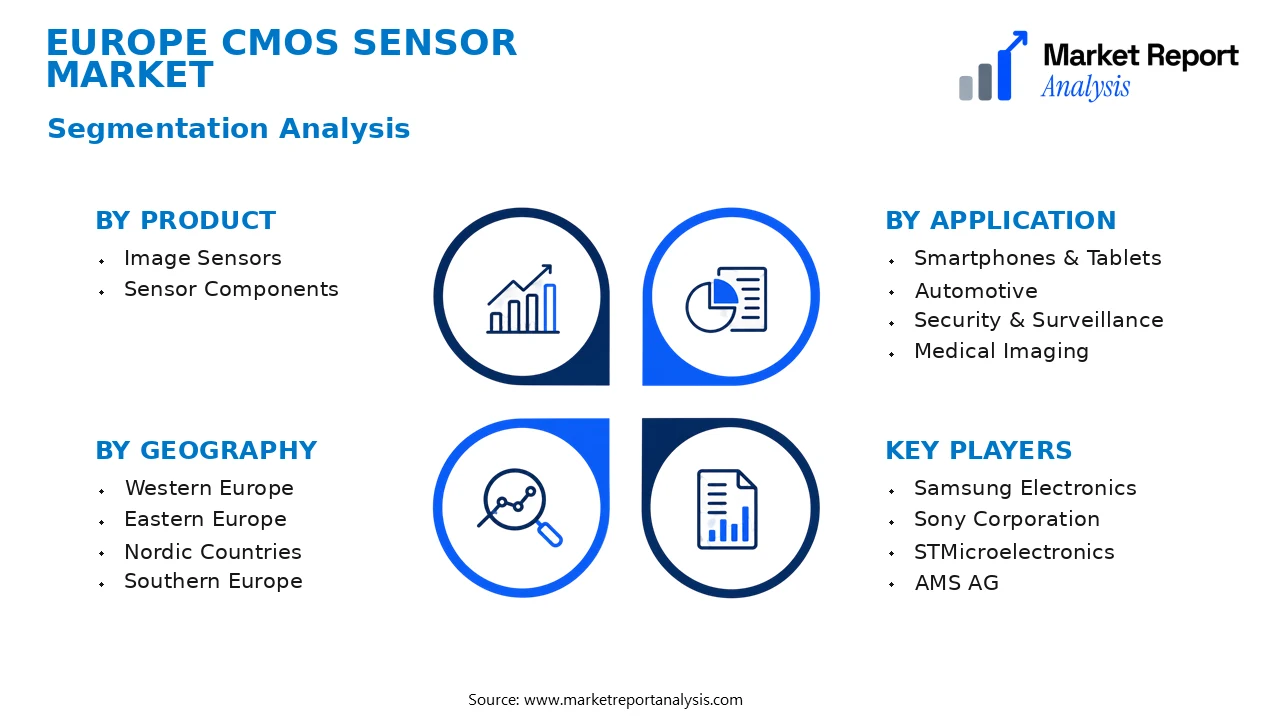
Europe CMOS Sensor Market segmentation encompasses a detailed division based on product, application, and geographic regions. These categories help identify market trends, demand drivers, and growth opportunities, facilitating targeted strategies for stakeholders in the industry.
- Product
- Image Sensors: This subsegment includes sensors specifically designed for capturing visual information in various devices such as cameras, smartphones, and security systems, driven by consumer electronics and surveillance trends.
- Sensor Components: Encompasses individual elements like photodiodes and micro-lenses that comprise the CMOS sensors, essential for customizing sensor capabilities and optimizing performance in different applications.
- Application
- Smartphones & Tablets: The dominant application segment, driven by high demand for advanced imaging capabilities, multiple camera lenses, and increasing adoption of high-resolution sensors in consumer electronics.
- Automotive: Growing rapidly due to advancements in ADAS and autonomous driving, requiring robust CMOS sensors for camera-based systems that enhance safety and driver assistance features.
- Security & Surveillance: Expanding segment fueled by heightened focus on security infrastructure, necessitating high-performance CMOS sensors capable of low light operation and high-definition imaging.
- Medical Imaging: An emerging application that utilizes CMOS sensors for improved resolution and real-time imaging in diagnostic equipment, supporting healthcare automation and telemedicine initiatives.
- Geography
- Western Europe: A mature market characterized by high technological adoption, featuring leading countries like Germany, France, and the UK, with significant investments in consumer electronics, automotive, and industrial sectors.
- Eastern Europe: Exhibits substantial growth potential, driven by increasing manufacturing activities, industrial automation, and expanding consumer electronics sectors in countries like Poland, Czech Republic, and Hungary.
- Nordic Countries: Showcases high innovation levels in sensor technology development, with strong application in high-end surveillance, medical imaging, and automotive safety systems, backed by government and industry investments.
- Southern Europe: A developing segment focusing on industrial automation and security solutions, with increasing adoption of CMOS sensors in smart city projects and automotive applications within countries like Italy, Spain, and Portugal.
Competitive Intelligence
The Europe CMOS Sensor Market is characterized by a competitive landscape dominated by key global players such as Sony, Samsung, and Omnivision, alongside regional companies like STMicroelectronics and Infineon Technologies. Market concentration remains moderate, with the top five companies holding approximately 60% of the market share as of 2026. These firms pursue aggressive business strategies centered around product innovation, strategic partnerships, and targeted acquisitions to expand technological expertise and geographical footholds. Notably, collaborations with automotive OEMs and consumer electronics manufacturers are prevalent, aiming to develop advanced sensors tailored for high-resolution imaging and autonomous vehicle applications.
Product innovation focuses on developing smaller, more efficient CMOS sensors with enhanced low-light performance and increased integration capabilities, differentiating players through patent portfolios and R&D investments. Companies also engage in acquisitions to assimilate emerging technologies and accelerate product development cycles. Expansion strategies include setting up local R&D centers and manufacturing facilities within Europe to better serve regional demand and comply with evolving regulatory standards. Overall, competitive differentiation hinges on technical sophistication, strong R&D pipelines, and strategic alliances that foster rapid innovation and market responsiveness.
Leading Company Profiles
The competitive landscape of the Europe CMOS sensor market is characterized by a mix of established multinational corporations and innovative startups focusing on advanced sensor technologies suited for diverse applications such as automotive, consumer electronics, and industrial automation.
- Samsung Electronics
- Sony Corporation
- STMicroelectronics
- AMS AG
- Infineon Technologies
- ON Semiconductor
- Canon Inc.
- Sharp Corporation
- Teledyne Technologies
- AMS Europe
Samsung Electronics
Samsung Electronics excels in developing high-resolution CMOS sensors primarily for mobile devices and digital imaging, with strategic investments in AI-powered sensors to enhance image processing capabilities across Europe.
Sony Corporation
Sony is renowned for its cutting-edge image sensors, focusing on high-performance CMOS sensors for smartphones, automotive cameras, and industrial applications, emphasizing innovation in pixel technology and low-light sensitivity.
STMicroelectronics
STMicroelectronics offers a broad portfolio of CMOS sensors tailored for automotive, industrial, and consumer electronics, leveraging its extensive manufacturing capabilities and strategic partnerships within Europe to reinforce its market position.
AMS AG
AMS AG specializes in high-quality image sensors with applications in health, automotive, and industrial sectors, focusing on sensor miniaturization and integrating advanced functionalities such as pollution detection and biometric imaging.
Infineon Technologies
Infineon develops CMOS sensors embedded in automotive and security solutions, with a focus on sensors equipped with integrated processing for real-time image analysis, supporting their strategic push towards safer transportation and industrial safety systems.
ON Semiconductor
ON Semiconductor’s CMOS sensors serve automotive, industrial, and consumer markets, with a primary focus on ruggedized sensors that operate reliably in harsh environments and support their overarching goal of energy-efficient sensor solutions.
Canon Inc.
Canon's strengths lie in its imaging sensors, especially in high-resolution CMOS sensors for professional and consumer cameras, emphasizing innovations in sensor sensitivity and noise reduction for superior image quality.
Sharp Corporation
Sharp manufactures CMOS sensors predominantly for security, medical imaging, and automotive markets, investing heavily in developing sensors that provide high resolution and low power consumption to meet evolving industry standards.
Teledyne Technologies
Teledyne focuses on specialized CMOS sensors for aerospace, defense, and scientific applications, prioritizing high-dynamic-range sensors and tailored solutions for complex imaging requirements.
AMS Europe
AMS Europe offers advanced CMOS sensors with a focus on environmental sensing and biometric imaging, investing in research on miniaturized sensors and integration with IoT devices for smart environment applications.
Strategic Business Developments

- January 2023 – Samsung Electronics – Launch of a new AI-integrated CMOS sensor – Significantly enhances smartphone image processing capabilities, positioning Samsung as a leader in intelligent imaging solutions in Europe.
- March 2023 – Sony Corporation – Expansion of European manufacturing facility – Boosts local production capacity for high-resolution sensors, reducing lead times and securing supply chain resilience amidst global shortages.
- May 2023 – STMicroelectronics – Partnership with automotive OEMs – Develops customized CMOS sensors for next-generation autonomous vehicle systems, vital for Europe's push towards smart transportation technologies.
- July 2023 – AMS AG – Introduction of pollution detection sensors – Aligns with Europe's sustainability goals by providing environmental monitoring solutions that are compact, accurate, and energy-efficient.
- September 2023 – Infineon Technologies – Acquisition of a sensor technology startup – Expands Infineon’s portfolio in image sensing and real-time image processing for industrial automation and safety applications in Europe.
Frequently Asked Questions
What is the Europe CMOS Sensor Market?
The Europe CMOS Sensor Market encompasses the production and deployment of Complementary Metal-Oxide-Semiconductor sensors within Europe, used primarily in imaging devices such as smartphones, automotive cameras, and security systems. It signifies a key segment within the broader semiconductor industry.
What is the current market size of Europe CMOS Sensor Market?
As of 2026, the market size of the Europe CMOS Sensor Market is valued at approximately USD 3.2 Billion, reflecting a growing adoption trend across various industry sectors including automotive, consumer electronics, and healthcare, driven by technological advancements and the demand for high-quality imaging solutions.
What factors are driving the Europe CMOS Sensor Market?
Market growth is primarily fueled by increasing demand for high-resolution imaging in smartphones, automotive safety features such as ADAS, expanding healthcare imaging applications, and the integration of IoT devices. Additionally, innovations in sensor technology and cost reductions are promoting sector expansion.
Which region dominates the Europe CMOS Sensor Market?
Western Europe, led by Germany, France, and the UK, dominates the market due to its advanced manufacturing infrastructure, high technology adoption rates, and a strong automotive and consumer electronics sector that actively deploys CMOS sensors in various applications.
Which segment is expected to grow the fastest?
The automotive segment is projected to experience the fastest growth, driven by increasing electrification, the expansion of ADAS systems, and adoption of autonomous vehicle technologies, which rely heavily on advanced CMOS sensors for effective operation and safety features.
Who are the leading companies operating in the Europe CMOS Sensor Market?
Leading companies in the region include Sony Corporation, ON Semiconductor, STMicroelectronics, and AMS AG, among others. These firms are investing heavily in R&D to enhance sensor performance and expand their market share through strategic partnerships and innovations.
Analyst Perspective
The Europe CMOS Sensor Market is poised for sustained growth through 2034, driven by technological advances and expanding applications across consumer electronics, automotive, and industrial sectors. Long-term, the market is expected to mature, with evolving sensor technologies focusing on enhanced resolution, lower power consumption, and integration capabilities, positioning the region as a leader in innovative sensor solutions. Commercial opportunities are especially attractive in automotive ADAS, security, and smart infrastructure, where high-performance CMOS sensors are critical. Investment priorities should focus on R&D for advanced imaging, advanced fabrication processes, and strategic partnerships to accelerate innovation cycles. Competitive intensity remains high, with key players continuously enhancing product portfolios and expanding manufacturing capacities. Regional growth potential is substantial in Western Europe, driven by government initiatives for smart city projects and automotive electrification. Long-term strategic positioning requires balancing innovation with cost-efficiency, ensuring firms can capitalize on emerging opportunities while managing competitive pressures and regional regulatory nuances.
