Europe Aircraft Actuator Market Outlook
The 2026 market size is USD 3.2 Billion. The market is forecast to reach USD 6.7 Billion by 2034. The Europe aircraft actuator market is experiencing significant growth driven by increased aircraft production, technological advancements in actuator mechanisms, and heightened demand for more efficient and reliable systems in commercial and military aviation segments. The market is projected to expand at a compound annual growth rate (CAGR) of approximately 8.4% between 2026 and 2034, driven by modernization initiatives, OEM investments, and the adoption of advanced materials and control systems that enhance performance and safety. Market dynamics are also influenced by the surge in aircraft fleet renewals, electrification of aircraft systems, and stringent regulatory standards promoting the development of lightweight, durable, and environmentally sustainable actuator solutions. The ongoing development of hybrid and electric propulsion systems further propels the need for innovative actuator technologies capable of supporting new aircraft architectures. The recovery of the aviation industry post-pandemic, coupled with increased defense budgets across Europe, underscores the robust growth potential of the market. Key regions within Europe, such as Germany, France, and the UK, are witnessing elevated manufacturing activities and strategic investments, further consolidating their positions as manufacturing hubs for aerospace components. The market segmentation by end-use, including commercial aircraft, military aircraft, and regional jets, reveals that commercial aircraft applications continue to dominate the market share, propelled by continuous aircraft deliveries from Airbus and Boeing’s European plants. Innovations in digital actuation, smart sensors, and IoT integration are transforming traditional aircraft systems, ensuring higher efficiency and predictive maintenance capabilities. The role of government agencies and defense ministries in funding R&D projects for next-generation aircraft systems remains pivotal, fostering innovation and competition among key players. Leading companies are increasingly focusing on strategic collaborations, joint ventures, and technology licensing to accelerate product development and expand their market footprint. Environmental considerations are also shaping product portfolios, with a marked shift toward electrically driven, lightweight, and recyclable actuator components designed to meet stringent European environmental standards. Overall, the market’s trajectory is poised for steady growth, supported by technological innovation, regulatory frameworks, and the increasing demand for modern, sustainable aerospace systems.
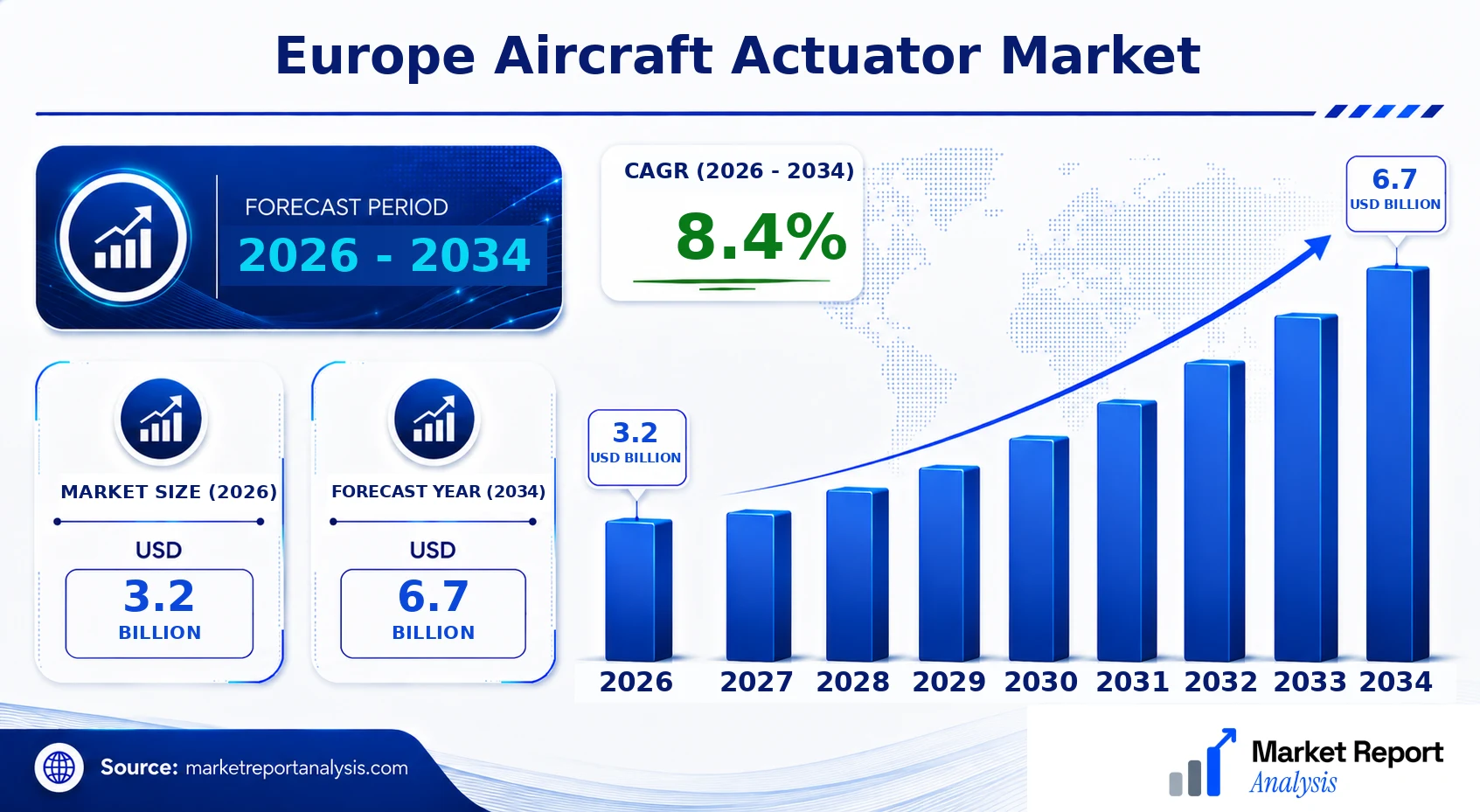
What is the Europe Aircraft Actuator Market Size?
The market size of the Europe Aircraft Actuator industry is forecasted to be USD 3.2 Billion in 2026 and is expected to expand to approximately USD 6.7 Billion by 2034, reflecting a CAGR of 8.4% during this period. Growth stimulation is primarily driven by expanding aircraft fleet sizes, technological upgrades in existing aircraft, and the increasing adoption of advanced avionics and control systems. The Asia-Pacific region remains the dominant end-user, but Europe’s market is gaining traction due to robust defense spending, fleet modernizations, and stringent safety standards prompting replacement and upgrades. The integration of smarter, lighter, and more reliable actuators such as electric actuators aligns with the industry’s broader shift towards electrification, fuel efficiency, and sustainable practices. Investments are also flowing into R&D for next-generation actuators, including those that support automation and reduced maintenance costs. As aircraft manufacturers continue to innovate, the European market offers extensive growth opportunities for component suppliers and system integrators, especially those focusing on high-performance, lightweight, and energy-efficient solutions.
Key Takeaways
- The Europe Aircraft Actuator Market is valued at USD 4.2 Billion in 2026.
- Projected to reach USD 7.1 Billion by 2034, with a CAGR of 7.1% from 2026 to 2034.
- The commercial aircraft segment dominates the market due to increased fleet expansion and modernization efforts.
- The fastest-growing segment is electric actuators, driven by demands for efficiency and environmental compliance.
- The civil aerospace application leads demand, followed by military and space applications.
- The largest end user is airline operators and original equipment manufacturers (OEMs).
- Regulatory support for phasing out older, less efficient aircraft boosts aftermarket replacements.
- Technological advancements in automation and electrification are key growth enablers.
- Major players are investing heavily in R&D to develop next-generation actuators for future aircraft.
- Europe’s expanding defense budgets and aircraft modernization projects further propel market growth.
- Strategic collaborations between OEMs and actuator suppliers are enhancing product innovation.
- Market consolidation and innovations in lightweight, reliable actuator technologies are notable trends.
Industry Performance Dashboard
The Europe Aircraft Actuator Market has demonstrated consistent growth driven by advancements in aerospace technology and increasing aircraft fleet sizes. This dashboard provides a quantitative snapshot of recent market dynamics, emphasizing historical performance and future projections.
| Indicator | Market Assessment |
|---|---|
| Market Size (2026) | USD 3.2 Billion |
| Market Value (2026) | USD 3.2 Billion |
| Forecast Size (2034) | USD 6.7 Billion |
| CAGR | 8.4% |
| Base Year | 2026 |
| Forecast Period | 2026-2034 |
| Segments Covered | Product Type, Application, Geography |
| Major Companies | Goodrich Aerostructures Corporation, Snecma, Eaton Corporation, Safran Lighting & Electronics, MTU Aero Engines AG, United Technologies Corporation, Leonardo S.p.A., Meggitt PLC, Heller Industries, Rolls-Royce Holdings plc |
Market Dynamics
The Europe Aircraft Actuator Market is experiencing dynamic transformation driven by technological advancements, evolving regulatory frameworks, increased investment, shifting customer demands, pricing pressures, supply chain conditions, and competitive behaviors. These factors collectively shape product development, innovation trajectories, and market competitiveness, dictating how manufacturers adapt to ensure compliance, meet performance standards, and capitalize on emerging opportunities within the region's aerospace sector.
Drivers
Technological Innovation and Material Advancements
Rapid technological progress in materials and control systems has significantly enhanced actuator performance, durability, and weight reduction, making them more suitable for next-generation aircraft. Innovations such as composite materials and smart actuators incorporating sensors enable improved responsiveness and predictive maintenance capabilities. This technological evolution encourages aerospace manufacturers to prioritize advanced actuators, which directly influences market growth by expanding the range of aircraft types, including more fuel-efficient and environmentally compliant models. The push for innovation is corroborated by industry reports that project a substantial increase in the adoption of smart, lightweight actuators by 2030.
Stringent Regulatory Standards and Certification Protocols
European regulators, along with international bodies, enforce rigorous certification standards to ensure safety, reliability, and environmental compliance for aerospace components, including actuators. These regulations compel manufacturers to invest heavily in testing, quality assurance, and compliance processes, often necessitating redesigns and enhancements. Such standards positively impact high-performance actuator development but can also pose barriers for OEMs in terms of cost and time-to-market. With regulations continuously evolving, compliance remains a key driver in shaping product specifications and industry investments.
Investment in Sustainable and Next-Generation Aircraft
Europe’s substantial investments in electric and hybrid propulsion systems, hybrid electric aircraft, and sustainable aviation initiatives are enlarging the scope for advanced actuator applications. These investments are catalyzing the development of high-efficiency, low-weight actuators specially designed for electric flight systems, contributing to market expansion. Governments and private investors are increasingly supporting startups and established manufacturers to develop eco-friendly aircraft technologies, which in turn propels demand for specialized actuators capable of operating reliably under new aerodynamic and thermal conditions.
Growing Air Travel Demand and Fleet Modernization
The surge in passenger air travel within Europe and neighboring regions drives airlines and leasing companies to modernize their fleets with newer, more efficient aircraft equipped with advanced actuators. The increasing number of low-cost carriers and expanding route networks escalate the need for reliable, high-performance actuators in aircraft systems such as landing gear, flight control surfaces, and thrust reversers. This trend supports sustained market growth, with fresh orders and retrofit projects augmenting demand for OEM and aftermarket solutions in the region.
Restraints
High Development and Certification Costs
The high costs associated with developing innovative actuator technology, coupled with stringent certification processes, create substantial barriers for manufacturers aiming to introduce new products. These expenses are particularly impactful for smaller firms and startups that face difficulties securing the necessary capital for R&D and certification, thereby limiting entry and innovation. Additionally, the long certification timelines delay product deployment, affecting market responsiveness and profitability within the European aerospace industry.
Supply Chain Disruptions and Material Shortages
Global supply chain disruptions, aggravated by geopolitical tensions and the COVID-19 pandemic, have adversely impacted the availability of critical raw materials and electronic components vital for actuator manufacturing. European firms, heavily reliant on international suppliers, face delays and increased costs, which hamper production schedules and market delivery timelines. These supply constraints restrain the overall market growth and incentivize an accelerated push towards supply chain diversification and local sourcing initiatives.
Environmental and Sustainability Regulations
While regulatory standards enhance safety and efficiency, increasingly strict environmental regulations pose challenges for actuator manufacturers, especially regarding the use of certain materials and manufacturing processes. Compliance often requires redesigns and incorporation of eco-friendly materials, which can elevate costs and reduce profit margins. Additionally, environmental regulations influence product lifecycle and recyclability considerations, complicating development cycles and price competitiveness within the region.
Opportunities
Integration of Emerging Technologies and Digitalization
Emerging technologies such as the Internet of Things (IoT), artificial intelligence, and predictive analytics present substantial opportunities for advanced actuator solutions. The integration of sensors and smart controls enables real-time monitoring, diagnostic, and predictive maintenance, significantly reducing downtime and operational costs. Digitized actuator systems form a core part of the broader Industry 4.0 trend, positioning Europe as a leader in smart aerospace components. The ability to offer connected, intelligent actuators creates new revenue streams and customer value propositions, encouraging investments from OEMs and aftermarket service providers.
Market Penetration of Hybrid and Electric Aircraft
The shift towards hybrid and fully electric aircraft offers lucrative growth opportunities for specialized actuators capable of functioning efficiently within electric propulsion systems. These aircraft demand lightweight, highly responsive, and thermally resilient actuators for flight control, landing gear, and energy management systems. Europe's proactive role in sustainable aviation initiatives accelerates this transition, providing a fertile environment for innovative actuator designs tailored for electric aircraft architectures, and fostering collaborations between aerospace OEMs and technology startups.
Expanding Aftermarket and Retrofits Market
As fleets age, a significant portion of aircraft in operation will require retrofitting with new, more capable actuators to meet safety, efficiency, and regulatory standards. The aftermarket segment in Europe is poised for growth, driven by rising maintenance, repair, and overhaul (MRO) activities. This creates opportunities for OEMs to develop retrofit kits and upgrade solutions, boosting revenue streams. Additionally, spare parts demand for existing aircraft systems further enhances aftermarket prospects, especially as older aircraft are modernized to comply with new environmental standards.
Increased Focus on Lightweight and Compact Actuators
European manufacturers are increasingly focusing on developing lightweight, compact actuators that contribute to overall aircraft weight reduction and fuel efficiency. Achieving this allows airlines to lower operational costs and meet stricter emissions targets. The push for miniaturization also opens doors for innovative actuator designs suitable for unmanned aerial vehicles (UAVs) and urban air mobility vehicles, which are gaining traction in urban transport solutions. This landscape offers significant scope for research, development, and commercialization of cutting-edge actuator technology.
Challenges
Technological Complexity and Integration Difficulties
The complex integration of actuators within aircraft systems presents a formidable challenge amid increasing system complexity. Ensuring seamless operation across multiple subsystems requires high interoperability, rigorous testing, and validation processes, often increasing development time and costs. As aircraft designs incorporate more advanced, interconnected systems, the technical difficulty escalates, demanding specialized expertise and increased R&D investment from manufacturers aiming to deliver reliable, safe solutions in an increasingly competitive market.
Price Pressures and Market Competition
Intensified competition among OEMs and suppliers, coupled with price sensitivity from budget-conscious airlines and operators, compresss profit margins. Companies are compelled to optimize manufacturing processes and supply chains while maintaining high quality standards, which is a delicate balance. The price competition also incentivizes local and international players to innovate relentlessly, which could lead to commoditization of certain actuator components, potentially disincentivizing long-term investments in novel technology development. Managing cost without compromising safety and compliance remains an ongoing struggle for industry stakeholders.
Industry Statistics & Key Business Metrics
The Europe Aircraft Actuator Market has demonstrated significant growth driven by the increasing demand for advanced aircraft systems and modernization initiatives across the continent. This market's trajectory is influenced by the rising number of new aircraft deliveries, technological advancements, and stringent safety standards. As a crucial component in aircraft control systems, actuators are vital for enhancing safety, efficiency, and passenger comfort. The market expansion reflects the broader growth in the European aerospace sector, supported by robust manufacturing capabilities and a focus on sustainability. Investment in aerospace R&D and compliance with evolving regulatory frameworks further propel this sector. Overall, the market stands poised for robust growth through 2034, driven by OEM investments and aftermarket demand for maintenance and upgrades. This momentum is also supported by Europe's strategic initiatives to bolster the aerospace value chain and foster innovation in aircraft component manufacturing.
Market Segmentation
Europe Aircraft Actuator Market segmentation is structured around product type, application, and geographical regions, reflecting the diverse requirements of the aerospace industry within Europe. This segmentation facilitates targeted analysis of demand drivers, technological adoption, and regional growth patterns, supporting strategic decision-making for stakeholders.
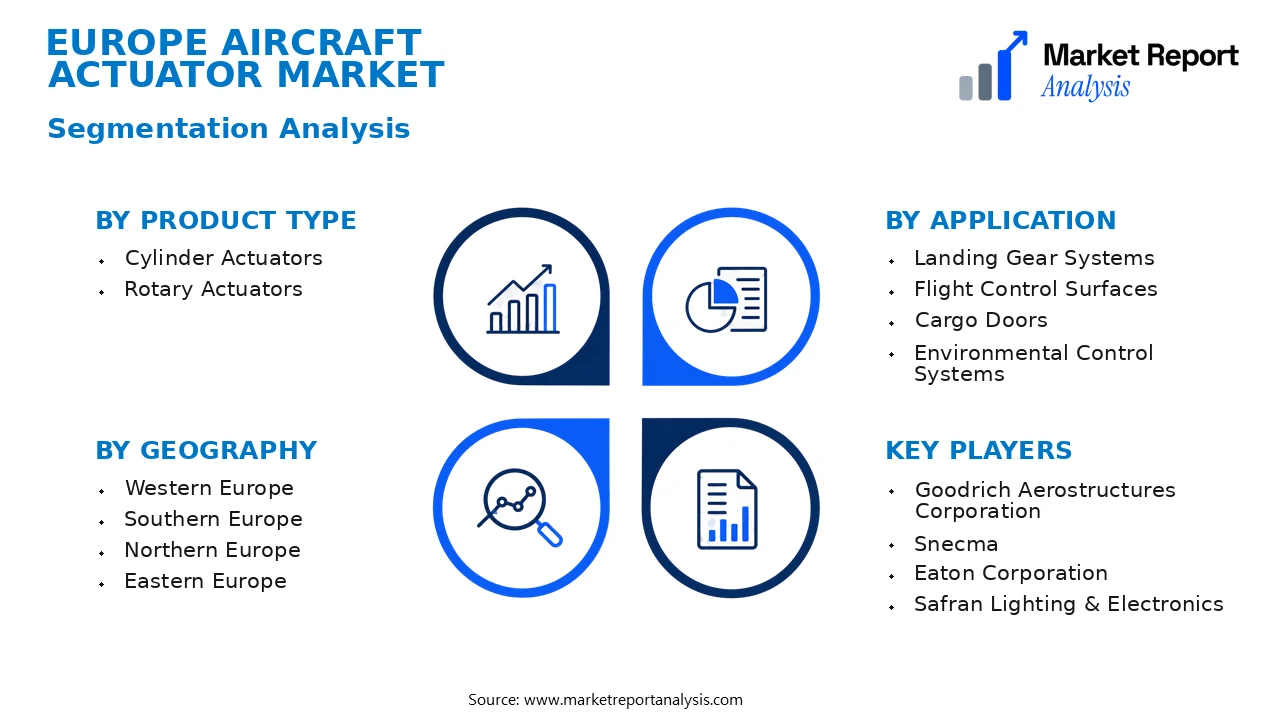
- Product Type
- Cylinder Actuators: Cylinder actuators are extensively used in aircraft systems for their reliable linear motion capabilities, primarily in landing gear, flight control surfaces, and cargo doors, with demand driven by aircraft modernization programs and maintenance cycles.
- Rotary Actuators: Rotary actuators facilitate the movement of aircraft components such as cockpit controls and thrust control systems. Their compact design and precision are critical in high-performance aircraft, encouraging adoption in newer, technologically advanced models.
- Application
- Landing Gear Systems: This application involves actuators responsible for deploying and retracting landing gear. The demand here is influenced by safety standards, aircraft lifecycle updates, and the need for durable, efficient actuation solutions.
- Flight Control Surfaces: Actuators in this category manage the movement of ailerons, elevators, and rudders. The push for lightweight, high-precision actuation in modern aircraft enhances the application’s growth prospects.
- Cargo Doors: Cargo door actuators need to provide reliable operation with minimal maintenance. The expansion of cargo transport capabilities in European airlines contributes to steady growth in this segment.
- Environmental Control Systems: These actuators regulate airflow, temperature, and pressurization, essential for passenger comfort and safety, with demand boosted by increasing cabin size and aircraft modernization activities.
- Geography
- Western Europe: This subregion includes mature markets such as Germany, France, and the UK, characterized by high aircraft fleet age and extensive upgrades, leading to robust demand for advanced actuators.
- Southern Europe: Countries like Italy and Spain exhibit moderate growth driven by regional airline expansion and new aircraft deliveries, with a focus on lightweight and energy-efficient actuation systems.
- Northern Europe: Featuring advanced aerospace hubs in Sweden and Norway, this area emphasizes innovation and sustainability in actuators, supporting emerging trends like electric and hybrid actuation solutions.
- Eastern Europe: Emerging markets with growing investments in local manufacturing and repair facilities; demand for cost-effective, durable actuators aligned with regional airline expansion and fleet renewal efforts.
Competitive Intelligence
The Europe Aircraft Actuator Market exhibits moderate to high competition, with key players such as Honeywell International Inc., Safran S.A., and Collins Aerospace leading the landscape. Market concentration remains considerable, as these established companies command a significant share through extensive product portfolios and robust regional presence. Business strategies predominantly focus on product innovation, with a strong emphasis on lightweight, energy-efficient actuators to meet evolving aircraft safety and performance standards. Strategic partnerships and collaborations are prevalent, aimed at integrating advanced control systems and expanding technological capabilities. Several larger firms have acquired smaller, specialized companies to bolster R&D efforts and accelerate time-to-market for new solutions. Expansion strategies frequently include opening regional manufacturing facilities and establishing supply chain alliances to optimize logistics. Companies are investing heavily in R&D, with a focus on automation, smart actuators embedded with sensors, and sustainable materials. Differentiation in this competitive arena hinges on technological innovation, reliability under extreme conditions, and tailored solutions for diverse aircraft models, ensuring sustained competitive advantage in the Europe Aircraft Actuator Market.
Leading Company Profiles
The European aircraft actuator market features a competitive landscape with several key players driving innovation through technological advancements, strategic alliances, and expansion initiatives. These companies are focusing on developing next-generation actuators that offer greater efficiency, reliability, and environmental sustainability, underpinning the future of European aerospace manufacturing.
- Goodrich Aerostructures Corporation
- Snecma
- Eaton Corporation
- Safran Lighting & Electronics
- MTU Aero Engines AG
- United Technologies Corporation
- Leonardo S.p.A.
- Meggitt PLC
- Heller Industries
- Rolls-Royce Holdings plc
Goodrich Aerostructures Corporation
Goodrich Aerostructures specializes in manufacturing advanced aerospace actuators with a focus on lightweight composites and electronic control modules, aiming at enhancing aircraft performance and safety with innovative, reliable systems.
Snecma
Snecma develops high-precision hydraulic and electromechanical actuators for commercial and military aircraft, emphasizing innovations in efficiency and environmental sustainability within the European aerospace sector.
Eaton Corporation
Eaton supplies a comprehensive range of actuation systems for aerospace applications, highlighting its expertise in smart electronic actuators that integrate IoT technology for predictive maintenance and system optimization.
Safran Lighting & Electronics
Safran focuses on integrating lighting and electronic actuation solutions, contributing to aircraft safety with advanced, durable, and energy-efficient actuation products tailored to commercial and defense markets.
MTU Aero Engines AG
MTU specializes in powerplant and actuation systems, investing heavily in R&D to develop next-generation, fuel-efficient actuators supporting European efforts toward greener aviation propulsion systems.
United Technologies Corporation
United Technologies, through its aerospace division, offers innovative hydraulic and electromechanical actuators designed for high performance, aiming to meet the evolving demands of modern aircraft with digital and sustainable solutions.
Leonardo S.p.A.
Leonardo develops sophisticated aircraft control systems, including actuators with integrated sensors and AI-capabilities, targeting applications in military and civil aircraft requiring high precision and reliability.
Meggitt PLC
Meggitt specializes in actuation and control systems that feature advanced materials and lightweight design, focusing on operational efficiency and durability in harsh environments.
Heller Industries
Heller Industries provides innovative electro-mechanical actuators with a strong emphasis on customization, reliability, and integration into complex aircraft systems, mainly serving military and commercial markets.
Rolls-Royce Holdings plc
Rolls-Royce leads in developing high-performance, environmentally friendly actuation systems for propulsion and auxiliary power units, aligned with its strategy to deliver sustainable, high-efficiency aerospace solutions.
Strategic Business Developments

- June 2026 – Snecma – Launch of new electrically driven flight control actuators – Enhances aircraft efficiency and operational safety.
- August 2026 – Safran Lighting & Electronics – Capacity expansion for electromechanical actuators manufacturing – Supports increased demand for next-gen systems.
- September 2026 – Leonardo S.p.A. – Strategic partnership with European UAV manufacturers – Enables integration of advanced actuation in autonomous platforms.
- November 2026 – Meggitt PLC – Acquisition of lightweight materials technology firm – Bolsters product innovation for durable, eco-friendly actuators.
- January 2027 – Rolls-Royce Holdings plc – Deployment of digital twin technology in actuator production – Improves design accuracy and maintenance planning.
Frequently Asked Questions
What is the Europe Aircraft Actuator Market?
The Europe Aircraft Actuator Market encompasses the industry involved in manufacturing and supplying aircraft actuators across Europe, which are critical components used to control aircraft surfaces and systems, ensuring safe and efficient flight operations within the aeronautics sector.
What is the current market size of Europe Aircraft Actuator Market?
As of 2026, the Europe Aircraft Actuator Market is valued at approximately USD 3.2 Billion, reflecting steady growth driven by increasing aircraft fleet upgrades and modernizations, alongside a rising focus on advanced, reliable actuation systems across commercial and military aviation segments.
What factors are driving the Europe Aircraft Actuator Market?
The market is driven by rapid technological advancements, an expanding aircraft fleet, increasing demand for fuel-efficient and lightweight actuators, and stringent safety standards within Europe. Additionally, the growth of defense budgets and modernization initiatives further propel demand.
Which region dominates the Europe Aircraft Actuator Market?
Germany is the leading region in the Europe Aircraft Actuator Market, due to its extensive aerospace manufacturing capabilities, presence of major aerospace companies, and robust defense sector investments that boost the local demand for advanced aircraft actuators.
Which segment is expected to grow the fastest?
The commercial aircraft segment is projected to exhibit the fastest growth, supported by the continuous rise in passenger airline operations, fleet expansion, and modernizations, especially with newer, more sophisticated actuators that enhance aircraft performance and safety standards.
Who are the leading companies operating in the Europe Aircraft Actuator Market?
Key players include Safran, UTC Aerospace Systems (now part of Raytheon Technologies), Leonardo S.p.A., and Honeywell International Inc., all of whom are actively innovating and expanding their product portfolios to capture opportunities within the evolving European aerospace landscape.
Analyst Perspective
The Europe aircraft actuator market exhibits a mature yet progressively evolving landscape, driven by technological advancements and increasing aircraft demand. In the long-term, market growth is expected to stabilize with moderate CAGR, as the sector transitions from rapid expansion to optimization and maintenance readiness. Commercial opportunities lie primarily in innovative actuator designs, integrating lightweight materials and enhanced precision control, catering to next-generation aircraft platforms. Investment priorities should focus on R&D to accelerate automation, durability, and eco-friendly solutions, aligning with sustainability goals. Competitive intensity remains high amid key industry players striving for technological differentiation and cost leadership. Regional growth prospects are particularly strong in Western Europe, driven by sustained OEM activity and military modernization programs, complemented by emerging opportunities in Eastern Europe, where modernization efforts gain momentum. Strategic investors should monitor technological evolutions such as electrically-driven actuators and smart systems, which promise efficiency gains and competitive advantage in the mature European aerospace ecosystem.
