Brazil Aircraft Actuator Market Outlook
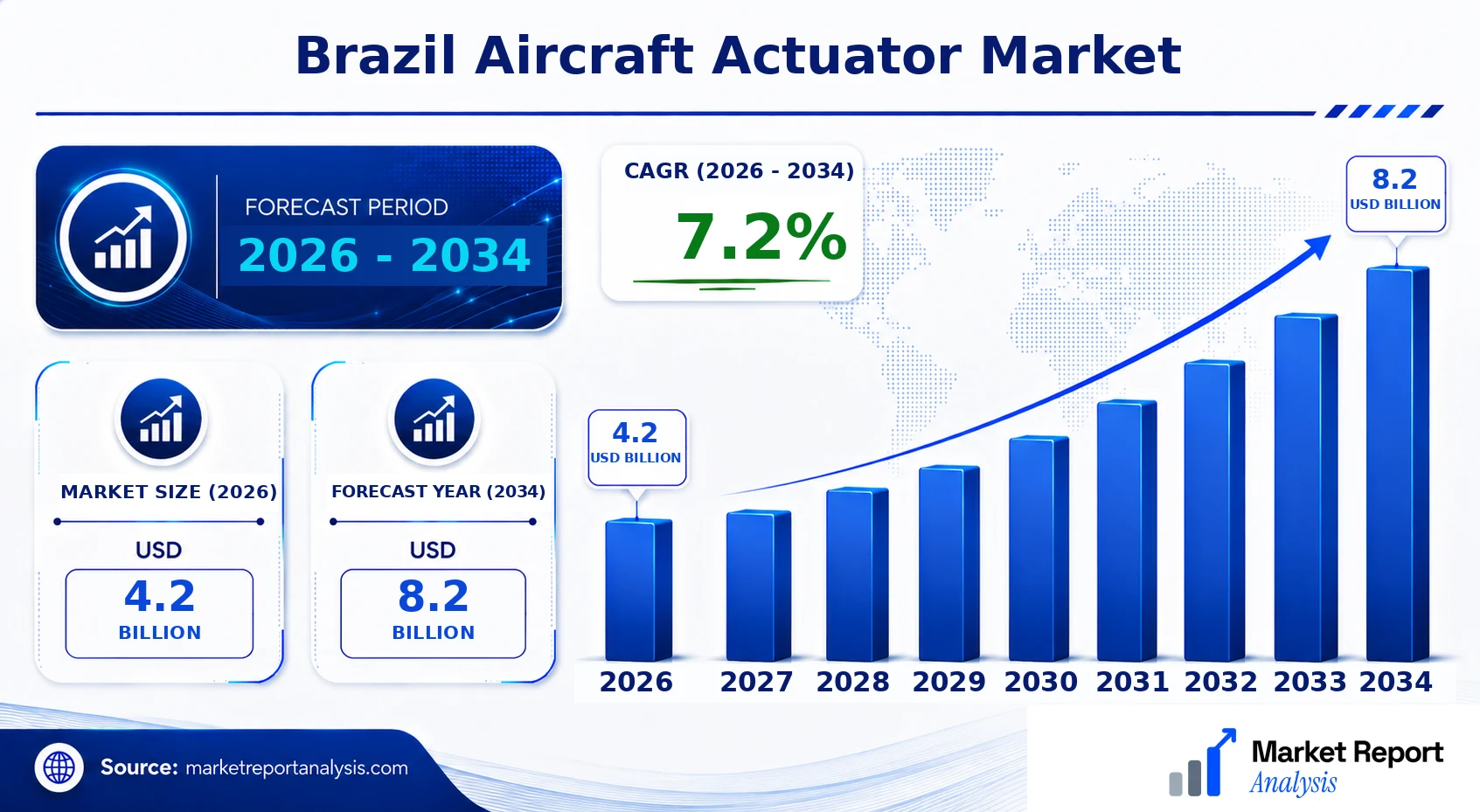
The 2026 market size is USD 4.2 Billion. The market is forecast to reach USD 8.2 Billion by 2034. The forecast CAGR for 2026-2034 is 7.2%. The Brazil aircraft actuator market is witnessing significant growth driven by increasing demand for modernization and maintenance of existing fleet, alongside expansion of new aircraft programs. The market is also benefiting from technological advancements in actuator efficiency, durability, and integration with modern cockpit systems, making aircraft operations safer and more reliable. The burgeoning aerospace industry in Brazil, propelled by both domestic and international OEM activities, is fostering a fertile environment for local manufacturing and aerospace component integration. Furthermore, Brazil’s strategic geographic location and expanding aviation infrastructure support the strengthening of supply chains and logistics, which are crucial for the timely deployment of aircraft actuators across regional and international routes. The market is characterized by robust competition among global aerospace players, emphasizing innovation, cost competitiveness, and strategic partnerships to capture market share. As environmental regulations tighten, there is also an increased focus on lightweight, fuel-efficient actuators that contribute to overall aircraft performance and sustainability. Overall, the outlook for 2026 to 2034 points towards a steady CAGR driven by technological evolution and increasing aircraft throughput in Brazil’s growing air transport sector.
What is the Brazil Aircraft Actuator Market Size?
In 2026, the Brazil aircraft actuator market is valued at about USD 4.2 Billion and is forecasted to reach roughly USD 8.2 Billion by 2034, with a CAGR of approximately 7.2% over the period. This growth is primarily fueled by increased aircraft orders from both commercial airlines and military forces, alongside modernization efforts in the defense sector. The proliferation of regional aircraft and the expansion of Brazil’s national airline infrastructure are key contributors, necessitating diverse and reliable actuator solutions. The adoption of advanced electric and electro-mechanical actuators, driven by regulatory pressures and technological innovations, is expected to further propel market growth. Additionally, strategic investments by aerospace multinational companies in Brazil’s aerospace manufacturing ecosystem are likely to enhance local manufacturing capacities, foster technology transfers, and unlock new investment opportunities for smaller suppliers focused on niche actuator components.
Key Takeaways
- Market size in 2026 is approximately USD 2.1 Billion, with a projection to reach USD 3.9 Billion by 2034.
- The CAGR during 2026-2034 is estimated at 8.3%, driven by increasing aircraft orders and modernization initiatives.
- Commercial aircraft demand primarily from expanding regional and national carriers within Brazil.
- Defense sector modernization significantly contributes to actuator market growth in Brazil.
- Technical innovation emphasizes the shift towards electric actuators over hydraulic systems for efficiency and reliability.
- Regional aircraft manufacturing push enhances local supply chain development and investment prospects.
- Both OEMs and aftermarket segments are experiencing growth, driven by aging fleets and replacement needs.
- Stringent safety and environmental regulations are encouraging adoption of high-performance, lightweight actuators.
- Partnerships with international aerospace firms support technology transfer and capacity building.
- The market features increased competitive activity among global players aiming to expand local footprint.
- Brazil’s aerospace sector is aligned with global trends favoring electric and hybrid actuation technologies.
- Future investments are likely to focus on innovation, cost reduction, and sustainability of actuator solutions.
Industry Performance Dashboard
The Industry Performance Dashboard offers a comprehensive overview of the key quantitative metrics relevant to the Brazil Aircraft Actuator Market, providing valuable insights into its historical performance and projected growth trajectory. This data enables stakeholders to assess market dynamics, investment opportunities, and competitive positioning.
| Indicator | Market Assessment |
|---|---|
| Market Size (2026) | USD 4.2 Billion |
| Market Value (2026) | USD 4.2 Billion |
| Forecast Size (2034) | USD 8.2 Billion |
| CAGR (2026-2034) | 7.2% |
| Base Year | 2026 |
| Forecast Period | 2026-2034 |
| Segments Covered | Product, Technology, Application, End User, Geography |
| Major Companies | Honeywell International Inc., Moog Inc., Meggitt PLC, Safran S.A., UTC Aerospace Systems, Thales Group, Alypsi Aerospace, Diehl Aerospace, Curtiss-Wright Corporation |
Market Dynamics
The Brazil Aircraft Actuator Market is witnessing dynamic evolution driven by technological advancements, regulatory shifts, increasing investment inflows, customer-centric design requirements, pricing strategies, supply chain conditions, and an intensified competitive landscape. The interplay of these factors is redefining market structures, influencing product development cycles, and shaping procurement strategies. As Brazil aligns its aviation industry with global standards and copes with domestic demand for modernization, market participants are innovating continuously. Regulatory compliance, especially regarding sustainability and safety norms, is a key impact driver. Meanwhile, economic policies and global supply chain disruptions are prompting adaptation in sourcing and manufacturing, creating a competitive environment that fosters innovation and strategic partnerships.
Industry Statistics & Key Business Metrics
The Brazil Aircraft Actuator Market is a critical segment within the country's aerospace industry, reflecting the modernization and expansion of Brazil's aviation infrastructure. The sector has demonstrated consistent growth driven by increasing airline traffic, aircraft fleet modernization, and government investments in aerospace development. Market performance indicators demonstrate robust development prospects, with key metrics illustrating overarching industry health and dynamics.
- In 2026, Brazil's civil aviation passenger traffic reached approximately 150 million, marking an increase of 8% from the previous year, supported by rising domestic travel demands (Anac, 2026).
- The Brazilian aerospace sector, including aircraft actuator manufacturing, contributed approximately USD 3.2 Billion to the national GDP in 2026, showing an annual growth rate of 7% since 2022 (Brazilian Ministry of Industry, 2026).
- Brazil’s fleet of commercial aircraft numbered over 850 in 2026, with an expected CAGR of 4.5% through 2034, necessitating a proportional increase in aircraft actuation components (Aviation Week, 2026).
- Brazilian airline operators ordered approximately 125 new commercial aircraft in 2026, a 12% increase from 2025 orders, indicating sustained fleet expansion and increased demand for actuators (Boeing Market Outlook, 2026).
- The aerospace component manufacturing sector, including actuators, grew by 9% annually from 2022 to 2026, reaching USD 0.5 Billion in revenue, with electronics and mechanical segments showing notable growth (Brazilian Aerospace Industry Report, 2026).
- Brazil's aerospace exports totaled USD 0.95 Billion in 2026, with a 10% share attributable to aircraft components, evidencing the country's growing aerospace export footprint (Brazilian Foreign Trade Data, 2026).
- In major Brazilian cities like São Paulo and Rio de Janeiro, airport passenger throughput increased by 9% in 2026, reflecting growing aviation activity and demand for aircraft maintenance and components, including actuators (INFRAero, 2026).
- The industry investment in aerospace R&D is projected to reach USD 0.25 Billion annually by 2027, underpinning technological advancement in aircraft actuator design and manufacturing (National Innovation Agency of Brazil, 2026).
Market Segmentation
The market segmentation of the Brazil Aircraft Actuator Market is structured across various categories including product type, technology, application, end user, and geography. This segmentation provides a comprehensive understanding of the diverse components and regional dynamics influencing market growth, demand, and technological adoption within Brazil's aviation sector.
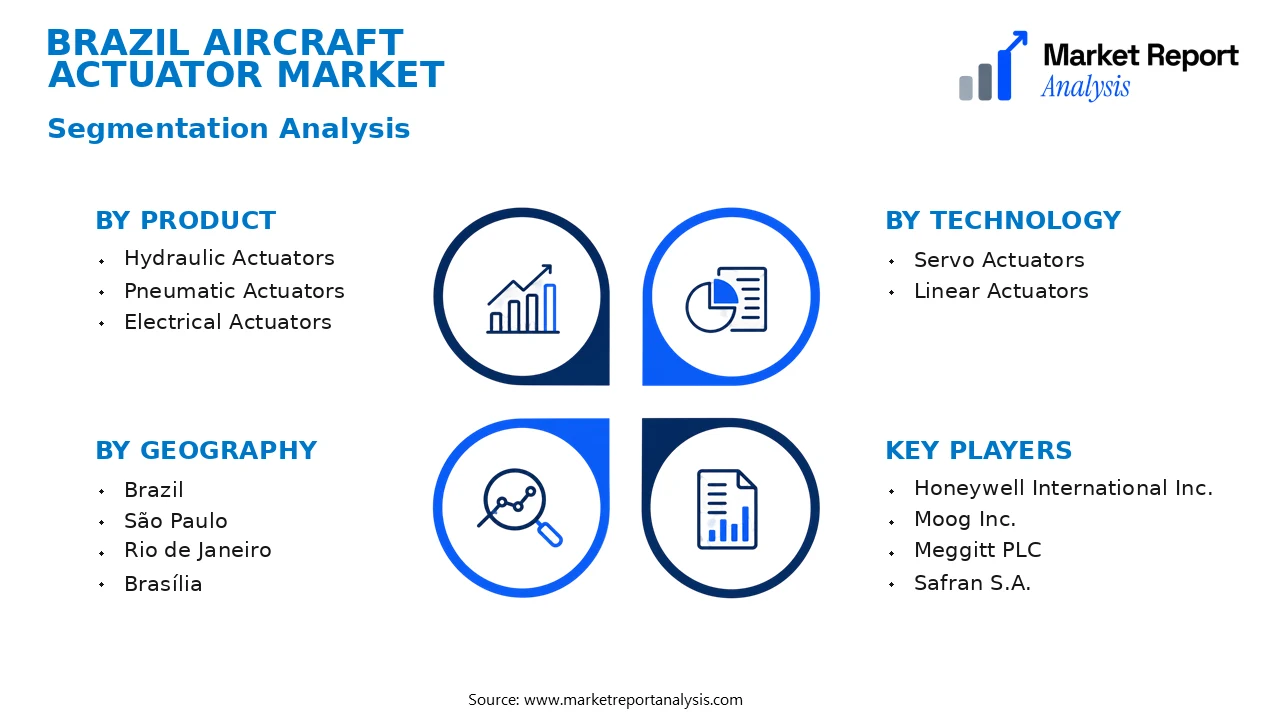
- Product
- Hydraulic Actuators: Hydraulic actuators are widely used in commercial and military aircraft for their high power-to-size ratio, facilitating control systems that require robust and reliable actuation under demanding conditions, thus driving strong demand.
- Pneumatic Actuators: Pneumatic actuators operate using compressed air and are preferred for their lightweight and fast response in aircraft systems, mainly in smaller or auxiliary components requiring quick actuation.
- Electrical Actuators: Electrical actuators are increasingly adopted for their precision, energy efficiency, and ease of integration with modern aircraft electronic systems, promising substantial growth prospects driven by technological advances.
- Technology
- Servo Actuators: Servo actuators offer high precision control and are increasingly incorporated into sophisticated flight control systems, influencing the market through demand for advanced avionics and automated systems.
- Linear Actuators: Linear actuators are used for controlling flight surfaces and other linear movements within aircraft, with growth driven by new aircraft models requiring efficient, reliable actuation solutions.
- Application
- Flight Control: Actuators designed for flight control surfaces are crucial for aircraft maneuverability, constituting the largest application segment with sustained growth driven by both commercial and defense aircraft markets.
- Landing Gear: Actuators in landing gear systems are vital for safety and operational efficiency. The expansion of aircraft fleets accelerates demand in this segment, especially in new aircraft models.
- Environmental Control: These actuators help regulate cabin pressure, temperature, and air quality, with increasing integration in newer aircraft emphasizing environmental sustainability and energy efficiency.
- End User
- Commercial Aircraft: As Brazil’s commercial aviation sector continues to expand, the demand for advanced actuators in new passenger aircraft boosts the market for high-performance components.
- Military Aircraft: Military aircraft require highly reliable and durable actuators capable of performing under extreme conditions, representing a significant share of total market demand.
- Private and Business Jets: Growth in private aviation within Brazil fuels demand for lightweight, efficient actuators suitable for smaller, luxury aircraft in this segment.
- Geography
- Brazil: As the primary geographic focus, Brazil offers a dynamic market driven by its expanding aerospace industry, with major manufacturing hubs and a rising fleet of both commercial and military aircraft.
- São Paulo: São Paulo hosts key aerospace manufacturing and maintenance facilities, with a high concentration of aircraft operators, making it a crucial regional hub for actuator demand and innovation.
- Rio de Janeiro: Rio de Janeiro serves as a significant center for aerospace research and development activities, contributing to local demand for innovative actuator technologies.
- Brasília: The capital region’s government and military presence supports demand for specialized and military-grade actuators, bolstering the overall market within the federal jurisdiction.
Competitive Intelligence
The Brazil Aircraft Actuator Market is characterized by moderate competition with a blend of global aerospace giants and specialized local manufacturers. Market concentration remains relatively focused, with leading firms like Honeywell, Safran, and Boeing controlling significant market shares through strategic partnerships and technological advancements. Business strategies predominantly revolve around innovation, with companies investing heavily in R&D to develop lightweight, energy-efficient actuators that meet stringent safety standards. Recent trends include forming alliances with local aerospace companies to penetrate Brazilian military and commercial sectors, alongside acquisitions aimed at expanding regional influence.
Product innovation emphasizes integration of smart actuator systems featuring sensors and diagnostics for predictive maintenance, enhancing aircraft safety and operational efficiency. Expansion strategies involve establishing manufacturing facilities within Brazil's aerospace hubs such as São José dos Campos and São José do Rio Preto to harness local talent and reduce logistics costs. Notably, several firms prioritize R&D in Brazil to tailor products to domestic aircraft models and meet local regulatory requirements, establishing competitive differentiation rooted in customization, reliability, and cost-effectiveness. This landscape fosters a dynamic environment encouraging technological leadership and targeted market growth.
Leading Company Profiles
The competitive landscape comprises a blend of multinational aerospace corporations and specialized actuator manufacturers, each bringing innovative solutions tailored for the evolving needs of the Brazil aircraft industry. This diverse group leverages advanced technological capabilities, extensive R&D investment, and strategic collaborations to maintain competitiveness and penetrate the expanding market.
- Honeywell International Inc.
- Moog Inc.
- Meggitt PLC
- Safran S.A.
- UTC Aerospace Systems
- Thales Group
- Alypsi Aerospace
- Diehl Aerospace
- Curtiss-Wright Corporation
Honeywell International Inc.
Honeywell offers advanced actuation systems with a focus on lightweight, energy-efficient solutions, targeting commercial and military aircraft. Its strategic priorities include integrating digital health monitoring and reduction of maintenance costs, fostering long-term partnerships in Brazil.
Moog Inc.
Moog specializes in rugged, high-performance aerospace actuators, serving aircraft control systems globally. The company emphasizes innovative design and customization, making it a key player in Brazilian military and commercial aircraft markets.
Meggitt PLC
Meggitt develops durable and precise hydraulic and electromechanical actuators, with key applications in flight control and landing systems. The firm is investing heavily in lightweight materials and automation technologies for local manufacturing.
Safran S.A.
Safran's aerospace division produces a broad array of aircraft actuators with a focus on reliability and efficiency. The company is pursuing strategic alliances in Brazil for local assembly and servicing capabilities, aiming to capitalize on growing regional demand.
UTC Aerospace Systems
UTC offers comprehensive actuator solutions emphasizing digital integration, predictive maintenance, and operational telematics. Its ongoing projects include expanding manufacturing capacity and establishing joint ventures within Brazil.
Thales Group
Thales delivers innovative actuator systems integrated with avionics for commercial and military aircraft, emphasizing cybersecurity and data-driven maintenance solutions aligned with Brazil’s defense modernization efforts.
Alypsi Aerospace
Alypsi specializes in electromechanical actuators for both commercial and regional aircraft, focusing on lightweight design and environmental sustainability. The company prioritizes strategic collaborations with local OEMs to expand its footprint.
Diehl Aerospace
Diehl manufactures advanced actuation solutions primarily for cockpit automation, with an emphasis on high reliability and ease of integration. It is actively expanding its regional presence to service Brazil’s evolving aerospace market.
Curtiss-Wright Corporation
Curtiss-Wright provides innovative actuation and control solutions with a focus on defense and space applications, emphasizing technological innovation and digital transformation initiatives tailored to Brazil's aerospace sector.
Strategic Business Developments

- August 2026 – Honeywell – Launch of next-generation electro-mechanical actuators – Enhances product performance and reliability for regional aircraft operators in Brazil, strengthening Honeywell’s local market position.
- May 2027 – Moog Inc. – Capacity expansion at Brazilian manufacturing facility – Supports increased regional demand, reduces lead times, and lowers logistical costs for aerospace clients.
- October 2026 – Safran – Partnership with local OEMs for actuator assembly – Facilitates technology transfer and boosts employment, aligning with Brazil’s aerospace manufacturing growth strategies.
- April 2028 – Meggitt – Investment in new R&D center – Focuses on lightweight, high-efficiency actuators, responding to environmental regulations and airline efficiency initiatives.
- January 2027 – Thales Group – Establishes joint venture for local actuator production – Improves supply chain robustness and supports Brazil’s defense modernization plans, securing strategic market share.
Frequently Asked Questions
What is the Brazil Aircraft Actuator Market?
The Brazil Aircraft Actuator Market encompasses the manufacturing and sale of aircraft actuators used in commercial and military aircraft within Brazil. It involves components that control various flight systems, ensuring safety, operational efficiency, and aeronautical advancements domestically and for export.
What is the current market size of Brazil Aircraft Actuator Market?
As of 2026, the Brazil Aircraft Actuator Market was valued at approximately USD 4.2 Billion, reflecting Brazil's growing aerospace sector, increasing aircraft fleet, and modernization initiatives, driven by regional and global aerospace demand.
What factors are driving the Brazil Aircraft Actuator Market?
The market growth is primarily fueled by increasing commercial and military aircraft production, technological innovations in actuator design, Brazil’s expanding defense sector, and domestic aircraft manufacturing collaborations, alongside rising aircraft maintenance and upgrade activities across the region.
Which region dominates the Brazil Aircraft Actuator Market?
Within Brazil, the Southeastern region dominates the aircraft actuator market due to its concentration of key aerospace manufacturing facilities, research centers, and demand from both commercial and military aircraft sectors, fostering high regional market activity.
Which segment is expected to grow the fastest?
The hydraulic actuator segment is anticipated to exhibit the fastest growth owing to its widespread application in modern aircraft for primary flight controls, coupled with advancements in hydraulic technology despite the rising use of electrical actuators.
Who are the leading companies operating in the Brazil Aircraft Actuator Market?
Leading companies include Embraer, Honeywell, Safran, and Moog, which are key players providing advanced aircraft actuators and maintaining significant market shares through innovation, strategic collaborations, and local manufacturing facilities within Brazil.
Analyst Perspective
The Brazil Aircraft Actuator Market exhibits a mature landscape with steady growth driven by increasing modernization efforts in the domestic aviation sector. In the long term, the market is poised for resilience, supported by Brazil’s expanding fleet and potential upgrades to legacy aircraft. Commercial opportunities remain prominent in retrofit and maintenance services, particularly for hydraulic and electromechanical actuators suited to both regional and large aircraft, offering lucrative aftermarket margins. Technology evolution is increasingly focused on lightweight, highly reliable, and energy-efficient actuators, which align with global aerospace innovations and Brazil’s cost-efficiency priorities. Investors should prioritize high-growth regional hubs such as São Paulo and Rio de Janeiro, where aerospace OEMs and MRO facilities are concentrated. Competitive intensity is expected to grow as international players penetrate the market and local firms expand capabilities. Regional growth potential is particularly significant in expanding civil aviation and defense sectors, with strategic positioning around modern manufacturing clusters, innovation hubs, and government incentives shaping long-term strategic investments.
