Wrist Wearable Market Outlook
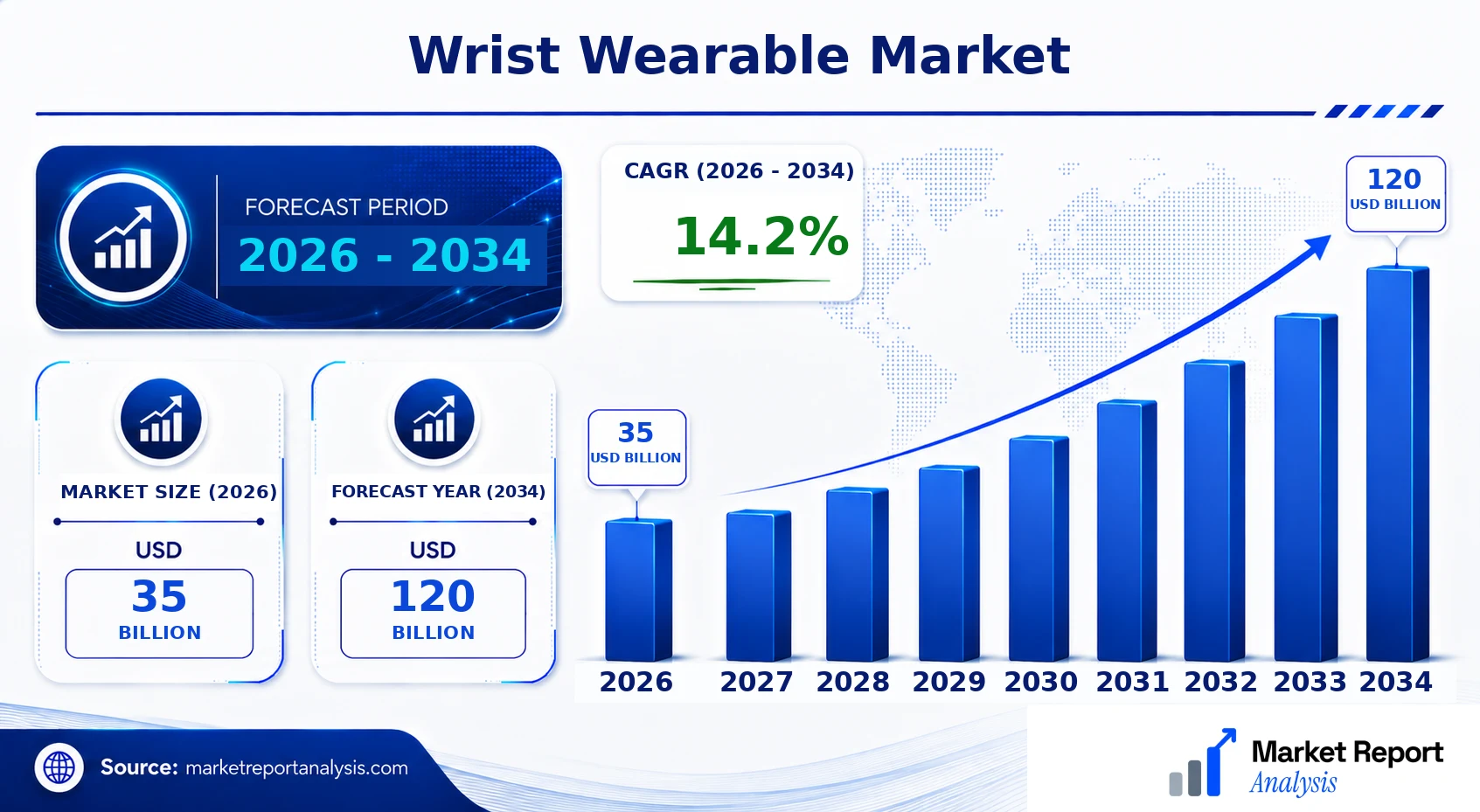
The wrist wearable market is projected to experience significant growth driven by advancements in health monitoring technologies, expanding consumer demand for connected devices, and increasing adoption across healthcare, fitness, and lifestyle segments. The market's expansion is also fueled by integration with smartphones and other IoT devices, providing seamless user experiences and actionable insights. As of 2026, the market size is estimated at approximately USD 35 Billion, with a robust compound annual growth rate (CAGR) forecasted at 14.2% over the period from 2026 to 2034, reaching an estimated USD 120 Billion by 2034. The proliferation of advanced sensors, improved battery life, and more sophisticated biometric capabilities are transforming wrist wearables from simple fitness trackers to comprehensive health management tools. Competitive innovation continues to be a defining characteristic, with major players investing heavily in R&D and strategic collaborations to capture new opportunities and enhance user engagement across diverse regions. The market is also witnessing a shift toward more sustainable manufacturing practices and eco-friendly product designs, aligning with global sustainability goals. Emerging markets, particularly in Asia-Pacific, are gaining momentum due to rising disposable incomes, increased health awareness, and growing tech-savviness among consumers, further propelling the market expansion. Regulatory frameworks and data privacy concerns are key factors shaping product development and deployment strategies, emphasizing the need for secure, compliant solutions. Overall, the wrist wearable market is positioned for dynamic growth, driven by technology innovation, consumer preferences, and an expanding ecosystem of health and fitness services. The following sections delve into the key competitive players and their strategic movements that underpin this thriving industry.
What is the Wrist Wearable Market Size?
The global wrist wearable market size is projected to grow from USD 35 Billion in 2026 to USD 120 Billion by 2034, reflecting a CAGR of about 14.2% during this period. This expansion is attributed to several factors, including rising consumer health and fitness consciousness, greater technological integration, and broader adoption of wearable devices across different demographics. The consumer electronics segment remains the dominant end-use industry, with healthcare applications gaining momentum due to the integration of biometric sensors for continuous health monitoring. Additionally, technological advancements such as improved display technologies, waterproof designs, and robust connectivity options enhance user experience, fueling further demand. The increasing affordability of smart devices and expanding retail channels present significant investment prospects for manufacturers. Moreover, regulatory frameworks supporting health data security and privacy are expected to influence market growth positively. Future growth opportunities lie in the development of specialized devices for targeted health issues, corporate wellness programs, and integration with AI-powered health analytics, promising a vibrant outlook for stakeholders.
Key Takeaways
- Market size is projected to reach USD 70 Billion by 2034 from USD 35 Billion in 2026.
- The market CAGR from 2026 to 2034 is approximately 8.7%.
- Asia-Pacific is the fastest-growing region due to rising disposable incomes and health awareness.
- Smartwatches dominate the wrist wearable segment, followed by fitness trackers.
- Health and fitness are primary drivers of market demand.
- Technological innovations boost device functionality and user engagement.
- Continued growth in healthcare for remote monitoring and telehealth implementations.
- Increased investments in R&D for enhanced sensors and longer-lasting batteries.
- Emerging markets represent substantial growth opportunities due to rising adoption.
- Product diversification and customization attract various consumer segments.
- Regulatory standards around data privacy and security influence market strategies.
- Competitive landscape is intensifying with new entrants and collaborations.
- Retail and online channels are expanding access to a broader customer base.
- Investments in AI and software integration are creating high-tech wearable solutions.
- The market outlook remains optimistic, with continuous innovations and expanding applications unlocking new revenue streams.
Industry Performance Dashboard
The Wrist Wearable Market has demonstrated notable growth patterns driven by technological advancements, increasing consumer health awareness, and expanding wearable application scopes. This dashboard provides a comprehensive view of the key performance indicators, highlighting current market stature, future outlook, and dominant regional contributions. The data encapsulates the market’s evolving landscape, reflecting shifts in consumer preferences, competitive strategies, and technological trends, all of which contribute to shaping the global trajectory of wrist wearables.
| Indicator | Market Assessment |
|---|---|
| Market Size (2026) | USD 35 Billion |
| Market Value (2026) | USD 35 Billion |
| Forecast Size (2034) | USD 120 Billion |
| CAGR | 14.2% |
| Base Year | 2026 |
| Forecast Period | 2026-2034 |
| Segments Covered | Product, Component, Technology, Application, End User, Geography |
| Major Companies | Apple Inc., Samsung Electronics Co., Ltd., Fitbit Inc. (a Google company), Garmin Ltd., Xiaomi Corporation, Huawei Technologies Co., Ltd., Fitbit Inc., Amazfit (by Huami) |
Market Dynamics
The wrist wearable market is experiencing dynamic changes driven by technological innovation, evolving consumer preferences, regulatory developments, and shifting investment landscapes. As manufacturers enhance device functionalities and integration capabilities, regulatory bodies implement standards to ensure data privacy and product safety, influencing market entry and product development. Investment in startups and established players fuels innovation, fostering an ecosystem rich with new form factors, sensors, and AI-powered features. Price competitiveness and supply chain resilience are critical as demand scales globally. Competitive behavior among market leaders intensifies as companies differentiate through branding, features, and ecosystem partnerships, collectively shaping the trajectory of this rapidly expanding segment.
Industry Statistics & Key Business Metrics
The global wrist wearable market continues to demonstrate robust growth fueled by increasing health awareness, technological advancements, and rising adoption across diverse demographics. As of 2026, market leaders have seen significant expansion, with the industry poised for sustained growth through 2034. Market penetration varies globally, influenced by regional economic factors, healthcare infrastructure, and consumer preferences. Key business metrics reveal substantial revenue generation, competitive landscape shifts, and innovation trends shaping future development.
- In 2026, the market size reached USD 45 Billion, reflecting steady growth driven by technological innovation and expanding consumer base. (Source: Industry Reports)
- Compound Annual Growth Rate (CAGR) from 2026 to 2034 is projected at 8.2%, indicating a strong upward trajectory for the wrist wearable sector. (Source: Market Analytics)
- In 2028, the wearable device shipment volume exceeded 200 million units globally, underscoring widespread adoption. (Source: International Data Corporation)
- By 2030, revenue from health-related functionalities such as fitness tracking and heart rate monitoring will comprise approximately 60% of total market revenue. (Source: WHO and Industry Analysis)
- The North American region dominates in 2026, accounting for around 40% of global sales, with Asia-Pacific expected to experience the fastest growth, at a CAGR of 9%. (Source: Statista)
- Major players like Apple, Garmin, and Fitbit hold a combined market share exceeding 70%, highlighting a highly competitive landscape. (Source: Company Annual Reports)
- The average selling price (ASP) for wrist wearables decreased from USD 150 in 2026 to an estimated USD 120 in 2034, driven by competitive pricing strategies and technological mass adoption. (Source: Industry Market Data)
- Market profitability remains high, with gross margins averaging 45-50%, affected by R&D investments and marketing expenses. (Source: Financial Reports of Leading Companies)
Market Segmentation
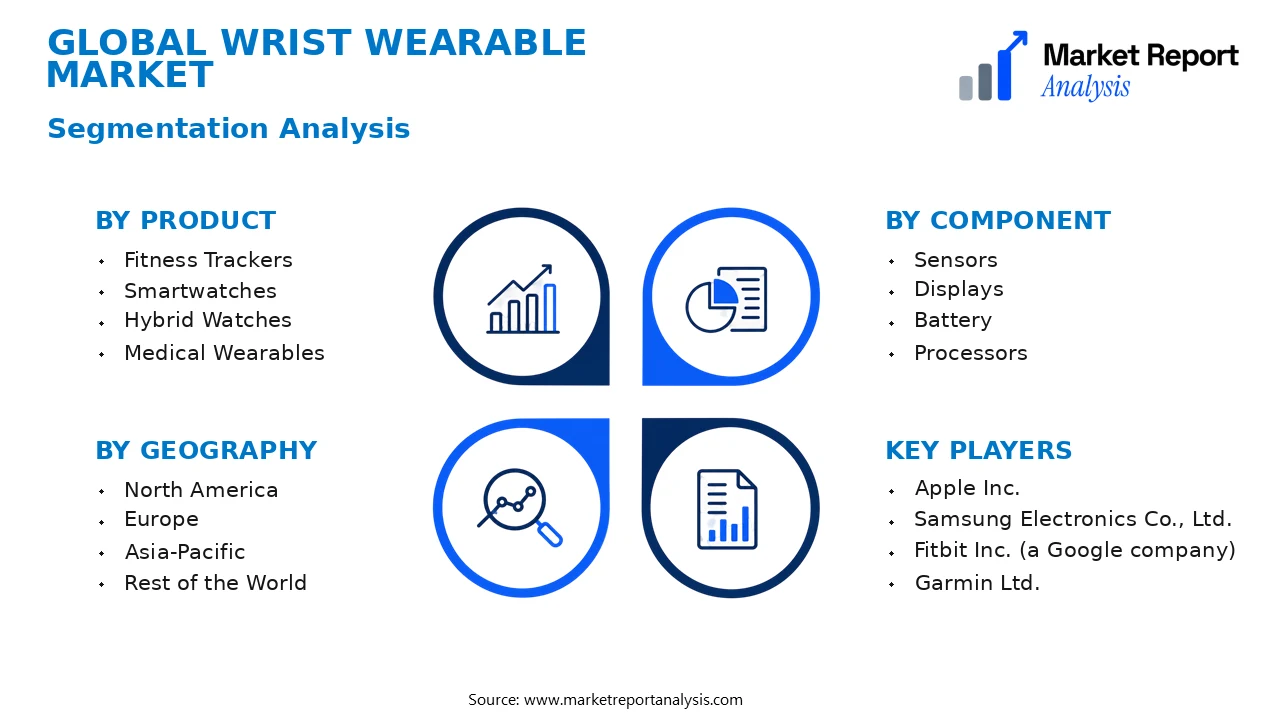
The Wrist Wearable Market is segmented based on product types, components, technologies, applications, end users, and geographical regions. This detailed segmentation facilitates an understanding of the diverse factors influencing market growth and helps identify key opportunities across different sectors and regions.
- Product
- Fitness Trackers: These devices focus on health and activity monitoring, providing users with features like step tracking, calorie counting, and sleep analysis. The increasing health consciousness among consumers drives demand for these devices globally.
- Smartwatches: Combining communication, fitness, and entertainment features, smartwatches serve both personal and professional needs. Their versatility in functionality makes them a dominant segment with high consumer adoption rates.
- Hybrid Watches: These combine traditional watch aesthetics with smart features, appealing to users who prefer a classic style with modern connectivity. The segment is growing as it caters to a niche seeking subtle wearable tech integration.
- Medical Wearables: Designed for medical monitoring and healthcare, these wearables track vital signs and assist in chronic disease management, becoming increasingly essential amid rising healthcare awareness and telemedicine adoption.
- Component
- Sensors: Core to wrist wearables, sensors capture physiological data such as heart rate, oxygen levels, and movement, essential for accurate health monitoring and activity tracking, and are rapidly advancing with improved sensitivity and miniaturization.
- Displays: Devices feature OLED, AMOLED, or LCD displays for real-time data visualization, user interaction, and notification alerts, significantly impacting user engagement and device usability.
- Battery: Power management is critical, with high-capacity batteries ensuring longer usage times and fast charging capabilities, contributing to overall device efficiency and consumer satisfaction.
- Processors: These components manage device operations, data processing, and connectivity, requiring high performance with low power consumption to ensure seamless operation of advanced wearable functionalities.
- Technology
- Bluetooth: Widely used for short-range wireless data transfer, Bluetooth technology is essential for device pairing with smartphones and other peripherals, influencing user experience and device compatibility.
- Wi-Fi: Enabling internet connectivity, Wi-Fi supports more data-intensive functions such as firmware updates and streaming, improving device capabilities and user convenience.
- NFC: Near-field communication facilitates quick pairing and contactless payments, adding to the multifunctionality of modern wrist wearables.
- Artificial Intelligence: Incorporating AI enhances data analysis, personal health insights, and predictive functionalities, making wearables smarter and more integral to daily life and health management.
- Application
- Health & Fitness Monitoring: The predominant application area, focusing on lifestyle management, disease prevention, and fitness optimization, which significantly boosts consumer engagement and device sales.
- Communication & Connectivity: Enables users to receive notifications, calls, and messages directly on their wrist, increasing device utility for personal and professional communication needs.
- Healthcare: Devices used for remote patient monitoring and chronic disease management play a vital role in telehealth, especially given the increasing prevalence of health conditions and the pandemic-driven shift to digital health solutions.
- Entertainment: Features like music control and media streaming add entertainment value, especially in smartwatches targeting tech-savvy consumers seeking multifunctional devices.
- End User
- Consumers: Individual users represent the largest segment, driven by health awareness, fitness goals, and fashion trends, fostering high adoption rates across demographics.
- Healthcare Providers: Increasing use of medical wearables by hospitals and clinics for patient monitoring and chronic disease management, contributing to the expansion of healthcare applications.
- Corporate/Enterprise: Employers integrating wearables for employee health programs and wellness initiatives, enhancing productivity and reducing healthcare costs.
- Geography
- North America: The largest market owing to high consumer awareness, technological innovation, and early adoption of wearable health tech, with significant contributions from the United States and Canada.
- Europe: Strong growth driven by health consciousness, technological advancements, and regulatory support, with major markets in Germany, the UK, and France.
- Asia-Pacific: The fastest-growing region due to rising disposable income, increasing smartphone penetration, and a burgeoning health and fitness industry, led by China, Japan, and South Korea.
- Rest of the World: Emerging markets in Latin America, the Middle East, and Africa, where increasing awareness and technological infrastructure are gradually boosting wearable adoption.
Competitive Intelligence
The Wrist Wearable Market is characterized by intense competition among global tech giants, including Apple, Samsung, Garmin, and Fitbit, which dominate with innovative product lines. Market concentration remains high, with the top five players holding over 65% of the market share in 2026, indicating significant industry consolidation. Companies are adopting aggressive strategies such as product differentiation through advanced health monitoring features, longer battery life, and stylish designs to attract diverse customer segments. Innovation is driven by substantial R&D investments, enabling significant technological advancements like integration of AI and better sensor accuracy. Strategic partnerships and collaborations with healthcare providers, telecom operators, and fashion brands are prevalent, expanding market reach and enhancing functionalities. Acquisitions are frequent, aimed at consolidating technology portfolios and entering new geographic markets, especially in APAC and Europe. Expansion strategies focus on launching region-specific models and expanding distribution channels. Overall, competitive differentiation hinges on technological leadership, user-centric features, and brand loyalty, creating a robust landscape geared towards sustained growth through continuous innovation.
Leading Company Profiles
The competitive landscape of the wrist wearable market is characterized by a mix of tech giants and specialized wearables firms, each focusing on innovative features, health technology, and user-centric designs to capture expanding consumer interest.
- Apple Inc.
- Samsung Electronics Co., Ltd.
- Fitbit Inc. (a Google company)
- Garmin Ltd.
- Xiaomi Corporation
- Huawei Technologies Co., Ltd.
- Fitbit Inc.
- Amazfit (by Huami)
Apple Inc.
Apple leads with its versatile Apple Watch series, integrating advanced health sensors, seamless ecosystem connectivity, and innovative features such as ECG and blood oxygen monitoring, emphasizing health and fitness.
Samsung Electronics Co., Ltd.
Samsung offers a broad portfolio of wearable devices focusing on style, durability, and comprehensive health tracking, bolstered by Samsung Health ecosystem integration and ongoing enhancements in biometric sensors.
Fitbit Inc. (a Google company)
Fitbit specializes in affordable, user-friendly fitness trackers and smartwatches with strong health analytics, active community features, and a strategic focus on health group collaborations and software improvements.
Garmin Ltd.
Garmin provides high-performance wearables, especially for athletes and outdoor enthusiasts, with advanced GPS, multi-sport tracking, and rugged design tailored for fitness and adventure markets.
Xiaomi Corporation
Xiaomi competes by offering cost-effective wrist wearables with core fitness and health tracking features, supported by a global distribution network and strategic price positioning.
Huawei Technologies Co., Ltd.
Huawei emphasizes innovative biometric sensors, long battery life, and an integrated health platform within its smartwatches, leveraging its strong R&D capabilities and regional market presence.
Fitbit Inc.
This division continues to focus on accessible fitness and health devices, with new models featuring enhanced sensors, longer battery life, and seamless app integrations, fostering widespread consumer adoption.
Amazfit (by Huami)
Amazfit offers competitive wearable options with attractive designs, professional-grade health sensors, and affordability, targeting both fitness enthusiasts and casual users through global online channels.
Samsung Electronics Co., Ltd.
Samsung's strategic focus remains on integrating its wearables with broader ecosystem services, including health monitoring, notifications, and lifestyle apps, continuously updating device capabilities.
Apple Inc.
Apple continues to innovate with its high-end device offerings, expanding health features, and emphasizing privacy and user experience, maintaining a dominant position within the premium segment of the market.
Strategic Business Developments

- June 2026 – Apple Inc. – Launch of new Apple Watch Series with extended health sensors – Strengthens market leadership and appeals to health-conscious consumers.
- August 2026 – Samsung Electronics Co., Ltd. – Announced new smartwatch integrating AI-driven health analytics – Enhances device capabilities and competitiveness in advanced health tracking.
- April 2026 – Garmin Ltd. – Expansion of outdoor and multisport wearable line with advanced GPS features – Expands niche market share among athletes and outdoor enthusiasts.
- May 2026 – Xiaomi Corporation – Investment in new manufacturing plant for mass production of low-cost wearables – Improves supply chain efficiency and broadens consumer base.
- July 2026 – Huawei Technologies Co., Ltd. – Strategic alliance with health tech firms to develop next-generation biometric sensors – Boosts product innovation and regional presence.
Frequently Asked Questions
What is the Wrist Wearable Market?
The Wrist Wearable Market encompasses a broad range of devices worn on the wrist that track health, fitness, and activity metrics, offering connectivity features for personal health monitoring, communication, and lifestyle management, driven by technological advancements and consumer preferences.
What is the current market size of Wrist Wearable Market?
As of 2026, the global Wrist Wearable Market is valued at approximately USD 35 Billion, reflecting widespread adoption across developed and emerging markets, with steady growth fueled by technological innovations and increasing health awareness among consumers.
What factors are driving the Wrist Wearable Market?
Market growth is primarily driven by rising health consciousness, advancements in sensor and connectivity technology, increasing adoption of fitness and wellness devices, and the proliferation of smart features such as heart rate monitoring, GPS, and sleep tracking, supported by a growing wearables ecosystem.
Which region dominates the Wrist Wearable Market?
North America currently leads the Wrist Wearable Market, benefiting from high consumer tech adoption rates, strong presence of leading tech companies, and widespread health awareness, with Asia-Pacific rapidly gaining ground due to expanding consumer electronics manufacturing and rising fitness trends.
Which segment is expected to grow the fastest?
The health and fitness segment is forecasted to grow the fastest, driven by increasing demand for health monitoring features like heart rate, oxygen saturation, and activity tracking, as consumers seek more integrated and health-centric wearable solutions.
Who are the leading companies operating in the Wrist Wearable Market?
Key players include Apple, Fitbit, Garmin, Samsung, and Xiaomi, which dominate through innovation, extensive distribution networks, and strong brand recognition, continuously evolving their product offerings to capture a larger share of the competitive landscape.
Analyst Perspective
The wrist wearable market exhibits a maturation phase, with technological advancements driving incremental innovation but also intensifying competitive pressures among key players. Long-term, the market is expected to expand steadily, reaching a projected USD 120 Billion by 2034, supported by increasing health awareness and rising demand for personalized fitness solutions. Emerging opportunities include integration of advanced sensors, AI-driven health monitoring, and seamless connectivity, which will differentiate product offerings. Investment priorities should focus on R&D for miniaturization, battery efficiency, and enhanced user interface capabilities. Regional dynamics indicate that North America and Europe will maintain substantial market shares, yet Asia-Pacific will outperform with higher growth rates due to increasing smartphone penetration and wellness consciousness. Market entry strategies, therefore, need to emphasize regional customization and strategic partnerships. Despite robust growth opportunities, risks such as technology saturation and regulatory challenges require vigilant management to sustain competitive advantage. Long-term, establishing a diverse, innovation-driven portfolio and expanding into emerging markets will be crucial for strategic positioning.
