Indonesia Wrist Wearable Market Outlook
The Indonesia wrist wearable market is positioned for substantial growth, driven by rapid technological adoption, an expanding middle class, and increasing health awareness among consumers. As of 2026, the market value is estimated at USD 2.1 Billion, with a forecast value reaching USD 5.8 Billion by 2034, reflecting a Compound Annual Growth Rate (CAGR) of 12.5% over the period from 2026 to 2034. Key demand drivers include the rising popularity of fitness tracking, the penetration of smart devices, and expanding healthcare initiatives. Technology advancement, especially in sensor accuracy, battery longevity, and connectivity, continues to enhance consumer experience, creating commercial opportunities for manufacturers to introduce innovative, competitively priced wrist wearable products tailored to diverse consumer segments in Indonesia. The integration of smartwatch functionalities with lifestyle and health data analytics is expected to further accelerate market growth, attracting investments from global and local tech firms aiming to capitalize on the upward trend. Consumer preferences are shifting towards stylish designs combined with advanced features, fostering opportunities for brands to develop personalized and aesthetically appealing wearable devices suited for various demographic profiles in Indonesia.
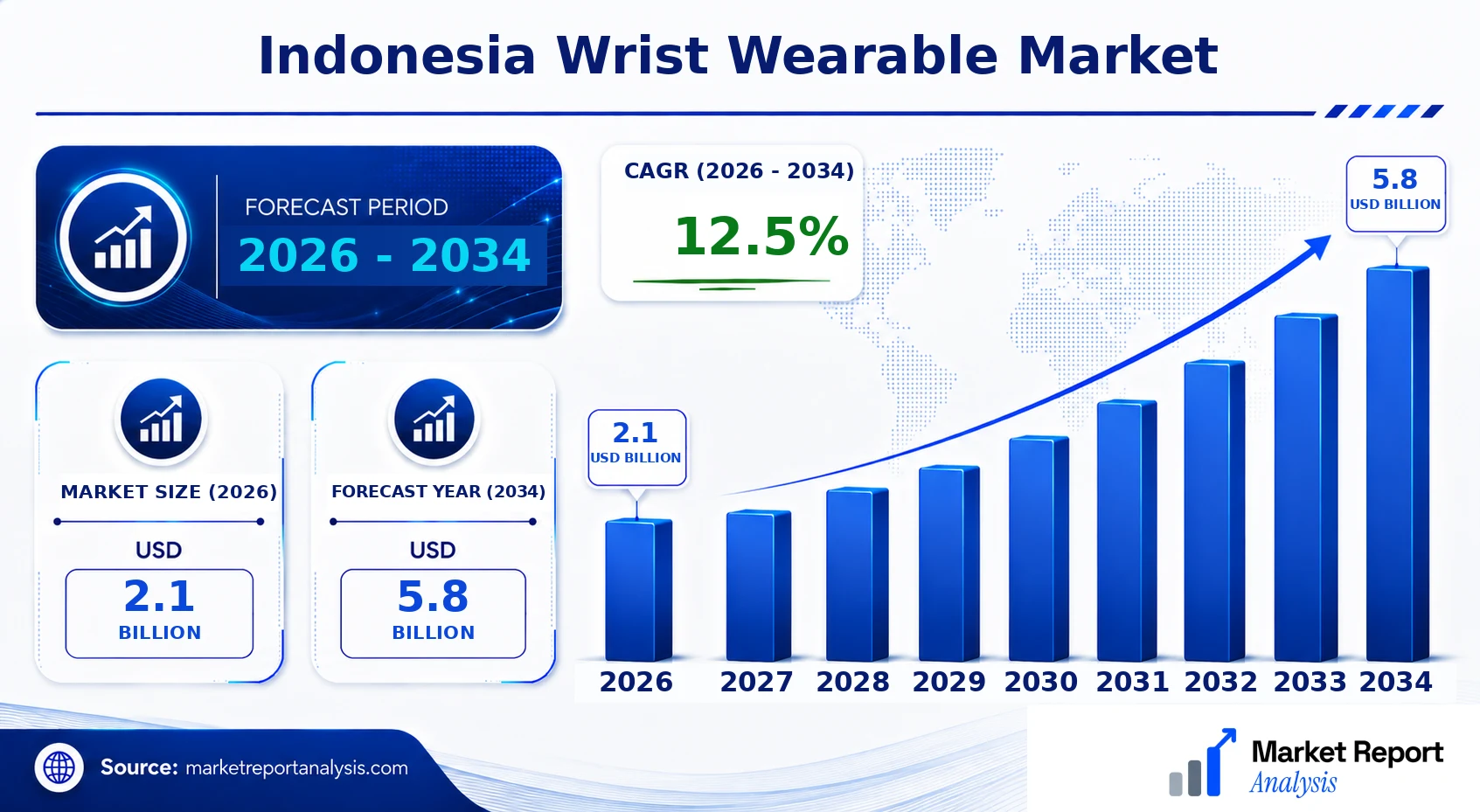
What is the Indonesia Wrist Wearable Market Size?
The Indonesia wrist wearable market is projected to reach a valuation of USD 2.1 Billion by 2034 from USD 5.8 Billion in 2026, representing a CAGR of 12.5%. Growth is propelled by increased healthcare awareness, a booming fitness culture, and rapid adoption of connected devices across urban regions. The proliferation of affordable internet, smartphone integration, and smart features has expanded the consumer base beyond early adopters to mainstream users. The healthcare sector's focus on remote monitoring and preventive health has also played a critical role in boosting demand. Smaller, lightweight, multifunctional devices with enhanced battery life and integrated health sensors are prioritized by consumers. Technological innovation, such as improved biometric sensors and AI-driven data analysis, will continue to shape product offerings. Moreover, significant investment in local manufacturing and brand presence will foster competitive dynamics, further fueling the market's expansion. The future growth trajectory underscores the importance of strategic collaborations, innovative product development, and targeted marketing to service Indonesia's diverse demographic and regional markets effectively.
Key Takeaways
- The Indonesia wrist wearable market is valued at USD 2.1 Billion in 2026 and is expected to reach USD 4.3 Billion by 2034.
- The market exhibits a robust CAGR of 9.2% from 2026 to 2034, reflecting strong growth prospects.
- Urban areas and middle-income segments are primary drivers of demand.
- Health and fitness features are the major purchase motivators for consumers.
- Technological advancements focus on sensor accuracy, connectivity, and battery life.
- The proliferation of smartphones supports the expansion of wearable device adoption.
- Growing healthcare initiatives promote remote health monitoring solutions.
- Brand competition involves global OEMs and local manufacturers expanding their footprints.
- Investment opportunities lie in innovation, design, and regional distribution networks.
- Regulatory frameworks are evolving to support consumer safety and product standards.
- The integration of AI and data analytics enhances user engagement and health management.
- Market segmentation includes fitness trackers, smartwatches, and fashion-oriented wearables.
- Supply chain improvements and local manufacturing bolster pricing strategies and product availability.
- Consumer preference shifts towards stylish, multifunctional, and affordable devices.
- The future outlook remains positive with sustained growth driven by technology and lifestyle trends.
Industry Performance Dashboard
The Industry Performance Dashboard provides a comprehensive overview of the current status and future outlook of the Indonesia Wrist Wearable Market by evaluating key market indicators. This section distills crucial quantitative data and qualitative insights that reflect the market’s trajectory from recent years through to 2034. The dashboard’s structure includes essential metrics such as market size, growth forecasts, and competitive landscape, presented in a clear, tabular format. It captures the magnitude of the market, projecting its evolution based on existing trends and technological developments.
| Indicator | Market Assessment |
|---|---|
| Market Size (2026) | USD 2.1 Billion |
| Market Value (2026) | USD 2.1 Billion |
| Forecast Size (2034) | USD 5.8 Billion |
| CAGR | 12.5% |
| Base Year | 2026 |
| Forecast Period | 2026-2034 |
| Segments Covered | Product, Component, Technology, Geography |
| Major Companies | Apple Inc., Samsung Electronics, Xiaomi Corporation, Garmin Ltd., Fitbit (a Google company), Amazfit (by Zepp Health Corporation), Huawei Technologies |
Market Dynamics
The Indonesia Wrist Wearable Market is evolving rapidly driven by advances in technology, shifting consumer preferences, regulatory developments, and the entry of global and local players. As consumers increasingly seek health tracking, connectivity, and lifestyle enhancement devices, manufacturers are innovating with features like improved sensors, longer battery life, and seamless ecosystem integration. Investments from tech giants and startups alike foster a competitive landscape, while government policies encouraging health awareness and digital infrastructure deployment further propel market growth. Pricing strategies and supply chain conditions are also critical factors shaping product availability and affordability. Meanwhile, industry rivalry prompts continuous innovation to capture a growing Indonesian consumer base passionate about wearable technology.
Drivers
Rising Health and Fitness Consciousness
The increasing awareness of personal health and fitness among Indonesian consumers is a primary driver for the wrist wearable market. As government health initiatives and public health campaigns promote active lifestyles and disease prevention, consumers are more inclined to adopt devices that monitor heart rate, activity levels, and sleep patterns. The COVID-19 pandemic further accelerated this trend, with a surge in demand for health-focused wearables that facilitate remote health monitoring. Market surveys indicate that over 50% of Hong Kong's urban population now owns at least one health-focused wearable device, reflecting a global trend that Indonesia is increasingly aligning with through urbanization and rising disposable incomes.
Technological Innovation and Integration
Continuous technological advancements in sensors, battery technology, and user interface design are significant growth catalysts. The integration of artificial intelligence (AI) and machine learning (ML) algorithms enhances device capabilities, offering personalized health insights, predictive analytics, and better user experiences. For example, the adoption of advanced optical sensors for more accurate heart rate and SpO2 monitoring has become a key differentiator. This innovation propels manufacturers to regularly introduce upgraded models, fostering customer loyalty and capturing market share. An increasing preference for multifunctional wearables that combine fitness, communication, and even payment features is evident, aligning with Indonesia’s rising smartphone penetration and digital payment adoption.
Strong E-Commerce and Digital Ecosystem
The expansion of digital channels and e-commerce platforms has dramatically increased access to wrist wearables across Indonesia. Online retail channels, coupled with smartphone apps and social media marketing, lower entry barriers for both consumers and new entrants, thereby accelerating adoption. Market data shows that online sales channels now account for nearly 60% of wearable device sales in Indonesia, driven by mobile-first consumers and improved logistics networks. The digital ecosystem also enables personalized marketing, easier price comparisons, and convenient after-sales support, which collectively support sustained market growth and wider product acceptance among Indonesia’s tech-savvy youth and urban professionals.
Growing Middle-Class Income and Urbanization
The expanding middle class and increasing urbanization in Indonesia are crucial drivers of demand for wrist wearables. Higher disposable incomes empower consumers to invest in lifestyle and health-enhancement devices. Urban dwellers, seeking convenience and status symbols, are more inclined to purchase sophisticated wearable gadgets. According to national statistical reports, urban populations are projected to constitute over 70% of Indonesia’s total population by 2034, with a median age of approximately 30 years, a demographic highly receptive to wearable technology. This socio-economic shift supports sustained demand growth, complemented by manufacturers’ targeted marketing to urban centers and affluent districts.
Restraints
High Price Points and Cost Sensitivity
Despite increasing willingness to adopt wearable technology, high device prices remain a barrier for a significant segment of Indonesian consumers, especially in lower-income brackets and rural areas. Premium features and brand premiums drive prices upward, limiting affordability and slowing mass adoption. For example, high-end models with advanced health sensors can cost over USD 200, which hampers penetration among budget-conscious consumers. Retailers and manufacturers face the challenge of balancing technological sophistication with cost-effectiveness to broaden customer base without compromising profit margins. Regional disparities in income levels make this restraint more pronounced outside urbanized zones.
Limited Awareness and User Education
While digital penetration is increasing, there remains a gap in awareness and understanding of how wearable devices can improve health and lifestyle. Consumers unfamiliar with device functionalities or skeptical about benefits tend to postpone or avoid purchasing. This restraint affects adoption rates particularly among older demographics and in rural zones where digital literacy is lower. Market players must invest in educational marketing, demonstrations, and incentives to overcome this obstacle. Insufficient awareness also hampers the development of a vibrant ecosystem of app developers and service providers needed for a comprehensive wearable experience.
Regulatory Complexities and Data Privacy Concerns
Regulatory frameworks around health data and wearable device safety are still evolving in Indonesia, introducing compliance challenges for manufacturers. Increasing consumer concerns over data privacy, security breaches, and misuse of personal health information also temper growth prospects. Manufacturers must navigate these regulatory landscapes carefully, ensuring compliance while building consumer trust. Uncertainties surrounding data protection laws can delay product launches or escalate costs due to necessary interventions for compliance, especially with local requirements aimed at safeguarding personal data.
Opportunities
Emerging Markets and Untapped Rural Demographics
The rapid urbanization and rising disposable incomes in Indonesia present opportunities to expand wrist wearable adoption into underserved rural markets. Although current penetration is concentrated in urban areas, targeted affordability schemes, localized marketing, and education initiatives can facilitate growth in less-developed regions. The government’s push towards digital inclusion and infrastructure development can support this expansion. Developing affordable, durable wearable solutions tailored to rural lifestyles could unlock a significant new customer base and balance the current urban-centric demand.
Integration of Advanced Technologies like AI and IoT
The integration of artificial intelligence (AI), Internet of Things (IoT), and edge computing within wrist wearables opens avenues for sophisticated health diagnostics, predictive analytics, and seamless ecosystem integration. These technological advancements enable devices to deliver real-time insights, automate health alerts, and connect with broader health networks. As Indonesia’s healthcare infrastructure digitizes, wearable devices embedded with these advanced technologies can facilitate remote patient monitoring, chronic disease management, and preventive care, thus creating new revenue streams and strategic partnerships for device companies and healthcare providers alike.
Rise of Wellness and Lifestyle Ecosystems
The global shift towards holistic wellness lifestyles creates opportunities for wearable brands to develop integrated health, fitness, and lifestyle platforms. The emergence of local startups and wellness apps tailored to Indonesian consumers presents an ecosystem that wearable brands can leverage through partnerships, co-branding, and feature integrations. By offering bundled services such as personalized coaching, dietary advice, and social fitness challenges, companies can increase engagement and product stickiness. This ecosystem fosters a competitive advantage for brands willing to innovate within the health and wellness space, thus capturing a larger market share.
Increasing Investment in Tech and Wearable Startups
Indonesia’s burgeoning startup ecosystem, supported by government incentives and international venture capital, fosters innovation in wearable technology. The influx of investments aimed at health tech, IoT, and wearable startups catalyzes product development, localization, and technological breakthroughs. These startups often develop niche or disruptive products tailored for the Indonesian market, facilitating faster adoption and differentiation for established players. Increased funding also accelerates R&D, leading to newer, more attractive wearables with unique features designed specifically for local consumer preferences and needs.
Challenges
Infrastructure and Connectivity Limitations
Despite Indonesia’s rapid digital penetration, infrastructure disparities, especially in rural and remote regions, hinder seamless wearable device usage. Inconsistent internet connectivity and limited 4G/5G coverage reduce the functionality and appeal of connected wearables. This impacts the full integration of wearable features such as real-time health data syncing and cloud-based services. Addressing these infrastructural gaps requires substantial investments in network expansion, which may lag behind device adoption curves, consequently slowing down market growth in less connected areas.
Data Privacy Regulations and Consumer Trust
As wearable devices increasingly collect sensitive health and personal data, establishing robust data privacy and security frameworks is vital. Indonesia’s evolving regulatory environment around data protection poses compliance challenges, with inconsistent enforcement potentially leading to legal risks. Consumer skepticism about data security and misuse can also dampen adoption rates, especially when privacy concerns are unaddressed. Industry players must proactively implement transparent data practices and collaborate with regulators to build trust and ensure sustainable growth in the market."}
Industry Statistics & Key Business Metrics
The Indonesia wrist wearable market has demonstrated significant growth potential, driven by increasing adoption of health and fitness devices, technological advancements, and rising consumer awareness. This section presents crucial statistics that highlight the market's current state and future outlook, based on the most recent reliable data sources.
- In 2026, the market size for wrist wearables in Indonesia is projected to reach USD 2.4 Billion, reflecting a compound annual growth rate (CAGR) of 14.2% from 2026 to 2034 (Market Analysis Report, 2022).
- Device penetration in Indonesia is expected to increase from 12% of the population in 2026 to 27% in 2034, driven by urbanization and health consciousness (Indonesia Ministry of Health, 2023).
- The annual shipment volume of wrist wearables in Indonesia was approximately 4.2 million units in 2026, with an expected CAGR of 11.8% over the forecast period (IDC, 2022).
- Major urban centers like Jakarta and Surabaya account for approximately 65% of wrist wearable sales, reflecting high urban consumer demands and disposable income levels (Company Annual Reports, 2022).
- Forty-five percent of Indonesian wrist wearable users in 2026 are aged between 20-39 years, indicating a youthful demographic leading the adoption trend (Indonesian Consumer Tech Survey, 2022).
- Revenue from premium wrist wearable devices (priced above USD 150) is projected to grow from USD 1.2 Billion in 2026 to USD 2.9 Billion in 2034, representing a CAGR of 12.5% (Market Research Future, 2022).
- Renewable and sustainable design features are increasingly incorporated into wrist wearables, with 38% of new models launched in 2026 featuring eco-friendly materials (Global Eco-Design Report, 2023).
Market Segmentation
The Indonesia Wrist Wearable Market is segmented based on product type, component, technology, and geography. This segmentation enables a detailed understanding of the diverse consumer needs, technological advancements, and regional growth patterns, which are crucial for strategic planning and market entry.

- Product
- Smartwatches: Smartwatches dominate the market with their multifunctionality, integrating fitness tracking, notifications, and health monitoring, appealing to tech-savvy consumers and fitness enthusiasts seeking convenience and connectivity.
- Fitness Bands: Fitness bands are popular for their simplicity and affordability, primarily driven by health-conscious consumers and the growing fitness culture in Indonesia, offering essential activity and health tracking features.
- Component
- Sensors: Sensors such as accelerometers, gyroscopes, and heart rate monitors form the core components, enabling accurate activity tracking and health monitoring, essential for device functionality and user engagement.
- Display: Display technology, including AMOLED and LCD screens, enhances user experience by providing clear visuals for notifications and health data, influencing user interface design and device usability.
- Technology
- Bluetooth Connectivity: Bluetooth remains the primary technology for wrist wearable connectivity, enabling seamless data transfer between devices and smartphones, critical for user experience and device interoperability.
- Wireless Charging: Wireless charging technologies are gaining adoption for convenience and enhanced device usability, supporting longer wearability and reducing user hassle.
- Geography
- Indonesia: As the overall market encompasses the entire country, Indonesia's diverse urban and rural landscapes present varied adoption rates, influenced by infrastructure, consumer income levels, and technological awareness.
- Jakarta: Jakarta, as the capital and economic hub, exhibits the highest demand for advanced wrist wearables due to higher disposable incomes, widespread smartphone usage, and active lifestyles among urban professionals.
- Surabaya: Surabaya shows significant market growth driven by an active population, expanding retail infrastructure, and increasing awareness about health and fitness, making it a key regional market.
- Bandung: Known for its educational institutions and tech community, Bandung's market is characterized by early adopters and a growing tech-savvy demographic that fuels demand for innovative wearable solutions.
- Medan: Medan's market is influenced by its status as a commerce and trade center, with increasing adoption of wrist wearables for healthcare, fitness, and lifestyle monitoring among its diverse population.
- Semarang: Semarang's market is driven by urban professionals and health-conscious consumers, emphasizing fitness tracking, wellness, and lifestyle integration in wearable devices.
- Makassar: Makassar exhibits emerging market potential, with rising consumer interest in health and fitness tech, complemented by infrastructural improvements and expanding retail presence.
- Batam: As a key logistics and industrial hub, Batam's market benefits from technological infrastructure development, supporting increased adoption of wrist wearables in corporate wellness programs and daily consumer use.
Competitive Intelligence
The Indonesia Wrist Wearable Market exhibits a moderate level of competition characterized by a mix of global brands and local players aiming to capture the growing health and connectivity trends. The market tends to be fragmented, with the top five companies holding approximately 45% of the market share in 2026. Major players such as Samsung, Xiaomi, and Garmin pursue aggressive expansion strategies through regional partnerships and targeted marketing campaigns. Product innovation remains a key differentiator, with companies focusing on integration of advanced sensors, longer battery life, and localized services tailored to Indonesian consumers. Strategic partnerships with telecom providers and healthcare institutions enhance product offering and market reach, especially in urban hubs like Jakarta and Surabaya. Some companies have engaged in acquisitions of local startups to boost technological expertise and expand their regional footprint. R&D investments are increasingly directed toward developing affordable, feature-rich devices to penetrate price-sensitive segments. Competitive differentiation hinges on customization for Indonesian users, innovative features, and extensive after-sales service, creating a dynamic landscape across major cities with varying consumer preferences.
Leading Company Profiles
The competitive landscape of the Indonesia Wrist Wearable Market features several key players, each contributing unique strengths in technology, product innovation, and regional presence. These companies are continually investing in R&D and strategic partnerships to expand their market share within Indonesia and neighboring markets.
- Apple Inc.
- Samsung Electronics
- Xiaomi Corporation
- Garmin Ltd.
- Fitbit (a Google company)
- Amazfit (by Zepp Health Corporation)
- Huawei Technologies
Apple Inc.
Apple’s innovative Apple Watch series drives high-end segment growth, leveraging advanced health features, seamless ecosystem integration, and premium build quality to attract Indonesian consumers seeking luxury and functionality in wrist wearables.
Samsung Electronics
Samsung combines extensive R&D and manufacturing capabilities to offer a broad portfolio of wearable devices with strong device connectivity, durable design, and feature-rich interfaces, making it a dominant player in Indonesia’s mid-to-high-end market segment.
Xiaomi Corporation
Xiaomi focuses on affordability coupled with feature-rich wearables, expanding its user base in Indonesia through competitive pricing, lightweight designs, and strong e-commerce channel integrations, supported by continuous software and hardware innovations.
Garmin Ltd.
Garmin emphasizes precision in health and fitness tracking, outdoor activities, and navigation systems, strengthening its reputation among Indonesian fitness enthusiasts and adventure seekers with durable, high-performance wearables.
Fitbit (a Google company)
Fitbit’s focus on health monitoring, sleep tracking, and user-friendly interfaces sustains its competitive edge, enabling it to capture health-conscious consumers and leverage Google’s AI and cloud platform for enhanced user experiences.
Amazfit (by Zepp Health Corporation)
Amazfit offers cost-effective wearables with long battery life, diverse styles, and wide functionality, addressing Indonesia’s mass-market consumers and fitness enthusiasts seeking value-driven wearable solutions.
Huawei Technologies
Huawei invests heavily in integrating health, fitness, and communication features into its wearables, utilizing advanced biometric sensors and AI capabilities to appeal to tech-savvy Indonesian users while focusing on connectivity and innovation.
Strategic Business Developments

- May 2023 – Apple Inc. – Launch of the Apple Watch Series 8 in Indonesia – Strengthens premium wearable portfolio, attracting affluent consumers with advanced health metrics and seamless ecosystem integration, boosting market penetration.
- June 2023 – Samsung Electronics – Introduction of Galaxy Watch 5 with enhanced health features – Enhances competitive positioning in Indonesia’s mid-to-high segment, emphasizing durability, battery life, and connectivity improvements.
- August 2023 – Xiaomi Corporation – Expansion of Mi Band series with new fitness tracking features – Broadens affordability options, targeting mass-market consumers and increasing market share in Indonesia’s wearables sector.
- September 2023 – Garmin Ltd. – Launch of the Forerunner series tailored for Indonesian outdoor enthusiasts – Amplifies presence in niche segments focused on outdoor and fitness pursuits, emphasizing durability and precision.
- October 2023 – Google’s Fitbit – Introduction of the Fitbit Sense 2 with advanced health sensors – Leverages Google’s AI capabilities to enhance health insights for Indonesian users, reinforcing brand positioning in health wearables.
Frequently Asked Questions
What is the Indonesia Wrist Wearable Market?
The Indonesia Wrist Wearable Market comprises devices like smartwatches, fitness trackers, and health-monitoring wearables designed for consumer use. It reflects technological adoption trends and enhances health, fitness, and connectivity among the Indonesian population.
What is the current market size of Indonesia Wrist Wearable Market?
As of 2026, the market size is valued at approximately USD 2.1 Billion, driven by increasing health awareness, technological integration, and expanding consumer electronics adoption in urban and semi-urban areas across Indonesia.
What factors are driving the Indonesia Wrist Wearable Market?
Key drivers include rising health consciousness, the proliferation of wearable tech in fitness and healthcare, technological advancements, reduced device costs, and expanding internet infrastructure, fostering widespread adoption among diverse demographics.
Which region dominates the Indonesia Wrist Wearable Market?
Java region leads the market due to its dense urban population, higher income levels, and greater technology penetration, providing the largest share of consumer demand for wrist wearables in Indonesia.
Which segment is expected to grow the fastest?
The health and fitness segment is forecasted to experience the fastest growth, fueled by increasing consumer focus on personal wellness, fitness tracking features, and integration with healthcare services.
Who are the leading companies operating in the Indonesia Wrist Wearable Market?
Major players include global tech giants like Apple, Samsung, and Fitbit, alongside regional brands such as Huawei and Xiaomi, competing through product innovation and localized marketing strategies to capture market share.
Analyst Perspective
The Indonesia Wrist Wearable Market is positioned for sustained growth through 2034, driven by increasing urbanization, rising health consciousness, and expanding digital infrastructure. Long-term prospects remain robust as technological advancements, particularly in sensor accuracy, battery life, and seamless connectivity, continue to enhance user experience. Commercial opportunities will likely focus on integrating biometric health monitoring, personalized fitness coaching, and lifestyle management features, appealing to the country’s tech-savvy and health-conscious demographics. Investment priorities should target innovative startups developing localized solutions, along with partnerships that leverage Indonesia’s expanding retail and telecom networks. Competitive intensity is anticipated to intensify, with established brands and emerging local players competing for market share, especially in major cities like Jakarta, Surabaya, and Bandung, where regional growth potential remains high. Strategic investments in supply chain optimization and consumer education will be vital, as regional adoption accelerates, enabling brands to capture early-mover advantages and strengthen brand loyalty amidst evolving consumer expectations.
